M.Rizwan

Shahzad Fasial

UzmaFazal

Nasira Aslam
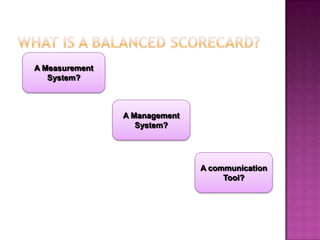
A Measurement
   System?


                A Management
                   System?


                               A communication
                                    Tool?
The Balanced Scorecard is a management
tool that provides stakeholders with a
comprehensive measure of how the
organization is progressing towards the
achievement of its strategic goals.
   Traditional financial reports look backward
     Reflect only the past: spending incurred and revenues earned
     Do not measure creation or destruction of future economic value
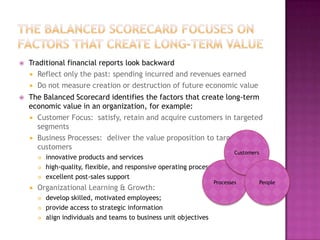
   The Balanced Scorecard identifies the factors that create long-term
    economic value in an organization, for example:
     Customer Focus: satisfy, retain and acquire customers in targeted
      segments
     Business Processes: deliver the value proposition to targeted
      customers
                                                                              Customers
           innovative products and services
           high-quality, flexible, and responsive operating processes
           excellent post-sales support
                                                                      Processes           People
       Organizational Learning & Growth:
           develop skilled, motivated employees;
           provide access to strategic information
           align individuals and teams to business unit objectives
 Translate mission, vision, strategy
 Provide the framework
 Measure four perspective
     Customer relation
     Financial
     Internal services process
     Learning innovation and growth
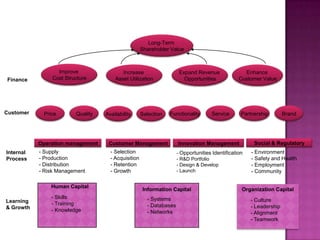
Long-Term
                                                    Shareholder Value


                 Improve                 Increase                    Expand Revenue               Enhance
Finance        Cost Structure         Asset Utilization                Opportunities            Customer Value


Customer    Price       Quality   Availability      Selection   Functionality      Service       Partnership        Brand


           Operation management    Customer Management              Innovation Management             Social & Regulatory
Internal   - Supply                 - Selection                     - Opportunities Identification   - Environment
Process    - Production             - Acquisition                   - R&D Portfolio                  - Safety and Health
           - Distribution           - Retention                     - Design & Develop               - Employment
           - Risk Management        - Growth                        - Launch                         - Community

               Human Capital
                                                    Information Capital                          Organization Capital
               - Skills                               - Systems
Learning                                                                                             - Culture
               - Training                             - Databases
& Growth                                                                                             - Leadership
               - Knowledge                            - Networks                                     - Alignment
                                                                                                     - Teamwork
 Translate   strategy into:
    Objective
    Measurement
    Targets
    Initiative
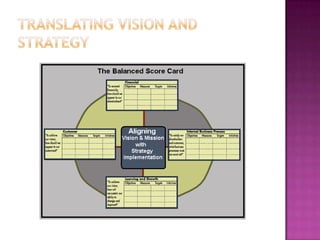
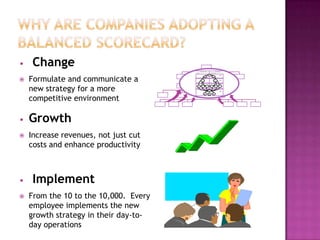
•    Change                                                The Revenue Growth Strategy                                                    The Productivity Strategy

                                       “Improve stability by broadeni ng the sources of rev enue fro m             “Improve operating efficiency by s hifting c ustomers to more cost-
                                       current customers”                                                          effective channels of distribution”


    Formulate and communicate a
                                                                                                    Improve
                                                                                                    Returns                                                      Financial
                                                                                                                                                                 Perspective
                                                                                                                          Improve
                                                                               Broaden                                    Operating



                                                                               Revenue                                    Efficiency
                                                                               Mix


                                                                Increase                                                           Increase
                                                                Customer                                                           Customer                      Customer
                                                                Confidenc e     in                                                 Satisfaction                  Perspective
                                                                Our     Financi al                                                 Through Superi or
                                                                Advice                                                             Execution


    new strategy for a more
                                                                                                                                                                 Internal
                                                                                                                                                                 Perspective


                                             Understand           Develop                 Cross-Sel l             Shift       to                                Provide
                                                                                                                                         Mini mize
                                             Customer             New                     the Product             Appropriate                                   Rapid
                                                                                                                                         Problems
                                             Segments             Products                Line                    Channel                                       Response


                                                                                                   Increase
                                                                                                   Employee
                                                                                                   Productivity                                                  Learning
                                                                                                                                                                 Perspective


    competitive environment
                                                                              Develop              Access      to            Align
                                                                              Strategic            Strategic                 Personal
                                                                              Skills               Information               Goals


•   Growth
   Increase revenues, not just cut
    costs and enhance productivity


•    Implement
   From the 10 to the 10,000. Every
    employee implements the new
    growth strategy in their day-to-
    day operations
 Clarifyingthe vision
 Gaining consensus
   Example????????
   Metro bank
Uzma Fazal   228
At the highest level, the Balanced Scorecard is a framework
that helps organizations to translate strategy into operational
objectives that drive both behavior and performance.
  The BSC is a structured approach to performance
measurement and performance management that links the
organization’s strategic thinking to the activities necessary to
achieve desired results
  The BSC is a vehicle for communicating an organization’s
strategic direction and for measuring achievements towards
these predetermined objectives
  The BSC clearly establishes linkage between strategic
objectives, the measures for determining progress, the
stretch targets established, and the focused initiatives needed
to move the organization forward to meet those
organizational goals
Three layers of management
            Top management
         Middle management
      First line management
 Advantages    of Communicating and linking
    Easy information flow
    Better understanding of company long term
     strategic goal
    Build a stronger commitment to achieve those
     goals
STRATEGIC IMPLEMENTATION: BALANCED SCORECARD


  Score card users generally engage in three activities
  Communicating and educating
  Setting goals
   Three levels of information
         Corporate objectives , measures and targets
         Leaves room for translating The corporate targets into
          targets for each business unit
         The company asks both individual and teams to articulate
          which of their own objectives would be consistent with
          the business unit and corporate objectives
  Linking rewards to performance measures
              E.g An oil company uses the scorecard as the basis of
              calculating incentive compensation.


Source: “Using the Balanced Scorecard as a Strategic Management System”, Kaplan and Norton, HBR, Jan-Feb 1996.
   Lets managers communicate their strategy up and down
    the organisation and links it to departmental and
    individual objectives

   Traditionally departments are evaluated by their financial
    performance and individual incentives are tied to short
    term financial goals

   The scorecard gives managers a way of ensuring that all
    levels of the organisation understand the long term
    strategy.
 Attractive and powerful linkages carries risk
 Assigning weights to each objective
Syed Shahzad Faisal Bukhari
              224
   Long run planning

   Short run planning
Every organization have
separate procedures and
organizational unit for
strategic planning and for
resource allocation and
budgeting
Resource allocation and
budgeting process run by the
finance staff set financial target
for revenues , expenses , profit
and investment for next fiscal
year
Financially & Non Financially
measurement of the
organization is called balanced
scorecard
 Creating a balanced scorecard forces
  companies to integrate there strategic
  planning and budgeting processes that helps
  to ensure that there budget support there
  strategies
 Scorecard user select measure of progress
  from all set targets
 The organizations determine which action
  will drive them toward their targets
Style Company…..
Nasira Aslam 220
 Give   capacity about strategic learning

 Existing
        feedback and review process focus
 on companies budgeted financial goal

 Withbalance scorecard company can monitor
 short –term results

 Enable   companies to modified strategies
   single loop learning process

 Double   loop learning process
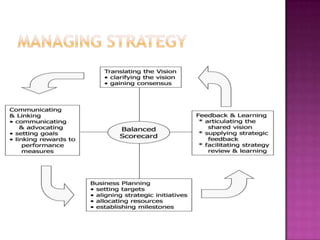
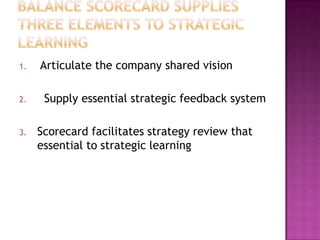
1.   Articulate the company shared vision

2.    Supply essential strategic feedback system

3.   Scorecard facilitates strategy review that
     essential to strategic learning
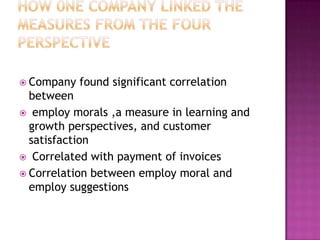
 Company   found significant correlation
  between
 employ morals ,a measure in learning and
  growth perspectives, and customer
  satisfaction
 Correlated with payment of invoices
 Correlation between employ moral and
  employ suggestions
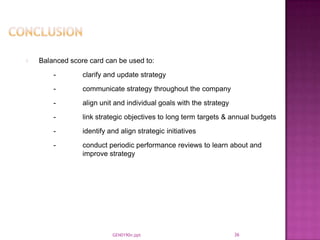
Balanced score card can be used to:
    -        clarify and update strategy
    -        communicate strategy throughout the company
    -        align unit and individual goals with the strategy
    -        link strategic objectives to long term targets & annual budgets
    -        identify and align strategic initiatives
    -        conduct periodic performance reviews to learn about and
             improve strategy


                       GEN0190n.ppt                              36
Thanks to Allah


37

Using the balanced

  • 3.
  • 4.
    A Measurement System? A Management System? A communication Tool?
  • 5.
    The Balanced Scorecardis a management tool that provides stakeholders with a comprehensive measure of how the organization is progressing towards the achievement of its strategic goals.
  • 6.
    Traditional financial reports look backward  Reflect only the past: spending incurred and revenues earned  Do not measure creation or destruction of future economic value  The Balanced Scorecard identifies the factors that create long-term economic value in an organization, for example:  Customer Focus: satisfy, retain and acquire customers in targeted segments  Business Processes: deliver the value proposition to targeted customers Customers  innovative products and services  high-quality, flexible, and responsive operating processes  excellent post-sales support Processes People  Organizational Learning & Growth:  develop skilled, motivated employees;  provide access to strategic information  align individuals and teams to business unit objectives
  • 7.
     Translate mission,vision, strategy  Provide the framework  Measure four perspective  Customer relation  Financial  Internal services process  Learning innovation and growth
  • 8.
    Long-Term Shareholder Value Improve Increase Expand Revenue Enhance Finance Cost Structure Asset Utilization Opportunities Customer Value Customer Price Quality Availability Selection Functionality Service Partnership Brand Operation management Customer Management Innovation Management Social & Regulatory Internal - Supply - Selection - Opportunities Identification - Environment Process - Production - Acquisition - R&D Portfolio - Safety and Health - Distribution - Retention - Design & Develop - Employment - Risk Management - Growth - Launch - Community Human Capital Information Capital Organization Capital - Skills - Systems Learning - Culture - Training - Databases & Growth - Leadership - Knowledge - Networks - Alignment - Teamwork
  • 9.
     Translate strategy into:  Objective  Measurement  Targets  Initiative
  • 11.
    Change The Revenue Growth Strategy The Productivity Strategy “Improve stability by broadeni ng the sources of rev enue fro m “Improve operating efficiency by s hifting c ustomers to more cost- current customers” effective channels of distribution” Formulate and communicate a Improve Returns Financial Perspective Improve Broaden Operating  Revenue Efficiency Mix Increase Increase Customer Customer Customer Confidenc e in Satisfaction Perspective Our Financi al Through Superi or Advice Execution new strategy for a more Internal Perspective Understand Develop Cross-Sel l Shift to Provide Mini mize Customer New the Product Appropriate Rapid Problems Segments Products Line Channel Response Increase Employee Productivity Learning Perspective competitive environment Develop Access to Align Strategic Strategic Personal Skills Information Goals • Growth  Increase revenues, not just cut costs and enhance productivity • Implement  From the 10 to the 10,000. Every employee implements the new growth strategy in their day-to- day operations
  • 13.
     Clarifyingthe vision Gaining consensus Example???????? Metro bank
  • 14.
  • 16.
    At the highestlevel, the Balanced Scorecard is a framework that helps organizations to translate strategy into operational objectives that drive both behavior and performance. The BSC is a structured approach to performance measurement and performance management that links the organization’s strategic thinking to the activities necessary to achieve desired results The BSC is a vehicle for communicating an organization’s strategic direction and for measuring achievements towards these predetermined objectives The BSC clearly establishes linkage between strategic objectives, the measures for determining progress, the stretch targets established, and the focused initiatives needed to move the organization forward to meet those organizational goals
  • 17.
    Three layers ofmanagement Top management Middle management First line management
  • 18.
     Advantages of Communicating and linking  Easy information flow  Better understanding of company long term strategic goal  Build a stronger commitment to achieve those goals
  • 19.
    STRATEGIC IMPLEMENTATION: BALANCEDSCORECARD Score card users generally engage in three activities Communicating and educating Setting goals  Three levels of information  Corporate objectives , measures and targets  Leaves room for translating The corporate targets into targets for each business unit  The company asks both individual and teams to articulate which of their own objectives would be consistent with the business unit and corporate objectives Linking rewards to performance measures E.g An oil company uses the scorecard as the basis of calculating incentive compensation. Source: “Using the Balanced Scorecard as a Strategic Management System”, Kaplan and Norton, HBR, Jan-Feb 1996.
  • 20.
    Lets managers communicate their strategy up and down the organisation and links it to departmental and individual objectives  Traditionally departments are evaluated by their financial performance and individual incentives are tied to short term financial goals  The scorecard gives managers a way of ensuring that all levels of the organisation understand the long term strategy.
  • 21.
     Attractive andpowerful linkages carries risk  Assigning weights to each objective
  • 22.
  • 24.
    Long run planning  Short run planning
  • 26.
    Every organization have separateprocedures and organizational unit for strategic planning and for resource allocation and budgeting
  • 27.
    Resource allocation and budgetingprocess run by the finance staff set financial target for revenues , expenses , profit and investment for next fiscal year
  • 28.
    Financially & NonFinancially measurement of the organization is called balanced scorecard
  • 29.
     Creating abalanced scorecard forces companies to integrate there strategic planning and budgeting processes that helps to ensure that there budget support there strategies  Scorecard user select measure of progress from all set targets  The organizations determine which action will drive them toward their targets
  • 30.
  • 31.
  • 32.
     Give capacity about strategic learning  Existing feedback and review process focus on companies budgeted financial goal  Withbalance scorecard company can monitor short –term results  Enable companies to modified strategies
  • 33.
    single loop learning process  Double loop learning process
  • 34.
    1. Articulate the company shared vision 2. Supply essential strategic feedback system 3. Scorecard facilitates strategy review that essential to strategic learning
  • 35.
     Company found significant correlation between  employ morals ,a measure in learning and growth perspectives, and customer satisfaction  Correlated with payment of invoices  Correlation between employ moral and employ suggestions
  • 36.
    Balanced score cardcan be used to: - clarify and update strategy - communicate strategy throughout the company - align unit and individual goals with the strategy - link strategic objectives to long term targets & annual budgets - identify and align strategic initiatives - conduct periodic performance reviews to learn about and improve strategy GEN0190n.ppt 36
  • 37.