Paul Stanton
Kings Fund Associate
Visiting Professor
De Montfort University
CEO Southminster Consultancy Associates Ltd
Provider boards contributions to the governance of
sustainability & transformation:
“If things are going to stay the same, they are going to have to
change” Lampedusa, The Leopard.
NHS Providers Governance Conference
July 2016
• Slides + data base
circulated
electronically
A context of complex uncertainty
• Post Brexit imponderables
– “I do not believe it would be prudent for us to
assume any additional NHS funding over the
next several years…
– “frankly, we should be arguing that [any
additional funds] should be going to social
care”. Stephens (July 2016).
• Austerity, efficiency imperative +
inexorable growth in demand
• Necessity and urgency of STP
• Improve process’ refine outcomes,
implement transformational change
• Shape evolution of new forms of
governance for new ‘entities’
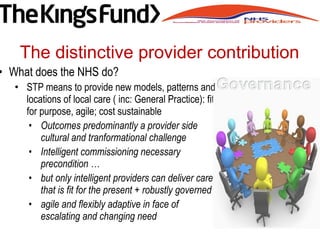
• What does the NHS do?
• STP means to provide new models, patterns and
locations of local care ( inc: General Practice): fit
for purpose, agile; cost sustainable
• Outcomes predominantly a provider side
cultural and tranformational challenge
• Intelligent commissioning necessary
precondition …
• but only intelligent providers can deliver care
that is fit for the present + robustly governed
• agile and flexibly adaptive in face of
escalating and changing need
The distinctive provider contribution
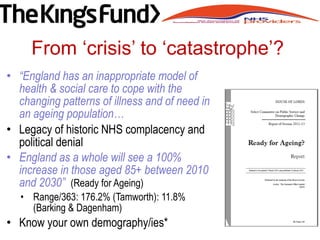
• “England has an inappropriate model of
health & social care to cope with the
changing patterns of illness and of need in
an ageing population…
• Legacy of historic NHS complacency and
political denial
• England as a whole will see a 100%
increase in those aged 85+ between 2010
and 2030” (Ready for Ageing)
• Range/363: 176.2% (Tamworth): 11.8%
(Barking & Dagenham)
• Know your own demography/ies*
From ‘crisis’ to ‘catastrophe’?
• UK dependency ratio 43.6% by 2040
[Germany 62.4%]
– “People are living longer …
– demands for services are directly
related to age and, because of the
strong association between increasing
incidence and increasing age for most
major diseases (like cancer, heart
disease and dementia), population
change will be the biggest single driver
for health and social care need over the
coming decades” NESHA 2008 Our Vision,
Our Future, Our NHS
Profound demographic shift
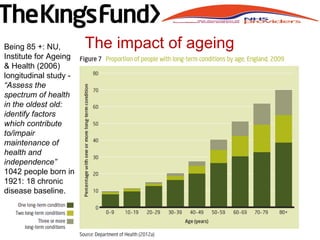
The impact of ageingBeing 85 +: NU,
Institute for Ageing
& Health (2006)
longitudinal study -
“Assess the
spectrum of health
in the oldest old:
identify factors
which contribute
to/impair
maintenance of
health and
independence”
1042 people born in
1921: 18 chronic
disease baseline.
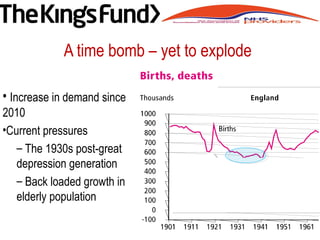
A time bomb – yet to explode
• Increase in demand since
2010
•Current pressures
– The 1930s post-great
depression generation
– Back loaded growth in
elderly population
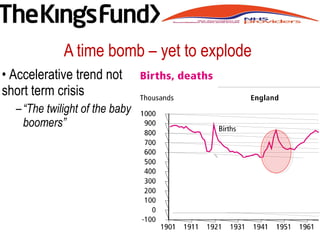
• Accelerative trend not
short term crisis
–“The twilight of the baby
boomers”
•
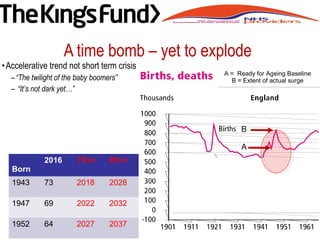
A time bomb – yet to explode
•Accelerative trend not short term crisis
–“The twilight of the baby boomers”
– “It’s not dark yet…”
•
 
Born
2016 75 in 85 in
1943 73 2018 2028
1947 69 2022 2032
1952 64 2027 2037
A = Ready for Ageing Baseline
B = Extent of actual surge
A = Ready for Ageing Baseline
B = Extent of actual surge
B
A
A time bomb – yet to explode
• Inexorable (though variegated) accelerative
increase in demand
• Life style associated illness, obesity, increased
expectation – impact of decreased investment
in prevention and decoupling of public health
• The urgent need for rationalisation,
consolidation and whole system transformation
• “This is not a distant issue. The public are
entitled to an honest conversation about the
implications.” Lord Filkin Chair ‘Ready for Ageing? 2012
Public awareness?
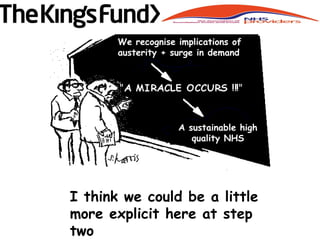
A sustainable high
quality NHS
We recognise implications of
austerity + surge in demand
I think we could be a little
more explicit here at step
two
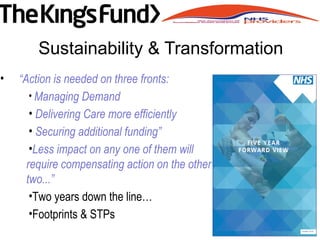
Sustainability & Transformation
• “Action is needed on three fronts:
• Managing Demand
• Delivering Care more efficiently
• Securing additional funding”
•Less impact on any one of them will
require compensating action on the other
two...”
•Two years down the line…
•Footprints & STPs
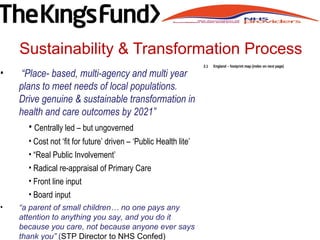
Sustainability & Transformation Process
• “Place- based, multi-agency and multi year
plans to meet needs of local populations.
Drive genuine & sustainable transformation in
health and care outcomes by 2021”
• Centrally led – but ungoverned
• Cost not ‘fit for future’ driven – ‘Public Health lite’
• “Real Public Involvement’
• Radical re-appraisal of Primary Care
• Front line input
• Board input
• “a parent of small children… no one pays any
attention to anything you say, and you do it
because you care, not because anyone ever says
thank you” (STP Director to NHS Confed)
Gateway reference: 04
2.1 England – footprint map (index on next page)
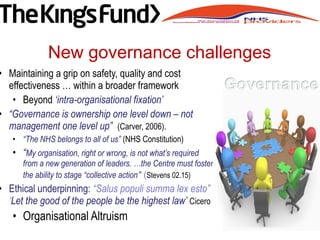
• Maintaining a grip on safety, quality and cost
effectiveness … within a broader framework
• Beyond ‘intra-organisational fixation’
• “Governance is ownership one level down – not
management one level up” (Carver, 2006).
• “The NHS belongs to all of us” (NHS Constitution)
• “My organisation, right or wrong, is not what’s required
from a new generation of leaders. …the Centre must foster
the ability to stage “collective action” (Stevens 02.15)
• Ethical underpinning: “Salus populi summa lex esto”
‘Let the good of the people be the highest law’ Cicero
• Organisational Altruism
New governance challenges
• “What is important is that the interest of the
population is put ahead of the self interest and
preservation of organisations” (Dalton, HSJ ,22.6.16).
• “ There is a clear, compelling and urgent need for
leadership cooperation across boundaries, within
and across organisations and sectors …
• a collective leadership culture at the system level
where the success [and cost effectiveness] of care
by the system is every one’s priority”
• Evolution of new locally relevant forms of
‘communities of practice’ (not structures) – new
governance of these ‘communities’ or ‘entities’
New problems – new solutions
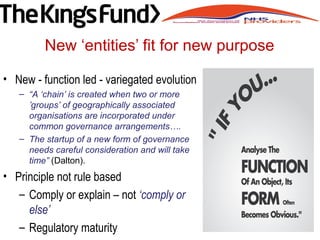
New ‘entities’ fit for new purpose
• New - function led - variegated evolution
– “A ‘chain’ is created when two or more
’groups’ of geographically associated
organisations are incorporated under
common governance arrangements….
– The startup of a new form of governance
needs careful consideration and will take
time” (Dalton).
• Principle not rule based
– Comply or explain – not ‘comply or
else’
– Regulatory maturity
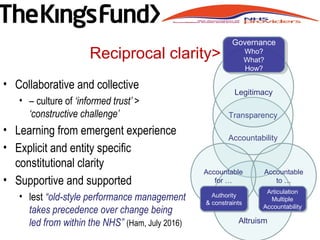
Reciprocal clarity>
• Collaborative and collective
• – culture of ‘informed trust’ >
‘constructive challenge’
• Learning from emergent experience
• Explicit and entity specific
constitutional clarity
• Supportive and supported
• lest “old-style performance management
takes precedence over change being
led from within the NHS” (Ham, July 2016)
Accountability
Transparency
Legitimacy
Governance
Who?
What?
How?
Governance
Who?
What?
How?
Altruism
Accountable
to …
Accountable
for …
Articulation
Multiple
Accountability
Articulation
Multiple
Accountability
Authority
& constraints
Authority
& constraints
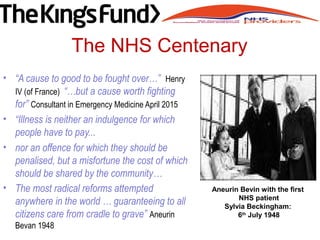
The NHS Centenary
• “A cause to good to be fought over…” Henry
IV (of France) “…but a cause worth fighting
for” Consultant in Emergency Medicine April 2015
• “Illness is neither an indulgence for which
people have to pay...
• nor an offence for which they should be
penalised, but a misfortune the cost of which
should be shared by the community…
• The most radical reforms attempted
anywhere in the world … guaranteeing to all
citizens care from cradle to grave” Aneurin
Bevan 1948
Aneurin Bevin with the first
NHS patient
Sylvia Beckingham:
6th
July 1948
Paul.stanton@southminster-ca.co.uk
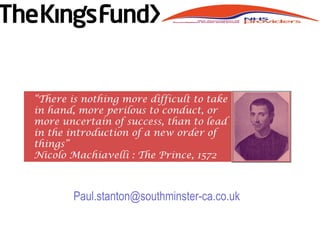
“There is nothing more difficult to take
in hand, more perilous to conduct, or
more uncertain of success, than to lead
in the introduction of a new order of
things”
Nicolo Machiavelli : The Prince, 1572

Paul Stanton Handout

  • 1.
    Paul Stanton Kings FundAssociate Visiting Professor De Montfort University CEO Southminster Consultancy Associates Ltd Provider boards contributions to the governance of sustainability & transformation: “If things are going to stay the same, they are going to have to change” Lampedusa, The Leopard. NHS Providers Governance Conference July 2016 • Slides + data base circulated electronically
  • 2.
    A context ofcomplex uncertainty • Post Brexit imponderables – “I do not believe it would be prudent for us to assume any additional NHS funding over the next several years… – “frankly, we should be arguing that [any additional funds] should be going to social care”. Stephens (July 2016). • Austerity, efficiency imperative + inexorable growth in demand • Necessity and urgency of STP • Improve process’ refine outcomes, implement transformational change • Shape evolution of new forms of governance for new ‘entities’
  • 3.
    • What doesthe NHS do? • STP means to provide new models, patterns and locations of local care ( inc: General Practice): fit for purpose, agile; cost sustainable • Outcomes predominantly a provider side cultural and tranformational challenge • Intelligent commissioning necessary precondition … • but only intelligent providers can deliver care that is fit for the present + robustly governed • agile and flexibly adaptive in face of escalating and changing need The distinctive provider contribution
  • 4.
    • “England hasan inappropriate model of health & social care to cope with the changing patterns of illness and of need in an ageing population… • Legacy of historic NHS complacency and political denial • England as a whole will see a 100% increase in those aged 85+ between 2010 and 2030” (Ready for Ageing) • Range/363: 176.2% (Tamworth): 11.8% (Barking & Dagenham) • Know your own demography/ies* From ‘crisis’ to ‘catastrophe’?
  • 5.
    • UK dependencyratio 43.6% by 2040 [Germany 62.4%] – “People are living longer … – demands for services are directly related to age and, because of the strong association between increasing incidence and increasing age for most major diseases (like cancer, heart disease and dementia), population change will be the biggest single driver for health and social care need over the coming decades” NESHA 2008 Our Vision, Our Future, Our NHS Profound demographic shift
  • 6.
    The impact ofageingBeing 85 +: NU, Institute for Ageing & Health (2006) longitudinal study - “Assess the spectrum of health in the oldest old: identify factors which contribute to/impair maintenance of health and independence” 1042 people born in 1921: 18 chronic disease baseline.
  • 7.
    A time bomb– yet to explode • Increase in demand since 2010 •Current pressures – The 1930s post-great depression generation – Back loaded growth in elderly population
  • 8.
    • Accelerative trendnot short term crisis –“The twilight of the baby boomers” • A time bomb – yet to explode
  • 9.
    •Accelerative trend notshort term crisis –“The twilight of the baby boomers” – “It’s not dark yet…” •   Born 2016 75 in 85 in 1943 73 2018 2028 1947 69 2022 2032 1952 64 2027 2037 A = Ready for Ageing Baseline B = Extent of actual surge A = Ready for Ageing Baseline B = Extent of actual surge B A A time bomb – yet to explode
  • 10.
    • Inexorable (thoughvariegated) accelerative increase in demand • Life style associated illness, obesity, increased expectation – impact of decreased investment in prevention and decoupling of public health • The urgent need for rationalisation, consolidation and whole system transformation • “This is not a distant issue. The public are entitled to an honest conversation about the implications.” Lord Filkin Chair ‘Ready for Ageing? 2012 Public awareness?
  • 11.
    A sustainable high qualityNHS We recognise implications of austerity + surge in demand I think we could be a little more explicit here at step two
  • 12.
    Sustainability & Transformation •“Action is needed on three fronts: • Managing Demand • Delivering Care more efficiently • Securing additional funding” •Less impact on any one of them will require compensating action on the other two...” •Two years down the line… •Footprints & STPs
  • 13.
    Sustainability & TransformationProcess • “Place- based, multi-agency and multi year plans to meet needs of local populations. Drive genuine & sustainable transformation in health and care outcomes by 2021” • Centrally led – but ungoverned • Cost not ‘fit for future’ driven – ‘Public Health lite’ • “Real Public Involvement’ • Radical re-appraisal of Primary Care • Front line input • Board input • “a parent of small children… no one pays any attention to anything you say, and you do it because you care, not because anyone ever says thank you” (STP Director to NHS Confed) Gateway reference: 04 2.1 England – footprint map (index on next page)
  • 14.
    • Maintaining agrip on safety, quality and cost effectiveness … within a broader framework • Beyond ‘intra-organisational fixation’ • “Governance is ownership one level down – not management one level up” (Carver, 2006). • “The NHS belongs to all of us” (NHS Constitution) • “My organisation, right or wrong, is not what’s required from a new generation of leaders. …the Centre must foster the ability to stage “collective action” (Stevens 02.15) • Ethical underpinning: “Salus populi summa lex esto” ‘Let the good of the people be the highest law’ Cicero • Organisational Altruism New governance challenges
  • 15.
    • “What isimportant is that the interest of the population is put ahead of the self interest and preservation of organisations” (Dalton, HSJ ,22.6.16). • “ There is a clear, compelling and urgent need for leadership cooperation across boundaries, within and across organisations and sectors … • a collective leadership culture at the system level where the success [and cost effectiveness] of care by the system is every one’s priority” • Evolution of new locally relevant forms of ‘communities of practice’ (not structures) – new governance of these ‘communities’ or ‘entities’ New problems – new solutions
  • 16.
    New ‘entities’ fitfor new purpose • New - function led - variegated evolution – “A ‘chain’ is created when two or more ’groups’ of geographically associated organisations are incorporated under common governance arrangements…. – The startup of a new form of governance needs careful consideration and will take time” (Dalton). • Principle not rule based – Comply or explain – not ‘comply or else’ – Regulatory maturity
  • 17.
    Reciprocal clarity> • Collaborativeand collective • – culture of ‘informed trust’ > ‘constructive challenge’ • Learning from emergent experience • Explicit and entity specific constitutional clarity • Supportive and supported • lest “old-style performance management takes precedence over change being led from within the NHS” (Ham, July 2016) Accountability Transparency Legitimacy Governance Who? What? How? Governance Who? What? How? Altruism Accountable to … Accountable for … Articulation Multiple Accountability Articulation Multiple Accountability Authority & constraints Authority & constraints
  • 18.
    The NHS Centenary •“A cause to good to be fought over…” Henry IV (of France) “…but a cause worth fighting for” Consultant in Emergency Medicine April 2015 • “Illness is neither an indulgence for which people have to pay... • nor an offence for which they should be penalised, but a misfortune the cost of which should be shared by the community… • The most radical reforms attempted anywhere in the world … guaranteeing to all citizens care from cradle to grave” Aneurin Bevan 1948 Aneurin Bevin with the first NHS patient Sylvia Beckingham: 6th July 1948
  • 19.
    Paul.stanton@southminster-ca.co.uk “There is nothingmore difficult to take in hand, more perilous to conduct, or more uncertain of success, than to lead in the introduction of a new order of things” Nicolo Machiavelli : The Prince, 1572