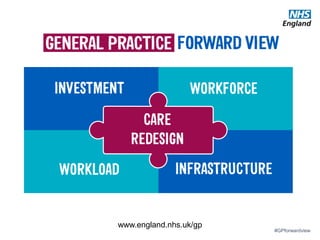
#GPforwardview#GPforwardview
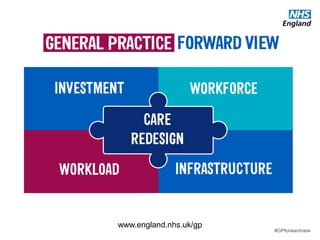
www.england.nhs.uk/gp
england.gpdevelopment@nhs.net
Welcome
#GPforwardview
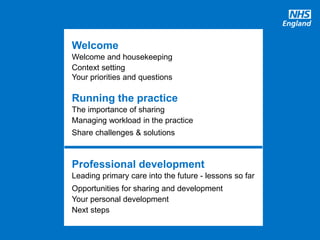
Welcome
Welcome and housekeeping
Context setting
Your priorities and questions
Running the practice
The importance of sharing
Managing workload in the practice
Share challenges & solutions
Professional development
Leading primary care into the future - lessons so far
Opportunities for sharing and development
Your personal development
Next steps
#GPforwardview
#GPforwardview
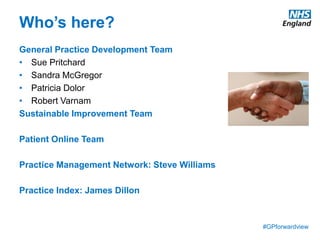
Who’s here?
General Practice Development Team
• Sue Pritchard
• Sandra McGregor
• Patricia Dolor
• Robert Varnam
Sustainable Improvement Team
Patient Online Team
Practice Management Network: Steve Williams
Practice Index: James Dillon
#GPforwardview
pollev.com/gpfv
#GPforwardview#GPforwardview
Dr Robert Varnam
Head of general practice development
@robertvarnam
Why
are we here?
#GPforwardview
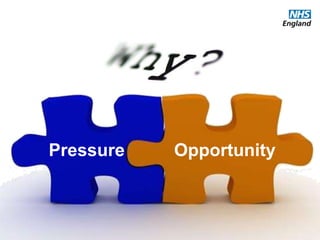
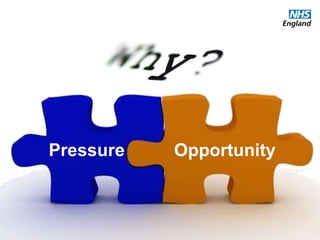
So why are people talking about change?
It’s partly about the pressure we’re under
right now, and partly about the huge
opportunity to do something better. And,
for once, the same changes that would
help with one are also necessary for the
other.
Pressure Opportunity
#GPforwardview
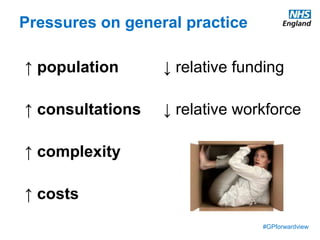
Pressures on general practice
↑ population
↑ consultations
↑ complexity
↑ costs
↓ relative funding
↓ relative workforce
#GPforwardview
At the heart of the case for change is not the workload of practices – important though that is – it is the needs of patients, and
they way they are changing. When the NHS was founded, its purpose was fairly simple. Every now and then, people got ill.
When they did, they consulted their doctor. If it was a straightforward problem, they would give a prescription, the person
would get better, return to work and, in a year or two, they might need the doctor again. If it was less straightforward, they
would be referred to a clever doctor – who would give a prescription or cut out the offending part. The patient would then get
better, return to work, and, in a year or two, they might become ill again.
That accounted for the majority of the anticipated work of the NHS. And, for some patients, that’s still the kind of care that’s
needed.
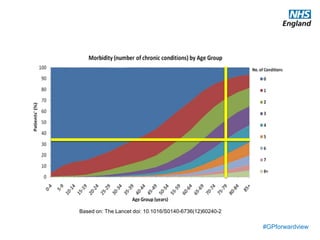
However, a growing proportion of our work is fundamentally different. This now seminal chart illustrates the central fact
underlying the quantitative and qualitative change in the work of primary care. It illustrates the rise in multimorbidity with age.
As people get older, they have more simultaneous longterm conditions. So that, by the age of 75, for example, at least a third
of people are living with four or more LTCs. And, as our demography changes, the proportion of older people increases.
Dealing with longterm conditions already accounts for over half of work in primary care. It is set to increase.
And, crucially, this represents a qualitative change in the nature of work. These are not people who visit the GP every year or
two to get cured of their problem. These are people with problems that we cannot cure – they are living with multiple issues
which will not go away, and they visit the GP six, seven, eight or more times a year. At least. Furthermore, the more
simultaneous problems someone has, or the greater their frailty, the less helpful it is to pass their care to a doctor specialising
in one part of the body. These people need treating as people, not diseases.
So the population of people who need what only primary care can offer has grown, the amount of time they need has grown –
and both are set to continue growing. This is the chief case for change in primary care, the pressure of patients’ needs.
This is not a blip requiring a short-term correction to the priorities of the NHS. It is a fundamental shift which requires every
developed nation on earth to turn away from what Muir Gray has termed the ‘century of the hospital’, and place the emphasis
where the population’s need is.
Based on: The Lancet doi: 10.1016/S0140-6736(12)60240-2
#GPforwardview
www.england.nhs.uk/gp
#GPforwardview
www.england.nhs.uk/gp
#GPforwardview
www.england.nhs.uk/gp
#GPforwardview
www.england.nhs.uk/gp
#GPforwardview
www.england.nhs.uk/gp
#GPforwardview
www.nhsalliance.org/making-time-in-general-practice/
#GPforwardview
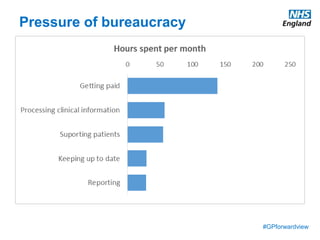
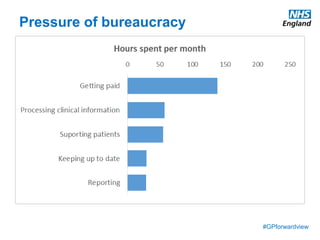
Pressure of bureaucracy
#GPforwardview
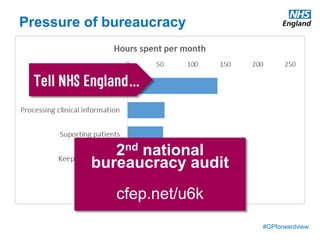
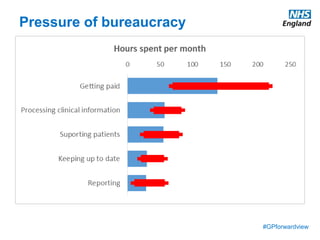
Pressure of bureaucracy
2nd national
bureaucracy audit
cfep.net/u6k
#GPforwardview
www.england.nhs.uk/gp
#GPforwardview
www.england.nhs.uk/gp
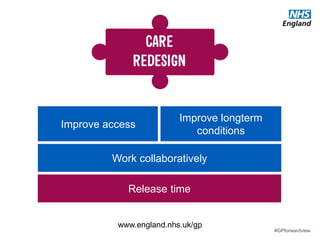
Improve access
Improve longterm
conditions
Work collaboratively
Release timeRelease time
#GPforwardview
So why are people talking about change?
It’s partly about the pressure we’re under
right now, and partly about the huge
opportunity to do something better. And,
for once, the same changes that would
help with one are also necessary for the
other.
Pressure Opportunity
#GPforwardview
What are the biggest challenges in
running the practice productively?
What would you most like to learn from
colleagues today?
Your priorities
The importance of sharing ~
The GP Forward View and Practice Manager
Development Programme
Welcome!
• Practice manager development
• Practice managers are a vital resource in the NHS, playing a key role
in maintaining a quality service and in redesigning care for the
future. Yet they are also one of the most neglected parts of the
workforce, receiving relatively little formal training or ongoing
development. Many practice managers report feeling overburdened
and isolated in their role, and it is often noted that the most
efficient ways of working are slow to spread between practices.
• NHS England 2016
General Practice – The increasing
workload
• Practice manager development
• We want to share our wide experience as business managers with
our colleagues in practice management and with others in the NHS.
We want to promote excellence, provide practical support and
identify examples of good practice. We will identify sources of
expertise and encourage collaboration.
• We will champion the cause of practice management and the
development of ever higher professional standards.
• Practice Management Network 2009
General Practice – The increasing
workload
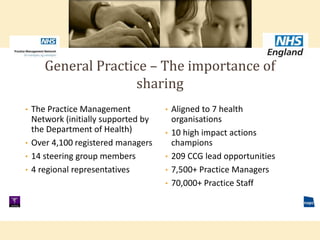
• Aligned to 7 health
organisations
• 10 high impact actions
champions
• 209 CCG lead opportunities
• 7,500+ Practice Managers
• 70,000+ Practice Staff
• The Practice Management
Network (initially supported by
the Department of Health)
• Over 4,100 registered managers
• 14 steering group members
• 4 regional representatives
General Practice – The importance of
sharing
General Practice – The Way Forward
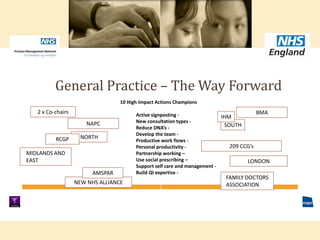
10 High Impact Actions Champions
Active signposting -
New consultation types -
Reduce DNA’s -
Develop the team -
Productive work flows -
Personal productivity -
Partnership working –
Use social prescribing –
Support self care and management -
Build QI expertise -
2 x Co-chairs
NORTH
SOUTH
MIDLANDS AND
EAST LONDON
209 CCG’s
BMA
NEW NHS ALLIANCE
IHM
RCGP
AMSPAR
NAPC
FAMILY DOCTORS
ASSOCIATION
• Performance reviews
• Other resources
• The GP forward view
• Leader or follower ?
• General Practice Today –
The Challenges
• Who’s who in your practice
• Practice policies
• Practice benefits
General Practice – The importance of
sharing
• Support for PM’s and a voice
• Representing the profession, professional development and
primary care transformation
• Support for PM’s in terms of brainstorming and problems
• To ensure that PM’s are fully supported in their work and are
allowed to develop their skills
General Practice – What You Say
SUPPORT
• Understanding the main
challenges faced in surgery.
• Supporting your team to
manage workload and
identifying where to delegate
appropriate tasks
• How does this fit into the
General Practice Forward View?
• What do the Five Year and
General Practice Forward Views
mean to my practice.
• How can I take part in the
initiatives and access funding?
• Taking a leadership role in
driving improvements in
provision of primary care.
General Practice – The Challenges
General Practice – The Way Forward
In a survey of almost 2,000 people in Great Britain, the most
commonly perceived barriers to seeing a GP were finding it
difficult to get an appointment with a particular doctor (42 per
cent), or at a convenient time (42 per cent), and disliking
having to talk to GP receptionists about symptoms (40
percent).
11th October 2016
General Practice – The Way Forward
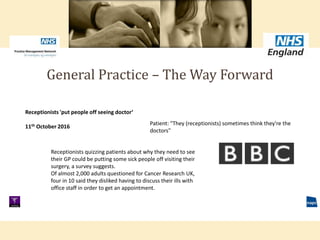
Receptionists 'put people off seeing doctor‘
11th October 2016
Patient: "They (receptionists) sometimes think they're the
doctors"
Receptionists quizzing patients about why they need to see
their GP could be putting some sick people off visiting their
surgery, a survey suggests.
Of almost 2,000 adults questioned for Cancer Research UK,
four in 10 said they disliked having to discuss their ills with
office staff in order to get an appointment.
General Practice – The Way Forward
The PMn is in discussion with NHSE to determine how the
funding of £6 million can be best utilised
AMSPAR already provide education and training with the
Level 5 certificate/diploma in Primary Care Healthcare
Management and offer professional membership
The NAPC with help from the PMn will be introducing an Advanced
Practice Manager Programme – expected October 2017
General Practice – The Way Forward
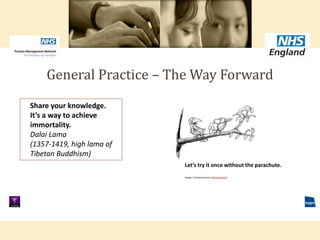
Share your knowledge.
It’s a way to achieve
immortality.
Dalai Lama
(1357-1419, high lama of
Tibetan Buddhism)
Let’s try it once without the parachute.
Image: Cartoonresource (Shutterstock)
C’mon guys, we’ll find someone with the answers. Just keep
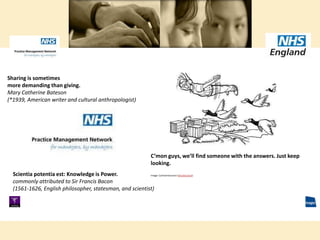
looking.
Image: Cartoonresource (Shutterstock)
Sharing is sometimes
more demanding than giving.
Mary Catherine Bateson
(*1939, American writer and cultural anthropologist)
Scientia potentia est: Knowledge is Power.
commonly attributed to Sir Francis Bacon
(1561-1626, English philosopher, statesman, and scientist)
Sharing is caring.Unknown
@robertvarnam
Managing workload
in the practice
Dr Robert Varnam
Head of General Practice Development
NHS England
@robertvarnam
#GPforwardview
Pressure of bureaucracy
#GPforwardview
Pressure of bureaucracy
#GPforwardview
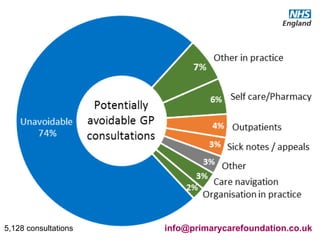
Self-rating by GPs
5,128 consultations info@primarycarefoundation.co.uk
#GPforwardview
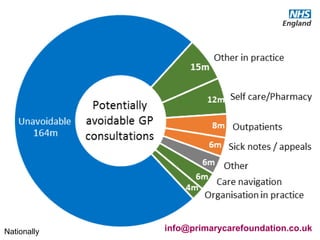
Nationally info@primarycarefoundation.co.uk
#GPforwardview
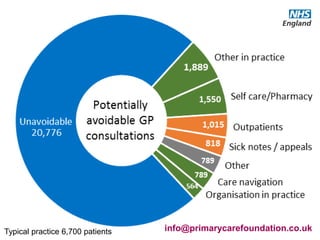
Typical practice 6,700 patients info@primarycarefoundation.co.uk
#GPforwardview
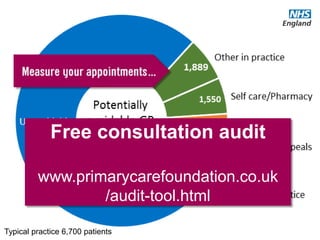
Typical practice 6,700 patients
Free consultation audit
www.primarycarefoundation.co.uk
/audit-tool.html
#GPforwardview
10 high impact actions
to release time for care
#GPforwardview
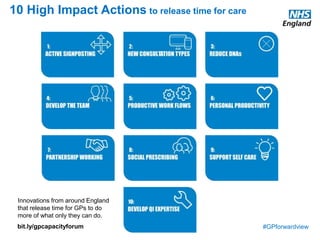
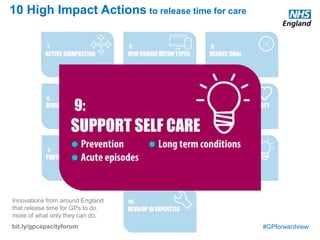
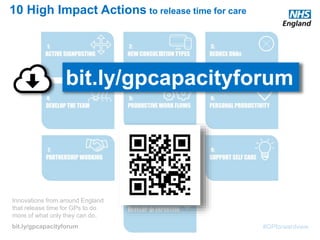
10 High Impact Actions to release time for care
Innovations from around England
that release time for GPs to do
more of what only they can do.
bit.ly/gpcapacityforum
#GPforwardview
10 High Impact Actions to release time for care
Innovations from around England
that release time for GPs to do
more of what only they can do.
bit.ly/gpcapacityforum
#GPforwardview
10 High Impact Actions to release time for care
Innovations from around England
that release time for GPs to do
more of what only they can do.
bit.ly/gpcapacityforum
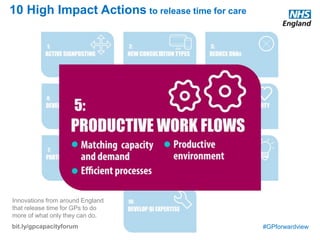
Introduce new ways of working which enable staff to work smarter, not just harder. These can reduce wasted time, reduce queues, ensure more
problems are dealt with first time and that uncomplicated follow-ups are less reliant on GPs consultations.
Match capacity with demand
Appointment systems and staff rotas are designed in order to ensure sufficient capacity is available to match patterns of demand as they vary
through the week and the year. This requires an ongoing system of measuring demand and adjusting capacity accordingly. It may also involve
scheduling routine work (eg annual reviews and clinical audit) for less busy times of the year. The benefits are a reduction in delays for
appointments, less stress for staff and patients, and better access.
Efficient processes
The application of Lean principles to measure, understand and improve common processes in the practice, in order to reduce waste and errors.
Typical targets include clinical follow-up protocols, processing of letters and test results, requests from patients, staff messages and team
decision making. Staff themselves often have a wealth of ideas about ways in which processes could be improved to release time. Practices who
take a systematic approach to identifying and testing these generally find that this improves care for patients as well as freeing staff time for other
things. The use of pre-prepared plans for managing common simple follow-up processes can improve their reliability and efficiency, freeing GP
time. Common examples include management of hypertension, monitoring of tests after the initiation of new medication, and adjustment of
medication doses to reach a target.
Productive environment
The physical layout within the practice is assessed for its effect on staff's productivity, and improvements are introduced which reduce wasted
time. The Lean technique of 5S is the best known approach for doing this. Additionally, work can be undertaken to ensure that staff can access
information needed to support their work quickly. This reduces time spent searching for information and can improve patient safety as well.
#GPforwardview
bit.ly/10hiavideo23
#GPforwardview
10 High Impact Actions to release time for care
Innovations from around England
that release time for GPs to do
more of what only they can do.
bit.ly/gpcapacityforum
Take every opportunity to support people to play a greater role in their own health and care. This begins before the consultation, with methods of
signposting patients to sources of information, advice and support in the community. Common examples include patient information websites,
community pharmacies and patient support groups. For people with longterm conditions, this involves working in partnership to understand
patients' mental and social needs as well as physical. Many patients will benefit from training in managing their condition, as well as connections
to care and support services in the community.
Prevention
Some practices are fostering links with their local community and launching new programmes to improve population health and prevent disease.
This spans a range of activities, including health education, promoting healthy eating and physical activity, and influencing other aspects of public
health. A common feature is a focus on communities helping themselves, with statutory services providing support.
Patient online
Technology changes are enabling patients to access their personal record online, through web portals and a growing number of health apps for
mobile phones. This makes common transactions such as ordering a repeat prescription quicker for the patient and for practice staff. It also
allows patients to become better informed about their health and care, and to play a more active role. With explanation and support, patients and
their carers are able to check test results, the progress of investigations and referrals, read and share their care plan, and enter details of home
monitoring, such as blood pressure, weight, and sugar tests. As well as being popular with patients, GP practices are reporting a reduction in
workload as a result of patients using these online services.
Acute episodes
Practices are increasingly involved in supporting patients with minor ailments to care for themselves. This often includes providing advice and
signposting to services provided by community pharmacy. Education also plays a part, with growing numbers of practies contributing to efforts to
teach people about the best ways to seek help when ill. This often begins with engagement in local primary schools.
Longterm conditions
For people with longterm conditions, a more proactive approach to care is being adopted, alongside a focused effort to help people play a more
active role in monitoring and managing their condition. Initiatives include supporting people to access their full medical record online, the use of
health coaching in clinical consultations and the provision of training and support in the community, aiming to build the knowledge, skills and
confidence for patients and carers to manage their condition. This builds patients’ own assets and quality of life, as well as reducing their
dependence on services such as the general practice.
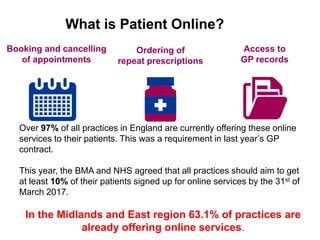
Booking and cancelling
of appointments
Ordering of
repeat prescriptions
Access to
GP records
What is Patient Online?
Over 97% of all practices in England are currently offering these online
services to their patients. This was a requirement in last year’s GP
contract.
This year, the BMA and NHS agreed that all practices should aim to get
at least 10% of their patients signed up for online services by the 31st of
March 2017.
In the Midlands and East region 63.1% of practices are
already offering online services.
Why should I do it?
Convenient way for patients to contact the
practice 24/7
Reduces footfall
Frees up phone lines for other patients
Reduces the amount of no shows
More efficient prescription process and less
prescription waste
Increases patient satisfaction and self care
Frees up valuable time for other essential tasks
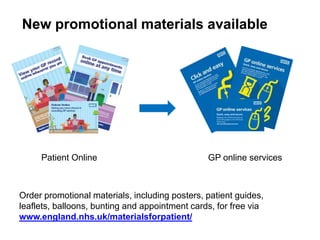
New promotional materials available
Patient Online GP online services
Order promotional materials, including posters, patient guides,
leaflets, balloons, bunting and appointment cards, for free via
www.england.nhs.uk/materialsforpatient/
www.england.nhs.uk/patient-online
#GPforwardview
10 High Impact Actions to release time for care
Innovations from around England
that release time for GPs to do
more of what only they can do.
bit.ly/gpcapacityforum
#TimeforCare
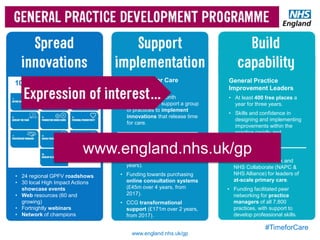
www.england.nhs.uk/gp
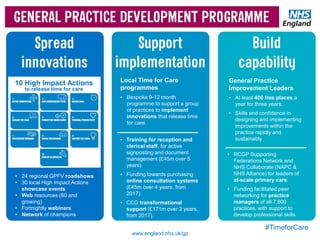
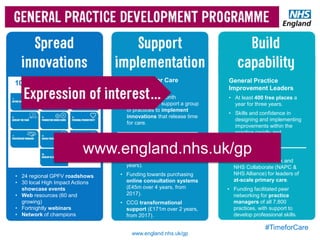
Local Time for Care
programmes
• Bespoke 9-12 month
programme to support a group
of practices to implement
innovations that release time
for care.
• Training for reception and
clerical staff, for active
signposting and document
management (£45m over 5
years).
• Funding towards purchasing
online consultation systems
(£45m over 4 years, from
2017).
• CCG transformational
support (£171m over 2 years,
from 2017).
General Practice
Improvement Leaders
• At least 400 free places a
year for three years.
• Skills and confidence in
designing and implementing
improvements within the
practice rapidly and
sustainably.
• RCGP Supporting
Federations Network and
NHS Collaborate (NAPC &
NHS Alliance) for leaders of
at-scale primary care.
• Funding facilitated peer
networking for practice
managers of all 7,800
practices, with support to
develop professional skills.
• 24 regional GPFV roadshows
• 30 local High Impact Actions
showcase events
• Web resources (60 and
growing)
• Fortnightly webinars
• Network of champions
10 High Impact Actions
to release time for care
#GPforwardview
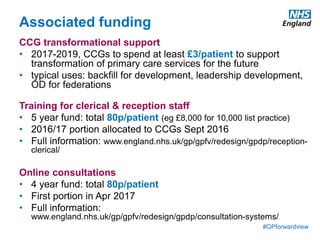
Associated funding
CCG transformational support
• 2017-2019, CCGs to spend at least £3/patient to support
transformation of primary care services for the future
• typical uses: backfill for development, leadership development,
OD for federations
Training for clerical & reception staff
• 5 year fund: total 80p/patient (eg £8,000 for 10,000 list practice)
• 2016/17 portion allocated to CCGs Sept 2016
• Full information: www.england.nhs.uk/gp/gpfv/redesign/gpdp/reception-
clerical/
Online consultations
• 4 year fund: total 80p/patient
• First portion in Apr 2017
• Full information:
www.england.nhs.uk/gp/gpfv/redesign/gpdp/consultation-systems/
#TimeforCare
www.england.nhs.uk/gp
Local Time for Care
programmes
• Bespoke 9-12 month
programme to support a group
of practices to implement
innovations that release time
for care.
• Training for reception and
clerical staff, for active
signposting and document
management (£45m over 5
years).
• Funding towards purchasing
online consultation systems
(£45m over 4 years, from
2017).
• CCG transformational
support (£171m over 2 years,
from 2017).
General Practice
Improvement Leaders
• At least 400 free places a
year for three years.
• Skills and confidence in
designing and implementing
improvements within the
practice rapidly and
sustainably.
• RCGP Supporting
Federations Network and
NHS Collaborate (NAPC &
NHS Alliance) for leaders of
at-scale primary care.
• Funding facilitated peer
networking for practice
managers of all 7,800
practices, with support to
develop professional skills.
• 24 regional GPFV roadshows
• 30 local High Impact Actions
showcase events
• Web resources (60 and
growing)
• Fortnightly webinars
• Network of champions
10 High Impact Actions
to release time for care
www.england.nhs.uk/gp
#GPforwardview
10 High Impact Actions to release time for care
Innovations from around England
that release time for GPs to do
more of what only they can do.
bit.ly/gpcapacityforum
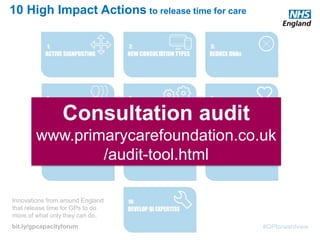
Consultation audit
www.primarycarefoundation.co.uk
/audit-tool.html
#GPforwardview
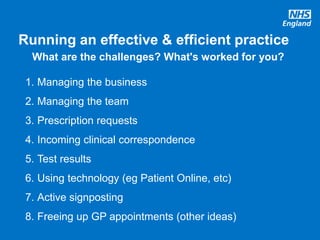
Running an effective & efficient practice
What are the challenges? What's worked for you?
1. Managing the business
2. Managing the team
3. Prescription requests
4. Incoming clinical correspondence
5. Test results
6. Using technology (eg Patient Online, etc)
7. Active signposting
8. Freeing up GP appointments (other ideas)
#GPforwardview
#GPforwardview#GPforwardview
Leading primary care into the
future - lessons so far
Dr Robert Varnam
Head of General Practice Development
NHS England
@robertvarnam
@robertvarnam
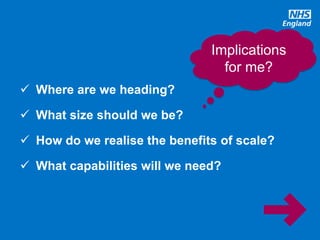
 Where are we heading?
 What size should we be?
 How do we realise the benefits of scale?
 What capabilities will we need?
@robertvarnam
 Where are we heading?
 What size should we be?
 How do we realise the benefits of scale?
 What capabilities will we need?
#GPforwardview
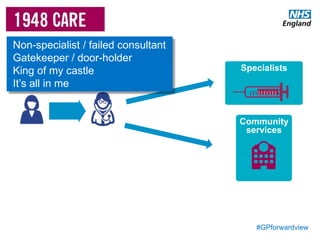
Specialists
Non-specialist / failed consultant
Gatekeeper / door-holder
King of my castle
It’s all in me
Community
services
#GPforwardview
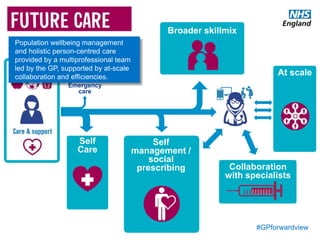
Self
Care
Broader skillmix
Self
management /
social
prescribing
Emergency
care
Collaboration
with specialists
At scale
Population wellbeing management
and holistic person-centred care
provided by a multiprofessional team
led by the GP, supported by at-scale
collaboration and efficiencies.
@robertvarnam
 Where are we heading?
 What size should we be?
 How do we realise the benefits of scale?
 What capabilities will we need?
@robertvarnam
 Where are we heading?
 What size should we be?
 How do we realise the benefits of scale?
 What capabilities will we need?
@robertvarnam
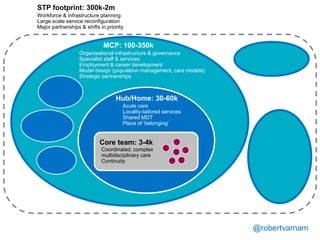
STP footprint: 300k-2m
Workforce & infrastructure planning
Large scale service reconfiguration
Major partnerships & shifts in priority
MCP: 100-350k
Organisational infrastructure & governance
Specialist staff & services
Employment & career development
Model design (population management, care models)
Strategic partnerships
Hub/Home: 30-60k
Acute care
Locality-tailored services
Shared MDT
Place of ‘belonging’
Core team: 3-4k
Coordinated, complex
multidisciplinary care
Continuity
@robertvarnam
 Where are we heading?
 What size should we be?
 How do we realise the benefits of scale?
 What capabilities will we need?
@robertvarnam
 Where are we heading?
 What size should we be?
 How do we realise the benefits of scale?
 What capabilities will we need?
@robertvarnam
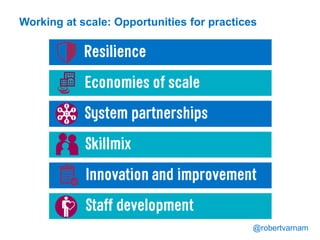
Working at scale: Opportunities for practices
#GPforwardview
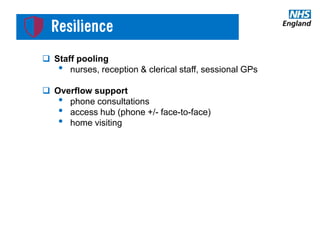
 Staff pooling
• nurses, reception & clerical staff, sessional GPs
 Overflow support
• phone consultations
• access hub (phone +/- face-to-face)
• home visiting
#GPforwardview
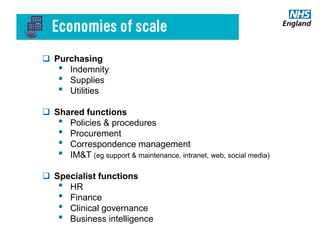
 Purchasing
• Indemnity
• Supplies
• Utilities
 Shared functions
• Policies & procedures
• Procurement
• Correspondence management
• IM&T (eg support & maintenance, intranet, web, social media)
 Specialist functions
• HR
• Finance
• Clinical governance
• Business intelligence
#GPforwardview
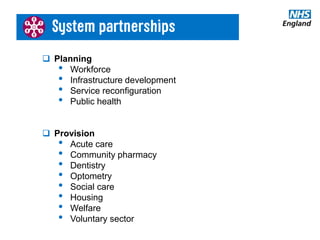
 Planning
• Workforce
• Infrastructure development
• Service reconfiguration
• Public health
 Provision
• Acute care
• Community pharmacy
• Dentistry
• Optometry
• Social care
• Housing
• Welfare
• Voluntary sector
#GPforwardview
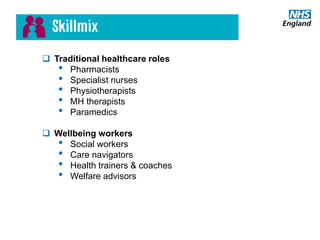
 Traditional healthcare roles
• Pharmacists
• Specialist nurses
• Physiotherapists
• MH therapists
• Paramedics
 Wellbeing workers
• Social workers
• Care navigators
• Health trainers & coaches
• Welfare advisors
#GPforwardview
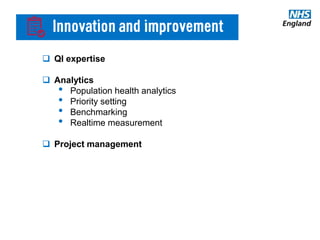
 QI expertise
 Analytics
• Population health analytics
• Priority setting
• Benchmarking
• Realtime measurement
 Project management
#GPforwardview
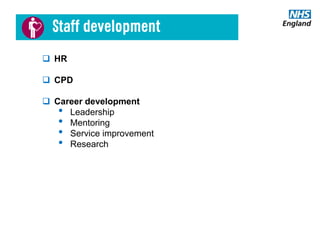
 HR
 CPD
 Career development
• Leadership
• Mentoring
• Service improvement
• Research
@robertvarnam
 Where are we heading?
 What size should we be?
 How do we realise the benefits of scale?
 What capabilities will we need?
@robertvarnam
 Where are we heading?
 What size should we be?
 How do we realise the benefits of scale?
 What capabilities will we need?
@robertvarnam
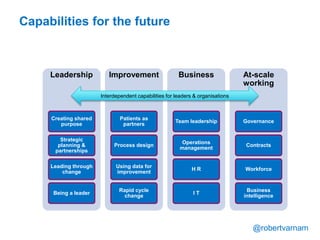
Leadership
Creating shared
purpose
Strategic
planning &
partnerships
Leading through
change
Being a leader
Improvement
Patients as
partners
Process design
Using data for
improvement
Rapid cycle
change
Business
Team leadership
Operations
management
H R
I T
At-scale
working
Governance
Contracts
Workforce
Business
intelligence
Capabilities for the future
Interdependent capabilities for leaders & organisations
#TimeforCare
www.england.nhs.uk/gp
Local Time for Care
programmes
• Bespoke 9-12 month
programme to support a group
of practices to implement
innovations that release time
for care.
• Training for reception and
clerical staff, for active
signposting and document
management (£45m over 5
years).
• Funding towards purchasing
online consultation systems
(£45m over 4 years, from
2017).
• CCG transformational
support (£171m over 2 years,
from 2017).
General Practice
Improvement Leaders
• At least 400 free places a
year for three years.
• Skills and confidence in
designing and implementing
improvements within the
practice rapidly and
sustainably.
• RCGP Supporting
Federations Network and
NHS Collaborate (NAPC &
NHS Alliance) for leaders of
at-scale primary care.
• Funding facilitated peer
networking for practice
managers of all 7,800
practices, with support to
develop professional skills.
• 24 regional GPFV roadshows
• 30 local High Impact Actions
showcase events
• Web resources (60 and
growing)
• Fortnightly webinars
• Network of champions
10 High Impact Actions
to release time for care
www.england.nhs.uk/gp
@robertvarnam
 Where are we heading?
 What size should we be?
 How do we realise the benefits of scale?
 What capabilities will we need?
Implications
for me?
#GPforwardview#GPforwardview
Opportunities for sharing and
development
James Dillon
Practice Index
#GPforwardview
Connect with other practice managers
Join a network
Write up one of successes
Sign up for a course
Do some eLearning
Self-directed reading / viewing
Your personal development
#GPforwardview
Share…
 best things you've done
 what you’re going to do next
Your personal development
#GPforwardview#GPforwardview
bit.ly/gpfvpmsurvey1
How should NHS England
support practice
managers’ development?
#GPforwardview#GPforwardview
bit.ly/gpfvpmsurvey1
www.england.nhs.uk/gp
england.gpdevelopment@nhs.net

Practice Manager networking event, 13 Dec

  • 1.
  • 2.
    #GPforwardview Welcome Welcome and housekeeping Contextsetting Your priorities and questions Running the practice The importance of sharing Managing workload in the practice Share challenges & solutions Professional development Leading primary care into the future - lessons so far Opportunities for sharing and development Your personal development Next steps
  • 3.
  • 4.
    #GPforwardview Who’s here? General PracticeDevelopment Team • Sue Pritchard • Sandra McGregor • Patricia Dolor • Robert Varnam Sustainable Improvement Team Patient Online Team Practice Management Network: Steve Williams Practice Index: James Dillon
  • 5.
  • 6.
    #GPforwardview#GPforwardview Dr Robert Varnam Headof general practice development @robertvarnam Why are we here?
  • 7.
    #GPforwardview So why arepeople talking about change? It’s partly about the pressure we’re under right now, and partly about the huge opportunity to do something better. And, for once, the same changes that would help with one are also necessary for the other. Pressure Opportunity
  • 8.
    #GPforwardview Pressures on generalpractice ↑ population ↑ consultations ↑ complexity ↑ costs ↓ relative funding ↓ relative workforce
  • 9.
    #GPforwardview At the heartof the case for change is not the workload of practices – important though that is – it is the needs of patients, and they way they are changing. When the NHS was founded, its purpose was fairly simple. Every now and then, people got ill. When they did, they consulted their doctor. If it was a straightforward problem, they would give a prescription, the person would get better, return to work and, in a year or two, they might need the doctor again. If it was less straightforward, they would be referred to a clever doctor – who would give a prescription or cut out the offending part. The patient would then get better, return to work, and, in a year or two, they might become ill again. That accounted for the majority of the anticipated work of the NHS. And, for some patients, that’s still the kind of care that’s needed. However, a growing proportion of our work is fundamentally different. This now seminal chart illustrates the central fact underlying the quantitative and qualitative change in the work of primary care. It illustrates the rise in multimorbidity with age. As people get older, they have more simultaneous longterm conditions. So that, by the age of 75, for example, at least a third of people are living with four or more LTCs. And, as our demography changes, the proportion of older people increases. Dealing with longterm conditions already accounts for over half of work in primary care. It is set to increase. And, crucially, this represents a qualitative change in the nature of work. These are not people who visit the GP every year or two to get cured of their problem. These are people with problems that we cannot cure – they are living with multiple issues which will not go away, and they visit the GP six, seven, eight or more times a year. At least. Furthermore, the more simultaneous problems someone has, or the greater their frailty, the less helpful it is to pass their care to a doctor specialising in one part of the body. These people need treating as people, not diseases. So the population of people who need what only primary care can offer has grown, the amount of time they need has grown – and both are set to continue growing. This is the chief case for change in primary care, the pressure of patients’ needs. This is not a blip requiring a short-term correction to the priorities of the NHS. It is a fundamental shift which requires every developed nation on earth to turn away from what Muir Gray has termed the ‘century of the hospital’, and place the emphasis where the population’s need is. Based on: The Lancet doi: 10.1016/S0140-6736(12)60240-2
  • 10.
  • 11.
  • 12.
  • 13.
  • 14.
  • 15.
  • 16.
  • 17.
    #GPforwardview Pressure of bureaucracy 2ndnational bureaucracy audit cfep.net/u6k
  • 18.
  • 19.
  • 20.
    #GPforwardview So why arepeople talking about change? It’s partly about the pressure we’re under right now, and partly about the huge opportunity to do something better. And, for once, the same changes that would help with one are also necessary for the other. Pressure Opportunity
  • 21.
    #GPforwardview What are thebiggest challenges in running the practice productively? What would you most like to learn from colleagues today? Your priorities
  • 22.
    The importance ofsharing ~ The GP Forward View and Practice Manager Development Programme Welcome!
  • 23.
    • Practice managerdevelopment • Practice managers are a vital resource in the NHS, playing a key role in maintaining a quality service and in redesigning care for the future. Yet they are also one of the most neglected parts of the workforce, receiving relatively little formal training or ongoing development. Many practice managers report feeling overburdened and isolated in their role, and it is often noted that the most efficient ways of working are slow to spread between practices. • NHS England 2016 General Practice – The increasing workload
  • 24.
    • Practice managerdevelopment • We want to share our wide experience as business managers with our colleagues in practice management and with others in the NHS. We want to promote excellence, provide practical support and identify examples of good practice. We will identify sources of expertise and encourage collaboration. • We will champion the cause of practice management and the development of ever higher professional standards. • Practice Management Network 2009 General Practice – The increasing workload
  • 25.
    • Aligned to7 health organisations • 10 high impact actions champions • 209 CCG lead opportunities • 7,500+ Practice Managers • 70,000+ Practice Staff • The Practice Management Network (initially supported by the Department of Health) • Over 4,100 registered managers • 14 steering group members • 4 regional representatives General Practice – The importance of sharing
  • 26.
    General Practice –The Way Forward 10 High Impact Actions Champions Active signposting - New consultation types - Reduce DNA’s - Develop the team - Productive work flows - Personal productivity - Partnership working – Use social prescribing – Support self care and management - Build QI expertise - 2 x Co-chairs NORTH SOUTH MIDLANDS AND EAST LONDON 209 CCG’s BMA NEW NHS ALLIANCE IHM RCGP AMSPAR NAPC FAMILY DOCTORS ASSOCIATION
  • 27.
    • Performance reviews •Other resources • The GP forward view • Leader or follower ? • General Practice Today – The Challenges • Who’s who in your practice • Practice policies • Practice benefits General Practice – The importance of sharing
  • 28.
    • Support forPM’s and a voice • Representing the profession, professional development and primary care transformation • Support for PM’s in terms of brainstorming and problems • To ensure that PM’s are fully supported in their work and are allowed to develop their skills General Practice – What You Say SUPPORT
  • 29.
    • Understanding themain challenges faced in surgery. • Supporting your team to manage workload and identifying where to delegate appropriate tasks • How does this fit into the General Practice Forward View? • What do the Five Year and General Practice Forward Views mean to my practice. • How can I take part in the initiatives and access funding? • Taking a leadership role in driving improvements in provision of primary care. General Practice – The Challenges
  • 30.
    General Practice –The Way Forward In a survey of almost 2,000 people in Great Britain, the most commonly perceived barriers to seeing a GP were finding it difficult to get an appointment with a particular doctor (42 per cent), or at a convenient time (42 per cent), and disliking having to talk to GP receptionists about symptoms (40 percent). 11th October 2016
  • 31.
    General Practice –The Way Forward Receptionists 'put people off seeing doctor‘ 11th October 2016 Patient: "They (receptionists) sometimes think they're the doctors" Receptionists quizzing patients about why they need to see their GP could be putting some sick people off visiting their surgery, a survey suggests. Of almost 2,000 adults questioned for Cancer Research UK, four in 10 said they disliked having to discuss their ills with office staff in order to get an appointment.
  • 32.
    General Practice –The Way Forward
  • 33.
    General Practice –The Way Forward
  • 34.
    General Practice –The Way Forward
  • 35.
    General Practice –The Way Forward
  • 36.
    General Practice –The Way Forward The PMn is in discussion with NHSE to determine how the funding of £6 million can be best utilised AMSPAR already provide education and training with the Level 5 certificate/diploma in Primary Care Healthcare Management and offer professional membership The NAPC with help from the PMn will be introducing an Advanced Practice Manager Programme – expected October 2017
  • 37.
    General Practice –The Way Forward Share your knowledge. It’s a way to achieve immortality. Dalai Lama (1357-1419, high lama of Tibetan Buddhism) Let’s try it once without the parachute. Image: Cartoonresource (Shutterstock)
  • 38.
    C’mon guys, we’llfind someone with the answers. Just keep looking. Image: Cartoonresource (Shutterstock) Sharing is sometimes more demanding than giving. Mary Catherine Bateson (*1939, American writer and cultural anthropologist) Scientia potentia est: Knowledge is Power. commonly attributed to Sir Francis Bacon (1561-1626, English philosopher, statesman, and scientist)
  • 39.
  • 40.
    @robertvarnam Managing workload in thepractice Dr Robert Varnam Head of General Practice Development NHS England @robertvarnam
  • 41.
  • 42.
  • 43.
    #GPforwardview Self-rating by GPs 5,128consultations info@primarycarefoundation.co.uk
  • 44.
  • 45.
    #GPforwardview Typical practice 6,700patients info@primarycarefoundation.co.uk
  • 46.
    #GPforwardview Typical practice 6,700patients Free consultation audit www.primarycarefoundation.co.uk /audit-tool.html
  • 47.
    #GPforwardview 10 high impactactions to release time for care
  • 48.
    #GPforwardview 10 High ImpactActions to release time for care Innovations from around England that release time for GPs to do more of what only they can do. bit.ly/gpcapacityforum
  • 49.
    #GPforwardview 10 High ImpactActions to release time for care Innovations from around England that release time for GPs to do more of what only they can do. bit.ly/gpcapacityforum bit.ly/gpcapacityforum
  • 50.
    #GPforwardview 10 High ImpactActions to release time for care Innovations from around England that release time for GPs to do more of what only they can do. bit.ly/gpcapacityforum Introduce new ways of working which enable staff to work smarter, not just harder. These can reduce wasted time, reduce queues, ensure more problems are dealt with first time and that uncomplicated follow-ups are less reliant on GPs consultations. Match capacity with demand Appointment systems and staff rotas are designed in order to ensure sufficient capacity is available to match patterns of demand as they vary through the week and the year. This requires an ongoing system of measuring demand and adjusting capacity accordingly. It may also involve scheduling routine work (eg annual reviews and clinical audit) for less busy times of the year. The benefits are a reduction in delays for appointments, less stress for staff and patients, and better access. Efficient processes The application of Lean principles to measure, understand and improve common processes in the practice, in order to reduce waste and errors. Typical targets include clinical follow-up protocols, processing of letters and test results, requests from patients, staff messages and team decision making. Staff themselves often have a wealth of ideas about ways in which processes could be improved to release time. Practices who take a systematic approach to identifying and testing these generally find that this improves care for patients as well as freeing staff time for other things. The use of pre-prepared plans for managing common simple follow-up processes can improve their reliability and efficiency, freeing GP time. Common examples include management of hypertension, monitoring of tests after the initiation of new medication, and adjustment of medication doses to reach a target. Productive environment The physical layout within the practice is assessed for its effect on staff's productivity, and improvements are introduced which reduce wasted time. The Lean technique of 5S is the best known approach for doing this. Additionally, work can be undertaken to ensure that staff can access information needed to support their work quickly. This reduces time spent searching for information and can improve patient safety as well.
  • 51.
  • 52.
    #GPforwardview 10 High ImpactActions to release time for care Innovations from around England that release time for GPs to do more of what only they can do. bit.ly/gpcapacityforum Take every opportunity to support people to play a greater role in their own health and care. This begins before the consultation, with methods of signposting patients to sources of information, advice and support in the community. Common examples include patient information websites, community pharmacies and patient support groups. For people with longterm conditions, this involves working in partnership to understand patients' mental and social needs as well as physical. Many patients will benefit from training in managing their condition, as well as connections to care and support services in the community. Prevention Some practices are fostering links with their local community and launching new programmes to improve population health and prevent disease. This spans a range of activities, including health education, promoting healthy eating and physical activity, and influencing other aspects of public health. A common feature is a focus on communities helping themselves, with statutory services providing support. Patient online Technology changes are enabling patients to access their personal record online, through web portals and a growing number of health apps for mobile phones. This makes common transactions such as ordering a repeat prescription quicker for the patient and for practice staff. It also allows patients to become better informed about their health and care, and to play a more active role. With explanation and support, patients and their carers are able to check test results, the progress of investigations and referrals, read and share their care plan, and enter details of home monitoring, such as blood pressure, weight, and sugar tests. As well as being popular with patients, GP practices are reporting a reduction in workload as a result of patients using these online services. Acute episodes Practices are increasingly involved in supporting patients with minor ailments to care for themselves. This often includes providing advice and signposting to services provided by community pharmacy. Education also plays a part, with growing numbers of practies contributing to efforts to teach people about the best ways to seek help when ill. This often begins with engagement in local primary schools. Longterm conditions For people with longterm conditions, a more proactive approach to care is being adopted, alongside a focused effort to help people play a more active role in monitoring and managing their condition. Initiatives include supporting people to access their full medical record online, the use of health coaching in clinical consultations and the provision of training and support in the community, aiming to build the knowledge, skills and confidence for patients and carers to manage their condition. This builds patients’ own assets and quality of life, as well as reducing their dependence on services such as the general practice.
  • 53.
    Booking and cancelling ofappointments Ordering of repeat prescriptions Access to GP records What is Patient Online? Over 97% of all practices in England are currently offering these online services to their patients. This was a requirement in last year’s GP contract. This year, the BMA and NHS agreed that all practices should aim to get at least 10% of their patients signed up for online services by the 31st of March 2017. In the Midlands and East region 63.1% of practices are already offering online services.
  • 54.
    Why should Ido it? Convenient way for patients to contact the practice 24/7 Reduces footfall Frees up phone lines for other patients Reduces the amount of no shows More efficient prescription process and less prescription waste Increases patient satisfaction and self care Frees up valuable time for other essential tasks
  • 55.
    New promotional materialsavailable Patient Online GP online services Order promotional materials, including posters, patient guides, leaflets, balloons, bunting and appointment cards, for free via www.england.nhs.uk/materialsforpatient/
  • 56.
  • 57.
    #GPforwardview 10 High ImpactActions to release time for care Innovations from around England that release time for GPs to do more of what only they can do. bit.ly/gpcapacityforum bit.ly/gpcapacityforum
  • 58.
    #TimeforCare www.england.nhs.uk/gp Local Time forCare programmes • Bespoke 9-12 month programme to support a group of practices to implement innovations that release time for care. • Training for reception and clerical staff, for active signposting and document management (£45m over 5 years). • Funding towards purchasing online consultation systems (£45m over 4 years, from 2017). • CCG transformational support (£171m over 2 years, from 2017). General Practice Improvement Leaders • At least 400 free places a year for three years. • Skills and confidence in designing and implementing improvements within the practice rapidly and sustainably. • RCGP Supporting Federations Network and NHS Collaborate (NAPC & NHS Alliance) for leaders of at-scale primary care. • Funding facilitated peer networking for practice managers of all 7,800 practices, with support to develop professional skills. • 24 regional GPFV roadshows • 30 local High Impact Actions showcase events • Web resources (60 and growing) • Fortnightly webinars • Network of champions 10 High Impact Actions to release time for care
  • 59.
    #GPforwardview Associated funding CCG transformationalsupport • 2017-2019, CCGs to spend at least £3/patient to support transformation of primary care services for the future • typical uses: backfill for development, leadership development, OD for federations Training for clerical & reception staff • 5 year fund: total 80p/patient (eg £8,000 for 10,000 list practice) • 2016/17 portion allocated to CCGs Sept 2016 • Full information: www.england.nhs.uk/gp/gpfv/redesign/gpdp/reception- clerical/ Online consultations • 4 year fund: total 80p/patient • First portion in Apr 2017 • Full information: www.england.nhs.uk/gp/gpfv/redesign/gpdp/consultation-systems/
  • 60.
    #TimeforCare www.england.nhs.uk/gp Local Time forCare programmes • Bespoke 9-12 month programme to support a group of practices to implement innovations that release time for care. • Training for reception and clerical staff, for active signposting and document management (£45m over 5 years). • Funding towards purchasing online consultation systems (£45m over 4 years, from 2017). • CCG transformational support (£171m over 2 years, from 2017). General Practice Improvement Leaders • At least 400 free places a year for three years. • Skills and confidence in designing and implementing improvements within the practice rapidly and sustainably. • RCGP Supporting Federations Network and NHS Collaborate (NAPC & NHS Alliance) for leaders of at-scale primary care. • Funding facilitated peer networking for practice managers of all 7,800 practices, with support to develop professional skills. • 24 regional GPFV roadshows • 30 local High Impact Actions showcase events • Web resources (60 and growing) • Fortnightly webinars • Network of champions 10 High Impact Actions to release time for care www.england.nhs.uk/gp
  • 61.
    #GPforwardview 10 High ImpactActions to release time for care Innovations from around England that release time for GPs to do more of what only they can do. bit.ly/gpcapacityforum Consultation audit www.primarycarefoundation.co.uk /audit-tool.html
  • 62.
    #GPforwardview Running an effective& efficient practice What are the challenges? What's worked for you? 1. Managing the business 2. Managing the team 3. Prescription requests 4. Incoming clinical correspondence 5. Test results 6. Using technology (eg Patient Online, etc) 7. Active signposting 8. Freeing up GP appointments (other ideas)
  • 63.
  • 64.
    #GPforwardview#GPforwardview Leading primary careinto the future - lessons so far Dr Robert Varnam Head of General Practice Development NHS England @robertvarnam
  • 65.
    @robertvarnam  Where arewe heading?  What size should we be?  How do we realise the benefits of scale?  What capabilities will we need?
  • 66.
    @robertvarnam  Where arewe heading?  What size should we be?  How do we realise the benefits of scale?  What capabilities will we need?
  • 67.
    #GPforwardview Specialists Non-specialist / failedconsultant Gatekeeper / door-holder King of my castle It’s all in me Community services
  • 68.
    #GPforwardview Self Care Broader skillmix Self management / social prescribing Emergency care Collaboration withspecialists At scale Population wellbeing management and holistic person-centred care provided by a multiprofessional team led by the GP, supported by at-scale collaboration and efficiencies.
  • 69.
    @robertvarnam  Where arewe heading?  What size should we be?  How do we realise the benefits of scale?  What capabilities will we need?
  • 70.
    @robertvarnam  Where arewe heading?  What size should we be?  How do we realise the benefits of scale?  What capabilities will we need?
  • 71.
    @robertvarnam STP footprint: 300k-2m Workforce& infrastructure planning Large scale service reconfiguration Major partnerships & shifts in priority MCP: 100-350k Organisational infrastructure & governance Specialist staff & services Employment & career development Model design (population management, care models) Strategic partnerships Hub/Home: 30-60k Acute care Locality-tailored services Shared MDT Place of ‘belonging’ Core team: 3-4k Coordinated, complex multidisciplinary care Continuity
  • 72.
    @robertvarnam  Where arewe heading?  What size should we be?  How do we realise the benefits of scale?  What capabilities will we need?
  • 73.
    @robertvarnam  Where arewe heading?  What size should we be?  How do we realise the benefits of scale?  What capabilities will we need?
  • 74.
    @robertvarnam Working at scale:Opportunities for practices
  • 75.
    #GPforwardview  Staff pooling •nurses, reception & clerical staff, sessional GPs  Overflow support • phone consultations • access hub (phone +/- face-to-face) • home visiting
  • 76.
    #GPforwardview  Purchasing • Indemnity •Supplies • Utilities  Shared functions • Policies & procedures • Procurement • Correspondence management • IM&T (eg support & maintenance, intranet, web, social media)  Specialist functions • HR • Finance • Clinical governance • Business intelligence
  • 77.
    #GPforwardview  Planning • Workforce •Infrastructure development • Service reconfiguration • Public health  Provision • Acute care • Community pharmacy • Dentistry • Optometry • Social care • Housing • Welfare • Voluntary sector
  • 78.
    #GPforwardview  Traditional healthcareroles • Pharmacists • Specialist nurses • Physiotherapists • MH therapists • Paramedics  Wellbeing workers • Social workers • Care navigators • Health trainers & coaches • Welfare advisors
  • 79.
    #GPforwardview  QI expertise Analytics • Population health analytics • Priority setting • Benchmarking • Realtime measurement  Project management
  • 80.
    #GPforwardview  HR  CPD Career development • Leadership • Mentoring • Service improvement • Research
  • 81.
    @robertvarnam  Where arewe heading?  What size should we be?  How do we realise the benefits of scale?  What capabilities will we need?
  • 82.
    @robertvarnam  Where arewe heading?  What size should we be?  How do we realise the benefits of scale?  What capabilities will we need?
  • 83.
    @robertvarnam Leadership Creating shared purpose Strategic planning & partnerships Leadingthrough change Being a leader Improvement Patients as partners Process design Using data for improvement Rapid cycle change Business Team leadership Operations management H R I T At-scale working Governance Contracts Workforce Business intelligence Capabilities for the future Interdependent capabilities for leaders & organisations
  • 84.
    #TimeforCare www.england.nhs.uk/gp Local Time forCare programmes • Bespoke 9-12 month programme to support a group of practices to implement innovations that release time for care. • Training for reception and clerical staff, for active signposting and document management (£45m over 5 years). • Funding towards purchasing online consultation systems (£45m over 4 years, from 2017). • CCG transformational support (£171m over 2 years, from 2017). General Practice Improvement Leaders • At least 400 free places a year for three years. • Skills and confidence in designing and implementing improvements within the practice rapidly and sustainably. • RCGP Supporting Federations Network and NHS Collaborate (NAPC & NHS Alliance) for leaders of at-scale primary care. • Funding facilitated peer networking for practice managers of all 7,800 practices, with support to develop professional skills. • 24 regional GPFV roadshows • 30 local High Impact Actions showcase events • Web resources (60 and growing) • Fortnightly webinars • Network of champions 10 High Impact Actions to release time for care www.england.nhs.uk/gp
  • 85.
    @robertvarnam  Where arewe heading?  What size should we be?  How do we realise the benefits of scale?  What capabilities will we need? Implications for me?
  • 86.
    #GPforwardview#GPforwardview Opportunities for sharingand development James Dillon Practice Index
  • 87.
    #GPforwardview Connect with otherpractice managers Join a network Write up one of successes Sign up for a course Do some eLearning Self-directed reading / viewing Your personal development
  • 88.
    #GPforwardview Share…  best thingsyou've done  what you’re going to do next Your personal development
  • 89.
    #GPforwardview#GPforwardview bit.ly/gpfvpmsurvey1 How should NHSEngland support practice managers’ development?
  • 90.

Editor's Notes

  • #2 PREP EACH TIME: Who’s here – slide 4 Table numbers for world café
  • #3 Aims: provide updates, clarify information, answer questions .. ultimately, so you can plan yourself
  • #8 So why are people talking about change? It’s partly about the pressure we’re under right now, and partly about the huge opportunity to do something better. And, for once, the same changes that would help with one are also necessary for the other.
  • #9 2% population growth /yr 2.5% inc in consultations every year since 2007 GP numbers grown by 5,000 FTEs in past 10y - but hospital consultant numbers have roughly tripled
  • #10 At the heart of the case for change is not the workload of practices – important though that is – it is the needs of patients, and they way they are changing. When the NHS was founded, its purpose was fairly simple. Every now and then, people got ill. When they did, they consulted their doctor. If it was a straightforward problem, they would give a prescription, the person would get better, return to work and, in a year or two, they might need the doctor again. If it was less straightforward, they would be referred to a clever doctor – who would give a prescription or cut out the offending part. The patient would then get better, return to work, and, in a year or two, they might become ill again. That accounted for the majority of the anticipated work of the NHS. And, for some patients, that’s still the kind of care that’s needed. However, a growing proportion of our work is fundamentally different. This now seminal chart illustrates the central fact underlying the quantitative and qualitative change in the work of primary care. It illustrates the rise in multimorbidity with age. As people get older, they have more simultaneous longterm conditions. So that, by the age of 75, for example, at least a third of people are living with four or more LTCs. And, as our demography changes, the proportion of older people increases. Dealing with longterm conditions already accounts for over half of work in primary care. It is set to increase. And, crucially, this represents a qualitative change in the nature of work. These are not people who visit the GP every year or two to get cured of their problem. These are people with problems that we cannot cure – they are living with multiple issues which will not go away, and they visit the GP six, seven, eight or more times a year. At least. Furthermore, the more simultaneous problems someone has, or the greater their frailty, the less helpful it is to pass their care to a doctor specialising in one part of the body. These people need treating as people, not diseases. So the population of people who need what only primary care can offer has grown, the amount of time they need has grown – and both are set to continue growing. This is the chief case for change in primary care, the pressure of patients’ needs. This is not a blip requiring a short-term correction to the priorities of the NHS. It is a fundamental shift which requires every developed nation on earth to turn away from what Muir Gray has termed the ‘century of the hospital’, and place the emphasis where the population’s need is.
  • #11 Stabilisation AND transformation The START
  • #21 So why are people talking about change? It’s partly about the pressure we’re under right now, and partly about the huge opportunity to do something better. And, for once, the same changes that would help with one are also necessary for the other.
  • #22 Talk til 1:15pm
  • #23 15min to 1:30pm
  • #41 30min: 1:30 – 2:00pm
  • #44 56 GPs rated 5,128 consecutive consultations to identify which might have been avoided. Outpatients: this includes patients re-consulting with the GP because they missed an appointment and were discharged automatically; outpatient prescriptions which were not issued by the hospital; and investigations and other follow-up activity included in the outpatient plan but which the GP practice were asked to undertake.
  • #45 56 GPs rated 5,128 consecutive consultations to identify which might have been avoided. Outpatients: this includes patients re-consulting with the GP because they missed an appointment and were discharged automatically; outpatient prescriptions which were not issued by the hospital; and investigations and other follow-up activity included in the outpatient plan but which the GP practice were asked to undertake.
  • #46 56 GPs rated 5,128 consecutive consultations to identify which might have been avoided. Outpatients: this includes patients re-consulting with the GP because they missed an appointment and were discharged automatically; outpatient prescriptions which were not issued by the hospital; and investigations and other follow-up activity included in the outpatient plan but which the GP practice were asked to undertake.
  • #47 56 GPs rated 5,128 consecutive consultations to identify which might have been avoided. Outpatients: this includes patients re-consulting with the GP because they missed an appointment and were discharged automatically; outpatient prescriptions which were not issued by the hospital; and investigations and other follow-up activity included in the outpatient plan but which the GP practice were asked to undertake.
  • #48 If that’s the WHAT, this is the HOW These have come from practices around England * SEE HANDOUT *
  • #50 A growing collection – submit your own examples and questions.
  • #51 Introduce new ways of working which enable staff to work smarter, not just harder. These can reduce wasted time, reduce queues, ensure more problems are dealt with first time and that uncomplicated follow-ups are less reliant on GPs consultations. Match capacity with demand Appointment systems and staff rotas are designed in order to ensure sufficient capacity is available to match patterns of demand as they vary through the week and the year. This requires an ongoing system of measuring demand and adjusting capacity accordingly. It may also involve scheduling routine work (eg annual reviews and clinical audit) for less busy times of the year. The benefits are a reduction in delays for appointments, less stress for staff and patients, and better access. Efficient processes The application of Lean principles to measure, understand and improve common processes in the practice, in order to reduce waste and errors. Typical targets include clinical follow-up protocols, processing of letters and test results, requests from patients, staff messages and team decision making. Staff themselves often have a wealth of ideas about ways in which processes could be improved to release time. Practices who take a systematic approach to identifying and testing these generally find that this improves care for patients as well as freeing staff time for other things. The use of pre-prepared plans for managing common simple follow-up processes can improve their reliability and efficiency, freeing GP time. Common examples include management of hypertension, monitoring of tests after the initiation of new medication, and adjustment of medication doses to reach a target. Productive environment The physical layout within the practice is assessed for its effect on staff's productivity, and improvements are introduced which reduce wasted time. The Lean technique of 5S is the best known approach for doing this. Additionally, work can be undertaken to ensure that staff can access information needed to support their work quickly. This reduces time spent searching for information and can improve patient safety as well.
  • #53 Take every opportunity to support people to play a greater role in their own health and care. This begins before the consultation, with methods of signposting patients to sources of information, advice and support in the community. Common examples include patient information websites, community pharmacies and patient support groups. For people with longterm conditions, this involves working in partnership to understand patients' mental and social needs as well as physical. Many patients will benefit from training in managing their condition, as well as connections to care and support services in the community. Prevention Some practices are fostering links with their local community and launching new programmes to improve population health and prevent disease. This spans a range of activities, including health education, promoting healthy eating and physical activity, and influencing other aspects of public health. A common feature is a focus on communities helping themselves, with statutory services providing support. Patient online Technology changes are enabling patients to access their personal record online, through web portals and a growing number of health apps for mobile phones. This makes common transactions such as ordering a repeat prescription quicker for the patient and for practice staff. It also allows patients to become better informed about their health and care, and to play a more active role. With explanation and support, patients and their carers are able to check test results, the progress of investigations and referrals, read and share their care plan, and enter details of home monitoring, such as blood pressure, weight, and sugar tests. As well as being popular with patients, GP practices are reporting a reduction in workload as a result of patients using these online services. Acute episodes Practices are increasingly involved in supporting patients with minor ailments to care for themselves. This often includes providing advice and signposting to services provided by community pharmacy. Education also plays a part, with growing numbers of practies contributing to efforts to teach people about the best ways to seek help when ill. This often begins with engagement in local primary schools. Longterm conditions For people with longterm conditions, a more proactive approach to care is being adopted, alongside a focused effort to help people play a more active role in monitoring and managing their condition. Initiatives include supporting people to access their full medical record online, the use of health coaching in clinical consultations and the provision of training and support in the community, aiming to build the knowledge, skills and confidence for patients and carers to manage their condition. This builds patients’ own assets and quality of life, as well as reducing their dependence on services such as the general practice.
  • #58 A growing collection – submit your own examples and questions.
  • #59 Scenarios
  • #61 Scenarios
  • #62 A growing collection – submit your own examples and questions.
  • #63 World Café – 2 sessions Til 2:45 (break)
  • #64 Til 3:10pm
  • #65 15min til 3:25
  • #75 Resilience Economies of scale System partnerships Skillmix Innovation and improvement Staff development
  • #84 One of the tasks of the Call to Action was to identify the actions necessary to promote, support and sustain the adoption of the kind of innovation and improvements we seek. We consulted with practice managers, clinicians, commissioners, policy makers and improvement experts, as well as drawing on the experience of building primary care improvement capability in the UK and internationally. A comprehensive list of areas emerged from this process. This has been tested and refined through ongoing consultation with innovators and professional leaders. The framework describes a set of intrinsic capabilities required by practices to lead service change rapidly, safely and sustainably, and a set of enablers which can be used by policymakers and commissioners to make change easier and more sustainable. Since April 2014, we have had the opportunity to use this framework in support of 1100 GP practices across England in the Prime Minister’s Challenge Fund. As these 20 groups of practices have introduced a range of service innovations, they have received a bespoke programme of capability-building and direct access to national support for key enablers. Feedback from practices and leaders has been very positive, with many examples of faster and better progress being made as a result of it. NHS England are now considering ways in which this framework can be used to secure support for other national initiatives, for example further extension of access improvements, support to workforce innovators and a programme to release capacity through reducing workload and working differently.
  • #85 Scenarios
  • #87 15min
  • #88 Speed dating: to 4:20pm 4 or 5 x5min
  • #89 Speed dating: to 4:20pm 4 or 5 x5min
  • #90 Speed dating: to 4:20pm 4 or 5 x5min