Delivering system change and place-
based care through MSK networks of care
Professor Peter Kay National Clinical Director MSK, NHS England
Federico Moscogiuri CEO Arthritis and Musculoskeletal Alliance (ARMA)
Bernadette Kennedy Head of Integrated Falls and Bone Health Service ,
St George’s University Hospitals NHS Foundation Trust
Christina Heaton, Nurse Consultant , Bridgewater Community Healthcare
NHS Foundation Trust
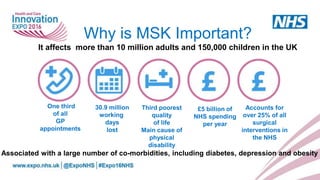
30.9 million
working
days
lost
One third
of all
GP
appointments
Third poorest
quality
of life
Main cause of
physical
disability
£5 billion of
NHS spending
per year
Why is MSK Important?
It affects more than 10 million adults and 150,000 children in the UK
Associated with a large number of co-morbidities, including diabetes, depression and obesity
Accounts for
over 25% of all
surgical
interventions in
the NHS
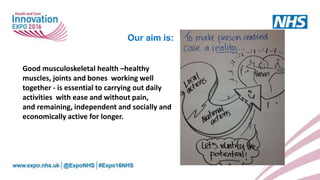
Good musculoskeletal health –healthy
muscles, joints and bones working well
together - is essential to carrying out daily
activities with ease and without pain,
and remaining, independent and socially and
economically active for longer.
Our aim is:
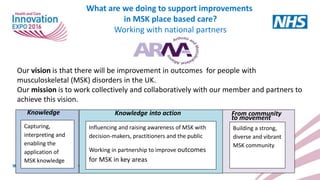
Our vision is that there will be improvement in outcomes for people with
musculoskeletal (MSK) disorders in the UK.
Our mission is to work collectively and collaboratively with our member and partners to
achieve this vision.
Capturing,
interpreting and
enabling the
application of
MSK knowledge
Influencing and raising awareness of MSK with
decision-makers, practitioners and the public
Working in partnership to improve outcomes
for MSK in key areas
Building a strong,
diverse and vibrant
MSK community
From community
to movement
Knowledge into actionKnowledge
What are we doing to support improvements
in MSK place based care?
Working with national partners
What are we doing to support improvements
in MSK place based care?
MSK Programme
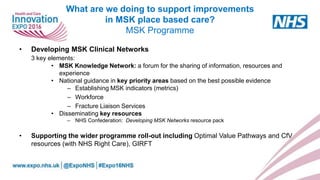
• Developing MSK Clinical Networks
3 key elements:
• MSK Knowledge Network: a forum for the sharing of information, resources and
experience
• National guidance in key priority areas based on the best possible evidence
– Establishing MSK indicators (metrics)
– Workforce
– Fracture Liaison Services
• Disseminating key resources
– NHS Confederation: Developing MSK Networks resource pack
• Supporting the wider programme roll-out including Optimal Value Pathways and CfV
resources (with NHS Right Care), GIRFT
What have we done so far?
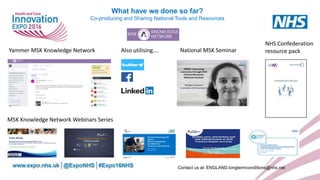
Co-producing and Sharing National Tools and Resources
Yammer MSK Knowledge Network Also utilising….
MSK Knowledge Network Webinars Series
Contact us at: ENGLAND.longtermconditions@nhs.net
NHS Confederation
resource packNational MSK Seminar
What have we done so far?
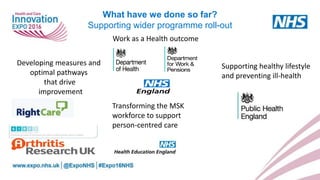
Supporting wider programme roll-out
Developing measures and
optimal pathways
that drive
improvement
Work as a Health outcome
Supporting healthy lifestyle
and preventing ill-health
Transforming the MSK
workforce to support
person-centred care
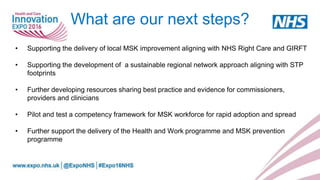
What are our next steps?
• Supporting the delivery of local MSK improvement aligning with NHS Right Care and GIRFT
• Supporting the development of a sustainable regional network approach aligning with STP
footprints
• Further developing resources sharing best practice and evidence for commissioners,
providers and clinicians
• Pilot and test a competency framework for MSK workforce for rapid adoption and spread
• Further support the delivery of the Health and Work programme and MSK prevention
programme
Delivering system change and place-based
care through MSK networks of care:
Best Practice Examples
Self Referral and patient empowerment model
Sept 2016
Bernadette Kennedy, Head of Integrated Falls and Bone
Health
St Georges University Hospitals NHS Foundation Trust
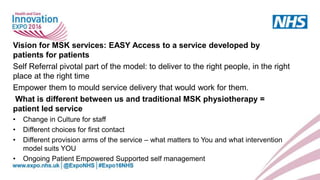
Vision for MSK services: EASY Access to a service developed by
patients for patients
Self Referral pivotal part of the model: to deliver to the right people, in the right
place at the right time
Empower them to mould service delivery that would work for them.
What is different between us and traditional MSK physiotherapy =
patient led service
• Change in Culture for staff
• Different choices for first contact
• Different provision arms of the service – what matters to You and what intervention
model suits YOU
• Ongoing Patient Empowered Supported self management
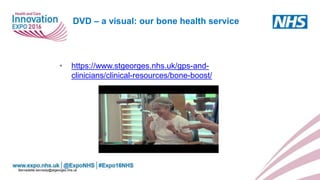
DVD – a visual: our bone health service
• https://www.stgeorges.nhs.uk/gps-and-
clinicians/clinical-resources/bone-boost/
Bernadette.kennedy@stgeorges.nhs.uk
Integrated Falls Management & Fracture Liaison Service
Sept 2016
Christina Heaton, Nurse Consultant
Bridgewater Community Healthcare NHS Foundation
Trust
Integrated Falls Management & Fracture Liaison Service
Christina Heaton Nurse Consultant
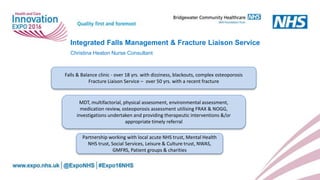
Falls & Balance clinic - over 18 yrs. with dizziness, blackouts, complex osteoporosis
Fracture Liaison Service – over 50 yrs. with a recent fracture
MDT, multifactorial, physical assessment, environmental assessment,
medication review, osteoporosis assessment utilising FRAX & NOGG,
investigations undertaken and providing therapeutic interventions &/or
appropriate timely referral
Partnership working with local acute NHS trust, Mental Health
NHS trust, Social Services, Leisure & Culture trust, NWAS,
GMFRS, Patient groups & charities
Key Performance outcomes
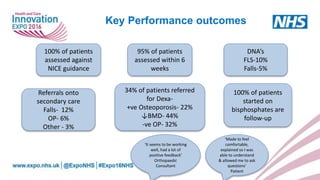
100% of patients
assessed against
NICE guidance
95% of patients
assessed within 6
weeks
Referrals onto
secondary care
Falls- 12%
OP- 6%
Other - 3%
100% of patients
started on
bisphosphates are
follow-up
DNA’s
FLS-10%
Falls-5%
34% of patients referred
for Dexa-
+ve Osteoporosis- 22%
↓BMD- 44%
-ve OP- 32%
‘Made to feel
comfortable,
explained so I was
able to understand
& allowed me to ask
questions’
Patient
‘It seems to be working
well, had a lot of
positive feedback’
Orthopaedic
Consultant
How can you get involved?
Join our Yammer MSK Community
Contact us at: ENGLAND.longtermconditions@nhs.net
Any Questions?

Delivering system change and place based care

  • 1.
    Delivering system changeand place- based care through MSK networks of care Professor Peter Kay National Clinical Director MSK, NHS England Federico Moscogiuri CEO Arthritis and Musculoskeletal Alliance (ARMA) Bernadette Kennedy Head of Integrated Falls and Bone Health Service , St George’s University Hospitals NHS Foundation Trust Christina Heaton, Nurse Consultant , Bridgewater Community Healthcare NHS Foundation Trust
  • 2.
    30.9 million working days lost One third ofall GP appointments Third poorest quality of life Main cause of physical disability £5 billion of NHS spending per year Why is MSK Important? It affects more than 10 million adults and 150,000 children in the UK Associated with a large number of co-morbidities, including diabetes, depression and obesity Accounts for over 25% of all surgical interventions in the NHS
  • 3.
    Good musculoskeletal health–healthy muscles, joints and bones working well together - is essential to carrying out daily activities with ease and without pain, and remaining, independent and socially and economically active for longer. Our aim is:
  • 4.
    Our vision isthat there will be improvement in outcomes for people with musculoskeletal (MSK) disorders in the UK. Our mission is to work collectively and collaboratively with our member and partners to achieve this vision. Capturing, interpreting and enabling the application of MSK knowledge Influencing and raising awareness of MSK with decision-makers, practitioners and the public Working in partnership to improve outcomes for MSK in key areas Building a strong, diverse and vibrant MSK community From community to movement Knowledge into actionKnowledge What are we doing to support improvements in MSK place based care? Working with national partners
  • 6.
    What are wedoing to support improvements in MSK place based care? MSK Programme • Developing MSK Clinical Networks 3 key elements: • MSK Knowledge Network: a forum for the sharing of information, resources and experience • National guidance in key priority areas based on the best possible evidence – Establishing MSK indicators (metrics) – Workforce – Fracture Liaison Services • Disseminating key resources – NHS Confederation: Developing MSK Networks resource pack • Supporting the wider programme roll-out including Optimal Value Pathways and CfV resources (with NHS Right Care), GIRFT
  • 7.
    What have wedone so far? Co-producing and Sharing National Tools and Resources Yammer MSK Knowledge Network Also utilising…. MSK Knowledge Network Webinars Series Contact us at: ENGLAND.longtermconditions@nhs.net NHS Confederation resource packNational MSK Seminar
  • 8.
    What have wedone so far? Supporting wider programme roll-out Developing measures and optimal pathways that drive improvement Work as a Health outcome Supporting healthy lifestyle and preventing ill-health Transforming the MSK workforce to support person-centred care
  • 9.
    What are ournext steps? • Supporting the delivery of local MSK improvement aligning with NHS Right Care and GIRFT • Supporting the development of a sustainable regional network approach aligning with STP footprints • Further developing resources sharing best practice and evidence for commissioners, providers and clinicians • Pilot and test a competency framework for MSK workforce for rapid adoption and spread • Further support the delivery of the Health and Work programme and MSK prevention programme
  • 10.
    Delivering system changeand place-based care through MSK networks of care: Best Practice Examples
  • 11.
    Self Referral andpatient empowerment model Sept 2016 Bernadette Kennedy, Head of Integrated Falls and Bone Health St Georges University Hospitals NHS Foundation Trust
  • 12.
    Vision for MSKservices: EASY Access to a service developed by patients for patients Self Referral pivotal part of the model: to deliver to the right people, in the right place at the right time Empower them to mould service delivery that would work for them. What is different between us and traditional MSK physiotherapy = patient led service • Change in Culture for staff • Different choices for first contact • Different provision arms of the service – what matters to You and what intervention model suits YOU • Ongoing Patient Empowered Supported self management
  • 13.
    DVD – avisual: our bone health service • https://www.stgeorges.nhs.uk/gps-and- clinicians/clinical-resources/bone-boost/ Bernadette.kennedy@stgeorges.nhs.uk
  • 14.
    Integrated Falls Management& Fracture Liaison Service Sept 2016 Christina Heaton, Nurse Consultant Bridgewater Community Healthcare NHS Foundation Trust
  • 15.
    Integrated Falls Management& Fracture Liaison Service Christina Heaton Nurse Consultant Falls & Balance clinic - over 18 yrs. with dizziness, blackouts, complex osteoporosis Fracture Liaison Service – over 50 yrs. with a recent fracture MDT, multifactorial, physical assessment, environmental assessment, medication review, osteoporosis assessment utilising FRAX & NOGG, investigations undertaken and providing therapeutic interventions &/or appropriate timely referral Partnership working with local acute NHS trust, Mental Health NHS trust, Social Services, Leisure & Culture trust, NWAS, GMFRS, Patient groups & charities
  • 16.
    Key Performance outcomes 100%of patients assessed against NICE guidance 95% of patients assessed within 6 weeks Referrals onto secondary care Falls- 12% OP- 6% Other - 3% 100% of patients started on bisphosphates are follow-up DNA’s FLS-10% Falls-5% 34% of patients referred for Dexa- +ve Osteoporosis- 22% ↓BMD- 44% -ve OP- 32% ‘Made to feel comfortable, explained so I was able to understand & allowed me to ask questions’ Patient ‘It seems to be working well, had a lot of positive feedback’ Orthopaedic Consultant
  • 17.
    How can youget involved? Join our Yammer MSK Community Contact us at: ENGLAND.longtermconditions@nhs.net Any Questions?