www.england.nhs.uk @robertvarnam
The future of
general
practice
Dr Robert Varnam
Head of general practice development
robert.varnam@nhs.net
@robertvarnam
Tameside CCG
18 June 2015
bit.ly/20150618future
www.england.nhs.uk @robertvarnam
The future of
general
practice
Dr Robert Varnam
Head of general practice development
robert.varnam@nhs.net
@robertvarnam
Tameside CCG
18 June 2015
bit.ly/20150618future
www.england.nhs.uk @robertvarnam
One of the things motivating me as I first looked outside the walls of our practice, to lead
some local service redesign for diabetes, was fear. A fear that general practice, despite
being a service depended on by the country, had a very uncertain future.
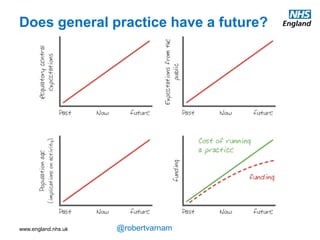
In fact, I was afraid that general practice was being run into the ground. Although NHS
spending was rising, with growing amounts of staff and money, the majority was going
elsewhere in the system. Even though we were talking increasingly about the importance
of providing more care outside hospital, the investment was going inside hospital.
Does general practice have a future?
www.england.nhs.uk @robertvarnam
The founding principles of UK primary care are admired the world over, and rightly so.
General practice is a jewel in the crown of this country.
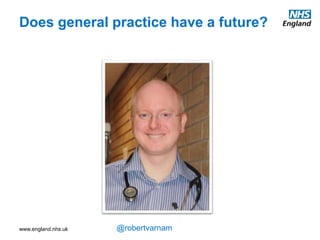
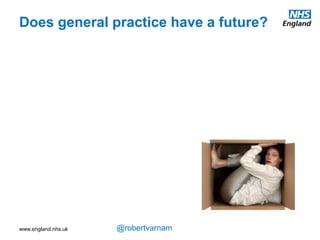
Right now, general practice feels in a bad place. Constrained, hemmed-in and, to some,
marginalised.
Whatever the state of things in your part of the country, in general, I think it’s fair to say
that, at the very least, general practice is currently constrained from delivering its full
potential.
We need to see increases in funding, a growth in the workforce, and improvements to
premises. Without those, existing services may not be sustainable.
Does general practice have a future?
www.england.nhs.uk @robertvarnam
Does general practice have a future?
www.england.nhs.uk @robertvarnam
I joined NHS England back in the summer of 2013 to help with the newly announced Call
to Action on General Practice. Among other things, this was an opportunity to take stock
of the challenges facing general practice and the ways in which NHS England could play
a part in supporting sustainable and improved care. Very much building on what people
told us then, the NHS Five Year Forward View outlines ways in which we are committed to
being part of the solution to the present challenges.
bit.ly/c2aGP
bit.ly/nhs5yfv
How are things?
Where are you heading?
www.england.nhs.uk @robertvarnam
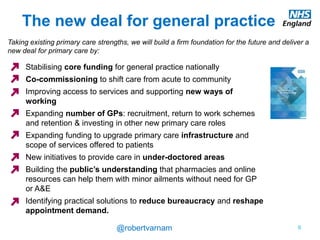
For that reason, I’m very pleased at the
progress being made nationally on driving
change here – to improve the amount and
the fairness of funding, giving greater
power to local CCGs, training extra GPs,
making the profession more attractive,
improving premises and IT. We’ll feel the
benefit of some of those things sooner than
others, but they’re all welcome, and I’m
proud to have played a part in creating this
momentum.
The new deal for general practice
7
Stabilising core funding for general practice nationally
Co-commissioning to shift care from acute to community
Improving access to services and supporting new ways of
working
Expanding number of GPs: recruitment, return to work schemes
and retention & investing in other new primary care roles
Expanding funding to upgrade primary care infrastructure and
scope of services offered to patients
New initiatives to provide care in under-doctored areas
Building the public’s understanding that pharmacies and online
resources can help them with minor ailments without need for GP
or A&E
Identifying practical solutions to reduce bureaucracy and reshape
appointment demand.
Taking existing primary care strengths, we will build a firm foundation for the future and deliver a
new deal for primary care by:
www.england.nhs.uk @robertvarnam
So, for the first time in a while, there seem
to be several reasons for optimism about
the future of general practice.
BUT I don’t believe that simply carrying on
is going to cut it.
?
It’s too easy to approach challenges just by
thinking we need more.
The NHS has a well established habit of
this – new initiatives, new challenges or
opportunities are usually met by us talking
about more. More money, more staff – or
both. And, we know that, in general
practice, we do need both more money
and more staff.
BUT – and it’s a big but – just doing more
of the same is simply not going to cut it any
longer.
www.england.nhs.uk @robertvarnam
It is very clear that everyone is talking
about change. In many parts of the
country, change is already underway in a
wide range of areas.
This actually makes it even more important
to ensure we’re clear about why. What is
the case for change? Where are we
heading with it?
If you’re currently engaged in a programme
of change in your practices, are these two
things really clear?
www.england.nhs.uk @robertvarnam
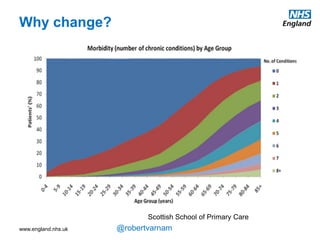
This seminal data, which you’ve probably already seen,
illustrates the reason why just doing more of the same
isn’t appropriate – either clinically for our patients or at
a system level for the country.
We are now spending at least half our time dealing
with people who have multiple longterm problems. And
that proportion is just going to rise as we all get older.
Yet these are not problems the NHS was originally
structured to deal with. In 1948 it was generally
assumed that someone gets ill and they consult their
GP. If it’s a simple, quick and straightforward thing, the
GP will give a prescription and the person will be cured.
If not, a referral will be made to a clever doctor – who
will give a prescription, perform an operation – and the
person will be cured. And, perhaps, in a year or two,
they might fall ill again, and they’ll return for a cure.
LTCs are problems that can’t be cured. And most
people have several. So seeing a specialist in one
condition with the expectation they’ll cure you is no
longer appropriate for the people we spend most of our
time with.
Why change?
Scottish School of Primary Care
www.england.nhs.uk @robertvarnam
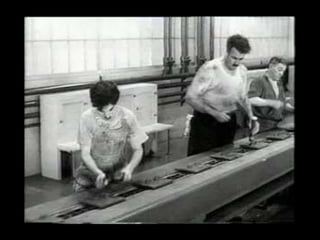
We need a qualitative change in the model of
care for these people. Just turning the handle
faster, or adding more staff to do the same
things would actually be wrong. We need also to
change tack – quite considerably.
Not just more of the same…
• New GPs will take TIME to train
• The world has changed more than general practice
• demography
• technology
• economics
• Many patients need a different kind of care
• less medical
• less dependent
• New care models present big opportunities, now
You may be feeling rather uncomfortable by
now, about all this change. Personally, I’ve been
through many periods of deep discomfort over
recent months as I’ve grappled with all this and
met with colleagues around the country and the
world who are doing likewise.
However, I believe that much of what’s being
described at the moment is about releasing the
potential already in our model of primary care.
It’s about returning to the values which attracted
me to general practice in the first place. The
things that are most admired about the NHS
when you speak to people from other countries.
These are descriptions of what people told us
they were working towards in the Call to Action.
And they’re embedded in the vision of the future
presented by the Five Year Forward View.
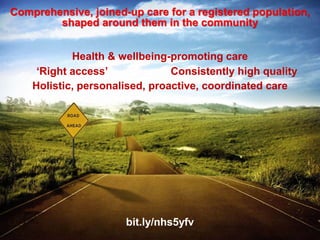
Health & wellbeing-promoting care
‘Right access’ Consistently high quality
Holistic, personalised, proactive, coordinated care
Comprehensive, joined-up care for a registered population,
shaped around them in the community
bit.ly/nhs5yfv
Here are some of the innovations being
implemented right now by practices around
England. For years, much of this has been
theoretical or a matter of wishful thinking.
But it’s happening now, and many of these
are, I think, set to become mainstream in
the foreseeable future.
Phone first.
Community diagnostics.
Practice based paramedics.
Pharmacy first.
Web consultations.
Primary care led urgent care centre.
Minor injury service.
Physio first
Direct specialist advice.
Condition management training.
Shared records.
Care coordination.
Hospital in-reach.
Care home ward rounds.
Virtual ward.
Primary care-employed specialists.
Social prescribing.
Travelling health pods.
Peer-led walking groups
Health coaching.
Befrienders.
Schools outreach.
Community development.
www.england.nhs.uk @robertvarnam
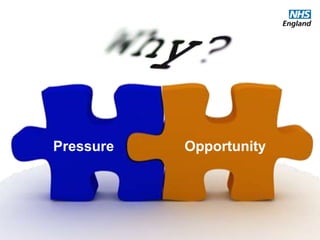
So why are people talking about change?
It’s partly about the pressure we’re under
right now, and partly about the huge
opportunity to do something better. And, for
once, the same changes that would help
with one are also necessary for the other.
Pressure Opportunity
www.england.nhs.uk @robertvarnam
New organisational
forms for integrated
care
www.england.nhs.uk @robertvarnam
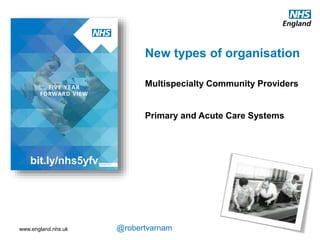
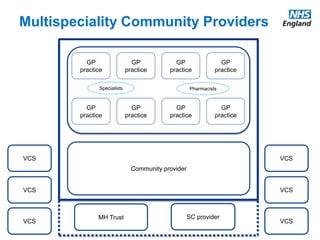
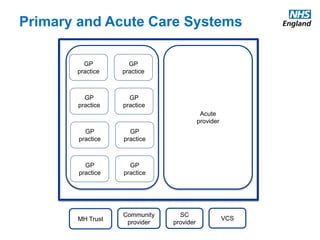
The NHS Five Year Forward View outlined
a number of new organisational forms
which we believe will help make these
changes more attractive, simpler and more
sustainable. The two with the biggest
interest for general practice are the
multispeciality community provider and the
primary and acute care system.
bit.ly/nhs5yfv
New types of organisation
Multispecialty Community Providers
Primary and Acute Care Systems
www.england.nhs.uk @robertvarnam
Multispeciality Community Providers
GP
practice
GP
practice
GP
practice
GP
practice
GP
practice
GP
practice
GP
practice
GP
practice
Specialists Pharmacists
Community provider
SC provider
VCS
VCS
VCS
MH Trust
VCS
VCS
VCS
www.england.nhs.uk @robertvarnam
Primary and Acute Care Systems
Community
provider
SC
provider
VCSMH Trust
Acute
provider
GP
practice
GP
practice
GP
practice
GP
practice
GP
practice
GP
practice
GP
practice
GP
practice
www.england.nhs.uk @robertvarnam
What could the future
look like?
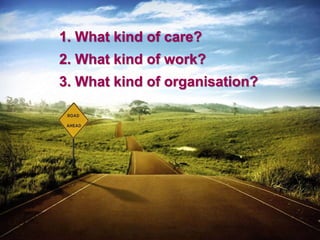
1. What kind of care?
2. What kind of work?
3. What kind of organisation?
www.england.nhs.uk @robertvarnam
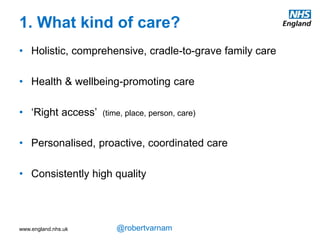
This is the kind of care I think patients
should expect from us
1. What kind of care?
• Holistic, comprehensive, cradle-to-grave family care
• Health & wellbeing-promoting care
• ‘Right access’ (time, place, person, care)
• Personalised, proactive, coordinated care
• Consistently high quality
www.england.nhs.uk @robertvarnam
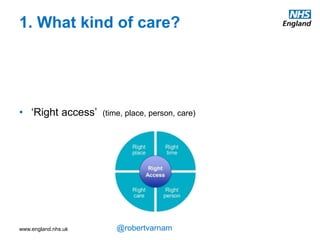
A small aside about access – we need to
do much better at defining and improving it
so as to deliver real improvements in value
for patients. It’s not a one-dimensional
thing.
This is the kind of care I think patients
should expect from us
1. What kind of care?
Holistic, comprehensive, cradle-to-grave family care
Health & wellbeing-promoting care
• ‘Right access’ (time, place, person, care)
Personalised, proactive, coordinated care
Consistently high quality
www.england.nhs.uk @robertvarnam
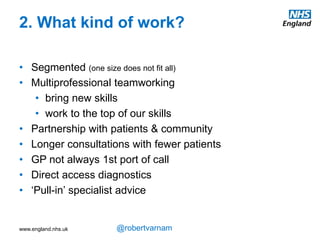
These are key design principles we’ll need
as we build for the future. I don’t think
there are any silver bullets here – we’ll
need to include all of them. How that looks
in practice will need to be different in
different parts of the country, depending on
the needs of your population and the
opportunities presented by your current
arrangements.
2. What kind of work?
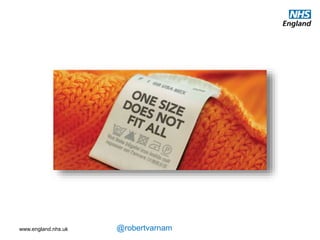
• Segmented (one size does not fit all)
• Multiprofessional teamworking
• bring new skills
• work to the top of our skills
• Partnership with patients & community
• Longer consultations with fewer patients
• GP not always 1st port of call
• Direct access diagnostics
• ‘Pull-in’ specialist advice
www.england.nhs.uk @robertvarnam
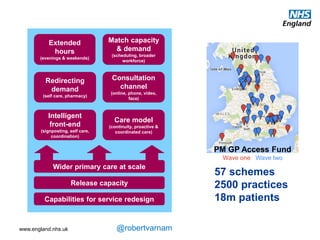
An example of this in practice at the
moment is the Prime Minister’s GP Access
Fund. Now covering a significant
proportion of the country, practices in this
are implementing quite wide-ranging
redesign of their services, acknowledging
that just extending opening hours isn’t
enough, and that other things need to
happen in order for that to happen anyway.
Wider primary care at scale
Redirecting
demand
(self care, pharmacy)
Intelligent
front-end
(signposting, self care,
coordination)
Consultation
channel
(online, phone, video,
face)
Match capacity
& demand
(scheduling, broader
workforce)
Care model
(continuity, proactive &
coordinated care)
Release capacity
Extended
hours
(evenings & weekends)
Capabilities for service redesign
PM GP Access Fund
Wave one Wave two
57 schemes
2500 practices
18m patients
www.england.nhs.uk @robertvarnam
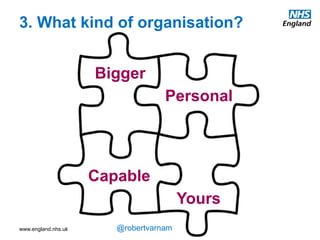
At an organisational level, what will wider primary care
at scale look like? Again, the precise details should be
locally determined. But we should aim for it to be
bigger, in a way that brings real patient to patients and
staff, not just creating a new organisation because it
makes us feel safer. Our new networks, federations or
mergers should have enhanced capabilities, for
leadership, management, services and improvement.
We also need to ensure that, as we operate at large
scale, we maintain the personal care which is so hugely
important for many patients (and staff). That will take
deliberate design: it won’t just happen. Finally, it should
like it’s ‘yours’ – by which I mean that staff will need to
have the same sense of belonging, ownership and
commitment as in the best practices now. Regardless of
the actual business model. That, too, will take planning
and skill.
3. What kind of organisation?
Bigger
Personal
Capable
Yours
www.england.nhs.uk @robertvarnam
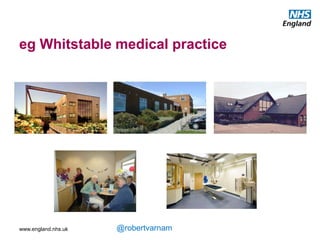
One example is the Whitstable medical
practice. Here, through practice mergers,
they are now a single organisation serving
34000 patients. They have great facilities
which enable them to provide a wider
range of care, and more holistic, less
medical approaches to long term
conditions
eg Whitstable medical practice
www.england.nhs.uk @robertvarnam
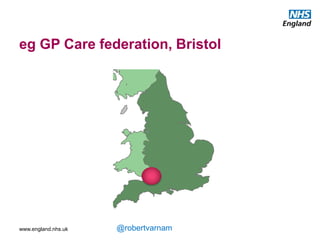
On the other hand, the same design
principles are being applied by the GP
Care federation in the Bristol area. Here,
practices have remained entirely
independent as businesses, but they’re
working in increasingly close collaboration,
developing new services and sharing back
office infrastructure.
eg GP Care federation, Bristol
www.england.nhs.uk @robertvarnam
Where to start?
www.england.nhs.uk @robertvarnam
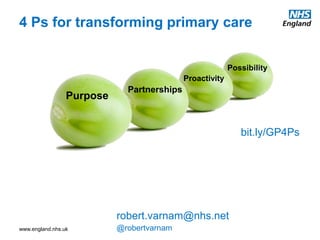
Here are my 4Ps for where you could
start…
bit.ly/GP4Ps
Purpose
Partnerships
Proactivity
Possibility
4 Ps for transforming primary care
robert.varnam@nhs.net

Future of general practice (for Tameside CCG)

  • 1.
    www.england.nhs.uk @robertvarnam The futureof general practice Dr Robert Varnam Head of general practice development robert.varnam@nhs.net @robertvarnam Tameside CCG 18 June 2015 bit.ly/20150618future
  • 2.
    www.england.nhs.uk @robertvarnam The futureof general practice Dr Robert Varnam Head of general practice development robert.varnam@nhs.net @robertvarnam Tameside CCG 18 June 2015 bit.ly/20150618future
  • 3.
    www.england.nhs.uk @robertvarnam One ofthe things motivating me as I first looked outside the walls of our practice, to lead some local service redesign for diabetes, was fear. A fear that general practice, despite being a service depended on by the country, had a very uncertain future. In fact, I was afraid that general practice was being run into the ground. Although NHS spending was rising, with growing amounts of staff and money, the majority was going elsewhere in the system. Even though we were talking increasingly about the importance of providing more care outside hospital, the investment was going inside hospital. Does general practice have a future?
  • 4.
    www.england.nhs.uk @robertvarnam The foundingprinciples of UK primary care are admired the world over, and rightly so. General practice is a jewel in the crown of this country. Right now, general practice feels in a bad place. Constrained, hemmed-in and, to some, marginalised. Whatever the state of things in your part of the country, in general, I think it’s fair to say that, at the very least, general practice is currently constrained from delivering its full potential. We need to see increases in funding, a growth in the workforce, and improvements to premises. Without those, existing services may not be sustainable. Does general practice have a future?
  • 5.
  • 6.
    www.england.nhs.uk @robertvarnam I joinedNHS England back in the summer of 2013 to help with the newly announced Call to Action on General Practice. Among other things, this was an opportunity to take stock of the challenges facing general practice and the ways in which NHS England could play a part in supporting sustainable and improved care. Very much building on what people told us then, the NHS Five Year Forward View outlines ways in which we are committed to being part of the solution to the present challenges. bit.ly/c2aGP bit.ly/nhs5yfv How are things? Where are you heading?
  • 7.
    www.england.nhs.uk @robertvarnam For thatreason, I’m very pleased at the progress being made nationally on driving change here – to improve the amount and the fairness of funding, giving greater power to local CCGs, training extra GPs, making the profession more attractive, improving premises and IT. We’ll feel the benefit of some of those things sooner than others, but they’re all welcome, and I’m proud to have played a part in creating this momentum. The new deal for general practice 7 Stabilising core funding for general practice nationally Co-commissioning to shift care from acute to community Improving access to services and supporting new ways of working Expanding number of GPs: recruitment, return to work schemes and retention & investing in other new primary care roles Expanding funding to upgrade primary care infrastructure and scope of services offered to patients New initiatives to provide care in under-doctored areas Building the public’s understanding that pharmacies and online resources can help them with minor ailments without need for GP or A&E Identifying practical solutions to reduce bureaucracy and reshape appointment demand. Taking existing primary care strengths, we will build a firm foundation for the future and deliver a new deal for primary care by:
  • 8.
    www.england.nhs.uk @robertvarnam So, forthe first time in a while, there seem to be several reasons for optimism about the future of general practice. BUT I don’t believe that simply carrying on is going to cut it. ?
  • 9.
    It’s too easyto approach challenges just by thinking we need more. The NHS has a well established habit of this – new initiatives, new challenges or opportunities are usually met by us talking about more. More money, more staff – or both. And, we know that, in general practice, we do need both more money and more staff. BUT – and it’s a big but – just doing more of the same is simply not going to cut it any longer.
  • 10.
    www.england.nhs.uk @robertvarnam It isvery clear that everyone is talking about change. In many parts of the country, change is already underway in a wide range of areas. This actually makes it even more important to ensure we’re clear about why. What is the case for change? Where are we heading with it? If you’re currently engaged in a programme of change in your practices, are these two things really clear?
  • 11.
    www.england.nhs.uk @robertvarnam This seminaldata, which you’ve probably already seen, illustrates the reason why just doing more of the same isn’t appropriate – either clinically for our patients or at a system level for the country. We are now spending at least half our time dealing with people who have multiple longterm problems. And that proportion is just going to rise as we all get older. Yet these are not problems the NHS was originally structured to deal with. In 1948 it was generally assumed that someone gets ill and they consult their GP. If it’s a simple, quick and straightforward thing, the GP will give a prescription and the person will be cured. If not, a referral will be made to a clever doctor – who will give a prescription, perform an operation – and the person will be cured. And, perhaps, in a year or two, they might fall ill again, and they’ll return for a cure. LTCs are problems that can’t be cured. And most people have several. So seeing a specialist in one condition with the expectation they’ll cure you is no longer appropriate for the people we spend most of our time with. Why change? Scottish School of Primary Care
  • 12.
    www.england.nhs.uk @robertvarnam We needa qualitative change in the model of care for these people. Just turning the handle faster, or adding more staff to do the same things would actually be wrong. We need also to change tack – quite considerably. Not just more of the same… • New GPs will take TIME to train • The world has changed more than general practice • demography • technology • economics • Many patients need a different kind of care • less medical • less dependent • New care models present big opportunities, now
  • 13.
    You may befeeling rather uncomfortable by now, about all this change. Personally, I’ve been through many periods of deep discomfort over recent months as I’ve grappled with all this and met with colleagues around the country and the world who are doing likewise. However, I believe that much of what’s being described at the moment is about releasing the potential already in our model of primary care. It’s about returning to the values which attracted me to general practice in the first place. The things that are most admired about the NHS when you speak to people from other countries. These are descriptions of what people told us they were working towards in the Call to Action. And they’re embedded in the vision of the future presented by the Five Year Forward View. Health & wellbeing-promoting care ‘Right access’ Consistently high quality Holistic, personalised, proactive, coordinated care Comprehensive, joined-up care for a registered population, shaped around them in the community bit.ly/nhs5yfv
  • 14.
    Here are someof the innovations being implemented right now by practices around England. For years, much of this has been theoretical or a matter of wishful thinking. But it’s happening now, and many of these are, I think, set to become mainstream in the foreseeable future.
  • 15.
    Phone first. Community diagnostics. Practicebased paramedics. Pharmacy first. Web consultations. Primary care led urgent care centre. Minor injury service. Physio first
  • 16.
    Direct specialist advice. Conditionmanagement training. Shared records. Care coordination. Hospital in-reach. Care home ward rounds. Virtual ward. Primary care-employed specialists.
  • 17.
    Social prescribing. Travelling healthpods. Peer-led walking groups Health coaching. Befrienders. Schools outreach. Community development.
  • 18.
    www.england.nhs.uk @robertvarnam So whyare people talking about change? It’s partly about the pressure we’re under right now, and partly about the huge opportunity to do something better. And, for once, the same changes that would help with one are also necessary for the other. Pressure Opportunity
  • 19.
  • 20.
    www.england.nhs.uk @robertvarnam The NHSFive Year Forward View outlined a number of new organisational forms which we believe will help make these changes more attractive, simpler and more sustainable. The two with the biggest interest for general practice are the multispeciality community provider and the primary and acute care system. bit.ly/nhs5yfv New types of organisation Multispecialty Community Providers Primary and Acute Care Systems
  • 21.
    www.england.nhs.uk @robertvarnam Multispeciality CommunityProviders GP practice GP practice GP practice GP practice GP practice GP practice GP practice GP practice Specialists Pharmacists Community provider SC provider VCS VCS VCS MH Trust VCS VCS VCS
  • 22.
    www.england.nhs.uk @robertvarnam Primary andAcute Care Systems Community provider SC provider VCSMH Trust Acute provider GP practice GP practice GP practice GP practice GP practice GP practice GP practice GP practice
  • 23.
  • 24.
  • 25.
    1. What kindof care? 2. What kind of work? 3. What kind of organisation?
  • 26.
    www.england.nhs.uk @robertvarnam This isthe kind of care I think patients should expect from us 1. What kind of care? • Holistic, comprehensive, cradle-to-grave family care • Health & wellbeing-promoting care • ‘Right access’ (time, place, person, care) • Personalised, proactive, coordinated care • Consistently high quality
  • 27.
    www.england.nhs.uk @robertvarnam A smallaside about access – we need to do much better at defining and improving it so as to deliver real improvements in value for patients. It’s not a one-dimensional thing. This is the kind of care I think patients should expect from us 1. What kind of care? Holistic, comprehensive, cradle-to-grave family care Health & wellbeing-promoting care • ‘Right access’ (time, place, person, care) Personalised, proactive, coordinated care Consistently high quality
  • 28.
    www.england.nhs.uk @robertvarnam These arekey design principles we’ll need as we build for the future. I don’t think there are any silver bullets here – we’ll need to include all of them. How that looks in practice will need to be different in different parts of the country, depending on the needs of your population and the opportunities presented by your current arrangements. 2. What kind of work? • Segmented (one size does not fit all) • Multiprofessional teamworking • bring new skills • work to the top of our skills • Partnership with patients & community • Longer consultations with fewer patients • GP not always 1st port of call • Direct access diagnostics • ‘Pull-in’ specialist advice
  • 29.
    www.england.nhs.uk @robertvarnam An exampleof this in practice at the moment is the Prime Minister’s GP Access Fund. Now covering a significant proportion of the country, practices in this are implementing quite wide-ranging redesign of their services, acknowledging that just extending opening hours isn’t enough, and that other things need to happen in order for that to happen anyway. Wider primary care at scale Redirecting demand (self care, pharmacy) Intelligent front-end (signposting, self care, coordination) Consultation channel (online, phone, video, face) Match capacity & demand (scheduling, broader workforce) Care model (continuity, proactive & coordinated care) Release capacity Extended hours (evenings & weekends) Capabilities for service redesign PM GP Access Fund Wave one Wave two 57 schemes 2500 practices 18m patients
  • 30.
    www.england.nhs.uk @robertvarnam At anorganisational level, what will wider primary care at scale look like? Again, the precise details should be locally determined. But we should aim for it to be bigger, in a way that brings real patient to patients and staff, not just creating a new organisation because it makes us feel safer. Our new networks, federations or mergers should have enhanced capabilities, for leadership, management, services and improvement. We also need to ensure that, as we operate at large scale, we maintain the personal care which is so hugely important for many patients (and staff). That will take deliberate design: it won’t just happen. Finally, it should like it’s ‘yours’ – by which I mean that staff will need to have the same sense of belonging, ownership and commitment as in the best practices now. Regardless of the actual business model. That, too, will take planning and skill. 3. What kind of organisation? Bigger Personal Capable Yours
  • 31.
    www.england.nhs.uk @robertvarnam One exampleis the Whitstable medical practice. Here, through practice mergers, they are now a single organisation serving 34000 patients. They have great facilities which enable them to provide a wider range of care, and more holistic, less medical approaches to long term conditions eg Whitstable medical practice
  • 32.
    www.england.nhs.uk @robertvarnam On theother hand, the same design principles are being applied by the GP Care federation in the Bristol area. Here, practices have remained entirely independent as businesses, but they’re working in increasingly close collaboration, developing new services and sharing back office infrastructure. eg GP Care federation, Bristol
  • 33.
  • 34.
    www.england.nhs.uk @robertvarnam Here aremy 4Ps for where you could start… bit.ly/GP4Ps Purpose Partnerships Proactivity Possibility 4 Ps for transforming primary care robert.varnam@nhs.net

Editor's Notes

  • #4 One of the things motivating me as I first looked outside the walls of our practice, to lead some local service redesign for diabetes, was fear. A fear that general practice, despite being a service depended on by the country, had a very uncertain future. In fact, I was afraid that general practice was being run into the ground. Although NHS spending was rising, with growing amounts of staff and money, the majority was going elsewhere in the system. Even though we were talking increasingly about the importance of providing more care outside hospital, the investment was going inside hospital.
  • #5 The founding principles of UK primary care are admired the world over, and rightly so. General practice is a jewel in the crown of this country. Right now, general practice feels in a bad place. Constrained, hemmed-in and, to some, marginalised. Whatever the state of things in your part of the country, in general, I think it’s fair to say that, at the very least, general practice is currently constrained from delivering its full potential. We need to see increases in funding, a growth in the workforce, and improvements to premises. Without those, existing services may not be sustainable.
  • #7 I joined NHS England back in the summer of 2013 to help with the newly announced Call to Action on General Practice. Among other things, this was an opportunity to take stock of the challenges facing general practice and the ways in which NHS England could play a part in supporting sustainable and improved care. Very much building on what people told us then, the NHS Five Year Forward View outlines ways in which we are committed to being part of the solution to the present challenges.
  • #8 For that reason, I’m very pleased at the progress being made nationally on driving change here – to improve the amount and the fairness of funding, giving greater power to local CCGs, training extra GPs, making the profession more attractive, improving premises and IT. We’ll feel the benefit of some of those things sooner than others, but they’re all welcome, and I’m proud to have played a part in creating this momentum.
  • #9 So, for the first time in a while, there seem to be several reasons for optimism about the future of general practice. BUT I don’t believe that simply carrying on is going to cut it.
  • #10 It’s too easy to approach challenges just by thinking we need more. The NHS has a well established habit of this – new initiatives, new challenges or opportunities are usually met by us talking about more. More money, more staff – or both. And, we know that, in general practice, we do need both more money and more staff. BUT – and it’s a big but – just doing more of the same is simply not going to cut it any longer.
  • #11 It is very clear that everyone is talking about change. In many parts of the country, change is already underway in a wide range of areas. This actually makes it even more important to ensure we’re clear about why. What is the case for change? Where are we heading with it? If you’re currently engaged in a programme of change in your practices, are these two things really clear?
  • #12 This seminal data, which you’ve probably already seen, illustrates the reason why just doing more of the same isn’t appropriate – either clinically for our patients or at a system level for the country. We are now spending at least half our time dealing with people who have multiple longterm problems. And that proportion is just going to rise as we all get older. Yet these are not problems the NHS was originally structured to deal with. In 1948 it was generally assumed that someone gets ill and they consult their GP. If it’s a simple, quick and straightforward thing, the GP will give a prescription and the person will be cured. If not, a referral will be made to a clever doctor – who will give a prescription, perform an operation – and the person will be cured. And, perhaps, in a year or two, they might fall ill again, and they’ll return for a cure. LTCs are problems that can’t be cured. And most people have several. So seeing a specialist in one condition with the expectation they’ll cure you is no longer appropriate for the people we spend most of our time with.
  • #13 We need a qualitative change in the model of care for these people. Just turning the handle faster, or adding more staff to do the same things would actually be wrong. We need also to change tack – quite considerably.
  • #14 You may be feeling rather uncomfortable by now, about all this change. Personally, I’ve been through many periods of deep discomfort over recent months as I’ve grappled with all this and met with colleagues around the country and the world who are doing likewise. However, I believe that much of what’s being described at the moment is about releasing the potential already in our model of primary care. It’s about returning to the values which attracted me to general practice in the first place. The things that are most admired about the NHS when you speak to people from other countries. These are descriptions of what people told us they were working towards in the Call to Action. And they’re embedded in the vision of the future presented by the Five Year Forward View.
  • #15 Here are some of the innovations being implemented right now by practices around England. For years, much of this has been theoretical or a matter of wishful thinking. But it’s happening now, and many of these are, I think, set to become mainstream in the foreseeable future.
  • #19 So why are people talking about change? It’s partly about the pressure we’re under right now, and partly about the huge opportunity to do something better. And, for once, the same changes that would help with one are also necessary for the other.
  • #21 The NHS Five Year Forward View outlined a number of new organisational forms which we believe will help make these changes more attractive, simpler and more sustainable. The two with the biggest interest for general practice are the multispeciality community provider and the primary and acute care system.
  • #28 A small aside about access – we need to do much better at defining and improving it so as to deliver real improvements in value for patients. It’s not a one-dimensional thing.
  • #29 These are key design principles we’ll need as we build for the future. I don’t think there are any silver bullets here – we’ll need to include all of them. How that looks in practice will need to be different in different parts of the country, depending on the needs of your population and the opportunities presented by your current arrangements.
  • #30 An example of this in practice at the moment is the Prime Minister’s GP Access Fund. Now covering a significant proportion of the country, practices in this are implementing quite wide-ranging redesign of their services, acknowledging that just extending opening hours isn’t enough, and that other things need to happen in order for that to happen anyway.
  • #31 At an organisational level, what will wider primary care at scale look like? Again, the precise details should be locally determined. But we should aim for it to be bigger, in a way that brings real patient to patients and staff, not just creating a new organisation because it makes us feel safer. Our new networks, federations or mergers should have enhanced capabilities, for leadership, management, services and improvement. We also need to ensure that, as we operate at large scale, we maintain the personal care which is so hugely important for many patients (and staff). That will take deliberate design: it won’t just happen. Finally, it should like it’s ‘yours’ – by which I mean that staff will need to have the same sense of belonging, ownership and commitment as in the best practices now. Regardless of the actual business model. That, too, will take planning and skill.
  • #32 One example is the Whitstable medical practice. Here, through practice mergers, they are now a single organisation serving 34000 patients. They have great facilities which enable them to provide a wider range of care, and more holistic, less medical approaches to long term conditions
  • #33 On the other hand, the same design principles are being applied by the GP Care federation in the Bristol area. Here, practices have remained entirely independent as businesses, but they’re working in increasingly close collaboration, developing new services and sharing back office infrastructure.
  • #35 Here are my 4Ps for where you could start…