1 
P. E. SEBASTIANI - Ph.D. Student - paolo.sebastiani@uniroma1.it Dept. of Structural and Geotechnical Engineering - Sapienza University of Rome, Italy 
Ph.D. Student Paolo Emidio Sebastiani Advisors Prof. Franco Bontempi Dr. Francesco Petrini 
a.a. 2014/2015 – Seminario intermedio XXVIII Ciclo
2 
P. E. SEBASTIANI - Ph.D. Student - paolo.sebastiani@uniroma1.it Dept. of Structural and Geotechnical Engineering - Sapienza University of Rome, Italy 
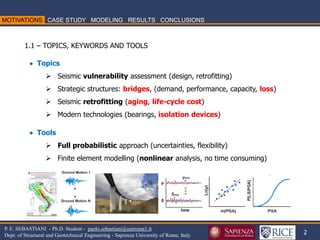
1.1 – TOPICS, KEYWORDS AND TOOLS 
 Topics 
Seismic vulnerability assessment (design, retrofitting) 
Strategic structures: bridges, (demand, performance, capacity, loss) 
Seismic retrofitting (aging, life-cycle cost) 
Modern technologies (bearings, isolation devices)  Tools 
Full probabilistic approach (uncertainties, flexibility) 
Finite element modelling (nonlinear analysis, no time consuming)
3 
P. E. SEBASTIANI - Ph.D. Student - paolo.sebastiani@uniroma1.it Dept. of Structural and Geotechnical Engineering - Sapienza University of Rome, Italy 
1.2 – STATE OF ART AND MOTIVATIONS 
 References on lifecycle costs (LCC) and aging 
“The time-dependency of risk (seismic) in a lifecycle context is a quite new area to be explored. In seismic analysis, aging consideration has started to be included in seismic performance prediction models” (Decò and Frangopol 2013, Ghosh and Padgett 2010) 
Decò A. and Frangopol D.M. (2013). Life-Cycle Risk Assessment of Spatially Distributed Aging Bridges under Seismic and Traffic Hazards. Earthquake Spectra: February 2013, Vol. 29, No. 1, pp. 127-153. Ghosh J. and Padgett J.E. (2010). Aging considerations in the development of time-dependent seismic fragility curves, Journal of Structural Engineering 136, 1497–1511
4 
P. E. SEBASTIANI - Ph.D. Student - paolo.sebastiani@uniroma1.it 
Dept. of Structural and Geotechnical Engineering - Sapienza University of Rome, Italy 
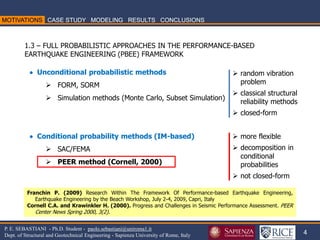
1.3 – FULL PROBABILISTIC APPROACHES IN THE PERFORMANCE-BASED EARTHQUAKE ENGINEERING (PBEE) FRAMEWORK 
Franchin P. (2009) Research Within The Framework Of Performance-based Earthquake Engineering, Earthquake Engineering by the Beach Workshop, July 2-4, 2009, Capri, Italy Cornell C.A. and Krawinkler H. (2000). Progress and Challenges in Seismic Performance Assessment. PEER Center News Spring 2000, 3(2). 
 Unconditional probabilistic methods 
FORM, SORM 
Simulation methods (Monte Carlo, Subset Simulation)  Conditional probability methods (IM-based) 
SAC/FEMA 
PEER method (Cornell, 2000) 
random vibration problem 
classical structural reliability methods 
closed-form 
more flexible 
decomposition in conditional probabilities 
not closed-form
5 
P. E. SEBASTIANI - Ph.D. Student - paolo.sebastiani@uniroma1.it Dept. of Structural and Geotechnical Engineering - Sapienza University of Rome, Italy 
Structural Engineers Assn. of California (SEAOC), (1995) Vision 2000 Committee. April 3, 1995. Performance Based Seismic Engineering of Buildings. J. Soulages, ed. 2 vols. [Sacramento, Calif.] Pinto P.E., Bazzurro P., Elnashai A., Franchin P., Gencturk B., Gunay S., Haukaas T., Mosalam K. & Vamvatsikos, D. (2012). Probabilistic Performance-Based Seismic Design. fib Bulletin 68 
1.4 – STATE OF PRACTICE AND MOTIVATIONS 
 Italian and european codes 
DM 14-01-08, Eurocodes  Other codes 
SEAOC Vision 2000 (1995), FEMA273 (1997) 
ATC-40 (1989) 
 References on PBEE for the state of practice 
“The (conditional probability approaches) have a distinct practice-oriented character, they are currently employed as a standard tool in the research community and are expected to gain ever increasing acceptance in professional practice” (Pinto et al., 2012) 
Semi-probabilistic approach 
Safety coefficient – limit states 
Quantifiable confidence 
Many performance levels
6 
P. E. SEBASTIANI - Ph.D. Student - paolo.sebastiani@uniroma1.it Dept. of Structural and Geotechnical Engineering - Sapienza University of Rome, Italy 
Cornell C.A. and Krawinkler H. (2000) Progress and Challenges in Seismic Performance Assessment. PEER Center News Spring 2000, 3(2). 
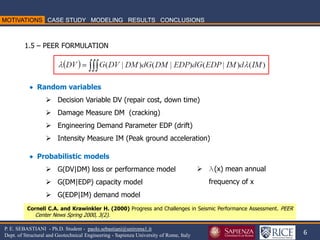
1.5 – PEER FORMULATION 
 Random variables 
Decision Variable DV (repair cost, down time) 
Damage Measure DM (cracking) 
Engineering Demand Parameter EDP (drift) 
Intensity Measure IM (Peak ground acceleration)  Probabilistic models 
G(DV|DM) loss or performance model 
G(DM|EDP) capacity model 
G(EDP|IM) demand model 
l(x) mean annual frequency of x
7 
P. E. SEBASTIANI - Ph.D. Student - paolo.sebastiani@uniroma1.it Dept. of Structural and Geotechnical Engineering - Sapienza University of Rome, Italy 
* 
STATE OF ART 
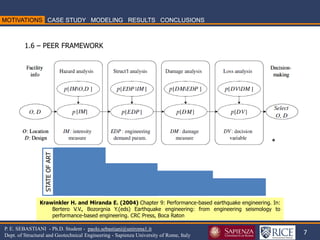
1.6 – PEER FRAMEWORK 
Krawinkler H. and Miranda E. (2004) Chapter 9: Performance-based earthquake engineering. In: Bertero V.V., Bozorgnia Y.(eds) Earthquake engineering: from engineering seismology to performance-based engineering. CRC Press, Boca Raton
8 
P. E. SEBASTIANI - Ph.D. Student - paolo.sebastiani@uniroma1.it Dept. of Structural and Geotechnical Engineering - Sapienza University of Rome, Italy 
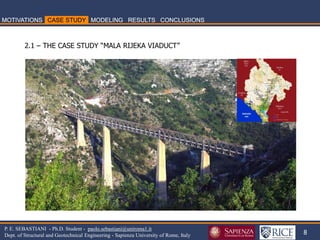
2.1 – THE CASE STUDY “MALA RIJEKA VIADUCT”
9 
P. E. SEBASTIANI - Ph.D. Student - paolo.sebastiani@uniroma1.it Dept. of Structural and Geotechnical Engineering - Sapienza University of Rome, Italy 
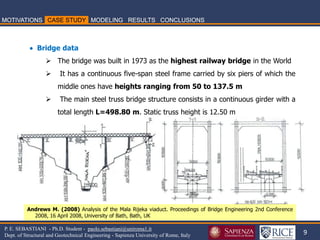
 Bridge data 
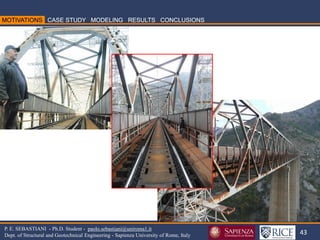
The bridge was built in 1973 as the highest railway bridge in the World 
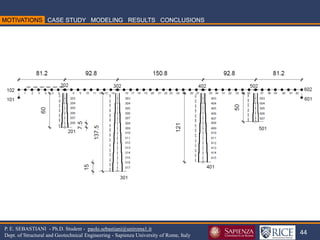
 It has a continuous five-span steel frame carried by six piers of which the middle ones have heights ranging from 50 to 137.5 m 
 The main steel truss bridge structure consists in a continuous girder with a total length L=498.80 m. Static truss height is 12.50 m 
Andrews M. (2008) Analysis of the Mala Rijeka viaduct. Proceedings of Bridge Engineering 2nd Conference 2008, 16 April 2008, University of Bath, Bath, UK
10 
P. E. SEBASTIANI - Ph.D. Student - paolo.sebastiani@uniroma1.it Dept. of Structural and Geotechnical Engineering - Sapienza University of Rome, Italy 
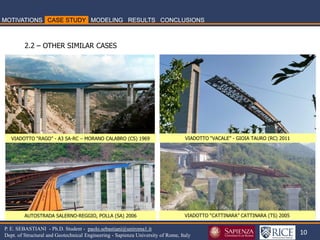
2.2 – OTHER SIMILAR CASES 
VIADOTTO “RAGO” - A3 SA-RC – MORANO CALABRO (CS) 1969 
VIADOTTO “VACALE” - GIOIA TAURO (RC) 2011 
VIADOTTO “CATTINARA” CATTINARA (TS) 2005 
AUTOSTRADA SALERNO-REGGIO, POLLA (SA) 2006
11 
P. E. SEBASTIANI - Ph.D. Student - paolo.sebastiani@uniroma1.it Dept. of Structural and Geotechnical Engineering - Sapienza University of Rome, Italy 
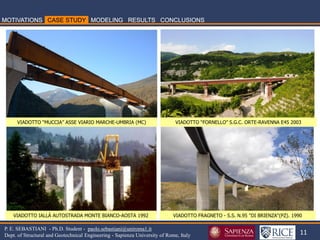
VIADOTTO “MUCCIA” ASSE VIARIO MARCHE-UMBRIA (MC) 
VIADOTTO “FORNELLO” S.G.C. ORTE-RAVENNA E45 2003 
VIADOTTO IALLÀ AUTOSTRADA MONTE BIANCO-AOSTA 1992 
VIADOTTO FRAGNETO - S.S. N.95 "DI BRIENZA"(PZ). 1990
12 
P. E. SEBASTIANI - Ph.D. Student - paolo.sebastiani@uniroma1.it Dept. of Structural and Geotechnical Engineering - Sapienza University of Rome, Italy 
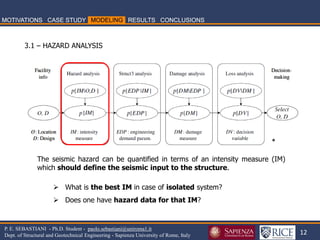
The seismic hazard can be quantified in terms of an intensity measure (IM) which should define the seismic input to the structure. 
What is the best IM in case of isolated system? 
Does one have hazard data for that IM? 
* 
3.1 – HAZARD ANALYSIS
13 
P. E. SEBASTIANI - Ph.D. Student - paolo.sebastiani@uniroma1.it Dept. of Structural and Geotechnical Engineering - Sapienza University of Rome, Italy 
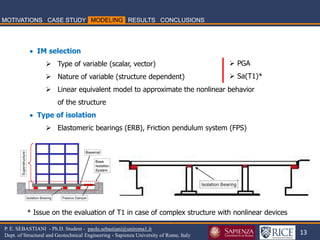
 IM selection 
Type of variable (scalar, vector) 
Nature of variable (structure dependent) 
Linear equivalent model to approximate the nonlinear behavior of the structure  Type of isolation 
Elastomeric bearings (ERB), Friction pendulum system (FPS) 
PGA 
Sa(T1)* 
* Issue on the evaluation of T1 in case of complex structure with nonlinear devices
14 
P. E. SEBASTIANI - Ph.D. Student - paolo.sebastiani@uniroma1.it Dept. of Structural and Geotechnical Engineering - Sapienza University of Rome, Italy 
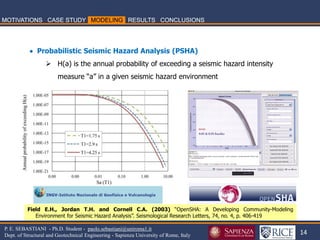
 Probabilistic Seismic Hazard Analysis (PSHA) 
H(a) is the annual probability of exceeding a seismic hazard intensity measure “a” in a given seismic hazard environment 
Field E.H., Jordan T.H. and Cornell C.A. (2003) “OpenSHA: A Developing Community-Modeling Environment for Seismic Hazard Analysis”. Seismological Research Letters, 74, no. 4, p. 406-419
15 
P. E. SEBASTIANI - Ph.D. Student - paolo.sebastiani@uniroma1.it Dept. of Structural and Geotechnical Engineering - Sapienza University of Rome, Italy 
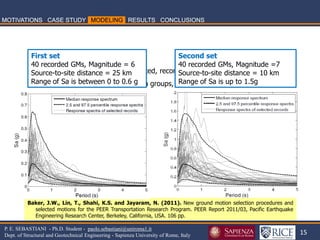
 Ground Motion selection 
Nature of the signal (Simulated, recorded, spectrum-compatible 
Elaboration of the signal (bin groups, scaled or unscaled) 
Baker, J.W., Lin, T., Shahi, K.S. and Jayaram, N. (2011). New ground motion selection procedures and selected motions for the PEER Transportation Research Program. PEER Report 2011/03, Pacific Earthquake Engineering Research Center, Berkeley, California, USA. 106 pp. 
First set 40 recorded GMs, Magnitude = 6 Source-to-site distance = 25 km Range of Sa is between 0 to 0.6 g 
Second set 40 recorded GMs, Magnitude =7 Source-to-site distance = 10 km Range of Sa is up to 1.5g
16 
P. E. SEBASTIANI - Ph.D. Student - paolo.sebastiani@uniroma1.it Dept. of Structural and Geotechnical Engineering - Sapienza University of Rome, Italy 
* 
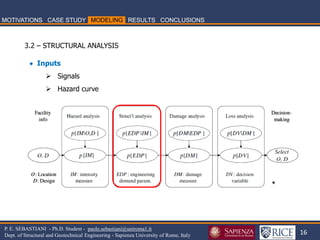
3.2 – STRUCTURAL ANALYSIS 
 Inputs 
Signals 
Hazard curve
17 P. E. SEBASTIANI - Ph.D. Student - paolo.sebastiani@uniroma1.it 
Dept. of Structural and Geotechnical Engineering - Sapienza University of Rome, Italy 
λE0 Ets 
ft 
(U, fpcU) 
(c0, fpc) 
E0=2fpc/c0 
Ep 
f Ets y 
16.5 m 
16.5 m 
cross section 
of the pier 
materials 
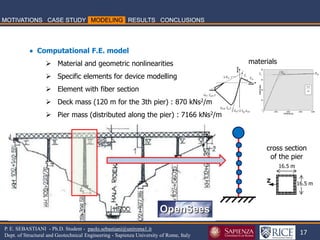
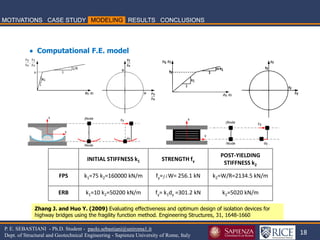
 Computational F.E. model 
 Material and geometric nonlinearities 
 Specific elements for device modelling 
 Element with fiber section 
 Deck mass (120 m for the 3th pier) : 870 kNs2/m 
 Pier mass (distributed along the pier) : 7166 kNs2/m
18 
P. E. SEBASTIANI - Ph.D. Student - paolo.sebastiani@uniroma1.it Dept. of Structural and Geotechnical Engineering - Sapienza University of Rome, Italy 
INITIAL STIFFNESS k1 
STRENGTH fy 
POST-YIELDING STIFFNESS k2 
FPS 
k1=75 k2=160000 kN/m 
fy=mW= 256.1 kN 
k2=W/R=2134.5 kN/m 
ERB 
k1=10 k2=50200 kN/m 
fy= k1dy =301.2 kN 
k2=5020 kN/m 
 Computational F.E. model 
Zhang J. and Huo Y. (2009) Evaluating effectiveness and optimum design of isolation devices for highway bridges using the fragility function method. Engineering Structures, 31, 1648-1660
19 
P. E. SEBASTIANI - Ph.D. Student - paolo.sebastiani@uniroma1.it Dept. of Structural and Geotechnical Engineering - Sapienza University of Rome, Italy 
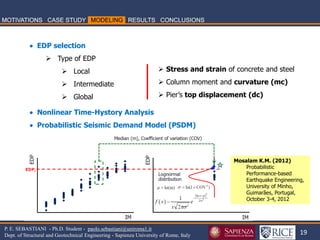
 EDP selection 
Type of EDP 
Local 
Intermediate 
Global  Nonlinear Time-Hystory Analysis  Probabilistic Seismic Demand Model (PSDM) 
Stress and strain of concrete and steel 
Column moment and curvature (mc) 
Pier’s top displacement (dc) 
Mosalam K.M. (2012) Probabilistic Performance-based Earthquake Engineering, University of Minho, Guimarães, Portugal, October 3-4, 2012
20 
P. E. SEBASTIANI - Ph.D. Student - paolo.sebastiani@uniroma1.it Dept. of Structural and Geotechnical Engineering - Sapienza University of Rome, Italy 
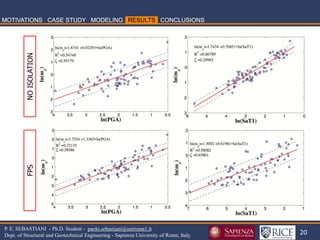
NO ISOLATION 
FPS
21 
P. E. SEBASTIANI - Ph.D. Student - paolo.sebastiani@uniroma1.it Dept. of Structural and Geotechnical Engineering - Sapienza University of Rome, Italy 
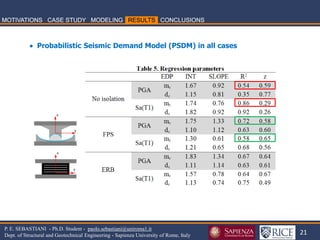
 Probabilistic Seismic Demand Model (PSDM) in all cases
22 
P. E. SEBASTIANI - Ph.D. Student - paolo.sebastiani@uniroma1.it Dept. of Structural and Geotechnical Engineering - Sapienza University of Rome, Italy 
* 
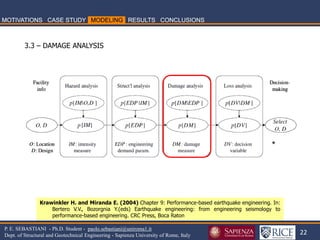
3.3 – DAMAGE ANALYSIS 
Krawinkler H. and Miranda E. (2004) Chapter 9: Performance-based earthquake engineering. In: Bertero V.V., Bozorgnia Y.(eds) Earthquake engineering: from engineering seismology to performance-based engineering. CRC Press, Boca Raton
23 
P. E. SEBASTIANI - Ph.D. Student - paolo.sebastiani@uniroma1.it Dept. of Structural and Geotechnical Engineering - Sapienza University of Rome, Italy 
23 
SEC 107 
SEC 105 
SEC 103 
SEC 101 
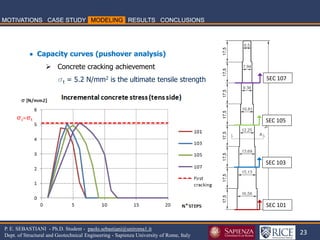
 Capacity curves (pushover analysis) 
Concrete cracking achievement st = 5.2 N/mm2 is the ultimate tensile strength
24 
P. E. SEBASTIANI - Ph.D. Student - paolo.sebastiani@uniroma1.it Dept. of Structural and Geotechnical Engineering - Sapienza University of Rome, Italy 
24 
SEC 107 
SEC 105 
SEC 103 
SEC 101 
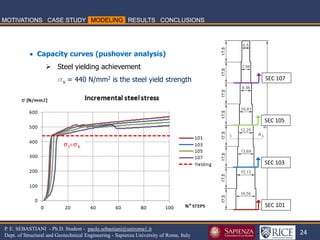
 Capacity curves (pushover analysis) 
Steel yielding achievement ss = 440 N/mm2 is the steel yield strength
25 
P. E. SEBASTIANI - Ph.D. Student - paolo.sebastiani@uniroma1.it Dept. of Structural and Geotechnical Engineering - Sapienza University of Rome, Italy 
Choi E., DesRoches R., Nielson B. (2004) “Seismic fragility of typical bridges in moderate seismic zones”. EngStruct 2004;26:187 
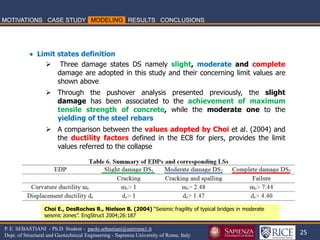
 Limit states definition 
 Three damage states DS namely slight, moderate and complete damage are adopted in this study and their concerning limit values are shown above 
Through the pushover analysis presented previously, the slight damage has been associated to the achievement of maximum tensile strength of concrete, while the moderate one to the yielding of the steel rebars 
A comparison between the values adopted by Choi et al. (2004) and the ductility factors defined in the EC8 for piers, provides the limit values referred to the collapse
26 
P. E. SEBASTIANI - Ph.D. Student - paolo.sebastiani@uniroma1.it Dept. of Structural and Geotechnical Engineering - Sapienza University of Rome, Italy 
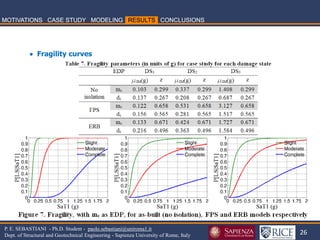
 Fragility curves
27 
P. E. SEBASTIANI - Ph.D. Student - paolo.sebastiani@uniroma1.it Dept. of Structural and Geotechnical Engineering - Sapienza University of Rome, Italy 
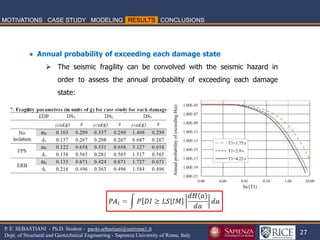
 Annual probability of exceeding each damage state 
The seismic fragility can be convolved with the seismic hazard in order to assess the annual probability of exceeding each damage state:
28 P. E. SEBASTIANI - Ph.D. Student - paolo.sebastiani@uniroma1.it 
Dept. of Structural and Geotechnical Engineering - Sapienza University of Rome, Italy 
PTf푖 = 1 − 1 − PA푖 T 
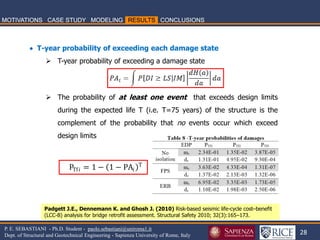
 T-year probability of exceeding each damage state 
 T-year probability of exceeding a damage state 
 The probability of at least one event that exceeds design limits 
during the expected life T (i.e. T=75 years) of the structure is the 
complement of the probability that no events occur which exceed 
design limits 
Padgett J.E., Dennemann K. and Ghosh J. (2010) Risk-based seismic life-cycle cost–benefit 
(LCC-B) analysis for bridge retrofit assessment. Structural Safety 2010; 32(3):165–173.
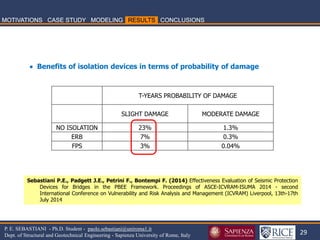
 Benefits of isolation devices in terms of probability of damage 
29 
P. E. SEBASTIANI - Ph.D. Student - paolo.sebastiani@uniroma1.it Dept. of Structural and Geotechnical Engineering - Sapienza University of Rome, Italy 
T-YEARS PROBABILITY OF DAMAGE 
SLIGHT DAMAGE 
MODERATE DAMAGE 
NO ISOLATION 
23% 
1.3% 
ERB 
7% 
0.3% 
FPS 
3% 
0.04% 
Sebastiani P.E., Padgett J.E., Petrini F., Bontempi F. (2014) Effectiveness Evaluation of Seismic Protection Devices for Bridges in the PBEE Framework. Proceedings of ASCE-ICVRAM-ISUMA 2014 - second International Conference on Vulnerability and Risk Analysis and Management (ICVRAM) Liverpool, 13th-17th July 2014
30 
P. E. SEBASTIANI - Ph.D. Student - paolo.sebastiani@uniroma1.it Dept. of Structural and Geotechnical Engineering - Sapienza University of Rome, Italy 
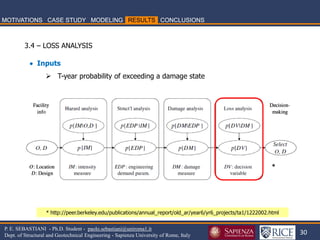
* http://peer.berkeley.edu/publications/annual_report/old_ar/year6/yr6_projects/ta1/1222002.html 
* 
3.4 – LOSS ANALYSIS 
 Inputs 
T-year probability of exceeding a damage state
31 
P. E. SEBASTIANI - Ph.D. Student - paolo.sebastiani@uniroma1.it Dept. of Structural and Geotechnical Engineering - Sapienza University of Rome, Italy 
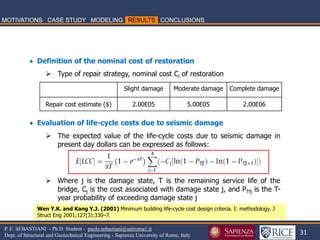
 Definition of the nominal cost of restoration 
Type of repair strategy, nominal cost Ci of restoration  Evaluation of life-cycle costs due to seismic damage 
The expected value of the life-cycle costs due to seismic damage in present day dollars can be expressed as follows: 
Where j is the damage state, T is the remaining service life of the bridge, Cj is the cost associated with damage state j, and PTfj is the T- year probability of exceeding damage state j 
Slight damage 
Moderate damage 
Complete damage 
Repair cost estimate ($) 
2.00E05 
5.00E05 
2.00E06 
Wen Y.K. and Kang Y.J. (2001) Minimum building life-cycle cost design criteria. I: methodology. J Struct Eng 2001;127(3):330–7.
32 
P. E. SEBASTIANI - Ph.D. Student - paolo.sebastiani@uniroma1.it Dept. of Structural and Geotechnical Engineering - Sapienza University of Rome, Italy 
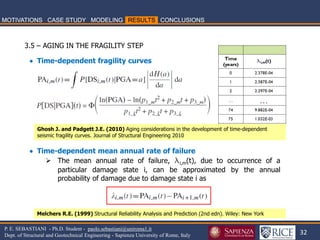
 Time-dependent fragility curves  Time-dependent mean annual rate of failure 
The mean annual rate of failure, li,m(t), due to occurrence of a particular damage state i, can be approximated by the annual probability of damage due to damage state i as 
Ghosh J. and Padgett J.E. (2010) Aging considerations in the development of time-dependent seismic fragility curves. Journal of Structural Engineering 2010 
Melchers R.E. (1999) Structural Reliability Analysis and Prediction (2nd edn). Wiley: New York 
3.5 – AGING IN THE FRAGILITY STEP
33 
P. E. SEBASTIANI - Ph.D. Student - paolo.sebastiani@uniroma1.it Dept. of Structural and Geotechnical Engineering - Sapienza University of Rome, Italy 
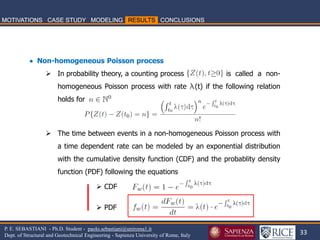
 Non-homogeneous Poisson process 
In probability theory, a counting process is called a non- homogeneous Poisson process with rate l(t) if the following relation holds for 
The time between events in a non-homogeneous Poisson process with a time dependent rate can be modeled by an exponential distribution with the cumulative density function (CDF) and the probablity density function (PDF) following the equations 
CDF 
PDF
34 
P. E. SEBASTIANI - Ph.D. Student - paolo.sebastiani@uniroma1.it Dept. of Structural and Geotechnical Engineering - Sapienza University of Rome, Italy 
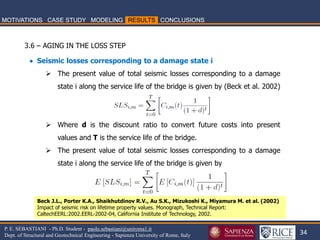
 Seismic losses corresponding to a damage state i 
The present value of total seismic losses corresponding to a damage state i along the service life of the bridge is given by (Beck et al. 2002) 
Where d is the discount ratio to convert future costs into present values and T is the service life of the bridge. 
The present value of total seismic losses corresponding to a damage state i along the service life of the bridge is given by 
Beck J.L., Porter K.A., Shaikhutdinov R.V., Au S.K., Mizukoshi K., Miyamura M. et al. (2002) Impact of seismic risk on lifetime property values. Monograph, Technical Report: CaltechEERL:2002.EERL-2002-04, California Institute of Technology, 2002. 
3.6 – AGING IN THE LOSS STEP
35 
P. E. SEBASTIANI - Ph.D. Student - paolo.sebastiani@uniroma1.it Dept. of Structural and Geotechnical Engineering - Sapienza University of Rome, Italy 
 Expected cost value 
Moreover the expected value can be evaluated as 
Where Ci,m is the nominal cost associated with damage state ith to restore the bridge and P[Ci,m(t)] is the probability of incurring the cost Ci,m 
The probability can be approximated by the summation of its PDF values calculated from t=0 to t=T in the discrete space as follows 
Ghosh, J. and Padgett, J.E. (2011) Probabilistic seismic loss assessment of aging bridges using a component-level cost estimation approach. Earthquake Engng Struct. Dyn.
36 
P. E. SEBASTIANI - Ph.D. Student - paolo.sebastiani@uniroma1.it Dept. of Structural and Geotechnical Engineering - Sapienza University of Rome, Italy 
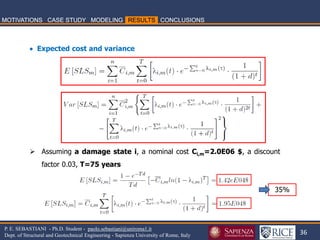
 Expected cost and variance 
Assuming a damage state i, a nominal cost Ci,m=2.0E06 $, a discount factor 0.03, T=75 years 
35%
37 
P. E. SEBASTIANI - Ph.D. Student - paolo.sebastiani@uniroma1.it Dept. of Structural and Geotechnical Engineering - Sapienza University of Rome, Italy 
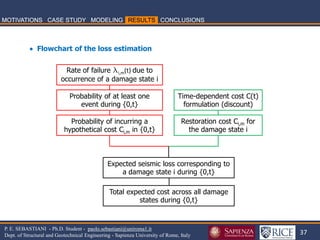
 Flowchart of the loss estimation 
Rate of failure li,m(t) due to occurrence of a damage state i 
Probability of at least one event during {0,t} 
Restoration cost Ci,m for the damage state i 
Probability of incurring a hypothetical cost Ci,m in {0,t} 
Expected seismic loss corresponding to a damage state i during {0,t} 
Time-dependent cost C(t) formulation (discount) 
Total expected cost across all damage states during {0,t}
38 
P. E. SEBASTIANI - Ph.D. Student - paolo.sebastiani@uniroma1.it Dept. of Structural and Geotechnical Engineering - Sapienza University of Rome, Italy 
4 – CONCLUSIONS 
 Topic 
PBEE for loss estimation of isolated bridges with aging effects  Contributions 
Application to a real case study, implementing the whole PEER procedure in Matlab environment 
Working on a recent formulation to evaluate expected cost and variance in case of aging effects, with a contribution in the discount factor implementation
39 
P. E. SEBASTIANI - Ph.D. Student - paolo.sebastiani@uniroma1.it 
Dept. of Structural and Geotechnical Engineering - Sapienza University of Rome, Italy 
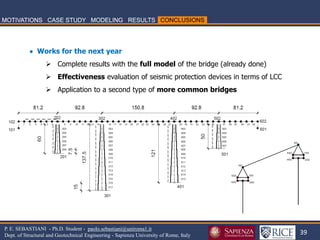
 Works for the next year 
Complete results with the full model of the bridge (already done) 
Effectiveness evaluation of seismic protection devices in terms of LCC 
Application to a second type of more common bridges
40 
P. E. SEBASTIANI - Ph.D. Student - paolo.sebastiani@uniroma1.it Dept. of Structural and Geotechnical Engineering - Sapienza University of Rome, Italy
41 
P. E. SEBASTIANI - Ph.D. Student - paolo.sebastiani@uniroma1.it Dept. of Structural and Geotechnical Engineering - Sapienza University of Rome, Italy 
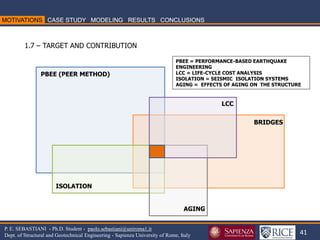
PBEE (PEER METHOD) 
BRIDGES 
ISOLATION 
AGING 
LCC 
PBEE = PERFORMANCE-BASED EARTHQUAKE ENGINEERING LCC = LIFE-CYCLE COST ANALYSIS ISOLATION = SEISMIC ISOLATION SYSTEMS AGING = EFFECTS OF AGING ON THE STRUCTURE 
1.7 – TARGET AND CONTRIBUTION
42 
P. E. SEBASTIANI - Ph.D. Student - paolo.sebastiani@uniroma1.it Dept. of Structural and Geotechnical Engineering - Sapienza University of Rome, Italy 
Mosalam K.M. (2012) Probabilistic Performance-based Earthquake Engineering, University of Minho, Guimarães, Portugal, October 3-4, 2012
43 
P. E. SEBASTIANI - Ph.D. Student - paolo.sebastiani@uniroma1.it Dept. of Structural and Geotechnical Engineering - Sapienza University of Rome, Italy
44 
P. E. SEBASTIANI - Ph.D. Student - paolo.sebastiani@uniroma1.it Dept. of Structural and Geotechnical Engineering - Sapienza University of Rome, Italy
45 
P. E. SEBASTIANI - Ph.D. Student - paolo.sebastiani@uniroma1.it Dept. of Structural and Geotechnical Engineering - Sapienza University of Rome, Italy
46 
P. E. SEBASTIANI - Ph.D. Student - paolo.sebastiani@uniroma1.it Dept. of Structural and Geotechnical Engineering - Sapienza University of Rome, Italy
47 
P. E. SEBASTIANI - Ph.D. Student - paolo.sebastiani@uniroma1.it Dept. of Structural and Geotechnical Engineering - Sapienza University of Rome, Italy 
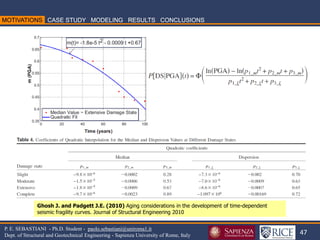
Ghosh J. and Padgett J.E. (2010) Aging considerations in the development of time-dependent seismic fragility curves. Journal of Structural Engineering 2010

Performance-Based Seismic Assessment for Loss Estimation of Isolated Bridges

  • 1.
    1 P. E.SEBASTIANI - Ph.D. Student - paolo.sebastiani@uniroma1.it Dept. of Structural and Geotechnical Engineering - Sapienza University of Rome, Italy Ph.D. Student Paolo Emidio Sebastiani Advisors Prof. Franco Bontempi Dr. Francesco Petrini a.a. 2014/2015 – Seminario intermedio XXVIII Ciclo
  • 2.
    2 P. E.SEBASTIANI - Ph.D. Student - paolo.sebastiani@uniroma1.it Dept. of Structural and Geotechnical Engineering - Sapienza University of Rome, Italy 1.1 – TOPICS, KEYWORDS AND TOOLS  Topics Seismic vulnerability assessment (design, retrofitting) Strategic structures: bridges, (demand, performance, capacity, loss) Seismic retrofitting (aging, life-cycle cost) Modern technologies (bearings, isolation devices)  Tools Full probabilistic approach (uncertainties, flexibility) Finite element modelling (nonlinear analysis, no time consuming)
  • 3.
    3 P. E.SEBASTIANI - Ph.D. Student - paolo.sebastiani@uniroma1.it Dept. of Structural and Geotechnical Engineering - Sapienza University of Rome, Italy 1.2 – STATE OF ART AND MOTIVATIONS  References on lifecycle costs (LCC) and aging “The time-dependency of risk (seismic) in a lifecycle context is a quite new area to be explored. In seismic analysis, aging consideration has started to be included in seismic performance prediction models” (Decò and Frangopol 2013, Ghosh and Padgett 2010) Decò A. and Frangopol D.M. (2013). Life-Cycle Risk Assessment of Spatially Distributed Aging Bridges under Seismic and Traffic Hazards. Earthquake Spectra: February 2013, Vol. 29, No. 1, pp. 127-153. Ghosh J. and Padgett J.E. (2010). Aging considerations in the development of time-dependent seismic fragility curves, Journal of Structural Engineering 136, 1497–1511
  • 4.
    4 P. E.SEBASTIANI - Ph.D. Student - paolo.sebastiani@uniroma1.it Dept. of Structural and Geotechnical Engineering - Sapienza University of Rome, Italy 1.3 – FULL PROBABILISTIC APPROACHES IN THE PERFORMANCE-BASED EARTHQUAKE ENGINEERING (PBEE) FRAMEWORK Franchin P. (2009) Research Within The Framework Of Performance-based Earthquake Engineering, Earthquake Engineering by the Beach Workshop, July 2-4, 2009, Capri, Italy Cornell C.A. and Krawinkler H. (2000). Progress and Challenges in Seismic Performance Assessment. PEER Center News Spring 2000, 3(2).  Unconditional probabilistic methods FORM, SORM Simulation methods (Monte Carlo, Subset Simulation)  Conditional probability methods (IM-based) SAC/FEMA PEER method (Cornell, 2000) random vibration problem classical structural reliability methods closed-form more flexible decomposition in conditional probabilities not closed-form
  • 5.
    5 P. E.SEBASTIANI - Ph.D. Student - paolo.sebastiani@uniroma1.it Dept. of Structural and Geotechnical Engineering - Sapienza University of Rome, Italy Structural Engineers Assn. of California (SEAOC), (1995) Vision 2000 Committee. April 3, 1995. Performance Based Seismic Engineering of Buildings. J. Soulages, ed. 2 vols. [Sacramento, Calif.] Pinto P.E., Bazzurro P., Elnashai A., Franchin P., Gencturk B., Gunay S., Haukaas T., Mosalam K. & Vamvatsikos, D. (2012). Probabilistic Performance-Based Seismic Design. fib Bulletin 68 1.4 – STATE OF PRACTICE AND MOTIVATIONS  Italian and european codes DM 14-01-08, Eurocodes  Other codes SEAOC Vision 2000 (1995), FEMA273 (1997) ATC-40 (1989)  References on PBEE for the state of practice “The (conditional probability approaches) have a distinct practice-oriented character, they are currently employed as a standard tool in the research community and are expected to gain ever increasing acceptance in professional practice” (Pinto et al., 2012) Semi-probabilistic approach Safety coefficient – limit states Quantifiable confidence Many performance levels
  • 6.
    6 P. E.SEBASTIANI - Ph.D. Student - paolo.sebastiani@uniroma1.it Dept. of Structural and Geotechnical Engineering - Sapienza University of Rome, Italy Cornell C.A. and Krawinkler H. (2000) Progress and Challenges in Seismic Performance Assessment. PEER Center News Spring 2000, 3(2). 1.5 – PEER FORMULATION  Random variables Decision Variable DV (repair cost, down time) Damage Measure DM (cracking) Engineering Demand Parameter EDP (drift) Intensity Measure IM (Peak ground acceleration)  Probabilistic models G(DV|DM) loss or performance model G(DM|EDP) capacity model G(EDP|IM) demand model l(x) mean annual frequency of x
  • 7.
    7 P. E.SEBASTIANI - Ph.D. Student - paolo.sebastiani@uniroma1.it Dept. of Structural and Geotechnical Engineering - Sapienza University of Rome, Italy * STATE OF ART 1.6 – PEER FRAMEWORK Krawinkler H. and Miranda E. (2004) Chapter 9: Performance-based earthquake engineering. In: Bertero V.V., Bozorgnia Y.(eds) Earthquake engineering: from engineering seismology to performance-based engineering. CRC Press, Boca Raton
  • 8.
    8 P. E.SEBASTIANI - Ph.D. Student - paolo.sebastiani@uniroma1.it Dept. of Structural and Geotechnical Engineering - Sapienza University of Rome, Italy 2.1 – THE CASE STUDY “MALA RIJEKA VIADUCT”
  • 9.
    9 P. E.SEBASTIANI - Ph.D. Student - paolo.sebastiani@uniroma1.it Dept. of Structural and Geotechnical Engineering - Sapienza University of Rome, Italy  Bridge data The bridge was built in 1973 as the highest railway bridge in the World  It has a continuous five-span steel frame carried by six piers of which the middle ones have heights ranging from 50 to 137.5 m  The main steel truss bridge structure consists in a continuous girder with a total length L=498.80 m. Static truss height is 12.50 m Andrews M. (2008) Analysis of the Mala Rijeka viaduct. Proceedings of Bridge Engineering 2nd Conference 2008, 16 April 2008, University of Bath, Bath, UK
  • 10.
    10 P. E.SEBASTIANI - Ph.D. Student - paolo.sebastiani@uniroma1.it Dept. of Structural and Geotechnical Engineering - Sapienza University of Rome, Italy 2.2 – OTHER SIMILAR CASES VIADOTTO “RAGO” - A3 SA-RC – MORANO CALABRO (CS) 1969 VIADOTTO “VACALE” - GIOIA TAURO (RC) 2011 VIADOTTO “CATTINARA” CATTINARA (TS) 2005 AUTOSTRADA SALERNO-REGGIO, POLLA (SA) 2006
  • 11.
    11 P. E.SEBASTIANI - Ph.D. Student - paolo.sebastiani@uniroma1.it Dept. of Structural and Geotechnical Engineering - Sapienza University of Rome, Italy VIADOTTO “MUCCIA” ASSE VIARIO MARCHE-UMBRIA (MC) VIADOTTO “FORNELLO” S.G.C. ORTE-RAVENNA E45 2003 VIADOTTO IALLÀ AUTOSTRADA MONTE BIANCO-AOSTA 1992 VIADOTTO FRAGNETO - S.S. N.95 "DI BRIENZA"(PZ). 1990
  • 12.
    12 P. E.SEBASTIANI - Ph.D. Student - paolo.sebastiani@uniroma1.it Dept. of Structural and Geotechnical Engineering - Sapienza University of Rome, Italy The seismic hazard can be quantified in terms of an intensity measure (IM) which should define the seismic input to the structure. What is the best IM in case of isolated system? Does one have hazard data for that IM? * 3.1 – HAZARD ANALYSIS
  • 13.
    13 P. E.SEBASTIANI - Ph.D. Student - paolo.sebastiani@uniroma1.it Dept. of Structural and Geotechnical Engineering - Sapienza University of Rome, Italy  IM selection Type of variable (scalar, vector) Nature of variable (structure dependent) Linear equivalent model to approximate the nonlinear behavior of the structure  Type of isolation Elastomeric bearings (ERB), Friction pendulum system (FPS) PGA Sa(T1)* * Issue on the evaluation of T1 in case of complex structure with nonlinear devices
  • 14.
    14 P. E.SEBASTIANI - Ph.D. Student - paolo.sebastiani@uniroma1.it Dept. of Structural and Geotechnical Engineering - Sapienza University of Rome, Italy  Probabilistic Seismic Hazard Analysis (PSHA) H(a) is the annual probability of exceeding a seismic hazard intensity measure “a” in a given seismic hazard environment Field E.H., Jordan T.H. and Cornell C.A. (2003) “OpenSHA: A Developing Community-Modeling Environment for Seismic Hazard Analysis”. Seismological Research Letters, 74, no. 4, p. 406-419
  • 15.
    15 P. E.SEBASTIANI - Ph.D. Student - paolo.sebastiani@uniroma1.it Dept. of Structural and Geotechnical Engineering - Sapienza University of Rome, Italy  Ground Motion selection Nature of the signal (Simulated, recorded, spectrum-compatible Elaboration of the signal (bin groups, scaled or unscaled) Baker, J.W., Lin, T., Shahi, K.S. and Jayaram, N. (2011). New ground motion selection procedures and selected motions for the PEER Transportation Research Program. PEER Report 2011/03, Pacific Earthquake Engineering Research Center, Berkeley, California, USA. 106 pp. First set 40 recorded GMs, Magnitude = 6 Source-to-site distance = 25 km Range of Sa is between 0 to 0.6 g Second set 40 recorded GMs, Magnitude =7 Source-to-site distance = 10 km Range of Sa is up to 1.5g
  • 16.
    16 P. E.SEBASTIANI - Ph.D. Student - paolo.sebastiani@uniroma1.it Dept. of Structural and Geotechnical Engineering - Sapienza University of Rome, Italy * 3.2 – STRUCTURAL ANALYSIS  Inputs Signals Hazard curve
  • 17.
    17 P. E.SEBASTIANI - Ph.D. Student - paolo.sebastiani@uniroma1.it Dept. of Structural and Geotechnical Engineering - Sapienza University of Rome, Italy λE0 Ets ft (U, fpcU) (c0, fpc) E0=2fpc/c0 Ep f Ets y 16.5 m 16.5 m cross section of the pier materials  Computational F.E. model  Material and geometric nonlinearities  Specific elements for device modelling  Element with fiber section  Deck mass (120 m for the 3th pier) : 870 kNs2/m  Pier mass (distributed along the pier) : 7166 kNs2/m
  • 18.
    18 P. E.SEBASTIANI - Ph.D. Student - paolo.sebastiani@uniroma1.it Dept. of Structural and Geotechnical Engineering - Sapienza University of Rome, Italy INITIAL STIFFNESS k1 STRENGTH fy POST-YIELDING STIFFNESS k2 FPS k1=75 k2=160000 kN/m fy=mW= 256.1 kN k2=W/R=2134.5 kN/m ERB k1=10 k2=50200 kN/m fy= k1dy =301.2 kN k2=5020 kN/m  Computational F.E. model Zhang J. and Huo Y. (2009) Evaluating effectiveness and optimum design of isolation devices for highway bridges using the fragility function method. Engineering Structures, 31, 1648-1660
  • 19.
    19 P. E.SEBASTIANI - Ph.D. Student - paolo.sebastiani@uniroma1.it Dept. of Structural and Geotechnical Engineering - Sapienza University of Rome, Italy  EDP selection Type of EDP Local Intermediate Global  Nonlinear Time-Hystory Analysis  Probabilistic Seismic Demand Model (PSDM) Stress and strain of concrete and steel Column moment and curvature (mc) Pier’s top displacement (dc) Mosalam K.M. (2012) Probabilistic Performance-based Earthquake Engineering, University of Minho, Guimarães, Portugal, October 3-4, 2012
  • 20.
    20 P. E.SEBASTIANI - Ph.D. Student - paolo.sebastiani@uniroma1.it Dept. of Structural and Geotechnical Engineering - Sapienza University of Rome, Italy NO ISOLATION FPS
  • 21.
    21 P. E.SEBASTIANI - Ph.D. Student - paolo.sebastiani@uniroma1.it Dept. of Structural and Geotechnical Engineering - Sapienza University of Rome, Italy  Probabilistic Seismic Demand Model (PSDM) in all cases
  • 22.
    22 P. E.SEBASTIANI - Ph.D. Student - paolo.sebastiani@uniroma1.it Dept. of Structural and Geotechnical Engineering - Sapienza University of Rome, Italy * 3.3 – DAMAGE ANALYSIS Krawinkler H. and Miranda E. (2004) Chapter 9: Performance-based earthquake engineering. In: Bertero V.V., Bozorgnia Y.(eds) Earthquake engineering: from engineering seismology to performance-based engineering. CRC Press, Boca Raton
  • 23.
    23 P. E.SEBASTIANI - Ph.D. Student - paolo.sebastiani@uniroma1.it Dept. of Structural and Geotechnical Engineering - Sapienza University of Rome, Italy 23 SEC 107 SEC 105 SEC 103 SEC 101  Capacity curves (pushover analysis) Concrete cracking achievement st = 5.2 N/mm2 is the ultimate tensile strength
  • 24.
    24 P. E.SEBASTIANI - Ph.D. Student - paolo.sebastiani@uniroma1.it Dept. of Structural and Geotechnical Engineering - Sapienza University of Rome, Italy 24 SEC 107 SEC 105 SEC 103 SEC 101  Capacity curves (pushover analysis) Steel yielding achievement ss = 440 N/mm2 is the steel yield strength
  • 25.
    25 P. E.SEBASTIANI - Ph.D. Student - paolo.sebastiani@uniroma1.it Dept. of Structural and Geotechnical Engineering - Sapienza University of Rome, Italy Choi E., DesRoches R., Nielson B. (2004) “Seismic fragility of typical bridges in moderate seismic zones”. EngStruct 2004;26:187  Limit states definition  Three damage states DS namely slight, moderate and complete damage are adopted in this study and their concerning limit values are shown above Through the pushover analysis presented previously, the slight damage has been associated to the achievement of maximum tensile strength of concrete, while the moderate one to the yielding of the steel rebars A comparison between the values adopted by Choi et al. (2004) and the ductility factors defined in the EC8 for piers, provides the limit values referred to the collapse
  • 26.
    26 P. E.SEBASTIANI - Ph.D. Student - paolo.sebastiani@uniroma1.it Dept. of Structural and Geotechnical Engineering - Sapienza University of Rome, Italy  Fragility curves
  • 27.
    27 P. E.SEBASTIANI - Ph.D. Student - paolo.sebastiani@uniroma1.it Dept. of Structural and Geotechnical Engineering - Sapienza University of Rome, Italy  Annual probability of exceeding each damage state The seismic fragility can be convolved with the seismic hazard in order to assess the annual probability of exceeding each damage state:
  • 28.
    28 P. E.SEBASTIANI - Ph.D. Student - paolo.sebastiani@uniroma1.it Dept. of Structural and Geotechnical Engineering - Sapienza University of Rome, Italy PTf푖 = 1 − 1 − PA푖 T  T-year probability of exceeding each damage state  T-year probability of exceeding a damage state  The probability of at least one event that exceeds design limits during the expected life T (i.e. T=75 years) of the structure is the complement of the probability that no events occur which exceed design limits Padgett J.E., Dennemann K. and Ghosh J. (2010) Risk-based seismic life-cycle cost–benefit (LCC-B) analysis for bridge retrofit assessment. Structural Safety 2010; 32(3):165–173.
  • 29.
     Benefits ofisolation devices in terms of probability of damage 29 P. E. SEBASTIANI - Ph.D. Student - paolo.sebastiani@uniroma1.it Dept. of Structural and Geotechnical Engineering - Sapienza University of Rome, Italy T-YEARS PROBABILITY OF DAMAGE SLIGHT DAMAGE MODERATE DAMAGE NO ISOLATION 23% 1.3% ERB 7% 0.3% FPS 3% 0.04% Sebastiani P.E., Padgett J.E., Petrini F., Bontempi F. (2014) Effectiveness Evaluation of Seismic Protection Devices for Bridges in the PBEE Framework. Proceedings of ASCE-ICVRAM-ISUMA 2014 - second International Conference on Vulnerability and Risk Analysis and Management (ICVRAM) Liverpool, 13th-17th July 2014
  • 30.
    30 P. E.SEBASTIANI - Ph.D. Student - paolo.sebastiani@uniroma1.it Dept. of Structural and Geotechnical Engineering - Sapienza University of Rome, Italy * http://peer.berkeley.edu/publications/annual_report/old_ar/year6/yr6_projects/ta1/1222002.html * 3.4 – LOSS ANALYSIS  Inputs T-year probability of exceeding a damage state
  • 31.
    31 P. E.SEBASTIANI - Ph.D. Student - paolo.sebastiani@uniroma1.it Dept. of Structural and Geotechnical Engineering - Sapienza University of Rome, Italy  Definition of the nominal cost of restoration Type of repair strategy, nominal cost Ci of restoration  Evaluation of life-cycle costs due to seismic damage The expected value of the life-cycle costs due to seismic damage in present day dollars can be expressed as follows: Where j is the damage state, T is the remaining service life of the bridge, Cj is the cost associated with damage state j, and PTfj is the T- year probability of exceeding damage state j Slight damage Moderate damage Complete damage Repair cost estimate ($) 2.00E05 5.00E05 2.00E06 Wen Y.K. and Kang Y.J. (2001) Minimum building life-cycle cost design criteria. I: methodology. J Struct Eng 2001;127(3):330–7.
  • 32.
    32 P. E.SEBASTIANI - Ph.D. Student - paolo.sebastiani@uniroma1.it Dept. of Structural and Geotechnical Engineering - Sapienza University of Rome, Italy  Time-dependent fragility curves  Time-dependent mean annual rate of failure The mean annual rate of failure, li,m(t), due to occurrence of a particular damage state i, can be approximated by the annual probability of damage due to damage state i as Ghosh J. and Padgett J.E. (2010) Aging considerations in the development of time-dependent seismic fragility curves. Journal of Structural Engineering 2010 Melchers R.E. (1999) Structural Reliability Analysis and Prediction (2nd edn). Wiley: New York 3.5 – AGING IN THE FRAGILITY STEP
  • 33.
    33 P. E.SEBASTIANI - Ph.D. Student - paolo.sebastiani@uniroma1.it Dept. of Structural and Geotechnical Engineering - Sapienza University of Rome, Italy  Non-homogeneous Poisson process In probability theory, a counting process is called a non- homogeneous Poisson process with rate l(t) if the following relation holds for The time between events in a non-homogeneous Poisson process with a time dependent rate can be modeled by an exponential distribution with the cumulative density function (CDF) and the probablity density function (PDF) following the equations CDF PDF
  • 34.
    34 P. E.SEBASTIANI - Ph.D. Student - paolo.sebastiani@uniroma1.it Dept. of Structural and Geotechnical Engineering - Sapienza University of Rome, Italy  Seismic losses corresponding to a damage state i The present value of total seismic losses corresponding to a damage state i along the service life of the bridge is given by (Beck et al. 2002) Where d is the discount ratio to convert future costs into present values and T is the service life of the bridge. The present value of total seismic losses corresponding to a damage state i along the service life of the bridge is given by Beck J.L., Porter K.A., Shaikhutdinov R.V., Au S.K., Mizukoshi K., Miyamura M. et al. (2002) Impact of seismic risk on lifetime property values. Monograph, Technical Report: CaltechEERL:2002.EERL-2002-04, California Institute of Technology, 2002. 3.6 – AGING IN THE LOSS STEP
  • 35.
    35 P. E.SEBASTIANI - Ph.D. Student - paolo.sebastiani@uniroma1.it Dept. of Structural and Geotechnical Engineering - Sapienza University of Rome, Italy  Expected cost value Moreover the expected value can be evaluated as Where Ci,m is the nominal cost associated with damage state ith to restore the bridge and P[Ci,m(t)] is the probability of incurring the cost Ci,m The probability can be approximated by the summation of its PDF values calculated from t=0 to t=T in the discrete space as follows Ghosh, J. and Padgett, J.E. (2011) Probabilistic seismic loss assessment of aging bridges using a component-level cost estimation approach. Earthquake Engng Struct. Dyn.
  • 36.
    36 P. E.SEBASTIANI - Ph.D. Student - paolo.sebastiani@uniroma1.it Dept. of Structural and Geotechnical Engineering - Sapienza University of Rome, Italy  Expected cost and variance Assuming a damage state i, a nominal cost Ci,m=2.0E06 $, a discount factor 0.03, T=75 years 35%
  • 37.
    37 P. E.SEBASTIANI - Ph.D. Student - paolo.sebastiani@uniroma1.it Dept. of Structural and Geotechnical Engineering - Sapienza University of Rome, Italy  Flowchart of the loss estimation Rate of failure li,m(t) due to occurrence of a damage state i Probability of at least one event during {0,t} Restoration cost Ci,m for the damage state i Probability of incurring a hypothetical cost Ci,m in {0,t} Expected seismic loss corresponding to a damage state i during {0,t} Time-dependent cost C(t) formulation (discount) Total expected cost across all damage states during {0,t}
  • 38.
    38 P. E.SEBASTIANI - Ph.D. Student - paolo.sebastiani@uniroma1.it Dept. of Structural and Geotechnical Engineering - Sapienza University of Rome, Italy 4 – CONCLUSIONS  Topic PBEE for loss estimation of isolated bridges with aging effects  Contributions Application to a real case study, implementing the whole PEER procedure in Matlab environment Working on a recent formulation to evaluate expected cost and variance in case of aging effects, with a contribution in the discount factor implementation
  • 39.
    39 P. E.SEBASTIANI - Ph.D. Student - paolo.sebastiani@uniroma1.it Dept. of Structural and Geotechnical Engineering - Sapienza University of Rome, Italy  Works for the next year Complete results with the full model of the bridge (already done) Effectiveness evaluation of seismic protection devices in terms of LCC Application to a second type of more common bridges
  • 40.
    40 P. E.SEBASTIANI - Ph.D. Student - paolo.sebastiani@uniroma1.it Dept. of Structural and Geotechnical Engineering - Sapienza University of Rome, Italy
  • 41.
    41 P. E.SEBASTIANI - Ph.D. Student - paolo.sebastiani@uniroma1.it Dept. of Structural and Geotechnical Engineering - Sapienza University of Rome, Italy PBEE (PEER METHOD) BRIDGES ISOLATION AGING LCC PBEE = PERFORMANCE-BASED EARTHQUAKE ENGINEERING LCC = LIFE-CYCLE COST ANALYSIS ISOLATION = SEISMIC ISOLATION SYSTEMS AGING = EFFECTS OF AGING ON THE STRUCTURE 1.7 – TARGET AND CONTRIBUTION
  • 42.
    42 P. E.SEBASTIANI - Ph.D. Student - paolo.sebastiani@uniroma1.it Dept. of Structural and Geotechnical Engineering - Sapienza University of Rome, Italy Mosalam K.M. (2012) Probabilistic Performance-based Earthquake Engineering, University of Minho, Guimarães, Portugal, October 3-4, 2012
  • 43.
    43 P. E.SEBASTIANI - Ph.D. Student - paolo.sebastiani@uniroma1.it Dept. of Structural and Geotechnical Engineering - Sapienza University of Rome, Italy
  • 44.
    44 P. E.SEBASTIANI - Ph.D. Student - paolo.sebastiani@uniroma1.it Dept. of Structural and Geotechnical Engineering - Sapienza University of Rome, Italy
  • 45.
    45 P. E.SEBASTIANI - Ph.D. Student - paolo.sebastiani@uniroma1.it Dept. of Structural and Geotechnical Engineering - Sapienza University of Rome, Italy
  • 46.
    46 P. E.SEBASTIANI - Ph.D. Student - paolo.sebastiani@uniroma1.it Dept. of Structural and Geotechnical Engineering - Sapienza University of Rome, Italy
  • 47.
    47 P. E.SEBASTIANI - Ph.D. Student - paolo.sebastiani@uniroma1.it Dept. of Structural and Geotechnical Engineering - Sapienza University of Rome, Italy Ghosh J. and Padgett J.E. (2010) Aging considerations in the development of time-dependent seismic fragility curves. Journal of Structural Engineering 2010