Art Student Select
SFAI Intermediate/Advanced Painting Summer 2014
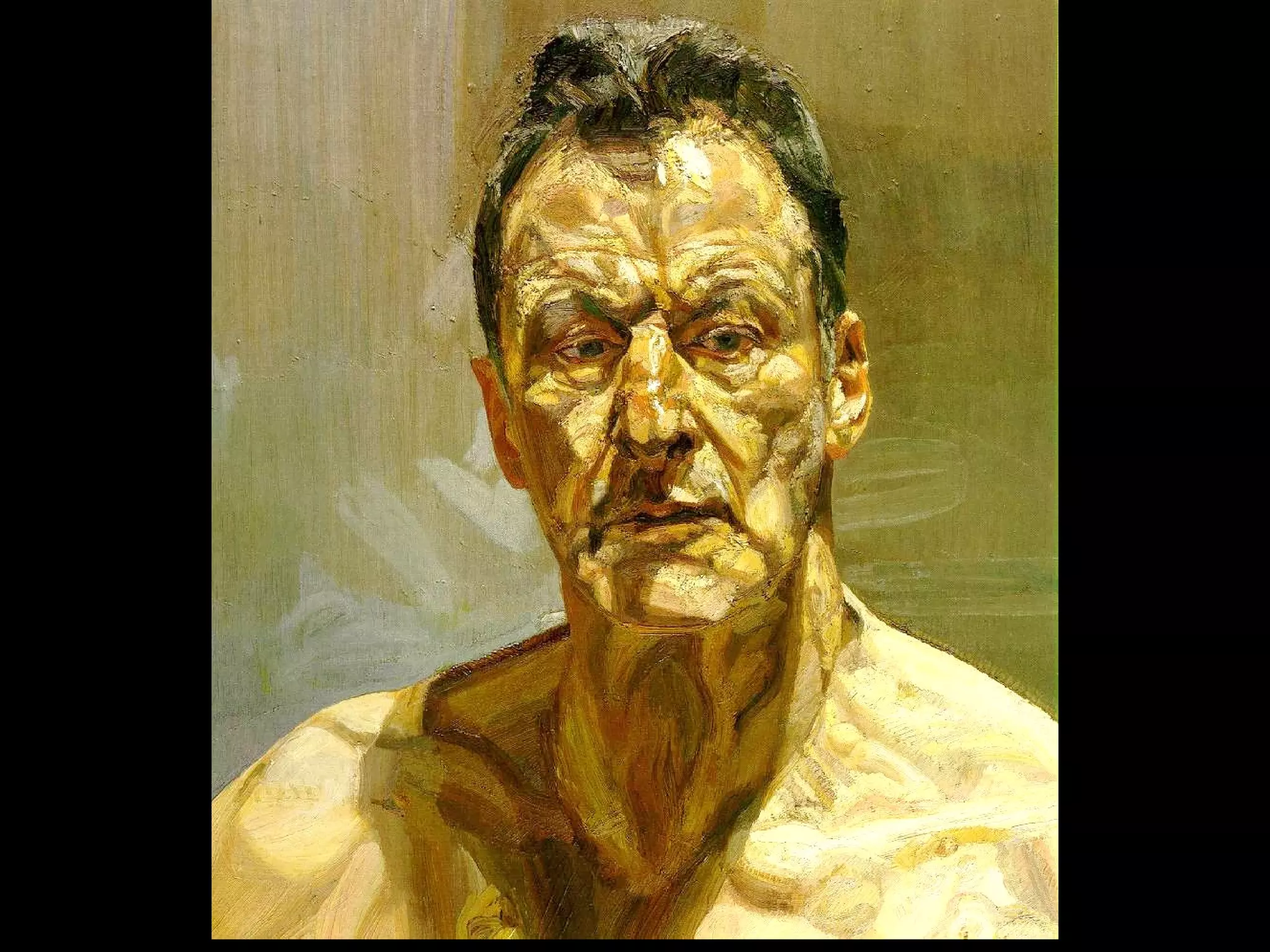
Lucian Freud
Great Britain (1922-2011)
Reflection (self portrait) 1985
Characterized as "harsh, visceral assessments," I'm
challenged by the ugly beauty and honesty of his work.
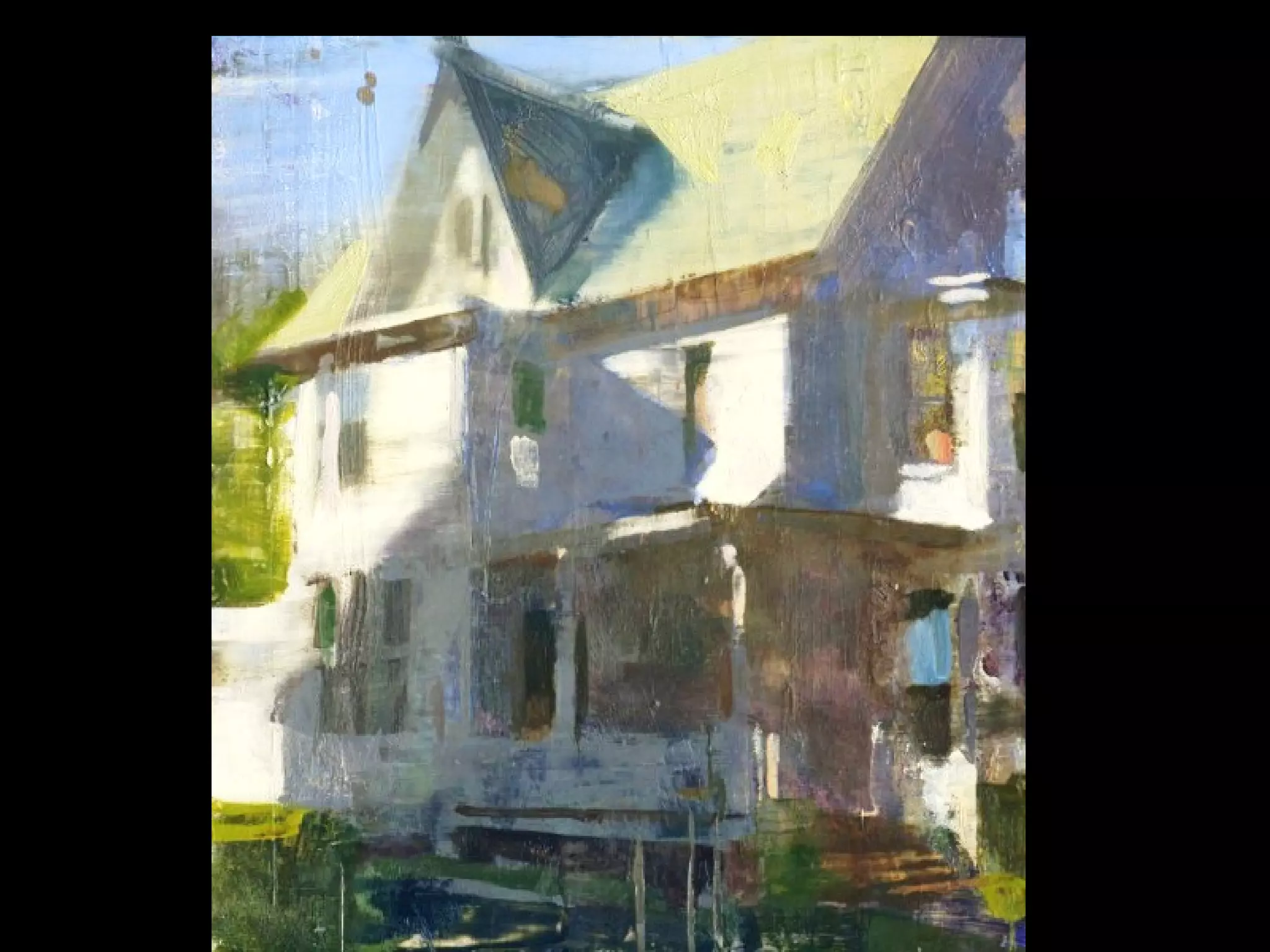
Jon Redmond
American (1962- )
Evening in West Chester (Pennsylvania)
10"x10" oil on board
Jon Redmond is called a "poet of light and shadow." He
pleases me with his Hopper-esque imagery, finding
beauty in everyday life.
He paints on small wooden panels - on site, wet-in-wet
(ala prima style).
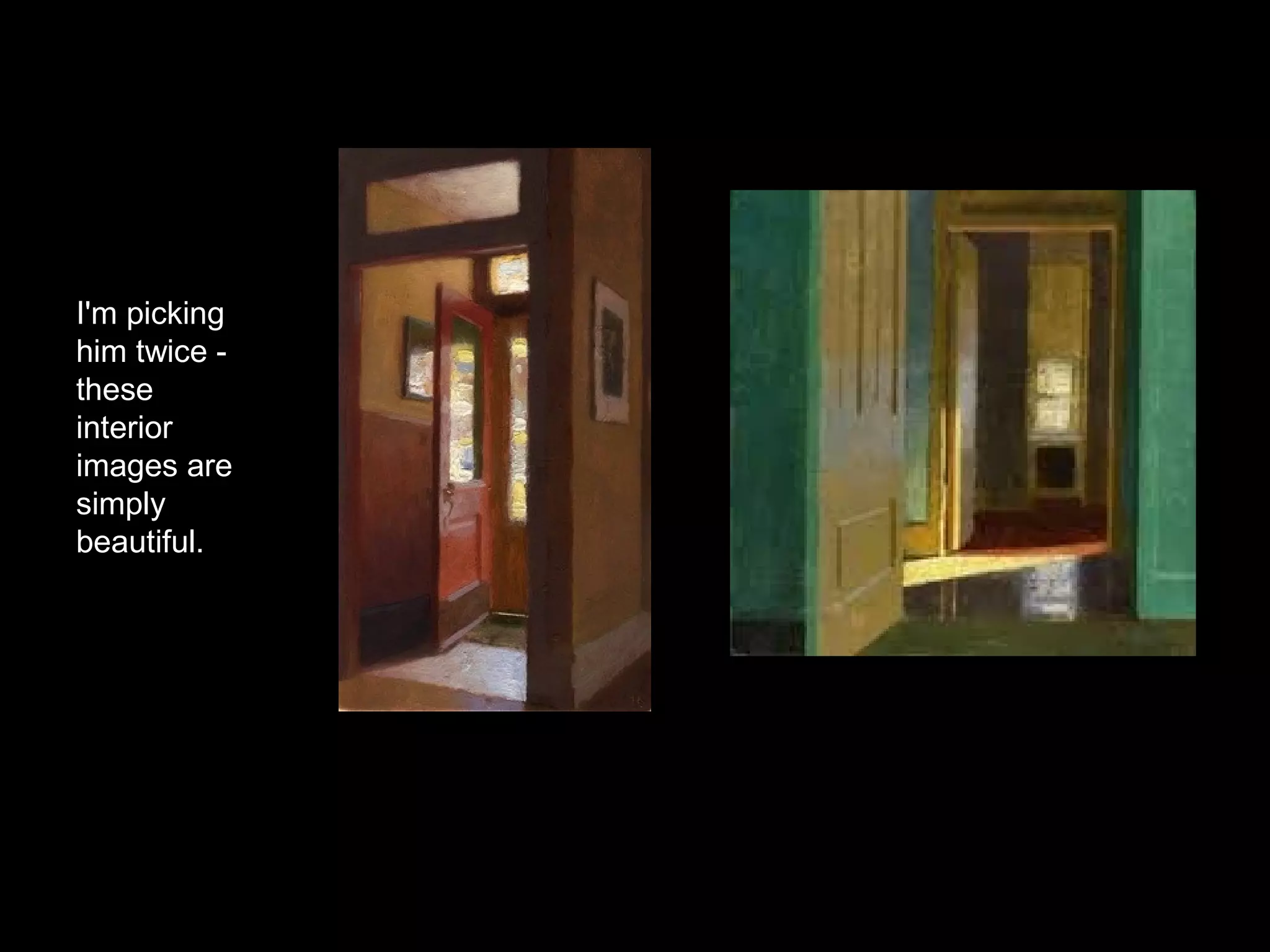
I'm picking
him twice -
these
interior
images are
simply
beautiful.
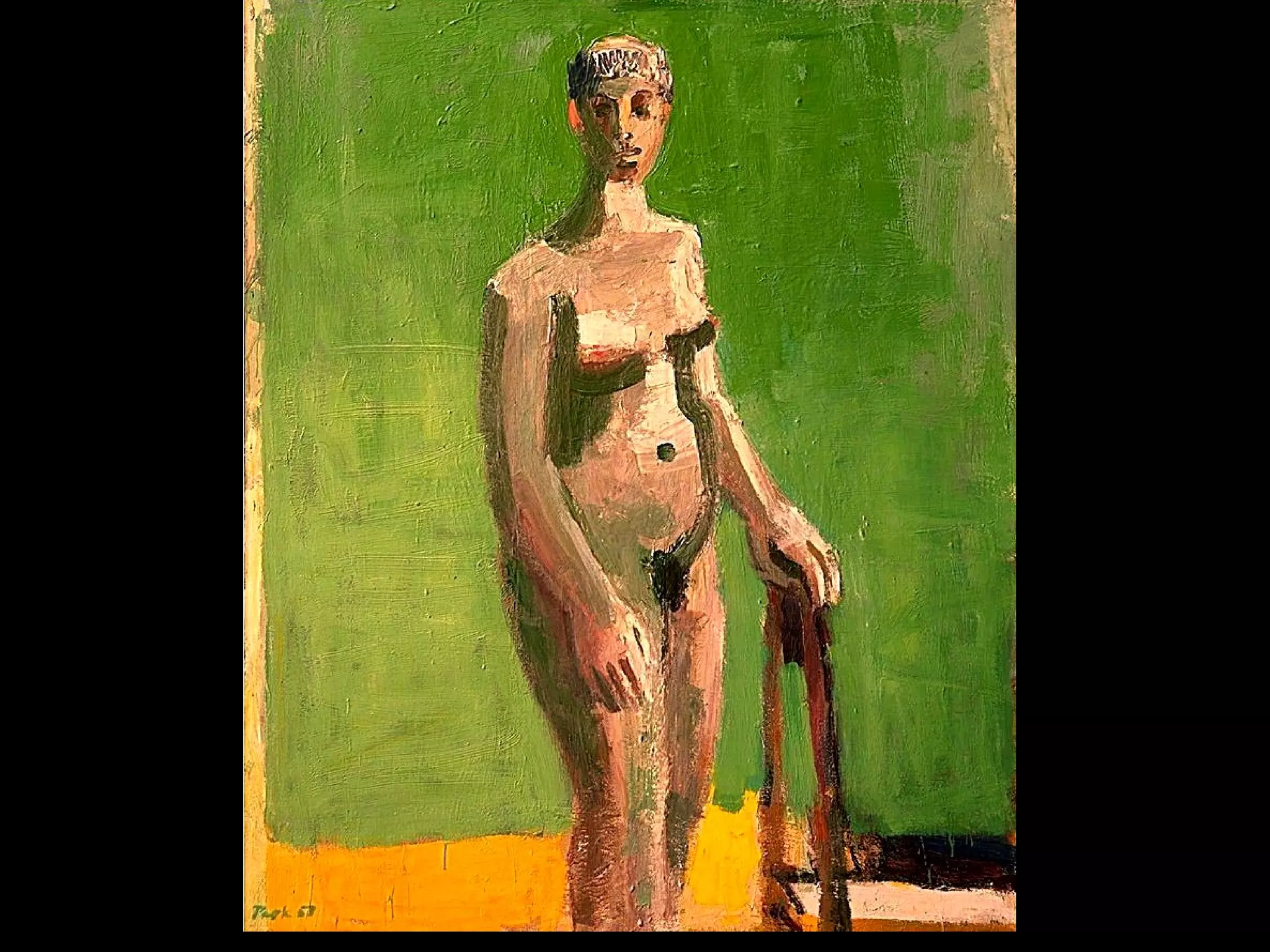
David Park
United States (1911-1960)
Nude Green 1957
68"x56" oil
I admire the freedom, simplicity and unexpected palette of his work.
A post-WW II abstract expressionist who returned to painting
recognizable subjects (along w/buddy Diebenkorn) - his portraits
were painted from memory.
Kathy Wilson
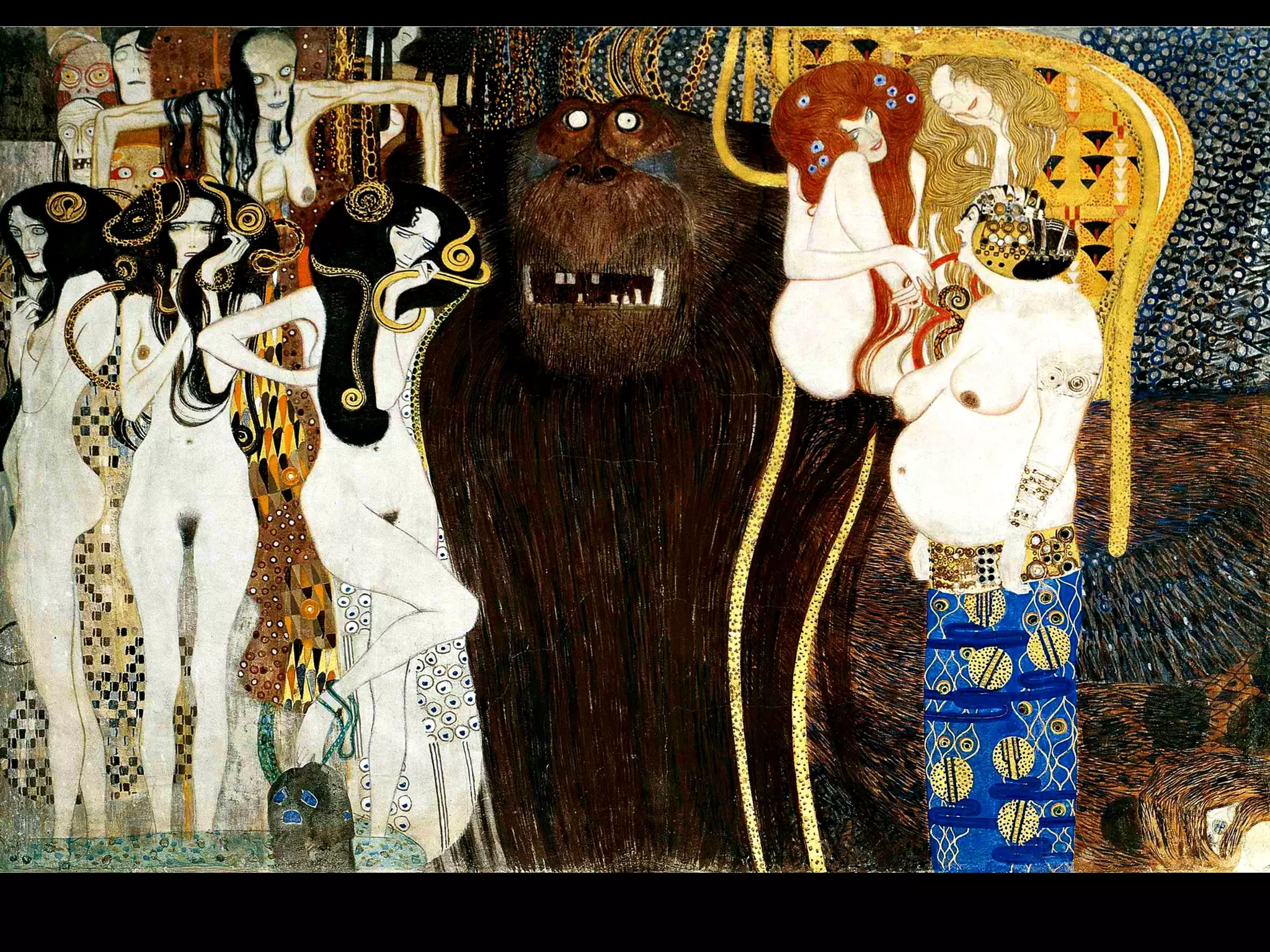
Gustav Klimt
Austria (1862-1918)
Beethoven Frieze (detail) 1901
I had never seen this painting. The imagery, in particular that
demonic character in the middle, seemed such a contrast to the
stunning golden beauty of Klimt’s Kiss, which powerfully holds
the world’s gaze along with my own.
Klimt’s painting portrays for me what I sense is true. Beauty is
impossible if one cuts loose the connection with the nether
world, with its expressions of the demonic/daimonic. Without
access to this world, the possibility of “transforming the tragedy
of existence into metaphysical beauty” is slight.
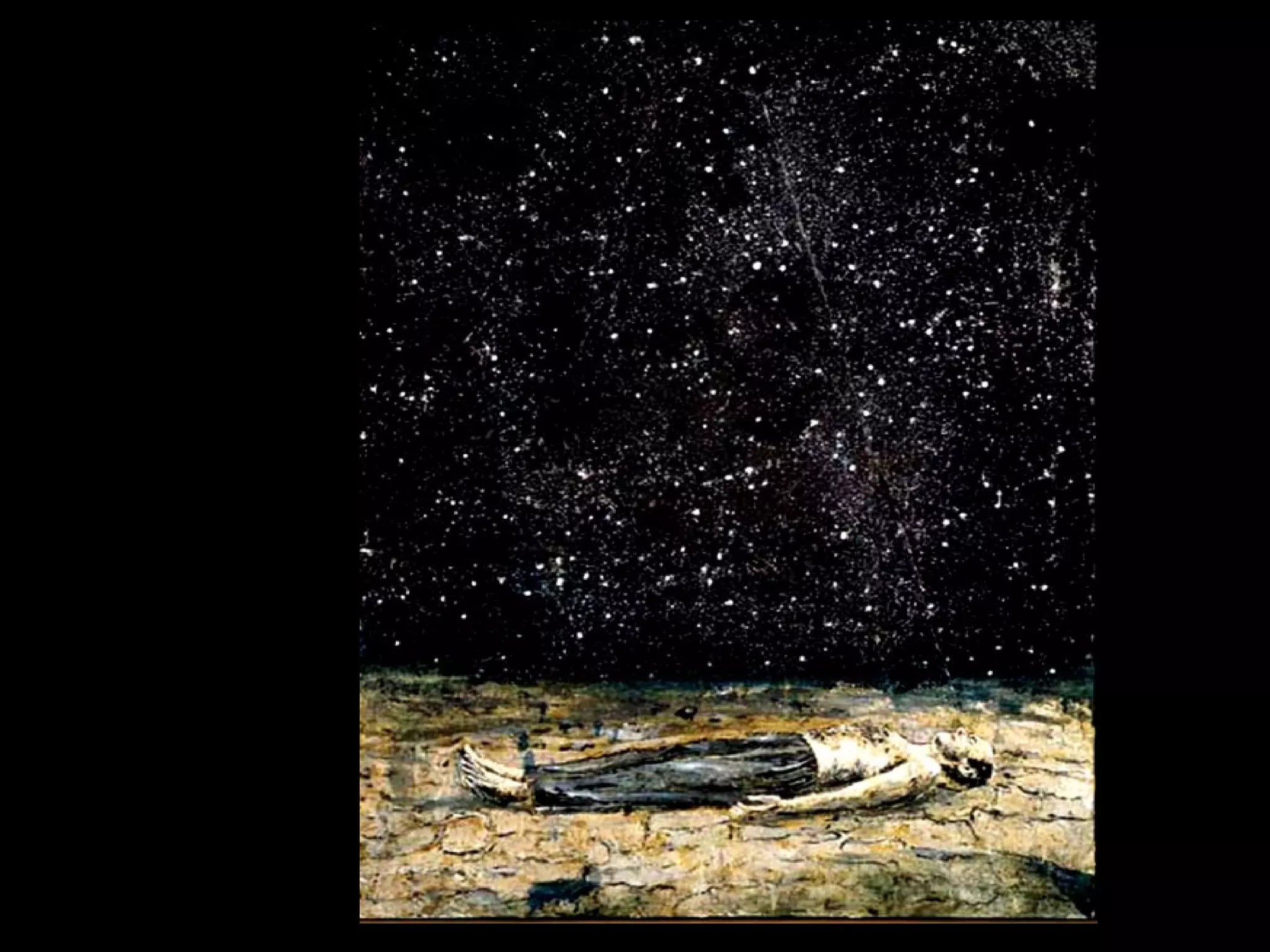
Anselm Kiefer
Germany (1945- )
All stories of heaven begin on earth
Desire is a way of dwelling with the earth, as the etymology (word-
story) of “desire” shows.
The word “desire” is related to con-siderae, meaning “a careful
observation of the stars.”
To gaze upward gives simultaneous consideration to the ground on
which we stand and the constellations passing overhead bringing the
experience of time to earth.
De-sire means “away from the stars” and so establishes desire as the
return to earth taken up as a reflection through the heavens.
Desire is our place between heaven and earth.
Raquel Kalil
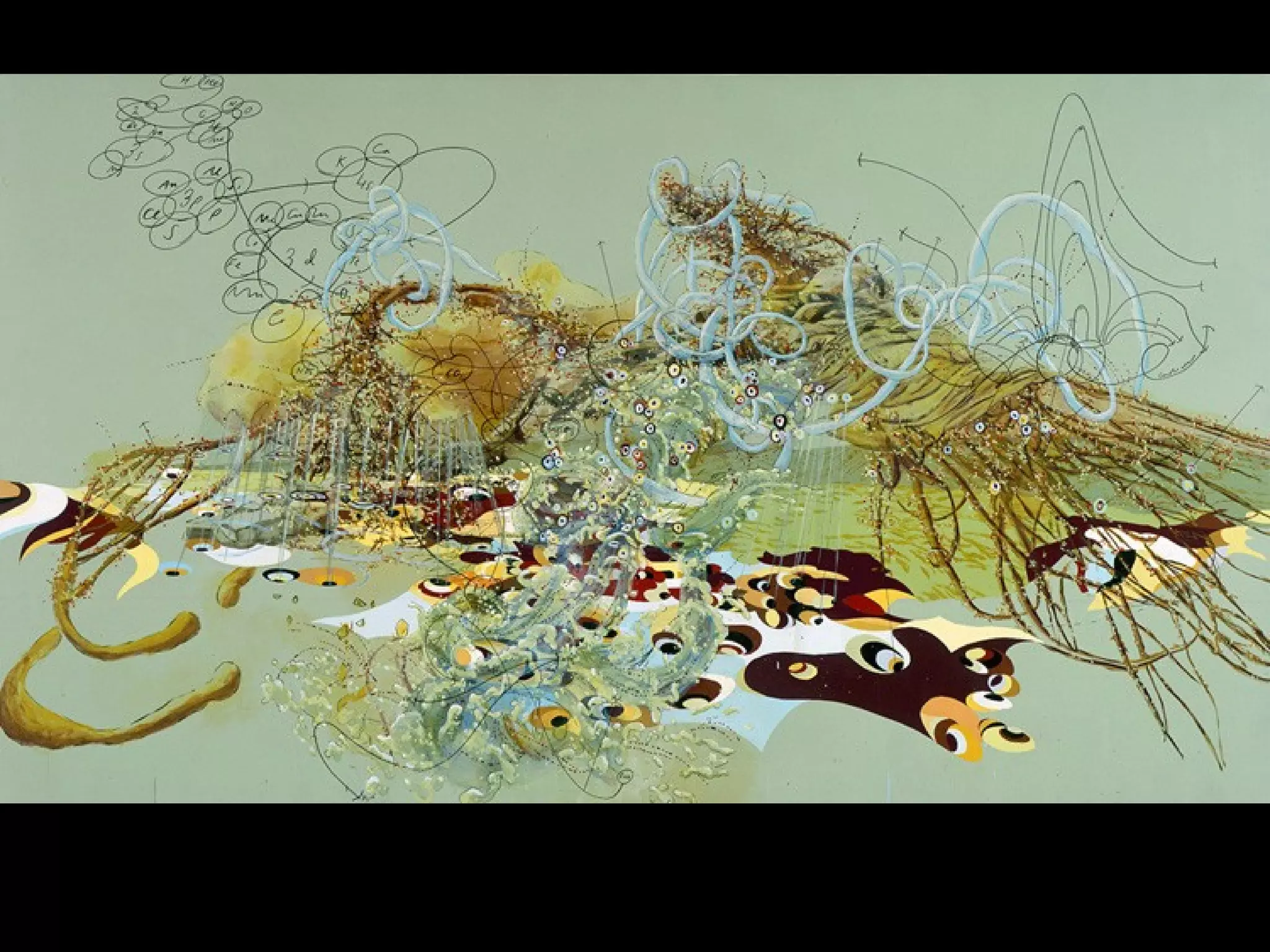
Julie Mehretu
Ethiopia/United States (1970 - )
Auguries, 2010
Mark making becomes a tectonic system for space making:
heavy marks & thin lines work as layers to envelop a kinetic
composition, and a sense of flow in space.
The composition is like controlled chaos- a mélange of various
energies overlaying each other creating a complex kaleidoscope
of architecture, space and time.
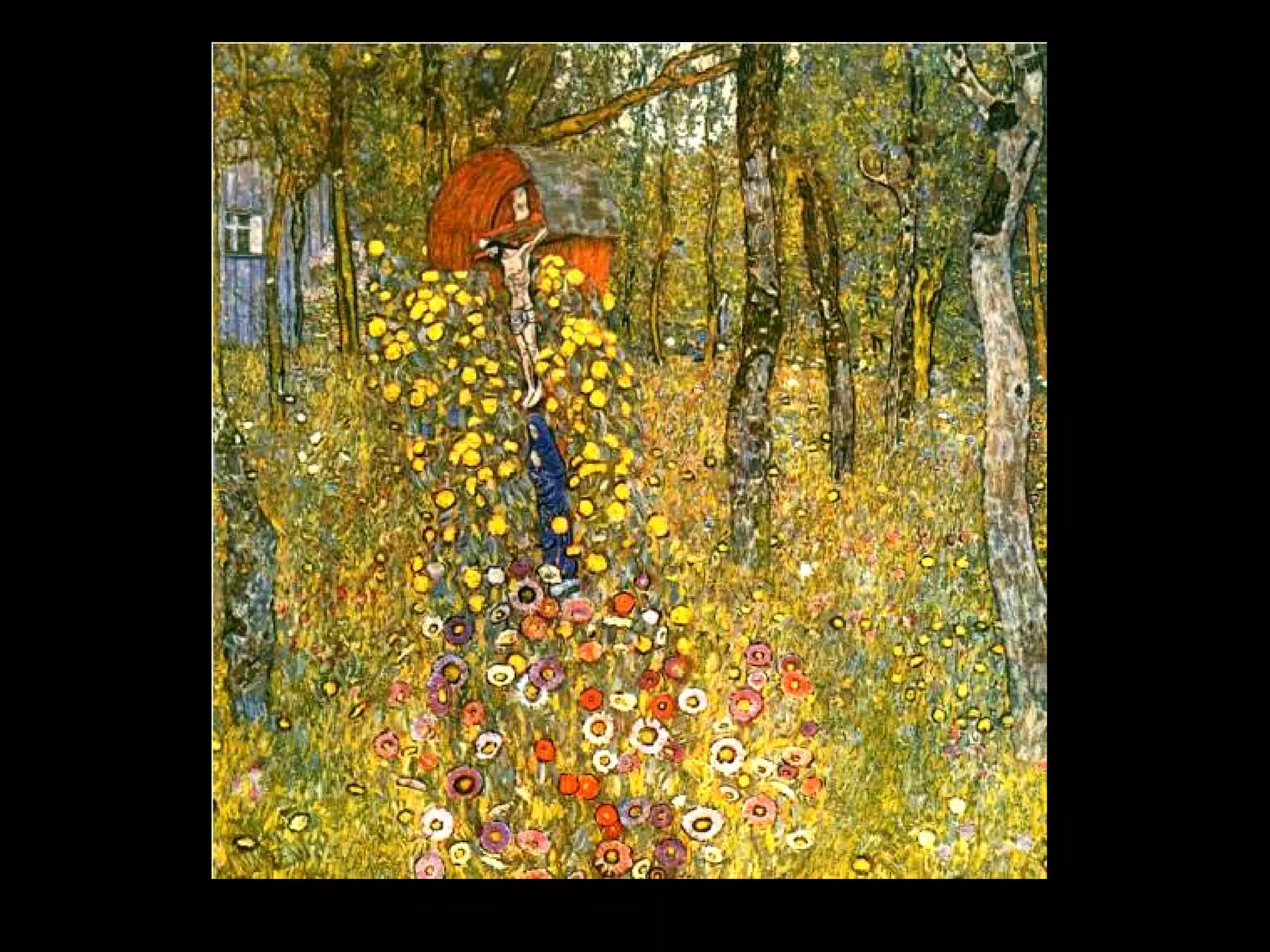
Gustav Klimt
Austria (1862-1918)
Barn with Crucifix, 1912
Space is defined by a cacophony of color.
The colors’ texture wistfully hints of a sacred artifact who does not
fight for light or attention, but rather accepts the embrace of
nature while still peaking through.
As if to say, "I'm still here, but not for long, you might find me in
another time..."
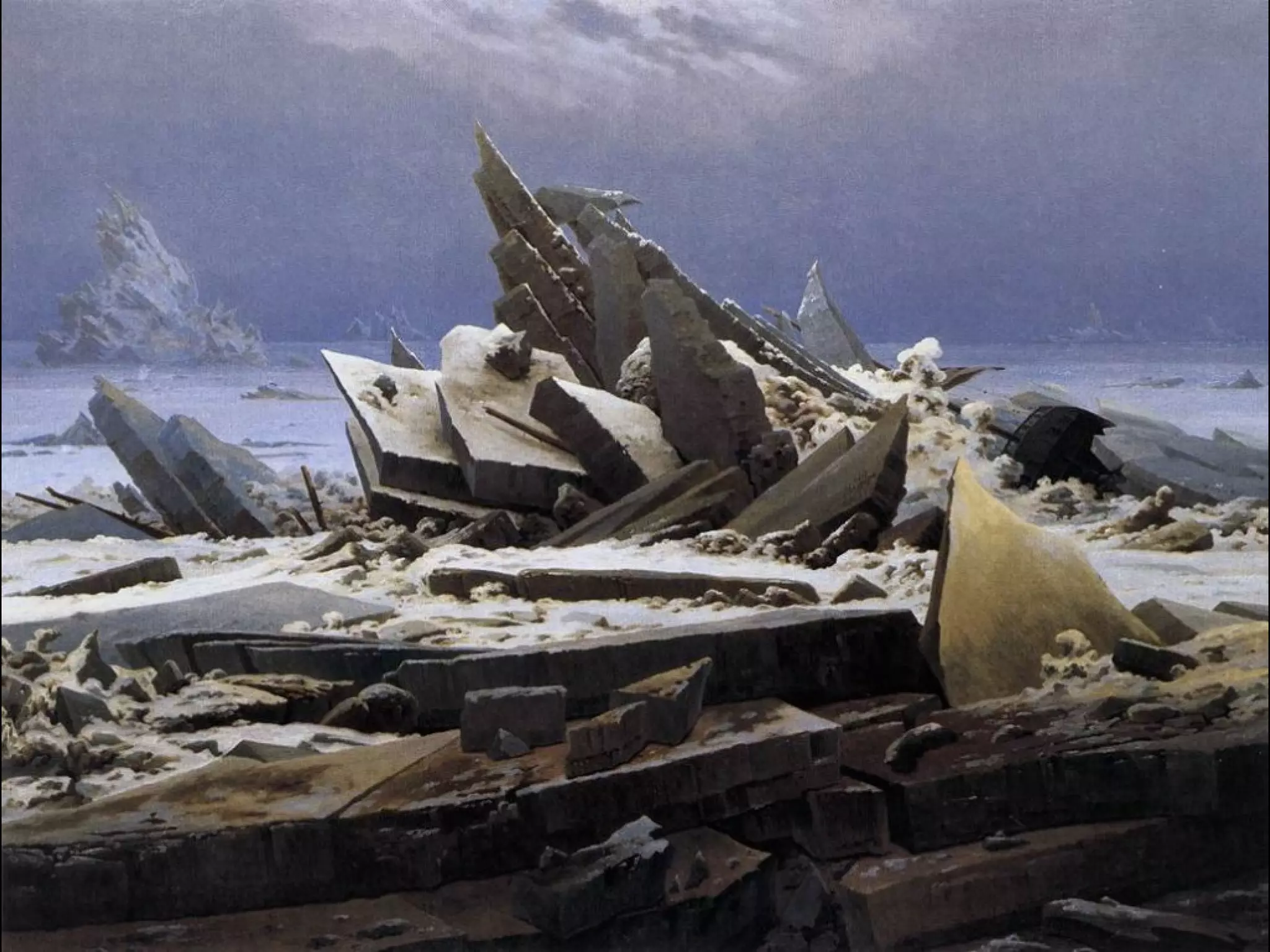
Caspar David Friedrich
Germany (1774-1840)
Sea of Ice/the Wreck of Hope, 1824
A dynamic relationship between architecture and landscape,
man versus nature.
Of fearsome monumentality, the triangular composition
displays no sign of life - only the aftermath of a shipwreck
which dramatically died into the ice.
Matthew Ritchie
United States, British decent (1964-)
Great Life, 2002
Pulling from a variety of sources, the artist yields a
new universe before us: weaving mythology, religion,
physics, linguistics, biology and architecture, the
painting integrates, assimilates and then proliferates
new forms over old ones.
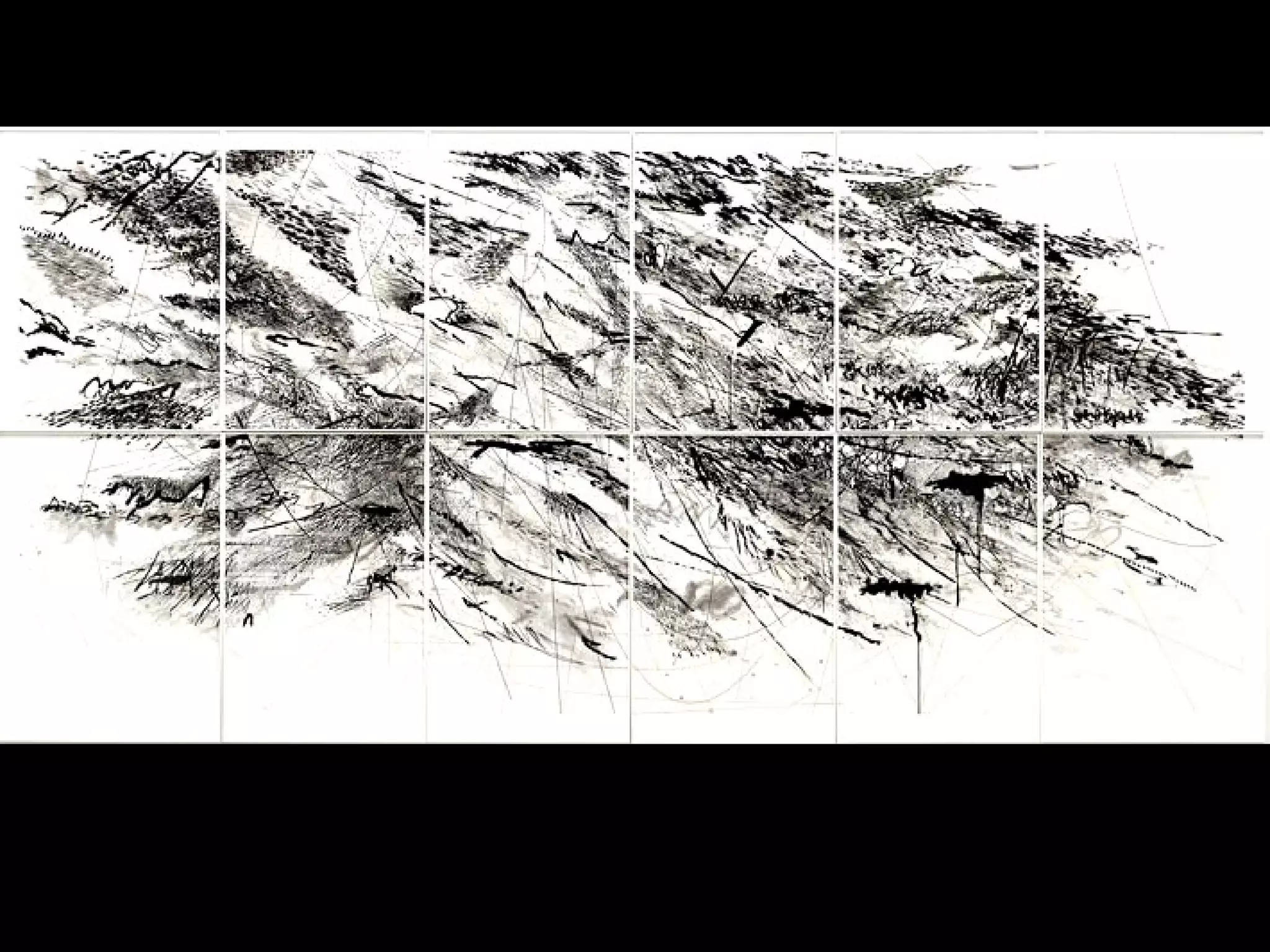
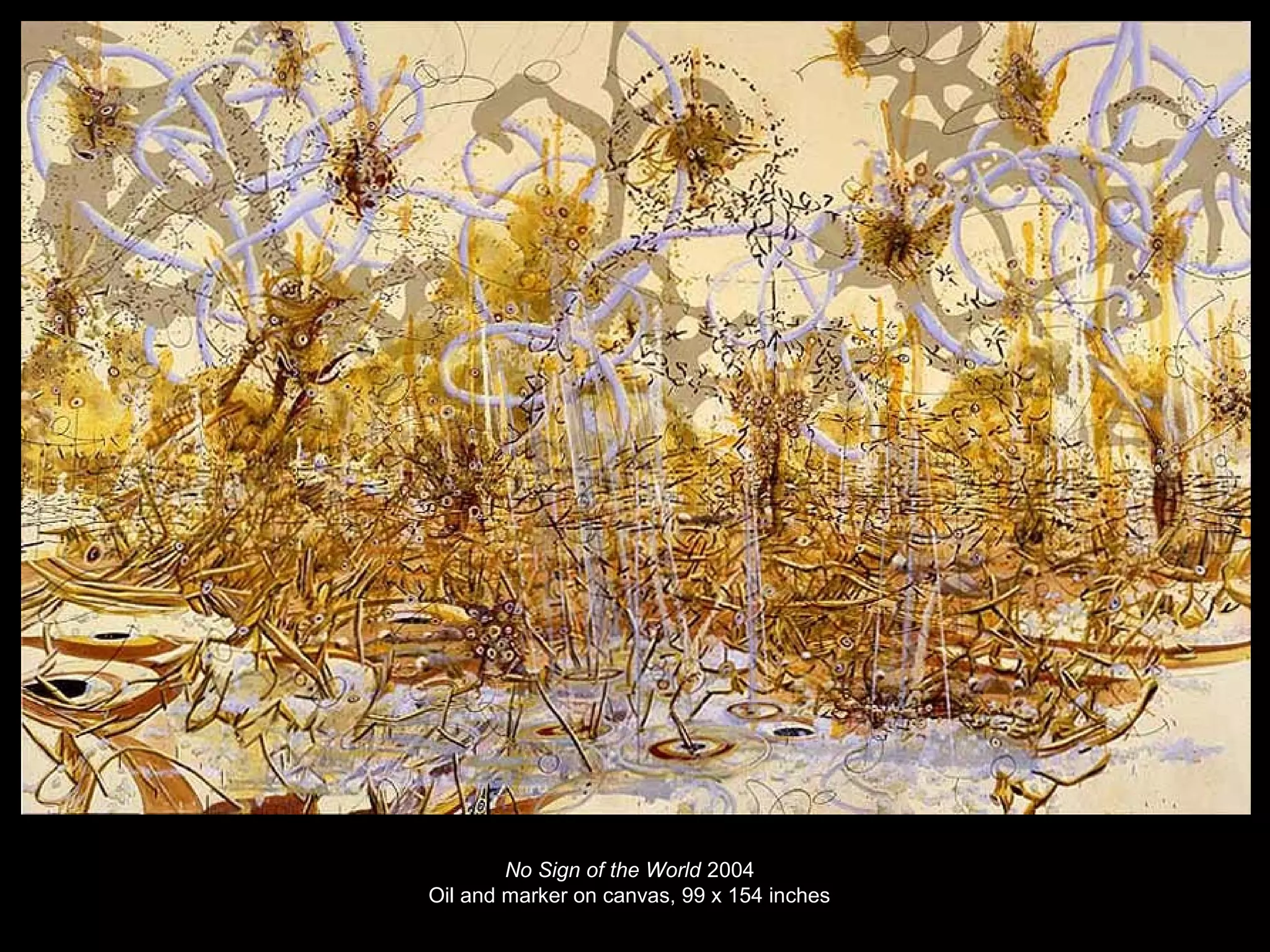
No Sign of the World 2004
Oil and marker on canvas, 99 x 154 inches
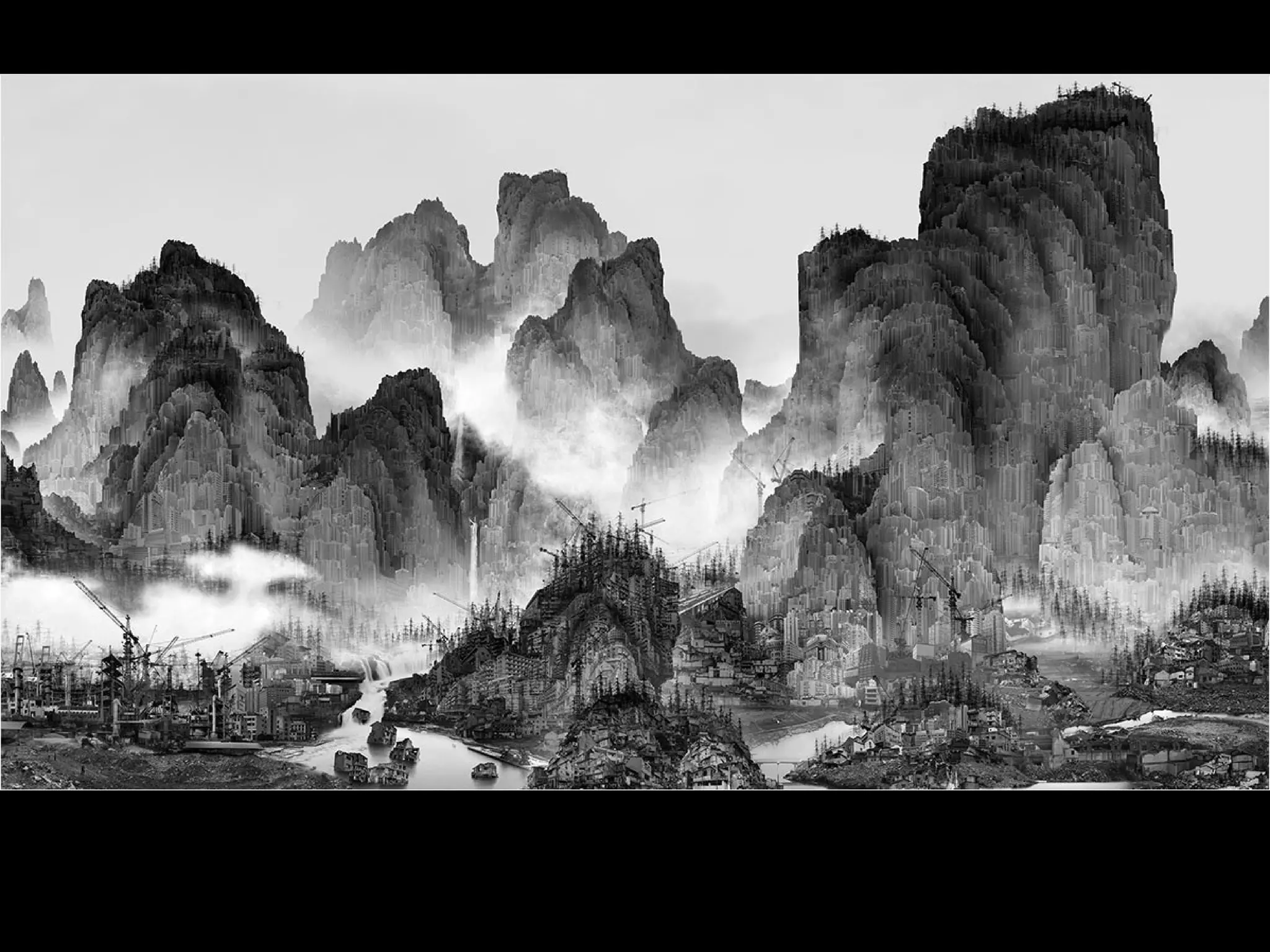
Yang Yongliang
China (1980 - )
Artificial Wonderland, 2010
Intricate Chinese inspired landscapes actually render modern
cityscapes with a hint of dystopia and a dash of apocalypse.
What seems beautiful from afar transforms upon attention
to detail.
New techniques playing with old art forms.
Paul Asadov
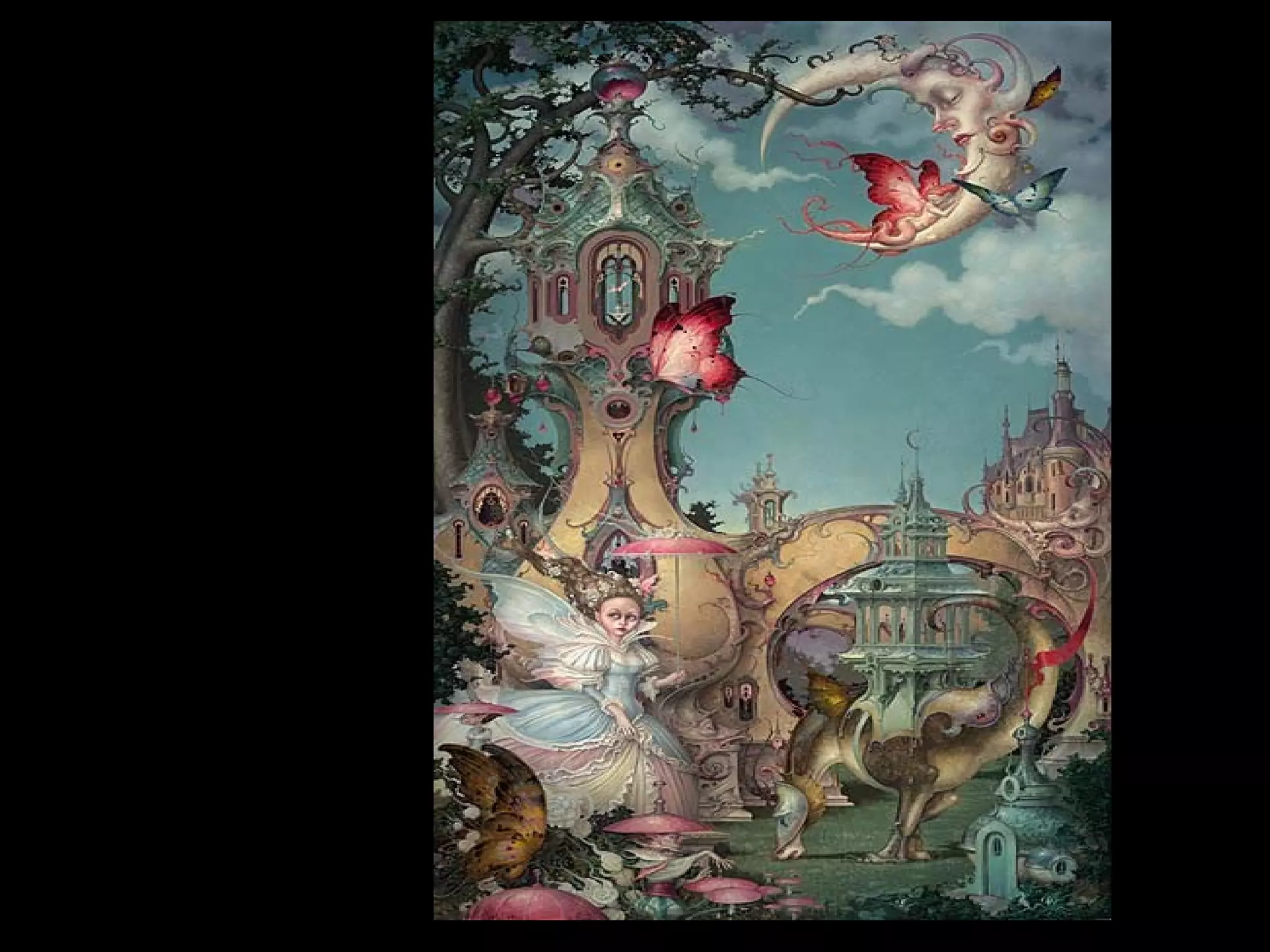
Daniel Merriam
United States (1963- )
Empty Kingdom
Merriam is a highly regarded contemporary surrealist and
is best known for his dry brush technique and gloriously
imaginative style.
One of seven children in a creative, artistic family, he
taught himself to paint at a very young age and used his
art as a method of reflective play throughout his childhood.
Salvador Dali
Spain (Catalonia) (1904-1989)
Dali’s painterly skills are often attributed to the influence
of Renaissance masters.
His expansive artistic repertoire included film, sculpture,
and photography, in collaboration with a range of artists
in a variety of media.
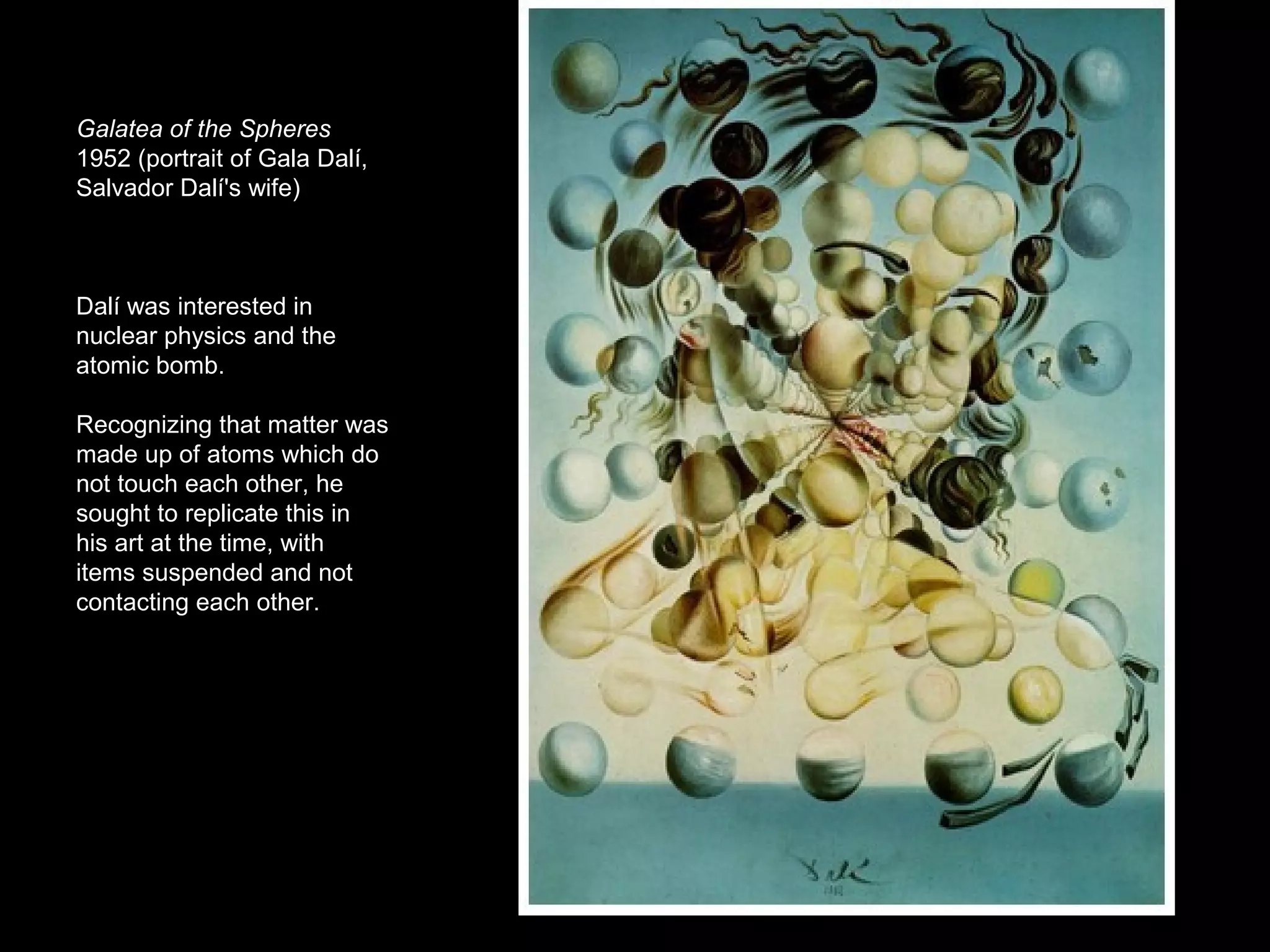
Galatea of the Spheres
1952 (portrait of Gala Dalí,
Salvador Dalí's wife)
Dalí was interested in
nuclear physics and the
atomic bomb.
Recognizing that matter was
made up of atoms which do
not touch each other, he
sought to replicate this in
his art at the time, with
items suspended and not
contacting each other.
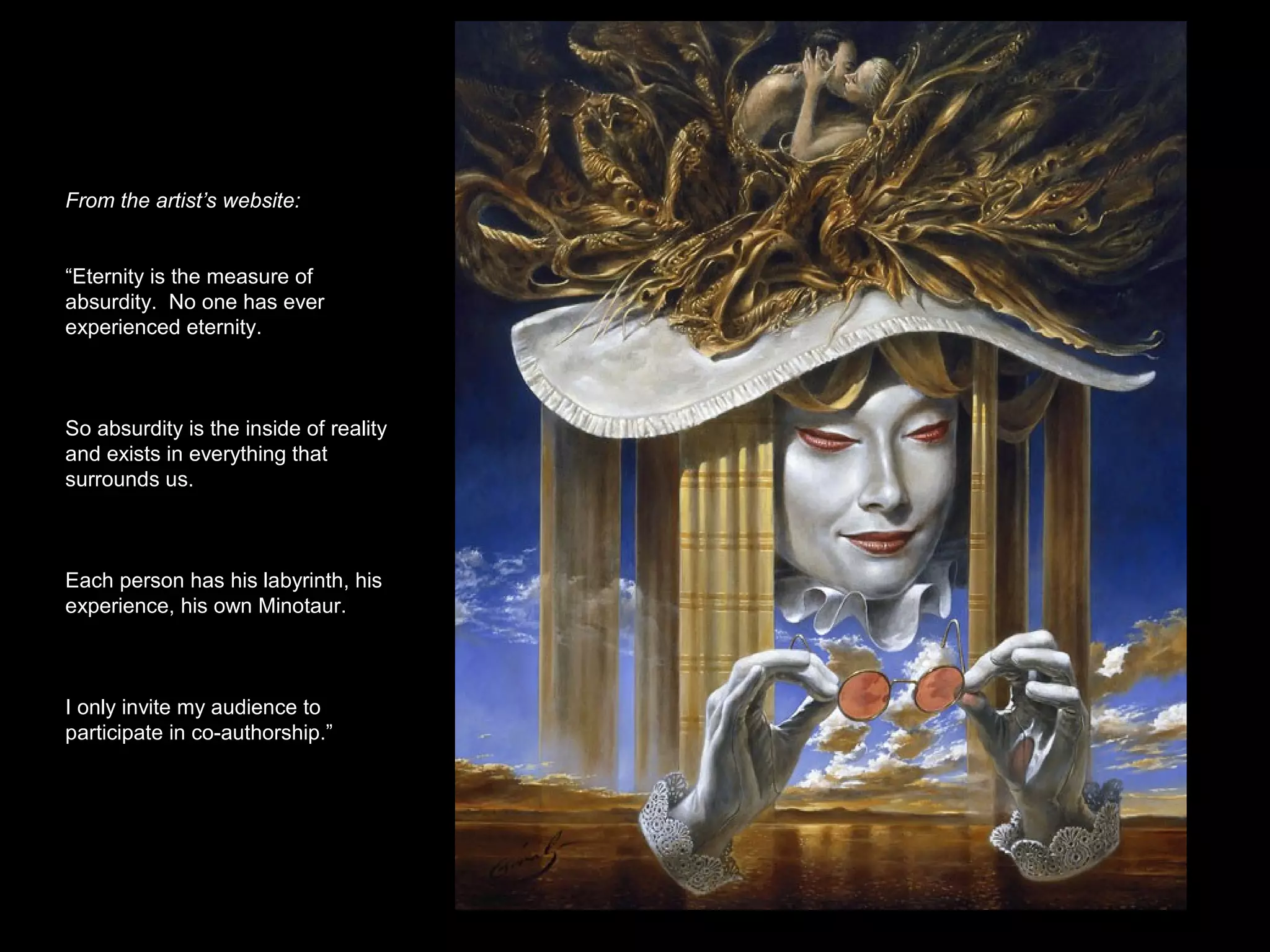
Michael Cheval
Russia (1966 - )
Cheval was born in 1966 in Kotelnikovo, a small town in southern
Russia.
Growing up in an artistic family, his love of drawing was
encouraged from early childhood by his father, Mikhail
Khokhlachev, a self-taught artist and by his grandfather, Yuri
Lipov, a professional artist and sculptor. His ability developed
quickly and by three years old, he could already draw complex
compositions.
From the artist’s website:
“Eternity is the measure of
absurdity. No one has ever
experienced eternity.
So absurdity is the inside of reality
and exists in everything that
surrounds us.
Each person has his labyrinth, his
experience, his own Minotaur.
I only invite my audience to
participate in co-authorship.”
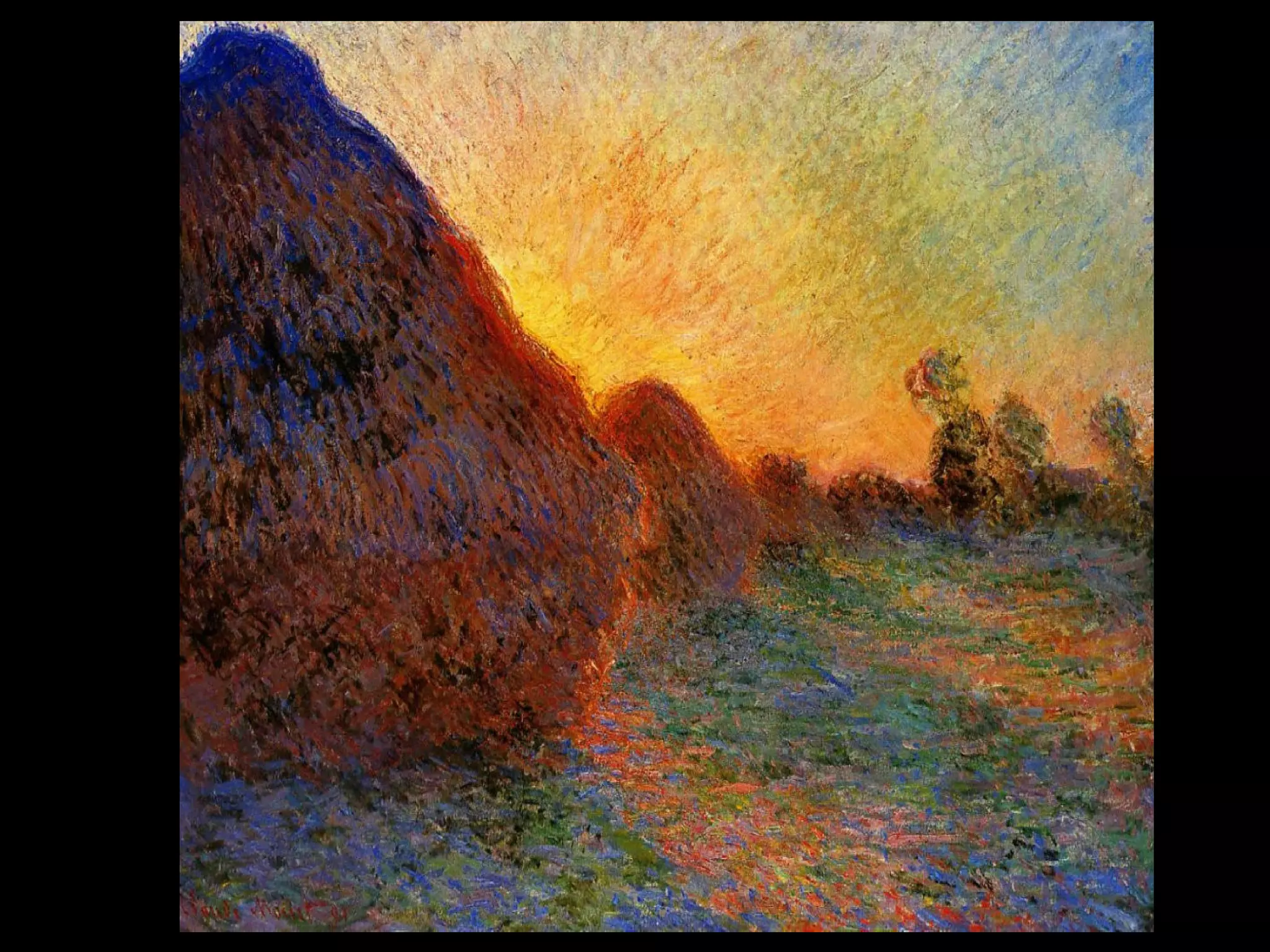
Claude Monet
France (1840-1926)
Monet was a founder of French Impressionist painting.
The term "Impressionism" is derived from the title of his
painting Impression, soleil levant (Impression, Sunrise),
which was exhibited in 1874 in the first of the independent
exhibitions mounted by Monet and his associates as an
alternative to the Salon de Paris.
Leonardo di Vinci
Italy (1452-1519)
Leonardo was an Italian Renaissance polymath: painter,
sculptor, architect, musician, mathematician, engineer,
inventor, anatomist, geologist, cartographer, botanist,
and writer.
According to art historian Helen Gardner, the scope and
depth of his interests were without precedent and "his
mind and personality seem to us superhuman, the man
himself mysterious and remote".
Marco Rosci states that while there is much speculation
about Leonardo, his vision of the world is essentially
logical rather than mysterious, and that the empirical
methods he employed were unusual for his time.
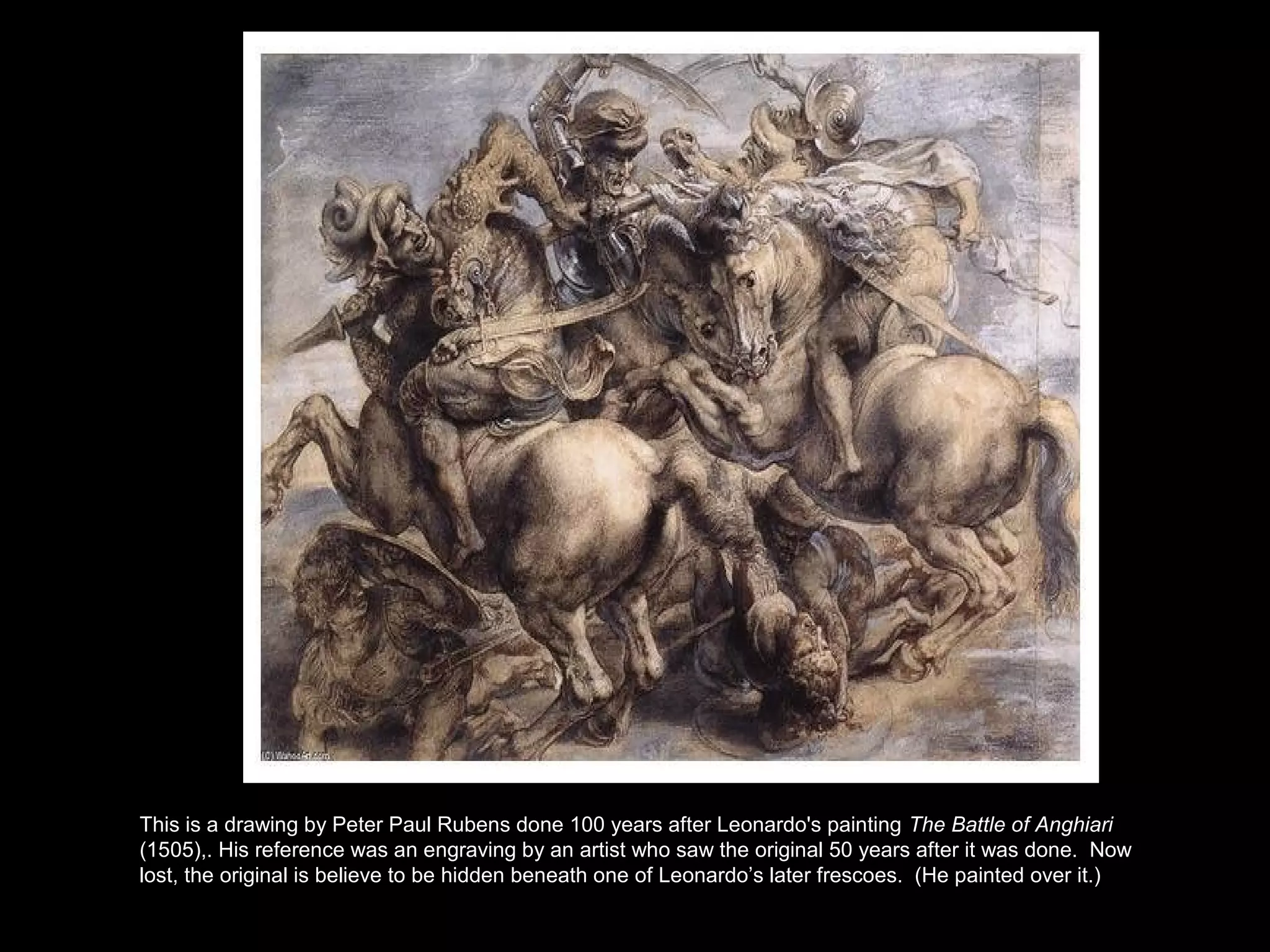
This is a drawing by Peter Paul Rubens done 100 years after Leonardo's painting The Battle of Anghiari
(1505),. His reference was an engraving by an artist who saw the original 50 years after it was done. Now
lost, the original is believe to be hidden beneath one of Leonardo’s later frescoes. (He painted over it.)
What I learned from Leonardo’s biography
LEONARDO THE ARTIST AND THE MAN by Sege Bramly
Florence in the late 15th
century was the center of Renaissance life and enjoyed complete tolerance
for its celebrated gay community (Leonardo and Michelangelo foremost among them).
In his 20s, Leonardo was primarily known as a singer. He had movie-star looks.
The Mona Lisa influenced Raphael with its chiaroscuro-lit portrait of a woman set in an actual
landscape … and (unusual at the time!) she was painted with hands.
Leonardo’s experiments with paint chemistry in the The Last Supper didn’t hold up very well (faded
and disintegrated).
Leonardo was widely known for elaborate practical jokes.
He wrote backwards to keep his notebooks a secret from the Catholic Inquisition.
Two-thirds of his notebooks are lost (someone threw them out 50 years after his death).
Mary Fong
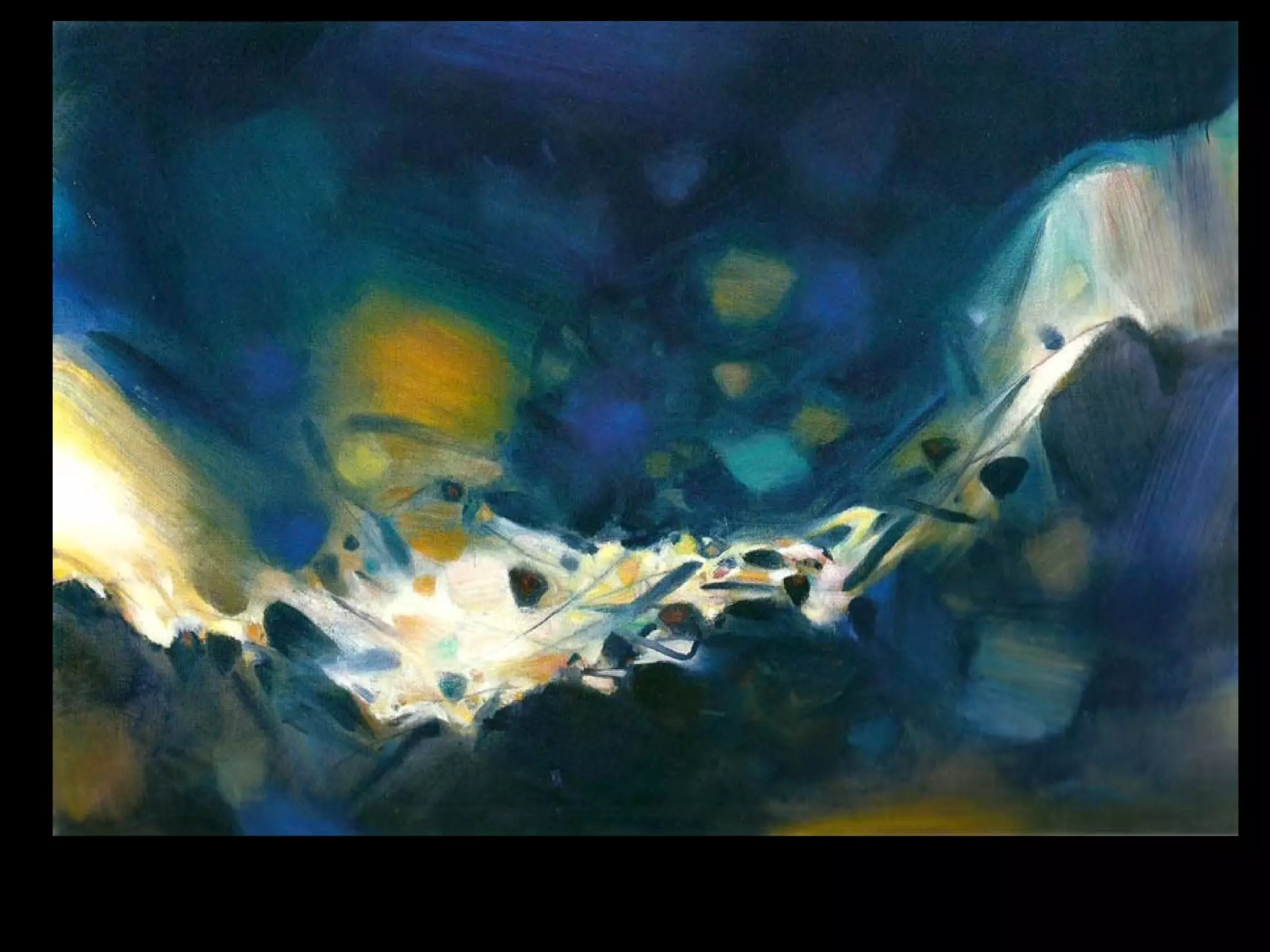
Chu Teh-Chun
China/France (1920-2014)
La vie qui anime les nuages 2004
This painting strongly shows the integration of
Chinese Calligraphy and western abstract
expression paintings.
In the painting, there is a bright path through the
darkness that creates a feeling of continuum. It’s the
East meet the West abstraction without a conflict.
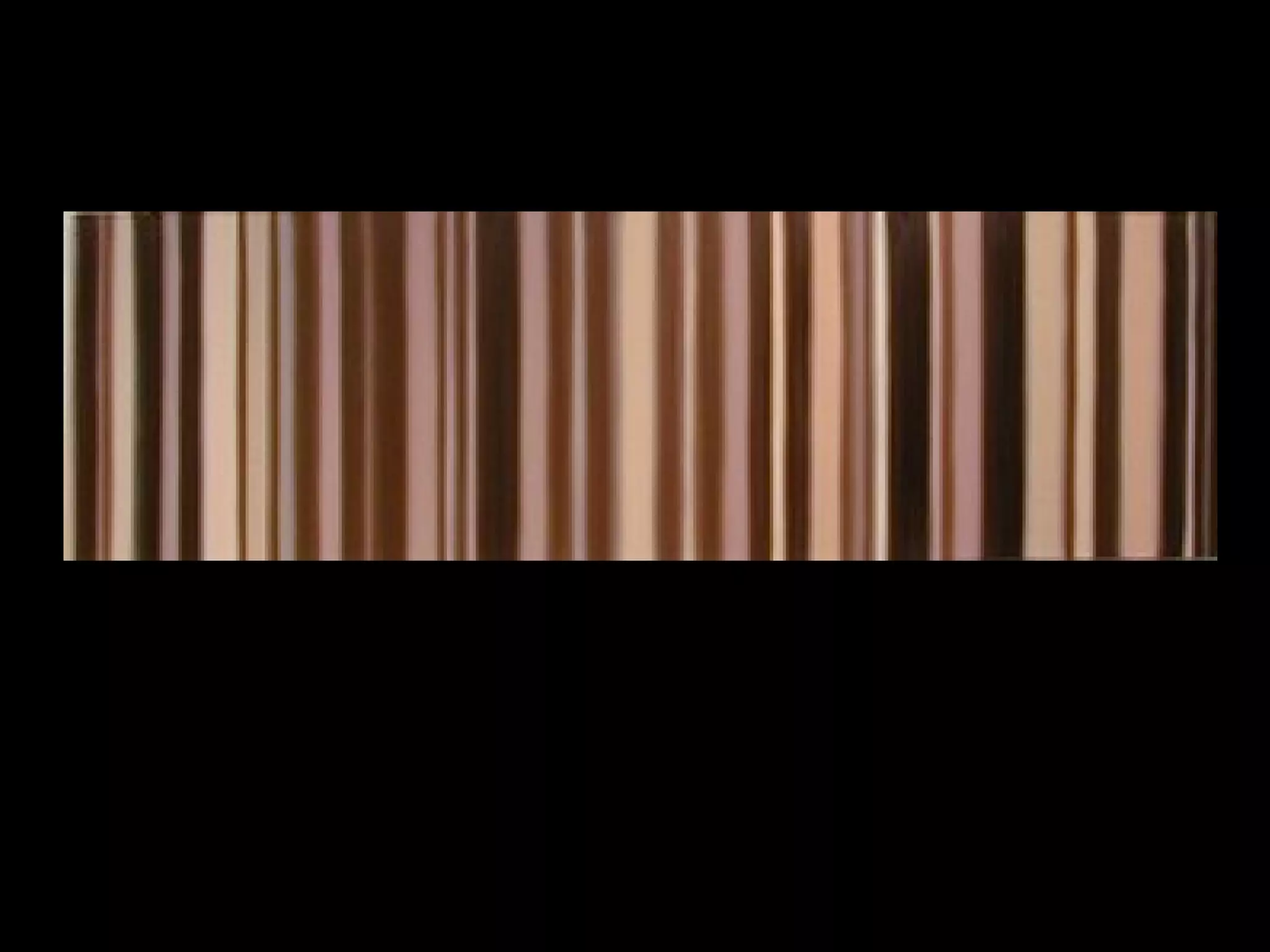
Patrick Dintino
American (1975 - )
Self-Portrait, 2000
I like his idea of creating abstract art through a scientific
process of human eyes, also called peripheral vision.
He processes the image through the relationship between
colors, light and dark, not by the shapes.
This painting is titled “Self portrait” -- his skin and hair color
are used to fill-in the bar code from his driver’s license.
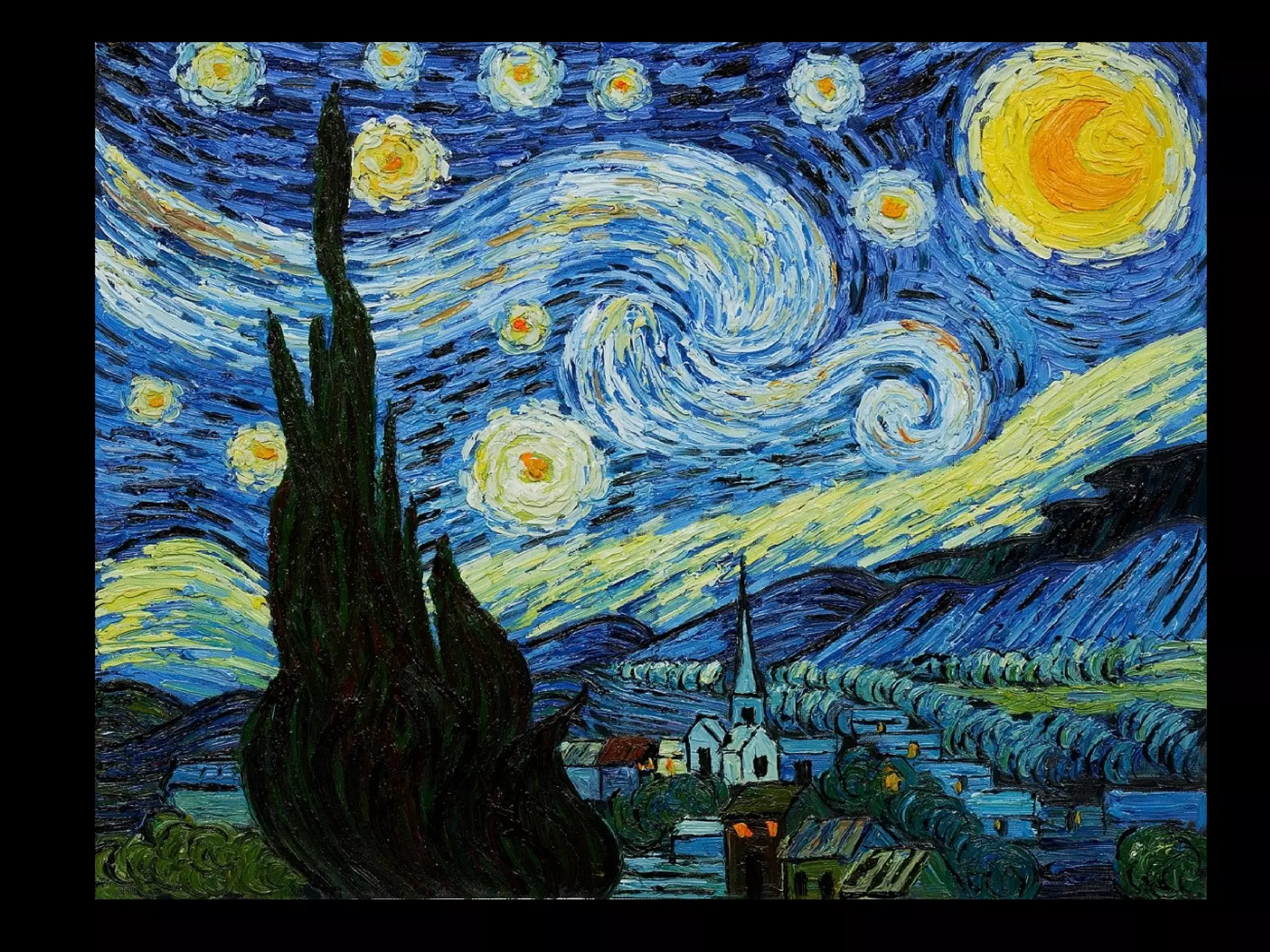
Vincent Van Gogh
Holland (1853-1890)
Starry Night, 1897
I like the intertwined drawing and painting throughout
the entire piece.
He created movements of the clouds/stars by
drawing the tractable swirl lines.
I also feel the energy driven by the big contrast of
yellows and blues.
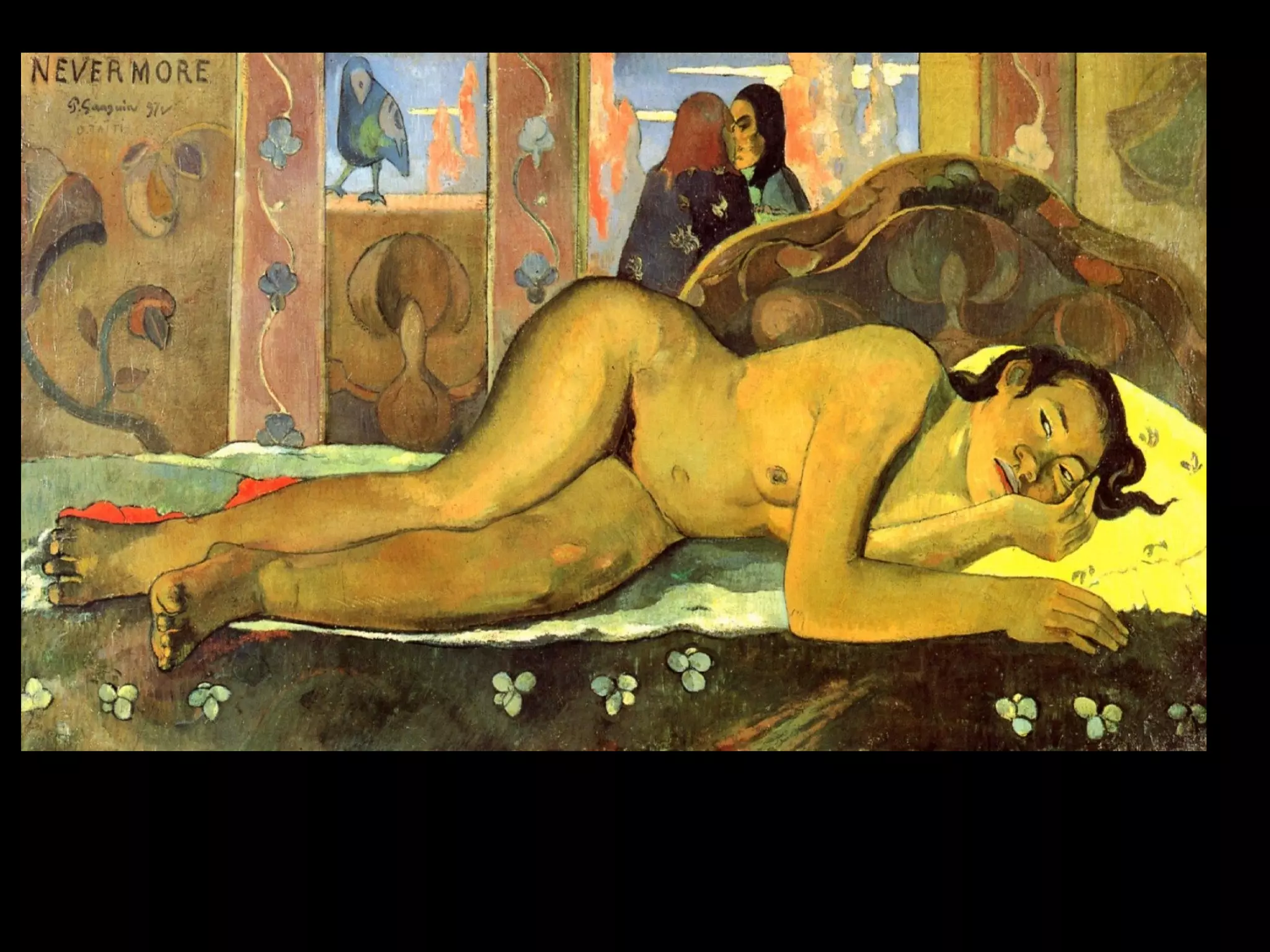
Paul Gauguin
France (1848-1903)
Nevermore, 1897
This narrative painting tells the most interesting story
through the woman’s facial expression, especially the
eyes.
They trigger my curiosity and anxiety to find out the myth
behind her.
Most of narrative paintings illustrate the subjects for
viewers to read.
But in this one, the subject herself speaks to the viewer.
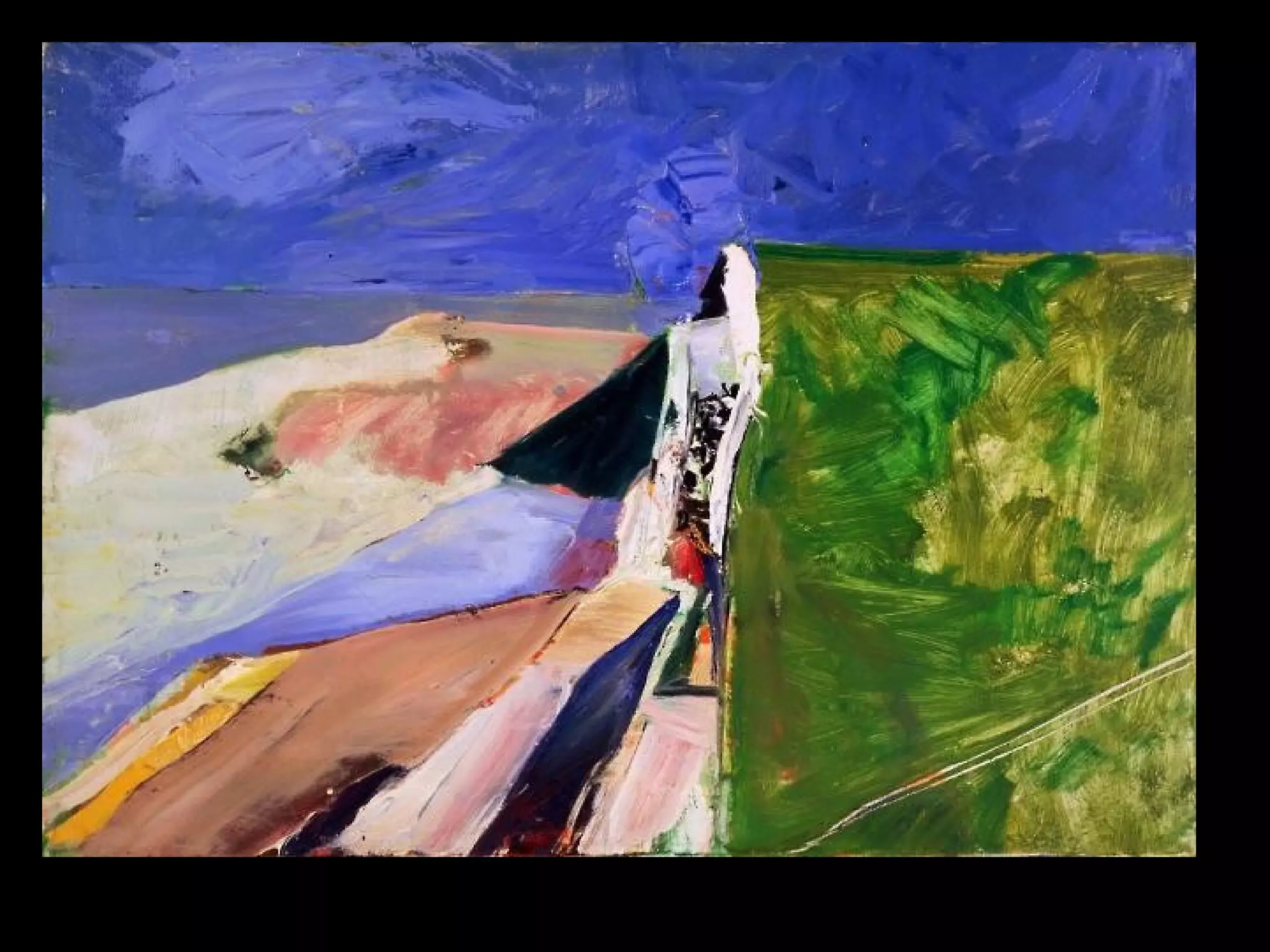
Richard Diebenkorn
United States (1922-1993)
Seawall 1957
The use of the soft colors in this landscape painting is
very emotional.
The uneven layers of paint show numerous processes
that create an unsettled feeling.
I admire his unique way of interpreting landscape.
Phyllis Hui-Sun
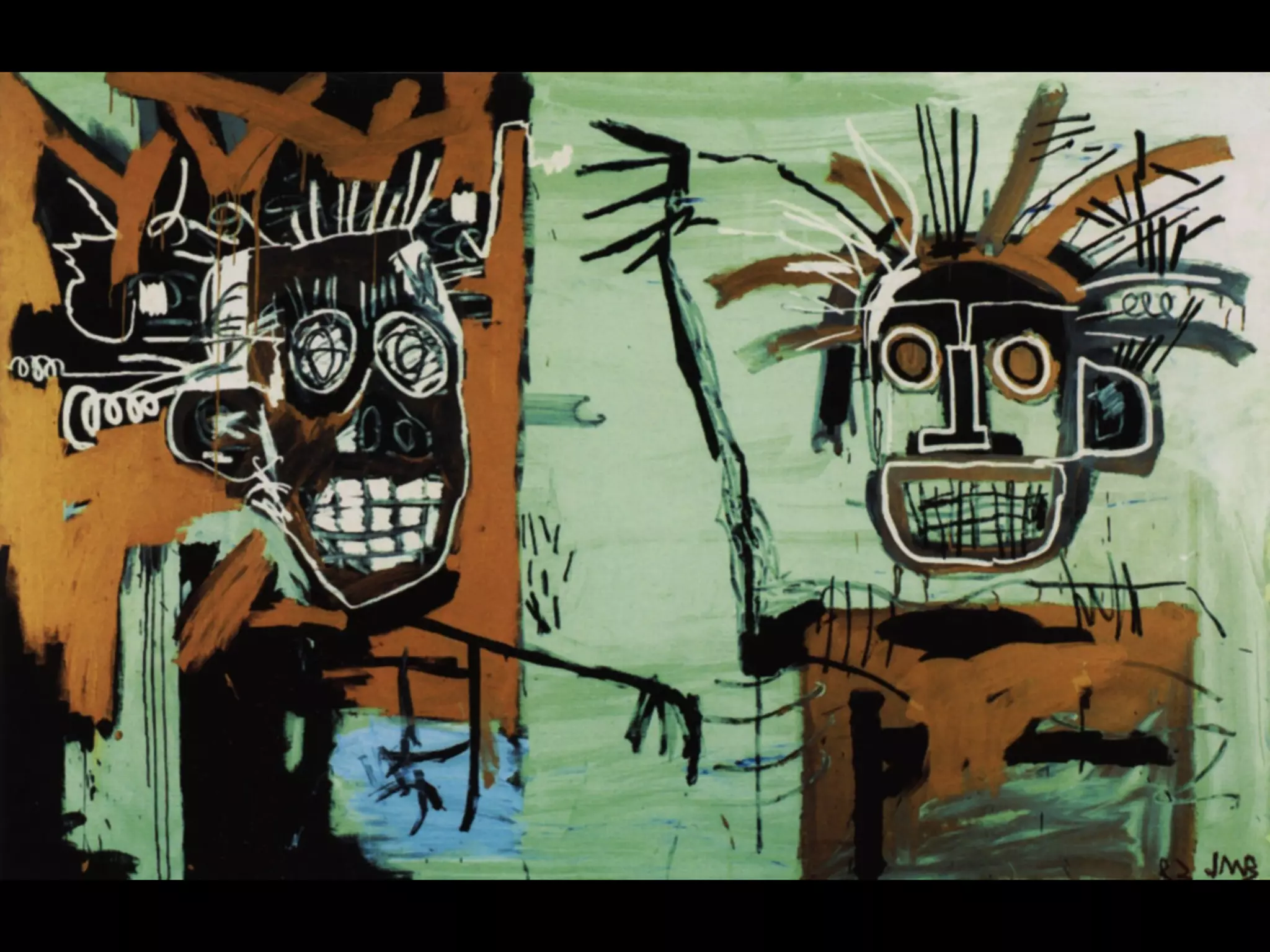
Jean Michel Basquiat
United States (1960-1988)
Two Heads on Gold
The Skull
Basquiat first achieved notoriety as an informal graffiti artist and
by the 1980s was exhibiting his Neo-expressionist and Primitivist
paintings in galleries and museums internationally.
His art focused on "suggestive dichotomies," such as wealth
versus poverty, integration versus segregation, and inner versus
outer experience – using social commentary in his paintings as a
springboard to deeper truths about the individual.
He appropriated poetry, drawing and painting, and married text
and image, abstraction and figuration, and historical information
with contemporary critique.
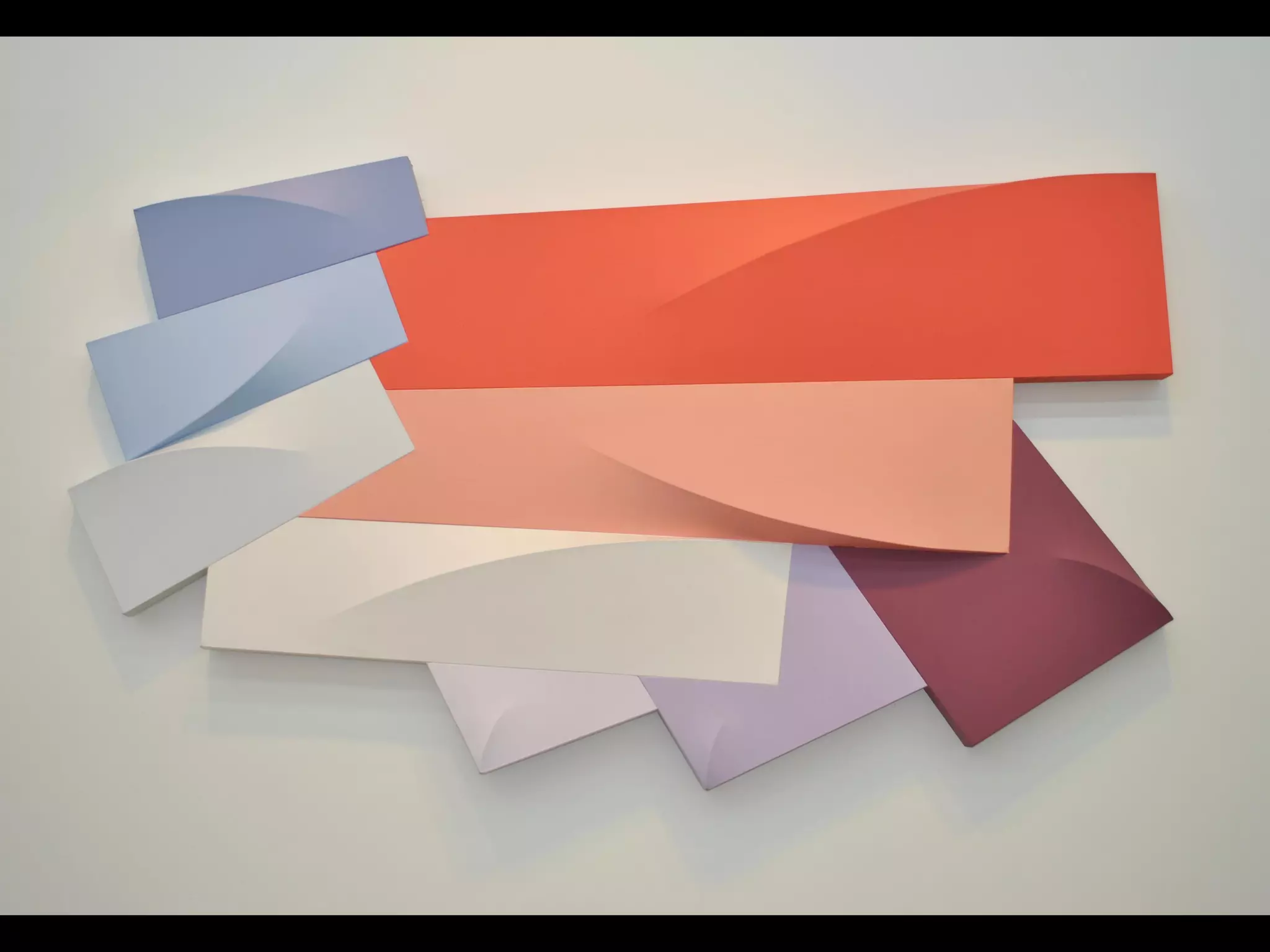
Charles Hinman
United States (1932 - )
Sea Shell
Hinman's hard-edge shaped minimal canvases are constructed with
reverse ribs which provide contours to his paintings.
By wrapping his canvases over these underpinnings, he adds a third
dimension.
Joe Reihsen
United States (1979 - )
Can You Tell Me How to Get to Newport? 2013
Acrylic on panel 11”x11”
Akhtar Husain
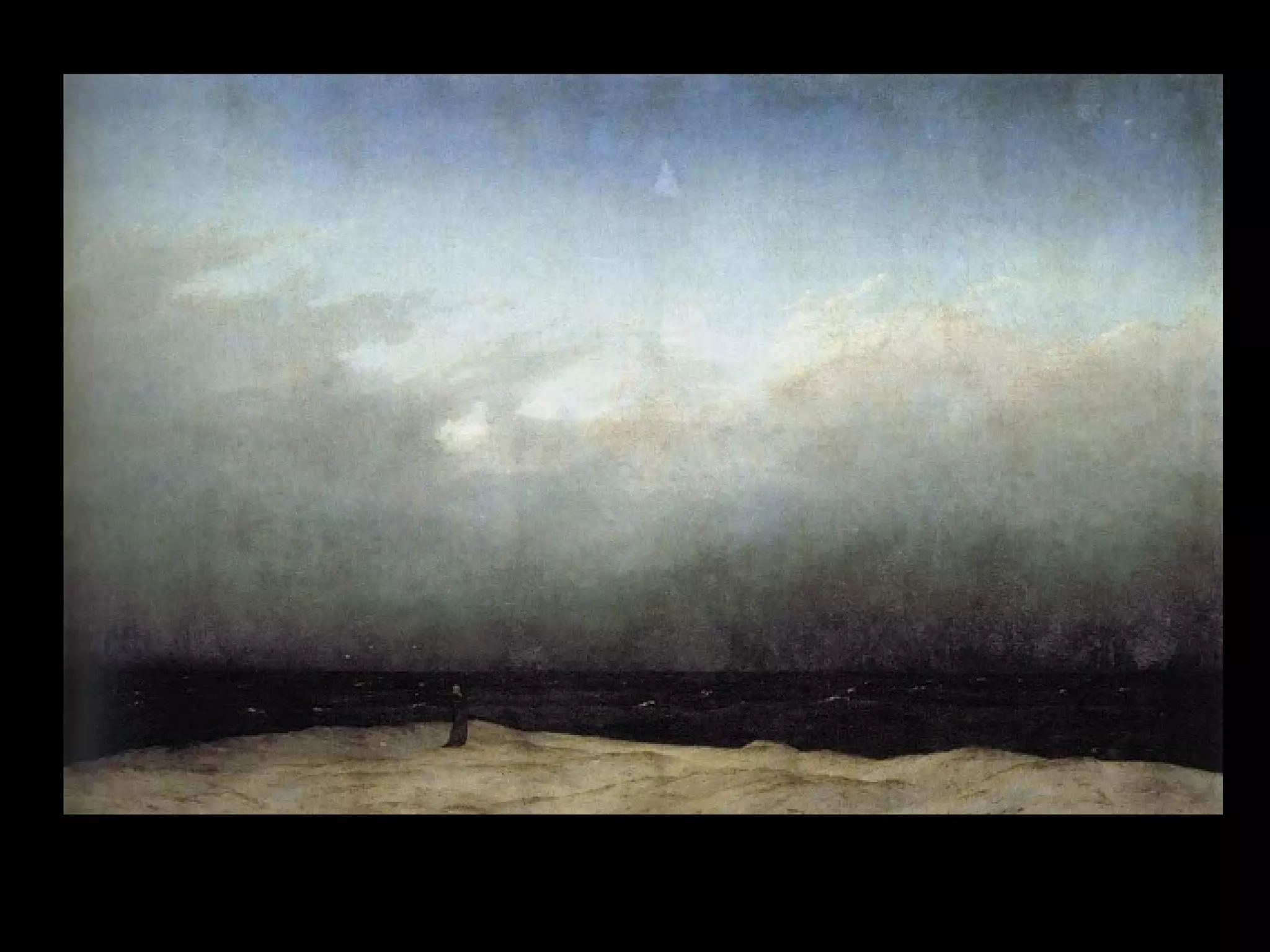
Caspar David Friedrich
Germany (1774-1840)
Monk by the Sea 1808
The is one artist who I can relate to a lot. The study of
the Romantic tradition (which Glenn introduced to
me) is still the main driving force for all my work. The
use of space and the spiritual light which is in many of
his works are beautiful.
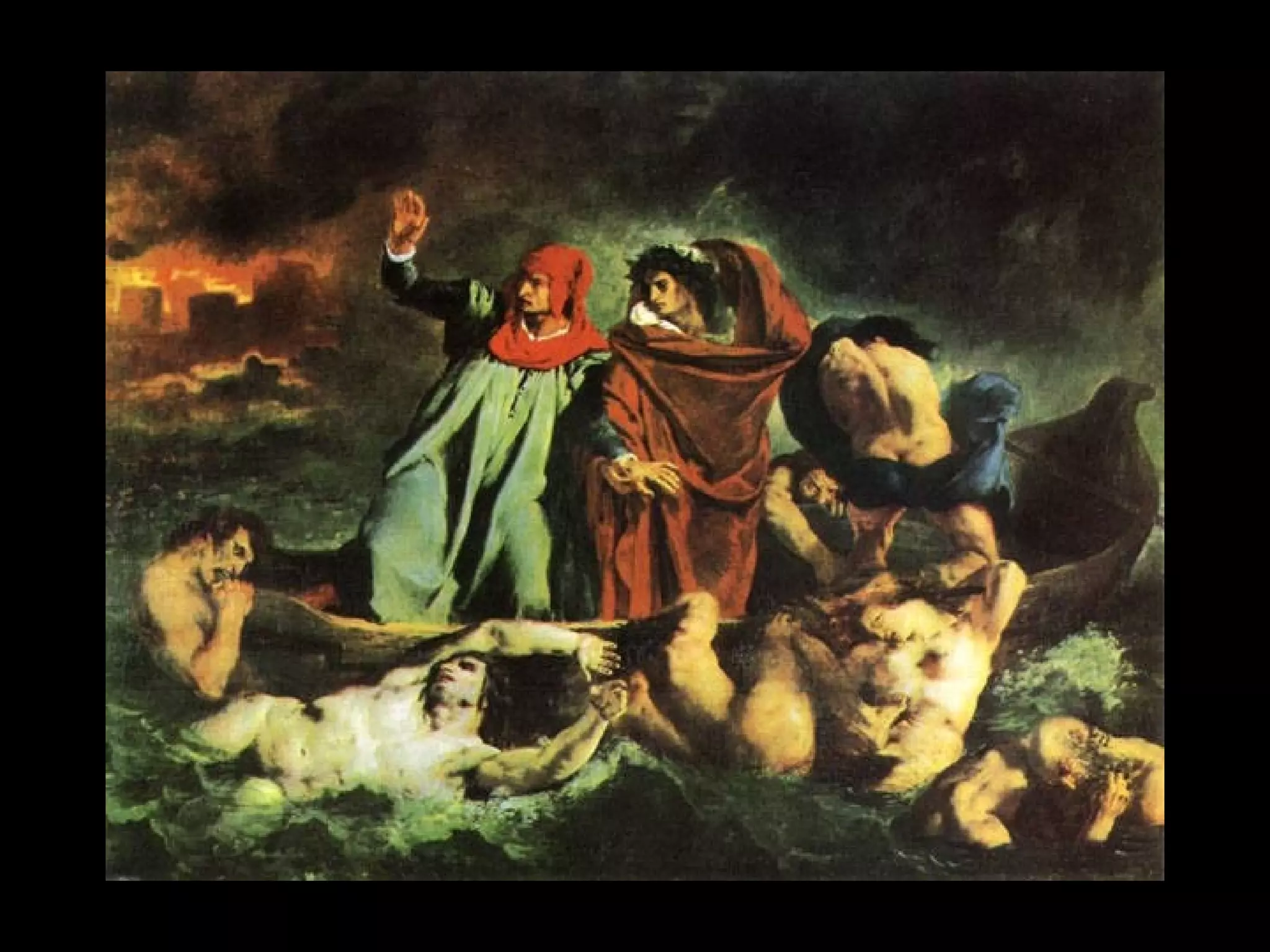
Eugene Delacroix
France (1798 – 1863)
Dante and Virgil in Hell 1822
The mood of the whole work is Dark and Romantic -- the
narrative, the color, the power of the shapes and the curved
lines - just love it!
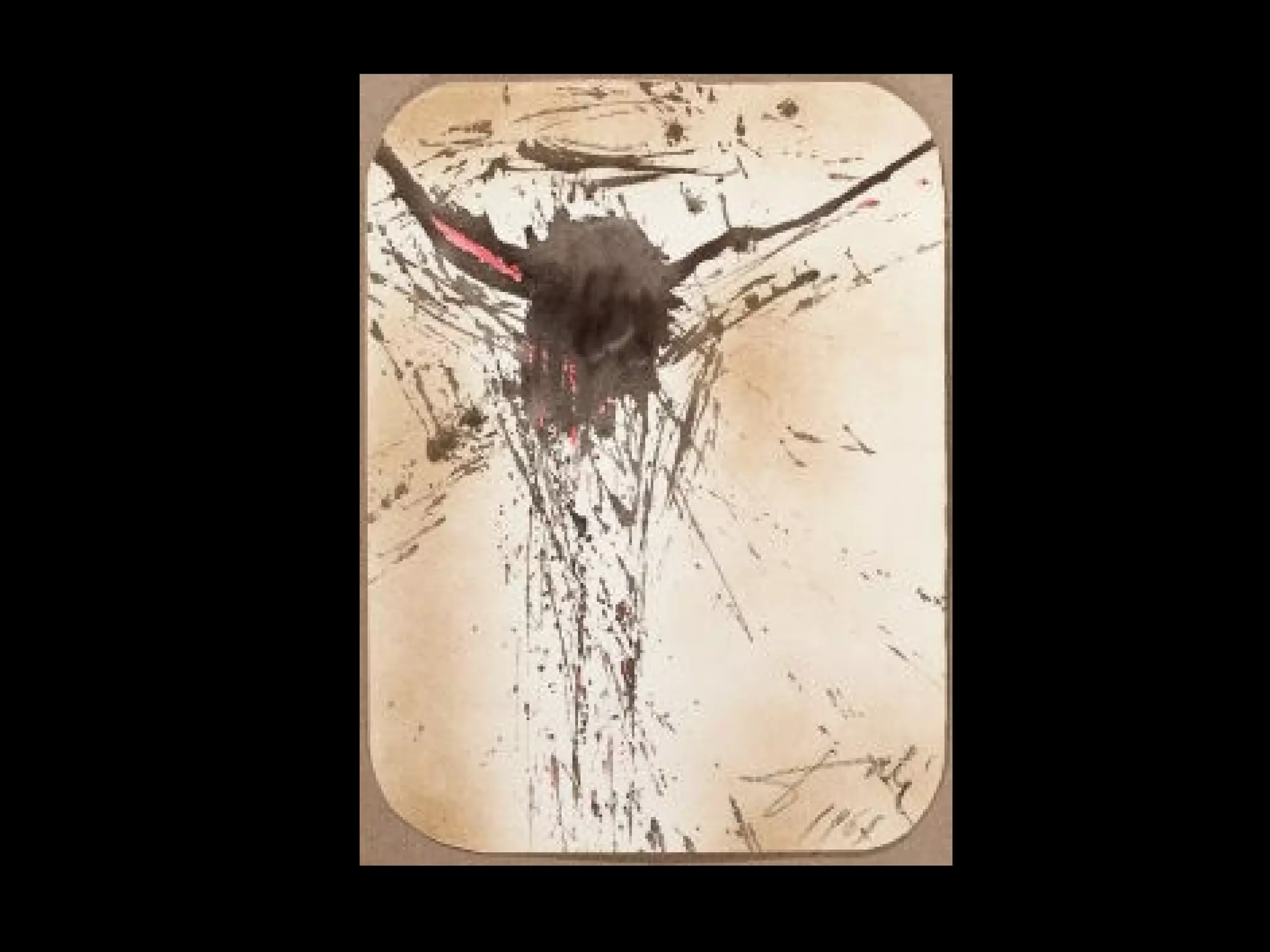
Salvador Dali
Spain (Catalonia) (1904-1989)
Christ on the Cross
I am drawn more to Dali's work which is not surrealistic.
Luckily, I got to see a retrospective of his work in San Fran
many years back, which showed that he stepped back to
other work in his later years.
His drawings were powerful and his line is so confident.
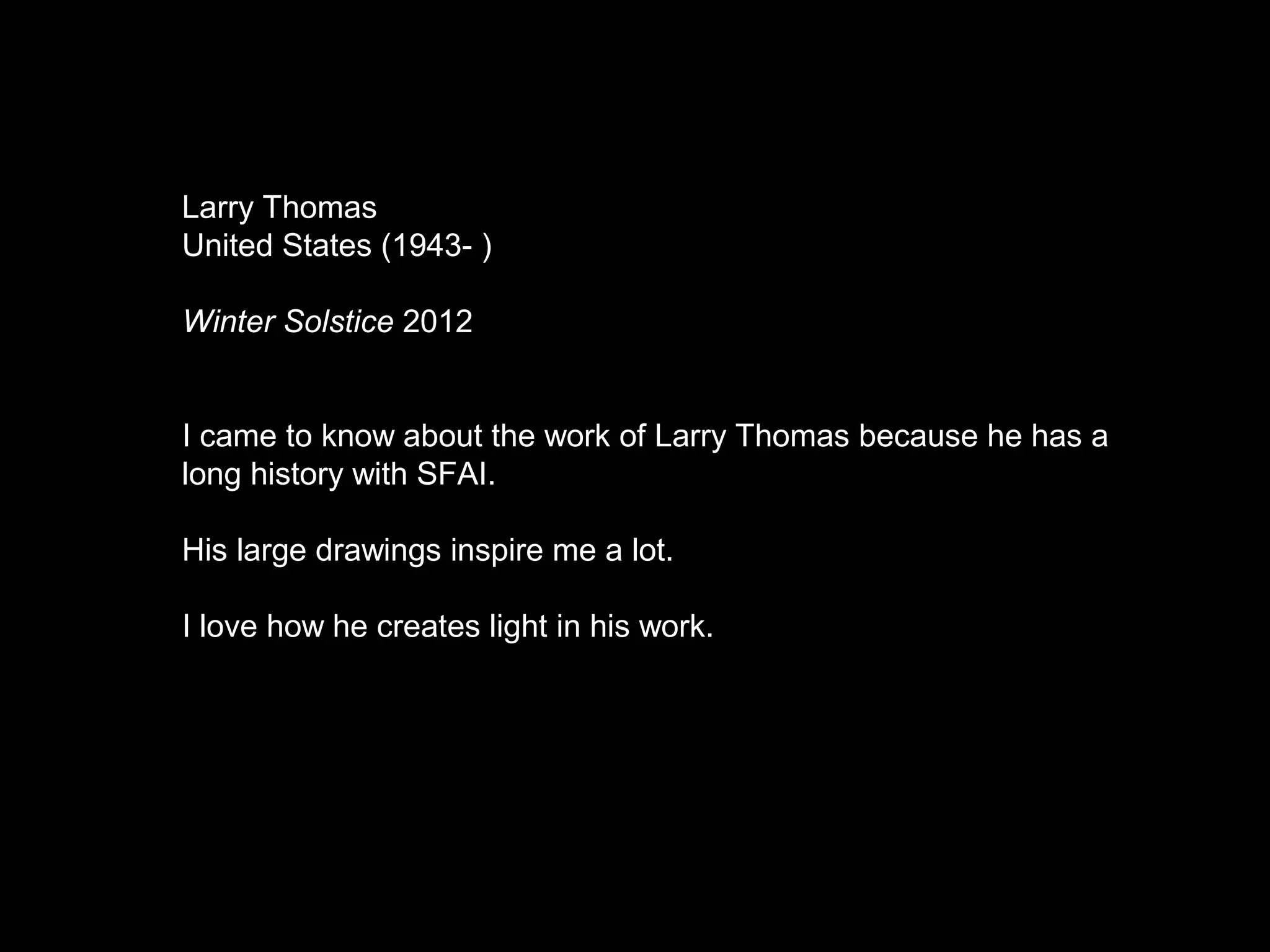
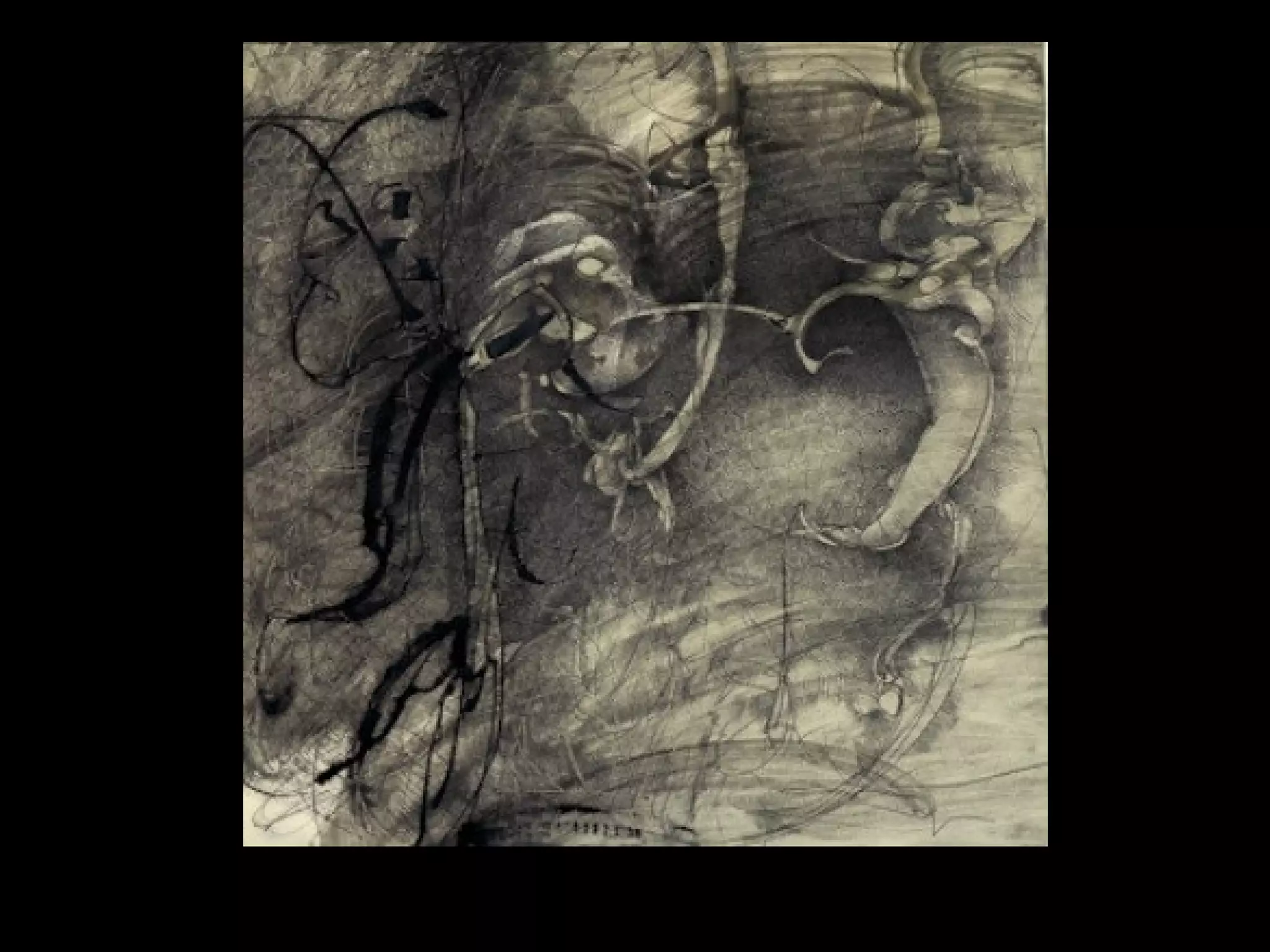
Larry Thomas
United States (1943- )
Winter Solstice 2012
I came to know about the work of Larry Thomas because he has a
long history with SFAI.
His large drawings inspire me a lot.
I love how he creates light in his work.
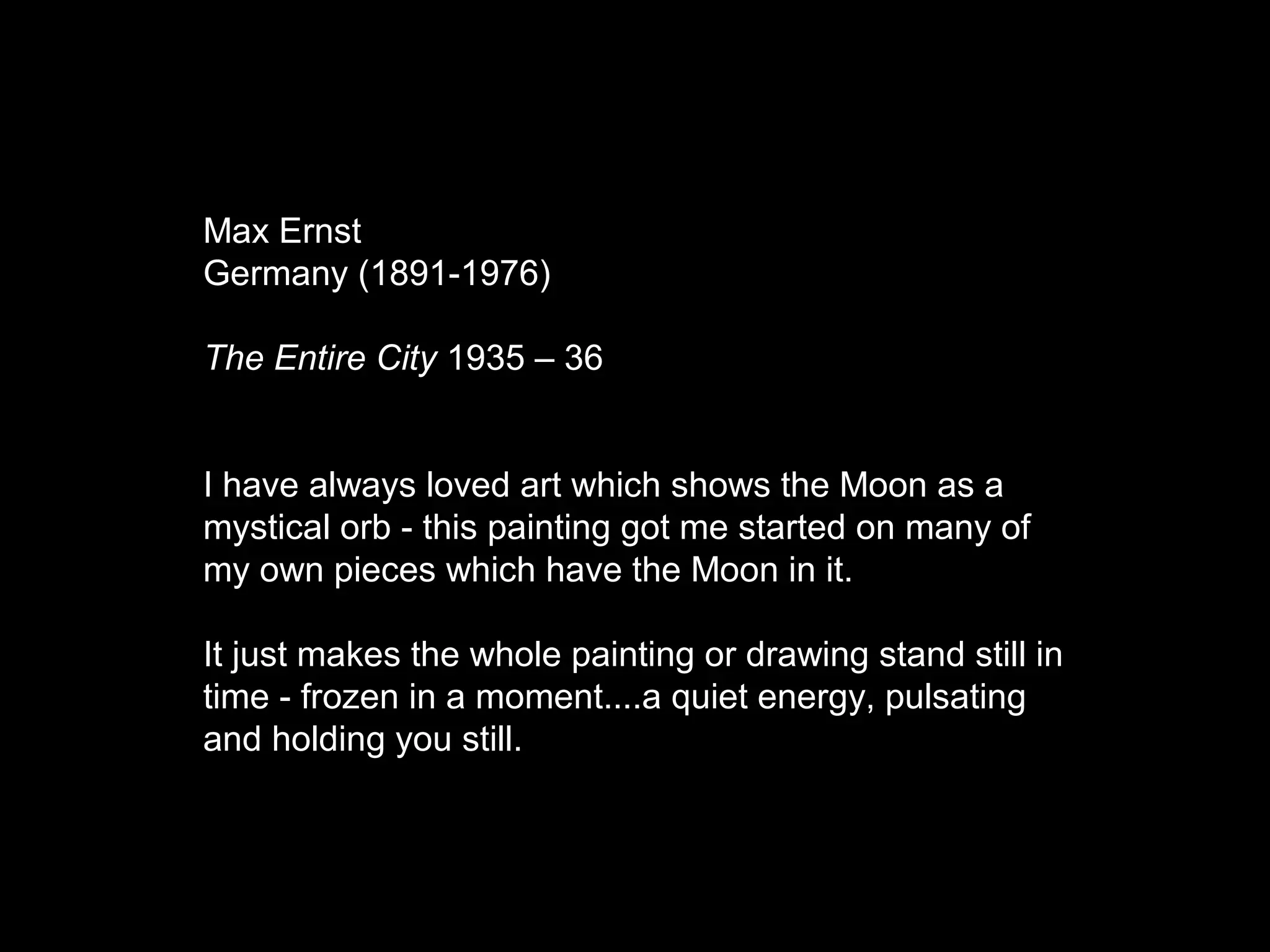
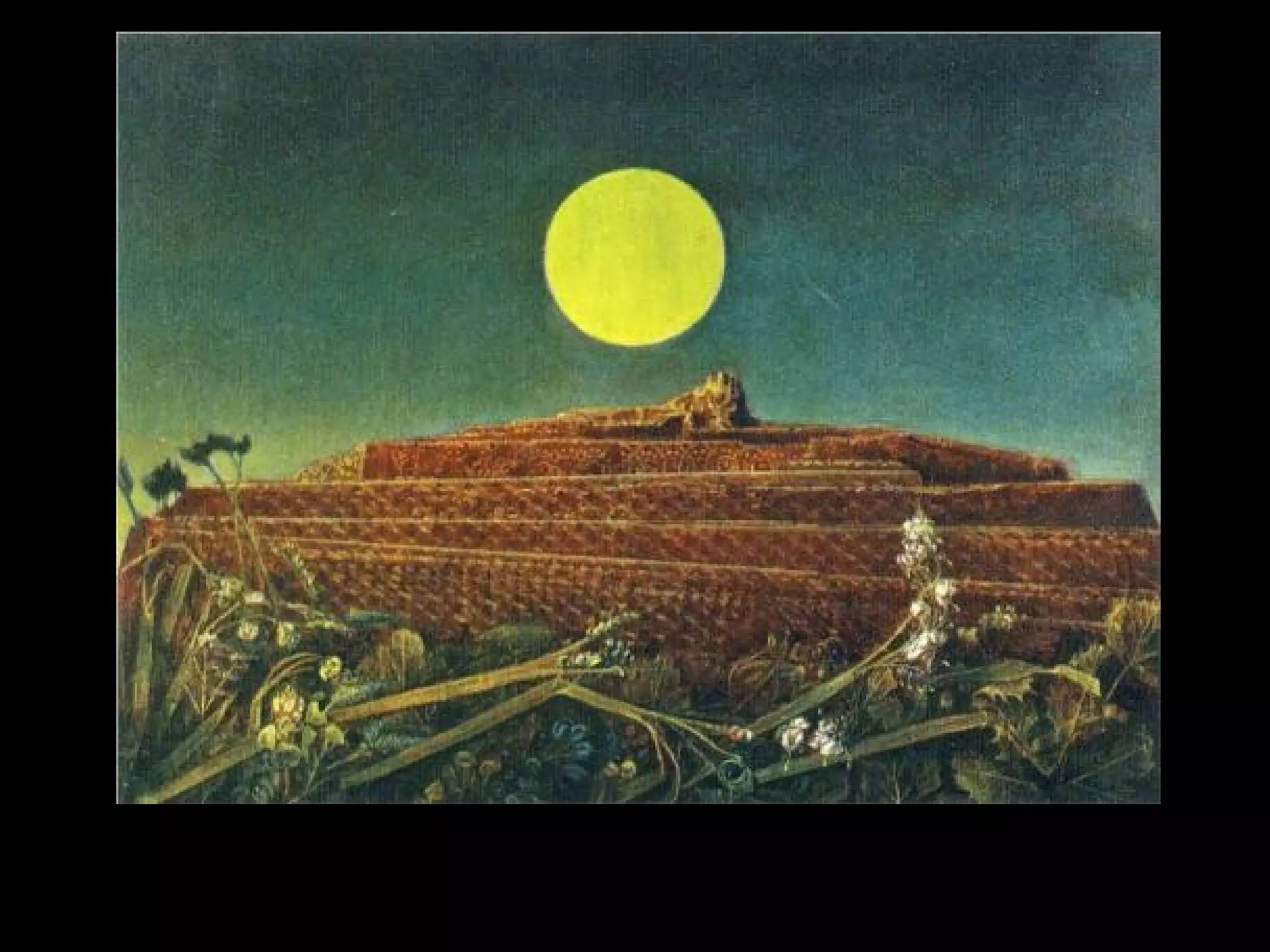
Max Ernst
Germany (1891-1976)
The Entire City 1935 – 36
I have always loved art which shows the Moon as a
mystical orb - this painting got me started on many of
my own pieces which have the Moon in it.
It just makes the whole painting or drawing stand still in
time - frozen in a moment....a quiet energy, pulsating
and holding you still.
Shuling Ding
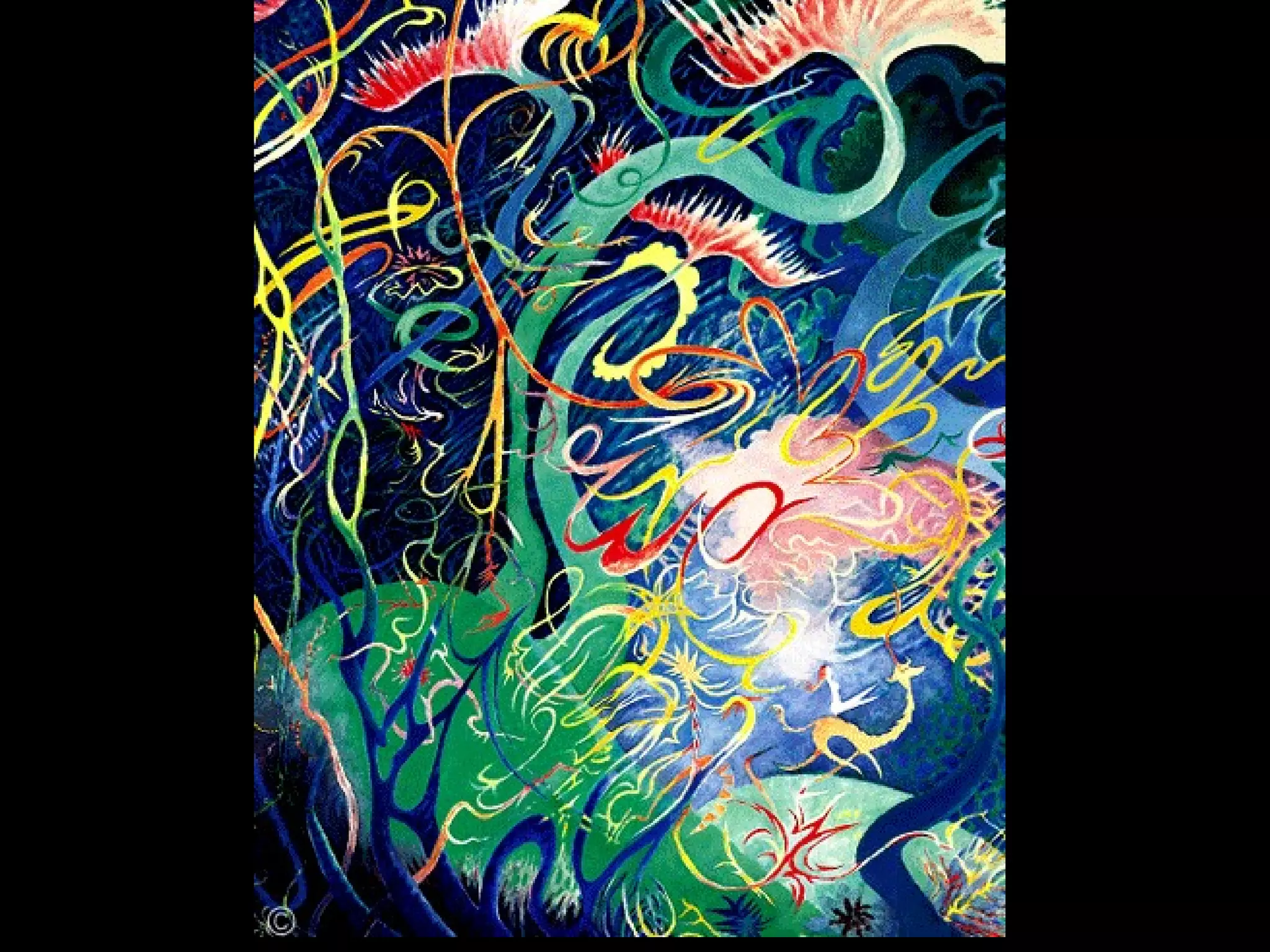
Theodor Seuss Geisel
United States (1904 – 1991)
If every single line is a bar, and every single color is a cell, and the whole
painting is a huge net waiting for its prey, then I don’t mind to be imprisoned
by the Dr.Seuss’s fascinating world of color.
Before seeing the little girl and the unicorn in the lower right-hand corner of
the artwork, I was captivated by the dynamic force behind the grotesque tree
trunks, branches and flowers, which were depicted in vibrant colors and
intensity.
The shimmering green and the bright red are trying to escape the capture of
the canvas, finding a life of its own kind. Behind the lyrical lines of blue,
orange and yellow, a universe full of imagination, playfulness and magic is
conveyed.
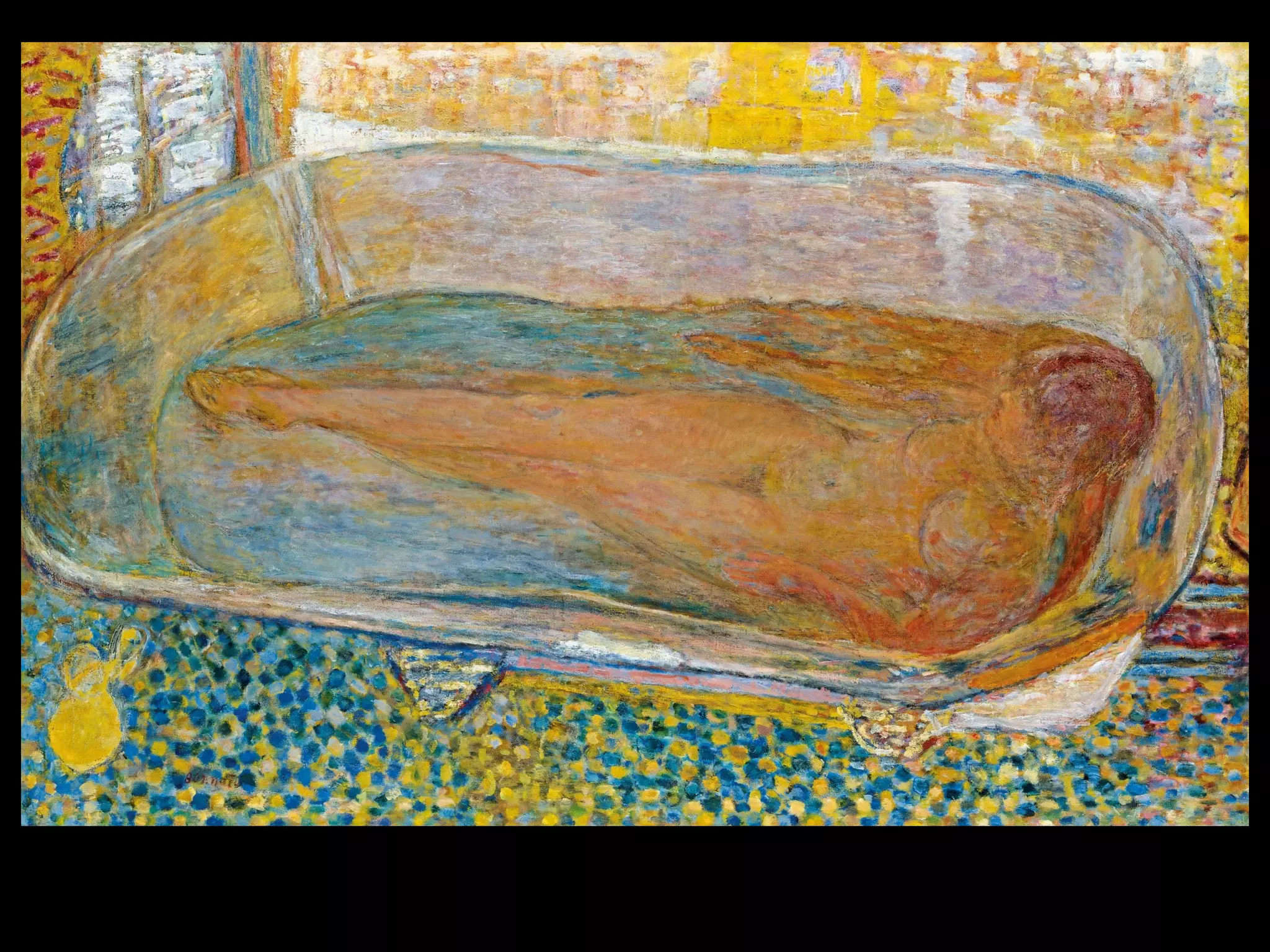
Pierre Bonnard
France (1867 – 1947)
I am attracted to this painting by its charm of idyllic beauty, which is
illustrated in a variety range of colors.
The glimmering contour of the female rendered in subtle gradations of
hue, as if she is behind a diaphanous veil. The cool blue and rich
yellows are contrasted to luminous color chords.
The playful lines of the bathtub drive the viewer’s eyes around the
canvas, and lead to the shimmering water surrounding the figure. The
shapes are formed with a flow that can’t be rushed, can’t be forced.
It is a place for simple beauty and romance.
Catherine Gutierrez
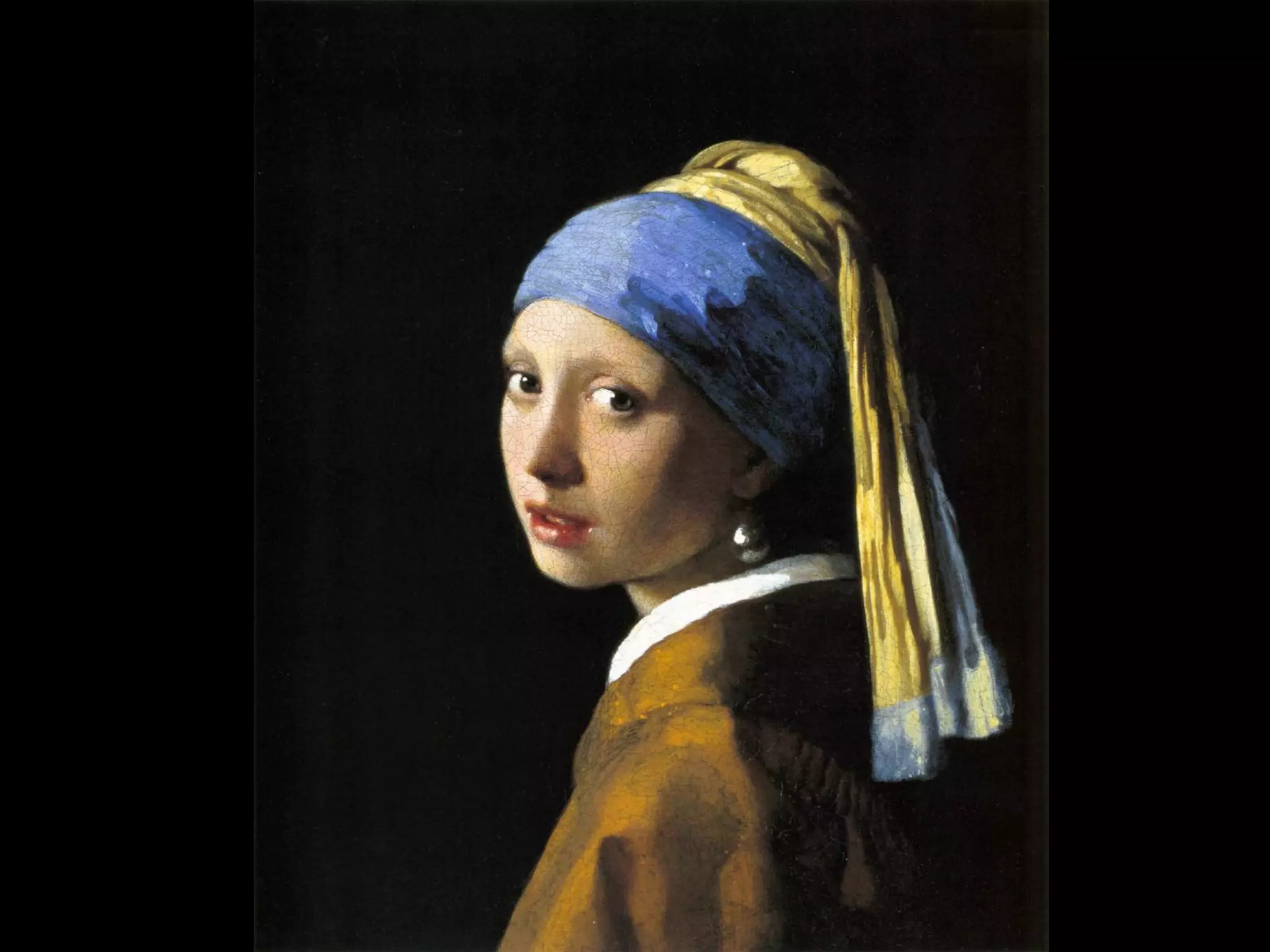
Johannes Vermeer
Holland (1632-1675)
Girl with a Pearl Earring
This is my favorite painting from my favorite painter.
The emotion and color in this piece speaks to me and I
strive for evoking an emotion from the viewer in my
paintings as well.
The light in her eyes tell so much more than just a pretty
portrait painting.
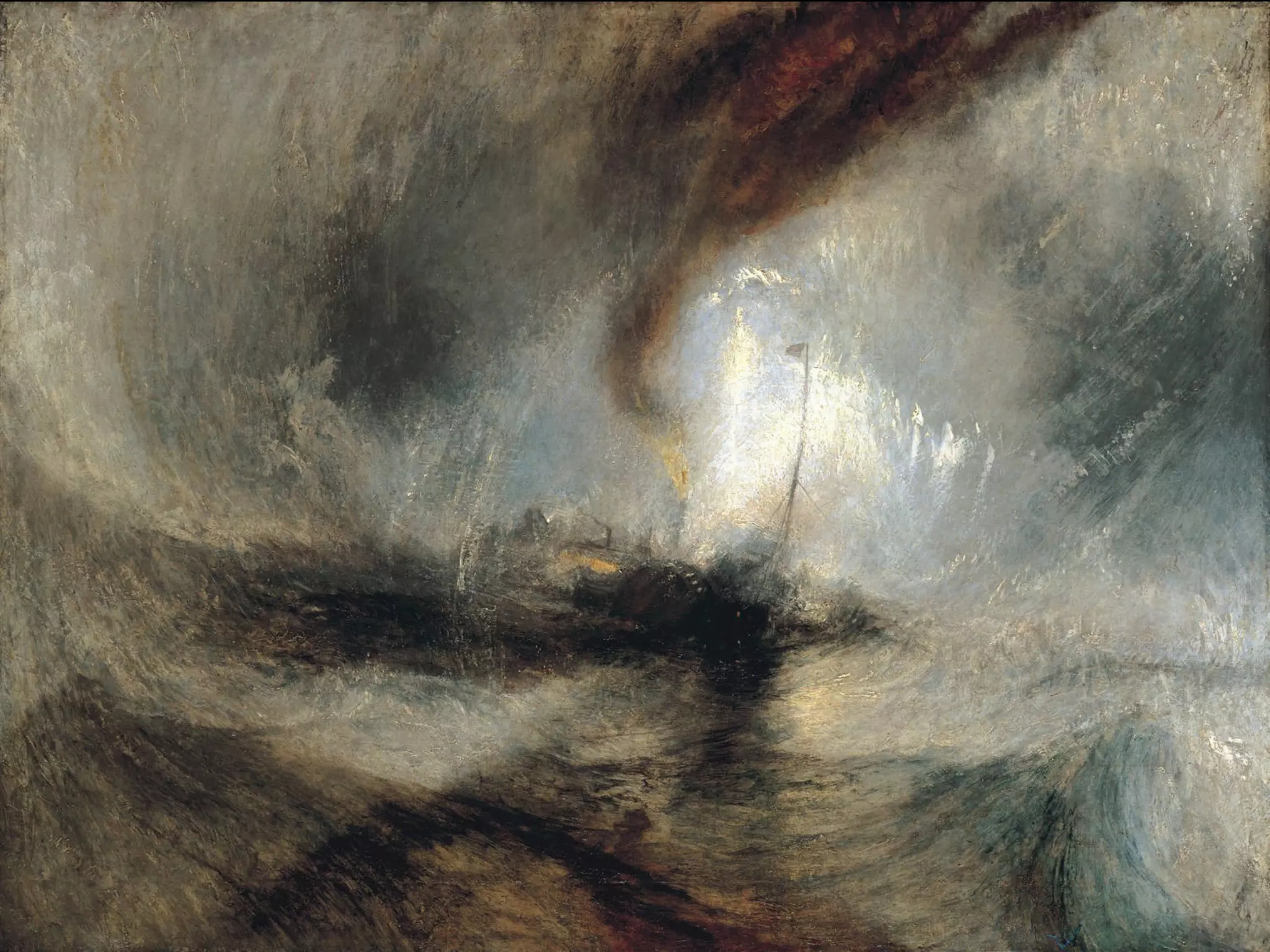
J.M.W. Turner
Great Britain (1775-1851)
The abstract nature of this painting draws me in
along with the light that cuts through this storm.
He has captured the motion and spirit of the
moment.
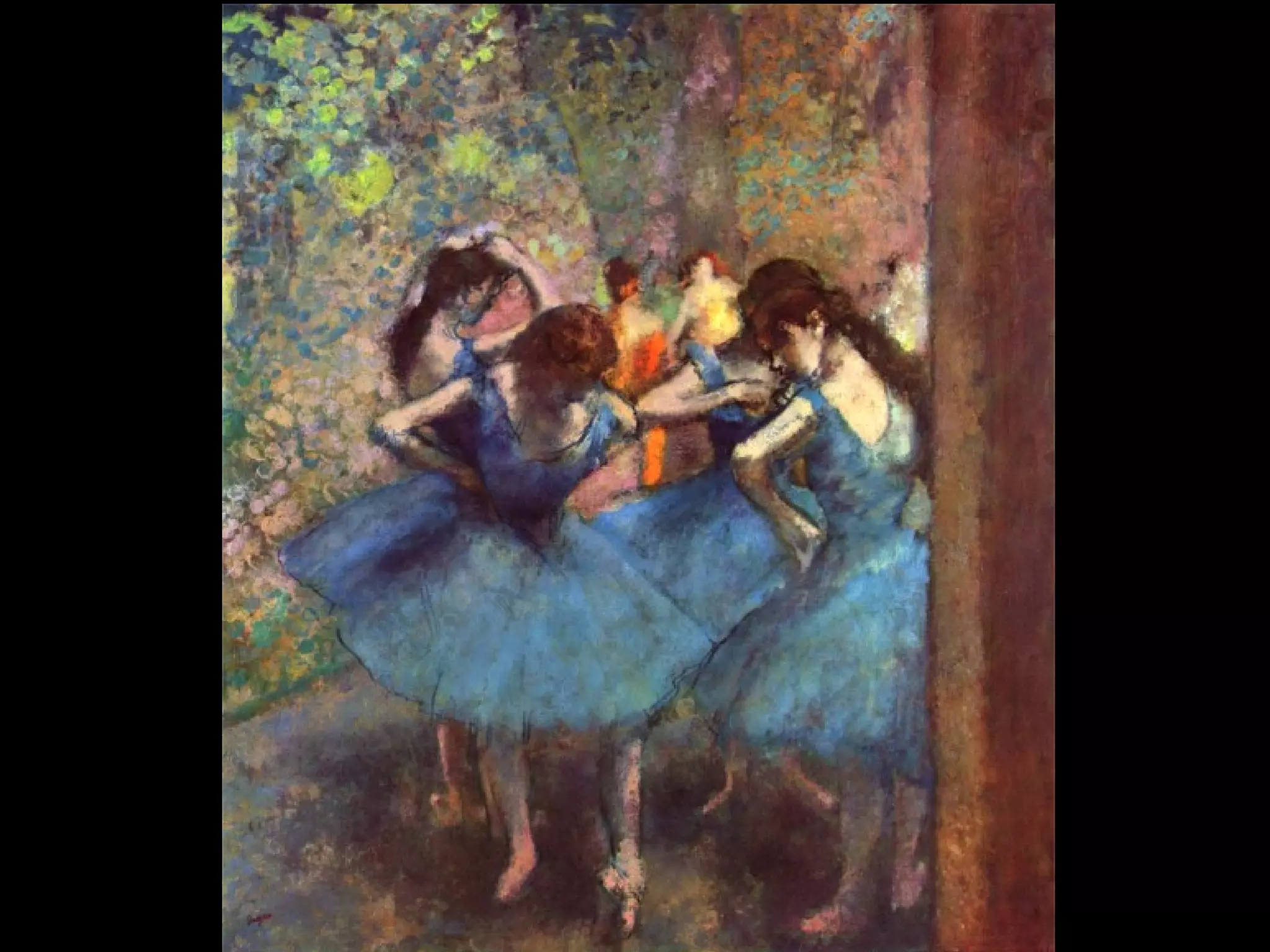
Edgar Degas
France (1834-1917)
Color color color!
Blending of colors to create such rich depth. Only
the shadows give a hint as to where the light is
coming from. Yet the background is abstract and
full of texture.
Susan Landor Keegin
United States (1958 - )
Family Time, September 17, 2013
I love azure-blue swimming pools. I love this painting. It
captures a precious joyful moment in time experienced in
our light-filled breathtaking northern California
landscape. As Susan exclaims:
They came. They swam. They left, leaving behind a
bounty of fun and laughter and love and
understanding that only family can provide. 40 years
later. So glad we did. September One, 1973.
Susan creates a little painting every day.
Pam Pitt
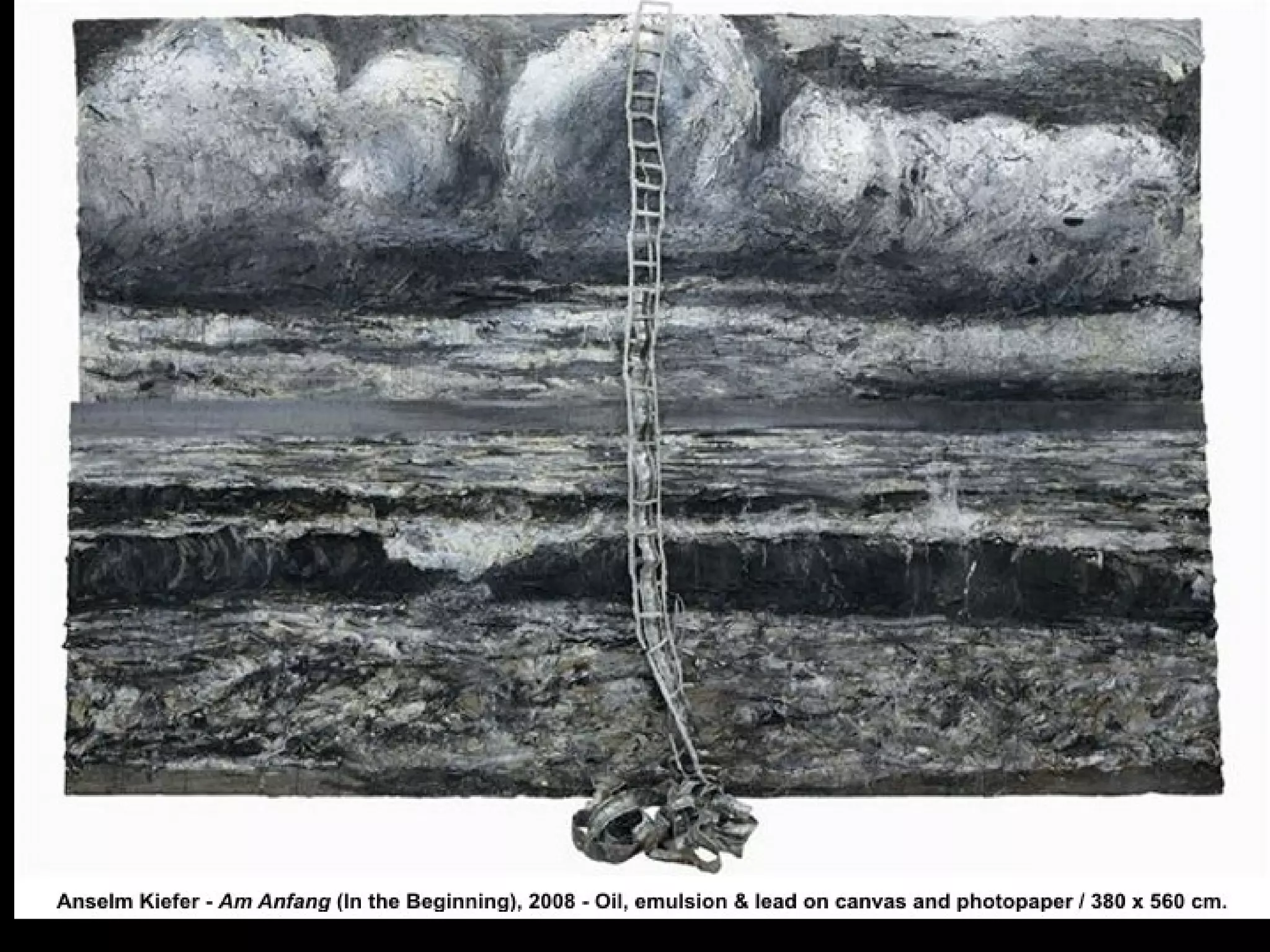
Anselm Kiefer
Germany (1945 - )
The work of Anselm Kiefer has an overwhelming presence.
It is not pretty colors. The dark and muted tones draw you in
to the discomforted mind of the artist.
Part of what also draws you in is the rough texture and
added elements such as straw and wood.
There is so much authority in these simple materials.
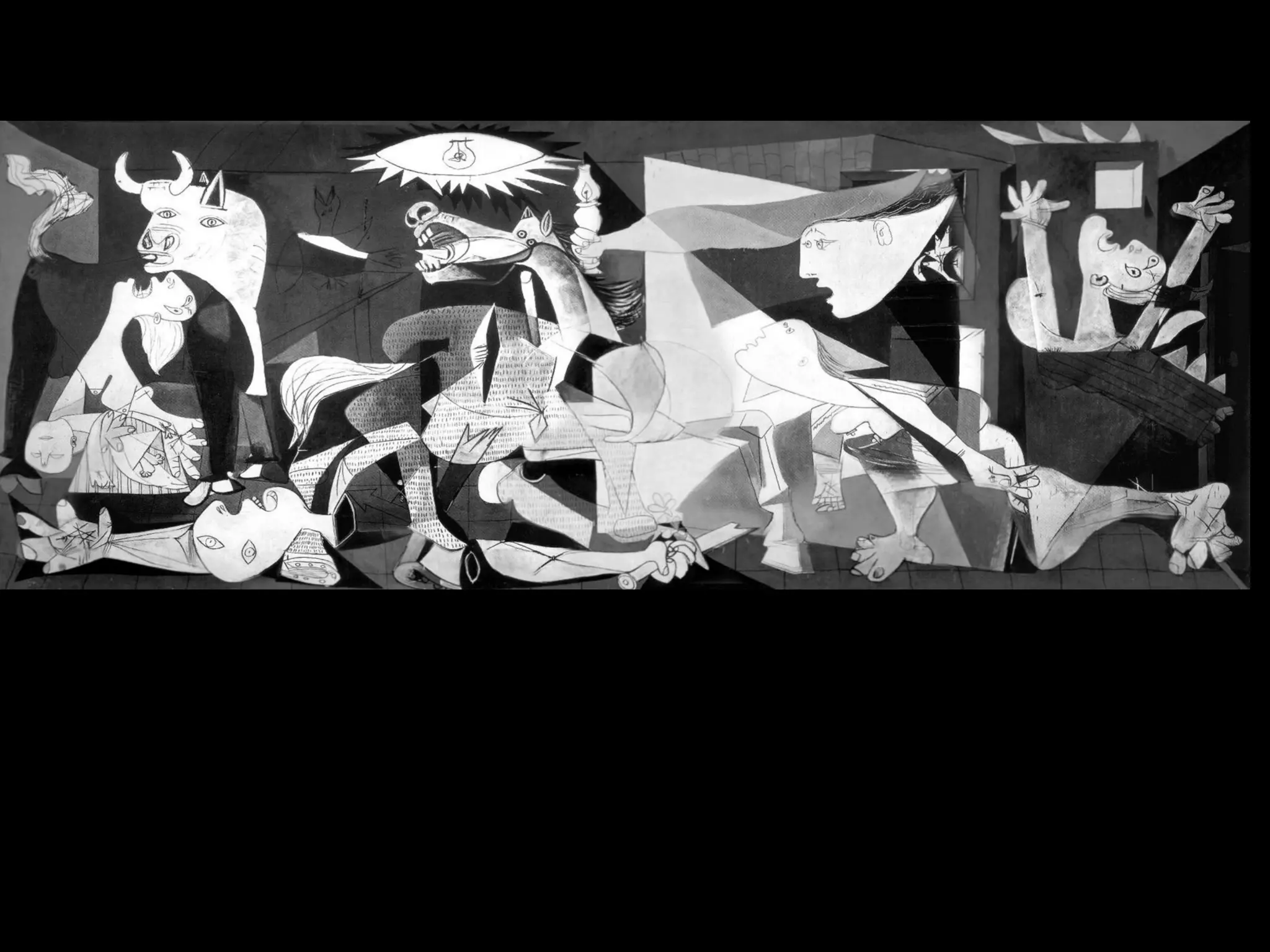
Pablo Picasso
Spain (1881-1973)
I was thinking about the intersection of social issues and
aesthetics -- whether or not you have to choose between
content and beauty.
Then I thought of Guernica and it does not need words.
The emotion just sucks you in.
Then I realized there is a lot of other art that addresses
social issues.
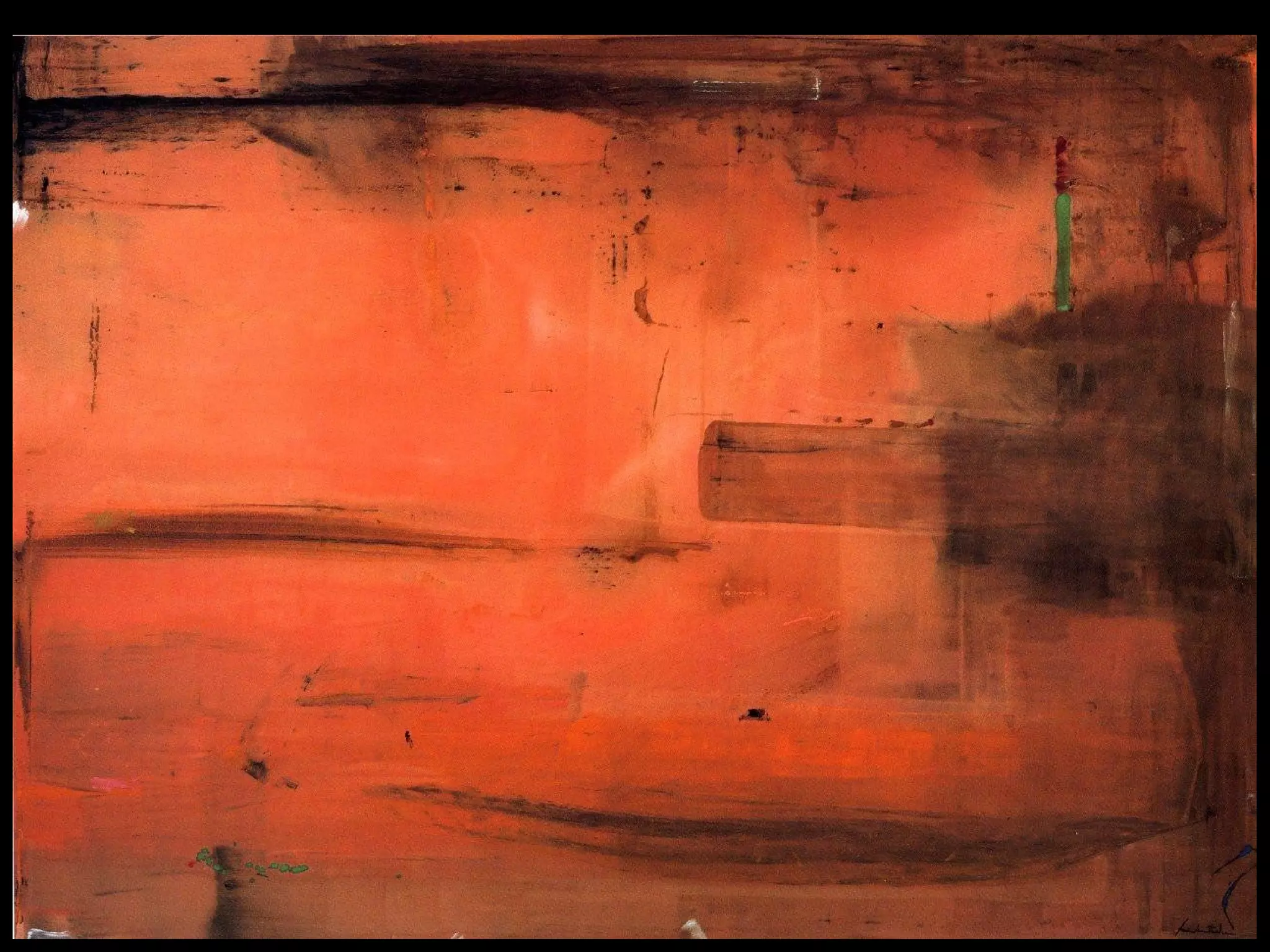
Helen Frankenthaler
United States (1928-2011)
When I was in high school I had never been to an art gallery or a
museum. But our family subscribed to Life magazine and there
was always an article about art in that.
I remember seeing abstract work and feeling all the possibilities it
represented. I could draw, but I was taken by the idea that a
painting could be about something you made up in your own head
and that it did not have to be limited to landscapes or other things
that were already there and that you could see with your eyes. So
I practiced drawing a lot of geometric compositions.
I picked this Helen Frankenthaler picture because the color knocks
me out.
Susan Scannon
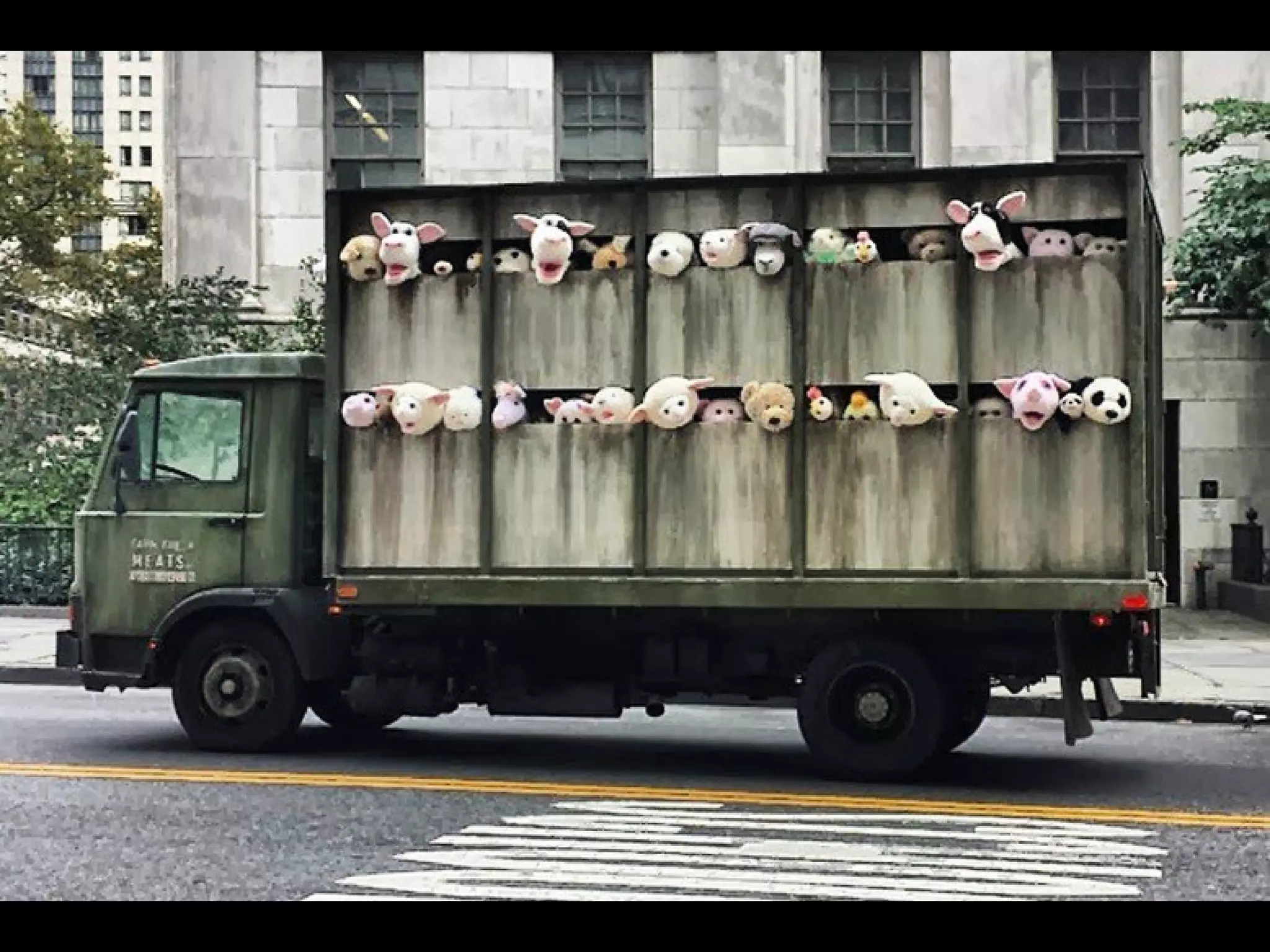
Banksy (Robert Banks)
Great Britain (1974 - )
Banksy is a graffiti artist, political activist, film director, and
painter.
His satirical street art and subversive epigrams combine dark
humor with graffiti, done in a distinctive stenciling technique.
His political and social commentary appear on streets, walls,
and bridges in cities throughout the world.
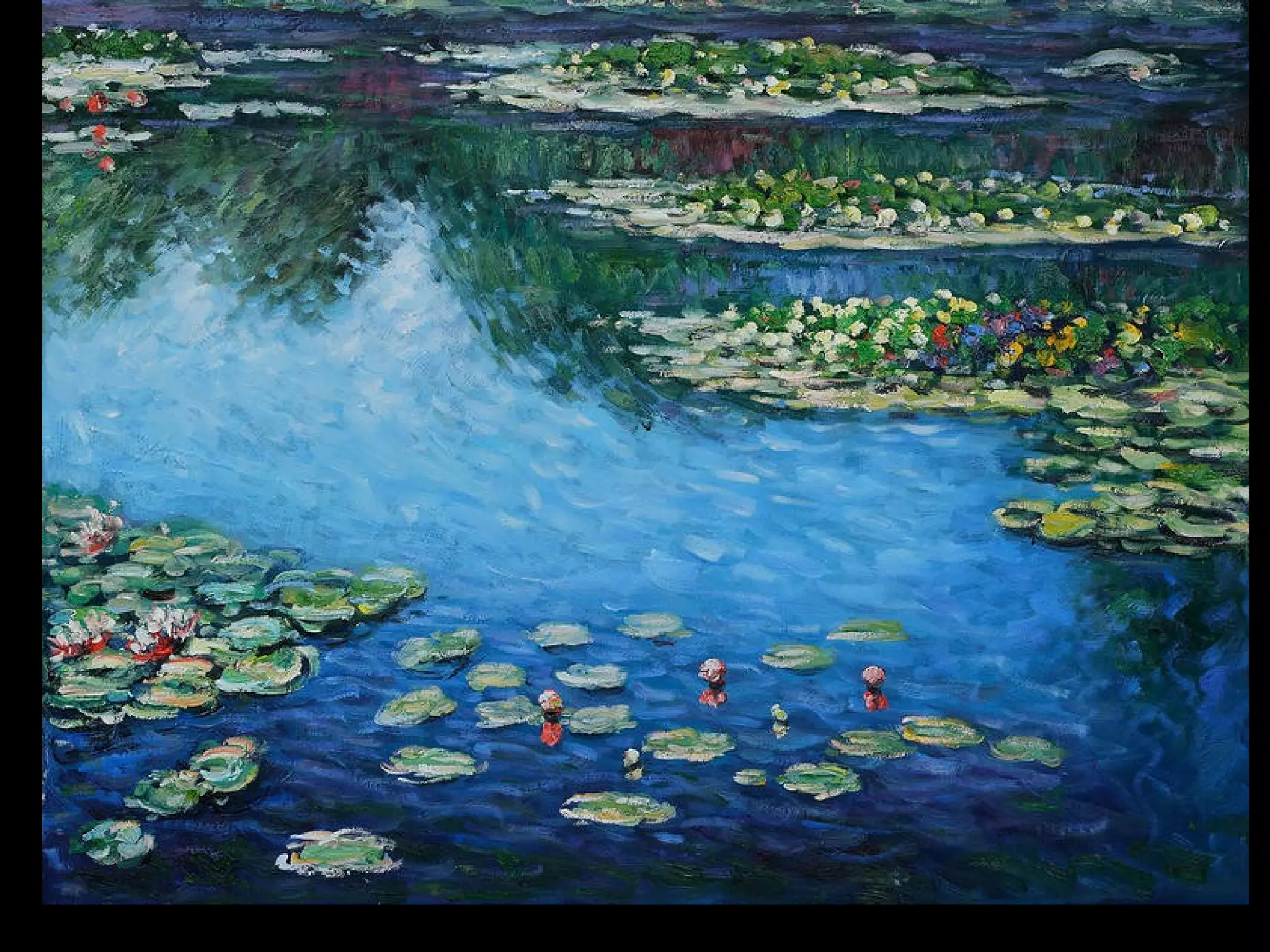
Claude Monet
France (1840-1926)
Beginning in the 1880s and 1890s through the end of his life in 1926,
Monet worked on "series" paintings, in which a subject was depicted in
varying light and weather conditions.
Vincent van Gogh
Holland (1853-1890)
I love the rhythmic movement across the whole canvas …
Art Students Select-SFAI Summer 2014

Art Students Select-SFAI Summer 2014

  • 1.
    Art Student Select SFAIIntermediate/Advanced Painting Summer 2014
  • 3.
    Lucian Freud Great Britain(1922-2011) Reflection (self portrait) 1985 Characterized as "harsh, visceral assessments," I'm challenged by the ugly beauty and honesty of his work.
  • 5.
    Jon Redmond American (1962-) Evening in West Chester (Pennsylvania) 10"x10" oil on board Jon Redmond is called a "poet of light and shadow." He pleases me with his Hopper-esque imagery, finding beauty in everyday life. He paints on small wooden panels - on site, wet-in-wet (ala prima style).
  • 7.
    I'm picking him twice- these interior images are simply beautiful.
  • 8.
    David Park United States(1911-1960) Nude Green 1957 68"x56" oil I admire the freedom, simplicity and unexpected palette of his work. A post-WW II abstract expressionist who returned to painting recognizable subjects (along w/buddy Diebenkorn) - his portraits were painted from memory.
  • 10.
  • 11.
    Gustav Klimt Austria (1862-1918) BeethovenFrieze (detail) 1901 I had never seen this painting. The imagery, in particular that demonic character in the middle, seemed such a contrast to the stunning golden beauty of Klimt’s Kiss, which powerfully holds the world’s gaze along with my own. Klimt’s painting portrays for me what I sense is true. Beauty is impossible if one cuts loose the connection with the nether world, with its expressions of the demonic/daimonic. Without access to this world, the possibility of “transforming the tragedy of existence into metaphysical beauty” is slight.
  • 13.
    Anselm Kiefer Germany (1945-) All stories of heaven begin on earth Desire is a way of dwelling with the earth, as the etymology (word- story) of “desire” shows. The word “desire” is related to con-siderae, meaning “a careful observation of the stars.” To gaze upward gives simultaneous consideration to the ground on which we stand and the constellations passing overhead bringing the experience of time to earth. De-sire means “away from the stars” and so establishes desire as the return to earth taken up as a reflection through the heavens. Desire is our place between heaven and earth.
  • 15.
  • 16.
    Julie Mehretu Ethiopia/United States(1970 - ) Auguries, 2010 Mark making becomes a tectonic system for space making: heavy marks & thin lines work as layers to envelop a kinetic composition, and a sense of flow in space. The composition is like controlled chaos- a mélange of various energies overlaying each other creating a complex kaleidoscope of architecture, space and time.
  • 18.
    Gustav Klimt Austria (1862-1918) Barnwith Crucifix, 1912 Space is defined by a cacophony of color. The colors’ texture wistfully hints of a sacred artifact who does not fight for light or attention, but rather accepts the embrace of nature while still peaking through. As if to say, "I'm still here, but not for long, you might find me in another time..."
  • 20.
    Caspar David Friedrich Germany(1774-1840) Sea of Ice/the Wreck of Hope, 1824 A dynamic relationship between architecture and landscape, man versus nature. Of fearsome monumentality, the triangular composition displays no sign of life - only the aftermath of a shipwreck which dramatically died into the ice.
  • 22.
    Matthew Ritchie United States,British decent (1964-) Great Life, 2002 Pulling from a variety of sources, the artist yields a new universe before us: weaving mythology, religion, physics, linguistics, biology and architecture, the painting integrates, assimilates and then proliferates new forms over old ones.
  • 24.
    No Sign ofthe World 2004 Oil and marker on canvas, 99 x 154 inches
  • 25.
    Yang Yongliang China (1980- ) Artificial Wonderland, 2010 Intricate Chinese inspired landscapes actually render modern cityscapes with a hint of dystopia and a dash of apocalypse. What seems beautiful from afar transforms upon attention to detail. New techniques playing with old art forms.
  • 27.
  • 28.
    Daniel Merriam United States(1963- ) Empty Kingdom Merriam is a highly regarded contemporary surrealist and is best known for his dry brush technique and gloriously imaginative style. One of seven children in a creative, artistic family, he taught himself to paint at a very young age and used his art as a method of reflective play throughout his childhood.
  • 30.
    Salvador Dali Spain (Catalonia)(1904-1989) Dali’s painterly skills are often attributed to the influence of Renaissance masters. His expansive artistic repertoire included film, sculpture, and photography, in collaboration with a range of artists in a variety of media.
  • 31.
    Galatea of theSpheres 1952 (portrait of Gala Dalí, Salvador Dalí's wife) Dalí was interested in nuclear physics and the atomic bomb. Recognizing that matter was made up of atoms which do not touch each other, he sought to replicate this in his art at the time, with items suspended and not contacting each other.
  • 32.
    Michael Cheval Russia (1966- ) Cheval was born in 1966 in Kotelnikovo, a small town in southern Russia. Growing up in an artistic family, his love of drawing was encouraged from early childhood by his father, Mikhail Khokhlachev, a self-taught artist and by his grandfather, Yuri Lipov, a professional artist and sculptor. His ability developed quickly and by three years old, he could already draw complex compositions.
  • 33.
    From the artist’swebsite: “Eternity is the measure of absurdity. No one has ever experienced eternity. So absurdity is the inside of reality and exists in everything that surrounds us. Each person has his labyrinth, his experience, his own Minotaur. I only invite my audience to participate in co-authorship.”
  • 34.
    Claude Monet France (1840-1926) Monetwas a founder of French Impressionist painting. The term "Impressionism" is derived from the title of his painting Impression, soleil levant (Impression, Sunrise), which was exhibited in 1874 in the first of the independent exhibitions mounted by Monet and his associates as an alternative to the Salon de Paris.
  • 36.
    Leonardo di Vinci Italy(1452-1519) Leonardo was an Italian Renaissance polymath: painter, sculptor, architect, musician, mathematician, engineer, inventor, anatomist, geologist, cartographer, botanist, and writer. According to art historian Helen Gardner, the scope and depth of his interests were without precedent and "his mind and personality seem to us superhuman, the man himself mysterious and remote". Marco Rosci states that while there is much speculation about Leonardo, his vision of the world is essentially logical rather than mysterious, and that the empirical methods he employed were unusual for his time.
  • 37.
    This is adrawing by Peter Paul Rubens done 100 years after Leonardo's painting The Battle of Anghiari (1505),. His reference was an engraving by an artist who saw the original 50 years after it was done. Now lost, the original is believe to be hidden beneath one of Leonardo’s later frescoes. (He painted over it.)
  • 38.
    What I learnedfrom Leonardo’s biography LEONARDO THE ARTIST AND THE MAN by Sege Bramly Florence in the late 15th century was the center of Renaissance life and enjoyed complete tolerance for its celebrated gay community (Leonardo and Michelangelo foremost among them). In his 20s, Leonardo was primarily known as a singer. He had movie-star looks. The Mona Lisa influenced Raphael with its chiaroscuro-lit portrait of a woman set in an actual landscape … and (unusual at the time!) she was painted with hands. Leonardo’s experiments with paint chemistry in the The Last Supper didn’t hold up very well (faded and disintegrated). Leonardo was widely known for elaborate practical jokes. He wrote backwards to keep his notebooks a secret from the Catholic Inquisition. Two-thirds of his notebooks are lost (someone threw them out 50 years after his death).
  • 39.
  • 40.
    Chu Teh-Chun China/France (1920-2014) Lavie qui anime les nuages 2004 This painting strongly shows the integration of Chinese Calligraphy and western abstract expression paintings. In the painting, there is a bright path through the darkness that creates a feeling of continuum. It’s the East meet the West abstraction without a conflict.
  • 42.
    Patrick Dintino American (1975- ) Self-Portrait, 2000 I like his idea of creating abstract art through a scientific process of human eyes, also called peripheral vision. He processes the image through the relationship between colors, light and dark, not by the shapes. This painting is titled “Self portrait” -- his skin and hair color are used to fill-in the bar code from his driver’s license.
  • 44.
    Vincent Van Gogh Holland(1853-1890) Starry Night, 1897 I like the intertwined drawing and painting throughout the entire piece. He created movements of the clouds/stars by drawing the tractable swirl lines. I also feel the energy driven by the big contrast of yellows and blues.
  • 46.
    Paul Gauguin France (1848-1903) Nevermore,1897 This narrative painting tells the most interesting story through the woman’s facial expression, especially the eyes. They trigger my curiosity and anxiety to find out the myth behind her. Most of narrative paintings illustrate the subjects for viewers to read. But in this one, the subject herself speaks to the viewer.
  • 48.
    Richard Diebenkorn United States(1922-1993) Seawall 1957 The use of the soft colors in this landscape painting is very emotional. The uneven layers of paint show numerous processes that create an unsettled feeling. I admire his unique way of interpreting landscape.
  • 50.
  • 51.
    Jean Michel Basquiat UnitedStates (1960-1988) Two Heads on Gold The Skull Basquiat first achieved notoriety as an informal graffiti artist and by the 1980s was exhibiting his Neo-expressionist and Primitivist paintings in galleries and museums internationally. His art focused on "suggestive dichotomies," such as wealth versus poverty, integration versus segregation, and inner versus outer experience – using social commentary in his paintings as a springboard to deeper truths about the individual. He appropriated poetry, drawing and painting, and married text and image, abstraction and figuration, and historical information with contemporary critique.
  • 53.
    Charles Hinman United States(1932 - ) Sea Shell Hinman's hard-edge shaped minimal canvases are constructed with reverse ribs which provide contours to his paintings. By wrapping his canvases over these underpinnings, he adds a third dimension.
  • 55.
    Joe Reihsen United States(1979 - ) Can You Tell Me How to Get to Newport? 2013 Acrylic on panel 11”x11”
  • 57.
  • 58.
    Caspar David Friedrich Germany(1774-1840) Monk by the Sea 1808 The is one artist who I can relate to a lot. The study of the Romantic tradition (which Glenn introduced to me) is still the main driving force for all my work. The use of space and the spiritual light which is in many of his works are beautiful.
  • 60.
    Eugene Delacroix France (1798– 1863) Dante and Virgil in Hell 1822 The mood of the whole work is Dark and Romantic -- the narrative, the color, the power of the shapes and the curved lines - just love it!
  • 62.
    Salvador Dali Spain (Catalonia)(1904-1989) Christ on the Cross I am drawn more to Dali's work which is not surrealistic. Luckily, I got to see a retrospective of his work in San Fran many years back, which showed that he stepped back to other work in his later years. His drawings were powerful and his line is so confident.
  • 64.
    Larry Thomas United States(1943- ) Winter Solstice 2012 I came to know about the work of Larry Thomas because he has a long history with SFAI. His large drawings inspire me a lot. I love how he creates light in his work.
  • 66.
    Max Ernst Germany (1891-1976) TheEntire City 1935 – 36 I have always loved art which shows the Moon as a mystical orb - this painting got me started on many of my own pieces which have the Moon in it. It just makes the whole painting or drawing stand still in time - frozen in a moment....a quiet energy, pulsating and holding you still.
  • 68.
  • 69.
    Theodor Seuss Geisel UnitedStates (1904 – 1991) If every single line is a bar, and every single color is a cell, and the whole painting is a huge net waiting for its prey, then I don’t mind to be imprisoned by the Dr.Seuss’s fascinating world of color. Before seeing the little girl and the unicorn in the lower right-hand corner of the artwork, I was captivated by the dynamic force behind the grotesque tree trunks, branches and flowers, which were depicted in vibrant colors and intensity. The shimmering green and the bright red are trying to escape the capture of the canvas, finding a life of its own kind. Behind the lyrical lines of blue, orange and yellow, a universe full of imagination, playfulness and magic is conveyed.
  • 71.
    Pierre Bonnard France (1867– 1947) I am attracted to this painting by its charm of idyllic beauty, which is illustrated in a variety range of colors. The glimmering contour of the female rendered in subtle gradations of hue, as if she is behind a diaphanous veil. The cool blue and rich yellows are contrasted to luminous color chords. The playful lines of the bathtub drive the viewer’s eyes around the canvas, and lead to the shimmering water surrounding the figure. The shapes are formed with a flow that can’t be rushed, can’t be forced. It is a place for simple beauty and romance.
  • 73.
  • 74.
    Johannes Vermeer Holland (1632-1675) Girlwith a Pearl Earring This is my favorite painting from my favorite painter. The emotion and color in this piece speaks to me and I strive for evoking an emotion from the viewer in my paintings as well. The light in her eyes tell so much more than just a pretty portrait painting.
  • 76.
    J.M.W. Turner Great Britain(1775-1851) The abstract nature of this painting draws me in along with the light that cuts through this storm. He has captured the motion and spirit of the moment.
  • 78.
    Edgar Degas France (1834-1917) Colorcolor color! Blending of colors to create such rich depth. Only the shadows give a hint as to where the light is coming from. Yet the background is abstract and full of texture.
  • 80.
    Susan Landor Keegin UnitedStates (1958 - ) Family Time, September 17, 2013 I love azure-blue swimming pools. I love this painting. It captures a precious joyful moment in time experienced in our light-filled breathtaking northern California landscape. As Susan exclaims: They came. They swam. They left, leaving behind a bounty of fun and laughter and love and understanding that only family can provide. 40 years later. So glad we did. September One, 1973. Susan creates a little painting every day.
  • 81.
  • 82.
    Anselm Kiefer Germany (1945- ) The work of Anselm Kiefer has an overwhelming presence. It is not pretty colors. The dark and muted tones draw you in to the discomforted mind of the artist. Part of what also draws you in is the rough texture and added elements such as straw and wood. There is so much authority in these simple materials.
  • 84.
    Pablo Picasso Spain (1881-1973) Iwas thinking about the intersection of social issues and aesthetics -- whether or not you have to choose between content and beauty. Then I thought of Guernica and it does not need words. The emotion just sucks you in. Then I realized there is a lot of other art that addresses social issues.
  • 86.
    Helen Frankenthaler United States(1928-2011) When I was in high school I had never been to an art gallery or a museum. But our family subscribed to Life magazine and there was always an article about art in that. I remember seeing abstract work and feeling all the possibilities it represented. I could draw, but I was taken by the idea that a painting could be about something you made up in your own head and that it did not have to be limited to landscapes or other things that were already there and that you could see with your eyes. So I practiced drawing a lot of geometric compositions. I picked this Helen Frankenthaler picture because the color knocks me out.
  • 88.
  • 89.
    Banksy (Robert Banks) GreatBritain (1974 - ) Banksy is a graffiti artist, political activist, film director, and painter. His satirical street art and subversive epigrams combine dark humor with graffiti, done in a distinctive stenciling technique. His political and social commentary appear on streets, walls, and bridges in cities throughout the world.
  • 91.
    Claude Monet France (1840-1926) Beginningin the 1880s and 1890s through the end of his life in 1926, Monet worked on "series" paintings, in which a subject was depicted in varying light and weather conditions.
  • 93.
    Vincent van Gogh Holland(1853-1890) I love the rhythmic movement across the whole canvas …

Editor's Notes

  • #14 Kiefer: “All stories of heaven begin on earth” . . . “The human imagination creates its own heaven with things on earth.”