Importance of child development
childhood developmental milestones include social skills, academic achievement,
and self-concept. Children learn about themselves and others through exploration
and play. They develop their social skills through peer interaction and observation.
When children feel accepted they are more likely to behave well and get along with
others. Academic achievement includes reading comprehension, math computation,
and writing. Self-concept refers to how a child sees himself and his place in the
world. A positive self-concept is associated with higher levels of optimism,
self-esteem, and social competence.
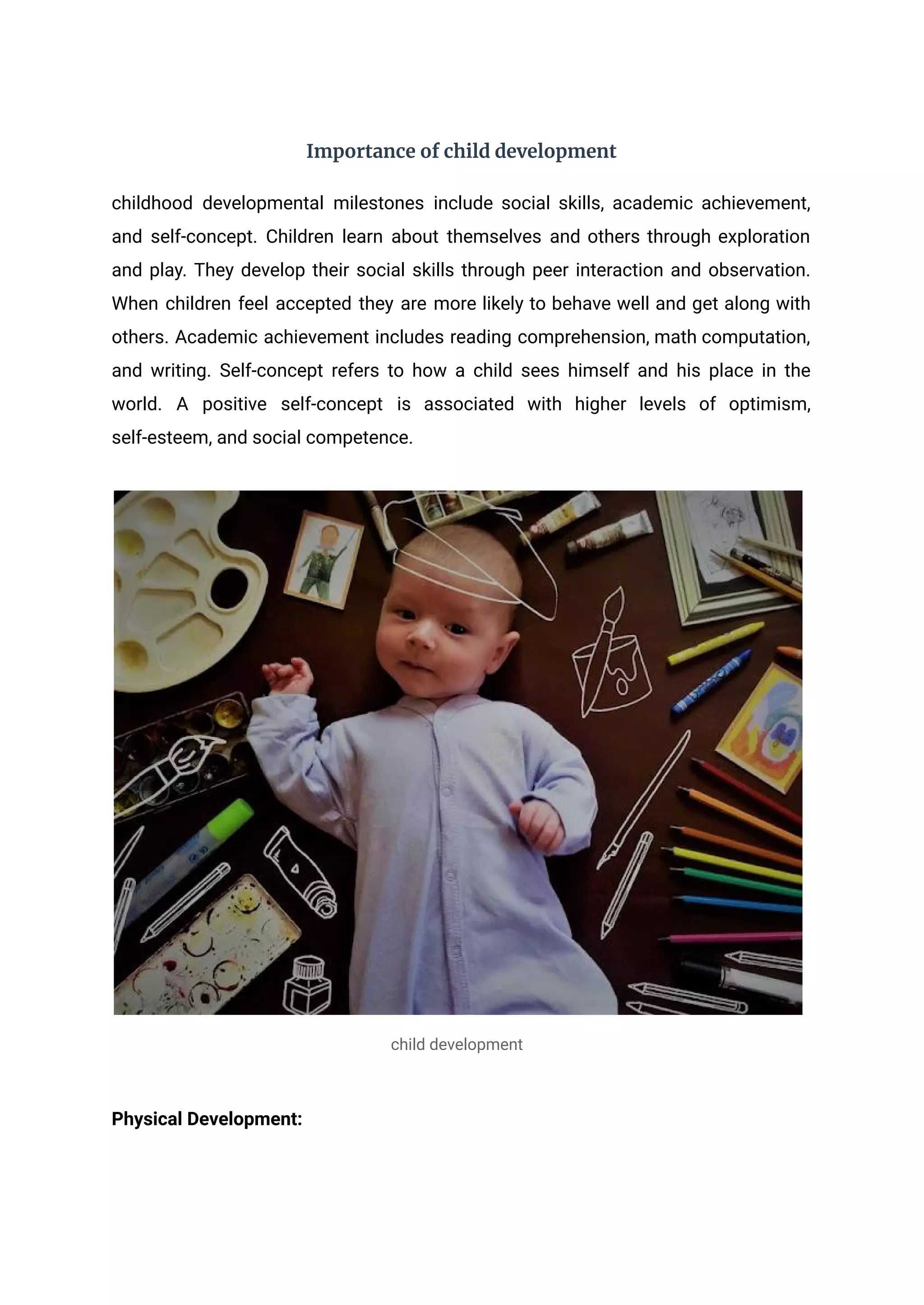
child development
Physical Development:
Physical development includes the development of muscles, bones, skin, hair, teeth,
and hearing. Children who participate in sports activities develop stronger bones,
muscles, and ligaments that make them less likely to get injured. Children need
consistent routine physical activity for proper development. Physical activity helps
children develop coordination, balance, muscle tone, endurance, and self-esteem.
Intellectual Development:
Intellectual development involves developing skills and abilities necessary for
thinking, problem-solving, reasoning, memory, and judgment. Children benefit from
learning how to read, write, do the math, use technology, explore their environment,
communicate, and establish friendships. Young children learn best through hands-on
experiences and play. Parents should encourage children to try different things and
explore their interests.
Emotional Development:
Emotional development includes developing social skills and coping mechanisms.
Children become aware of themselves and others at different ages. Emotional
development starts around age two and continues throughout childhood. At first,
parents tend to focus on teaching emotional regulation and discipline. As children
become older they continue to develop these skills. Parents should help children
cope with negative emotions such as anger, frustration, sadness, embarrassment,
jealousy, envy, and fear.
Spiritual Development:
Spiritual development refers to developing values and character traits. Children grow
spiritually by having faith in God, following rules, being honest, helping others,
respecting authority, making good decisions, appreciating nature, and enjoying time
together with family.
Learning:
Learning is very important at any age, however, children need to learn at different
rates than adults. Children may require shorter learning cycles than adults, and they
may have difficulty understanding abstract concepts. Also, children’s brains develop
differently from those of adults according to Dr. Peter Gray. As a result, children’s
thinking skills develop much slower than those of adults, and their brains are not fully
developed until the age of about eight years. However, some children do mature
earlier than others. There are many ways to promote learning in children including
reading books, playing games and doing puzzles, listening to music, going outside,
taking walks, and having conversations. Teachers should encourage children to use
their senses to help them memorize information by focusing on things such as
colors, shapes, sounds, textures, tastes, smells, and movements.
Physical Development:
Physical development refers to the body’s ability to perform its basic activities.
Children's bodies change rapidly during growth spurts lasting several months each
year. A growth spurt occurs when children reach puberty, which happens between
ages 8-12. At younger ages, children tend to spend less time exercising and playing
sports, although physical activity helps kids maintain a healthy weight, fitness, and
bone density. Young people who play sports regularly gain more muscle mass and
stamina, build stronger bones, and improve cardiovascular endurance compared to
non-athletes. Regular exercise also encourages proper posture and movement
patterns that will benefit the rest of a person’s life.
Social Development:
Socialization involves learning how to behave appropriately in society and
developing social skills. While children need to learn self-control, parents should
teach children how to interact and negotiate with peers during childhood. Parents
should try to understand what triggers negative behavior in their children and avoid
these situations to reinforce positive behaviors. In addition, parents should provide
opportunities for children to make friends. Good friends can enhance a child’s sense
of belonging, while poor friendships can reduce confidence and disrupt sleep,
leading to emotional disorders.
Language Development:
Language development is the foundation for literacy, reasoning, mathematics, and
science. To maximize language acquisition, parents should read to children often
and talk with them using simple sentences and short questions. Playing stimulating
games encourages children to think creatively and problem solve. Children who
practice math at home will likely excel in school, where teachers expect students to
perform mathematical calculations. Parents can help children become better readers
by teaching them how to recognize letters and words in print and by encouraging
them to listen to stories and poems.
Emotional Development:
Emotions influence our thoughts, feelings, and actions. Because emotions affect us
in both positive and negative ways, parents should encourage their children to
express their feelings. Children who feel loved and accepted by their parents, family
members, and peers develop a strong sense of self and enjoy successful
relationships later in life.
Moral Values:
Moral values refer to beliefs and standards related to right and wrong actions. By
instilling moral values in children, parents foster good character and a desire to treat
others well. Parents should emphasize the importance of honesty and fairness in
relationships and discourage lying, cheating, stealing, bullying, and other unethical
behaviors.
Cognitive Development:
Cognitive development involves the mental processes in which we store and retrieve
knowledge and experiences. It includes memory, perception, comprehension,
imagination, judgment, decision making, problem-solving, communication, creativity,
and leadership. Children develop cognitive abilities throughout childhood and
adolescence. These abilities continue to deepen and expand throughout adulthood.
Human Development Index (HDI):
The HDI is a measure of how well countries are performing in three broad
categories: 1) education, 2) income inequality, and 3) health. These categories help
us understand if countries are achieving their human potential, and they provide
insights into how well each country's citizens have access to basic freedoms and
opportunities. Because human development is a reflection of people's freedoms,
rights, and opportunities, we can use HDI as a way to track progress towards equality
among nations. A high HDI means that average citizens in a nation enjoy a good
standard of living and educational opportunities. As countries reach higher HDIs,
more people get access to higher levels of education, greater economic
opportunities, and better healthcare. Inequality between rich and poor gets smaller.
Child Mortality Rate (CMR):
Child mortality rates describe the number of children who die before reaching
adulthood per 1000 live births. When a country's CMR is low, fewer children die
before adulthood. Countries with lower CMRs tend to have longer life expectancies
and healthier populations. A rate of 10 deaths per 1000 births means that
approximately 10 percent of children do not survive until adulthood.
Infant Mortality Rate (IMR):
Infant mortality rates reflect the number of infants who die before the first birthday
per 100 live births. I'm telling us about the quality of care that parents receive during
pregnancy and after birth. Where infant death is uncommon, there are few chances
for maternal infections to occur and mothers may go through natural childbirth
without any medical intervention. On the contrary, where infant death is common,
many women may need assistance at birth, and infection is likely to spread
throughout the body.
Under-Five Mortality Rate (U5MR):
Under-five mortality rates show the number of under-fives who die before their fifth
birthday per 1000 live births. U5MRs indicate whether a society is making
investments to reduce infant mortality and improve nutritional status. One of the
ways that governments can decrease U5MRs is by providing children and families
access to clean water and sanitation facilities.
Prevalence of stunting:
Stunting refers to the physical shortening of the height of a person. Children whose
heights are two SD below the WHO median for age are considered to be stunted.
Stunting is caused by both genetic factors and environmental conditions.
Environmental conditions influence a child's cognitive ability and school
performance. Poor sanitation and hygiene result in intestinal parasites, which impair
digestion and cause nutrient loss. Infection and malnutrition contribute to diarrhea,
pneumonia, malaria, and measles, which lead to decreased immune function. There
is no cure for stunting, but nutrition interventions can prevent further decreases in
growth.
Immunization Coverage:
Immunizations protect children from illnesses that cause fever, convulsions, and
severe pain. They also prevent meningitis and encephalitis, which affect brain
functioning and can lead to long-term neurological damage. An immunization
campaign can increase awareness of the importance of immunizations and motivate
caregivers to vaccinate their children.

Importance of child development.pdf

  • 1.
    Importance of childdevelopment childhood developmental milestones include social skills, academic achievement, and self-concept. Children learn about themselves and others through exploration and play. They develop their social skills through peer interaction and observation. When children feel accepted they are more likely to behave well and get along with others. Academic achievement includes reading comprehension, math computation, and writing. Self-concept refers to how a child sees himself and his place in the world. A positive self-concept is associated with higher levels of optimism, self-esteem, and social competence. child development Physical Development:
  • 2.
    Physical development includesthe development of muscles, bones, skin, hair, teeth, and hearing. Children who participate in sports activities develop stronger bones, muscles, and ligaments that make them less likely to get injured. Children need consistent routine physical activity for proper development. Physical activity helps children develop coordination, balance, muscle tone, endurance, and self-esteem. Intellectual Development: Intellectual development involves developing skills and abilities necessary for thinking, problem-solving, reasoning, memory, and judgment. Children benefit from learning how to read, write, do the math, use technology, explore their environment, communicate, and establish friendships. Young children learn best through hands-on experiences and play. Parents should encourage children to try different things and explore their interests. Emotional Development: Emotional development includes developing social skills and coping mechanisms. Children become aware of themselves and others at different ages. Emotional development starts around age two and continues throughout childhood. At first, parents tend to focus on teaching emotional regulation and discipline. As children become older they continue to develop these skills. Parents should help children cope with negative emotions such as anger, frustration, sadness, embarrassment, jealousy, envy, and fear. Spiritual Development: Spiritual development refers to developing values and character traits. Children grow spiritually by having faith in God, following rules, being honest, helping others, respecting authority, making good decisions, appreciating nature, and enjoying time together with family. Learning: Learning is very important at any age, however, children need to learn at different rates than adults. Children may require shorter learning cycles than adults, and they
  • 3.
    may have difficultyunderstanding abstract concepts. Also, children’s brains develop differently from those of adults according to Dr. Peter Gray. As a result, children’s thinking skills develop much slower than those of adults, and their brains are not fully developed until the age of about eight years. However, some children do mature earlier than others. There are many ways to promote learning in children including reading books, playing games and doing puzzles, listening to music, going outside, taking walks, and having conversations. Teachers should encourage children to use their senses to help them memorize information by focusing on things such as colors, shapes, sounds, textures, tastes, smells, and movements. Physical Development: Physical development refers to the body’s ability to perform its basic activities. Children's bodies change rapidly during growth spurts lasting several months each year. A growth spurt occurs when children reach puberty, which happens between ages 8-12. At younger ages, children tend to spend less time exercising and playing sports, although physical activity helps kids maintain a healthy weight, fitness, and bone density. Young people who play sports regularly gain more muscle mass and stamina, build stronger bones, and improve cardiovascular endurance compared to non-athletes. Regular exercise also encourages proper posture and movement patterns that will benefit the rest of a person’s life. Social Development: Socialization involves learning how to behave appropriately in society and developing social skills. While children need to learn self-control, parents should teach children how to interact and negotiate with peers during childhood. Parents should try to understand what triggers negative behavior in their children and avoid these situations to reinforce positive behaviors. In addition, parents should provide opportunities for children to make friends. Good friends can enhance a child’s sense of belonging, while poor friendships can reduce confidence and disrupt sleep, leading to emotional disorders. Language Development:
  • 4.
    Language development isthe foundation for literacy, reasoning, mathematics, and science. To maximize language acquisition, parents should read to children often and talk with them using simple sentences and short questions. Playing stimulating games encourages children to think creatively and problem solve. Children who practice math at home will likely excel in school, where teachers expect students to perform mathematical calculations. Parents can help children become better readers by teaching them how to recognize letters and words in print and by encouraging them to listen to stories and poems. Emotional Development: Emotions influence our thoughts, feelings, and actions. Because emotions affect us in both positive and negative ways, parents should encourage their children to express their feelings. Children who feel loved and accepted by their parents, family members, and peers develop a strong sense of self and enjoy successful relationships later in life. Moral Values: Moral values refer to beliefs and standards related to right and wrong actions. By instilling moral values in children, parents foster good character and a desire to treat others well. Parents should emphasize the importance of honesty and fairness in relationships and discourage lying, cheating, stealing, bullying, and other unethical behaviors. Cognitive Development: Cognitive development involves the mental processes in which we store and retrieve knowledge and experiences. It includes memory, perception, comprehension, imagination, judgment, decision making, problem-solving, communication, creativity, and leadership. Children develop cognitive abilities throughout childhood and adolescence. These abilities continue to deepen and expand throughout adulthood. Human Development Index (HDI):
  • 5.
    The HDI isa measure of how well countries are performing in three broad categories: 1) education, 2) income inequality, and 3) health. These categories help us understand if countries are achieving their human potential, and they provide insights into how well each country's citizens have access to basic freedoms and opportunities. Because human development is a reflection of people's freedoms, rights, and opportunities, we can use HDI as a way to track progress towards equality among nations. A high HDI means that average citizens in a nation enjoy a good standard of living and educational opportunities. As countries reach higher HDIs, more people get access to higher levels of education, greater economic opportunities, and better healthcare. Inequality between rich and poor gets smaller. Child Mortality Rate (CMR): Child mortality rates describe the number of children who die before reaching adulthood per 1000 live births. When a country's CMR is low, fewer children die before adulthood. Countries with lower CMRs tend to have longer life expectancies and healthier populations. A rate of 10 deaths per 1000 births means that approximately 10 percent of children do not survive until adulthood. Infant Mortality Rate (IMR): Infant mortality rates reflect the number of infants who die before the first birthday per 100 live births. I'm telling us about the quality of care that parents receive during pregnancy and after birth. Where infant death is uncommon, there are few chances for maternal infections to occur and mothers may go through natural childbirth without any medical intervention. On the contrary, where infant death is common, many women may need assistance at birth, and infection is likely to spread throughout the body. Under-Five Mortality Rate (U5MR): Under-five mortality rates show the number of under-fives who die before their fifth birthday per 1000 live births. U5MRs indicate whether a society is making investments to reduce infant mortality and improve nutritional status. One of the
  • 6.
    ways that governmentscan decrease U5MRs is by providing children and families access to clean water and sanitation facilities. Prevalence of stunting: Stunting refers to the physical shortening of the height of a person. Children whose heights are two SD below the WHO median for age are considered to be stunted. Stunting is caused by both genetic factors and environmental conditions. Environmental conditions influence a child's cognitive ability and school performance. Poor sanitation and hygiene result in intestinal parasites, which impair digestion and cause nutrient loss. Infection and malnutrition contribute to diarrhea, pneumonia, malaria, and measles, which lead to decreased immune function. There is no cure for stunting, but nutrition interventions can prevent further decreases in growth. Immunization Coverage: Immunizations protect children from illnesses that cause fever, convulsions, and severe pain. They also prevent meningitis and encephalitis, which affect brain functioning and can lead to long-term neurological damage. An immunization campaign can increase awareness of the importance of immunizations and motivate caregivers to vaccinate their children.