IJRET: International Journal of Research in Engineering and Technology eISSN: 2319-1163 | pISSN: 2321-7308
_______________________________________________________________________________________
Volume: 05 Issue: 01 | Jan-2016, Available @ http://www.ijret.org 72
IMPLICATIONS OF HIGHWAY CAPACITY MANUAL ON FREEWAY
MEASURE OF EFFECTIVENESS: A CASE STUDY
Mohammad M Molla1
1
Graduate Research Assistant, Department of Civil and Environmental Engineering, North Dakota State University,
North Dakota, USA
Abstract
The Fargo-Moorhead Metropolitan Area’s rapid population and employment annual growth rate of 2.5 percent leading an
opportunity for transportation infrastructure development. The forecasted growth will add demand, new number of trips, persons,
vehicles, and vehicle hour travel, vehicle miles travel in the two principal Interstates (I-29 and I-94) in the Fargo-Moorhead
Metropolitan Area. Consequentially, due to the increasing demand, interstates planning performance could be affected
significantly in this area and will increase congestion, and thus, require a study with measuring of effectiveness in planning
context. Therefore, a study of interstate within the Fargo-Moorhead metro area will be performed with measuring the deficiencies
of several parameters such as volume, capacity, and level of service. The study will identify and provide guidance on congested
areas incurred due to the forecasted/induced travel demand.
Key Words: Interstate Operational Analysis, I-29 Corridor, I-94 Corridor, Travel Demand, and MPO
--------------------------------------------------------------------***----------------------------------------------------------------------
1. INTRODUCTION
1.1. Overview
The Fargo-Moorhead Metropolitan Planning Area (MPA)
lies in two counties, which is Cass County in North Dakota
and Clay County in Minnesota and 15 cities (Fargo, West
Fargo, Horace, Kindred, Mapleton, Casselton, Harwood,
Argusville, Oxbow Cities in North Dakota and Moorhead,
Dilworth, Sabin, Glydin, Hawley, Barnesville Cities in
Minnesota). According to US Census 2010, this MPA
population was 187,587 (Ulteigh and McKibben
Demographics Research, 2012). Since the current
population is more than two hundreds thousands, according
to (Transportation Research Board, 2012), this MPA could
be designated as medium size MPA. In this medium size
MPA; Fargo is one of the largest cities which hold 105,549
populations (more than 56 percent). According to 2014 long
range transportation plan, more than 95% of the workers
who lives in Cass and Clay counties works within Cass and
Clay county. The majority of the commuting working
pattern for this MPA is within the MPA.
Based on Federal Functional Classification System (Federal
Highway Administration, 2015) and (Fargo-Moorhead
Metropolitan Council of Governments, 2014), Interstates 29
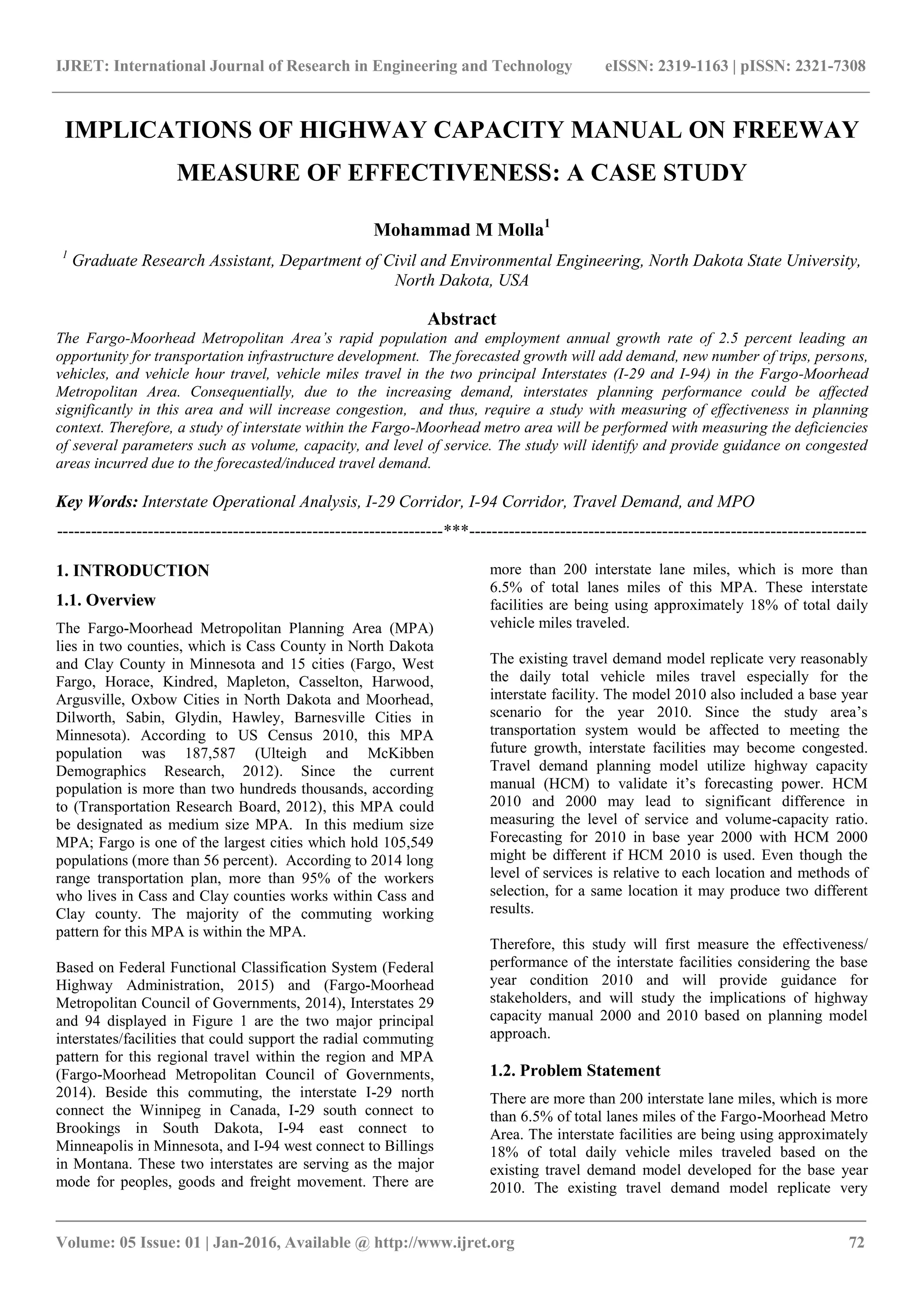
and 94 displayed in Figure 1 are the two major principal
interstates/facilities that could support the radial commuting
pattern for this regional travel within the region and MPA
(Fargo-Moorhead Metropolitan Council of Governments,
2014). Beside this commuting, the interstate I-29 north
connect the Winnipeg in Canada, I-29 south connect to
Brookings in South Dakota, I-94 east connect to
Minneapolis in Minnesota, and I-94 west connect to Billings
in Montana. These two interstates are serving as the major
mode for peoples, goods and freight movement. There are
more than 200 interstate lane miles, which is more than
6.5% of total lanes miles of this MPA. These interstate
facilities are being using approximately 18% of total daily
vehicle miles traveled.
The existing travel demand model replicate very reasonably
the daily total vehicle miles travel especially for the
interstate facility. The model 2010 also included a base year
scenario for the year 2010. Since the study area’s
transportation system would be affected to meeting the
future growth, interstate facilities may become congested.
Travel demand planning model utilize highway capacity
manual (HCM) to validate it’s forecasting power. HCM
2010 and 2000 may lead to significant difference in
measuring the level of service and volume-capacity ratio.
Forecasting for 2010 in base year 2000 with HCM 2000
might be different if HCM 2010 is used. Even though the
level of services is relative to each location and methods of
selection, for a same location it may produce two different
results.
Therefore, this study will first measure the effectiveness/
performance of the interstate facilities considering the base
year condition 2010 and will provide guidance for
stakeholders, and will study the implications of highway
capacity manual 2000 and 2010 based on planning model
approach.
1.2. Problem Statement
There are more than 200 interstate lane miles, which is more
than 6.5% of total lanes miles of the Fargo-Moorhead Metro
Area. The interstate facilities are being using approximately
18% of total daily vehicle miles traveled based on the
existing travel demand model developed for the base year
2010. The existing travel demand model replicate very
IJRET: International Journal of Research in Engineering and Technology eISSN: 2319-1163 | pISSN: 2321-7308
_______________________________________________________________________________________
Volume: 05 Issue: 01 | Jan-2016, Available @ http://www.ijret.org 73
reasonably the daily total vehicle miles travel especially for
the interstate facility. Since the study area’s transportation
system would be affected to meeting the future growth,
interstate facilities may become congested. Therefore, this
study will measure the effectiveness/performance of the
interstate facilities considering the base year condition 2010,
and will provide guidance for stakeholders, and will study
the implications of highway capacity manual 2000 and 2010
based on planning model approach.
Fig -1: Interstates Facilities in the Fargo-Moorhead
Metropolitan Area
1.3. Objective
This study will perform a case study with I-94 Eastbound
principal Interstate in the Fargo-Moorhead Metropolitan
Area. The study will identify and provide guidance on
congested areas on the freeway facilities incurred based on
future demand. The study will include the areas with
deficiencies in volume, capacity and level of services that
need to be improved towards meeting the demand. Finally,
the study will compare the implications of highway capacity
manual 2000 and 2010.
2. DATA COLLECTION, MODEL AND
METHODOLOGY
2.1. Study Area
This study area was limited to only Fargo-Moorhead
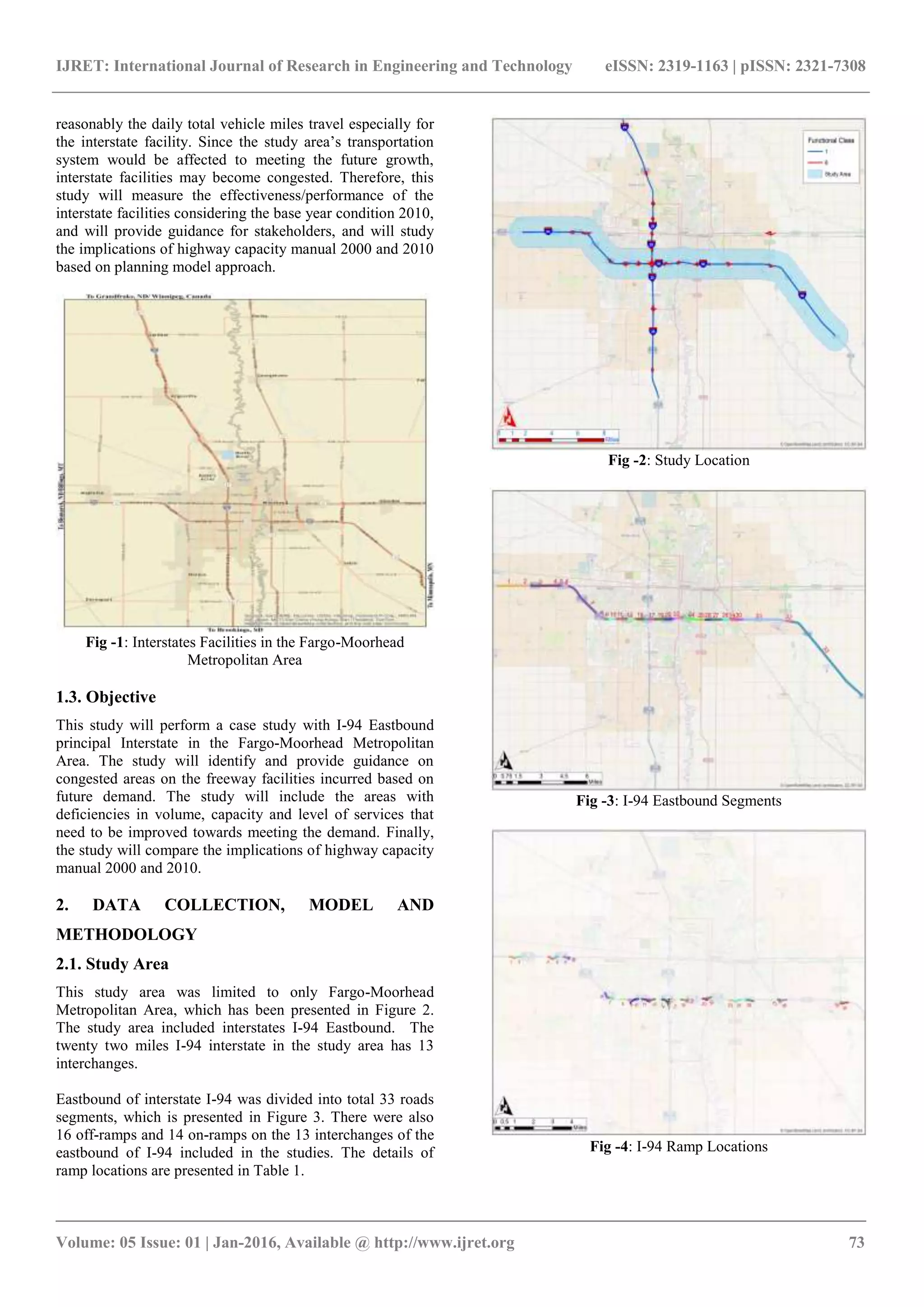
Metropolitan Area, which has been presented in Figure 2.
The study area included interstates I-94 Eastbound. The
twenty two miles I-94 interstate in the study area has 13
interchanges.
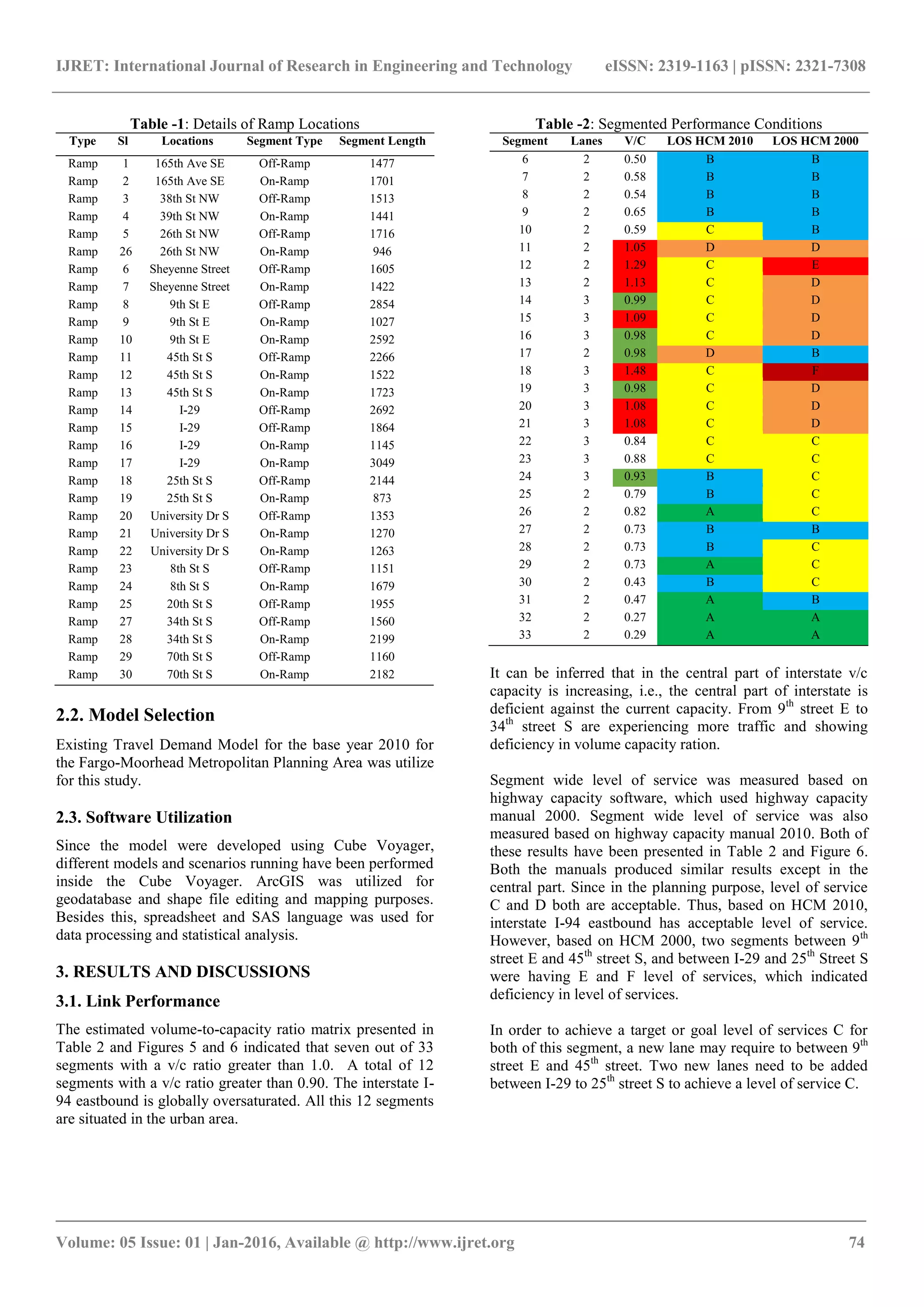
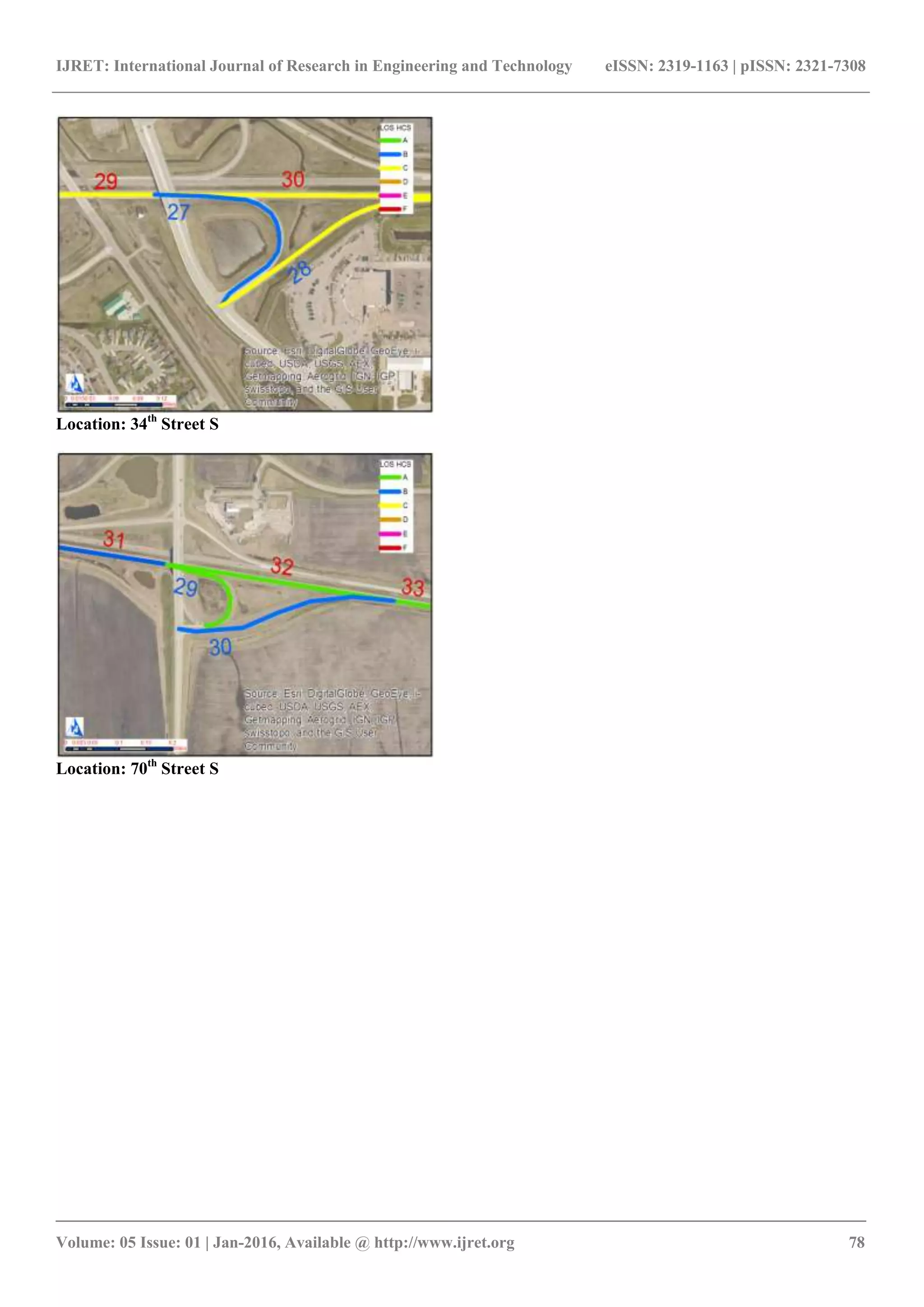
Eastbound of interstate I-94 was divided into total 33 roads
segments, which is presented in Figure 3. There were also
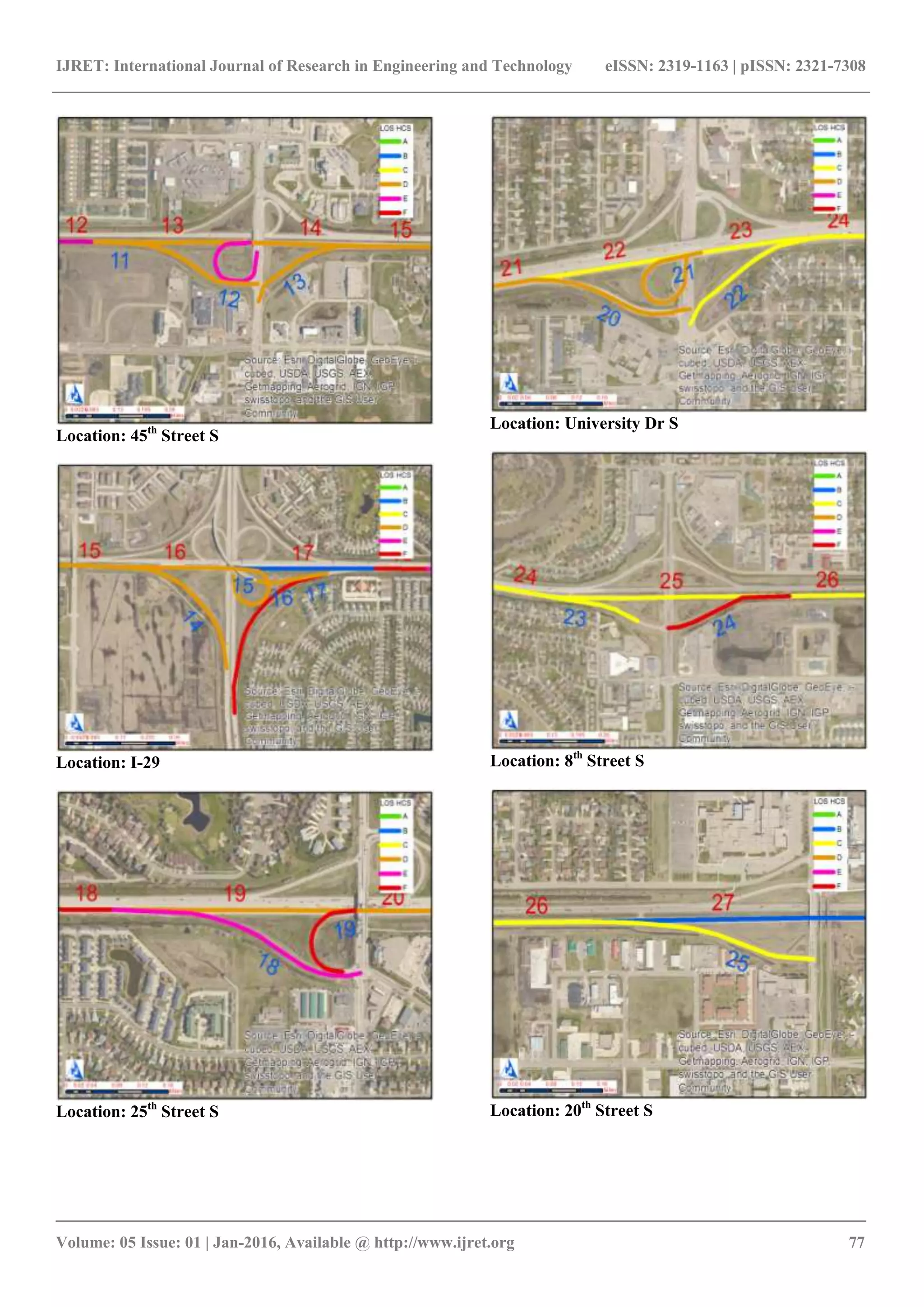
16 off-ramps and 14 on-ramps on the 13 interchanges of the
eastbound of I-94 included in the studies. The details of
ramp locations are presented in Table 1.
Fig -2: Study Location
Fig -3: I-94 Eastbound Segments
Fig -4: I-94 Ramp Locations
IJRET: International Journal of Research in Engineering and Technology eISSN: 2319-1163 | pISSN: 2321-7308
_______________________________________________________________________________________
Volume: 05 Issue: 01 | Jan-2016, Available @ http://www.ijret.org 74
Table -1: Details of Ramp Locations
Type Sl Locations Segment Type Segment Length
Ramp 1 165th Ave SE Off-Ramp 1477
Ramp 2 165th Ave SE On-Ramp 1701
Ramp 3 38th St NW Off-Ramp 1513
Ramp 4 39th St NW On-Ramp 1441
Ramp 5 26th St NW Off-Ramp 1716
Ramp 26 26th St NW On-Ramp 946
Ramp 6 Sheyenne Street Off-Ramp 1605
Ramp 7 Sheyenne Street On-Ramp 1422
Ramp 8 9th St E Off-Ramp 2854
Ramp 9 9th St E On-Ramp 1027
Ramp 10 9th St E On-Ramp 2592
Ramp 11 45th St S Off-Ramp 2266
Ramp 12 45th St S On-Ramp 1522
Ramp 13 45th St S On-Ramp 1723
Ramp 14 I-29 Off-Ramp 2692
Ramp 15 I-29 Off-Ramp 1864
Ramp 16 I-29 On-Ramp 1145
Ramp 17 I-29 On-Ramp 3049
Ramp 18 25th St S Off-Ramp 2144
Ramp 19 25th St S On-Ramp 873
Ramp 20 University Dr S Off-Ramp 1353
Ramp 21 University Dr S On-Ramp 1270
Ramp 22 University Dr S On-Ramp 1263
Ramp 23 8th St S Off-Ramp 1151
Ramp 24 8th St S On-Ramp 1679
Ramp 25 20th St S Off-Ramp 1955
Ramp 27 34th St S Off-Ramp 1560
Ramp 28 34th St S On-Ramp 2199
Ramp 29 70th St S Off-Ramp 1160
Ramp 30 70th St S On-Ramp 2182
2.2. Model Selection
Existing Travel Demand Model for the base year 2010 for
the Fargo-Moorhead Metropolitan Planning Area was utilize
for this study.
2.3. Software Utilization
Since the model were developed using Cube Voyager,
different models and scenarios running have been performed
inside the Cube Voyager. ArcGIS was utilized for
geodatabase and shape file editing and mapping purposes.
Besides this, spreadsheet and SAS language was used for
data processing and statistical analysis.
3. RESULTS AND DISCUSSIONS
3.1. Link Performance
The estimated volume-to-capacity ratio matrix presented in
Table 2 and Figures 5 and 6 indicated that seven out of 33
segments with a v/c ratio greater than 1.0. A total of 12
segments with a v/c ratio greater than 0.90. The interstate I-
94 eastbound is globally oversaturated. All this 12 segments
are situated in the urban area.
Table -2: Segmented Performance Conditions
Segment Lanes V/C LOS HCM 2010 LOS HCM 2000
6 2 0.50 B B
7 2 0.58 B B
8 2 0.54 B B
9 2 0.65 B B
10 2 0.59 C B
11 2 1.05 D D
12 2 1.29 C E
13 2 1.13 C D
14 3 0.99 C D
15 3 1.09 C D
16 3 0.98 C D
17 2 0.98 D B
18 3 1.48 C F
19 3 0.98 C D
20 3 1.08 C D
21 3 1.08 C D
22 3 0.84 C C
23 3 0.88 C C
24 3 0.93 B C
25 2 0.79 B C
26 2 0.82 A C
27 2 0.73 B B
28 2 0.73 B C
29 2 0.73 A C
30 2 0.43 B C
31 2 0.47 A B
32 2 0.27 A A
33 2 0.29 A A
It can be inferred that in the central part of interstate v/c
capacity is increasing, i.e., the central part of interstate is
deficient against the current capacity. From 9th
street E to
34th
street S are experiencing more traffic and showing
deficiency in volume capacity ration.
Segment wide level of service was measured based on
highway capacity software, which used highway capacity
manual 2000. Segment wide level of service was also
measured based on highway capacity manual 2010. Both of
these results have been presented in Table 2 and Figure 6.
Both the manuals produced similar results except in the
central part. Since in the planning purpose, level of service
C and D both are acceptable. Thus, based on HCM 2010,
interstate I-94 eastbound has acceptable level of service.
However, based on HCM 2000, two segments between 9th
street E and 45th
street S, and between I-29 and 25th
Street S
were having E and F level of services, which indicated
deficiency in level of services.
In order to achieve a target or goal level of services C for
both of this segment, a new lane may require to between 9th
street E and 45th
street. Two new lanes need to be added
between I-29 to 25th
street S to achieve a level of service C.
IJRET: International Journal of Research in Engineering and Technology eISSN: 2319-1163 | pISSN: 2321-7308
_______________________________________________________________________________________
Volume: 05 Issue: 01 | Jan-2016, Available @ http://www.ijret.org 75
Fig -5: V/C Ratio of Link Segments
Fig -6: Level of Service on I-94 Eastbound
3.2. Ramp Performance
Even though I-94 eastbound link segments is showing pretty
good level of services, however, 13 interchanges along the
eastbound are showing severely deficiency in level of
service in the central part of the metropolitan planning area.
Volume to capacity and level of service is presented in
Table 3. More details of each interchanges is included in
Appendix A.1.
It was revealed that five ramps located (on-ramp in 9th
St E,
off-ramp I-29, on-ramp I-29, 25th
St S off-ramp, and 8th
Street S off-ramp) is having severe volume to capacity ratio,
which was more than 1.0. Based on HCM 2010, four ramps
(off-ramp I-29, on-ramp I-29, 25th
St S off-ramp, and 8th
Street S off-ramps) are having level of service F and on-
ramp in 9th
St E are having level of service E. Since majority
of the ramp from 9th
St E to University Dr. S is deficient in
level of service, which has the similar case in link segment,
therefore, special focus is necessary for the deficient ramp
and areas. There are many ways the better level of service of
ramp could be attained. Here, addition of lanes approach
was considered. Adding one more lane on ramp segment
number 9 to 19 except ramp segment number 16 where two
more lanes requires defined in Table 3 may facilitate to
attain a desired level of service C.
Table -3: Performance of Interchanges
Segment Locations Segment Type V/C LOS HCM 2010 LOS HCM 2000
1 165th Ave SE Off-Ramp 0.07 A A
2 165th Ave SE On-Ramp 0.40 B B
3 38th St NW Off-Ramp 0.02 A B
4 39th St NW On-Ramp 0.23 A B
5 26th St NW Off-Ramp 0.03 A B
26 26th St NW On-Ramp 0.11 A B
6 Sheyenne Street Off-Ramp 0.09 A B
7 Sheyenne Street On-Ramp 0.25 A C
8 9th St E Off-Ramp 0.15 A B
9 9th St E On-Ramp 1.05 E F
10 9th St E On-Ramp 0.55 C F
11 45th St S Off-Ramp 0.36 B D
12 45th St S On-Ramp 0.80 D E
13 45th St S On-Ramp 0.35 B D
14 I-29 Off-Ramp 0.37 B D
15 I-29 Off-Ramp 1.12 F D
16 I-29 On-Ramp 2.06 F D
17 I-29 On-Ramp 0.75 D F
18 25th St S Off-Ramp 1.71 F E
19 25th St S On-Ramp 0.34 B F
20 University Dr S Off-Ramp 0.79 D D
21 University Dr S On-Ramp 0.12 A D
22 University Dr S On-Ramp 0.18 A C
23 8th St S Off-Ramp 1.37 F C
24 8th St S On-Ramp 0.07 A F
25 20th St S Off-Ramp 0.21 A C
27 34th St S Off-Ramp 0.68 D B
28 34th St S On-Ramp 0.09 A C
29 70th St S Off-Ramp 0.41 B A
30 70th St S On-Ramp 0.05 A B
The results revealed deficiencies of interstate I-94 eastbound
with respect to volume capacity ratio and level of services. It
can be concluded that the findings of the study indicated
potential problems of existing condition of interstate
facilities, which need to be under consideration seriously in
order to avoid the congestion. The result also reveals
significant difference in Highway Capacity Manual 2000
and 2010 in producing level of service measures.
4. CONCLUSIONS
This study compared the implications of highway capacity
manual 2010 and 2000 on measuring freeway level of
service and volume-capacity ratio. The study revealed
dissimilarity between the year 2000 and 2010. The study
presents a case study based on planning model approach.
However, the results could be useful to make suitable
transportation planning and decision making on freeway.
Road segment can be further divided into smaller pieces so
that details analysis would revealed better results.
REFERENCES
[1] Fargo-Moorhead Metropolitan Council of
Governments. (2014). 2014 Long Range Transporation
Plan. Fargo, ND.
[2] Federal Highway Administration. (2015, 3 26).
Highway Functional Classification: Concepts, Criteira
IJRET: International Journal of Research in Engineering and Technology eISSN: 2319-1163 | pISSN: 2321-7308
_______________________________________________________________________________________
Volume: 05 Issue: 01 | Jan-2016, Available @ http://www.ijret.org 76
and Procedures. Retrieved from
http://www.fhwa.dot.gov/planning/processes/statewide/
related/highway_functional_classifications/fcauab.pdf
[3] Transportation Research Board. (2000). Highway
Capacity Manual 2000. Washington, D.C.
[4] Transportation Research Board. (2007). Metropolitan
Travel Forecasting. Washington, D.C.
[5] Transportation Research Board. (2010). Highway
Capacity Manual. Washinton, D.C.
[6] Transportation Research Board. (2012). Travel Demand
Forecasting: Parameteres and Techniques, NCHRP
Report 716. Washington, D.C.
[7] Ulteigh and McKibben Demographics Research.
(2012). Demographic Forecast Study for the FM
Metropolitan Area. FArgo, ND. Retrieved 3 26, 2015,
from
http://www.fmmetrocog.org/new/assets/documents/Ma
ps/2012%20Demographic%20Forecast%20Final%20Re
port_Approved.pdf
APPENDIX A
A.1. I-94 Eastbound Interchange Details
Location: 165th
Ave SE
Location: 38th
Street NW
Location: 26th
Street NW
Location: Sheyenne Street
Location: 9th Street E
IJRET: International Journal of Research in Engineering and Technology eISSN: 2319-1163 | pISSN: 2321-7308
_______________________________________________________________________________________
Volume: 05 Issue: 01 | Jan-2016, Available @ http://www.ijret.org 77
Location: 45th
Street S
Location: I-29
Location: 25th
Street S
Location: University Dr S
Location: 8th
Street S
Location: 20th
Street S
IJRET: International Journal of Research in Engineering and Technology eISSN: 2319-1163 | pISSN: 2321-7308
_______________________________________________________________________________________
Volume: 05 Issue: 01 | Jan-2016, Available @ http://www.ijret.org 78
Location: 34th
Street S
Location: 70th
Street S

Implications of highway capacity manual on freeway measure of effectiveness a case study

  • 1.
    IJRET: International Journalof Research in Engineering and Technology eISSN: 2319-1163 | pISSN: 2321-7308 _______________________________________________________________________________________ Volume: 05 Issue: 01 | Jan-2016, Available @ http://www.ijret.org 72 IMPLICATIONS OF HIGHWAY CAPACITY MANUAL ON FREEWAY MEASURE OF EFFECTIVENESS: A CASE STUDY Mohammad M Molla1 1 Graduate Research Assistant, Department of Civil and Environmental Engineering, North Dakota State University, North Dakota, USA Abstract The Fargo-Moorhead Metropolitan Area’s rapid population and employment annual growth rate of 2.5 percent leading an opportunity for transportation infrastructure development. The forecasted growth will add demand, new number of trips, persons, vehicles, and vehicle hour travel, vehicle miles travel in the two principal Interstates (I-29 and I-94) in the Fargo-Moorhead Metropolitan Area. Consequentially, due to the increasing demand, interstates planning performance could be affected significantly in this area and will increase congestion, and thus, require a study with measuring of effectiveness in planning context. Therefore, a study of interstate within the Fargo-Moorhead metro area will be performed with measuring the deficiencies of several parameters such as volume, capacity, and level of service. The study will identify and provide guidance on congested areas incurred due to the forecasted/induced travel demand. Key Words: Interstate Operational Analysis, I-29 Corridor, I-94 Corridor, Travel Demand, and MPO --------------------------------------------------------------------***---------------------------------------------------------------------- 1. INTRODUCTION 1.1. Overview The Fargo-Moorhead Metropolitan Planning Area (MPA) lies in two counties, which is Cass County in North Dakota and Clay County in Minnesota and 15 cities (Fargo, West Fargo, Horace, Kindred, Mapleton, Casselton, Harwood, Argusville, Oxbow Cities in North Dakota and Moorhead, Dilworth, Sabin, Glydin, Hawley, Barnesville Cities in Minnesota). According to US Census 2010, this MPA population was 187,587 (Ulteigh and McKibben Demographics Research, 2012). Since the current population is more than two hundreds thousands, according to (Transportation Research Board, 2012), this MPA could be designated as medium size MPA. In this medium size MPA; Fargo is one of the largest cities which hold 105,549 populations (more than 56 percent). According to 2014 long range transportation plan, more than 95% of the workers who lives in Cass and Clay counties works within Cass and Clay county. The majority of the commuting working pattern for this MPA is within the MPA. Based on Federal Functional Classification System (Federal Highway Administration, 2015) and (Fargo-Moorhead Metropolitan Council of Governments, 2014), Interstates 29 and 94 displayed in Figure 1 are the two major principal interstates/facilities that could support the radial commuting pattern for this regional travel within the region and MPA (Fargo-Moorhead Metropolitan Council of Governments, 2014). Beside this commuting, the interstate I-29 north connect the Winnipeg in Canada, I-29 south connect to Brookings in South Dakota, I-94 east connect to Minneapolis in Minnesota, and I-94 west connect to Billings in Montana. These two interstates are serving as the major mode for peoples, goods and freight movement. There are more than 200 interstate lane miles, which is more than 6.5% of total lanes miles of this MPA. These interstate facilities are being using approximately 18% of total daily vehicle miles traveled. The existing travel demand model replicate very reasonably the daily total vehicle miles travel especially for the interstate facility. The model 2010 also included a base year scenario for the year 2010. Since the study area’s transportation system would be affected to meeting the future growth, interstate facilities may become congested. Travel demand planning model utilize highway capacity manual (HCM) to validate it’s forecasting power. HCM 2010 and 2000 may lead to significant difference in measuring the level of service and volume-capacity ratio. Forecasting for 2010 in base year 2000 with HCM 2000 might be different if HCM 2010 is used. Even though the level of services is relative to each location and methods of selection, for a same location it may produce two different results. Therefore, this study will first measure the effectiveness/ performance of the interstate facilities considering the base year condition 2010 and will provide guidance for stakeholders, and will study the implications of highway capacity manual 2000 and 2010 based on planning model approach. 1.2. Problem Statement There are more than 200 interstate lane miles, which is more than 6.5% of total lanes miles of the Fargo-Moorhead Metro Area. The interstate facilities are being using approximately 18% of total daily vehicle miles traveled based on the existing travel demand model developed for the base year 2010. The existing travel demand model replicate very
  • 2.
    IJRET: International Journalof Research in Engineering and Technology eISSN: 2319-1163 | pISSN: 2321-7308 _______________________________________________________________________________________ Volume: 05 Issue: 01 | Jan-2016, Available @ http://www.ijret.org 73 reasonably the daily total vehicle miles travel especially for the interstate facility. Since the study area’s transportation system would be affected to meeting the future growth, interstate facilities may become congested. Therefore, this study will measure the effectiveness/performance of the interstate facilities considering the base year condition 2010, and will provide guidance for stakeholders, and will study the implications of highway capacity manual 2000 and 2010 based on planning model approach. Fig -1: Interstates Facilities in the Fargo-Moorhead Metropolitan Area 1.3. Objective This study will perform a case study with I-94 Eastbound principal Interstate in the Fargo-Moorhead Metropolitan Area. The study will identify and provide guidance on congested areas on the freeway facilities incurred based on future demand. The study will include the areas with deficiencies in volume, capacity and level of services that need to be improved towards meeting the demand. Finally, the study will compare the implications of highway capacity manual 2000 and 2010. 2. DATA COLLECTION, MODEL AND METHODOLOGY 2.1. Study Area This study area was limited to only Fargo-Moorhead Metropolitan Area, which has been presented in Figure 2. The study area included interstates I-94 Eastbound. The twenty two miles I-94 interstate in the study area has 13 interchanges. Eastbound of interstate I-94 was divided into total 33 roads segments, which is presented in Figure 3. There were also 16 off-ramps and 14 on-ramps on the 13 interchanges of the eastbound of I-94 included in the studies. The details of ramp locations are presented in Table 1. Fig -2: Study Location Fig -3: I-94 Eastbound Segments Fig -4: I-94 Ramp Locations
  • 3.
    IJRET: International Journalof Research in Engineering and Technology eISSN: 2319-1163 | pISSN: 2321-7308 _______________________________________________________________________________________ Volume: 05 Issue: 01 | Jan-2016, Available @ http://www.ijret.org 74 Table -1: Details of Ramp Locations Type Sl Locations Segment Type Segment Length Ramp 1 165th Ave SE Off-Ramp 1477 Ramp 2 165th Ave SE On-Ramp 1701 Ramp 3 38th St NW Off-Ramp 1513 Ramp 4 39th St NW On-Ramp 1441 Ramp 5 26th St NW Off-Ramp 1716 Ramp 26 26th St NW On-Ramp 946 Ramp 6 Sheyenne Street Off-Ramp 1605 Ramp 7 Sheyenne Street On-Ramp 1422 Ramp 8 9th St E Off-Ramp 2854 Ramp 9 9th St E On-Ramp 1027 Ramp 10 9th St E On-Ramp 2592 Ramp 11 45th St S Off-Ramp 2266 Ramp 12 45th St S On-Ramp 1522 Ramp 13 45th St S On-Ramp 1723 Ramp 14 I-29 Off-Ramp 2692 Ramp 15 I-29 Off-Ramp 1864 Ramp 16 I-29 On-Ramp 1145 Ramp 17 I-29 On-Ramp 3049 Ramp 18 25th St S Off-Ramp 2144 Ramp 19 25th St S On-Ramp 873 Ramp 20 University Dr S Off-Ramp 1353 Ramp 21 University Dr S On-Ramp 1270 Ramp 22 University Dr S On-Ramp 1263 Ramp 23 8th St S Off-Ramp 1151 Ramp 24 8th St S On-Ramp 1679 Ramp 25 20th St S Off-Ramp 1955 Ramp 27 34th St S Off-Ramp 1560 Ramp 28 34th St S On-Ramp 2199 Ramp 29 70th St S Off-Ramp 1160 Ramp 30 70th St S On-Ramp 2182 2.2. Model Selection Existing Travel Demand Model for the base year 2010 for the Fargo-Moorhead Metropolitan Planning Area was utilize for this study. 2.3. Software Utilization Since the model were developed using Cube Voyager, different models and scenarios running have been performed inside the Cube Voyager. ArcGIS was utilized for geodatabase and shape file editing and mapping purposes. Besides this, spreadsheet and SAS language was used for data processing and statistical analysis. 3. RESULTS AND DISCUSSIONS 3.1. Link Performance The estimated volume-to-capacity ratio matrix presented in Table 2 and Figures 5 and 6 indicated that seven out of 33 segments with a v/c ratio greater than 1.0. A total of 12 segments with a v/c ratio greater than 0.90. The interstate I- 94 eastbound is globally oversaturated. All this 12 segments are situated in the urban area. Table -2: Segmented Performance Conditions Segment Lanes V/C LOS HCM 2010 LOS HCM 2000 6 2 0.50 B B 7 2 0.58 B B 8 2 0.54 B B 9 2 0.65 B B 10 2 0.59 C B 11 2 1.05 D D 12 2 1.29 C E 13 2 1.13 C D 14 3 0.99 C D 15 3 1.09 C D 16 3 0.98 C D 17 2 0.98 D B 18 3 1.48 C F 19 3 0.98 C D 20 3 1.08 C D 21 3 1.08 C D 22 3 0.84 C C 23 3 0.88 C C 24 3 0.93 B C 25 2 0.79 B C 26 2 0.82 A C 27 2 0.73 B B 28 2 0.73 B C 29 2 0.73 A C 30 2 0.43 B C 31 2 0.47 A B 32 2 0.27 A A 33 2 0.29 A A It can be inferred that in the central part of interstate v/c capacity is increasing, i.e., the central part of interstate is deficient against the current capacity. From 9th street E to 34th street S are experiencing more traffic and showing deficiency in volume capacity ration. Segment wide level of service was measured based on highway capacity software, which used highway capacity manual 2000. Segment wide level of service was also measured based on highway capacity manual 2010. Both of these results have been presented in Table 2 and Figure 6. Both the manuals produced similar results except in the central part. Since in the planning purpose, level of service C and D both are acceptable. Thus, based on HCM 2010, interstate I-94 eastbound has acceptable level of service. However, based on HCM 2000, two segments between 9th street E and 45th street S, and between I-29 and 25th Street S were having E and F level of services, which indicated deficiency in level of services. In order to achieve a target or goal level of services C for both of this segment, a new lane may require to between 9th street E and 45th street. Two new lanes need to be added between I-29 to 25th street S to achieve a level of service C.
  • 4.
    IJRET: International Journalof Research in Engineering and Technology eISSN: 2319-1163 | pISSN: 2321-7308 _______________________________________________________________________________________ Volume: 05 Issue: 01 | Jan-2016, Available @ http://www.ijret.org 75 Fig -5: V/C Ratio of Link Segments Fig -6: Level of Service on I-94 Eastbound 3.2. Ramp Performance Even though I-94 eastbound link segments is showing pretty good level of services, however, 13 interchanges along the eastbound are showing severely deficiency in level of service in the central part of the metropolitan planning area. Volume to capacity and level of service is presented in Table 3. More details of each interchanges is included in Appendix A.1. It was revealed that five ramps located (on-ramp in 9th St E, off-ramp I-29, on-ramp I-29, 25th St S off-ramp, and 8th Street S off-ramp) is having severe volume to capacity ratio, which was more than 1.0. Based on HCM 2010, four ramps (off-ramp I-29, on-ramp I-29, 25th St S off-ramp, and 8th Street S off-ramps) are having level of service F and on- ramp in 9th St E are having level of service E. Since majority of the ramp from 9th St E to University Dr. S is deficient in level of service, which has the similar case in link segment, therefore, special focus is necessary for the deficient ramp and areas. There are many ways the better level of service of ramp could be attained. Here, addition of lanes approach was considered. Adding one more lane on ramp segment number 9 to 19 except ramp segment number 16 where two more lanes requires defined in Table 3 may facilitate to attain a desired level of service C. Table -3: Performance of Interchanges Segment Locations Segment Type V/C LOS HCM 2010 LOS HCM 2000 1 165th Ave SE Off-Ramp 0.07 A A 2 165th Ave SE On-Ramp 0.40 B B 3 38th St NW Off-Ramp 0.02 A B 4 39th St NW On-Ramp 0.23 A B 5 26th St NW Off-Ramp 0.03 A B 26 26th St NW On-Ramp 0.11 A B 6 Sheyenne Street Off-Ramp 0.09 A B 7 Sheyenne Street On-Ramp 0.25 A C 8 9th St E Off-Ramp 0.15 A B 9 9th St E On-Ramp 1.05 E F 10 9th St E On-Ramp 0.55 C F 11 45th St S Off-Ramp 0.36 B D 12 45th St S On-Ramp 0.80 D E 13 45th St S On-Ramp 0.35 B D 14 I-29 Off-Ramp 0.37 B D 15 I-29 Off-Ramp 1.12 F D 16 I-29 On-Ramp 2.06 F D 17 I-29 On-Ramp 0.75 D F 18 25th St S Off-Ramp 1.71 F E 19 25th St S On-Ramp 0.34 B F 20 University Dr S Off-Ramp 0.79 D D 21 University Dr S On-Ramp 0.12 A D 22 University Dr S On-Ramp 0.18 A C 23 8th St S Off-Ramp 1.37 F C 24 8th St S On-Ramp 0.07 A F 25 20th St S Off-Ramp 0.21 A C 27 34th St S Off-Ramp 0.68 D B 28 34th St S On-Ramp 0.09 A C 29 70th St S Off-Ramp 0.41 B A 30 70th St S On-Ramp 0.05 A B The results revealed deficiencies of interstate I-94 eastbound with respect to volume capacity ratio and level of services. It can be concluded that the findings of the study indicated potential problems of existing condition of interstate facilities, which need to be under consideration seriously in order to avoid the congestion. The result also reveals significant difference in Highway Capacity Manual 2000 and 2010 in producing level of service measures. 4. CONCLUSIONS This study compared the implications of highway capacity manual 2010 and 2000 on measuring freeway level of service and volume-capacity ratio. The study revealed dissimilarity between the year 2000 and 2010. The study presents a case study based on planning model approach. However, the results could be useful to make suitable transportation planning and decision making on freeway. Road segment can be further divided into smaller pieces so that details analysis would revealed better results. REFERENCES [1] Fargo-Moorhead Metropolitan Council of Governments. (2014). 2014 Long Range Transporation Plan. Fargo, ND. [2] Federal Highway Administration. (2015, 3 26). Highway Functional Classification: Concepts, Criteira
  • 5.
    IJRET: International Journalof Research in Engineering and Technology eISSN: 2319-1163 | pISSN: 2321-7308 _______________________________________________________________________________________ Volume: 05 Issue: 01 | Jan-2016, Available @ http://www.ijret.org 76 and Procedures. Retrieved from http://www.fhwa.dot.gov/planning/processes/statewide/ related/highway_functional_classifications/fcauab.pdf [3] Transportation Research Board. (2000). Highway Capacity Manual 2000. Washington, D.C. [4] Transportation Research Board. (2007). Metropolitan Travel Forecasting. Washington, D.C. [5] Transportation Research Board. (2010). Highway Capacity Manual. Washinton, D.C. [6] Transportation Research Board. (2012). Travel Demand Forecasting: Parameteres and Techniques, NCHRP Report 716. Washington, D.C. [7] Ulteigh and McKibben Demographics Research. (2012). Demographic Forecast Study for the FM Metropolitan Area. FArgo, ND. Retrieved 3 26, 2015, from http://www.fmmetrocog.org/new/assets/documents/Ma ps/2012%20Demographic%20Forecast%20Final%20Re port_Approved.pdf APPENDIX A A.1. I-94 Eastbound Interchange Details Location: 165th Ave SE Location: 38th Street NW Location: 26th Street NW Location: Sheyenne Street Location: 9th Street E
  • 6.
    IJRET: International Journalof Research in Engineering and Technology eISSN: 2319-1163 | pISSN: 2321-7308 _______________________________________________________________________________________ Volume: 05 Issue: 01 | Jan-2016, Available @ http://www.ijret.org 77 Location: 45th Street S Location: I-29 Location: 25th Street S Location: University Dr S Location: 8th Street S Location: 20th Street S
  • 7.
    IJRET: International Journalof Research in Engineering and Technology eISSN: 2319-1163 | pISSN: 2321-7308 _______________________________________________________________________________________ Volume: 05 Issue: 01 | Jan-2016, Available @ http://www.ijret.org 78 Location: 34th Street S Location: 70th Street S