PERFORMANCE MANAGEMENT SYSTEMS
AND ASSESSMENT CENTERS Module 1
WHAT IS PERFORMANCE?
Activity – Understand the job of
Nurse
Police Officer
Politician
Janitor
Shop floor worker in a production unit
DEFINITION
Performance of an individual in an organizational setting may be defined
as the output delivered by an individual in relation to a given role
during a particular period of time under the set of circumstances
operating at that point of time
PERFORMANCE IS AFFECTED BY
ability (competence of a person in technical, managerial, human
relations, conceptual and abstract thinking, which is reflected through
knowledge, attitude, traits, qualities, values and skills)
motivation ( reflected through hard work, commitment and other such
behavior on the job)
Organizational support ( the extent to which a person receives support
from his/her boss and others in the organization to do the work well)
Chance factors
WHAT IS PERFORMANCE MANAGEMENT?
•Performance management involves thinking through facets of performance,
identifying critical dimensions of performance, planning, reviewing,
developing and enhancing performance and related competencies.
•“Performance management is the continuous process of improving perfor-
mance by setting individual and team goals which are aligned to the strate-
gic goals of the organization, planning performance to achieve the goals,
reviewing and assessing progress, and developing the knowledge, skills,
and abilities of people.”
WHAT IS PERFORMANCE MANAGEMENT?
•Performance management is a continuous process of identifying,
measuring and developing the performance of individuals and teams and
aligning performance with the strategic goals of the organization.
DIMENSIONS OF PERFORMANCE
•Output or result dimension
•Input dimension
•Time dimension
•Focus dimension
•Quality dimension
•Cost dimension
•Dyadic performance dimension
•Team performance dimension
THREE LEVELS OF MEASURING PERFORMANCE
•Individual level
•Group / Team level
•Organizational level
APPROACHES TO MEASURING PERFORMANCE
Behaviors – what an individual does/how an individual conducts
oneself, especially towards others
Traits – quality than an individual possess
Results
IDENTIFY
persistent
ambitious
open-minded
cautious
quiet
adaptive
loyal
generous
Respect
others
kind
sincere
Listen to
others
Being kind
PERFORMANCE MANAGEMENT SYSTEM (PMS)
It is a systematic process through which the organization aligns its
mission, goals, and objectives with available resources (e.g. Manpower,
material, etc.), systems, and set the priorities
A performance management system is a technologically driven process
for tracking the performance of employees consistently and
measurably.
A performance management system encompasses the processes that
an organization takes to facilitate effective and clear communication
between the supervisors and employees.
Purpose
Strategic
Administrative
Communication
Developmental
Organizational
maintenance
Documentation
ADVANTAGES OF PMS
Definitions of job and criteria and general understanding of organizational
goals are clarified
Motivation to perform increases
Managers gain insights about team members
Administrative actions are more fair and appropriate
Better protection from lawsuits
Organizational change is facilitated
Employees become more competent
AN IDEAL PERFORMANCE MANAGEMENT SYSTEM
•Congruent with strategy (there is a clear link among individual, unit and
organizational goals)
•Thorough (they include all relevant performance dimensions)
•Practical (they do not require excessive time and resources)
•Meaningful (they have important consequences)
•Specific (they provide a concrete employee improvement agenda)
•Ability to identify effective and ineffective performance (help
distinguish employees at different performance levels)
•Reliable (the measurement of performance is consistent)
•Valid (the measurement of performance is not contaminated or
deficient)
AN IDEAL PERFORMANCE MANAGEMENT SYSTEM
•Fair (people participating in the system believe the processes and
outcomes are just)
•Inclusive (they include input from multiple sources on an ongoing basis)
•Open (transparency is maintained)
•Correctable (they include mechanisms so that errors can be corrected)
•Standardized (performance is evaluated consistently across people and
time)
•Ethical (comply with ethical standards)
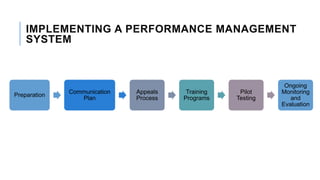
IMPLEMENTING A PERFORMANCE MANAGEMENT
SYSTEM
Preparation
Communication
Plan
Appeals
Process
Training
Programs
Pilot
Testing
Ongoing
Monitoring
and
Evaluation
PREPARATION
Need to gain system buy-in through:
 Communication plan regarding Performance Management system
 Including appeals process
 Training programs for raters
 Pilot testing system
 Ongoing monitoring and evaluation
COMMUNICATION PLAN ANSWERS
What is Performance Management (PM)?
How does PM fit in our strategy?
What’s in it for me?
How does it work?
What are our roles and responsibilities?
How does PM relate to other initiatives?
COGNITIVE BIASES THAT AFFECT
COMMUNICATIONS EFFECTIVENESS
Selective exposure
Selective perception
Selective retention
TO MINIMIZE EFFECTS OF COGNITIVE BIASES
A. Consider employees- Involve employees in system design, Show how
employee needs are met
B. Emphasize the positive- Use credible communicators, Strike first –
create positive attitude, Provide facts and conclusions
C. Repeat, document, be consistent- Put it in writing, Use multiple
channels of communication, Say it, and then – say it again
APPEALS PROCESS
Promote Employee buy-in to PM system
 Amicable/Non-retaliatory
 Resolution of disagreements
APPEALS PROCESS
Employees can question two types of issues:
 Judgmental - (validity of evaluation)
 Administrative - (whether policies and procedures were followed)
APPEALS PROCESS
Level 1
 HR reviews facts, policies, procedures
 HR reports to supervisor/employee
 HR attempts to negotiate settlement
Level 2
 Arbitrator (panel of peers and managers) and/or
 High-level manager – final decision
RATER TRAINING PROGRAMS
Content Areas to include
•Information - how the system works, Reasons for implementing the
performance management system, the appraisal form, system mechanics
•Identifying, Observing, Recording, Evaluating - How to identify and rank
job activities, How to observe, record, and measure performance, How to
minimize rating errors
•How to Interact with Employees - when they receive performance
information, How to conduct an appraisal interview, How to train, counsel,
and coach
RATER TRAINING PROGRAMS
Choices of Training Programs to implement
 Rater Error Training
 Frame of Reference Training
 Behavioral Observation
 Self-leadership Training
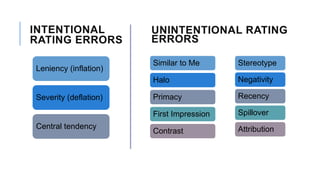
INTENTIONAL
RATING ERRORS
Leniency (inflation)
Severity (deflation)
Central tendency
UNINTENTIONAL RATING
ERRORS
Similar to Me
Halo
Primacy
First Impression
Contrast
Stereotype
Negativity
Recency
Spillover
Attribution
PILOT TESTING
Provides ability to
 Discover potential problems and fix them
 Has several benefits - Gain information from potential participants,
Learn about difficulties/obstacles, Collect recommendations on how to
improve, Understand personal reactions, Get early buy-in, Get higher
rate of acceptance
IMPLEMENTING A PILOT TEST
Roll out test version with sample group
 Staff and jobs generalizable to organization
Fully implement planned system
 All participants keep records of issues encountered
 Do not record appraisal scores
 Collect input from all participants
ONGOING MONITORING AND EVALUATION
When system is implemented, decide:
•How to evaluate system effectiveness - Reactions to the system,
Assessments of requirements –both Operational and Technical,
Effectiveness of performance ratings
•How to measure implementation
•How to measure results
INDICATORS TO CONSIDER
oNumber of individuals evaluated
oDistribution of performance ratings
oQuality of information
oQuality of performance discussion meetings
oSystem satisfaction
oCost/benefit ratio
oUnit-level and organization-level performance
SOME IMPORTANT TERMINOLOGIES IN PMS
KPA
KRA
PI/KPI
Performance standard

Performance Management system.pptx

  • 1.
    PERFORMANCE MANAGEMENT SYSTEMS ANDASSESSMENT CENTERS Module 1
  • 2.
    WHAT IS PERFORMANCE? Activity– Understand the job of Nurse Police Officer Politician Janitor Shop floor worker in a production unit
  • 3.
    DEFINITION Performance of anindividual in an organizational setting may be defined as the output delivered by an individual in relation to a given role during a particular period of time under the set of circumstances operating at that point of time
  • 4.
    PERFORMANCE IS AFFECTEDBY ability (competence of a person in technical, managerial, human relations, conceptual and abstract thinking, which is reflected through knowledge, attitude, traits, qualities, values and skills) motivation ( reflected through hard work, commitment and other such behavior on the job) Organizational support ( the extent to which a person receives support from his/her boss and others in the organization to do the work well) Chance factors
  • 5.
    WHAT IS PERFORMANCEMANAGEMENT? •Performance management involves thinking through facets of performance, identifying critical dimensions of performance, planning, reviewing, developing and enhancing performance and related competencies. •“Performance management is the continuous process of improving perfor- mance by setting individual and team goals which are aligned to the strate- gic goals of the organization, planning performance to achieve the goals, reviewing and assessing progress, and developing the knowledge, skills, and abilities of people.”
  • 6.
    WHAT IS PERFORMANCEMANAGEMENT? •Performance management is a continuous process of identifying, measuring and developing the performance of individuals and teams and aligning performance with the strategic goals of the organization.
  • 7.
    DIMENSIONS OF PERFORMANCE •Outputor result dimension •Input dimension •Time dimension •Focus dimension •Quality dimension •Cost dimension •Dyadic performance dimension •Team performance dimension
  • 8.
    THREE LEVELS OFMEASURING PERFORMANCE •Individual level •Group / Team level •Organizational level
  • 9.
    APPROACHES TO MEASURINGPERFORMANCE Behaviors – what an individual does/how an individual conducts oneself, especially towards others Traits – quality than an individual possess Results
  • 10.
  • 11.
    PERFORMANCE MANAGEMENT SYSTEM(PMS) It is a systematic process through which the organization aligns its mission, goals, and objectives with available resources (e.g. Manpower, material, etc.), systems, and set the priorities A performance management system is a technologically driven process for tracking the performance of employees consistently and measurably. A performance management system encompasses the processes that an organization takes to facilitate effective and clear communication between the supervisors and employees.
  • 12.
  • 13.
    ADVANTAGES OF PMS Definitionsof job and criteria and general understanding of organizational goals are clarified Motivation to perform increases Managers gain insights about team members Administrative actions are more fair and appropriate Better protection from lawsuits Organizational change is facilitated Employees become more competent
  • 14.
    AN IDEAL PERFORMANCEMANAGEMENT SYSTEM •Congruent with strategy (there is a clear link among individual, unit and organizational goals) •Thorough (they include all relevant performance dimensions) •Practical (they do not require excessive time and resources) •Meaningful (they have important consequences) •Specific (they provide a concrete employee improvement agenda) •Ability to identify effective and ineffective performance (help distinguish employees at different performance levels) •Reliable (the measurement of performance is consistent) •Valid (the measurement of performance is not contaminated or deficient)
  • 15.
    AN IDEAL PERFORMANCEMANAGEMENT SYSTEM •Fair (people participating in the system believe the processes and outcomes are just) •Inclusive (they include input from multiple sources on an ongoing basis) •Open (transparency is maintained) •Correctable (they include mechanisms so that errors can be corrected) •Standardized (performance is evaluated consistently across people and time) •Ethical (comply with ethical standards)
  • 16.
    IMPLEMENTING A PERFORMANCEMANAGEMENT SYSTEM Preparation Communication Plan Appeals Process Training Programs Pilot Testing Ongoing Monitoring and Evaluation
  • 17.
    PREPARATION Need to gainsystem buy-in through:  Communication plan regarding Performance Management system  Including appeals process  Training programs for raters  Pilot testing system  Ongoing monitoring and evaluation
  • 18.
    COMMUNICATION PLAN ANSWERS Whatis Performance Management (PM)? How does PM fit in our strategy? What’s in it for me? How does it work? What are our roles and responsibilities? How does PM relate to other initiatives?
  • 19.
    COGNITIVE BIASES THATAFFECT COMMUNICATIONS EFFECTIVENESS Selective exposure Selective perception Selective retention
  • 20.
    TO MINIMIZE EFFECTSOF COGNITIVE BIASES A. Consider employees- Involve employees in system design, Show how employee needs are met B. Emphasize the positive- Use credible communicators, Strike first – create positive attitude, Provide facts and conclusions C. Repeat, document, be consistent- Put it in writing, Use multiple channels of communication, Say it, and then – say it again
  • 21.
    APPEALS PROCESS Promote Employeebuy-in to PM system  Amicable/Non-retaliatory  Resolution of disagreements
  • 22.
    APPEALS PROCESS Employees canquestion two types of issues:  Judgmental - (validity of evaluation)  Administrative - (whether policies and procedures were followed)
  • 23.
    APPEALS PROCESS Level 1 HR reviews facts, policies, procedures  HR reports to supervisor/employee  HR attempts to negotiate settlement Level 2  Arbitrator (panel of peers and managers) and/or  High-level manager – final decision
  • 24.
    RATER TRAINING PROGRAMS ContentAreas to include •Information - how the system works, Reasons for implementing the performance management system, the appraisal form, system mechanics •Identifying, Observing, Recording, Evaluating - How to identify and rank job activities, How to observe, record, and measure performance, How to minimize rating errors •How to Interact with Employees - when they receive performance information, How to conduct an appraisal interview, How to train, counsel, and coach
  • 25.
    RATER TRAINING PROGRAMS Choicesof Training Programs to implement  Rater Error Training  Frame of Reference Training  Behavioral Observation  Self-leadership Training
  • 26.
    INTENTIONAL RATING ERRORS Leniency (inflation) Severity(deflation) Central tendency UNINTENTIONAL RATING ERRORS Similar to Me Halo Primacy First Impression Contrast Stereotype Negativity Recency Spillover Attribution
  • 27.
    PILOT TESTING Provides abilityto  Discover potential problems and fix them  Has several benefits - Gain information from potential participants, Learn about difficulties/obstacles, Collect recommendations on how to improve, Understand personal reactions, Get early buy-in, Get higher rate of acceptance
  • 28.
    IMPLEMENTING A PILOTTEST Roll out test version with sample group  Staff and jobs generalizable to organization Fully implement planned system  All participants keep records of issues encountered  Do not record appraisal scores  Collect input from all participants
  • 29.
    ONGOING MONITORING ANDEVALUATION When system is implemented, decide: •How to evaluate system effectiveness - Reactions to the system, Assessments of requirements –both Operational and Technical, Effectiveness of performance ratings •How to measure implementation •How to measure results
  • 30.
    INDICATORS TO CONSIDER oNumberof individuals evaluated oDistribution of performance ratings oQuality of information oQuality of performance discussion meetings oSystem satisfaction oCost/benefit ratio oUnit-level and organization-level performance
  • 31.
    SOME IMPORTANT TERMINOLOGIESIN PMS KPA KRA PI/KPI Performance standard