TALENT MANAGEMENT Ritika Agarwal Swetha  G.k. Ankit  Sahney Jaydeep Ghosh Rakesh  Patawari Siddharth Kumar
DEFINITION Talent management implies recognising a person's inherent skills, traits, personality and offering him a matching job. Every person has a unique talent that suits a particular job profile and any other position will cause discomfort.
Benefits The  Organisation  benefits from: Increased productivity and capability; a better linkage between individuals' efforts and business goals; commitment of valued employees; reduced turnover; increased bench strength and a better fit between people's jobs and skills.  Employees  benefit from: Higher motivation and commitment; career development; increased knowledge about and contribution to company goals; sustained motivation and job satisfaction.
INTRODUCTION Traditional method of talent management is usually understood to mean systematic efforts to recruit, develop and retain highly productive and promotable people. But the needs of business really go beyond that. There is a need to think beyond traditional talent management to Next Generation Talent Management (NGTM).
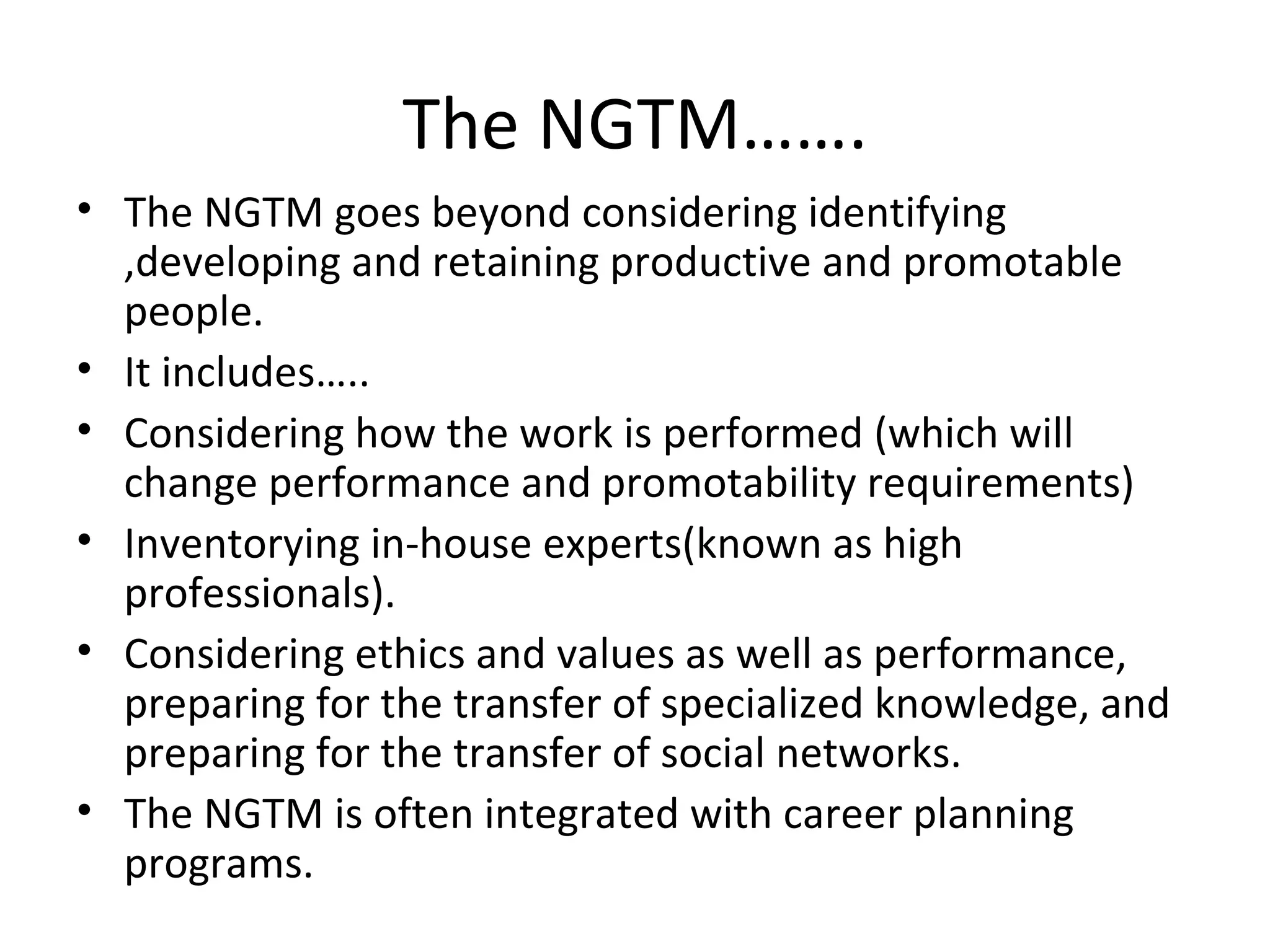
The NGTM……. The NGTM goes beyond considering identifying ,developing and retaining productive and promotable people.  It includes….. Considering how the work is performed (which will change performance and promotability requirements) Inventorying in-house experts(known as high professionals). Considering ethics and values as well as performance, preparing for the transfer of specialized knowledge, and preparing for the transfer of social networks. The NGTM is often integrated with career planning programs.
A Model of the Next Generation Talent Management
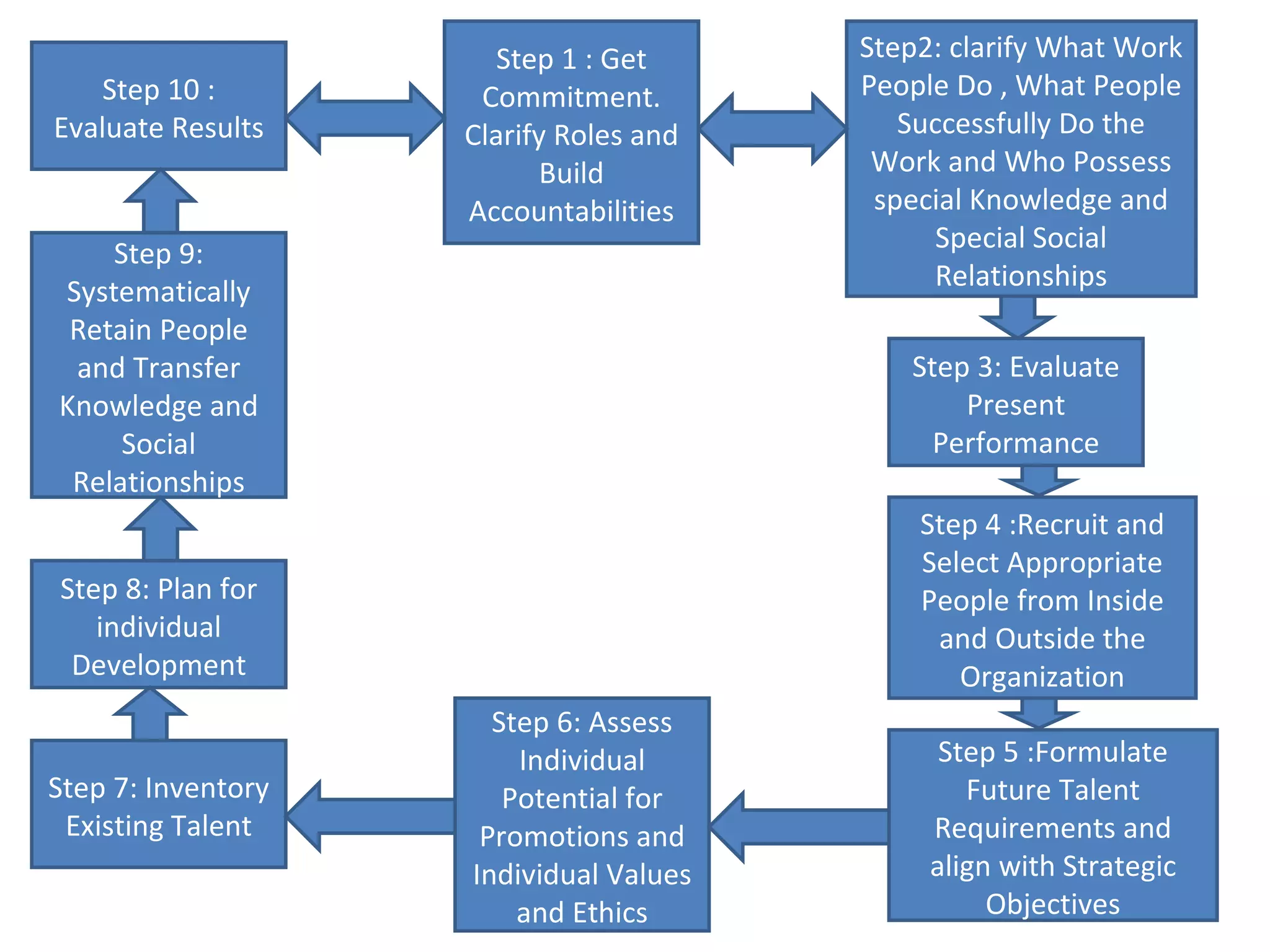
Step 1 : Get Commitment. Clarify Roles and Build Accountabilities Step2: clarify What Work People Do , What People Successfully Do the Work and Who Possess special Knowledge and Special Social Relationships Step 3: Evaluate Present Performance Step 4 :Recruit and Select Appropriate People from Inside and Outside the Organization Step 5 :Formulate Future Talent Requirements and align with Strategic Objectives Step 6: Assess Individual Potential for Promotions and Individual Values and Ethics Step 7: Inventory Existing Talent Step 8: Plan for individual Development Step 9: Systematically Retain People and Transfer Knowledge and Social Relationships Step 10 : Evaluate Results
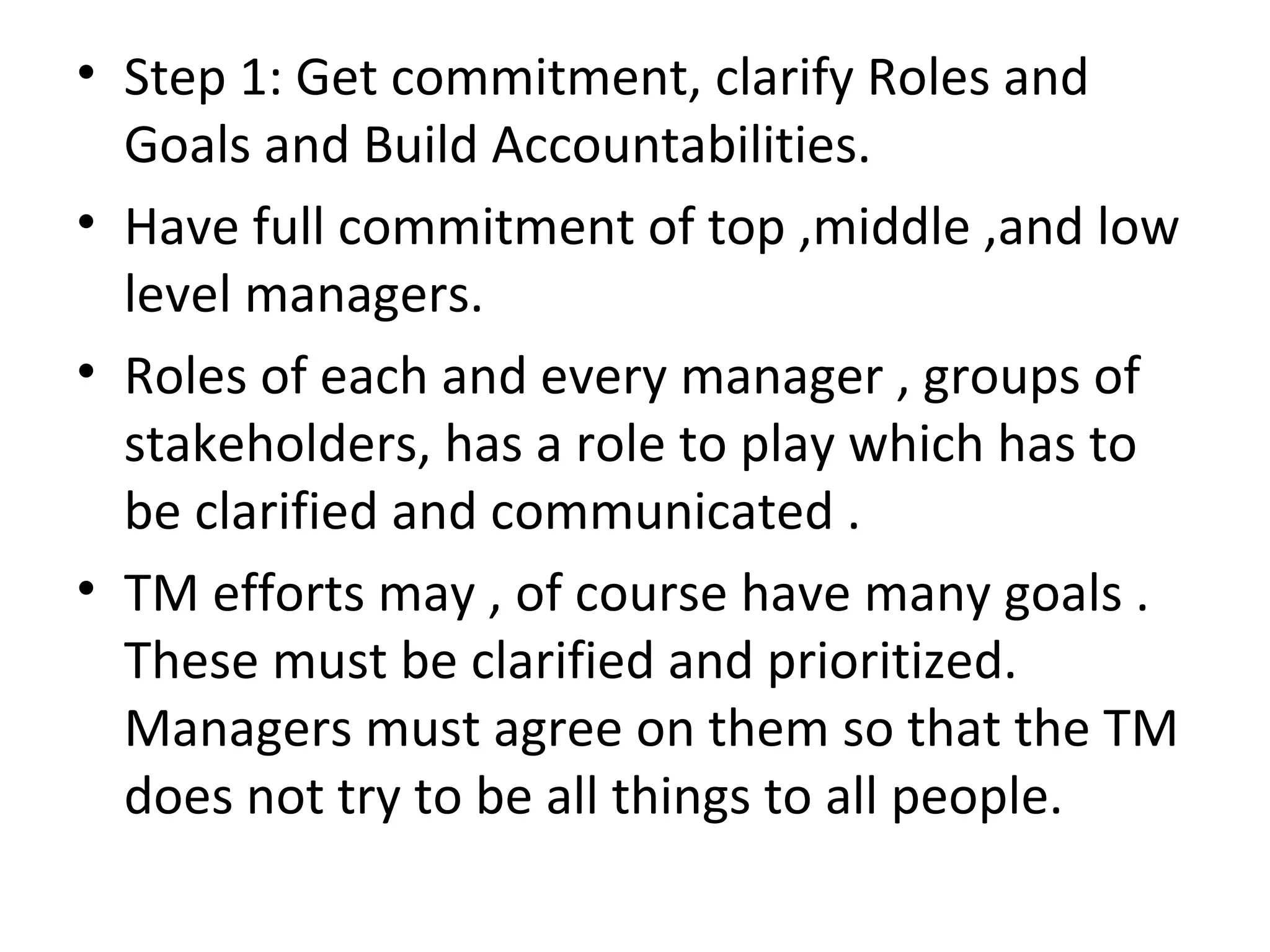
Step 1: Get commitment, clarify Roles and Goals and Build Accountabilities. Have full commitment of top ,middle ,and low level managers. Roles of each and every manager , groups of stakeholders, has a role to play which has to be clarified and communicated . TM efforts may , of course have many goals . These must be clarified and prioritized. Managers must agree on them so that the TM does not try to be all things to all people.
TM Goals are ……. Preparing sufficiently well qualified replacements before key leaders retire. Preparing sufficient numbers of well qualified people to support business expansion. Recruiting high potentials from outside the organization. Developing high potentials inside the organization. Role- modeling TM efforts by developing self and others.
STEP 10: EVALUATE RESULTS Talent Management can be evaluated by metrics established from the initial goals identified for the program. It can evaluate by using a Rating Chart as a  instrument  to check how well an organization perform.
Rating Your Organization
IMPLEMENTATION OF TALENT MANAGENENT There are 3 basic ways to start a Talent Management Program:-   1)Focus On Replacement Planning.   2)Focus On Top-Down Talent Management. 3)Focus On a Trouble Spot in Organization.
Conclusion Organizational leaders should specify the talent that is required for the organization. Organization should provide an environment of  creativity and innovation. Never attempt to force creativity. Involve the citizens of an organization in solutions to problem. Potential solutions may come if dealt in a creative manner.
BIBLOGRAPHY HRM REVIEW (The Icfai University Press) GOOGLE

Implementation Of Talent Managenent

  • 1.
    TALENT MANAGEMENT RitikaAgarwal Swetha G.k. Ankit Sahney Jaydeep Ghosh Rakesh Patawari Siddharth Kumar
  • 2.
    DEFINITION Talent managementimplies recognising a person's inherent skills, traits, personality and offering him a matching job. Every person has a unique talent that suits a particular job profile and any other position will cause discomfort.
  • 3.
    Benefits The Organisation benefits from: Increased productivity and capability; a better linkage between individuals' efforts and business goals; commitment of valued employees; reduced turnover; increased bench strength and a better fit between people's jobs and skills. Employees benefit from: Higher motivation and commitment; career development; increased knowledge about and contribution to company goals; sustained motivation and job satisfaction.
  • 4.
    INTRODUCTION Traditional methodof talent management is usually understood to mean systematic efforts to recruit, develop and retain highly productive and promotable people. But the needs of business really go beyond that. There is a need to think beyond traditional talent management to Next Generation Talent Management (NGTM).
  • 5.
    The NGTM……. TheNGTM goes beyond considering identifying ,developing and retaining productive and promotable people. It includes….. Considering how the work is performed (which will change performance and promotability requirements) Inventorying in-house experts(known as high professionals). Considering ethics and values as well as performance, preparing for the transfer of specialized knowledge, and preparing for the transfer of social networks. The NGTM is often integrated with career planning programs.
  • 6.
    A Model ofthe Next Generation Talent Management
  • 7.
    Step 1 :Get Commitment. Clarify Roles and Build Accountabilities Step2: clarify What Work People Do , What People Successfully Do the Work and Who Possess special Knowledge and Special Social Relationships Step 3: Evaluate Present Performance Step 4 :Recruit and Select Appropriate People from Inside and Outside the Organization Step 5 :Formulate Future Talent Requirements and align with Strategic Objectives Step 6: Assess Individual Potential for Promotions and Individual Values and Ethics Step 7: Inventory Existing Talent Step 8: Plan for individual Development Step 9: Systematically Retain People and Transfer Knowledge and Social Relationships Step 10 : Evaluate Results
  • 8.
    Step 1: Getcommitment, clarify Roles and Goals and Build Accountabilities. Have full commitment of top ,middle ,and low level managers. Roles of each and every manager , groups of stakeholders, has a role to play which has to be clarified and communicated . TM efforts may , of course have many goals . These must be clarified and prioritized. Managers must agree on them so that the TM does not try to be all things to all people.
  • 9.
    TM Goals are……. Preparing sufficiently well qualified replacements before key leaders retire. Preparing sufficient numbers of well qualified people to support business expansion. Recruiting high potentials from outside the organization. Developing high potentials inside the organization. Role- modeling TM efforts by developing self and others.
  • 10.
    STEP 10: EVALUATERESULTS Talent Management can be evaluated by metrics established from the initial goals identified for the program. It can evaluate by using a Rating Chart as a instrument to check how well an organization perform.
  • 11.
  • 12.
    IMPLEMENTATION OF TALENTMANAGENENT There are 3 basic ways to start a Talent Management Program:- 1)Focus On Replacement Planning. 2)Focus On Top-Down Talent Management. 3)Focus On a Trouble Spot in Organization.
  • 13.
    Conclusion Organizational leadersshould specify the talent that is required for the organization. Organization should provide an environment of creativity and innovation. Never attempt to force creativity. Involve the citizens of an organization in solutions to problem. Potential solutions may come if dealt in a creative manner.
  • 14.
    BIBLOGRAPHY HRM REVIEW(The Icfai University Press) GOOGLE