Implementation of OSS/BSS Solution
in IoT Ecosystem
By:
Students
of
Symbiosis Institute of Telecom Management, Pune, India
(A Syndicate Work)
1
Vishal Kumar [Email: vishal.kumar@sitm.ac.in]
Tanya Singh [Email: tanya.singh@sitm.ac.in]
Purvi Chugh [Email: purvi.chugh@sitm.ac.in]
Rahul Jadhav [Email: rahul.jadhav16@sitm.ac.in]
Subhajeet Biswas [Email: subhajit.biswas@sitm.ac.in]
Gaurav Joshi [Email: gaurav.joshi@sitm.ac.in]
• IoT Ecosystem & Value Chain
• High Level OSS/BSS Five Layer Architecture
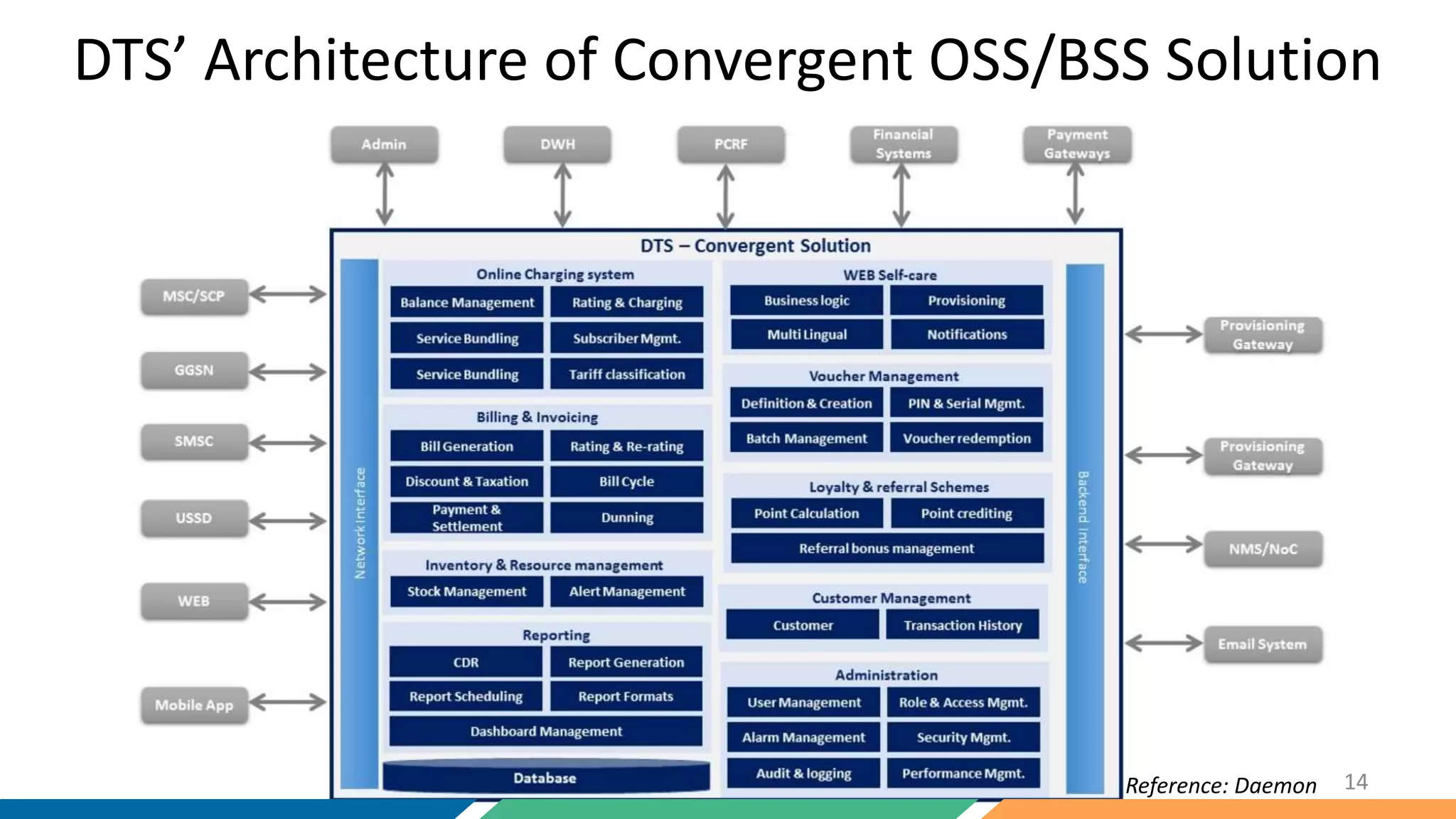
• Converged OSS/BSS Architecture – Daemon Telecom Suite
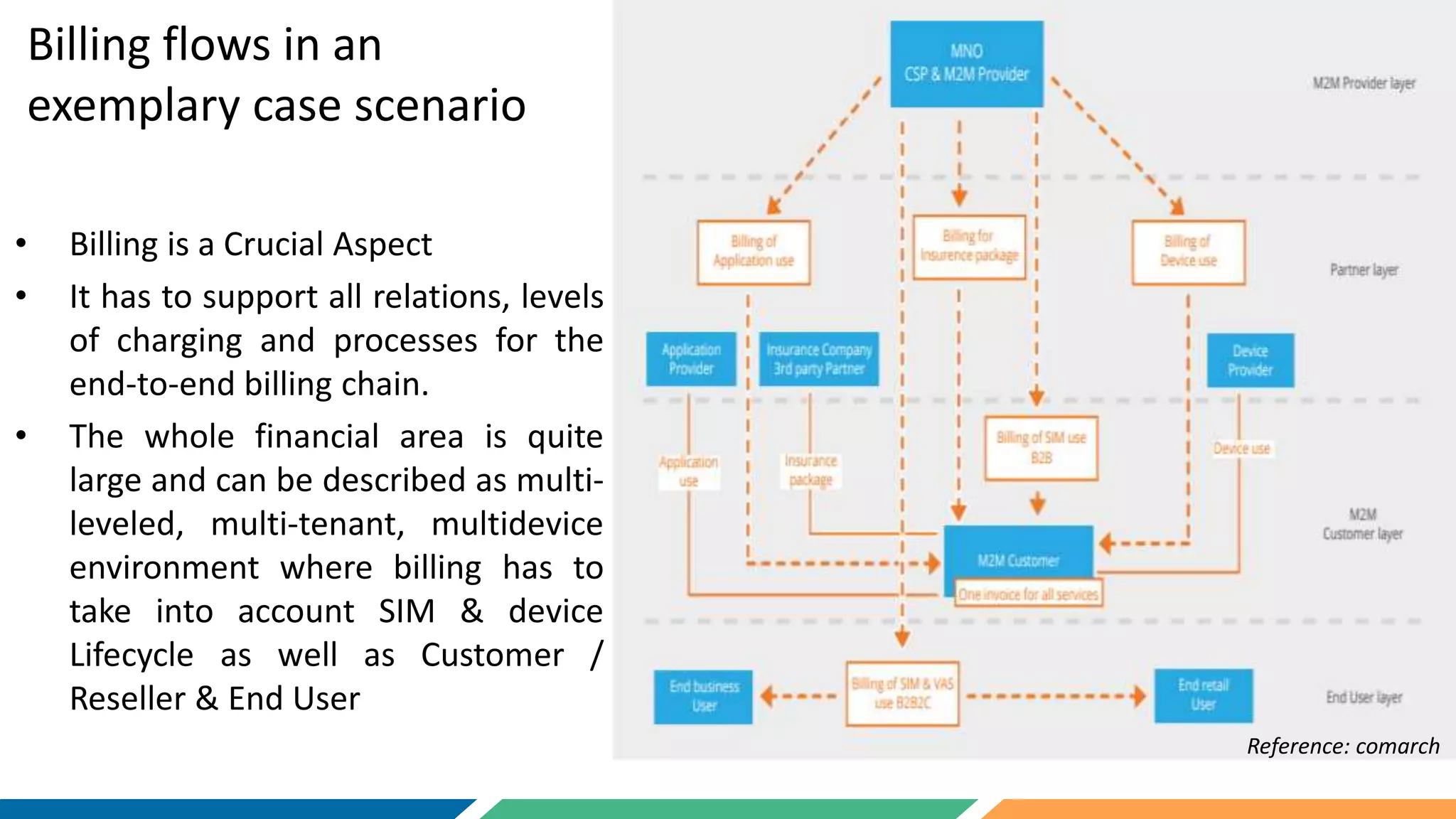
• Billing Flows
• Traditional OSS Solution and Shortcomings for IoT
Applications
• Proposed OSS Solution and Rationale Behind
2
Content
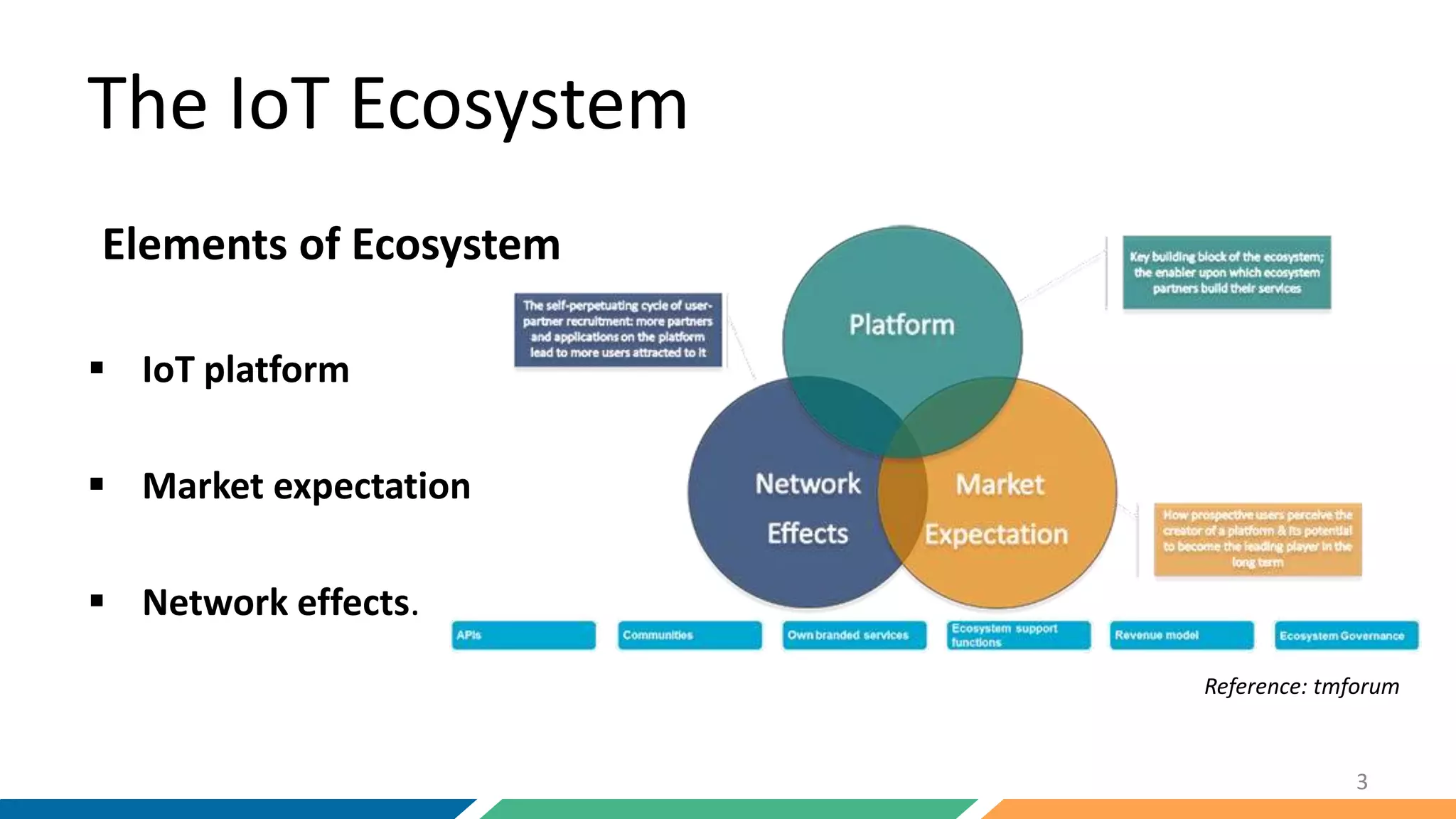
The IoT Ecosystem
Elements of Ecosystem
 IoT platform
 Market expectation
 Network effects.
3
Reference: tmforum
Key enablers of IoT ecosystem
 Enabling platforms: Platforms are the foundation of the ecosystem.
 APIs: APIs are the basic building blocks of an IoT ecosystem.
 Communities: Communities of partners need to exist for ecosystems to be true
ecosystems.
 Own branded services: Makes sense for businesses to offer complete IoT
solutions, either with their own products or through integration with partners.
 Revenue models: Revenue models are a key aspect for the successful
development of IoT ecosystems.
 Ecosystem support functions: The final enabler is the internal organization
and the related support functions.
4
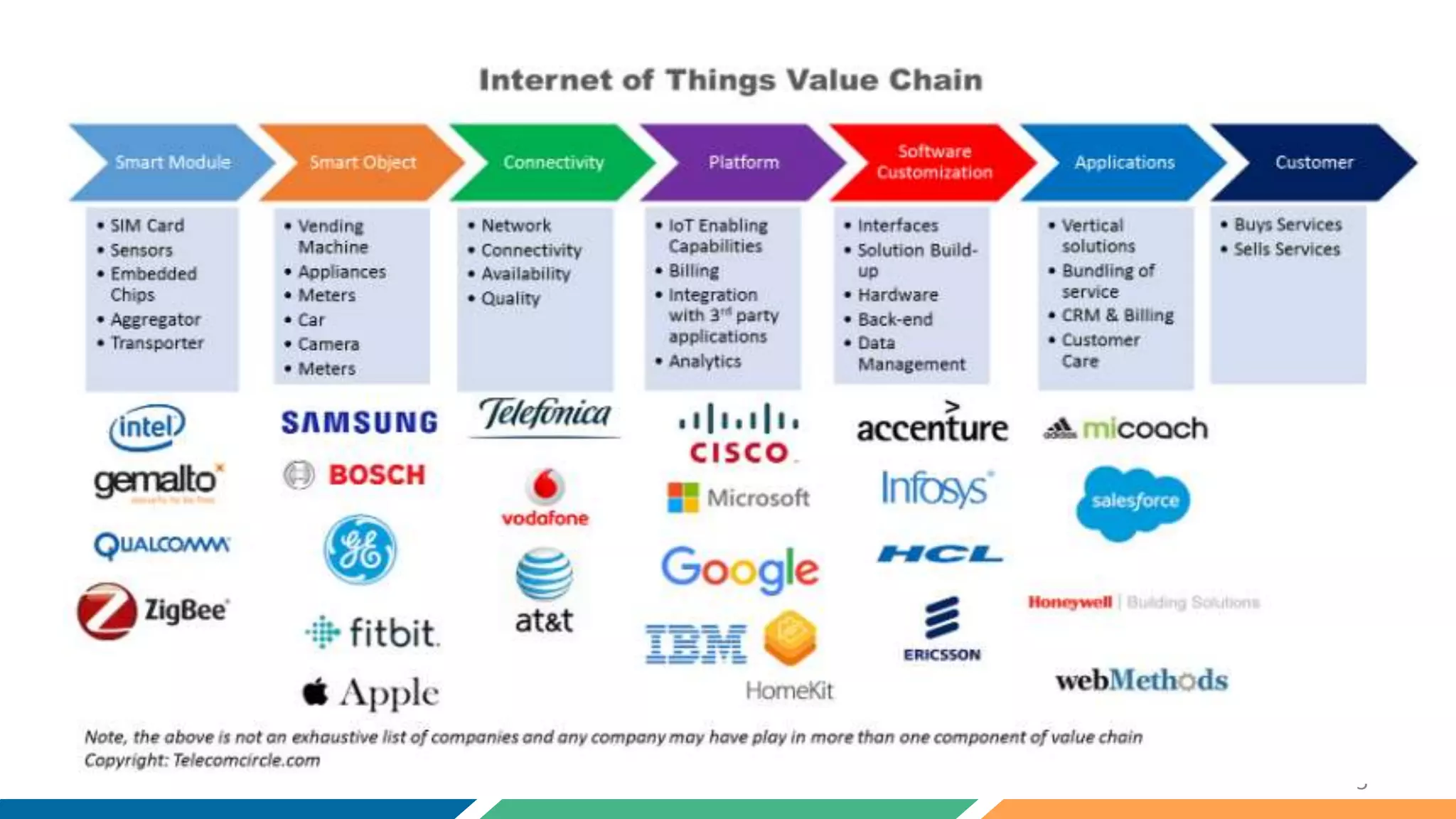
5
Why OSS/BSS
• América Móvil, AT&T, du, Etisalat, KPN, Ooredoo, NTT,
Sprint, Tele2, Telenor Connexion, TeliaSonera, Telstra,
Verizon, Vodafone and others, are creating these new
technology stacks (through buying, building or partnering)
in order to:
– Offer new IoT managed service
– Enable new business models
– Reduce risks in new markets
– Support simple integrations of both horizontal and vertical
solutions
6
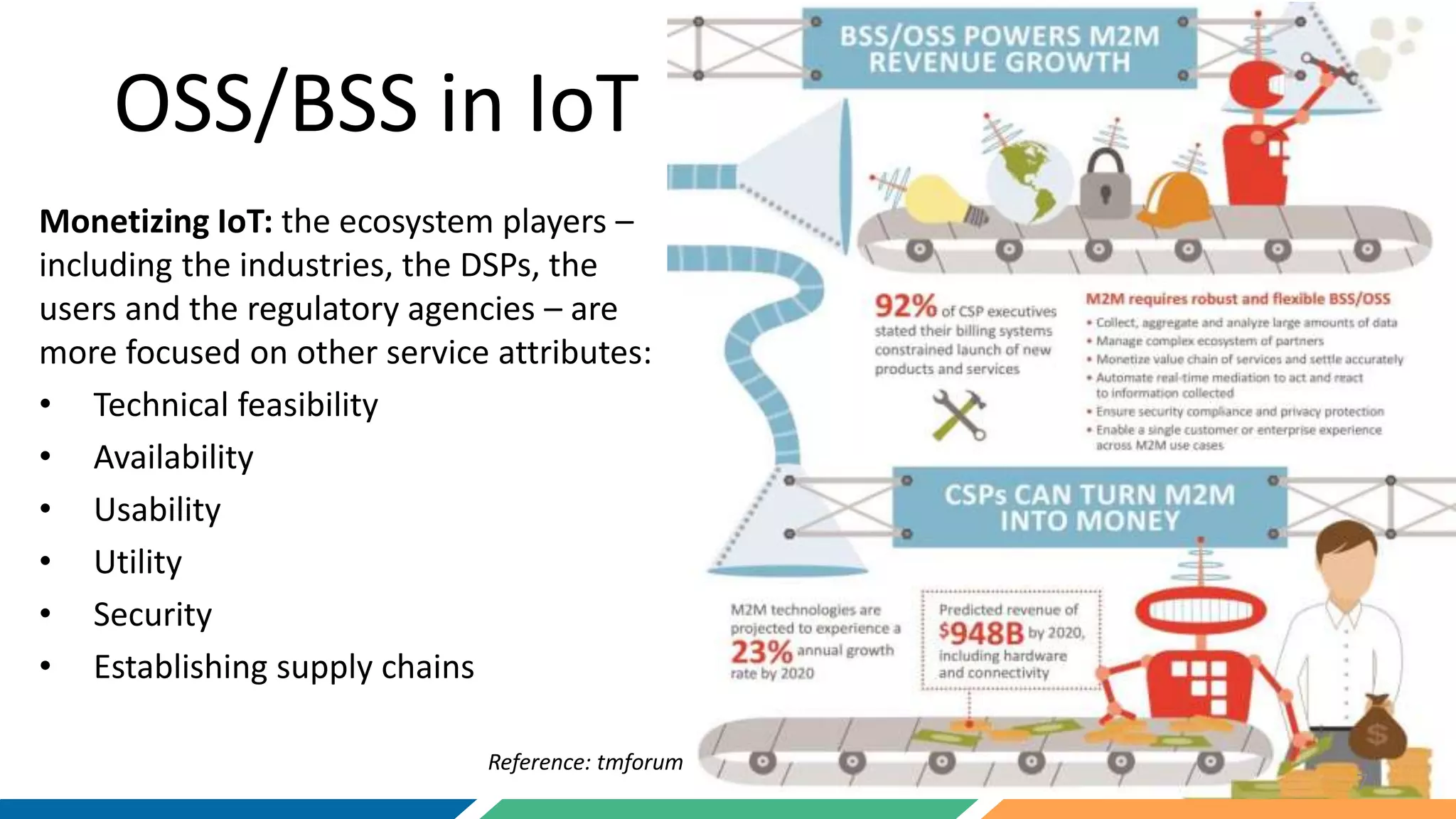
OSS/BSS in IoT
Monetizing IoT: the ecosystem players –
including the industries, the DSPs, the
users and the regulatory agencies – are
more focused on other service attributes:
• Technical feasibility
• Availability
• Usability
• Utility
• Security
• Establishing supply chains
7
Reference: tmforum
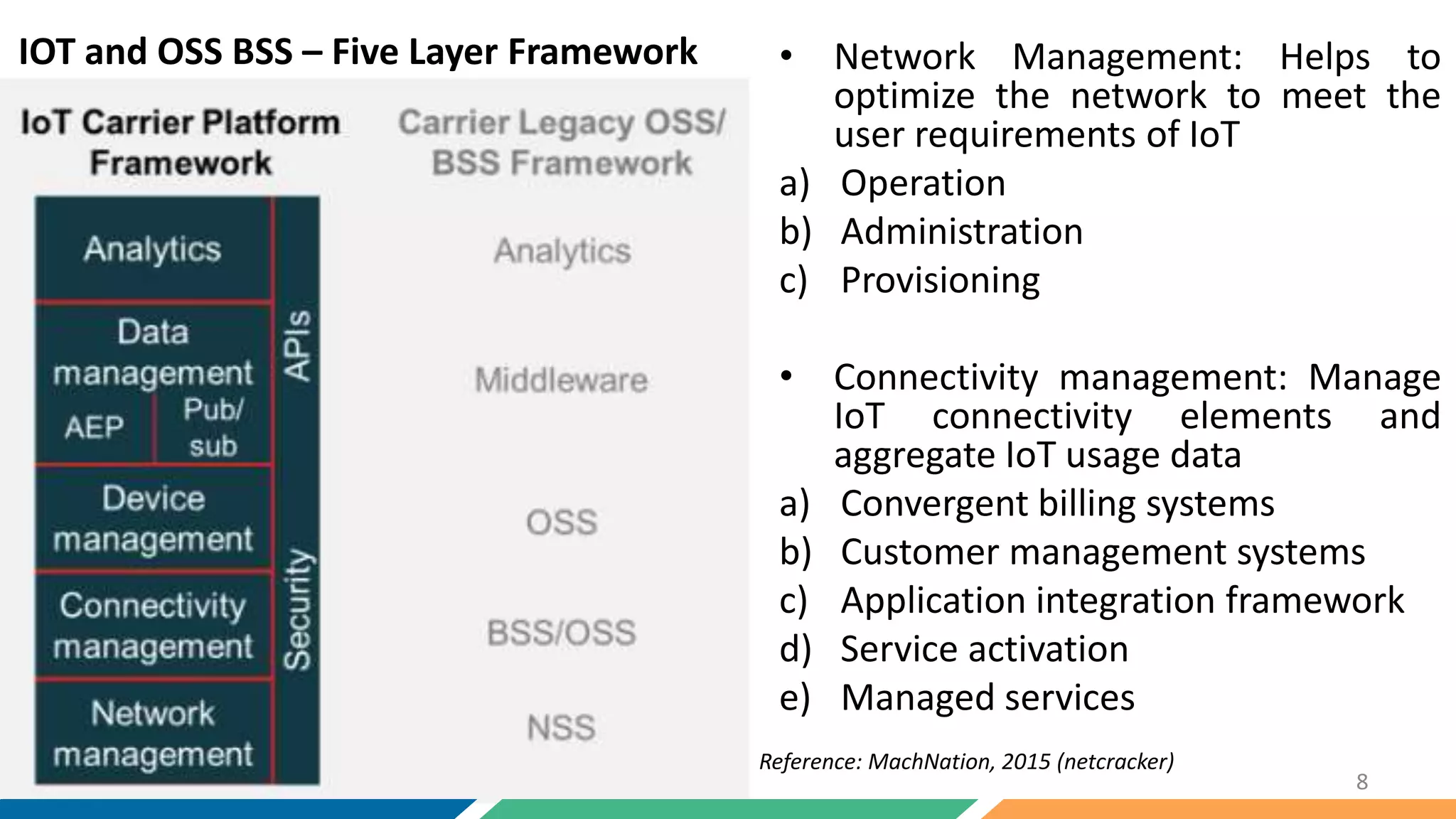
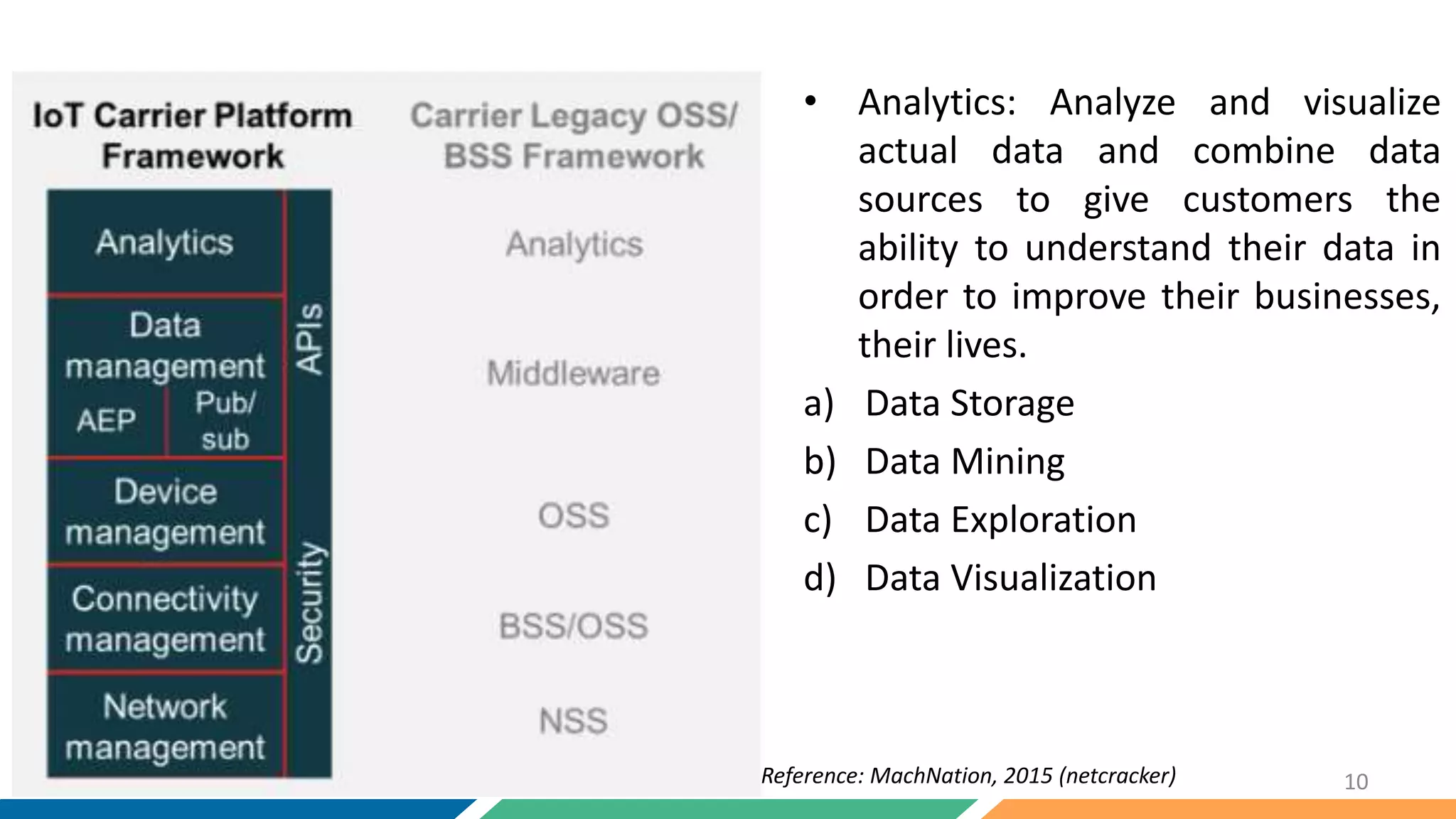
IOT and OSS BSS – Five Layer Framework • Network Management: Helps to
optimize the network to meet the
user requirements of IoT
a) Operation
b) Administration
c) Provisioning
• Connectivity management: Manage
IoT connectivity elements and
aggregate IoT usage data
a) Convergent billing systems
b) Customer management systems
c) Application integration framework
d) Service activation
e) Managed services
8
Reference: MachNation, 2015 (netcracker)
IOT and OSS BSS platform
framework
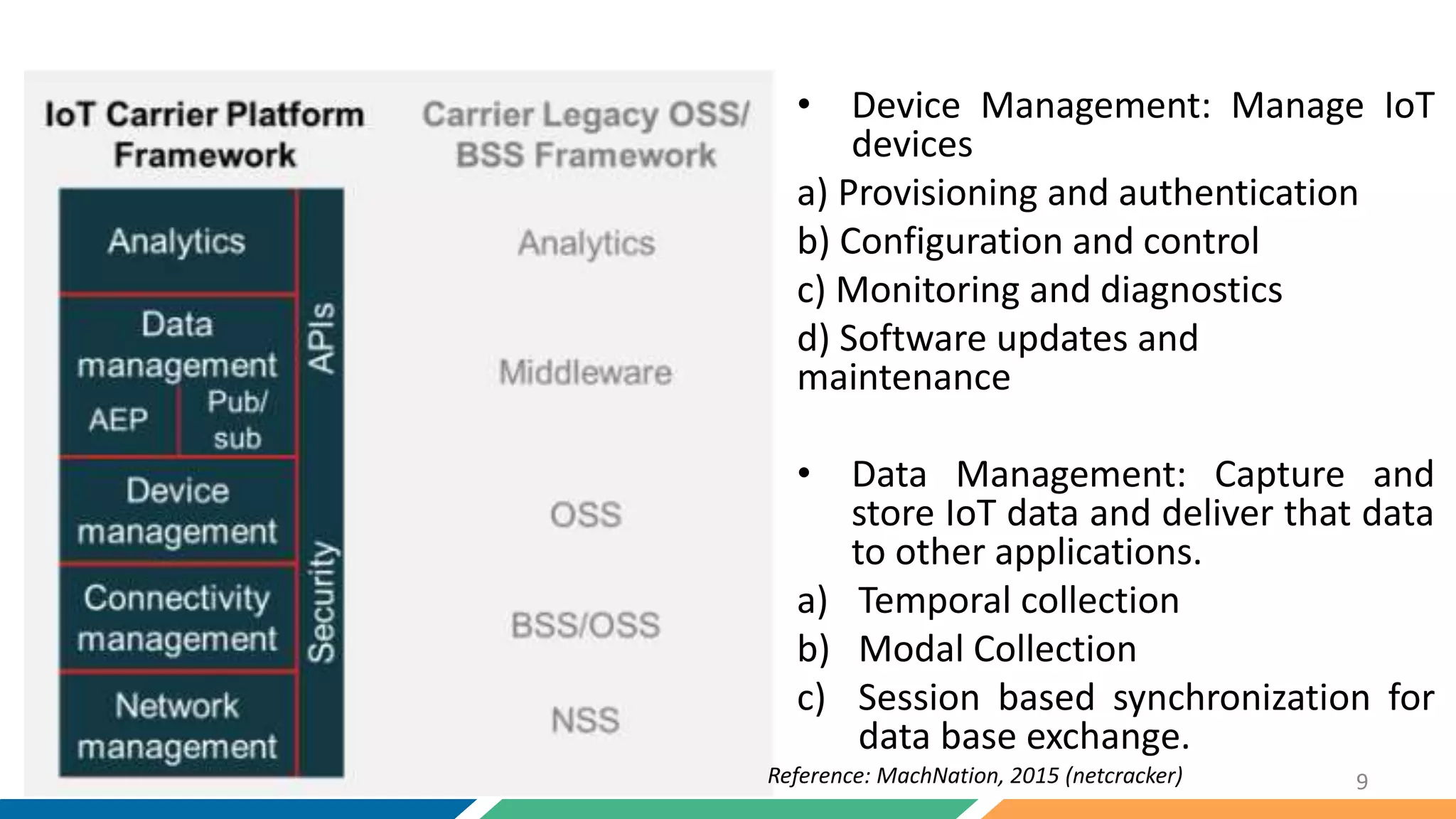
• Device Management: Manage IoT
devices
a) Provisioning and authentication
b) Configuration and control
c) Monitoring and diagnostics
d) Software updates and
maintenance
• Data Management: Capture and
store IoT data and deliver that data
to other applications.
a) Temporal collection
b) Modal Collection
c) Session based synchronization for
data base exchange.
9Reference: MachNation, 2015 (netcracker)
• Analytics: Analyze and visualize
actual data and combine data
sources to give customers the
ability to understand their data in
order to improve their businesses,
their lives.
a) Data Storage
b) Data Mining
c) Data Exploration
d) Data Visualization
10Reference: MachNation, 2015 (netcracker)
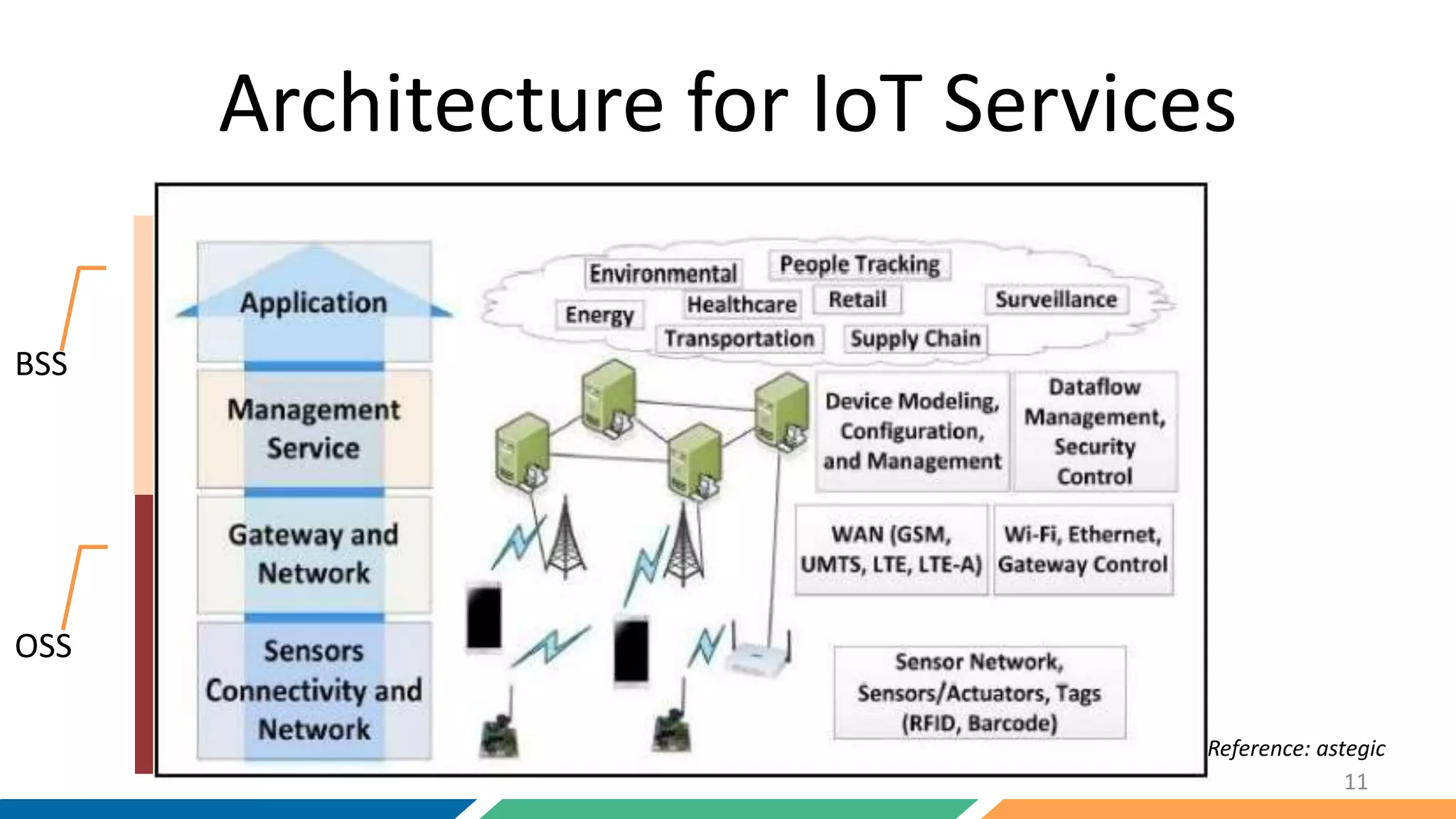
Architecture for IoT Services
11
BSS
OSS
Reference: astegic
Daemon Telecom Suite (Converged
BSS OSS Solution)
• Agile, Multi-play converged BSS solution
– CRM
– Billing
– Rating functions
– Personalized Features
• Solution to transform existing Legacy Billing, OSS and BSS and
partner management sol. Into NG Converged BSS OSS and
CRM solutions
12
Daemon Telecom Suite
• It provides settlement function for services across
data, voice, VOIP, IoT i.e. across multiple lines of
business.
• Configurable Bill Cycle
• It support TM Forum’s e-TOM standards
13
DTS’ Architecture of Convergent OSS/BSS Solution
14Reference: Daemon
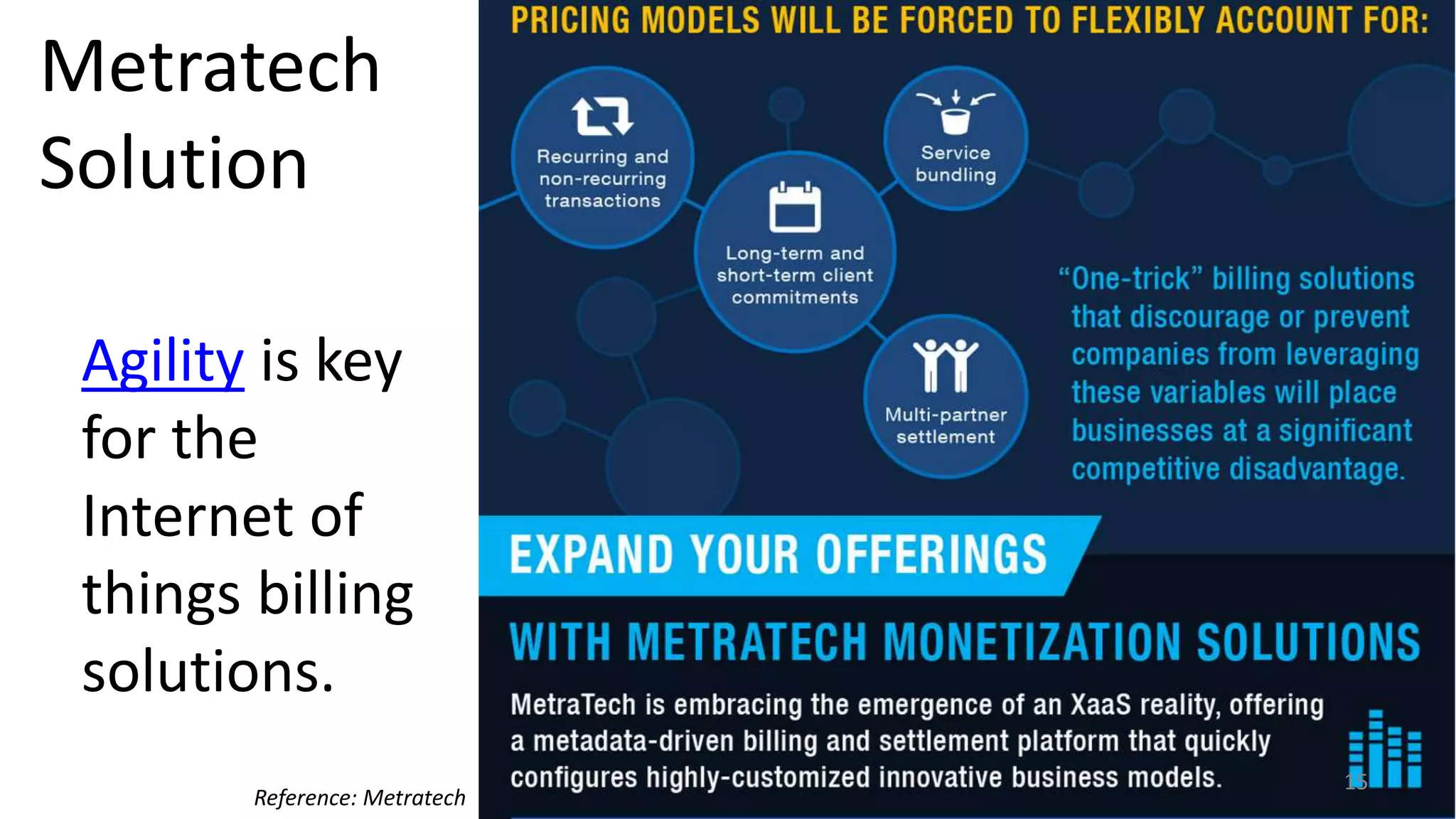
Metratech
Solution
Agility is key
for the
Internet of
things billing
solutions.
15
Reference: Metratech
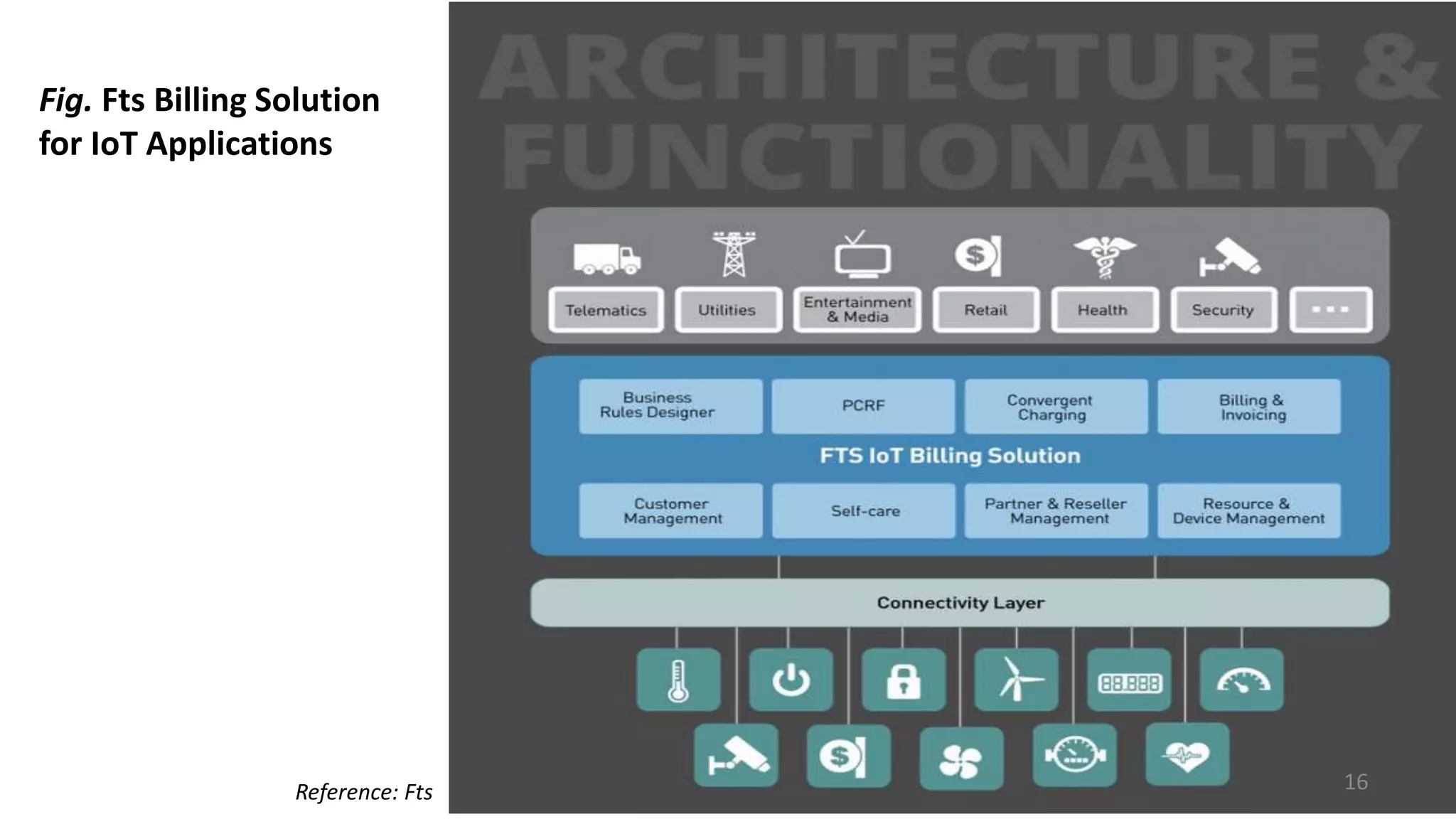
Fig. Fts Billing Solution
for IoT Applications
16Reference: Fts
Billing flows in an
exemplary case scenario
• Billing is a Crucial Aspect
• It has to support all relations, levels
of charging and processes for the
end-to-end billing chain.
• The whole financial area is quite
large and can be described as multi-
leveled, multi-tenant, multidevice
environment where billing has to
take into account SIM & device
Lifecycle as well as Customer /
Reseller & End User
Reference: comarch
LogiSense Coorporation & Cerillon
https://www.youtube.com/watch?time_continue=106&v=xtm
RcaX38mI
Cerillion Solutions:
1. Enterprise BSS/OSS Solution
2. Cerillion Skyline (Cloud Based)
https://www.cerillion.com/Products/SaaS/Cerillion-Skyline
18
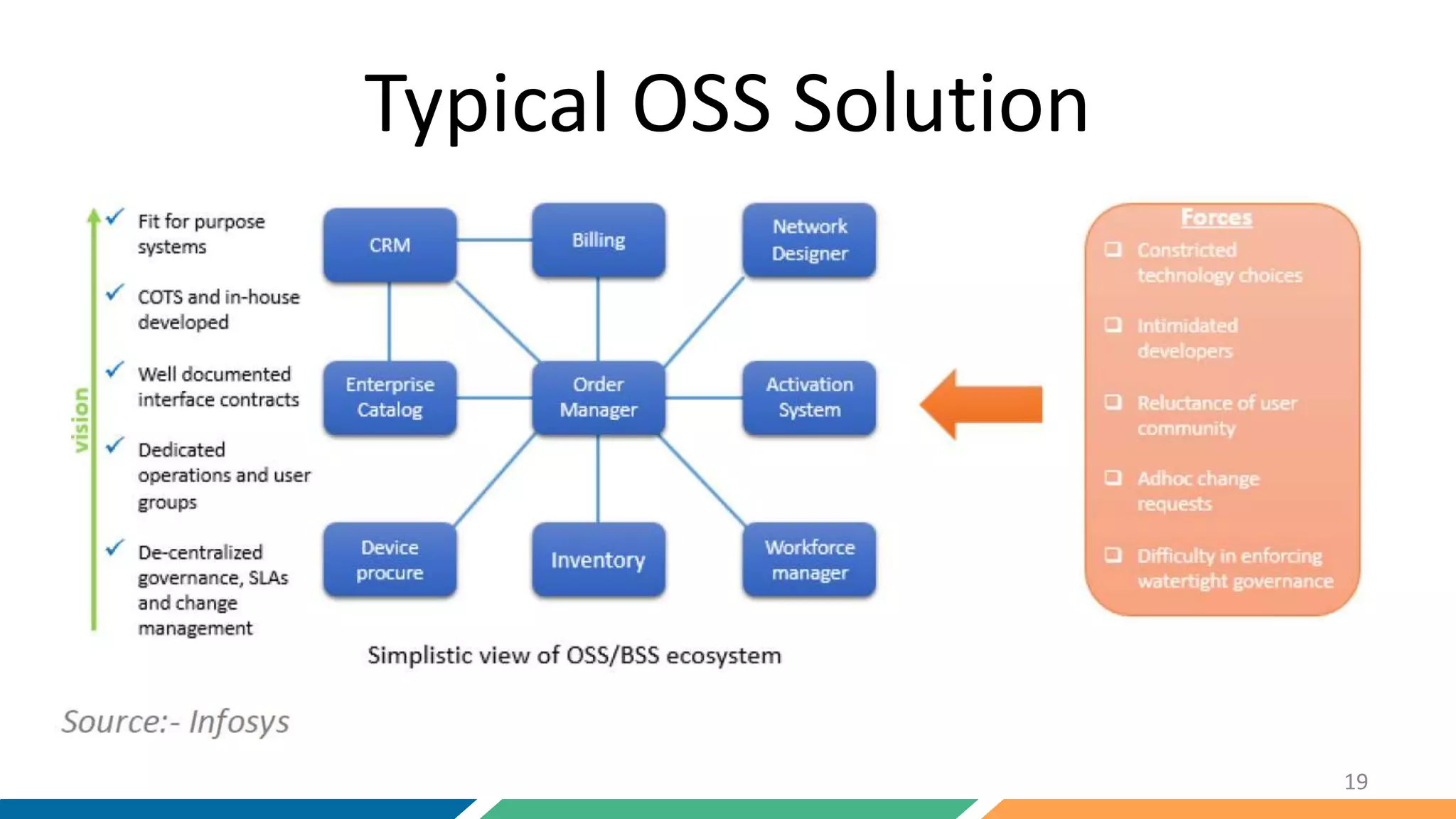
Typical OSS Solution
19
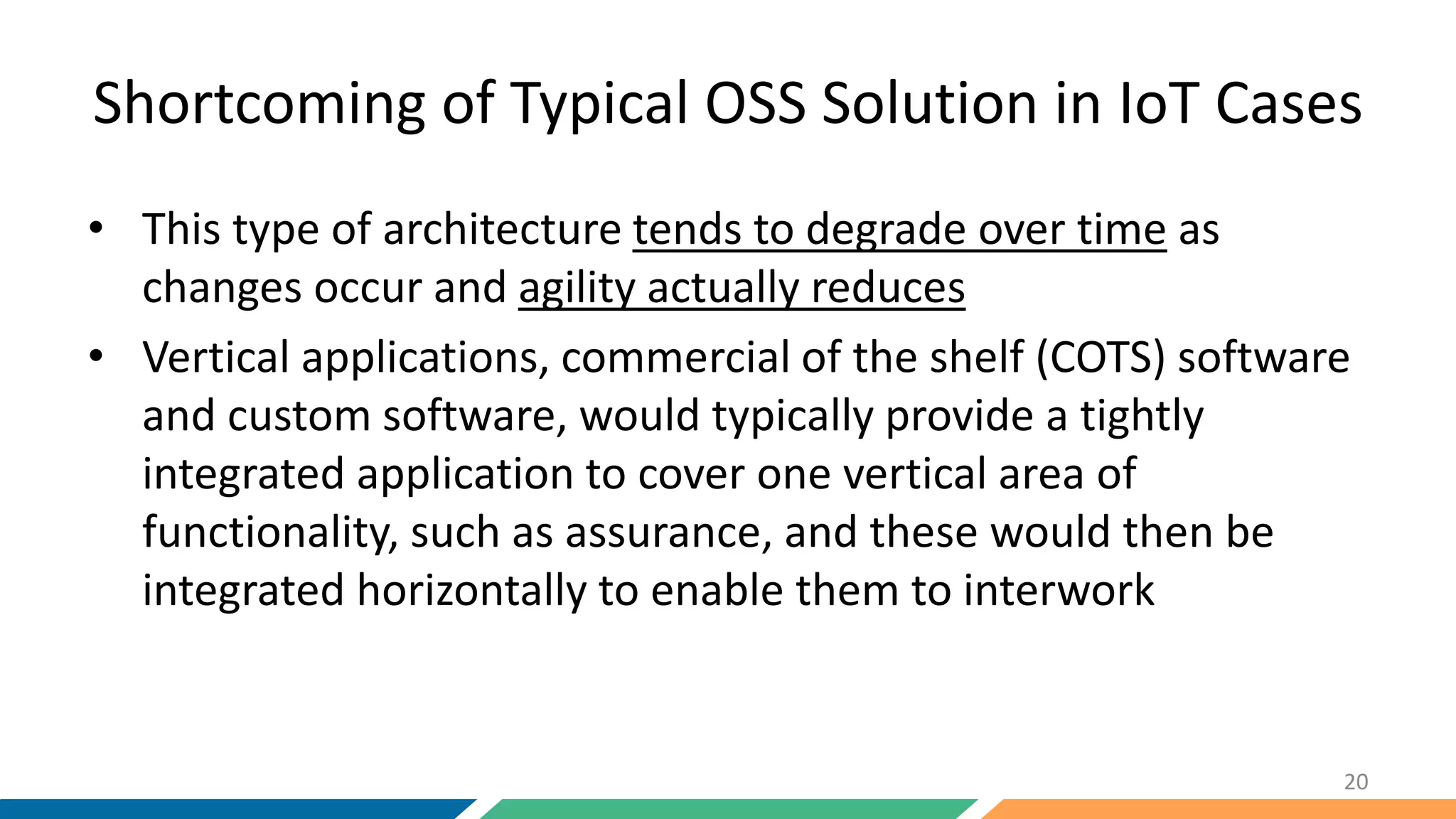
Shortcoming of Typical OSS Solution in IoT Cases
• This type of architecture tends to degrade over time as
changes occur and agility actually reduces
• Vertical applications, commercial of the shelf (COTS) software
and custom software, would typically provide a tightly
integrated application to cover one vertical area of
functionality, such as assurance, and these would then be
integrated horizontally to enable them to interwork
20
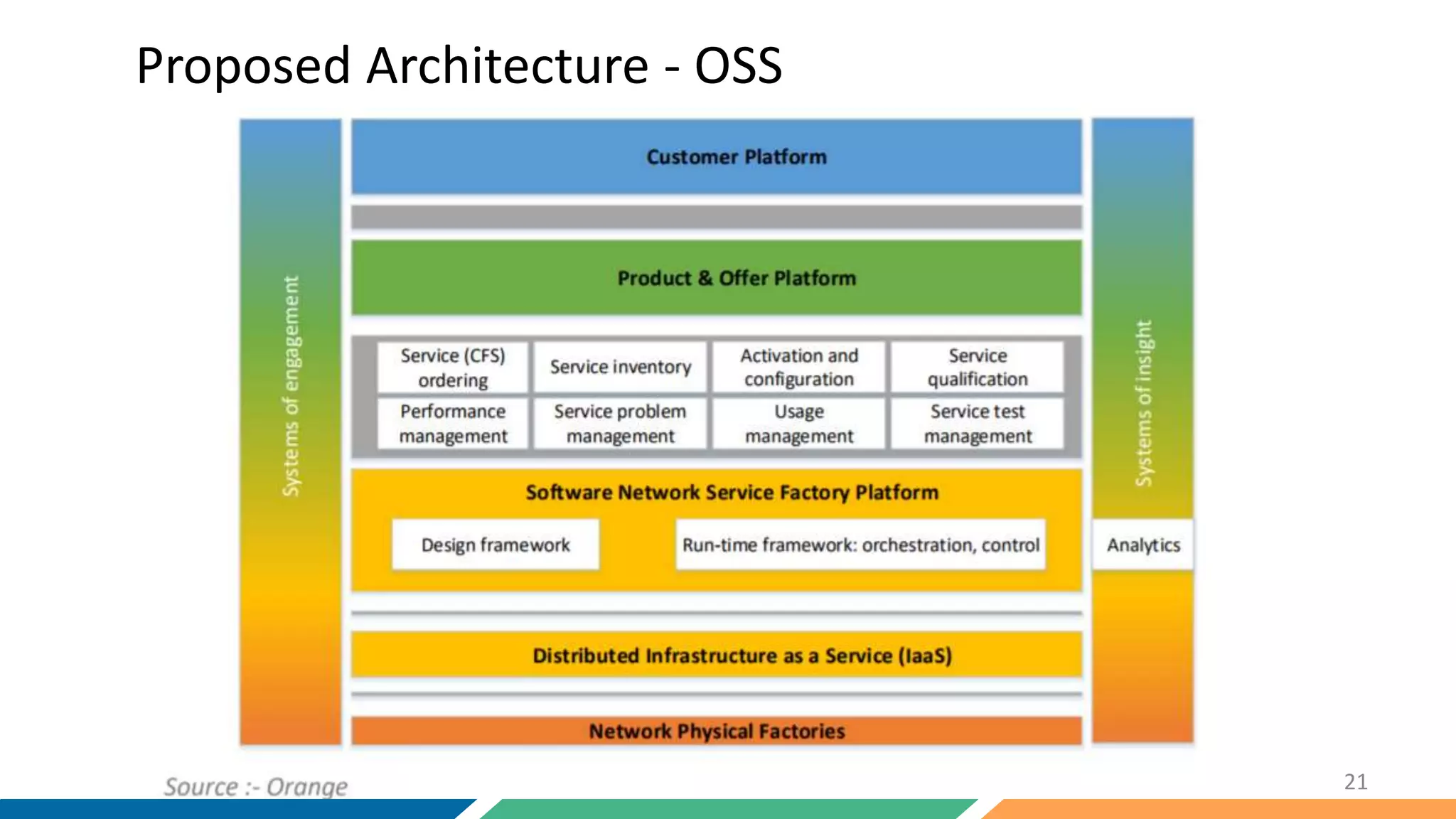
Proposed Architecture - OSS
21
Why Proposed Architecture?
• Horizontal SOA based layered approach to the OSS
architecture is better suited to delivering on the business
requirements.
• Loose coupling of components
– Minimized the risk that changes in one component will require
changes in any other component.
• All capabilities exposed by standardized APIs
• Network as a Service or NaaS
• Simple connection and policy enforcement
22
OSS of the Future: Catering IoE
• The service provider of the future – flexible and agile
• Rethinking the role of the OSS
• The OSS reimagined – from vertical to horizontal
• The role of Open Source – the network operating
system
• Onboarding – enabling a marketplace for network
functionality
• Modelling the OSS of the future with Frameworx
23
24
THANK YOU

Implementation of OSS/BSS Solution in IoT Ecosystem

  • 1.
    Implementation of OSS/BSSSolution in IoT Ecosystem By: Students of Symbiosis Institute of Telecom Management, Pune, India (A Syndicate Work) 1 Vishal Kumar [Email: vishal.kumar@sitm.ac.in] Tanya Singh [Email: tanya.singh@sitm.ac.in] Purvi Chugh [Email: purvi.chugh@sitm.ac.in] Rahul Jadhav [Email: rahul.jadhav16@sitm.ac.in] Subhajeet Biswas [Email: subhajit.biswas@sitm.ac.in] Gaurav Joshi [Email: gaurav.joshi@sitm.ac.in]
  • 2.
    • IoT Ecosystem& Value Chain • High Level OSS/BSS Five Layer Architecture • Converged OSS/BSS Architecture – Daemon Telecom Suite • Billing Flows • Traditional OSS Solution and Shortcomings for IoT Applications • Proposed OSS Solution and Rationale Behind 2 Content
  • 3.
    The IoT Ecosystem Elementsof Ecosystem  IoT platform  Market expectation  Network effects. 3 Reference: tmforum
  • 4.
    Key enablers ofIoT ecosystem  Enabling platforms: Platforms are the foundation of the ecosystem.  APIs: APIs are the basic building blocks of an IoT ecosystem.  Communities: Communities of partners need to exist for ecosystems to be true ecosystems.  Own branded services: Makes sense for businesses to offer complete IoT solutions, either with their own products or through integration with partners.  Revenue models: Revenue models are a key aspect for the successful development of IoT ecosystems.  Ecosystem support functions: The final enabler is the internal organization and the related support functions. 4
  • 5.
  • 6.
    Why OSS/BSS • AméricaMóvil, AT&T, du, Etisalat, KPN, Ooredoo, NTT, Sprint, Tele2, Telenor Connexion, TeliaSonera, Telstra, Verizon, Vodafone and others, are creating these new technology stacks (through buying, building or partnering) in order to: – Offer new IoT managed service – Enable new business models – Reduce risks in new markets – Support simple integrations of both horizontal and vertical solutions 6
  • 7.
    OSS/BSS in IoT MonetizingIoT: the ecosystem players – including the industries, the DSPs, the users and the regulatory agencies – are more focused on other service attributes: • Technical feasibility • Availability • Usability • Utility • Security • Establishing supply chains 7 Reference: tmforum
  • 8.
    IOT and OSSBSS – Five Layer Framework • Network Management: Helps to optimize the network to meet the user requirements of IoT a) Operation b) Administration c) Provisioning • Connectivity management: Manage IoT connectivity elements and aggregate IoT usage data a) Convergent billing systems b) Customer management systems c) Application integration framework d) Service activation e) Managed services 8 Reference: MachNation, 2015 (netcracker)
  • 9.
    IOT and OSSBSS platform framework • Device Management: Manage IoT devices a) Provisioning and authentication b) Configuration and control c) Monitoring and diagnostics d) Software updates and maintenance • Data Management: Capture and store IoT data and deliver that data to other applications. a) Temporal collection b) Modal Collection c) Session based synchronization for data base exchange. 9Reference: MachNation, 2015 (netcracker)
  • 10.
    • Analytics: Analyzeand visualize actual data and combine data sources to give customers the ability to understand their data in order to improve their businesses, their lives. a) Data Storage b) Data Mining c) Data Exploration d) Data Visualization 10Reference: MachNation, 2015 (netcracker)
  • 11.
    Architecture for IoTServices 11 BSS OSS Reference: astegic
  • 12.
    Daemon Telecom Suite(Converged BSS OSS Solution) • Agile, Multi-play converged BSS solution – CRM – Billing – Rating functions – Personalized Features • Solution to transform existing Legacy Billing, OSS and BSS and partner management sol. Into NG Converged BSS OSS and CRM solutions 12
  • 13.
    Daemon Telecom Suite •It provides settlement function for services across data, voice, VOIP, IoT i.e. across multiple lines of business. • Configurable Bill Cycle • It support TM Forum’s e-TOM standards 13
  • 14.
    DTS’ Architecture ofConvergent OSS/BSS Solution 14Reference: Daemon
  • 15.
    Metratech Solution Agility is key forthe Internet of things billing solutions. 15 Reference: Metratech
  • 16.
    Fig. Fts BillingSolution for IoT Applications 16Reference: Fts
  • 17.
    Billing flows inan exemplary case scenario • Billing is a Crucial Aspect • It has to support all relations, levels of charging and processes for the end-to-end billing chain. • The whole financial area is quite large and can be described as multi- leveled, multi-tenant, multidevice environment where billing has to take into account SIM & device Lifecycle as well as Customer / Reseller & End User Reference: comarch
  • 18.
    LogiSense Coorporation &Cerillon https://www.youtube.com/watch?time_continue=106&v=xtm RcaX38mI Cerillion Solutions: 1. Enterprise BSS/OSS Solution 2. Cerillion Skyline (Cloud Based) https://www.cerillion.com/Products/SaaS/Cerillion-Skyline 18
  • 19.
  • 20.
    Shortcoming of TypicalOSS Solution in IoT Cases • This type of architecture tends to degrade over time as changes occur and agility actually reduces • Vertical applications, commercial of the shelf (COTS) software and custom software, would typically provide a tightly integrated application to cover one vertical area of functionality, such as assurance, and these would then be integrated horizontally to enable them to interwork 20
  • 21.
  • 22.
    Why Proposed Architecture? •Horizontal SOA based layered approach to the OSS architecture is better suited to delivering on the business requirements. • Loose coupling of components – Minimized the risk that changes in one component will require changes in any other component. • All capabilities exposed by standardized APIs • Network as a Service or NaaS • Simple connection and policy enforcement 22
  • 23.
    OSS of theFuture: Catering IoE • The service provider of the future – flexible and agile • Rethinking the role of the OSS • The OSS reimagined – from vertical to horizontal • The role of Open Source – the network operating system • Onboarding – enabling a marketplace for network functionality • Modelling the OSS of the future with Frameworx 23
  • 24.

Editor's Notes

  • #7 Offer new IoT managed services – delivering more than just connectivity increases carriers’ wallet share. Enable new business models – facilitating both retail, wholesale and hybrid business models helps carriers diversify their IoT businesses. Reduce risks in new markets – providing multitenant cloud solutions with pay-as-you-go pricing helps carriers share risks with their IoT technology partners. Support simple integrations of both horizontal and vertical solutions – creating horizontal solutions to support high-volume growth and vertical solutions to differentiate themselves helps carriers profitably scale their IoT businesses.