A Comprehensive Report on
Internet of Things
VISHAL KUMAR
VISHAL.KUMAR@SITM.AC.IN / VISHALKR92@OUTLOOK.COM
CONTACT: +91-7894511169
1
IoT Landscape over the years
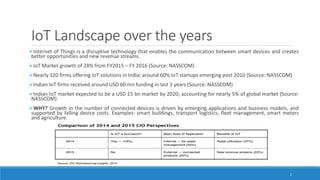
Internet of Things is a disruptive technology that enables the communication between smart devices and creates
better opportunities and new revenue streams.
IoT Market growth of 28% from FY2015 – FY 2016 (Source: NASSCOM)
Nearly 120 firms offering IoT solutions in India; around 60% IoT startups emerging post 2010 (Source: NASSCOM)
Indian IoT firms received around USD 60 mn funding in last 3 years (Source: NASSCOM)
Indian IoT market expected to be a USD 15 bn market by 2020; accounting for nearly 5% of global market (Source:
NASSCOM)
WHY? Growth in the number of connected devices is driven by emerging applications and business models, and
supported by falling device costs. Examples: smart buildings, transport logistics, fleet management, smart meters
and agriculture.
2
IoT Landscape over the years
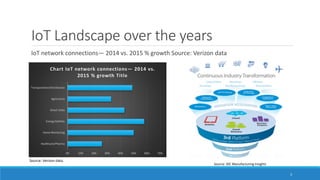
IoT network connections— 2014 vs. 2015 % growth Source: Verizon data
0% 10% 20% 30% 40% 50% 60% 70%
Healthcare/Pharma
Home Monitoring
Energy/Utilities
Smart Cities
Agriculture
Transportation/Distribution
Chart IoT network connections— 2014 vs.
2015 % growth Title
Source: Verizon data
Source: IDC Manufacturing Insights
3
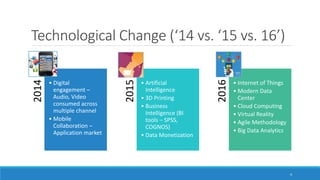
Technological Change (‘14 vs. ‘15 vs. 16’)2014
• Digital
engagement –
Audio, Video
consumed across
multiple channel
• Mobile
Collaboration –
Application market 2015
• Artificial
Intelligence
• 3D Printing
• Business
Intelligence (BI
tools – SPSS,
COGNOS)
• Data Monetization
2016
• Internet of Things
• Modern Data
Center
• Cloud Computing
• Virtual Reality
• Agile Methodology
• Big Data Analytics
4
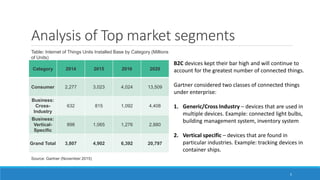
Analysis of Top market segments
Source: Gartner (November 2015)
Category 2014 2015 2016 2020
Consumer 2,277 3,023 4,024 13,509
Business:
Cross-
Industry
632 815 1,092 4,408
Business:
Vertical-
Specific
898 1,065 1,276 2,880
Grand Total 3,807 4,902 6,392 20,797
Table: Internet of Things Units Installed Base by Category (Millions
of Units)
B2C devices kept their bar high and will continue to
account for the greatest number of connected things.
Gartner considered two classes of connected things
under enterprise:
1. Generic/Cross Industry – devices that are used in
multiple devices. Example: connected light bulbs,
building management system, inventory system
2. Vertical specific – devices that are found in
particular industries. Example: tracking devices in
container ships.
5
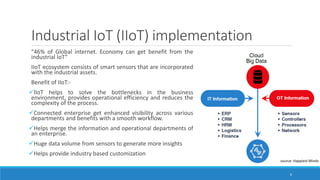
Industrial IoT (IIoT) implementation
“46% of Global internet. Economy can get benefit from the
industrial IoT”
IIoT ecosystem consists of smart sensors that are incorporated
with the industrial assets.
Benefit of IIoT:-
IIoT helps to solve the bottlenecks in the business
environment, provides operational efficiency and reduces the
complexity of the process.
Connected enterprise get enhanced visibility across various
departments and benefits with a smooth workflow.
Helps merge the information and operational departments of
an enterprise.
Huge data volume from sensors to generate more insights
Helps provide industry based customization
source: Happiest Minds
6
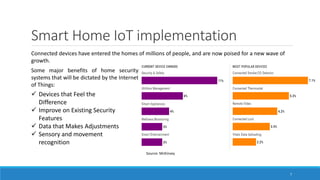
Smart Home IoT implementation
Source: McKinsey
 Devices that Feel the
Difference
 Improve on Existing Security
Features
 Data that Makes Adjustments
 Sensory and movement
recognition
Connected devices have entered the homes of millions of people, and are now poised for a new wave of
growth.
Some major benefits of home security
systems that will be dictated by the Internet
of Things:
7
Implementation in Automotive and
Other Industry
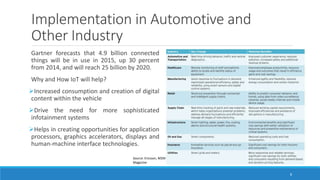
Gartner forecasts that 4.9 billion connected
things will be in use in 2015, up 30 percent
from 2014, and will reach 25 billion by 2020.
Why and How IoT will help?
Increased consumption and creation of digital
content within the vehicle
Drive the need for more sophisticated
infotainment systems
Helps in creating opportunities for application
processors, graphics accelerators, displays and
human-machine interface technologies.
Source: Ericsson, M2M
Magazine
8
Smart City - India
What is Smart City?
Smart Cities Mission is an urban renewal program by the Government of India with a mission to
develop 100 cities all over the country making them citizen friendly and sustainable.
Fundamental Pillars
Education, Healthcare, Security, Enterprise solutions
Why these pillars important?
It is important to take into account and find substantial gap in areas including education, safety,
sustainability, solid waste management and transport for a sustainable ecosystem.
Internet landscape comprises a great diversity of technology related topics involved in the
implementation of Smart Cities. Example: Ubiquitous computing, FTTH, Geographic Information
System, Cloud computing, E-Government and Internet of Things.
9
Fundamental Pillars of Smart City
Implementation in India
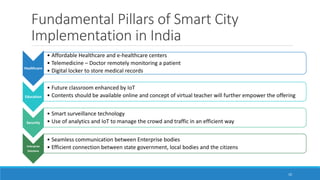
Healthcare
• Affordable Healthcare and e-healthcare centers
• Telemedicine – Doctor remotely monitoring a patient
• Digital locker to store medical records
Education
• Future classroom enhanced by IoT
• Contents should be available online and concept of virtual teacher will further empower the offering
Security
• Smart surveillance technology
• Use of analytics and IoT to manage the crowd and traffic in an efficient way
Enterprise
Solutions
• Seamless communication between Enterprise bodies
• Efficient connection between state government, local bodies and the citizens
10
Thank You
11

IoT_analysis_Vishal_Kumar

  • 1.
    A Comprehensive Reporton Internet of Things VISHAL KUMAR VISHAL.KUMAR@SITM.AC.IN / VISHALKR92@OUTLOOK.COM CONTACT: +91-7894511169 1
  • 2.
    IoT Landscape overthe years Internet of Things is a disruptive technology that enables the communication between smart devices and creates better opportunities and new revenue streams. IoT Market growth of 28% from FY2015 – FY 2016 (Source: NASSCOM) Nearly 120 firms offering IoT solutions in India; around 60% IoT startups emerging post 2010 (Source: NASSCOM) Indian IoT firms received around USD 60 mn funding in last 3 years (Source: NASSCOM) Indian IoT market expected to be a USD 15 bn market by 2020; accounting for nearly 5% of global market (Source: NASSCOM) WHY? Growth in the number of connected devices is driven by emerging applications and business models, and supported by falling device costs. Examples: smart buildings, transport logistics, fleet management, smart meters and agriculture. 2
  • 3.
    IoT Landscape overthe years IoT network connections— 2014 vs. 2015 % growth Source: Verizon data 0% 10% 20% 30% 40% 50% 60% 70% Healthcare/Pharma Home Monitoring Energy/Utilities Smart Cities Agriculture Transportation/Distribution Chart IoT network connections— 2014 vs. 2015 % growth Title Source: Verizon data Source: IDC Manufacturing Insights 3
  • 4.
    Technological Change (‘14vs. ‘15 vs. 16’)2014 • Digital engagement – Audio, Video consumed across multiple channel • Mobile Collaboration – Application market 2015 • Artificial Intelligence • 3D Printing • Business Intelligence (BI tools – SPSS, COGNOS) • Data Monetization 2016 • Internet of Things • Modern Data Center • Cloud Computing • Virtual Reality • Agile Methodology • Big Data Analytics 4
  • 5.
    Analysis of Topmarket segments Source: Gartner (November 2015) Category 2014 2015 2016 2020 Consumer 2,277 3,023 4,024 13,509 Business: Cross- Industry 632 815 1,092 4,408 Business: Vertical- Specific 898 1,065 1,276 2,880 Grand Total 3,807 4,902 6,392 20,797 Table: Internet of Things Units Installed Base by Category (Millions of Units) B2C devices kept their bar high and will continue to account for the greatest number of connected things. Gartner considered two classes of connected things under enterprise: 1. Generic/Cross Industry – devices that are used in multiple devices. Example: connected light bulbs, building management system, inventory system 2. Vertical specific – devices that are found in particular industries. Example: tracking devices in container ships. 5
  • 6.
    Industrial IoT (IIoT)implementation “46% of Global internet. Economy can get benefit from the industrial IoT” IIoT ecosystem consists of smart sensors that are incorporated with the industrial assets. Benefit of IIoT:- IIoT helps to solve the bottlenecks in the business environment, provides operational efficiency and reduces the complexity of the process. Connected enterprise get enhanced visibility across various departments and benefits with a smooth workflow. Helps merge the information and operational departments of an enterprise. Huge data volume from sensors to generate more insights Helps provide industry based customization source: Happiest Minds 6
  • 7.
    Smart Home IoTimplementation Source: McKinsey  Devices that Feel the Difference  Improve on Existing Security Features  Data that Makes Adjustments  Sensory and movement recognition Connected devices have entered the homes of millions of people, and are now poised for a new wave of growth. Some major benefits of home security systems that will be dictated by the Internet of Things: 7
  • 8.
    Implementation in Automotiveand Other Industry Gartner forecasts that 4.9 billion connected things will be in use in 2015, up 30 percent from 2014, and will reach 25 billion by 2020. Why and How IoT will help? Increased consumption and creation of digital content within the vehicle Drive the need for more sophisticated infotainment systems Helps in creating opportunities for application processors, graphics accelerators, displays and human-machine interface technologies. Source: Ericsson, M2M Magazine 8
  • 9.
    Smart City -India What is Smart City? Smart Cities Mission is an urban renewal program by the Government of India with a mission to develop 100 cities all over the country making them citizen friendly and sustainable. Fundamental Pillars Education, Healthcare, Security, Enterprise solutions Why these pillars important? It is important to take into account and find substantial gap in areas including education, safety, sustainability, solid waste management and transport for a sustainable ecosystem. Internet landscape comprises a great diversity of technology related topics involved in the implementation of Smart Cities. Example: Ubiquitous computing, FTTH, Geographic Information System, Cloud computing, E-Government and Internet of Things. 9
  • 10.
    Fundamental Pillars ofSmart City Implementation in India Healthcare • Affordable Healthcare and e-healthcare centers • Telemedicine – Doctor remotely monitoring a patient • Digital locker to store medical records Education • Future classroom enhanced by IoT • Contents should be available online and concept of virtual teacher will further empower the offering Security • Smart surveillance technology • Use of analytics and IoT to manage the crowd and traffic in an efficient way Enterprise Solutions • Seamless communication between Enterprise bodies • Efficient connection between state government, local bodies and the citizens 10
  • 11.