Process	Simulation	
Flow	Assurance	Case	Study
2014©COPYRIGHT	PROCESS	ECOLOGY	INC.
1
Estimation	of	slug	volume	using	
Aspen	Hydraulics
Background
• Heavy	fraction	in	natural	gas	condenses	may	
result	in	slugs	reaching	facilities
• Sizing	the	slug	catcher	requires	estimation	of	
slug	volume	and	duration
23/04/14 2014©COPYRIGHT	PROCESS	ECOLOGY	INC.
3
Project	description
• Much	richer	gas	was	expected	in	the	client	
pipeline.
• The	objective	of	this	project	was	to	estimate	
the	anticipated	slug	volume	and	duration
• Initial	estimates	indicated	a	3,000	bbl vessel
23/04/14 2014©COPYRIGHT	PROCESS	ECOLOGY	INC.
4
Slugging	types
• Terrain	–induced	slugging
– Caused	by	change	of	elevation	in	pipeline.
• Hydrodynamic	slugging
– Caused	by	formation	of	wave	on	liquid	surface	as	
a	result	of	faster	moving	gas	phase.
• Pig-Induced	slugging
– Caused	by	pigging	operations	in	pipeline.	Pig	is	
designed	to	push	most	of	the	liquid	contents	to	
the	outlet.
23/04/14 2014©COPYRIGHT	PROCESS	ECOLOGY	INC.
5
Slug	volume	prediction	methods
• Based	on	the	composition	and	operating	
conditions	at	slug	catcher
• Using	Aspen	HYSYS	Pipe	segment	slug	analysis	
tool	(Hydrodynamic	slug)
• Estimation	using	liquid	hold-up	profile	
(Pig-Induced)
• Transient	analysis	using	Aspen	Hydraulics	
(Terrain-Induced,	Pig-Induced)
23/04/14 2014©COPYRIGHT	PROCESS	ECOLOGY	INC.
6
23/04/14 2014©COPYRIGHT	PROCESS	ECOLOGY	INC.
7
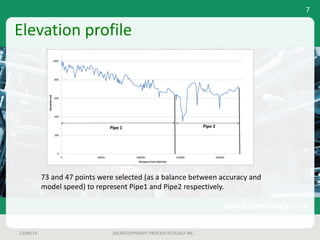
Elevation	profile
73	and	47	points	were	selected	(as	a	balance	between	accuracy	and	
model	speed)	to	represent	Pipe1	and	Pipe2	respectively.
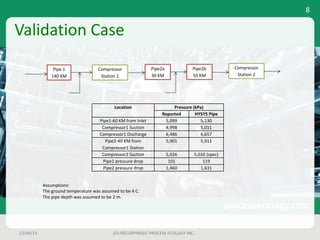
Validation	Case
Location Pressure	(kPa)
Reported HYSYS	Pipe
Pipe1-60	KM	from	Inlet 5,099 5,130
Compressor1	Suction 4,998 5,011
Compressor1	Discharge 6,486 6,657
Pipe2-40	KM from	
Compressor1	Station
5,901 5,911
Compressor2	Suction 5,026 5,026	(spec)
Pipe1	pressure	drop 101 119
Pipe2	pressure	drop 1,460 1,631
23/04/14 2014©COPYRIGHT	PROCESS	ECOLOGY	INC.
8
Pipe2a
30	KM
Pipe	1
140	KM
Compressor	
Station	1
Pipe2b
50	KM
Compressor	
Station	2
Assumptions:
The	ground	temperature	was	assumed	to	be	4	C.
The	pipe	depth	was	assumed	to	be	2	m.
Slug	Prediction
• Recovered	liquid	volume	flow	rate	from	flash	
calculation
• Slug	volume	based	on	the	liquid	holdup	profile
• Slug	Volume	based	on	transient	analysis	using	
HYSYS	Hydraulics
23/04/14 2014©COPYRIGHT	PROCESS	ECOLOGY	INC.
9
Slug	Prediction
• Recovered	liquid	volume	flow	rate	from	flash	
calculation
• Slug	volume	based	on	the	liquid	holdup	profile
• Slug	Volume	based	on	transient	analysis	using	
HYSYS	Hydraulics
23/04/14 2014©COPYRIGHT	PROCESS	ECOLOGY	INC.
10
Gas	composition
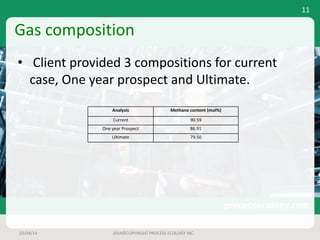
• Client	provided	3	compositions	for	current	
case,	One	year	prospect	and	Ultimate.
23/04/14 2014©COPYRIGHT	PROCESS	ECOLOGY	INC.
11
Analysis Methane	content	(mol%)
Current 90.59
One	year	Prospect 86.91
Ultimate 79.50
Flash	calculation	results
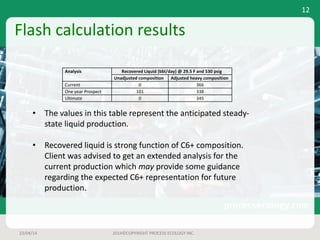
Analysis Recovered	Liquid	(bbl/day)	@	29.5	F	and	530	psig
Unadjusted	composition Adjusted	heavy	composition
Current 0 366
One	year	Prospect 101 338
Ultimate 0 345
23/04/14 2014©COPYRIGHT	PROCESS	ECOLOGY	INC.
12
• The	values	in	this	table	represent	the	anticipated	steady-
state	liquid	production.	
• Recovered	liquid	is	strong	function	of	C6+	composition.	
Client	was	advised	to	get	an	extended	analysis	for	the	
current	production	which	may provide	some	guidance	
regarding	the	expected	C6+	representation	for	future	
production.
Sensitivity	Analysis	– C6+/C7+	distribution
23/04/14 2014©COPYRIGHT	PROCESS	ECOLOGY	INC.
13
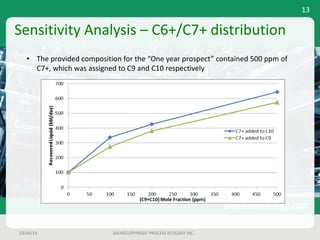
• The	provided	composition	for	the	“One	year	prospect”	contained	500	ppm	of	
C7+,	which	was	assigned	to	C9	and	C10	respectively
Slug	Prediction
• Recovered	liquid	volume	flow	rate	from	flash	
calculation
• Slug	volume	based	on	the	liquid	holdup	profile
• Slug	Volume	based	on	transient	analysis	using	
HYSYS	Hydraulics
23/04/14 2014©COPYRIGHT	PROCESS	ECOLOGY	INC.
14
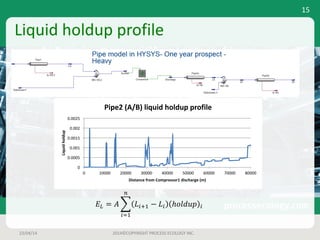
Liquid	holdup	profile
23/04/14 2014©COPYRIGHT	PROCESS	ECOLOGY	INC.
15
0
0.0005
0.001
0.0015
0.002
0.0025
0 10000 20000 30000 40000 50000 60000 70000 80000
Liquid	holdup
Distance	from	Compressor1	discharge	(m)
Pipe2	(A/B)	liquid	holdup	profile
𝐸" = 𝐴 % 𝐿'() − 𝐿' ℎ𝑜𝑙𝑑𝑢𝑝 '	
2
'3)
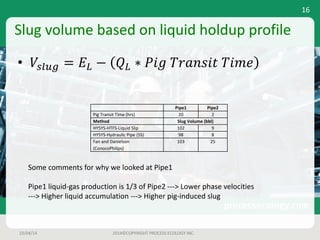
Slug	volume	based	on	liquid	holdup	profile
• 𝑉5678 = 𝐸" − 𝑄" ∗ 𝑃𝑖𝑔	𝑇𝑟𝑎𝑛𝑠𝑖𝑡	𝑇𝑖𝑚𝑒
23/04/14 2014©COPYRIGHT	PROCESS	ECOLOGY	INC.
16
Pipe1 Pipe2
Pig	Transit	Time	(hrs) 20 2
Method Slug	Volume	(bbl)
HYSYS-HTFS-Liquid	Slip 102 9
HYSYS-Hydraulic	Pipe	(SS) 98 8
Fan	and	Danielson	
(ConocoPhilips)
103 25
Some	comments	for	why	we	looked	at	Pipe1
Pipe1	liquid-gas	production	is	1/3	of	Pipe2	--->	Lower	phase	velocities
--->	Higher	liquid	accumulation	--->	Higher	pig-induced	slug
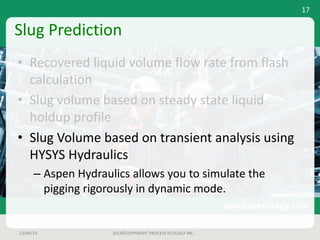
Slug	Prediction
• Recovered	liquid	volume	flow	rate	from	flash	
calculation
• Slug	volume	based	on	steady	state	liquid	
holdup	profile
• Slug	Volume	based	on	transient	analysis	using	
HYSYS	Hydraulics
– Aspen	Hydraulics	allows	you	to	simulate	the	
pigging	rigorously	in	dynamic	mode.
23/04/14 2014©COPYRIGHT	PROCESS	ECOLOGY	INC.
17
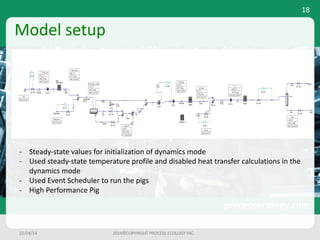
Model	setup
23/04/14 2014©COPYRIGHT	PROCESS	ECOLOGY	INC.
18
- Steady-state	values	for	initialization	of	dynamics	mode
- Used	steady-state	temperature	profile	and	disabled	heat	transfer	calculations	in	the	
dynamics	mode
- Used	Event	Scheduler	to	run	the	pigs
- High	Performance	Pig
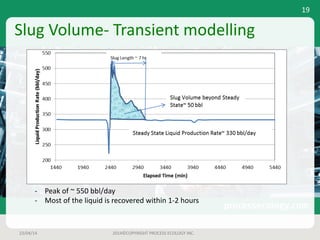
Slug	Volume- Transient	modelling
23/04/14 2014©COPYRIGHT	PROCESS	ECOLOGY	INC.
19
- Peak	of	~	550	bbl/day
- Most	of	the	liquid	is	recovered	within	1-2	hours
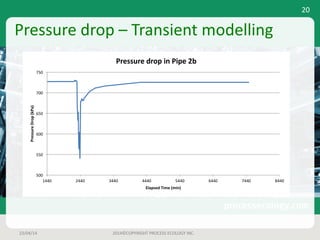
Pressure	drop	– Transient	modelling
23/04/14 2014©COPYRIGHT	PROCESS	ECOLOGY	INC.
20
500
550
600
650
700
750
1440 2440 3440 4440 5440 6440 7440 8440
Pressure	Drop	(kPa)
Elapsed	Time	(min)
Pressure	drop	in	Pipe	2b
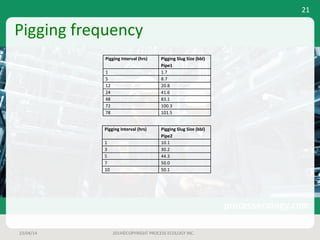
Pigging	frequency
23/04/14 2014©COPYRIGHT	PROCESS	ECOLOGY	INC.
21
Pigging Interval (hrs) Pigging Slug Size (bbl)
Pipe1
1 1.7
5 8.7
12 20.8
24 41.6
48 83.1
72 100.3
78 101.5
Pigging	Interval	(hrs) Pigging	Slug	Size	(bbl)
Pipe2
1 10.1
3 30.2
5 44.3
7 50.0
10 50.1
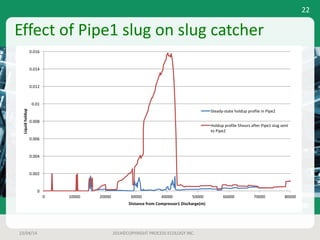
Effect	of	Pipe1	slug	on	slug	catcher
23/04/14 2014©COPYRIGHT	PROCESS	ECOLOGY	INC.
22
0
0.002
0.004
0.006
0.008
0.01
0.012
0.014
0.016
0 10000 20000 30000 40000 50000 60000 70000 80000
Liquid	holdup
Distance	from	Compressor1	Discharge(m)
Steady-state	holdup	profile	in	Pipe2
Holdup	profile	5hours	after	Pipe1	slug	sent	
to	Pipe2
Conclusions
• Results	are	highly	sensitive	to	the	composition	
of	heavy	components
• A	conservative	design	would	limit	the	size	of	
the	vessel	to	around	1,000	bbl
• Aspen	HYSYS	enables	the	estimation	of	slug	
volumes	with	various	levels	of	detail
• HYSYS	Upstream	Hydraulics	allows	the	
evaluation	of	transient	slug	formation
23/04/14 2014©COPYRIGHT	PROCESS	ECOLOGY	INC.
23
Thank	you	for	your	attention
• QUESTIONS?
• Alberto@processecology.com
• Ahad@processecology.com
23/04/14 2014©COPYRIGHT	PROCESS	ECOLOGY	INC.
24
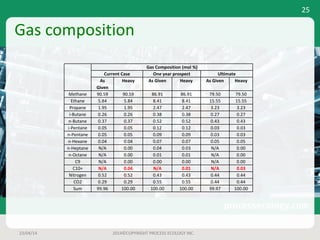
Gas	composition
Gas	Composition	(mol	%)
Current	Case One	year	prospect Ultimate
As	
Given
Heavy	 As	Given Heavy As	Given Heavy
Methane 90.59 90.59 86.91 86.91 79.50 79.50
Ethane 5.84 5.84 8.41 8.41 15.55 15.55
Propane 1.95 1.95 2.47 2.47 3.23 3.23
i-Butane 0.26 0.26 0.38 0.38 0.27 0.27
n-Butane 0.37 0.37 0.52 0.52 0.43 0.43
i-Pentane 0.05 0.05 0.12 0.12 0.03 0.03
n-Pentane 0.05 0.05 0.09 0.09 0.03 0.03
n-Hexane 0.04 0.04 0.07 0.07 0.05 0.05
n-Heptane N/A 0.00 0.04 0.03 N/A 0.00
n-Octane N/A 0.00 0.01 0.01 N/A 0.00
C9 N/A 0.00 0.00 0.00 N/A 0.00
C10+ N/A 0.04 N/A 0.01 N/A 0.03
Nitrogen 0.52 0.52 0.43 0.43 0.44 0.44
CO2 0.29 0.29 0.55 0.55 0.44 0.44
Sum 99.96 100.00 100.00 100.00 99.97 100.00
23/04/14 2014©COPYRIGHT	PROCESS	ECOLOGY	INC.
25

Flow assurance using AspenHYSYS Hydraulics