A Framework for Online
    Teaching and Learning:
The S-CARE Pedagogical Model
       Abtar Kaur, Open University Malaysia, Malaysia
   Shriram Raghunathan, Abdur Rahman University, India
Introduction
• Student satisfaction and retention is a key
  feature of any good educational
  programme. Deden (2005) reports a 7.7
  % improvement in student retention after
  one year through a number of measures
  including the quality of instructor’s online
  interaction
                                      Cont…
Introduction
When measuring the success of an online
programme a number of learning
permutations have to be considered,
namely: the learning activities, tools,
resources and Interactions/communication
What is a Pedagogical
      Scenario?
 A sequence of phases within which
participants have tasks to do and specific
roles to play
 High focus on learning activities that
achieve the learning outcomes
What is a Pedagogical Scenario?
When designing and executing a
pedagogical scenario the teacher has to
  – respect a harmonic equilibrium between
   the freedom which is necessary for
   intellectual development and motivation
Engagement and open confrontation of
ideas must be guided by structured
activities and a certain amount of
monitoring
What is the Problem?

 Great online teaching and learning
strategies not fully capitalized and
exploited
 There is an imbalance in the
difference pedagogical scenarios used
by the facilitators
Other Research Studies
Jara and Mohammed (2007)
   – categorized online learning in terms of content, learning activities,
     communication, resources, feedback and administration.
Lee (2009)
   – CAP (Concept ,Application, Practice) framework for designing online
     education platforms based on experience and scaffolding
Hathaway (2009)
   – formation of portraits from questionnaires.
Dabbagh & Kitsantas (2009)
   – studied the best practices of experienced online instructors and found that
     integrative learning technologies were subconsciously used to simulate self-
     learning among learners.
The Purpose
 To present the various pedagogical
scenarios used by different online MIDT
facilitators
 To seek student feedback on what
they prefer as an online student.
 To propose a model that is considered
optimal for teaching and learning online
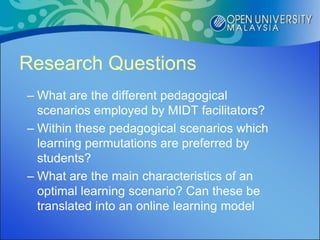
Research Questions
– What are the different pedagogical
  scenarios employed by MIDT facilitators?
– Within these pedagogical scenarios which
  learning permutations are preferred by
  students?
– What are the main characteristics of an
  optimal learning scenario? Can these be
  translated into an online learning model
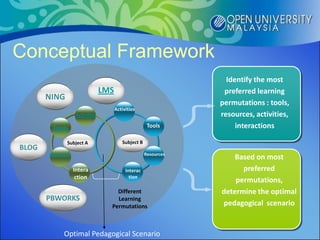
Conceptual Framework
                                                                    Identify the most
                                 LMS                               preferred learning
       NING
                                                                  permutations : tools,
                                       Activities
                    Activities                                    resources, activities,
        Tools                                          Tools           interactions

              Subject A                   Subject B
BLOG
       Resources                                      Resources
                                                                      Based on most
                   Intera                   Interac                     preferred
                    ction                     tion
                                                                      permutations,
                                     Different                    determine the optimal
       PBWORKS                       Learning
                                   Permutations                   pedagogical scenario


             Optimal Pedagogical Scenario
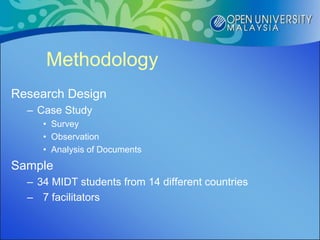
Methodology
Research Design
  – Case Study
     • Survey
     • Observation
     • Analysis of Documents
Sample
  – 34 MIDT students from 14 different countries
  – 7 facilitators
Results

RQ1: What are the different pedagogical
scenarios employed by MIDT
facilitators?


                                     Cont…
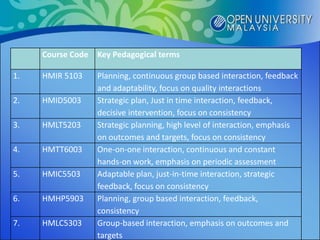
Course Code   Key Pedagogical terms

1.   HMIR 5103     Planning, continuous group based interaction, feedback
                   and adaptability, focus on quality interactions
2.   HMID5003      Strategic plan, Just in time interaction, feedback,
                   decisive intervention, focus on consistency
3.   HMLT5203      Strategic planning, high level of interaction, emphasis
                   on outcomes and targets, focus on consistency
4.   HMTT6003      One-on-one interaction, continuous and constant
                   hands-on work, emphasis on periodic assessment
5.   HMIC5503      Adaptable plan, just-in-time interaction, strategic
                   feedback, focus on consistency
6.   HMHP5903      Planning, group based interaction, feedback,
                   consistency
7.   HMLC5303      Group-based interaction, emphasis on outcomes and
                   targets
RQ2: Within these pedagogical
scenarios which learning permutations
are preferred by students?
Qualities sought by MIDT
         learners
 – People: feedback, dynamism, patience, subject
   knowledge, clear communication by facilitators,
   fellow students and supporting staff
 – Structure: clear delineation and comprehensiveness
   of activities
 – Environment: accessibility, ease of navigation,
   support
 – Resources : varied, well selected and suited to
   different learning styles
Factors in the success of online
learning environments
  – Usability
  – Stability
  – Instant access and
  – Instant notifications
  – The look and feel
  – Loss of data
Qualities students look
for in online facilitators
   – Patience, open mindedness, positive attitude and
     tolerance
   – Knowledge in the subject area
   – Availability and communication
   – Feedback
   – Good preparation (keeping in mind distance education
     students)
   – Reliability (students must be able to rely on the
     facilitator)
   – Ability to differentiate and apply different teaching
     methods (keeping in mind that students differ)
Major Findings of RQ1 and RQ2
Planning
Interaction
Feedback and resources
Overall focus
Discussion
There is a remarkable symmetry and significant points of divergence in
the students’ and facilitators’ views.
The students’ views on the facilitators’ approaches matched clearly with
what the facilitators viewed as their model.
The students and facilitators agreed on
     the factors important for an online learning environment, planning, feedback
      and resources.
The differences were subtle.
     The students’ viewed the learning outcomes and course outline as the vision
      document whereas the facilitators’ viewed them as guidelines.
     The students viewed interactions in the prism of course structure as an
      activity, whereas the facilitators viewed the interaction as a communication
      paradigm.
     The role of feedback was also similarly nuanced.
        • The facilitators preferred a scaffolded approach whereas the students viewed
          feedback as a score card.
RQ3: What are the main characteristics of an optimal learning
 scenario? Can these be translated into an online learning
                          model
 S- Strategic
     – Had a Strategic plan for the course which consisted of a clear plan what needs to be
       taught, how to do it and the knowledge of the environment.
 C- Consistent
     – Show Consistency in the approach. Consistency can help the learners understand
       better
 A- Adaptive
 Adapt to the demands of the following three elements
     – Students
     – Environment
     – Time
 R- Responsive
     – Responsively react to the situations
 E- effective
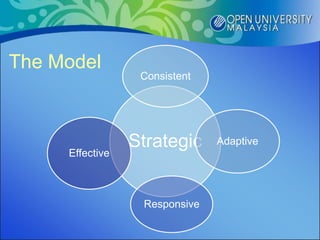
The Model
                  Consistent


                 Strategic     Adaptive
     Effective


                  Responsive
Conclusion
 The success of the S-CARE portends well for the
future in that it provides a structure to teaching and
learning within the framework of chaos of the online
environment.
 The combined experience of about 2 years of
work shows both the potential and the way forward
for the future and S-CARE is a step forward in
helping online teaching and learning achieve its
promise.
Comments & Thank You

Midt

  • 1.
    A Framework forOnline Teaching and Learning: The S-CARE Pedagogical Model Abtar Kaur, Open University Malaysia, Malaysia Shriram Raghunathan, Abdur Rahman University, India
  • 2.
    Introduction • Student satisfactionand retention is a key feature of any good educational programme. Deden (2005) reports a 7.7 % improvement in student retention after one year through a number of measures including the quality of instructor’s online interaction Cont…
  • 3.
    Introduction When measuring thesuccess of an online programme a number of learning permutations have to be considered, namely: the learning activities, tools, resources and Interactions/communication
  • 4.
    What is aPedagogical Scenario?  A sequence of phases within which participants have tasks to do and specific roles to play  High focus on learning activities that achieve the learning outcomes
  • 5.
    What is aPedagogical Scenario? When designing and executing a pedagogical scenario the teacher has to – respect a harmonic equilibrium between the freedom which is necessary for intellectual development and motivation Engagement and open confrontation of ideas must be guided by structured activities and a certain amount of monitoring
  • 6.
    What is theProblem?  Great online teaching and learning strategies not fully capitalized and exploited  There is an imbalance in the difference pedagogical scenarios used by the facilitators
  • 7.
    Other Research Studies Jaraand Mohammed (2007) – categorized online learning in terms of content, learning activities, communication, resources, feedback and administration. Lee (2009) – CAP (Concept ,Application, Practice) framework for designing online education platforms based on experience and scaffolding Hathaway (2009) – formation of portraits from questionnaires. Dabbagh & Kitsantas (2009) – studied the best practices of experienced online instructors and found that integrative learning technologies were subconsciously used to simulate self- learning among learners.
  • 8.
    The Purpose  Topresent the various pedagogical scenarios used by different online MIDT facilitators  To seek student feedback on what they prefer as an online student.  To propose a model that is considered optimal for teaching and learning online
  • 9.
    Research Questions – Whatare the different pedagogical scenarios employed by MIDT facilitators? – Within these pedagogical scenarios which learning permutations are preferred by students? – What are the main characteristics of an optimal learning scenario? Can these be translated into an online learning model
  • 10.
    Conceptual Framework Identify the most LMS preferred learning NING permutations : tools, Activities Activities resources, activities, Tools Tools interactions Subject A Subject B BLOG Resources Resources Based on most Intera Interac preferred ction tion permutations, Different determine the optimal PBWORKS Learning Permutations pedagogical scenario Optimal Pedagogical Scenario
  • 11.
    Methodology Research Design – Case Study • Survey • Observation • Analysis of Documents Sample – 34 MIDT students from 14 different countries – 7 facilitators
  • 12.
    Results RQ1: What arethe different pedagogical scenarios employed by MIDT facilitators? Cont…
  • 13.
    Course Code Key Pedagogical terms 1. HMIR 5103 Planning, continuous group based interaction, feedback and adaptability, focus on quality interactions 2. HMID5003 Strategic plan, Just in time interaction, feedback, decisive intervention, focus on consistency 3. HMLT5203 Strategic planning, high level of interaction, emphasis on outcomes and targets, focus on consistency 4. HMTT6003 One-on-one interaction, continuous and constant hands-on work, emphasis on periodic assessment 5. HMIC5503 Adaptable plan, just-in-time interaction, strategic feedback, focus on consistency 6. HMHP5903 Planning, group based interaction, feedback, consistency 7. HMLC5303 Group-based interaction, emphasis on outcomes and targets
  • 14.
    RQ2: Within thesepedagogical scenarios which learning permutations are preferred by students?
  • 15.
    Qualities sought byMIDT learners – People: feedback, dynamism, patience, subject knowledge, clear communication by facilitators, fellow students and supporting staff – Structure: clear delineation and comprehensiveness of activities – Environment: accessibility, ease of navigation, support – Resources : varied, well selected and suited to different learning styles
  • 16.
    Factors in thesuccess of online learning environments – Usability – Stability – Instant access and – Instant notifications – The look and feel – Loss of data
  • 17.
    Qualities students look forin online facilitators – Patience, open mindedness, positive attitude and tolerance – Knowledge in the subject area – Availability and communication – Feedback – Good preparation (keeping in mind distance education students) – Reliability (students must be able to rely on the facilitator) – Ability to differentiate and apply different teaching methods (keeping in mind that students differ)
  • 18.
    Major Findings ofRQ1 and RQ2 Planning Interaction Feedback and resources Overall focus
  • 19.
    Discussion There is aremarkable symmetry and significant points of divergence in the students’ and facilitators’ views. The students’ views on the facilitators’ approaches matched clearly with what the facilitators viewed as their model. The students and facilitators agreed on  the factors important for an online learning environment, planning, feedback and resources. The differences were subtle.  The students’ viewed the learning outcomes and course outline as the vision document whereas the facilitators’ viewed them as guidelines.  The students viewed interactions in the prism of course structure as an activity, whereas the facilitators viewed the interaction as a communication paradigm.  The role of feedback was also similarly nuanced. • The facilitators preferred a scaffolded approach whereas the students viewed feedback as a score card.
  • 20.
    RQ3: What arethe main characteristics of an optimal learning scenario? Can these be translated into an online learning model S- Strategic – Had a Strategic plan for the course which consisted of a clear plan what needs to be taught, how to do it and the knowledge of the environment. C- Consistent – Show Consistency in the approach. Consistency can help the learners understand better A- Adaptive Adapt to the demands of the following three elements – Students – Environment – Time R- Responsive – Responsively react to the situations E- effective
  • 21.
    The Model Consistent Strategic Adaptive Effective Responsive
  • 22.
    Conclusion  The successof the S-CARE portends well for the future in that it provides a structure to teaching and learning within the framework of chaos of the online environment.  The combined experience of about 2 years of work shows both the potential and the way forward for the future and S-CARE is a step forward in helping online teaching and learning achieve its promise.
  • 23.