Assessment in a constructivist, Technology-Supported Learning
This document discusses assessment in a constructivist classroom that utilizes technology. It defines key terms like assessment, constructivism, technology, and learning. There are three main types of assessment used - summative, formative, and authentic. Summative assessment measures knowledge through tests, formative provides feedback to improve learning, and authentic requires creative demonstration of skills. Constructivism focuses on learning how to think rather than memorization, and benefits include active involvement in learning and understanding how to learn.
Overview of assessment in constructivism emphasizing the integration of technology, types of assessment (summative, formative, authentic), and their educational benefits.
Assessment in a constructivist, Technology-Supported Learning
1.
Lesson 21: Assessmentin a
Constructivist, Technology-
Supported Learning
Reporter: Jacob C. Duncombe
Republic of the Philippines
ZAMBOANGA CITY STATE POLYTECHNIC COLLEGE
Region IX, Zamboanga Peninsula
R.T. Lim Blvd., Zamboanga City
Tel. No. (062)991-3815/993-0023
2.
OBJECTIVES:
At the endof the chapter, the learners should
able to:
Define the terms: assessment, theory of
constructivist, technology, and learning.
Discuss the assessment used in a
constructivist's classroom
Discuss the benefits of constructivism.
THEORY
OF
CONSTRUCTIVISM
It is atheory of knowledge
that argues that humans
generate knowledge and
meaning from an
interaction between their
experiences and ideas.
6.
TECHNOLOGY
Comes fromthe Greek word ‘’techne’’
which means art or craft. Thus it refers to
the art or craft of responding to the
educational need
-(Corpuz&Lucido2012)
Technology facilitates learning and
improving performances by creating,
using , and managing appropriate
technological processes and resources.
EXAMPLES: LAPTOPS, INTERNET,
ETC.
7.
LEARNING
The process ofacquiring
modifications in existing
knowledge, skills, habits
or tendencies through
experience practice or
exercise.
8.
ASSESSME
NT
It refers toall those activities
undertaken by the teachers,
and by their students in
assessing themselves, which
provide information to be used
as a feedback to modify the
teaching and learning activities
in which they are engaged.
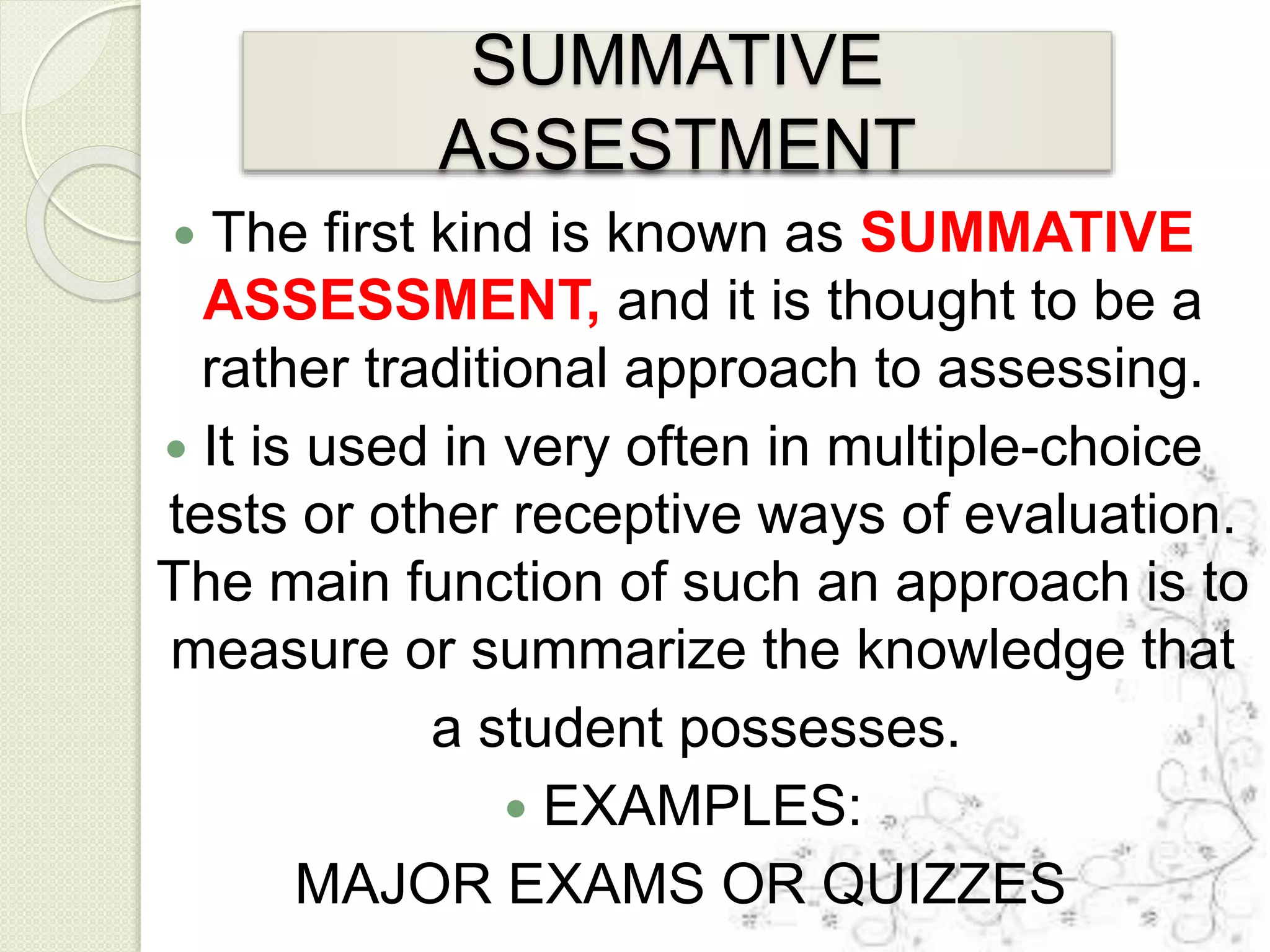
SUMMATIVE
ASSESTMENT
The firstkind is known as SUMMATIVE
ASSESSMENT, and it is thought to be a
rather traditional approach to assessing.
It is used in very often in multiple-choice
tests or other receptive ways of evaluation.
The main function of such an approach is to
measure or summarize the knowledge that
a student possesses.
EXAMPLES:
MAJOR EXAMS OR QUIZZES
11.
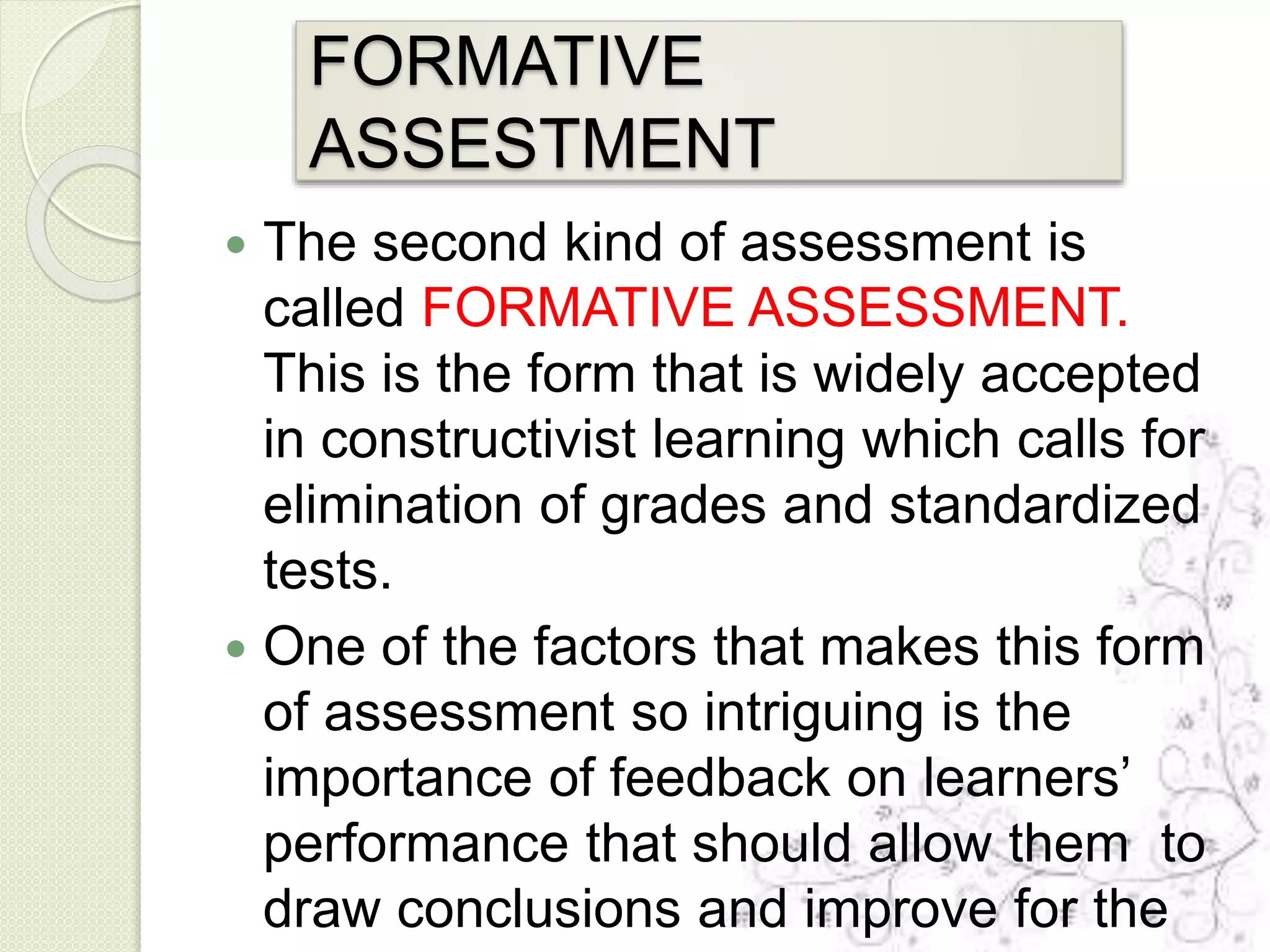
FORMATIVE
ASSESTMENT
The secondkind of assessment is
called FORMATIVE ASSESSMENT.
This is the form that is widely accepted
in constructivist learning which calls for
elimination of grades and standardized
tests.
One of the factors that makes this form
of assessment so intriguing is the
importance of feedback on learners’
performance that should allow them to
draw conclusions and improve for the
12.
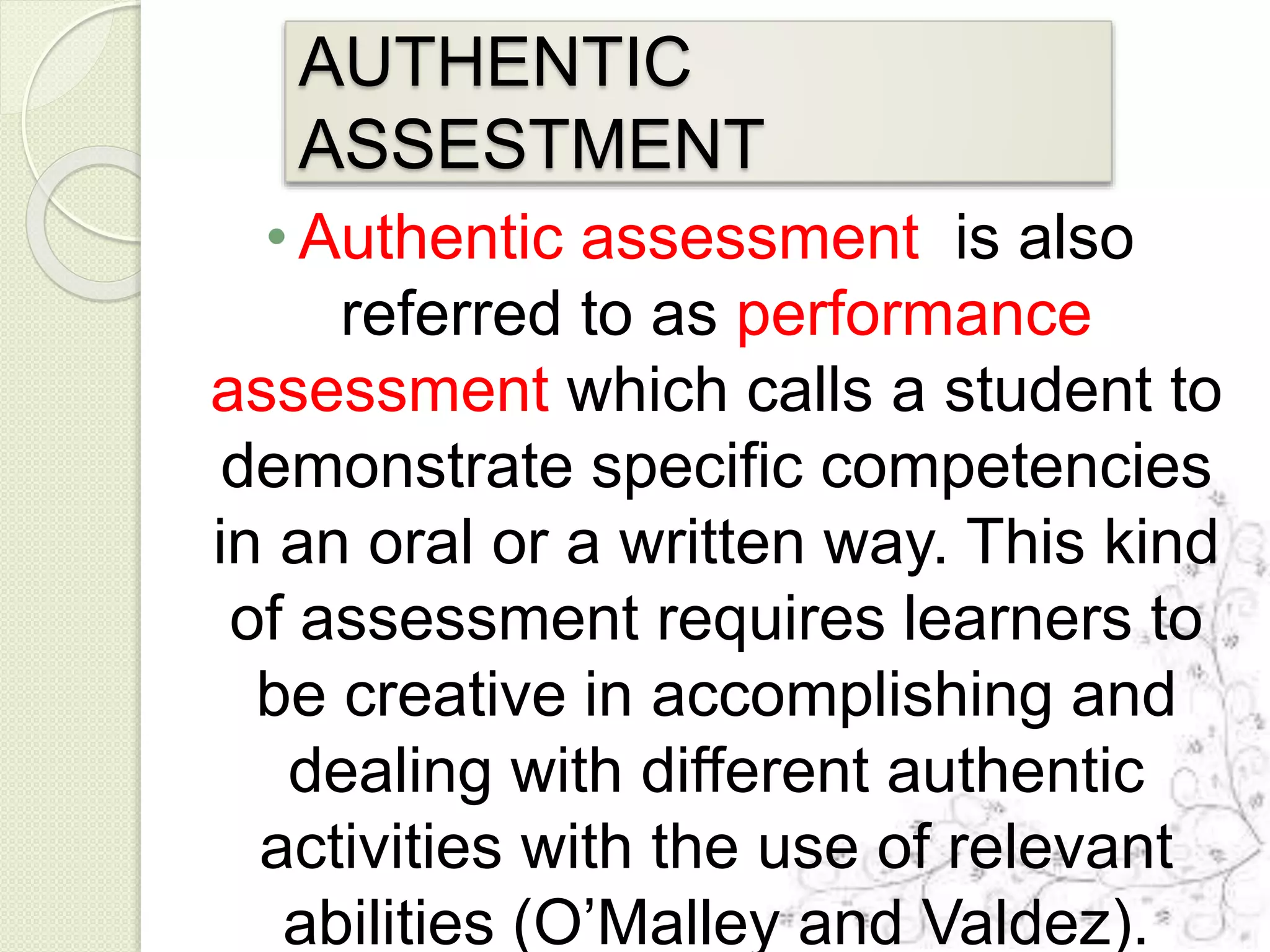
AUTHENTIC
ASSESTMENT
• Authentic assessmentis also
referred to as performance
assessment which calls a student to
demonstrate specific competencies
in an oral or a written way. This kind
of assessment requires learners to
be creative in accomplishing and
dealing with different authentic
activities with the use of relevant
abilities (O’Malley and Valdez).
13.
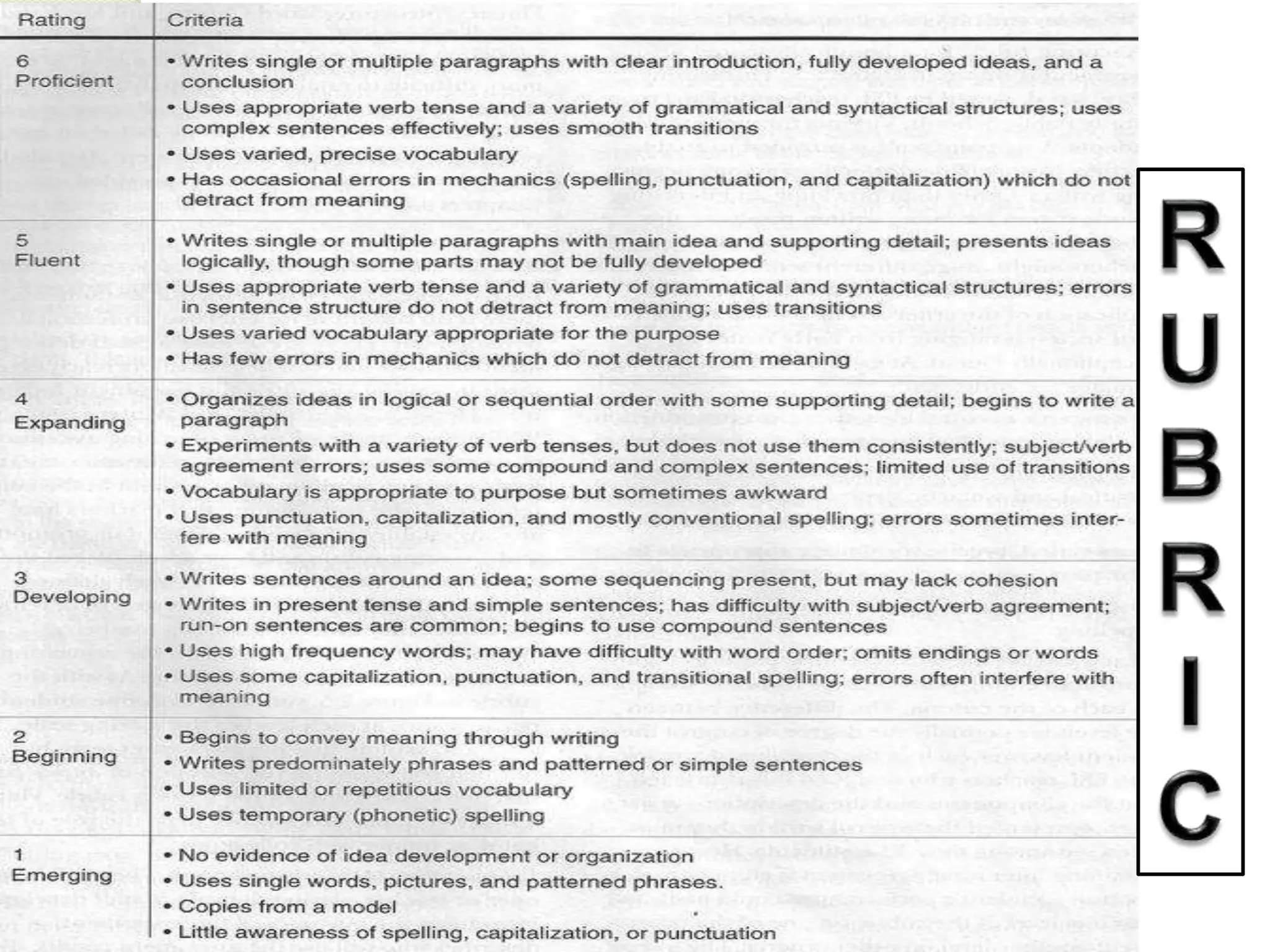
An authentic orperformance
assessment usually provides a
task for the learners in which
they need to perform. The
results of their performance is
evaluated with the use of a
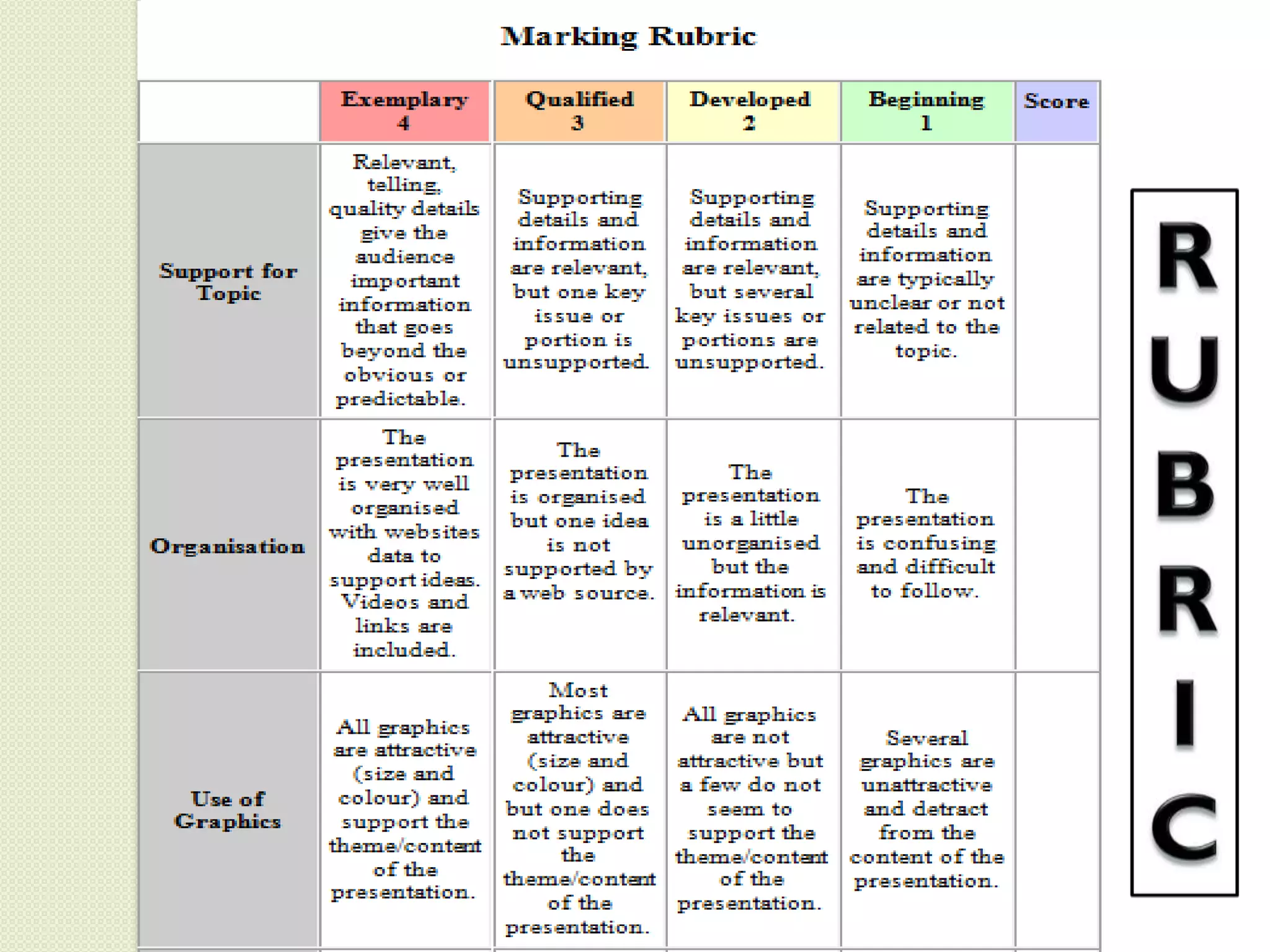
rubric which is a kind of a table
with is specially prepared
criteria for students’
performance allocated to the
accurate levels of expertise.
18.
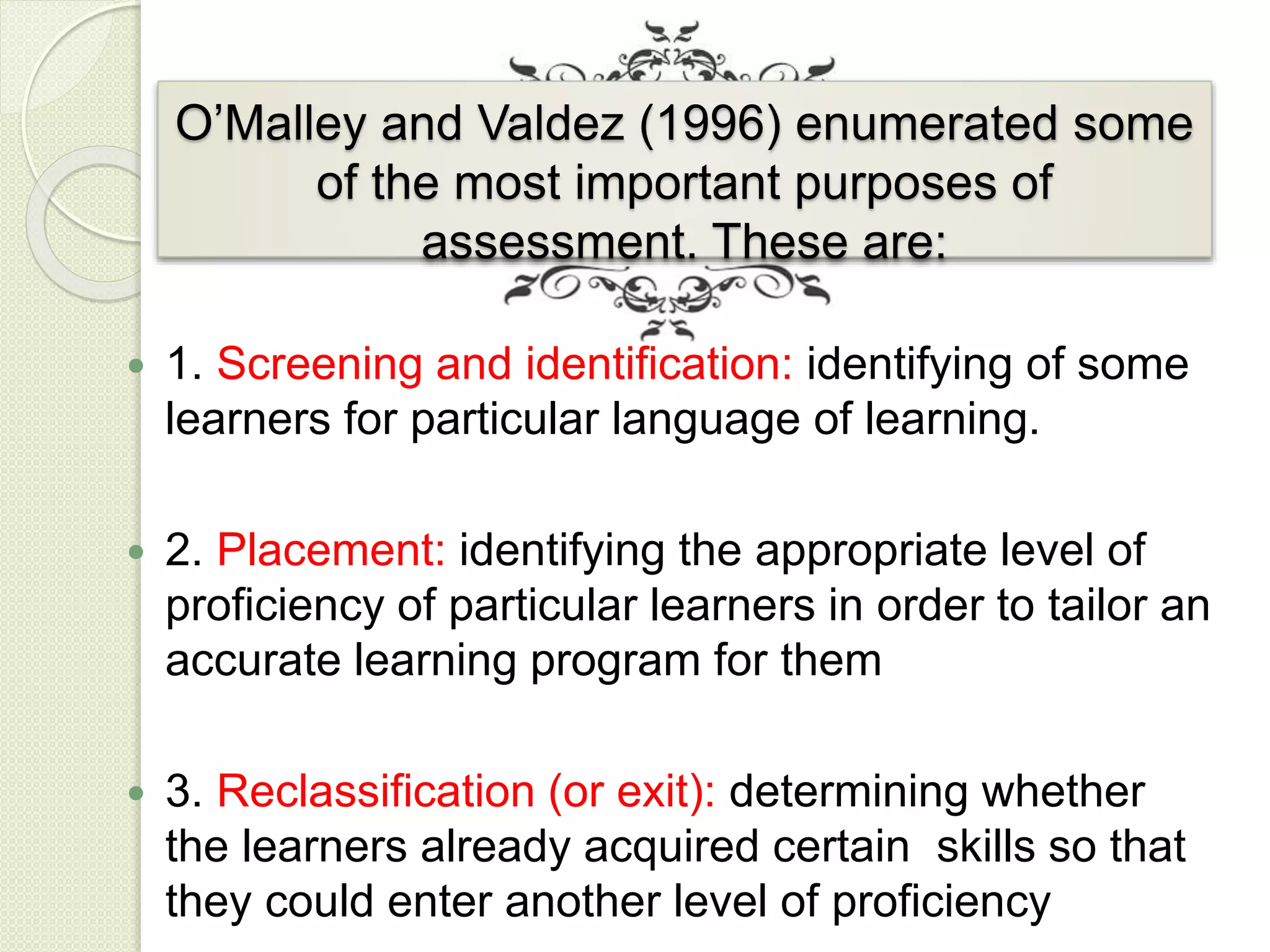
O’Malley and Valdez(1996) enumerated some
of the most important purposes of
assessment. These are:
1. Screening and identification: identifying of some
learners for particular language of learning.
2. Placement: identifying the appropriate level of
proficiency of particular learners in order to tailor an
accurate learning program for them
3. Reclassification (or exit): determining whether
the learners already acquired certain skills so that
they could enter another level of proficiency
19.
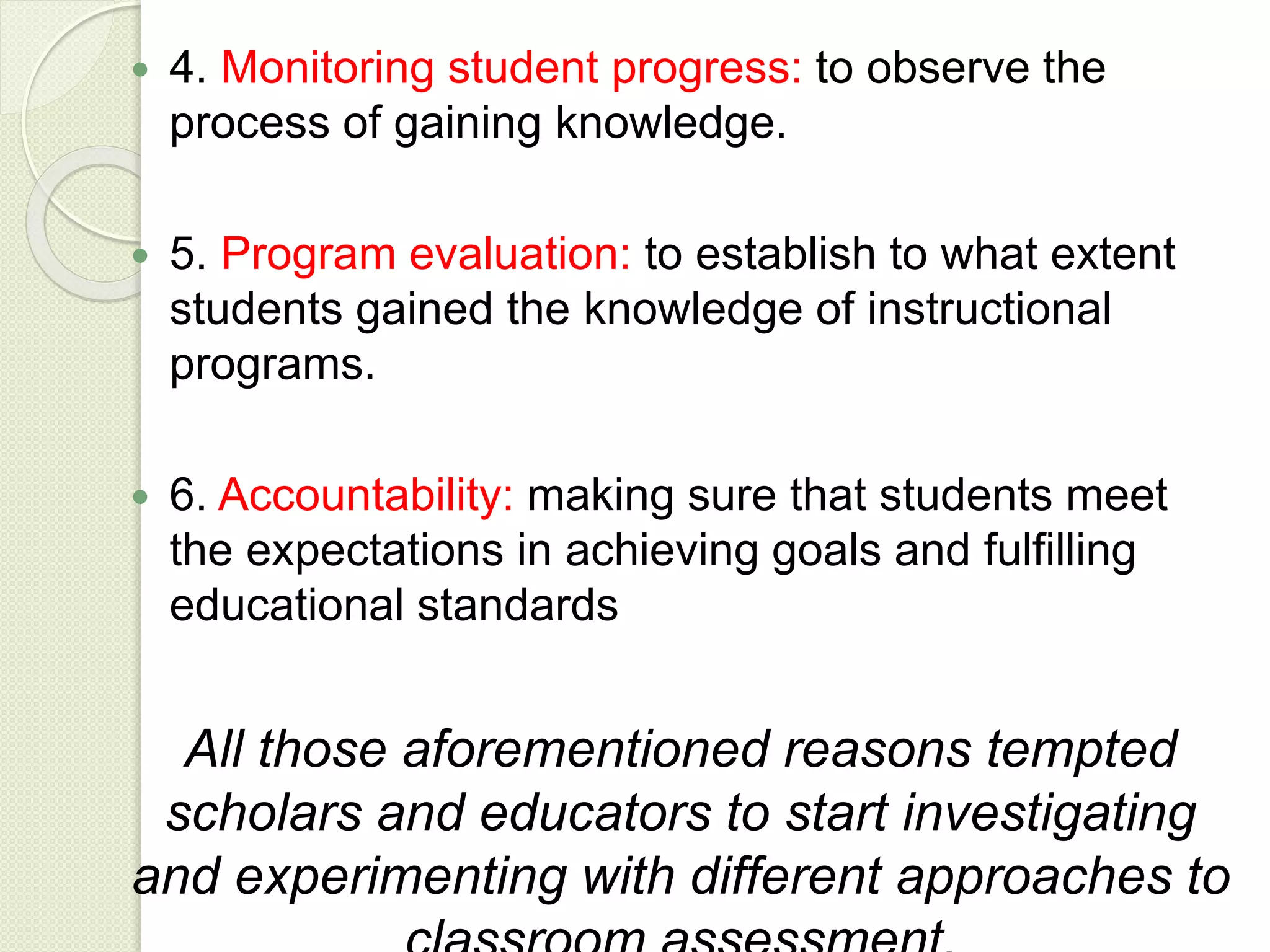
4. Monitoringstudent progress: to observe the
process of gaining knowledge.
5. Program evaluation: to establish to what extent
students gained the knowledge of instructional
programs.
6. Accountability: making sure that students meet
the expectations in achieving goals and fulfilling
educational standards
All those aforementioned reasons tempted
scholars and educators to start investigating
and experimenting with different approaches to
20.
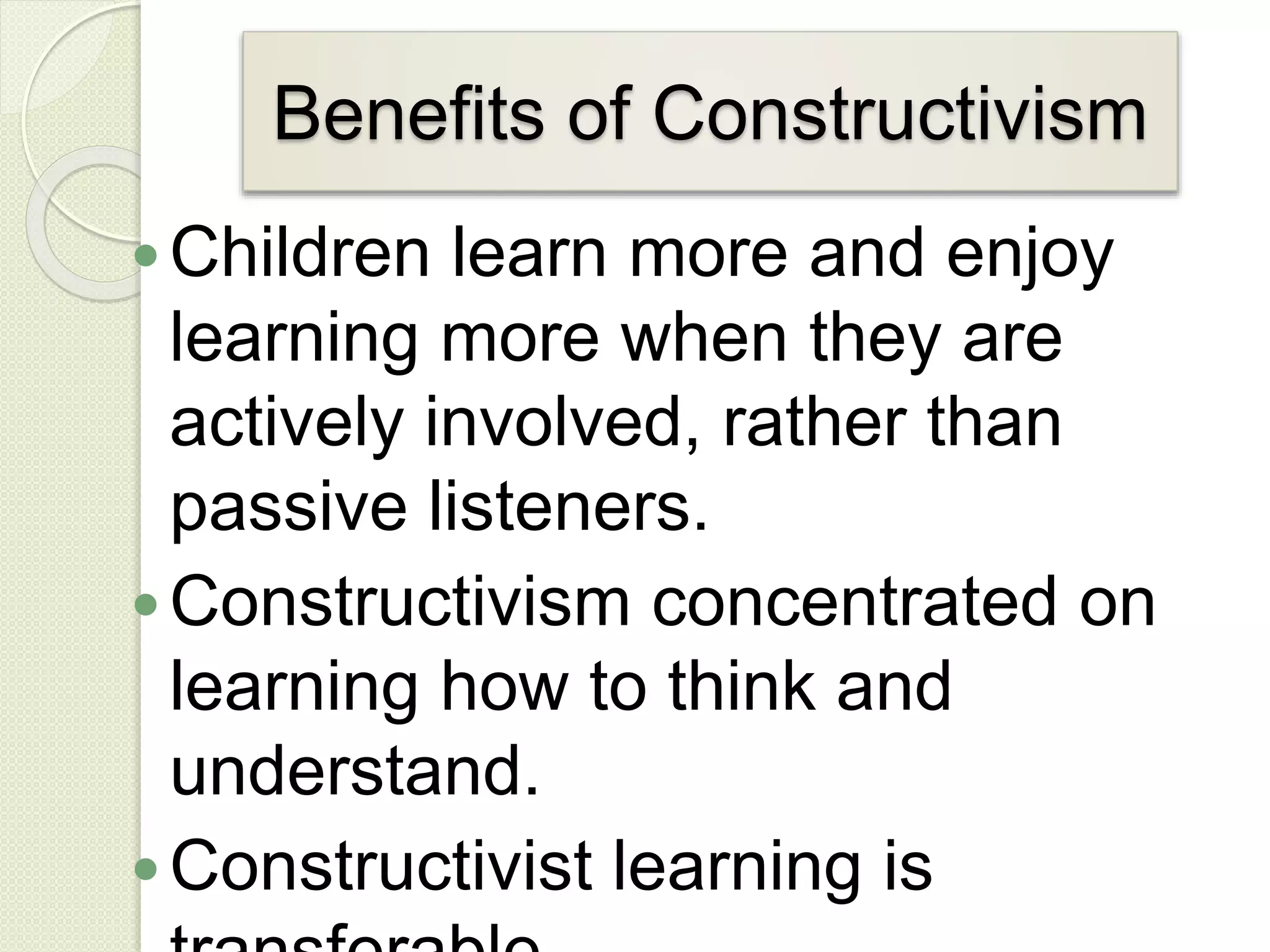
Benefits of Constructivism
Childrenlearn more and enjoy
learning more when they are
actively involved, rather than
passive listeners.
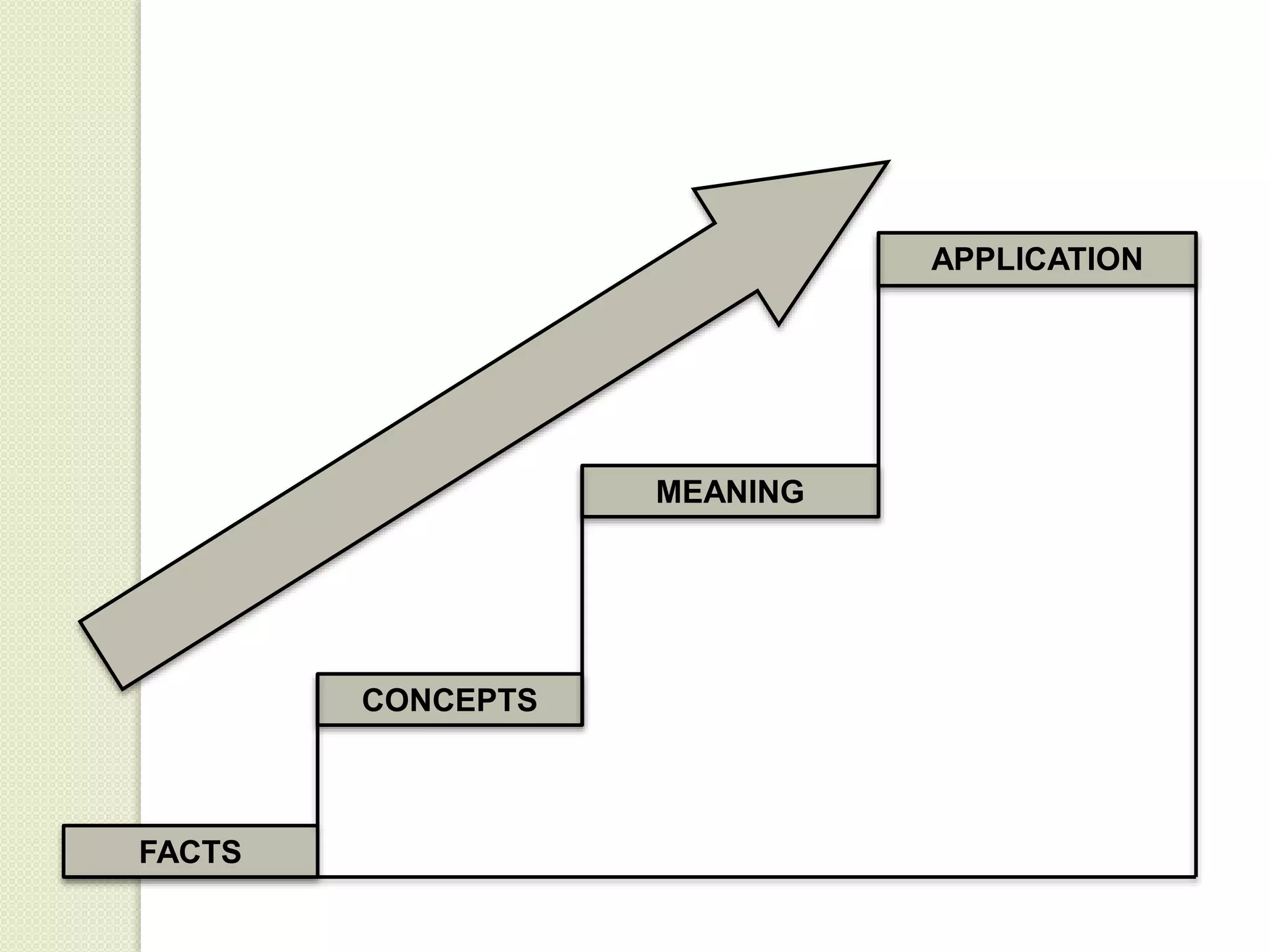
Constructivism concentrated on
learning how to think and
understand.
Constructivist learning is