The Age of Imperialism Section 3
Preview
• Main Idea / Reading Focus
• The New Imperialism
• European Claims in Africa
• African Resistance
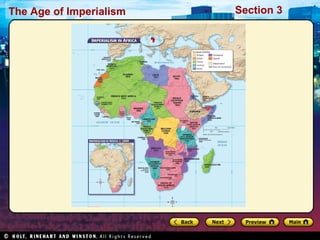
• Map: Imperialism in Africa
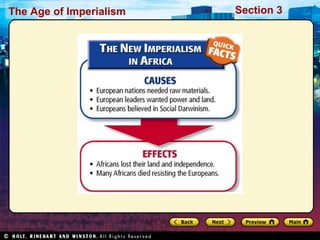
• Quick Facts: The New Imperialism in Africa
The Scramble for Africa
The Age of Imperialism Section 3
Reading Focus
• What factors led to the new imperialism?
• How did European powers claim territory in Africa?
• How did Africans resist European imperialism?
Main Idea
In the late 1800s and early 1900s, European powers claimed
land in much of Africa.
The Scramble for Africa
The Age of Imperialism Section 3
The New Imperialism
European countries controlled only small part of Africa
in 1880; but by 1914 only Ethiopia, Liberia remained
independent.
• European powers rapidly divided Africa
• Period known as “Scramble for Africa”
– Most visible example of new imperialism
– New imperialism not based on settlement of colonies
– European powers worked to directly govern large areas
occupied by non-European peoples
– Driven by economic interests, political competition, cultural
motives
The Age of Imperialism Section 3
• To gather, export natural
resources, European entrepreneurs
developed own mines, plantations,
trade routes
• Entrepreneurs sometimes called on
home countries to protect economic
interests from European
competitors
• In this way, drive for colonization
came from ambitious individuals,
not just European governments
Entrepreneurial Colonization
• Before early 1800s, several
European nations profited from
slave trade in Africa
• After some nations passed laws
abolishing slave trade, Europeans
looked to Africa as source for raw
materials
• Materials like coal, metals needed
to manufacture goods during
Industrial Revolution
• Needs fueled Europeans’ desire for
land with natural resources—
available in Africa
Raw Materials
Economic Interests
The Age of Imperialism Section 3
Nationalism a Factor
• Rise of Germany, Italy as powers contributed to the new imperialism
• Both nations jumped into race for colonization to assert status
• Nationalism also contributed to rise of new imperialism
• European leaders believed controlling colonies would gain them more
respect from other leaders
Political Competition
• Imperialism in Africa reflected struggles for power in Europe, such as long-
term rivalry between France, Britain
• France expanded control over West, Central Africa; Britain began to expand
colonial empire to block French
The Age of Imperialism Section 3
In addition to practical matters of economics and politics, the new
imperialism was motivated by cultural attitudes.
• European imperialists felt superior
to non-European peoples
• Some began to argue humanity
divided into distinct peoples, races
• Claimed biological differences
existed between races
• Racist view—people of European
descent superior to people of
African, Asian descent
Cultural Motives
• As result, some Europeans
believed rule in Africa justified
• Teaching Africans good
government
• Some imperialists believed
actions noble, their duty to
educate those considered inferior
• Referred to their influence in
Africa as “the white man’s
burden,” after poem by Rudyard
Kipling
Rule Justified
Cultural Motives
The Age of Imperialism Section 3
Darwin
• Defenders of imperialism often applied Charles Darwin’s theory of natural
selection to struggle between nations, races
• Darwin argued species more fit for environment will survive, reproduce
Cecil Rhodes
• Social Darwinism advocate Cecil Rhodes, “I contend that we are the finest
race in the world and that the more of the world we inhabit the better…”
• Believed British-built railway would bring benefits of civilization to all Africans
Social Darwinism
• Social Darwinism notion stated certain nations, races more fit than others
• Social Darwinists believed “fit” nations came to rule over “less fit” nations,
often showed discrimination against citizens of ruled nations
Justification
The Age of Imperialism Section 3
Find the Main Idea
What were some reasons that European
powers scrambled to claim colonies in
Africa?
Answer(s): for their own economic interests; to
compete with one another, and to teach the
Africans good government, European customs,
and Christian values
The Age of Imperialism Section 3
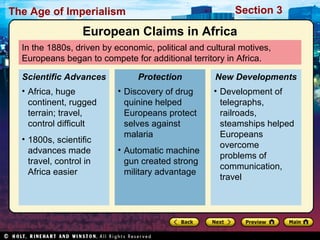
In the 1880s, driven by economic, political and cultural motives,
Europeans began to compete for additional territory in Africa.
• Africa, huge
continent, rugged
terrain; travel,
control difficult
• 1800s, scientific
advances made
travel, control in
Africa easier
Scientific Advances
• Discovery of drug
quinine helped
Europeans protect
selves against
malaria
• Automatic machine
gun created strong
military advantage
Protection
• Development of
telegraphs,
railroads,
steamships helped
Europeans
overcome
problems of
communication,
travel
New Developments
European Claims in Africa
The Age of Imperialism Section 3
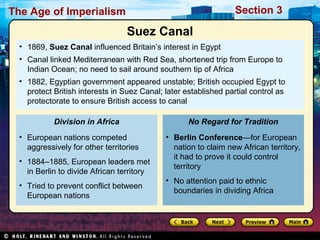
• 1869, Suez Canal influenced Britain’s interest in Egypt
• Canal linked Mediterranean with Red Sea, shortened trip from Europe to
Indian Ocean; no need to sail around southern tip of Africa
• 1882, Egyptian government appeared unstable; British occupied Egypt to
protect British interests in Suez Canal; later established partial control as
protectorate to ensure British access to canal
• European nations competed
aggressively for other territories
• 1884–1885, European leaders met
in Berlin to divide African territory
• Tried to prevent conflict between
European nations
Division in Africa
• Berlin Conference—for European
nation to claim new African territory,
it had to prove it could control
territory
• No attention paid to ethnic
boundaries in dividing Africa
No Regard for Tradition
Suez Canal
The Age of Imperialism Section 3
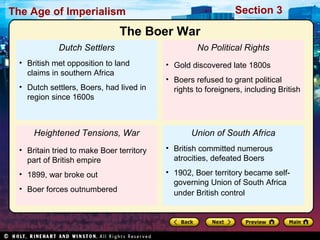
Dutch Settlers
• British met opposition to land
claims in southern Africa
• Dutch settlers, Boers, had lived in
region since 1600s
Heightened Tensions, War
• Britain tried to make Boer territory
part of British empire
• 1899, war broke out
• Boer forces outnumbered
No Political Rights
• Gold discovered late 1800s
• Boers refused to grant political
rights to foreigners, including British
Union of South Africa
• British committed numerous
atrocities, defeated Boers
• 1902, Boer territory became self-
governing Union of South Africa
under British control
The Boer War
The Age of Imperialism Section 3
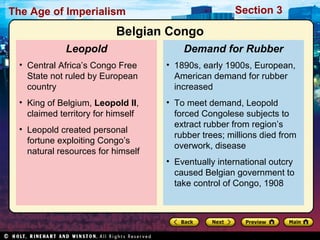
• 1890s, early 1900s, European,
American demand for rubber
increased
• To meet demand, Leopold
forced Congolese subjects to
extract rubber from region’s
rubber trees; millions died from
overwork, disease
• Eventually international outcry
caused Belgian government to
take control of Congo, 1908
Demand for Rubber
• Central Africa’s Congo Free
State not ruled by European
country
• King of Belgium, Leopold II,
claimed territory for himself
• Leopold created personal
fortune exploiting Congo’s
natural resources for himself
Leopold
Belgian Congo
The Age of Imperialism Section 3
Infer
How did the Berlin Conference contribute to
the Scramble for Africa?
Answer(s): set rules for the division of Africa
among the European nations
The Age of Imperialism Section 3
Even without modern weapons, other Africans still fiercely resisted
European powers.
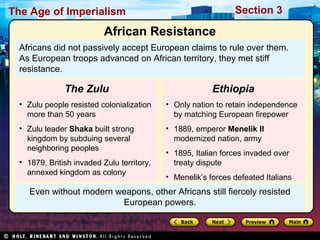
Africans did not passively accept European claims to rule over them.
As European troops advanced on African territory, they met stiff
resistance.
• Zulu people resisted colonialization
more than 50 years
• Zulu leader Shaka built strong
kingdom by subduing several
neighboring peoples
• 1879, British invaded Zulu territory,
annexed kingdom as colony
The Zulu
African Resistance
• Only nation to retain independence
by matching European firepower
• 1889, emperor Menelik II
modernized nation, army
• 1895, Italian forces invaded over
treaty dispute
• Menelik’s forces defeated Italians
Ethiopia
The Age of Imperialism Section 3
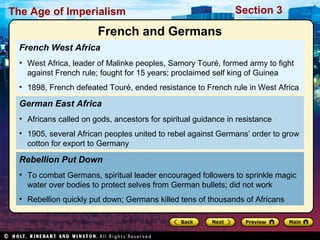
French West Africa
• West Africa, leader of Malinke peoples, Samory Touré, formed army to fight
against French rule; fought for 15 years; proclaimed self king of Guinea
• 1898, French defeated Touré, ended resistance to French rule in West Africa
Rebellion Put Down
• To combat Germans, spiritual leader encouraged followers to sprinkle magic
water over bodies to protect selves from German bullets; did not work
• Rebellion quickly put down; Germans killed tens of thousands of Africans
German East Africa
• Africans called on gods, ancestors for spiritual guidance in resistance
• 1905, several African peoples united to rebel against Germans’ order to grow
cotton for export to Germany
French and Germans
The Age of Imperialism Section 3
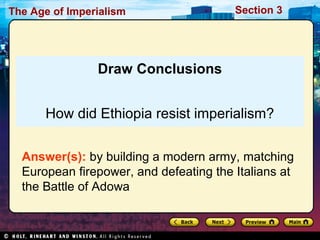
Draw Conclusions
How did Ethiopia resist imperialism?
Answer(s): by building a modern army, matching
European firepower, and defeating the Italians at
the Battle of Adowa

Scramble3

  • 1.
    The Age ofImperialism Section 3 Preview • Main Idea / Reading Focus • The New Imperialism • European Claims in Africa • African Resistance • Map: Imperialism in Africa • Quick Facts: The New Imperialism in Africa The Scramble for Africa
  • 2.
    The Age ofImperialism Section 3 Reading Focus • What factors led to the new imperialism? • How did European powers claim territory in Africa? • How did Africans resist European imperialism? Main Idea In the late 1800s and early 1900s, European powers claimed land in much of Africa. The Scramble for Africa
  • 3.
    The Age ofImperialism Section 3 The New Imperialism European countries controlled only small part of Africa in 1880; but by 1914 only Ethiopia, Liberia remained independent. • European powers rapidly divided Africa • Period known as “Scramble for Africa” – Most visible example of new imperialism – New imperialism not based on settlement of colonies – European powers worked to directly govern large areas occupied by non-European peoples – Driven by economic interests, political competition, cultural motives
  • 4.
    The Age ofImperialism Section 3 • To gather, export natural resources, European entrepreneurs developed own mines, plantations, trade routes • Entrepreneurs sometimes called on home countries to protect economic interests from European competitors • In this way, drive for colonization came from ambitious individuals, not just European governments Entrepreneurial Colonization • Before early 1800s, several European nations profited from slave trade in Africa • After some nations passed laws abolishing slave trade, Europeans looked to Africa as source for raw materials • Materials like coal, metals needed to manufacture goods during Industrial Revolution • Needs fueled Europeans’ desire for land with natural resources— available in Africa Raw Materials Economic Interests
  • 5.
    The Age ofImperialism Section 3 Nationalism a Factor • Rise of Germany, Italy as powers contributed to the new imperialism • Both nations jumped into race for colonization to assert status • Nationalism also contributed to rise of new imperialism • European leaders believed controlling colonies would gain them more respect from other leaders Political Competition • Imperialism in Africa reflected struggles for power in Europe, such as long- term rivalry between France, Britain • France expanded control over West, Central Africa; Britain began to expand colonial empire to block French
  • 6.
    The Age ofImperialism Section 3 In addition to practical matters of economics and politics, the new imperialism was motivated by cultural attitudes. • European imperialists felt superior to non-European peoples • Some began to argue humanity divided into distinct peoples, races • Claimed biological differences existed between races • Racist view—people of European descent superior to people of African, Asian descent Cultural Motives • As result, some Europeans believed rule in Africa justified • Teaching Africans good government • Some imperialists believed actions noble, their duty to educate those considered inferior • Referred to their influence in Africa as “the white man’s burden,” after poem by Rudyard Kipling Rule Justified Cultural Motives
  • 7.
    The Age ofImperialism Section 3 Darwin • Defenders of imperialism often applied Charles Darwin’s theory of natural selection to struggle between nations, races • Darwin argued species more fit for environment will survive, reproduce Cecil Rhodes • Social Darwinism advocate Cecil Rhodes, “I contend that we are the finest race in the world and that the more of the world we inhabit the better…” • Believed British-built railway would bring benefits of civilization to all Africans Social Darwinism • Social Darwinism notion stated certain nations, races more fit than others • Social Darwinists believed “fit” nations came to rule over “less fit” nations, often showed discrimination against citizens of ruled nations Justification
  • 8.
    The Age ofImperialism Section 3 Find the Main Idea What were some reasons that European powers scrambled to claim colonies in Africa? Answer(s): for their own economic interests; to compete with one another, and to teach the Africans good government, European customs, and Christian values
  • 9.
    The Age ofImperialism Section 3 In the 1880s, driven by economic, political and cultural motives, Europeans began to compete for additional territory in Africa. • Africa, huge continent, rugged terrain; travel, control difficult • 1800s, scientific advances made travel, control in Africa easier Scientific Advances • Discovery of drug quinine helped Europeans protect selves against malaria • Automatic machine gun created strong military advantage Protection • Development of telegraphs, railroads, steamships helped Europeans overcome problems of communication, travel New Developments European Claims in Africa
  • 10.
    The Age ofImperialism Section 3 • 1869, Suez Canal influenced Britain’s interest in Egypt • Canal linked Mediterranean with Red Sea, shortened trip from Europe to Indian Ocean; no need to sail around southern tip of Africa • 1882, Egyptian government appeared unstable; British occupied Egypt to protect British interests in Suez Canal; later established partial control as protectorate to ensure British access to canal • European nations competed aggressively for other territories • 1884–1885, European leaders met in Berlin to divide African territory • Tried to prevent conflict between European nations Division in Africa • Berlin Conference—for European nation to claim new African territory, it had to prove it could control territory • No attention paid to ethnic boundaries in dividing Africa No Regard for Tradition Suez Canal
  • 11.
    The Age ofImperialism Section 3 Dutch Settlers • British met opposition to land claims in southern Africa • Dutch settlers, Boers, had lived in region since 1600s Heightened Tensions, War • Britain tried to make Boer territory part of British empire • 1899, war broke out • Boer forces outnumbered No Political Rights • Gold discovered late 1800s • Boers refused to grant political rights to foreigners, including British Union of South Africa • British committed numerous atrocities, defeated Boers • 1902, Boer territory became self- governing Union of South Africa under British control The Boer War
  • 12.
    The Age ofImperialism Section 3 • 1890s, early 1900s, European, American demand for rubber increased • To meet demand, Leopold forced Congolese subjects to extract rubber from region’s rubber trees; millions died from overwork, disease • Eventually international outcry caused Belgian government to take control of Congo, 1908 Demand for Rubber • Central Africa’s Congo Free State not ruled by European country • King of Belgium, Leopold II, claimed territory for himself • Leopold created personal fortune exploiting Congo’s natural resources for himself Leopold Belgian Congo
  • 13.
    The Age ofImperialism Section 3
  • 14.
    The Age ofImperialism Section 3 Infer How did the Berlin Conference contribute to the Scramble for Africa? Answer(s): set rules for the division of Africa among the European nations
  • 15.
    The Age ofImperialism Section 3 Even without modern weapons, other Africans still fiercely resisted European powers. Africans did not passively accept European claims to rule over them. As European troops advanced on African territory, they met stiff resistance. • Zulu people resisted colonialization more than 50 years • Zulu leader Shaka built strong kingdom by subduing several neighboring peoples • 1879, British invaded Zulu territory, annexed kingdom as colony The Zulu African Resistance • Only nation to retain independence by matching European firepower • 1889, emperor Menelik II modernized nation, army • 1895, Italian forces invaded over treaty dispute • Menelik’s forces defeated Italians Ethiopia
  • 16.
    The Age ofImperialism Section 3 French West Africa • West Africa, leader of Malinke peoples, Samory Touré, formed army to fight against French rule; fought for 15 years; proclaimed self king of Guinea • 1898, French defeated Touré, ended resistance to French rule in West Africa Rebellion Put Down • To combat Germans, spiritual leader encouraged followers to sprinkle magic water over bodies to protect selves from German bullets; did not work • Rebellion quickly put down; Germans killed tens of thousands of Africans German East Africa • Africans called on gods, ancestors for spiritual guidance in resistance • 1905, several African peoples united to rebel against Germans’ order to grow cotton for export to Germany French and Germans
  • 17.
    The Age ofImperialism Section 3
  • 18.
    The Age ofImperialism Section 3 Draw Conclusions How did Ethiopia resist imperialism? Answer(s): by building a modern army, matching European firepower, and defeating the Italians at the Battle of Adowa