FACT & FIGURES
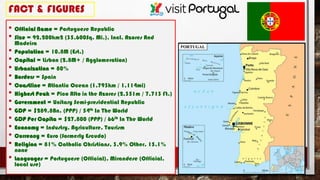
• Official Name = Portuguese Republic
• Size = 92,200km2 (35,600Sq. Mi.), Incl. Azores And
Madeira
• Population = 10.8M (Est.)
• Capital = Lisbon (2.8M+ / Agglomeration)
• Urbanization = 80%
• Borders = Spain
• Coastline = Atlantic Ocean (1,793km / 1,114mi)
• Highest Peak = Pico Alto in the Azores (2,351m / 7,713 Ft.)
• Government = Unitary Semi-presidential Republic
• GDP = $289.8Bn. (PPP) / 54th In The World
• GDP Per Capita = $27,800 (PPP) / 66th In The World
• Economy = Industry, Agriculture, Tourism
• Currency = Euro (formerly Escudo)
• Religion = 81% Catholic Christians, 3.9% Other, 15.1%
none
• Languages = Portuguese (Official), Mirandese (Official,
local use)
EARLY HISTORY
• Very similar early history as the rest of the
Iberian peninsula
• Stronger Celtic presence, less Phoenician
influence
• During Roman times, known as Lusitania
• After fall of Rome Germanic tribes form the
Kingdom of Suebi
• Visigoths conquer the Suebi Kingdom in 585
• Region is conquered with the rest of Iberia
by the Moors
• During the Moorish period, the region was
part of different Muslim ruled states
• Reconquered by the end of 9th century,
becomes the County of Portugal, name
after Portus Cale (Porto), under the
Kingdom of Leon
• In 1139, Portugal becomes an independent
Kingdom
• In 1249, after reconquering the Algarve
region, Portugal acquires its current borders
• Under Henry the Navigator, Portugal
spearheaded the Age of Discovery,
exploring the Atlantic and the West coast of
Africa
EARLY EXPLORERS
Before the Iberians
• It can be argued that the first explorers were
our hominid and Homo Sapiens ancestors who
walked or floated out of Africa into the Middle
East, Europe, Asia and Australia / Melanesia by
some 45K years ago, with their Asian
descendants moving into America some 18-20K
years ago across Beringia
• The first long range sea explorers were the
Austronesian people, who between 5K and
800 years ago moved from mainland Asia into
the Malay archipelago, Micronesia, Polynesia
as far as Rapa Nui and westwards to
Madagascar
• The Vikings moved out by sea and river from
their lands to settle across Europe, Russia,
Faroe Islands, Iceland, Greenland and
probably Newfoundland in North America
• The Arabs after Islam conducted extensive sea
and desert trade across the Sahara, the east
coast of Africa, India and the Malay
archipelago, though did not settle in large
numbers
• The Chinese had long traded in the ‘7 Seas’,
and in the early 15th century conducted large
naval expeditions under Admiral Cheng Ho,
until the Ming decided for isolationism
AGE OF DISCOVERY
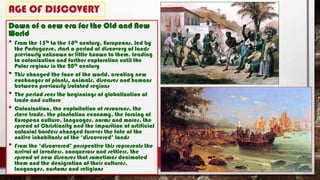
Dawn of a new era for the Old and New
World
• From the 15th to the 18th century, Europeans, led by
the Portuguese, start a period of discovery of lands
previously unknown or little known to them, leading
to colonization and further exploration until the
Polar regions in the 20th century
• This changed the face of the world, creating new
exchanges of plants, animals, diseases and humans
between previously isolated regions
• The period sees the beginnings of globalization of
trade and culture
• Colonization, the exploitation of resources, the
slave trade, the plantation economy, the forcing of
European culture, languages, norms and mores, the
spread of Christianity and the imposition of artificial
colonial borders changed forever the fate of the
native inhabitants of the ‘discovered’ lands
• From the ‘discovered’ perspective this represents the
arrival of invaders, conquerors and settlers, the
spread of new diseases that sometimes decimated
them and the denigration of their cultures,
languages, customs and religions
COLUMBIAN EXCHANGE
7
AGE OF DISCOVERY
Atlantic Explorations
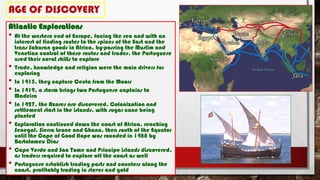
• At the western end of Europe, facing the sea and with an
interest of finding routes to the spices of the East and the
trans Saharan goods in Africa, by-passing the Muslim and
Venetian control of these routes and trades, the Portuguese
used their naval skills to explore
• Trade, knowledge and religion were the main drivers for
exploring
• In 1415, they capture Ceuta from the Moors
• In 1419, a storm brings two Portuguese captains to
Madeira
• In 1427, the Azores are discovered. Colonization and
settlement start in the islands, with sugar cane being
planted
• Exploration continued down the coast of Africa, reaching
Senegal, Sierra Leone and Ghana, then south of the Equator
until the Cape of Good Hope was rounded in 1488 by
Bartolomeu Dias
• Cape Verde and Sao Tome and Principe islands discovered,
as traders required to explore off the coast as well
• Portuguese establish trading posts and counters along the
coast, profitably trading in slaves and gold
AGE OF DISCOVERY
Indian Ocean and Asian
Explorations
• An overdue expedition, commanded by
Vasco de Gama, is finally launched in 1497
to travel beyond the Cape of Good Hope
and reach India
• In 1498 they reach Calicut in India and
return to glory as the first Europeans to have
sailed from Europe to India
• A larger expedition is launched in 1500,
reaching Madagascar in 1501, and
establishing the first trading posts in India
• Later expeditions in 1506 and 1507 occupy
Socotra, discover Mauritius and land in Sri
Lanka
• Afonso de Albuquerque conquers Malacca
in 1511, with the intention of discovering
the secret location of the Maluku Islands,
the fabled Spice Islands, which they reach
in 1512
• To ensure their trade monopoly, Muscat,
Hormuz and Bahrain are conquered as well
AGE OF DISCOVERY
China and the Far East
• From Malacca, the Portuguese send
several diplomatic missions and are the
first Europeans to visit the Kingdom of
Siam
• In 1513, one of the envoys reaches one
of the islands in the Pearl River delta,
while in 1516 another envoy reaches
Guangzhou and in 1517 another
explorer forces open trade with China
• Battles with the Chinese ensue in 1521
and 1522, with the Chinese capturing
Portuguese canons and reverse
engineering them
• Hostilities cease after a few decades
and in 1557 the Chinese allow the
Portuguese to settle in Macau
• In 1542 the Portuguese are the first
Europeans to reach Japan, and in 1570
they found the city of Nagasaki, the
only European trading post in Japan for
many years until it was taken over by
the Dutch
AGE OF DISCOVERY
New World and Treaty of
Tordesillas
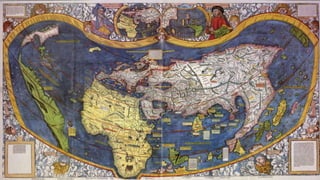
• After the voyages of Christopher
Columbus, Spain and Portugal need to
agree on their respective zones of
influence
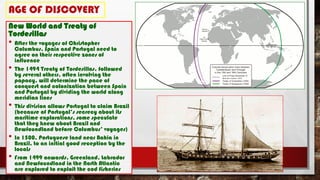
• The 1494 Treaty of Tordesillas, followed
by several others, often involving the
papacy, will determine the pace of
conquest and colonization between Spain
and Portugal by dividing the world along
meridian lines
• This division allows Portugal to claim Brazil
(because of Portugal’s secrecy about its
maritime explorations, some speculate
that they knew about Brazil and
Newfoundland before Columbus’ voyages)
• In 1500, Portuguese land near Bahia in
Brazil, to an initial good reception by the
locals
• From 1499 onwards, Greenland, Labrador
and Newfoundland in the North Atlantic
are explored to exploit the cod fisheries
COLONIZATION
Brazil
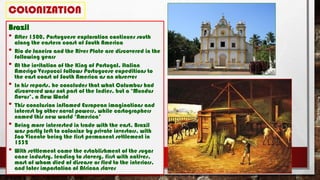
• After 1500, Portuguese exploration continues south
along the eastern coast of South America
• Rio de Janeiro and the River Plate are discovered in the
following years
• At the invitation of the King of Portugal, Italian
Amerigo Vespucci follows Portuguese expeditions to
the east coast of South America as an observer
• In his reports, he concludes that what Columbus had
discovered was not part of the Indies, but a ‘Mundus
Novus’, a New World
• This conclusion inflamed European imaginations and
interest by other naval powers, while cartographers
named this new world ‘America’
• Being more interested in trade with the east, Brazil
was partly left to colonize by private investors, with
Sao Vicente being the first permanent settlement in
1532
• With settlement came the establishment of the sugar
cane industry, leading to slavery, first with natives,
most of whom died of disease or fled to the interiors,
and later importation of African slaves
COLONIZATION
Brazil
• In 1567, the Portuguese destroy a 10 years old
French settlement called France Antarctique, and in
1654 they recover land in the northeast previously
taken by the Dutch for a few years
• Though under the Treaty of Tordesillas the Amazon
basin was supposed to be under Spanish control, it is
de facto occupied by Portuguese settlers who
expand westwards in search of native slaves and
minerals
• Gold and precious minerals are discovered in Minais
Gerais and Brazil becomes a leading supplier of gold
in the 18th century
• With other cash crops being important exports,
Portugal benefits from this wealth at a time when
most other colonies in Asia are lost to the Dutch
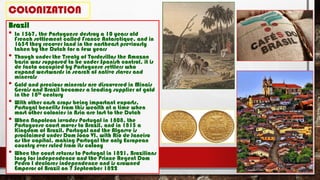
• When Napoleon invades Portugal in 1808, the
Portuguese court moves to Brazil, and in 1815 a
Kingdom of Brazil, Portugal and the Algarve is
proclaimed under Dom Joao VI, with Rio de Janeiro
as the capital, making Portugal the only European
country ever ruled from its colony
• When the court returns to Portugal in 1821, Brazilians
long for independence and the Prince Regent Dom
Pedro I declares independence and is crowned
Emperor of Brazil on 7 September 1822
PORTUGUESE VOYAGES, COUNTERS AND COLONIES
COLONIZATION
Portuguese Africa
• After the height of discovery and conquest in the 15th and
16th centuries, the Portuguese will loose most of their
possessions to the Dutch, British, French, Moroccans,
Omanis, Ottomans and Indians, retaining Brazil, some
outposts in India, Indonesia and China and a few trading
colonies in Africa
• Portugal is further weakened by the devastating 1755
earthquake and tsunami that destroy most of Lisbon
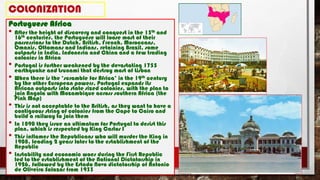
• When there is the ‘scramble for Africa’ in the 19th century
by the other European powers, Portugal expands its
African outposts into state sized colonies, with the plan to
join Angola with Mozambique across southern Africa (the
Pink Map)
• This is not acceptable to the British, as they want to have a
contiguous string of colonies from the Cape to Cairo and
build a railway to join them
• In 1890 they issue an ultimatum for Portugal to desist this
plan, which is respected by King Carlos I
• This inflames the Republicans who will murder the King in
1908, leading 2 years later to the establishment of the
Republic
• Instability and economic woes during the First Republic
led to the establishment of the National Dictatorship in
1926, followed by the Estado Novo dictatorship of Antonio
de Oliveira Salazar from 1933
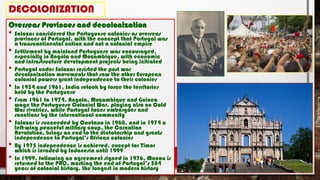
DECOLONIZATION
Overseas Provinces and decolonization
• Salazar considered the Portuguese colonies as overseas
provinces of Portugal, with the concept that Portugal was
a transcontinental nation and not a colonial empire
• Settlement by mainland Portuguese was encouraged,
especially in Angola and Mozambique, with economic
and infrastructure development projects being initiated
• Portugal under Salazar resisted the post war
decolonization movements that saw the other European
colonial powers grant independence to their colonies
• In 1954 and 1961, India retook by force the territories
held by the Portuguese
• From 1961 to 1974, Angola, Mozambique and Guinea
wage the Portuguese Colonial War, playing also on Cold
War rivalries, while Portugal faces embargoes and
sanctions by the international community
• Salazar is succeeded by Caetano in 1968, and in 1974 a
left-wing peaceful military coup, the Carnation
Revolution, brings an end to the dictatorship and grants
independence to Portugal’s African colonies
• By 1975 independence is achieved, except for Timor
which is invaded by Indonesia until 1999
• In 1999, following an agreement signed in 1976, Macau is
returned to the PRC, marking the end of Portugal’s 584
years of colonial history, the longest in modern history
DISCOVERING LISBON
DISCOVERING LISBON
DISCOVERING LISBON
DISCOVERING LISBON
LISBON FADO • The word ‘Fado’ comes from Latin fatum, meaning ‘fate’
• The origins of Fado are not clear but may go back centuries
• Similar music is found in Cabo Verde, Brazil and Indonesia
• Characterized by mournful tunes and lyrics, reflecting a
feeling of longing (saudade) and irreparable loss
• Lyrics are often about the sea, life of the poor or lost love
• Best known style is the Lisbon Fado
• Listed by UNESCO as an Intangible Cultural Heritage
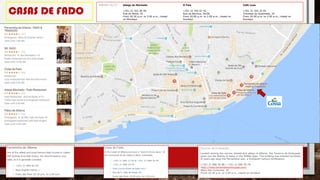
CASAS DE FADO
Taverna do Embuçado
Located among the narrow streets and alleys of Alfama, the Taverna do Embuçado
gives you the feeling of being in the Middle Ages. The building was erected hundreds
of years ago atop the Fernandina wall, a thirteenth-century fortification.
•+351 21 886 50 88 / +351 21 886 50 78
•http://www.tavernadoembucado.com/
•Beco dos Curtumes, 10
•From 20.30 p.m. to 3.00 a.m., closed on Sundays
BAIRRO ALTO Adega do Machado O Faia Café Luso
+351 21 322 46 40 +351 21 342 67 42 +351 21 342 22 81
Rua do Norte, 91 Rua da Barroca, 54/56 Travessa da Queimada, 10
From 20.30 p.m. to 3.00 a.m., closed From 20.00 p.m. to 2.00 a.m., closed on From 20.00 p.m. to 2.00 a.m., closed on
on Mondays Sundays Sundays
DISCOVERING SINTRA
DISCOVERING SINTRA
DISCOVERING SINTRA
DISCOVERING FATIMA
Imperial Portugal

Imperial Portugal

  • 2.
    FACT & FIGURES •Official Name = Portuguese Republic • Size = 92,200km2 (35,600Sq. Mi.), Incl. Azores And Madeira • Population = 10.8M (Est.) • Capital = Lisbon (2.8M+ / Agglomeration) • Urbanization = 80% • Borders = Spain • Coastline = Atlantic Ocean (1,793km / 1,114mi) • Highest Peak = Pico Alto in the Azores (2,351m / 7,713 Ft.) • Government = Unitary Semi-presidential Republic • GDP = $289.8Bn. (PPP) / 54th In The World • GDP Per Capita = $27,800 (PPP) / 66th In The World • Economy = Industry, Agriculture, Tourism • Currency = Euro (formerly Escudo) • Religion = 81% Catholic Christians, 3.9% Other, 15.1% none • Languages = Portuguese (Official), Mirandese (Official, local use)
  • 3.
    EARLY HISTORY • Verysimilar early history as the rest of the Iberian peninsula • Stronger Celtic presence, less Phoenician influence • During Roman times, known as Lusitania • After fall of Rome Germanic tribes form the Kingdom of Suebi • Visigoths conquer the Suebi Kingdom in 585 • Region is conquered with the rest of Iberia by the Moors • During the Moorish period, the region was part of different Muslim ruled states • Reconquered by the end of 9th century, becomes the County of Portugal, name after Portus Cale (Porto), under the Kingdom of Leon • In 1139, Portugal becomes an independent Kingdom • In 1249, after reconquering the Algarve region, Portugal acquires its current borders • Under Henry the Navigator, Portugal spearheaded the Age of Discovery, exploring the Atlantic and the West coast of Africa
  • 4.
    EARLY EXPLORERS Before theIberians • It can be argued that the first explorers were our hominid and Homo Sapiens ancestors who walked or floated out of Africa into the Middle East, Europe, Asia and Australia / Melanesia by some 45K years ago, with their Asian descendants moving into America some 18-20K years ago across Beringia • The first long range sea explorers were the Austronesian people, who between 5K and 800 years ago moved from mainland Asia into the Malay archipelago, Micronesia, Polynesia as far as Rapa Nui and westwards to Madagascar • The Vikings moved out by sea and river from their lands to settle across Europe, Russia, Faroe Islands, Iceland, Greenland and probably Newfoundland in North America • The Arabs after Islam conducted extensive sea and desert trade across the Sahara, the east coast of Africa, India and the Malay archipelago, though did not settle in large numbers • The Chinese had long traded in the ‘7 Seas’, and in the early 15th century conducted large naval expeditions under Admiral Cheng Ho, until the Ming decided for isolationism
  • 5.
    AGE OF DISCOVERY Dawnof a new era for the Old and New World • From the 15th to the 18th century, Europeans, led by the Portuguese, start a period of discovery of lands previously unknown or little known to them, leading to colonization and further exploration until the Polar regions in the 20th century • This changed the face of the world, creating new exchanges of plants, animals, diseases and humans between previously isolated regions • The period sees the beginnings of globalization of trade and culture • Colonization, the exploitation of resources, the slave trade, the plantation economy, the forcing of European culture, languages, norms and mores, the spread of Christianity and the imposition of artificial colonial borders changed forever the fate of the native inhabitants of the ‘discovered’ lands • From the ‘discovered’ perspective this represents the arrival of invaders, conquerors and settlers, the spread of new diseases that sometimes decimated them and the denigration of their cultures, languages, customs and religions
  • 6.
  • 7.
  • 8.
    AGE OF DISCOVERY AtlanticExplorations • At the western end of Europe, facing the sea and with an interest of finding routes to the spices of the East and the trans Saharan goods in Africa, by-passing the Muslim and Venetian control of these routes and trades, the Portuguese used their naval skills to explore • Trade, knowledge and religion were the main drivers for exploring • In 1415, they capture Ceuta from the Moors • In 1419, a storm brings two Portuguese captains to Madeira • In 1427, the Azores are discovered. Colonization and settlement start in the islands, with sugar cane being planted • Exploration continued down the coast of Africa, reaching Senegal, Sierra Leone and Ghana, then south of the Equator until the Cape of Good Hope was rounded in 1488 by Bartolomeu Dias • Cape Verde and Sao Tome and Principe islands discovered, as traders required to explore off the coast as well • Portuguese establish trading posts and counters along the coast, profitably trading in slaves and gold
  • 9.
    AGE OF DISCOVERY IndianOcean and Asian Explorations • An overdue expedition, commanded by Vasco de Gama, is finally launched in 1497 to travel beyond the Cape of Good Hope and reach India • In 1498 they reach Calicut in India and return to glory as the first Europeans to have sailed from Europe to India • A larger expedition is launched in 1500, reaching Madagascar in 1501, and establishing the first trading posts in India • Later expeditions in 1506 and 1507 occupy Socotra, discover Mauritius and land in Sri Lanka • Afonso de Albuquerque conquers Malacca in 1511, with the intention of discovering the secret location of the Maluku Islands, the fabled Spice Islands, which they reach in 1512 • To ensure their trade monopoly, Muscat, Hormuz and Bahrain are conquered as well
  • 10.
    AGE OF DISCOVERY Chinaand the Far East • From Malacca, the Portuguese send several diplomatic missions and are the first Europeans to visit the Kingdom of Siam • In 1513, one of the envoys reaches one of the islands in the Pearl River delta, while in 1516 another envoy reaches Guangzhou and in 1517 another explorer forces open trade with China • Battles with the Chinese ensue in 1521 and 1522, with the Chinese capturing Portuguese canons and reverse engineering them • Hostilities cease after a few decades and in 1557 the Chinese allow the Portuguese to settle in Macau • In 1542 the Portuguese are the first Europeans to reach Japan, and in 1570 they found the city of Nagasaki, the only European trading post in Japan for many years until it was taken over by the Dutch
  • 11.
    AGE OF DISCOVERY NewWorld and Treaty of Tordesillas • After the voyages of Christopher Columbus, Spain and Portugal need to agree on their respective zones of influence • The 1494 Treaty of Tordesillas, followed by several others, often involving the papacy, will determine the pace of conquest and colonization between Spain and Portugal by dividing the world along meridian lines • This division allows Portugal to claim Brazil (because of Portugal’s secrecy about its maritime explorations, some speculate that they knew about Brazil and Newfoundland before Columbus’ voyages) • In 1500, Portuguese land near Bahia in Brazil, to an initial good reception by the locals • From 1499 onwards, Greenland, Labrador and Newfoundland in the North Atlantic are explored to exploit the cod fisheries
  • 12.
    COLONIZATION Brazil • After 1500,Portuguese exploration continues south along the eastern coast of South America • Rio de Janeiro and the River Plate are discovered in the following years • At the invitation of the King of Portugal, Italian Amerigo Vespucci follows Portuguese expeditions to the east coast of South America as an observer • In his reports, he concludes that what Columbus had discovered was not part of the Indies, but a ‘Mundus Novus’, a New World • This conclusion inflamed European imaginations and interest by other naval powers, while cartographers named this new world ‘America’ • Being more interested in trade with the east, Brazil was partly left to colonize by private investors, with Sao Vicente being the first permanent settlement in 1532 • With settlement came the establishment of the sugar cane industry, leading to slavery, first with natives, most of whom died of disease or fled to the interiors, and later importation of African slaves
  • 13.
    COLONIZATION Brazil • In 1567,the Portuguese destroy a 10 years old French settlement called France Antarctique, and in 1654 they recover land in the northeast previously taken by the Dutch for a few years • Though under the Treaty of Tordesillas the Amazon basin was supposed to be under Spanish control, it is de facto occupied by Portuguese settlers who expand westwards in search of native slaves and minerals • Gold and precious minerals are discovered in Minais Gerais and Brazil becomes a leading supplier of gold in the 18th century • With other cash crops being important exports, Portugal benefits from this wealth at a time when most other colonies in Asia are lost to the Dutch • When Napoleon invades Portugal in 1808, the Portuguese court moves to Brazil, and in 1815 a Kingdom of Brazil, Portugal and the Algarve is proclaimed under Dom Joao VI, with Rio de Janeiro as the capital, making Portugal the only European country ever ruled from its colony • When the court returns to Portugal in 1821, Brazilians long for independence and the Prince Regent Dom Pedro I declares independence and is crowned Emperor of Brazil on 7 September 1822
  • 14.
  • 15.
    COLONIZATION Portuguese Africa • Afterthe height of discovery and conquest in the 15th and 16th centuries, the Portuguese will loose most of their possessions to the Dutch, British, French, Moroccans, Omanis, Ottomans and Indians, retaining Brazil, some outposts in India, Indonesia and China and a few trading colonies in Africa • Portugal is further weakened by the devastating 1755 earthquake and tsunami that destroy most of Lisbon • When there is the ‘scramble for Africa’ in the 19th century by the other European powers, Portugal expands its African outposts into state sized colonies, with the plan to join Angola with Mozambique across southern Africa (the Pink Map) • This is not acceptable to the British, as they want to have a contiguous string of colonies from the Cape to Cairo and build a railway to join them • In 1890 they issue an ultimatum for Portugal to desist this plan, which is respected by King Carlos I • This inflames the Republicans who will murder the King in 1908, leading 2 years later to the establishment of the Republic • Instability and economic woes during the First Republic led to the establishment of the National Dictatorship in 1926, followed by the Estado Novo dictatorship of Antonio de Oliveira Salazar from 1933
  • 16.
    DECOLONIZATION Overseas Provinces anddecolonization • Salazar considered the Portuguese colonies as overseas provinces of Portugal, with the concept that Portugal was a transcontinental nation and not a colonial empire • Settlement by mainland Portuguese was encouraged, especially in Angola and Mozambique, with economic and infrastructure development projects being initiated • Portugal under Salazar resisted the post war decolonization movements that saw the other European colonial powers grant independence to their colonies • In 1954 and 1961, India retook by force the territories held by the Portuguese • From 1961 to 1974, Angola, Mozambique and Guinea wage the Portuguese Colonial War, playing also on Cold War rivalries, while Portugal faces embargoes and sanctions by the international community • Salazar is succeeded by Caetano in 1968, and in 1974 a left-wing peaceful military coup, the Carnation Revolution, brings an end to the dictatorship and grants independence to Portugal’s African colonies • By 1975 independence is achieved, except for Timor which is invaded by Indonesia until 1999 • In 1999, following an agreement signed in 1976, Macau is returned to the PRC, marking the end of Portugal’s 584 years of colonial history, the longest in modern history
  • 17.
  • 18.
  • 19.
  • 20.
  • 21.
    LISBON FADO •The word ‘Fado’ comes from Latin fatum, meaning ‘fate’ • The origins of Fado are not clear but may go back centuries • Similar music is found in Cabo Verde, Brazil and Indonesia • Characterized by mournful tunes and lyrics, reflecting a feeling of longing (saudade) and irreparable loss • Lyrics are often about the sea, life of the poor or lost love • Best known style is the Lisbon Fado • Listed by UNESCO as an Intangible Cultural Heritage
  • 22.
    CASAS DE FADO Tavernado Embuçado Located among the narrow streets and alleys of Alfama, the Taverna do Embuçado gives you the feeling of being in the Middle Ages. The building was erected hundreds of years ago atop the Fernandina wall, a thirteenth-century fortification. •+351 21 886 50 88 / +351 21 886 50 78 •http://www.tavernadoembucado.com/ •Beco dos Curtumes, 10 •From 20.30 p.m. to 3.00 a.m., closed on Sundays BAIRRO ALTO Adega do Machado O Faia Café Luso +351 21 322 46 40 +351 21 342 67 42 +351 21 342 22 81 Rua do Norte, 91 Rua da Barroca, 54/56 Travessa da Queimada, 10 From 20.30 p.m. to 3.00 a.m., closed From 20.00 p.m. to 2.00 a.m., closed on From 20.00 p.m. to 2.00 a.m., closed on on Mondays Sundays Sundays
  • 23.
  • 24.
  • 25.
  • 26.