Evaluating a K-12 Technology Integration program: IMPACTing Students and Teachers1:1 Leadership Institute – July 10, 2009Dr. Melinda Mollette,Latricia Townsend, Kim CohenJessica Huff, and Megan Townsend
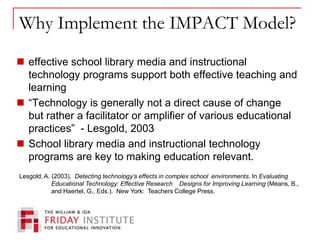
Why Implement the IMPACT Model?effective school library media and instructional technology programs support both effective teaching and learning“Technology is generally not a direct cause of change but rather a facilitator or amplifier of various educational practices”  - Lesgold, 2003 School library media and instructional technology programs are key to making education relevant.  Lesgold, A. (2003).  Detecting technology’s effects in complex school 	environments. In Evaluating 	Educational Technology: Effective Research 	Designs for Improving Learning (Means, B., 	and Haertel, G., Eds.).  New York:  Teachers College Press.
IMPACT InformationSupported by the North Carolina Department of Public Instruction through a U.S. Department of Education grant under the Elementary and Secondary Education Act, Enhancing Education Through Technology (EETT)Competitive Grant Schools responded to an RFP to receive fundingComplete evaluation findings will be given to the North Carolina Department of Public Instruction in September 2009
IMPACT School Locations in NC
IMPACT CohortsIMPACT I-2003-20068 Elementary/2 Middle SchoolsOne School perLEAIMPACT II-2007-2009FiveMiddle SchoolsOne School perLEAIMPACTing Leadership-2006-2008Quarterly Prof’l Development Workshops – 3 days each (2006/07)Follow-up support – 2007/08Funding distributed July 2008IMPACT III-2008-2009IMPACTing Leadership schools that locally fundeda media specialist and a technology facilitatorDistrict-wide initiative – gr. K-12 in two of the three LEA’sIMPACT IV-2008-2009Weeklong summer professional development workshop for school-level MTAC  membersCentral office personnel attended IMPACT Academy District-wide initiative at upper grade levels (only gr. 3-12) in four LEA’s
IMPACT IV (2008-2009)Series of professional development workshops for school-level MTAC (Summer 08)Central office personnel attended IMPACT Academy (Summer 08)Based on lessons from IMPACT I/II, how do school/district leaders respond to condensed wkshps & more immediate funding of the model?
Asheboro City (6-12) & Kannapolis City (5-12)
Perquimans/Edenton-Chowan (3-12)
Thomasville City (4-12)Evaluation InstrumentsSchool Readiness for InnovationSchool Technology Needs Assessment (STNA)Quality of Professional DevelopmentStandards Assessment Inventory (National Staff Development Council)Technological Literacy of StudentsTechnology Skills Checklist 3-5 and 6-12Technology skills and behaviors of Teachers and AdministrationsNational Education Technology Standards for Teachers (NETS-T)National Education Technology Standards for Administrators (NETS-A)Student achievementEnd-of-Grade Tests in Reading/Math (EOG)End-of-Course Tests – High school only (EOC)
IMPACT Model ComponentsCollaboration
Supportive Leadership
Technology Integration
Flexible Access to resources
Professional development
Variety of Resources/equipment
Personnel (Tech Facilitator/Media Coordinator)
Formative Evaluation to monitor progress IMPACT ModelIMPACT Model OutcomesTeachers will integrate technology

IMPACT Powerpoint

  • 1.
    Evaluating a K-12Technology Integration program: IMPACTing Students and Teachers1:1 Leadership Institute – July 10, 2009Dr. Melinda Mollette,Latricia Townsend, Kim CohenJessica Huff, and Megan Townsend
  • 2.
    Why Implement theIMPACT Model?effective school library media and instructional technology programs support both effective teaching and learning“Technology is generally not a direct cause of change but rather a facilitator or amplifier of various educational practices” - Lesgold, 2003 School library media and instructional technology programs are key to making education relevant. Lesgold, A. (2003). Detecting technology’s effects in complex school environments. In Evaluating Educational Technology: Effective Research Designs for Improving Learning (Means, B., and Haertel, G., Eds.). New York: Teachers College Press.
  • 3.
    IMPACT InformationSupported bythe North Carolina Department of Public Instruction through a U.S. Department of Education grant under the Elementary and Secondary Education Act, Enhancing Education Through Technology (EETT)Competitive Grant Schools responded to an RFP to receive fundingComplete evaluation findings will be given to the North Carolina Department of Public Instruction in September 2009
  • 4.
  • 5.
    IMPACT CohortsIMPACT I-2003-20068Elementary/2 Middle SchoolsOne School perLEAIMPACT II-2007-2009FiveMiddle SchoolsOne School perLEAIMPACTing Leadership-2006-2008Quarterly Prof’l Development Workshops – 3 days each (2006/07)Follow-up support – 2007/08Funding distributed July 2008IMPACT III-2008-2009IMPACTing Leadership schools that locally fundeda media specialist and a technology facilitatorDistrict-wide initiative – gr. K-12 in two of the three LEA’sIMPACT IV-2008-2009Weeklong summer professional development workshop for school-level MTAC membersCentral office personnel attended IMPACT Academy District-wide initiative at upper grade levels (only gr. 3-12) in four LEA’s
  • 6.
    IMPACT IV (2008-2009)Seriesof professional development workshops for school-level MTAC (Summer 08)Central office personnel attended IMPACT Academy (Summer 08)Based on lessons from IMPACT I/II, how do school/district leaders respond to condensed wkshps & more immediate funding of the model?
  • 7.
    Asheboro City (6-12)& Kannapolis City (5-12)
  • 8.
  • 9.
    Thomasville City (4-12)EvaluationInstrumentsSchool Readiness for InnovationSchool Technology Needs Assessment (STNA)Quality of Professional DevelopmentStandards Assessment Inventory (National Staff Development Council)Technological Literacy of StudentsTechnology Skills Checklist 3-5 and 6-12Technology skills and behaviors of Teachers and AdministrationsNational Education Technology Standards for Teachers (NETS-T)National Education Technology Standards for Administrators (NETS-A)Student achievementEnd-of-Grade Tests in Reading/Math (EOG)End-of-Course Tests – High school only (EOC)
  • 10.
  • 11.
  • 12.
  • 13.
  • 14.
  • 15.
  • 16.
  • 17.
    Formative Evaluation tomonitor progress IMPACT ModelIMPACT Model OutcomesTeachers will integrate technology