IDC TECHNOLOGY SPOTLIGHT
Sponsoredby:MemVerge
Big Memory Computing Emerges to Better
Enable Data-Intensive IT
June 2020
Written by: Eric Burgener, Research Vice President, Infrastructure Systems, Platforms, and Technologies Group
Introduction
Digitaltransformation (DX)—theevolutionamongenterprisesofallsizes
towardmuchmoredata-drivenbusinessmodels—isunderwayinmost
industries.Moredatathaneverbeforeisbeingcaptured,stored,
protected,andanalyzed,and ITorganizationsare morefocusedthanever
ondrivingdirectbusinessvaluefromthedatatheycollecton customers,
productsandservices,markets,andinternalprocessesandworkflows.
Next-generationapplications(NGAs)arebeingdeployedtohelpdrivethis
value,andmanyofthememploya"bigdataanalytics"orientationthat
leveragesdata-intensivetechnologiessuchasartificialintelligence (AI),
machinelearning (ML),anddeeplearningtogleaninsightsthatresultin
betterbusinessdecisions.Real-timeworkloadsareappearinginmany
industries—examplesincludefraud analyticsinfinancialservices,
customerprofilinginsocialmediaand streaming, InternetofThings(IoT)
applications,andsecurityandcyberthreatdetectionacrossmanydifferent
industries—andthepercentageofreal-timedataisontherise.
Thesetypesofreal-timebigdataanalyticsworkloadsareputtingperformancedemandsonITinfrastructurethatarevery
difficulttomeet costeffectivelywithlegacyarchitectures.Butperformance isnottheonlychallenge.Asenterprises
evolvetheirbusinessmodels,manyoftheseNGAsformthefoundationforcompetitivedifferentiation,andtheyare
increasinglybeingviewedasmissioncritical.Indeed,IDCpredictsthatby2021,60–70%ofthe Global2000willhaveat
leastone real-timebigdataanalyticsworkloadthatisalso considered missioncritical.AsenterprisesmodernizetheirIT
infrastructuretomeetthese evolvingperformance and availabilityrequirements,the largeperformancegapinthe
memory/storagehierarchybetween volatile,byte-addressable,andexpensivemain memoryandblock-addressable
solid statedisks(SSDs)(which arebothpersistent and lessexpensiveona$/GBbasis)isbecomingincreasingly
problematic.Althoughsome applicationshavebeenwrittento run inmainmemory(e.g.,OracleDatabaseIn-Memory,
SAPHANA)toimprovetheperformanceandefficiencyof resourceutilization,today'smainmemorycapacityisstillquite
limited. Inaddition,thecatalogofofferingsthathavebeenrewritteninthismannerisextremelylimitedbecause itisa
major software engineeringprojecttoretoolanapplicationforin-memoryoperation.
As real-time analytics workloads become more prevalent, the gap in the memory/storage
hierarchy is highlighting a significant market opportunity that is addressed by a new market
category called Big Memory Computing.
KEY TAKEAWAYS
» Many new workloads being deployed by
enterprises undergoing digital
transformation demand memory-class
performance.
» By combining Persistent Memory
technology with software-defined
memory virtualization, Big Memory
Computing meets new workflow needs.
» Because Big Memory Computing runs on
industry-standard server hardware and
does not require any application
modifications, enterprises should be able
to easily evaluate how the technology can
apply to them.
AT A GLANCE
Page 2#US46573120
IDC TECHNOLOGY SPOTLIGHT Big Memory Computing Emerges to Better Enable Data-Intensive IT
Asreal-time,mission-criticalbigdataanalyticsworkloadsbecomemoreprevalent,this"gap"inthememory/storage
hierarchyishighlightingasignificantmarketopportunity. Whatisneeded isanabilitytosignificantlyextendthe capacity
ofmainmemorytoaccommodatemuch largerdatasetswitha solution exhibitingnear-DRAMperformanceatlower
costthatisbothpersistentand appropriateformission-criticalworkloads.Tomaximizenear-termadoption,thissolution
shoulddeliverthesecapabilitieswithoutrequiringexistingapplicationstobe rewritten.
A Confluence of Market and Technology Enablers
Thepreviouslydefinedsolutionshouldcome asnosurprisetoITpractitioners,butuntilrecently,themarket imperative
andthetechnologytosolvetheproblemdidnotexist.Atthebeginningofthepastdecade,severalsmallstart-ups
attemptedtoaddressthisissue,buta strongmarketrequirementandthekeytechnologiesneededto solveitwerenot
there.Thesituation isverydifferenttoday.WiththerecentexplosioninAI/ML-drivenreal-timebigdataanalytics,the
marketneedforaviablenear-term solution isclear,directlyrelatedtobusinesssuccessformanyenterprises,andwill
becomewidespreadoverthenext12–24months.
Unlikeadecadeago,severalnewtechnologieshavearisenthatmakeitpracticaltoaddressthisneedtoday.Thefirstis
the concentratedcomputepower,nowwidespread,that'sneededtoleveragetechnologiessuchasAI/MLforbigdata
analytics.MulticoreCPUsandgeneral-purpose GPUsareavailableinvolumefrommultiplevendors,affordablydelivering
themassive computepower neededforreal-timeAI/ML-drivenworkloads.
Thesecondisanewclassofstorage,referredto asPersistentMemory(PM),that ispersistent,byteaddressable,
availableinmuchlargercapacitiesthantraditionalDRAMDIMMs,costslessona$/GBbasisthanDRAM,anddelivers
accesslatenciesintheseveralhundrednanosecondrange.PMproductsareavailabletodayfromasinglevendorbutare
expectedtobeavailableinvolumefrommultiplevendorsby2022.IDCexpectsthatfrom2019to2023,thePM market
willgrowata248%compoundannualgrowthrate (CAGR)tocrest$2.6billioninannualrevenue.
Thethirdtechnologyisasoftware-definedmemoryvirtualizationlayerthat createsalogicalpoolofpersistentstorage
composedofbothDRAMandPMthat canbe sharedacrossserversthrougha switched remotedirectmemoryaccess
(RDMA)network.Thisisnot anNVMeoverFabricsnetwork(which supportsblock-addressabletraffic);thisisan RDMA
networkthat supportsbyte-addressabletraffic. This"memorylake"willprovide significantlyhighercapacitiesthanDRAM
technologyaloneatablendedcost/GBthatisalreadylowerthanthatofDRAMandwillcontinuetodropasmultiple
vendorsbeginto shipproductsin volume.
TomeetNGArequirements,thismemoryvirtualizationlayershouldincludeseveralkeyfeaturesbesidesjust memory
pooling. First,itshouldprovideintelligentdataplacementwithinthememorylaketo optimizeaccesslatenciesand
generalperformance.Second,itshouldincludeenterprise-classdataservicesthatenable mission-criticaloperation.
Ataminimum,thisshouldincludedataprotectionfeaturessuchasRAIDand/orerasure codingandfastrecovery
featuressuchassnapshotsand replication.Giventhattradingandfinancialmarketanalyticsare anearlyusecase,
encryptionwouldalsobean attractive earlyfeature.Third,itshouldbeusablewithexistingworkloadswithoutrequiring
anyapplicationrewrites.
Page 3#US46573120
IDC TECHNOLOGY SPOTLIGHT Big Memory Computing Emerges to Better Enable Data-Intensive IT
Definitions
IDCbelievesthatthepreviouslymentioned marketopportunityandsolutiondefinitionwillbecomethebasisfor anew
market category.An aptnameforthismarketthat isbothdescriptive and shortisBigMemoryComputing. The solution
outlinedpreviouslyrequirestechnologiesfromatleastseveralvendors,anditisimportanttonotethatmultiplevendors
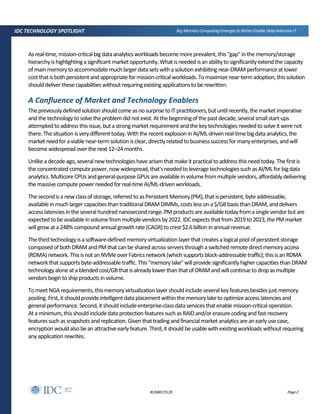
arealreadyworkingonboththehardware componentsandthesoftwarecomponentsforthisplatform. Figure 1
providesasimple,nonvendor-specificdefinitionofBigMemoryComputing.
FIGURE 1: The DefinitionofBig Memory Computing
Source: IDC, 2020
Benefits
Thebusinessbenefitsof BigMemoryComputingareclear.First,itputsmoredatacloserto computeresourcesand
makesthedataaccessibleatDRAM-like speeds,providingsignificantlymore consistentandscalableperformancethan is
possiblewithtoday'smemory/storagehierarchy. Bigdataanalyticsworkloadsthatrequirehighdegreesofconcurrency
whileworkingonverylargedatasetswillbe abletodrivebetterresultsfasterwiththisnewparadigm. Infact,manyof
thesenewworkloadswouldnotevenbefeasiblewithoutthecombinationofacceleratedcomputeand BigMemory
Computing.Asdata setsgrowandreal-timeapplicationsbecomemorepervasive,BigMemoryComputingwillbecomea
requiredpartofthe ITinfrastructureformoreenterprises.
Second,the software-definedmemoryvirtualizationlayerunlocksthetruepotentialofthenewPMhardware.Muchlike
the server virtualization (hypervisor)layerenabledtheparallelismtotakefulladvantageofmulticoreCPUarchitectures,
thememoryvirtualizationtierwilldothesameforthenewPMmedia.Thiswilldrive improvedefficienciesintermsof
increased ITinfrastructureandmixedenterpriseworkloaddensity,streamliningdatacentersbyloweringenergyand
floorspaceconsumptioncosts.Withsupportforenterprise-classdataservicessuchasRAID,snapshots,andreplicationfor
memory-residentdatabuiltintothismemoryvirtualizationtier,ITmanagershavethetoolstoprovidethehighavailability
andfastrecoveryneededformission-criticalworkloads.Inaddition,theabilitytocreateamemorylakethatsignificantly
Page 4#US46573120
IDC TECHNOLOGY SPOTLIGHT Big Memory Computing Emerges to Better Enable Data-Intensive IT
transcendsthememorycapacityofanysingle serverandenablessharingacrossmanyserversaddressestoday'sDRAM
capacitylimitations.Ultimately,BigMemoryComputingshouldsupportmemorylakeshundredsofterabytesin size,
deliveringthehighconcurrencynecessaryevenasthescaleof"bigdata"growsovertime.
Third,theintroductionofamemorylakewillstreamlineinfrastructure,allowingsmallerconfigurationstomeetanygiven
performancegoal.FormanyofthetargetNGAworkloads,theintroductionofBigMemoryComputingwilltranscendthe
needforolder-stylepersistent"performancestorage,"allowingthattiertoberemovedentirely.Themuchloweraverage
latenciesdrivenbytheBigMemorytier(relativetotheolderperformancestorage)willdrivehigherCPUutilization,allowing
customerstogetmoreoutofcomputeresources.ThisimprovedefficiencycantranslatetofewerCPUcores(andultimately
servers)neededtomeetagivenperformancelevel,whichinturncandrivelowerapplicationsoftwarelicensingcosts.
TheabilitytodelivertheadvantagesofBigMemoryComputingfortoday'sworkloadswithoutrequiringanyapplication
modificationswillbecriticaltothesuccessofthisnewcategory.Givingenterprisestheabilitytoaccesstheperformance
advantagesofthisnewapproachquicklyandeasilywillbe keytorapidadoption.Thevisionof BigMemoryComputingis
thatcustomerscanuseindustry-standard servers,runningwidelyavailableLinuxoperatingsystems,addPMhardware
and memoryvirtualization software,andthen immediatelyenjoytheperformancebenefitsofin-memorycomputing.
Despitetheclearperformanceadvantagesofin-memorycomputing,wehavealreadyseenthatwhen applicationsmust
bespecificallymodifiedtotake advantageofitandmain memorycapacityremainslimited,adoptionproceedsvery
slowly. Sotheabilitytoquicklyandeasilyadopt in-memorycomputingforexistingworkloadswithoutmodificationwith
largememorylakeswillbecriticaltorapidmarketpenetration.
Considering MemVerge
Foundedin2017andheadquarteredinMilpitas,California,MemVergeisastoragesoftwarecompanythatprovidesthe
memoryvirtualizationlayerforBigMemoryComputing.Thevendor'sBigMemoryComputingvisionhasgarneredthesupport
ofmanykeyindustryplayersthathavebecomeinvestors,includingIntel,Cisco,NetApp,andSKhynix.MemVerge'sMemory
Machinesoftwareinstallsonindustry-standardIntelArchitectureserversrunningLinux,allofwhichareinterconnectedusing
anInfiniBandRDMAnetwork.DRAMandPMcapacityfromallattachedserversarepooledintoamemorylakeaccessibleby
allservers.TheMemoryMachineincludesenterprise-classdataservicessuchasZeroIOSnapshot,RDMA-basedreplication,
andmemorytiering,givingadministratorsthetoolsneededtorunmission-criticalworkloadsinMemoryMachine
environments.Anyoftoday'sworkloadscanberuninthisenvironmentwithoutrequiringanymodifications,enabling
applicationstoquicklyandeasilybenefitfromtheperformanceandefficiencyofin-memoryoperation.
MemVerge'simplementation,whileprovidingbackward compatibilitywithexistingapplications,offersseveral APIs.
WithTransparentMemoryService,theMemoryMachineusescombinedDRAMandPMcapacityasvolatilememory,
extendingmainmemorycapacitywhilemakingitoverallmoreaffordable(duetotheblended$/GBcostofDRAMand
PM). Inthat case,theoperatingsystem just seestheadditionalPMcapacityasmore mainmemory. In addition,
MemVergedeliversanin-memorysnapshotfeature,utilizingthepersistenceoftheunderlyingmemory,ontopofthe
TransparentMemoryService.Suchsnapshotsare instantandnondisruptivetoapplications,enablingapplicationrollback,
crashrecovery,and cloning.MemVergeMemoryMachinealsoincludesaSoftwareDevelopmentKit (SDK)with APIs,and
if ITorganizationswanttomodifyorbuildapplicationsusingtheSDK,theycan getmoregranularcontrolofthe memory
virtualizationlayerforimprovedefficiencyofoperation,havemorecomplete accesstodataservices,andpossiblyenjoy
moreperformance(dependingonaworkload'sI/Oprofileandworkflows).
Page 5#US46573120
IDC TECHNOLOGY SPOTLIGHT Big Memory Computing Emerges to Better Enable Data-Intensive IT
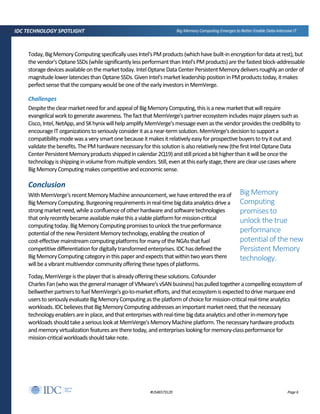
MemVergeistargetingseveralusecaseswithitsBigMemoryComputingplatform(seeFigure2).Thefirstusecaseisinreal-
timedataanalyticsandordermanagementwherelowerlatenciestranslatedirectlytoimprovedrevenuestreams.
Tradingfloorapplicationsandotherworkloadsthathavesingle-threadedsequencerscanbenefitsignificantlyfromthe
muchlowerlatenciesofBigMemoryComputing(whichcanbeinthe200–400nanosecondrange).Thesecondusecaseis
forin-memorydatabasecloning.MemVerge'spatentedZeroIOSnapshotenablesscalableclonecreationwithout
noticeablelatencyimpactswhenthesamedatasetneedstobeusedfordifferentworkflows(suchasdev/test,analytics,or
reporting),whilethepersistentbutsharedmemorypoolsupportsalmostinstantaneousrecoveryintheeventofserveror
applicationcrashes.ThethirdusecaseisinAI/ML-assistedworkloadssuchasfrauddetectionorinferenceengineswhere
theperformancecandropdramaticallywhentherelevantdatasetislargerthanthemainmemorycapacity.Theabilityto
recoverrapidlyusingMemVerge'ssnapshottechnologyisasignificantadvantageinthisusecaseaswell.
FIGURE 2: Key Early UseCases forBig Memory Computing
Source: IDC, 2020
MemVergeisbenefitingfrom someverylargeandwell-knownnamesinenterprise computinginitsgo-to-market
strategy.KeyinvestorsincludeCisco,Intel,NetApp,andSKhynixaswellasseveralventurecapitalists.Cisco isa major
servervendorlookingtodifferentiatefromitscompetitorsbybeingfirsttomarketwithconverged infrastructure
offeringsthatsupportBigMemoryComputing. IntelisafirstmoverinthePMhardware arena,NetAppalreadyoffersa
PMsolutionforitsONTAP-basedenterprise storagearrays,andSKhynixisamarketleaderinsolidstatememory
technologies.MemVerge'scurrent go-to-marketapproachisbasedaround a100%indirectchannelstrategy,butthe
companywillbenefitsignificantlyfromthemarketpowerofthese vendorsastheyestablish marketbeachheadsthatwill
introduce BigMemoryComputingtotheenterpriseinfrastructure.
IntelwasthefirstvendortointroducegenerallyavailablePMproducts(whichthevendorbrandsunderthe IntelOptane
Data CenterPersistentMemoryname).Optaneproductsuseanewmediatypethatthevendorjointlydevelopedwith
Microncalled3DXPoint,andultimatelyMicronisexpectedtoshipPMproductsinvolumeaswell. Intelusesthe3D
XPointmediainbothbyte-addressable (PM)andblock-addressable (storage-classmemoryorSCM)storagedevices,
whichthevendorisalreadysellingtoday. IntelOptaneData CenterPersistentMemoryproductsplugdirectlyinto
standardmemoryslotsonIntelArchitecture systemsandareaccessibleusingthebyte-addressableDDR4interface.
Page 6#US46573120
IDC TECHNOLOGY SPOTLIGHT Big Memory Computing Emerges to Better Enable Data-Intensive IT
Today, BigMemoryComputingspecificallyusesIntel'sPMproducts (whichhavebuilt-inencryptionfordata atrest),but
the vendor'sOptaneSSDs(whilesignificantlylessperformantthan Intel'sPMproducts)arethefastestblock-addressable
storagedevicesavailableonthemarkettoday. IntelOptaneData CenterPersistentMemorydeliversroughlyanorderof
magnitudelowerlatenciesthan Optane SSDs.GivenIntel'smarketleadershippositioninPMproductstoday,itmakes
perfectsensethatthecompanywouldbeoneoftheearlyinvestorsinMemVerge.
Challenges
Despitetheclearmarketneedforandappealof BigMemoryComputing,thisisanewmarketthatwillrequire
evangelicalworktogenerate awareness.ThefactthatMemVerge'spartnerecosystemincludesmajorplayers suchas
Cisco,Intel,NetApp,andSKhynixwillhelp amplifyMemVerge'smessageevenasthe vendorprovidesthecredibilityto
encourageITorganizationstoseriouslyconsideritasanear-term solution.MemVerge'sdecisiontosupporta
compatibilitymodewasa verysmartonebecause itmakesitrelativelyeasyforprospectivebuyerstotryitout and
validatethebenefits.ThePMhardwarenecessaryforthissolution isalsorelativelynew (thefirstIntelOptaneData
CenterPersistentMemoryproductsshippedincalendar2Q19)andstillpricedabithigherthanitwillbeoncethe
technologyisshippinginvolumefrom multiplevendors. Still,evenatthisearlystage,there areclearusecaseswhere
BigMemoryComputingmakescompetitive andeconomicsense.
Conclusion
WithMemVerge'srecentMemoryMachineannouncement,wehaveenteredthe eraof
BigMemoryComputing.Burgeoningrequirementsinreal-timebigdataanalyticsdrivea
strongmarketneed,whilea confluenceofotherhardware and softwaretechnologies
thatonlyrecentlybecameavailablemakethisaviableplatformformission-critical
computingtoday.BigMemoryComputingpromisestounlockthetrueperformance
potentialofthenewPersistentMemorytechnology,enablingthe creationof
cost-effectivemainstream computingplatformsfor manyoftheNGAsthatfuel
competitivedifferentiationfordigitallytransformedenterprises.IDChasdefinedthe
BigMemoryComputingcategoryinthispaperandexpectsthatwithintwo yearsthere
willbea vibrantmultivendor communityofferingthesetypesofplatforms.
Today,MemVergeistheplayerthat isalreadyofferingthesesolutions.Cofounder
CharlesFan(whowasthegeneralmanagerofVMware'svSANbusiness)haspulledtogetheracompellingecosystemof
bellwetherpartnerstofuelMemVerge'sgo-to-marketefforts,andthatecosystemisexpectedtodrivemarquee end
userstoseriouslyevaluateBigMemoryComputingastheplatformofchoiceformission-criticalreal-timeanalytics
workloads.IDCbelievesthat BigMemoryComputingaddressesanimportant marketneed,thatthenecessary
technologyenablersareinplace,andthatenterpriseswithreal-timebigdataanalyticsandotherin-memorytype
workloadsshouldtakeaseriouslookatMemVerge'sMemoryMachineplatform.Thenecessaryhardwareproducts
and memoryvirtualizationfeaturesaretheretoday,andenterpriseslookingformemory-classperformancefor
mission-criticalworkloadsshouldtakenote.
Big Memory
Computing
promises to
unlock the true
performance
potential of the new
Persistent Memory
technology.
Page 7#US46573120
IDC TECHNOLOGY SPOTLIGHT Big Memory Computing Emerges to Better Enable Data-Intensive IT
About the Analyst
EricBurgener,Research Vice President, Infrastructure Systems, Platforms, and
Technologies
EricBurgenerisResearchVicePresidentwithinIDC'sEnterpriseInfrastructurepractice.Mr.Burgener'score
researchcoverageincludesstoragesystems,softwareandsolutions,quarterlytrackers,andend-user
researchaswellasadvisoryservicesandconsultingprograms.Basedonhisbackgroundcoveringenterprise
storage,Mr.Burgener'sresearchincludesaparticularemphasisonsolidstatetechnologiesinenterprise
storagesystemsaswellassoftware-definedinfrastructure.HewasawardedtheAlexanderMotsenigos
MemorialAwardforOutstandingInnovationinMarketResearchin2017byIDC,wasrecognizedasoneof
theArchitectAnalystPower100in2019byindependentresearcherARInsights,andisanactiveparticipant
intheITBuyer'sResearchProgramatIDC.
The content in this paper was adapted from existing IDC research published on www.idc.com.
IDC Research,Inc.
5 Speen Street
Framingham, MA 01701, USA
T 508.872.8200
F 508.935.4015
Twitter @IDC
idc-insights-community.com
www.idc.com
This publication was produced by IDC Custom Solutions. The opinion, analysis, and research results presented herein are drawn from
more detailed research and analysis independently conducted and published by IDC, unless specific vendor sponsorship is noted. IDC
Custom Solutions makes IDC content available in a wide range of formats for distribution by various companies. A license to distribute
IDC content does not imply endorsement of or opinion about the licensee.
External Publication of IDC Information and Data — Any IDC information that is to be used in advertising, press releases, or promotional
materials requires prior written approval from the appropriate IDC Vice President or Country Manager. A draft of the proposed
document should accompany any such request. IDC reserves the right to deny approval of external usage for any reason.
Copyright 2020 IDC. Reproduction without written permission is completely forbidden.

IDC Technology Spotlight: Big Memory Computing Emerges to Better Enable Data-Instensive IT

  • 1.
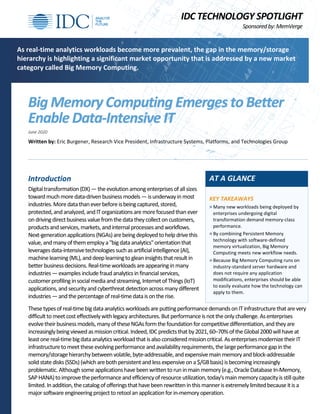
    IDC TECHNOLOGY SPOTLIGHT Sponsoredby:MemVerge BigMemory Computing Emerges to Better Enable Data-Intensive IT June 2020 Written by: Eric Burgener, Research Vice President, Infrastructure Systems, Platforms, and Technologies Group Introduction Digitaltransformation (DX)—theevolutionamongenterprisesofallsizes towardmuchmoredata-drivenbusinessmodels—isunderwayinmost industries.Moredatathaneverbeforeisbeingcaptured,stored, protected,andanalyzed,and ITorganizationsare morefocusedthanever ondrivingdirectbusinessvaluefromthedatatheycollecton customers, productsandservices,markets,andinternalprocessesandworkflows. Next-generationapplications(NGAs)arebeingdeployedtohelpdrivethis value,andmanyofthememploya"bigdataanalytics"orientationthat leveragesdata-intensivetechnologiessuchasartificialintelligence (AI), machinelearning (ML),anddeeplearningtogleaninsightsthatresultin betterbusinessdecisions.Real-timeworkloadsareappearinginmany industries—examplesincludefraud analyticsinfinancialservices, customerprofilinginsocialmediaand streaming, InternetofThings(IoT) applications,andsecurityandcyberthreatdetectionacrossmanydifferent industries—andthepercentageofreal-timedataisontherise. Thesetypesofreal-timebigdataanalyticsworkloadsareputtingperformancedemandsonITinfrastructurethatarevery difficulttomeet costeffectivelywithlegacyarchitectures.Butperformance isnottheonlychallenge.Asenterprises evolvetheirbusinessmodels,manyoftheseNGAsformthefoundationforcompetitivedifferentiation,andtheyare increasinglybeingviewedasmissioncritical.Indeed,IDCpredictsthatby2021,60–70%ofthe Global2000willhaveat leastone real-timebigdataanalyticsworkloadthatisalso considered missioncritical.AsenterprisesmodernizetheirIT infrastructuretomeetthese evolvingperformance and availabilityrequirements,the largeperformancegapinthe memory/storagehierarchybetween volatile,byte-addressable,andexpensivemain memoryandblock-addressable solid statedisks(SSDs)(which arebothpersistent and lessexpensiveona$/GBbasis)isbecomingincreasingly problematic.Althoughsome applicationshavebeenwrittento run inmainmemory(e.g.,OracleDatabaseIn-Memory, SAPHANA)toimprovetheperformanceandefficiencyof resourceutilization,today'smainmemorycapacityisstillquite limited. Inaddition,thecatalogofofferingsthathavebeenrewritteninthismannerisextremelylimitedbecause itisa major software engineeringprojecttoretoolanapplicationforin-memoryoperation. As real-time analytics workloads become more prevalent, the gap in the memory/storage hierarchy is highlighting a significant market opportunity that is addressed by a new market category called Big Memory Computing. KEY TAKEAWAYS » Many new workloads being deployed by enterprises undergoing digital transformation demand memory-class performance. » By combining Persistent Memory technology with software-defined memory virtualization, Big Memory Computing meets new workflow needs. » Because Big Memory Computing runs on industry-standard server hardware and does not require any application modifications, enterprises should be able to easily evaluate how the technology can apply to them. AT A GLANCE
  • 2.
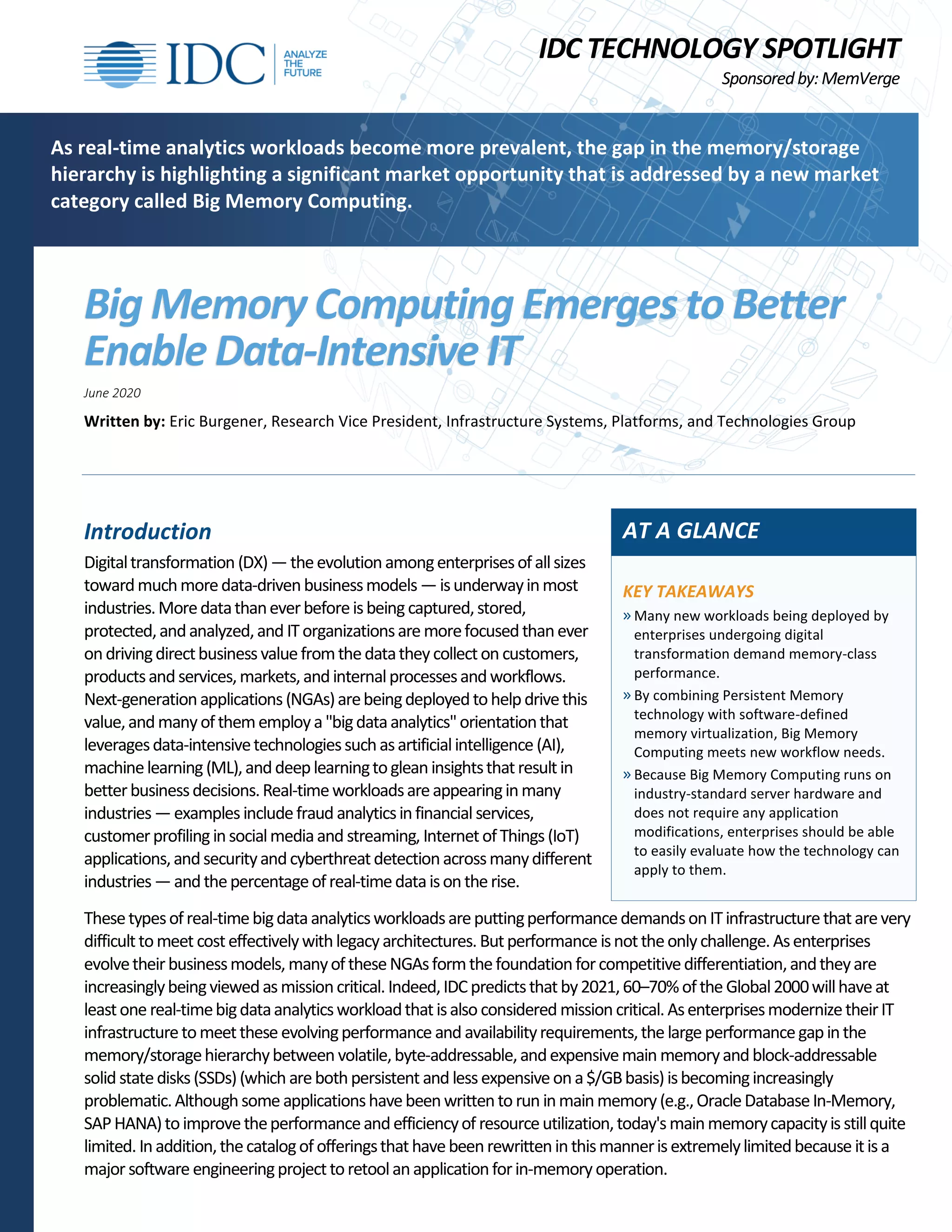
    Page 2#US46573120 IDC TECHNOLOGYSPOTLIGHT Big Memory Computing Emerges to Better Enable Data-Intensive IT Asreal-time,mission-criticalbigdataanalyticsworkloadsbecomemoreprevalent,this"gap"inthememory/storage hierarchyishighlightingasignificantmarketopportunity. Whatisneeded isanabilitytosignificantlyextendthe capacity ofmainmemorytoaccommodatemuch largerdatasetswitha solution exhibitingnear-DRAMperformanceatlower costthatisbothpersistentand appropriateformission-criticalworkloads.Tomaximizenear-termadoption,thissolution shoulddeliverthesecapabilitieswithoutrequiringexistingapplicationstobe rewritten. A Confluence of Market and Technology Enablers Thepreviouslydefinedsolutionshouldcome asnosurprisetoITpractitioners,butuntilrecently,themarket imperative andthetechnologytosolvetheproblemdidnotexist.Atthebeginningofthepastdecade,severalsmallstart-ups attemptedtoaddressthisissue,buta strongmarketrequirementandthekeytechnologiesneededto solveitwerenot there.Thesituation isverydifferenttoday.WiththerecentexplosioninAI/ML-drivenreal-timebigdataanalytics,the marketneedforaviablenear-term solution isclear,directlyrelatedtobusinesssuccessformanyenterprises,andwill becomewidespreadoverthenext12–24months. Unlikeadecadeago,severalnewtechnologieshavearisenthatmakeitpracticaltoaddressthisneedtoday.Thefirstis the concentratedcomputepower,nowwidespread,that'sneededtoleveragetechnologiessuchasAI/MLforbigdata analytics.MulticoreCPUsandgeneral-purpose GPUsareavailableinvolumefrommultiplevendors,affordablydelivering themassive computepower neededforreal-timeAI/ML-drivenworkloads. Thesecondisanewclassofstorage,referredto asPersistentMemory(PM),that ispersistent,byteaddressable, availableinmuchlargercapacitiesthantraditionalDRAMDIMMs,costslessona$/GBbasisthanDRAM,anddelivers accesslatenciesintheseveralhundrednanosecondrange.PMproductsareavailabletodayfromasinglevendorbutare expectedtobeavailableinvolumefrommultiplevendorsby2022.IDCexpectsthatfrom2019to2023,thePM market willgrowata248%compoundannualgrowthrate (CAGR)tocrest$2.6billioninannualrevenue. Thethirdtechnologyisasoftware-definedmemoryvirtualizationlayerthat createsalogicalpoolofpersistentstorage composedofbothDRAMandPMthat canbe sharedacrossserversthrougha switched remotedirectmemoryaccess (RDMA)network.Thisisnot anNVMeoverFabricsnetwork(which supportsblock-addressabletraffic);thisisan RDMA networkthat supportsbyte-addressabletraffic. This"memorylake"willprovide significantlyhighercapacitiesthanDRAM technologyaloneatablendedcost/GBthatisalreadylowerthanthatofDRAMandwillcontinuetodropasmultiple vendorsbeginto shipproductsin volume. TomeetNGArequirements,thismemoryvirtualizationlayershouldincludeseveralkeyfeaturesbesidesjust memory pooling. First,itshouldprovideintelligentdataplacementwithinthememorylaketo optimizeaccesslatenciesand generalperformance.Second,itshouldincludeenterprise-classdataservicesthatenable mission-criticaloperation. Ataminimum,thisshouldincludedataprotectionfeaturessuchasRAIDand/orerasure codingandfastrecovery featuressuchassnapshotsand replication.Giventhattradingandfinancialmarketanalyticsare anearlyusecase, encryptionwouldalsobean attractive earlyfeature.Third,itshouldbeusablewithexistingworkloadswithoutrequiring anyapplicationrewrites.
  • 3.
    Page 3#US46573120 IDC TECHNOLOGYSPOTLIGHT Big Memory Computing Emerges to Better Enable Data-Intensive IT Definitions IDCbelievesthatthepreviouslymentioned marketopportunityandsolutiondefinitionwillbecomethebasisfor anew market category.An aptnameforthismarketthat isbothdescriptive and shortisBigMemoryComputing. The solution outlinedpreviouslyrequirestechnologiesfromatleastseveralvendors,anditisimportanttonotethatmultiplevendors arealreadyworkingonboththehardware componentsandthesoftwarecomponentsforthisplatform. Figure 1 providesasimple,nonvendor-specificdefinitionofBigMemoryComputing. FIGURE 1: The DefinitionofBig Memory Computing Source: IDC, 2020 Benefits Thebusinessbenefitsof BigMemoryComputingareclear.First,itputsmoredatacloserto computeresourcesand makesthedataaccessibleatDRAM-like speeds,providingsignificantlymore consistentandscalableperformancethan is possiblewithtoday'smemory/storagehierarchy. Bigdataanalyticsworkloadsthatrequirehighdegreesofconcurrency whileworkingonverylargedatasetswillbe abletodrivebetterresultsfasterwiththisnewparadigm. Infact,manyof thesenewworkloadswouldnotevenbefeasiblewithoutthecombinationofacceleratedcomputeand BigMemory Computing.Asdata setsgrowandreal-timeapplicationsbecomemorepervasive,BigMemoryComputingwillbecomea requiredpartofthe ITinfrastructureformoreenterprises. Second,the software-definedmemoryvirtualizationlayerunlocksthetruepotentialofthenewPMhardware.Muchlike the server virtualization (hypervisor)layerenabledtheparallelismtotakefulladvantageofmulticoreCPUarchitectures, thememoryvirtualizationtierwilldothesameforthenewPMmedia.Thiswilldrive improvedefficienciesintermsof increased ITinfrastructureandmixedenterpriseworkloaddensity,streamliningdatacentersbyloweringenergyand floorspaceconsumptioncosts.Withsupportforenterprise-classdataservicessuchasRAID,snapshots,andreplicationfor memory-residentdatabuiltintothismemoryvirtualizationtier,ITmanagershavethetoolstoprovidethehighavailability andfastrecoveryneededformission-criticalworkloads.Inaddition,theabilitytocreateamemorylakethatsignificantly
  • 4.
    Page 4#US46573120 IDC TECHNOLOGYSPOTLIGHT Big Memory Computing Emerges to Better Enable Data-Intensive IT transcendsthememorycapacityofanysingle serverandenablessharingacrossmanyserversaddressestoday'sDRAM capacitylimitations.Ultimately,BigMemoryComputingshouldsupportmemorylakeshundredsofterabytesin size, deliveringthehighconcurrencynecessaryevenasthescaleof"bigdata"growsovertime. Third,theintroductionofamemorylakewillstreamlineinfrastructure,allowingsmallerconfigurationstomeetanygiven performancegoal.FormanyofthetargetNGAworkloads,theintroductionofBigMemoryComputingwilltranscendthe needforolder-stylepersistent"performancestorage,"allowingthattiertoberemovedentirely.Themuchloweraverage latenciesdrivenbytheBigMemorytier(relativetotheolderperformancestorage)willdrivehigherCPUutilization,allowing customerstogetmoreoutofcomputeresources.ThisimprovedefficiencycantranslatetofewerCPUcores(andultimately servers)neededtomeetagivenperformancelevel,whichinturncandrivelowerapplicationsoftwarelicensingcosts. TheabilitytodelivertheadvantagesofBigMemoryComputingfortoday'sworkloadswithoutrequiringanyapplication modificationswillbecriticaltothesuccessofthisnewcategory.Givingenterprisestheabilitytoaccesstheperformance advantagesofthisnewapproachquicklyandeasilywillbe keytorapidadoption.Thevisionof BigMemoryComputingis thatcustomerscanuseindustry-standard servers,runningwidelyavailableLinuxoperatingsystems,addPMhardware and memoryvirtualization software,andthen immediatelyenjoytheperformancebenefitsofin-memorycomputing. Despitetheclearperformanceadvantagesofin-memorycomputing,wehavealreadyseenthatwhen applicationsmust bespecificallymodifiedtotake advantageofitandmain memorycapacityremainslimited,adoptionproceedsvery slowly. Sotheabilitytoquicklyandeasilyadopt in-memorycomputingforexistingworkloadswithoutmodificationwith largememorylakeswillbecriticaltorapidmarketpenetration. Considering MemVerge Foundedin2017andheadquarteredinMilpitas,California,MemVergeisastoragesoftwarecompanythatprovidesthe memoryvirtualizationlayerforBigMemoryComputing.Thevendor'sBigMemoryComputingvisionhasgarneredthesupport ofmanykeyindustryplayersthathavebecomeinvestors,includingIntel,Cisco,NetApp,andSKhynix.MemVerge'sMemory Machinesoftwareinstallsonindustry-standardIntelArchitectureserversrunningLinux,allofwhichareinterconnectedusing anInfiniBandRDMAnetwork.DRAMandPMcapacityfromallattachedserversarepooledintoamemorylakeaccessibleby allservers.TheMemoryMachineincludesenterprise-classdataservicessuchasZeroIOSnapshot,RDMA-basedreplication, andmemorytiering,givingadministratorsthetoolsneededtorunmission-criticalworkloadsinMemoryMachine environments.Anyoftoday'sworkloadscanberuninthisenvironmentwithoutrequiringanymodifications,enabling applicationstoquicklyandeasilybenefitfromtheperformanceandefficiencyofin-memoryoperation. MemVerge'simplementation,whileprovidingbackward compatibilitywithexistingapplications,offersseveral APIs. WithTransparentMemoryService,theMemoryMachineusescombinedDRAMandPMcapacityasvolatilememory, extendingmainmemorycapacitywhilemakingitoverallmoreaffordable(duetotheblended$/GBcostofDRAMand PM). Inthat case,theoperatingsystem just seestheadditionalPMcapacityasmore mainmemory. In addition, MemVergedeliversanin-memorysnapshotfeature,utilizingthepersistenceoftheunderlyingmemory,ontopofthe TransparentMemoryService.Suchsnapshotsare instantandnondisruptivetoapplications,enablingapplicationrollback, crashrecovery,and cloning.MemVergeMemoryMachinealsoincludesaSoftwareDevelopmentKit (SDK)with APIs,and if ITorganizationswanttomodifyorbuildapplicationsusingtheSDK,theycan getmoregranularcontrolofthe memory virtualizationlayerforimprovedefficiencyofoperation,havemorecomplete accesstodataservices,andpossiblyenjoy moreperformance(dependingonaworkload'sI/Oprofileandworkflows).
  • 5.
    Page 5#US46573120 IDC TECHNOLOGYSPOTLIGHT Big Memory Computing Emerges to Better Enable Data-Intensive IT MemVergeistargetingseveralusecaseswithitsBigMemoryComputingplatform(seeFigure2).Thefirstusecaseisinreal- timedataanalyticsandordermanagementwherelowerlatenciestranslatedirectlytoimprovedrevenuestreams. Tradingfloorapplicationsandotherworkloadsthathavesingle-threadedsequencerscanbenefitsignificantlyfromthe muchlowerlatenciesofBigMemoryComputing(whichcanbeinthe200–400nanosecondrange).Thesecondusecaseis forin-memorydatabasecloning.MemVerge'spatentedZeroIOSnapshotenablesscalableclonecreationwithout noticeablelatencyimpactswhenthesamedatasetneedstobeusedfordifferentworkflows(suchasdev/test,analytics,or reporting),whilethepersistentbutsharedmemorypoolsupportsalmostinstantaneousrecoveryintheeventofserveror applicationcrashes.ThethirdusecaseisinAI/ML-assistedworkloadssuchasfrauddetectionorinferenceengineswhere theperformancecandropdramaticallywhentherelevantdatasetislargerthanthemainmemorycapacity.Theabilityto recoverrapidlyusingMemVerge'ssnapshottechnologyisasignificantadvantageinthisusecaseaswell. FIGURE 2: Key Early UseCases forBig Memory Computing Source: IDC, 2020 MemVergeisbenefitingfrom someverylargeandwell-knownnamesinenterprise computinginitsgo-to-market strategy.KeyinvestorsincludeCisco,Intel,NetApp,andSKhynixaswellasseveralventurecapitalists.Cisco isa major servervendorlookingtodifferentiatefromitscompetitorsbybeingfirsttomarketwithconverged infrastructure offeringsthatsupportBigMemoryComputing. IntelisafirstmoverinthePMhardware arena,NetAppalreadyoffersa PMsolutionforitsONTAP-basedenterprise storagearrays,andSKhynixisamarketleaderinsolidstatememory technologies.MemVerge'scurrent go-to-marketapproachisbasedaround a100%indirectchannelstrategy,butthe companywillbenefitsignificantlyfromthemarketpowerofthese vendorsastheyestablish marketbeachheadsthatwill introduce BigMemoryComputingtotheenterpriseinfrastructure. IntelwasthefirstvendortointroducegenerallyavailablePMproducts(whichthevendorbrandsunderthe IntelOptane Data CenterPersistentMemoryname).Optaneproductsuseanewmediatypethatthevendorjointlydevelopedwith Microncalled3DXPoint,andultimatelyMicronisexpectedtoshipPMproductsinvolumeaswell. Intelusesthe3D XPointmediainbothbyte-addressable (PM)andblock-addressable (storage-classmemoryorSCM)storagedevices, whichthevendorisalreadysellingtoday. IntelOptaneData CenterPersistentMemoryproductsplugdirectlyinto standardmemoryslotsonIntelArchitecture systemsandareaccessibleusingthebyte-addressableDDR4interface.
  • 6.
    Page 6#US46573120 IDC TECHNOLOGYSPOTLIGHT Big Memory Computing Emerges to Better Enable Data-Intensive IT Today, BigMemoryComputingspecificallyusesIntel'sPMproducts (whichhavebuilt-inencryptionfordata atrest),but the vendor'sOptaneSSDs(whilesignificantlylessperformantthan Intel'sPMproducts)arethefastestblock-addressable storagedevicesavailableonthemarkettoday. IntelOptaneData CenterPersistentMemorydeliversroughlyanorderof magnitudelowerlatenciesthan Optane SSDs.GivenIntel'smarketleadershippositioninPMproductstoday,itmakes perfectsensethatthecompanywouldbeoneoftheearlyinvestorsinMemVerge. Challenges Despitetheclearmarketneedforandappealof BigMemoryComputing,thisisanewmarketthatwillrequire evangelicalworktogenerate awareness.ThefactthatMemVerge'spartnerecosystemincludesmajorplayers suchas Cisco,Intel,NetApp,andSKhynixwillhelp amplifyMemVerge'smessageevenasthe vendorprovidesthecredibilityto encourageITorganizationstoseriouslyconsideritasanear-term solution.MemVerge'sdecisiontosupporta compatibilitymodewasa verysmartonebecause itmakesitrelativelyeasyforprospectivebuyerstotryitout and validatethebenefits.ThePMhardwarenecessaryforthissolution isalsorelativelynew (thefirstIntelOptaneData CenterPersistentMemoryproductsshippedincalendar2Q19)andstillpricedabithigherthanitwillbeoncethe technologyisshippinginvolumefrom multiplevendors. Still,evenatthisearlystage,there areclearusecaseswhere BigMemoryComputingmakescompetitive andeconomicsense. Conclusion WithMemVerge'srecentMemoryMachineannouncement,wehaveenteredthe eraof BigMemoryComputing.Burgeoningrequirementsinreal-timebigdataanalyticsdrivea strongmarketneed,whilea confluenceofotherhardware and softwaretechnologies thatonlyrecentlybecameavailablemakethisaviableplatformformission-critical computingtoday.BigMemoryComputingpromisestounlockthetrueperformance potentialofthenewPersistentMemorytechnology,enablingthe creationof cost-effectivemainstream computingplatformsfor manyoftheNGAsthatfuel competitivedifferentiationfordigitallytransformedenterprises.IDChasdefinedthe BigMemoryComputingcategoryinthispaperandexpectsthatwithintwo yearsthere willbea vibrantmultivendor communityofferingthesetypesofplatforms. Today,MemVergeistheplayerthat isalreadyofferingthesesolutions.Cofounder CharlesFan(whowasthegeneralmanagerofVMware'svSANbusiness)haspulledtogetheracompellingecosystemof bellwetherpartnerstofuelMemVerge'sgo-to-marketefforts,andthatecosystemisexpectedtodrivemarquee end userstoseriouslyevaluateBigMemoryComputingastheplatformofchoiceformission-criticalreal-timeanalytics workloads.IDCbelievesthat BigMemoryComputingaddressesanimportant marketneed,thatthenecessary technologyenablersareinplace,andthatenterpriseswithreal-timebigdataanalyticsandotherin-memorytype workloadsshouldtakeaseriouslookatMemVerge'sMemoryMachineplatform.Thenecessaryhardwareproducts and memoryvirtualizationfeaturesaretheretoday,andenterpriseslookingformemory-classperformancefor mission-criticalworkloadsshouldtakenote. Big Memory Computing promises to unlock the true performance potential of the new Persistent Memory technology.
  • 7.
    Page 7#US46573120 IDC TECHNOLOGYSPOTLIGHT Big Memory Computing Emerges to Better Enable Data-Intensive IT About the Analyst EricBurgener,Research Vice President, Infrastructure Systems, Platforms, and Technologies EricBurgenerisResearchVicePresidentwithinIDC'sEnterpriseInfrastructurepractice.Mr.Burgener'score researchcoverageincludesstoragesystems,softwareandsolutions,quarterlytrackers,andend-user researchaswellasadvisoryservicesandconsultingprograms.Basedonhisbackgroundcoveringenterprise storage,Mr.Burgener'sresearchincludesaparticularemphasisonsolidstatetechnologiesinenterprise storagesystemsaswellassoftware-definedinfrastructure.HewasawardedtheAlexanderMotsenigos MemorialAwardforOutstandingInnovationinMarketResearchin2017byIDC,wasrecognizedasoneof theArchitectAnalystPower100in2019byindependentresearcherARInsights,andisanactiveparticipant intheITBuyer'sResearchProgramatIDC. The content in this paper was adapted from existing IDC research published on www.idc.com. IDC Research,Inc. 5 Speen Street Framingham, MA 01701, USA T 508.872.8200 F 508.935.4015 Twitter @IDC idc-insights-community.com www.idc.com This publication was produced by IDC Custom Solutions. The opinion, analysis, and research results presented herein are drawn from more detailed research and analysis independently conducted and published by IDC, unless specific vendor sponsorship is noted. IDC Custom Solutions makes IDC content available in a wide range of formats for distribution by various companies. A license to distribute IDC content does not imply endorsement of or opinion about the licensee. External Publication of IDC Information and Data — Any IDC information that is to be used in advertising, press releases, or promotional materials requires prior written approval from the appropriate IDC Vice President or Country Manager. A draft of the proposed document should accompany any such request. IDC reserves the right to deny approval of external usage for any reason. Copyright 2020 IDC. Reproduction without written permission is completely forbidden.