CargoConnect - May 201616
cover story
CargoConnect - may 201616
Roadmap for Logistics
Megatrends &
Opportunities
May 2016 - CargoConnect 17
cover story
may 2016 - CargoConnect 17
Indian Logistics Industry has witnessed an exponential growth in the last few years.
If we go by the statistics, the logistics market in India is expected to be worth US$
301.89 billion by 2020. Key initiatives like government’s ‘Make in India’ campaign,
DFC, boost in e-commerce Industry, increasing number of multi-modal logistics
players, development of inland waterways etc., have led to this significant growth.
Ritika Arora Bhola, with the help of experts jots down key megatrends and
opportunities in logistics and related sectors
CargoConnect - May 201618
Logistics Sector: Overview
I
ndian logistics industry has evolved in last two three decades from a basic
transportation service with some value-added service provider to a truly com-
petent partner at par with global supply chain standards. Oliver Bohm, CEO,
Schenker India Pvt Ltd highlights few megatrends that have benefitted logis-
tics industry as a whole.
1. Make in India - This initiative is excellent news for India. India is the country
which can provide an alternative to China as a manufacturing base is India.
We have abundant land, people and unutilised resources. The challenges are
infrastructure and Ease of Doing Business. Fortunately the government is
focused on the same and the winds of change have gradually started blowing in
the right direction and all stalled infrastructure projects are being revived. The
country is already witnessing a spike in investments in domestic manufacturing
which will have an enormous positive impact on the logistics industry, thereby
opening up endless opportunities in domestic supply chain management.
2. Dedicated Freight Corridor – Dedicated Western Freight Corridor from
Mumbai to Delhi and Eastern Freight Corridor from Kolkata to Ludhiana,
meeting Western Freight Corridor at Dadri, would become the backbone of
India freight transportation. Apart from connecting major industrial hubs
throughout India, it will make transportation more cost-effective and reduce
the turnaround time for our customers. The government is trying its level best to
improve railway network and increase the railway freight to reduce the burden
on Indian roads which move almost 64 per cent of total freight.
3. Infrastructure Projects - The recent budget has clearly focused on large scale
infrastructure development with a slew of incentives. Further improvement
in infrastructure like four to six lane highways, new ports, inland waterways,
Sagarmala Project etc., will reduce turnaround times and fuel consumption
which would result in reducing logistics cost and bringing in efficiency.
4. IT in Logistics Sectors – Information Technology will be the deciding factor
in the cutting-edge competition. Faster responses and efficient execution
to the ever changing demand of customers will decide the bigger share of
pie of the supply chain market in India. GST would be a game changer and
industry is waiting for its implementation expecting to transform India into
an uniform market.
5. Ease of Doing Business/Political environment – The Government of India
has been making sincere efforts to make India business friendly. With further
improvements in the Ease of Doing Business and a stable political environment;
the logistics industry will certainly thrive with new initiatives.
6. Domestic and Export/Import Patterns – Improvement in the global economic
scenario and continued domestic growth will be a major driver for the logistics
industry in the years to come.
Agreeing with Bohm, Mark Martyn–Fisher, Managing Director, UPS India,
also shares his viewpoints and reiterates, “India is well-positioned to enable and
capture the opportunities presented by the following trends:
1.	 Retail e-commerce growth: With the growing internet access and e-commerce,
retailers are reaching customers across markets and geographical boundaries.
While domestic e-commerce is at its growth stage, cross-border e-commerce
is also gaining momentum, creating new international markets for consumers
and retailers. E-commerce is not only receiving heavy investments but also
driving online retailers to compete harder on prices, logistics cycles, coverage
area, and developing strong domestic as well as international markets. Many
online marketplaces have devised solutions to address their last mile delivery
challenges. The growth of e-commerce is creating an environment where supply
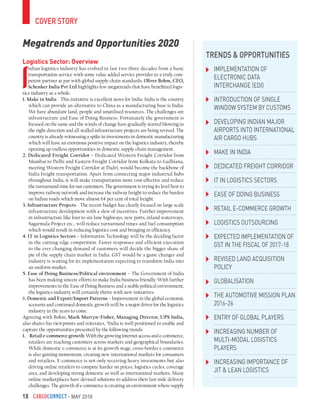
Implementation of
Electronic Data
Interchange (EDI)
Introduction of Single
Window System by customs
Developing Indian major
airports into international
air cargo hubs
Make in India
Dedicated Freight Corridor
IT in Logistics Sectors
Ease of doing business
Retail e-commerce growth
Logistics outsourcing
expected implementation of
GST in the fiscal of 2017-18
Revised Land Acquisition
Policy
Globalisation
The Automotive Mission Plan
2016-26
Entry of global players
Increasing number of
multi-modal logistics
players
Increasing importance of
JIT & Lean Logistics
Trends & Opportunities
cover story
Megatrends and Opportunities 2020
While the logistics sector could be among the primary bottlenecks
in driving economic growth, it will also act as a catalyst to realising
India’s vision to be a manufacturing hub over the next decade.
Opportunities for realising this dream will come from a more
connected global marketplace and economies around the world.
Mark Martyn–Fisher, Managing Director, UPS India
cover story
chains are adapting to new models.
2.	Emerging market growth: Emerging
market opportunities continue to expand.
Over the next 15 years, these markets
will represent nearly three quarters of
global GDP growth and, thus, increasing
proportion of global trade. These markets
are gradually creating new hubs and trade
lanes, creating substantial opportunity
for international service providers. With
increased focus from the global operators,
many emerging markets need to focus
on building stronger infrastructure and
adopting business-friendly policies in order
to foster further growth.
3.	 Logistics outsourcing: Logistics plays a
major role in business strategy. Customers
today want to depend on trustworthy
expertise in solving complex supply chain
challenges. Supply chain management is
thus becoming more prevalent. The 2016
Logistics Market Research Report believes
that the global outsourced logistics market
was valued at over US $760 bn in 2015,
R. Sai Logistics India Advantage
Finished Vehicle Logistics Pan India
The trucks/trailers are installed with global positioning tracking system and
the location of the trucks/trailers are available on our system via the Internet.
Provision for the customer to access this information can be extended.
High levels of Expertise and Experience
On Line Track and Trace 24x7
603, 604, Vipul Trade Center, Gurgaon-Sohna Road, Gurgaon - 122 018, Haryana, India
R. Sai Logistics India Pvt. Ltd.
Tel: 0124-2666080-99, Fax: 0124-2666090, Email: admin@rsailogistics.com
CargoConnect - May 201622
having grown by almost five per cent
in 2015. The growth is primarily driven
by increased economic activity and the
continued trend in outsourcing logistics
activities to third parties.
Meanwhile Vikas Anand, Managing
Director, DHL Supply Chain presents a
different viewpoint. He states, “Demographic
changes and urbanisation can be considered
the most influential megatrend. These trends
will shape countries and businesses as well
as many other industries over the next few
decades. The global population is expected
to increase from 6.9 billion people in 2010 to
8 billion in 2025, with growth found almost
exclusively in developing countries. At the
same time, the population in almost all coun-
tries is aging. The average age in Germany
will rise from 44 in 2010 to 48 in 2025, while
the median age in China will increase from
35 to 40 during the same period (UN 2010).
This megatrend will lead to rising incomes
in the emerging world and rising export op-
portunities for life sciences manufacturers.
This will be accompanied by a growing de-
mand for products and services. Apart from
population growth and aging, mankind will
witness an unprecedented migration from
rural to urban areas.
By 2025, the share of people living in cit-
ies, globally, is expected to increase to 58
per cent from 52 per cent in 2010 (UN 2011).
This shift will have direct consequences for
the supply chain industry. Cities are also
the place for modern lifestyles, which are
at the core of the consumerism megatrend.
This underlines that economic growth in
the emerging world is much faster than in
industrialised countries. At the same time,
we will see a changing competitive landscape
with India and China trying to become more
influential in global trade and politics.”
Expert logistician Samik Chakraborty,
Business Head East, DIESL also explains
the factors which are significant to the
growth of logistics Industry in India:
1. The expected implementation of GST in
the fiscal of 2017-18: Due to consolidation
of many direct and indirect taxes
levied by state/central government, the
manufacturing and trading organisations
may re-look at the present structure
of state based distribution model and
consolidate further. This requires an
alignment of logistics infrastructure and
a complete revamping of distribution
network for service providers. Some
strategic locations may stand-out as
consolidation points for storage, to
support which creation of associate
infrastructure would be required.
2. Revised Land Acquisition Policy: It would
facilitate industrial and commercial
infrastructure development programs
which will act as a catalyst for supply
chain realignment post GST.
3. For consumer products, the growth rate of
rural markets is higher than the saturated
and competitive urban areas. So, service
providers are working on creating a
deep delivery network and last mile
capabilities to reach larger geographies.
From a researcher’s viewpoint, J Sivan,
Senior Consultant, Supply Chain &
Logistics Transformation Practice, Frost
& Sullivan briefly rounds up the key emerg-
ing trends.
•	Globalisation – On one hand, global
supply chain for many companies is
becoming increasingly complex due to
sourcing from different regions. On the
other hand, companies increasingly focus
on core competencies thus opting for
logistics outsourcing. As India becomes
more open to trade and investment,
the need for logistics services increases
proportionately, providing more
opportunities for service providers.
•	 Demography and Demand – India
is expected to reap the benefits of the
demographic dividend–young workforce,
rapidly expanding middle income,
increasing market expansion of many
cover story
The Government of India has been making sincere efforts to make
India business friendly and with further improvements in the Ease
of Doing Business and a stable political environment; the logistics
industry will certainly thrive with new initiatives.
Oliver Bohm, CEO, Schenker India Pvt Ltd
Demographic
changes and
urbanisation
can be
considered the
most influential
megatrend.
CargoConnect - May 201624
products and services such as consumer
durables, education and healthcare. Due
to low penetration levels, India will
remain attractive in the next ten years.
•	Industrialisation and Focus on
Manufacturing – Make in India opens
up new market opportunities for
industrial expansion in both traditional
and hi-tech industries. The Government
reforms are targeted towards removing
restrictions on business environment to
improve Ease of Doing Business which
will make India more attractive for
international investment.
•	Digitalisation – Mobile and internet
penetration has been grow ing
exponentially in recent years, increasing
digital literacy and opening up
opportunities for mobile based business
services such as e-commerce, education
and healthcare. Traditional delivery
models are being transformed to meet
changing expectations of consumers.
•	Trade – Trade policy efforts focus on
increasing exports upto $900 billion by
2020. This will have a direct impact on
transportation and warehousing, as more
than 80 per cent of foreign trade is
done through sea trade.
•	Infrastructure Expansion
– Infrastructure constraints
are a key factor determining
competitiveness. To keep up
with growing demand from
both industrial and consumer/
household demand; energy,
construction and transportation
sectors will continue to be
prioritised, providing a strong
base for logistics-related
infrastructure development.
A ir C ar go S ec tor: Key
Megatrends
Indian air cargo industry has grown con-
siderably in the last few years. With the in-
creased participation and interest of foreign
freight forwarders and international airlines
in India, the cargo share and movement in
India hasn’t seen a downfall.
K S Kunwar, Director General, Air Cargo
Forum India (ACFI) jots down few mega-
trends and opportunities that are certainly
going to benefit the air cargo sector in the
coming years:
1. The implementation of Electronic
Data Interchange (EDI) supported by
digital signature in the processing and
documentation of EXIM trade at gateway
airports by the government agencies
like customs, other ancillary regulatory
agencies and stakeholders of air cargo
logistics trade, will assure that the
required hardware shall be procured and
placed in bring Ease of Doing Business
with paperless transactions, processing
will become faster, inconvenience due
to human interference will be negligible,
and transaction cost in the processing
shall become reasonable. On its full
implementation, the existing bottlenecks
of the users shall be minimised and it will
boost the growth of air cargo.
2. Introduction of Single Window System by
customs for all the stakeholders including
other ancillary regulatory agencies. This
will provide a facility of filing EXIM
documents by importers and exporters
at one point online and transmission of
NOC clearance by all other regulatory
agencies to customs online i.e. paperless.
This will infuse total paperless processing
of international cargo through one access
point and help in fast clearance.
3. Developing Indian major airports into
international air cargo hubs: One of the
key components of any successful world-
class airport is that it works as a hub
in-terms of better flight connectivity,
fastest transit time, simplified procedures
and least interference of regulatory
authorities. Such ingredient could only be
achieved in a cargo village which works
under free zone environment where all
cover story
In the next few years, changes in the world of airfreight in the
form of e-commerce, staff turnover, competition and belly capacity
will be seen and LSPs should be prepared for these biggest
disappointments because of the lack of interest that current supply
chain professionals are showing for training the next generation.
Bharat J Thakkar, Co-Founder & Joint Managing Director,
Zeus Air Services Pvt Ltd
Developing
Indian major
airports into
international
air cargo hubs.
CargoConnect - May 201626
the stakeholders including the regulatory and the
facilitating agencies like airport operators, cargo
terminal operators, airlines and freight forwarders,
integrators are under one Free Zone Authority.
Meanwhile, Anand Yedery, Regional Cargo Manager–
South Asia, Middle East & Africa, Cathay Pacific
Airways focuses on the growing e-commerce and phar-
maceutical industry and says, “E-commerce and pharma
are two key segments that are growing rapidly. Use of
technology and automation in logistics will play a key
role in changing the face of the industry in the coming
years and hence will be a space to watch out for. Oil
prices are expected to stay relatively low for some time,
and thus boosting some increase in air freight volumes
in this region. However, yields are likely to fall further.”
Automotive Sector: Key Megatrends
Sushil Rathi, Chief Operating Officer, Mahindra
Logistics shares latest megatrends and opportunities
that will benefit the Indian automotive sector in the
coming years:
The Automotive Mission Plan 2016-26 (AMP 2026)
AMP is the collective vision of Government of India
and the Indian Automotive Industry
on where the vehicles, auto compo-
nents, and tractor industries should
reach over the next ten years in terms
of size, contribution to India’s devel-
opment, global footprint, technologi-
cal maturity, competitiveness, and
institutional capabilities. AMP 2026
also seeks to define the trajectory of
evolution of the automotive ecosys-
tem in India including the glide path
of specific regulations and policies
that govern research, design, technol-
ogy, testing, manufacturing, import/
export, sale, use, repair, and recycling
of automotive vehicles, components
and services. With this initiative, the
Indian automotive industry is expected
to contribute around 13 per cent to the
national GDP.
‘Make in India’ Campaign
This campaign presents a great op-
portunity for the Indian automotive
logistics sector. There will be a signifi-
cant increase in the movement of capi-
tal goods, raw materials and finished
goods. It will also create a demand for
domestic and international transpor-
tation, warehousing and distribution.
Today, the transaction costs are high
in India. The ‘Make in India’ cam-
paign will encourage usage of technol-
ogy like latest community platforms
which will enable better shipment
visibility and reduce inventory costs.
Administrative costs will go down as
the duplication of data entry will be
eliminated. Technology adoption and
infrastructure development expected
to be brought about by the ‘Make in
India’ campaign will make the Indian
logistics industry globally competitive.
Increased focus on making India
an automotive manufacturing as
well as export hub
The Indian government’s focus on mak-
ing India an automotive manufactur-
ing as well as export hub is drawing
investments and attracting the atten-
tion of automakers from around the
globe. Global MNCs are setting up new
plants and expanding existing ones to
ramp up production in anticipation of
a rise in demand, both in domestic and
export markets. A lot of established
players have also increased their focus
on the export market.
Public-private investments in
transport infrastructure
Transport connectivity within India
is still quite poor. Multiple initiatives
to strengthen the same are in the
process. However, there is a need for
coordination between transport cor-
ridors being promoted to maximise
network integration and provide a
major boost to economic activities.
The PPPs are also expected to improve
the quality of Indian automotive logis-
tics operations through better speed
and connectivity.
Entry of global players
Several global players view the Indian
automotive logistics market favourably
and have announced intentions to in-
crease their capacity of transporting
goods from/to Indian markets. Several
large global logistics companies have
entered India by the way of mergers
cover story
“We can expect a paradigm shift in the quality and scale of logistics
infrastructure due to advent of e-commerce business. GST will also
change the scenario in the logistics sector, creating a huge demand
for Multimodal Logistics Parks and especially rail-connected
Multimodal Logistics Parks.
P Alli Rani, Finance Director, CONCOR
CargoConnect - May 201628
with or acquisitions of Indian logistics com-
panies and joint venture agreements.
Increasing number of multi-modal lo-
gistics players
The demand for multi-modal transport ser-
vices by the end users is increasing, because
it results in the reduction of overall transpor-
tation costs and quicker movement of cargo.
It also requires less documentation. Several
Indian 3PLs have formed joint ventures with
other global and local players so as to provide
multi-modal logistics services extending to
air, rail, road and water.
Increasing importance of JIT & Lean
Logistics
Just-In-Time is the key element in lean logis-
tics. It is a philosophy and a way of work-
ing involving eliminating all forms of waste
(where waste is defined as anything that
does not add value in the production process
and supply chain). JIT is aimed at reducing
waste, maximising cost efficiency, and secur-
ing a competitive advantage in the process.
JIT typically involves small lot sizes, short
set-up and changeover times, efficient and
effective quality controls, and most impor-
tantly, designing the whole production pro-
cess to minimise backups and maximise the
efficiency of human and machine labour.
JIT supports lean manufacturing & logis-
tics by reducing the inventory holding costs
and ensuring visibility and availability of
goods at the right time and place.
M a r i t i m e S e c t o r : K e y
Megatrends
Capt. Atuldutt Sharma, Head of
Operations, Sarjak Container Lines Pvt
Ltd states, “The rapidly growing industrial
sector, coupled with the healthy progress of
the agricultural sector, has led to the rise of
extensive supply chains across the country
to facilitate sourcing and distribution of pro-
duction. The distribution network in India
comprises of multiple level of intermediaries.
Organisations find it increasingly difficult to
work in such an intricate market. This is en-
couraging many LSPs, who are experienced
in complex logistics operations, to enter
and gain a strong foothold in the market.
Moreover, the trend of outsourcing logistic
activities to organised third-party logistics
(3PLs) is finding favour among domestic
companies, as it leaves them free to focus on
their core competencies. Foreign companies
doing business in India prefer to outsource
all their major logistics requirements due
to the unfamiliarity with the local policies,
regulations and market.
He continues, “Logistics companies are
taking to expanding across geographical
boundaries, a trend that is expected to gain
much importance in the years to come. 3PL
is anticipated to increase in future as col-
laborating efficiently and strengthening al-
liances are two factors which are expected
to be looked up in the logistics industry. It is
notable that companies with specialisations
have excelled to a considerable extent in the
logistics sector. However, success of these
companies will be determined based on how
effectively these companies make use of the
opportunities available to them. Studies re-
veal that logistics capability is related to a
firm performance in the market, and is not
affected by logistics outsourcing.
“The transportation sector is evolv-
ing with multimodal transportation solu-
tions being set-up and the development of
inter-modal transportation infrastructure
facilities. Dedicated Freight Corridors by
the railways and improvements in coastal
shipping facilities along with the construc-
tion of massive state-of-the-art logistics
parks at key distribution hubs are helping
cover story
According to a market research data, e-commerce business is
expected to grow to $220 billion by 2025 with a CAGR of 12 per cent.
Based on the requirement of e-commerce business, the service
providers require separate set of capabilities, which is different
from conventional B2B distribution model.
Samik Chakraborty, Business Head East, DIESL
CargoConnect - May 201630
cover story
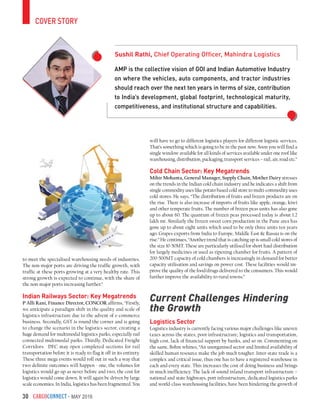
AMP is the collective vision of GOI and Indian Automotive Industry
on where the vehicles, auto components, and tractor industries
should reach over the next ten years in terms of size, contribution
to India’s development, global footprint, technological maturity,
competitiveness, and institutional structure and capabilities.
Sushil Rathi, Chief Operating Officer, Mahindra Logistics
to meet the specialised warehousing needs of industries.
The non-major ports are driving the traffic growth, with
traffic at these ports growing at a very healthy rate. This
strong growth is expected to continue, with the share of
the non-major ports increasing further.”
Indian Railways Sector: Key Megatrends
P Alli Rani, Finance Director, CONCOR affirms, “Firstly,
we anticipate a paradigm shift in the quality and scale of
logistics infrastructure due to the advent of e-commerce
business. Secondly, GST is round the corner and is going
to change the scenario in the logistics sector, creating a
huge demand for multimodal logistics parks, especially rail
connected multimodal parks. Thirdly, Dedicated Freight
Corridors. DFC may open completed sections for rail
transportation before it is ready to flag it off in its entirety.
These three mega events would roll out in such a way that
two definite outcomes will happen - one, the volumes for
logistics would go up as never before and two, the cost for
logistics would come down. It will again be driven by large
scale economies. In India, logistics has been fragmented. You
will have to go to different logistics players for different logistic services.
That’s something which is going to be in the past now. Soon you will find a
single window available for all kinds of services available under one roof like
warehousing, distribution, packaging, transport services – rail, air, road etc.”
Cold Chain Sector: Key Megatrends
Mihir Mohanta, General Manager, Supply Chain, Mother Dairy stresses
on the trends in the Indian cold chain industry and he indicates a shift from
single commodity uses like potato based cold store to multi-commodity uses
cold stores. He says, “The distribution of fruits and frozen products are on
the rise. There is also increase of imports of fruits like apple, orange, kiwi
and other temperate fruits. The number of frozen peas units has also gone
up to about 60. The quantum of frozen peas processed today is about 1.2
lakh mt. Similarly the frozen sweet corn production in the Pune area has
gone up to about eight units which used to be only three units ten years
ago. Grapes exports from India to Europe, Middle East & Russia is on the
rise.” He continues, “Another trend that is catching up is small cold stores of
the size 10-50MT. These are particularly utilised for short haul distribution
for largely medicines or used as ripening chamber for fruits. A pattern of
200-500MT capacity of cold chambers is increasingly in demand for better
capacity utilisation and savings on power cost. These facilities would im-
prove the quality of the food/drugs delivered to the consumers. This would
further improve the availability to rural towns.”
Current Challenges Hindering
the Growth
Logistics Sector
Logistics industry is currently facing various major challenges like uneven
taxes across the states, poor infrastructure, logistics and transportation,
high cost, lack of financial support by banks, and so on. Commenting on
the same, Bohm whines, “An unorganised sector and limited availability of
skilled human resource make the job much tougher. Inter-state trade is a
complex and critical issue, thus one has to have a registered warehouse in
each and every state. This increases the cost of doing business and brings
in much inefficiency. The lack of sound inland transport infrastructure –
national and state highways, port infrastructure, dedicated logistics parks
and world-class warehousing facilities, have been hindering the growth of
CargoConnect - May 201632
cover story
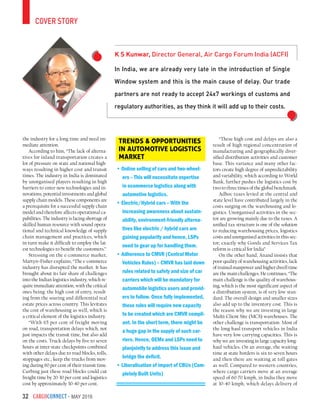
In India, we are already very late in the introduction of Single
Window system and this is the main cause of delay. Our trade
partners are not ready to accept 24x7 workings of customs and
regulatory authorities, as they think it will add up to their costs.
K S Kunwar, Director General, Air Cargo Forum India (ACFI)
the industry for a long time and need im-
mediate attention.
According to him, “The lack of alterna-
tives for inland transportation creates a
lot of pressure on state and national high-
ways resulting in higher cost and transit
times. The industry in India is dominated
by unorganised players resulting in high
barriers to enter new technologies and in-
novations, potential investments and global
supply chain models. These components are
a prerequisite for a successful supply chain
model and therefore affects operational ca-
pabilities. The industry is facing shortage of
skilled human resource with sound opera-
tional and technical knowledge of supply
chain management and practices, which
in-turn make it difficult to employ the lat-
est technologies to benefit the customers.”
Stressing on the e-commerce market,
Martyn–Fisher explains, “The e-commerce
industry has disrupted the market. It has
brought about its fair share of challenges
into the Indian logistics industry, which re-
quire immediate attention, with the critical
ones being: the high cost of entry, result-
ing from the soaring and differential real
estate prices across country. This levitates
the cost of warehousing as well, which is
a critical element of the logistics industry.
“With 65 per cent of freight moving
on road, transportation delays which, not
just impacts the transit time, but also add
on the costs. Truck delays by five to seven
hours at inter-state checkpoints combined
with other delays due to road blocks, tolls,
stoppages etc., keep the trucks from mov-
ing during 60 per cent of their transit time.
Curbing just these road blocks could cut
freight time by 20-30 per cent and logistics
cost by approximately 30-40 per cent.
“These high cost and delays are also a
result of high regional concentration of
manufacturing and geographically diver-
sified distribution activities and customer
base. This variance and many other fac-
tors create high degree of unpredictability
and variability, which according to World
Bank, further pushes the logistics cost by
two to three times of the global benchmark.
Adhoc taxes levied at the central and
state level have contributed largely in the
costs surging on the warehousing and lo-
gistics. Unorganised activities in the sec-
tor are growing mainly due to the taxes. A
unified tax structure is one of the solution
to reducing warehousing prices, logistics
costs and unorganised activities in this sec-
tor; exactly why Goods and Services Tax
reform is critical for India”
On the other hand, Anand insists that
poor quality of warehousing activities, lack
of trained manpower and higher dwell time
are the main challenges. He continues, “The
main challenge is the quality of warehous-
ing, which is the most significant aspect of
a distribution system, is of very low stan-
dard. The overall design and smaller sizes
also add up to the inventory cost. This is
the reason why we are investing in large
Multi-Client Site (MCS) warehouses. The
other challenge is transportation. Most of
the long-haul transport vehicles in India
have very low carrying capacities. This is
why we are investing in large capacity long-
haul vehicles. On an average, the waiting
time at state borders is six to seven hours
and then there are waiting at toll gates
as well. Compared to western countries,
where cargo carriers move at an average
speed of 60-70 kmph, in India they move
at 30-40 kmph, which delays delivery of
• Online selling of cars and two-wheel-
ers – This will necessitate expertise
in ecommerce logistics along with
automotive logistics.
• Electric/Hybrid cars – With the
increasing awareness about sustain-
ability, environment-friendly alterna-
tives like electric / hybrid cars are
gaining popularity and hence, LSPs
need to gear up for handling them.
• Adherence to CMVR (Central Motor
Vehicles Rules) – CMVR has laid down
rules related to safety and size of car
carriers which will be mandatory for
automobile logistics users and provid-
ers to follow. Once fully implemented,
these rules will require new capacity
to be created which are CMVR compli-
ant. In the short term, there might be
a huge gap in the supply of such car-
riers. Hence, OEMs and LSPs need to
planjointly to address this issue and
bridge the deficit.
• Liberalisation of import of CBUs (Com-
pletely Built Units)
Trends & Opportunities
in Automotive Logistics
Market
CargoConnect - May 201634
cover story
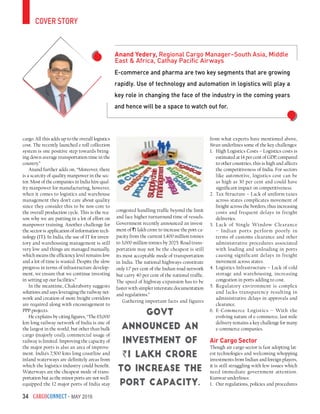
E-commerce and pharma are two key segments that are growing
rapidly. Use of technology and automation in logistics will play a
key role in changing the face of the industry in the coming years
and hence will be a space to watch out for.
Anand Yedery, Regional Cargo Manager–South Asia, Middle
East & Africa, Cathay Pacific Airways
cargo. All this adds up to the overall logistics
cost. The recently launched e-toll collection
system is one positive step towards bring-
ing down average transportation time in the
country.”
Anand further adds on, “Moreover, there
is a scarcity of quality manpower in the sec-
tor. Most of the companies in India hire qual-
ity manpower for manufacturing, however,
when it comes to logistics and warehouse
management they don’t care about quality
since they consider this to be non-core to
the overall production cycle. This is the rea-
son why we are putting in a lot of effort on
manpower training. Another challenge for
the sector is application of information tech-
nology (IT). In India, the use of IT for inven-
tory and warehousing management is still
very low and things are managed manually,
which means the efficiency level remains low
and a lot of time is wasted. Despite the slow
progress in terms of infrastructure develop-
ment, we ensure that we continue investing
in setting up our facilities.”
In the meantime, Chakraborty suggests
solutions and says leveraging the railway net-
work and creation of more freight corridors
are required along with encouragement to
PPP projects.
He explains by citing figures, “The 65,000
km long railway network of India is one of
the largest in the world, but other than bulk
cargo (majorly coal), commercial usage of
railway is limited. Improving the capacity of
the major ports is also an area of improve-
ment. India’s 7,500 kms long coastline and
inland waterways are definitely areas from
which the logistics industry could benefit.
Waterways are the cheapest mode of trans-
portation but as the minor ports are not well-
equipped the 12 major ports of India stay
congested handling traffic beyond the limit
and face higher turnaround time of vessels.
Government recently announced an invest-
ment of `1 lakh crore to increase the port ca-
pacity from the current 1,400 million tonnes
to 3,000 million tonnes by 2025. Road trans-
portation may not be the cheapest is still
its most acceptable mode of transportation
in India. The national highways constitute
only 1.7 per cent of the Indian road network
but carry 40 per cent of the national traffic.
The speed of highway expansion has to be
faster with simpler interstate documentation
and regulations.”
Gathering important facts and figures
from what experts have mentioned above,
Sivan underlines some of the key challenges:
1.	 High Logistics Costs – Logistics costs is
estimated at 14 per cent of GDP, compared
to other countries, this is high and affects
the competitiveness of India. For sectors
like automotive, logistics cost can be
as high as 30 per cent and could have
significant impact on competitiveness.
2.	 Tax Structure – Lack of uniform taxes
across states complicates movement of
freight across the borders, thus increasing
costs and frequent delays in freight
deliveries.
3.	 Lack of Single Window Clearance
– Indian ports perform poorly in
terms of customs clearance and other
administrative procedures associated
with loading and unloading in ports
causing significant delays in freight
movement across states.
4.	 Logistics Infrastructure – Lack of cold
storage and warehousing, increasing
congestion in ports adding to cost.
5.	 Regulatory environment is complex
and lacks transparency resulting in
administrative delays in approvals and
clearance.
6.	E-Commerce Logistics – With the
evolving nature of e-commerce, last mile
delivery remains a key challenge for many
e-commerce companies.
Air Cargo Sector
Though air cargo sector is fast adopting lat-
est technologies and welcoming whopping
investments from Indian and foreign players,
it is still struggling with few issues which
need immediate government attention.
Kunwar underlines:
1.	 Our regulations, policies and procedures
Govt
announced an
investment of
`1 lakh crore
to increase the
port capacity.
CargoConnect - May 201636
cover story
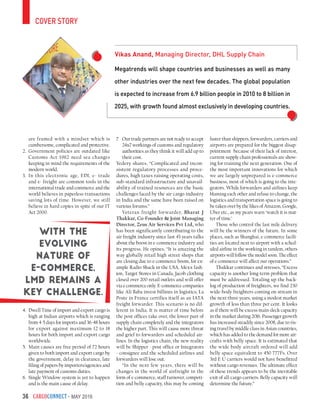
Megatrends will shape countries and businesses as well as many
other industries over the next few decades. The global population
is expected to increase from 6.9 billion people in 2010 to 8 billion in
2025, with growth found almost exclusively in developing countries.
Vikas Anand, Managing Director, DHL Supply Chain
are framed with a mindset which is
cumbersome, complicated and protective.
2.	 Government policies are outdated like
Customs Act 1962 need sea changes
keeping in mind the requirements of the
modern world.
3.	 In this electronic age, EDI, e- trade
and e- freight are common tools in the
international trade and commerce and the
world believes in paperless transactions
saving lots of time. However, we still
believe in hard copies in spite of our IT
Act 2000.
4.	 Dwell Time of import and export cargo is
high at Indian airports which is ranging
from 4-5 days for imports and 36-48 hours
for export against maximum 12 to 18
hours for both import and export cargo
worldwide.
5.	 Main causes are free period of 72 hours
given to both import and export cargo by
the government, delay in clearance, late
filing of papers by importers/agencies and
late payment of customs duties.
6.	 Single Window system is yet to happen
and is the main cause of delay.
7.	 Our trade partners are not ready to accept
24x7 workings of customs and regulatory
authorities as they think it will add up to
their cost.
Yedery shares, “Complicated and incon-
sistent regulatory processes and proce-
dures, high taxes raising operating costs,
sub-standard infrastructure and unavail-
ability of trained resources are the basic
challenges faced by the air cargo industry
in India and the same have been raised on
various forums.”
Veteran freight forwarder, Bharat J
Thakkar, Co-Founder & Joint Managing
Director, Zeus Air Services Pvt Ltd, who
has been significantly contributing to the
air freight industry since last 43 years talks
about the boost in e-commerce industry and
its progress. He opines, “It is amazing the
way globally retail high street shops that
are closing due to e-commerce boom, for ex-
ample Radio Shack in the USA, Mexx fash-
ion, Target Stores in Canada, Jacob clothing
closed over 200 retail outlets and will offer
via e commerce only. E-commerce companies
like Ali Baba invest billions in logistics; La
Poste in France certifies itself as an IATA
freight forwarder. This scenario is no dif-
ferent in India. It is matter of time before
the post offices take over, the lower part of
supply chain completely and the integrators
the higher part. This will cause more threat
and grief to forwarders and scheduled air-
lines. In the logistics chain, the new reality
will be Shipper - post office or Integrators
- consignee and the scheduled airlines and
forwarders will lose out.
“In the next few years, there will be
changes in the world of airfreight in the
form of e-commerce, staff turnover, competi-
tion and belly capacity, this may be coming
faster than shippers, forwarders, carriers and
airports are prepared for the biggest disap-
pointment because of their lack of interest,
current supply chain professionals are show-
ing for training the next generation. One of
the most important innovations for which
we are largely unprepared is e-commerce
business, most of which is going to the inte-
grators. While forwarders and airlines keep
blaming each other and refuse to change, the
logistics and transportation space is going to
be taken over by the likes of Amazon, Google,
Uber etc., as my pears warn ‘watch it is mat-
ter of time.’
Those who control the last mile delivery
will be the winners of the future. In some
places, such as Shanghai, e-commerce facili-
ties are located next to airport with a sched-
uled airline in the working in tandem, others
airports will follow the model soon. The effect
of e-commerce will affect our operations.”
Thakkar continues and stresses, “Excess
capacity is another long-term problem that
must be addressed. Totaling up the back-
log of production of freighters, we find 230
wide-body freighters coming on stream in
the next three years, using a modest market
growth of less than three per cent. It looks
as if there will be excess main-deck capacity
in the market during 2016. Passenger growth
has increased steadily since 2008, due to ris-
ing travel by middle class in Asian countries,
which has added to the demand for more air-
crafts with belly space. It is estimated that
the wide body aircraft ordered will add
belly space equivalent to 450 777Fs. Over
3rd E U carriers would not have benefitted
without cargo revenues. The ultimate effect
of these trends appears to be the inevitable
exit of all-cargo carriers. Belly capacity will
determine the future.”
With the
evolving
nature of
e-commerce,
lMD remains a
key challenge.
CargoConnect - May 201638
cover story
The trend of outsourcing logistics activities to 3PLs is finding favour
among domestic companies, as it leaves them free to focus on their
core competencies. Foreign companies doing business in India
prefer to outsource all their major logistics requirements due to
unfamiliarity with the local policies, regulations and market.
Capt. Atuldutt Sharma, Head of Operations, Sarjak Container
Lines Pvt Ltd
Automotive Sector
Rathi says the key challenges faced by the
automotive industry are in its fragmented
and unorganised nature, insufficient and
inefficient transport infrastructure, trade
regulations and bureaucratic policies, lack
of adequate skilled manpower and training
institutions, poor warehousing and storage
facilities, reluctance to adopt technology, etc.
Rathi states, “Factors that are affecting
the truck transport in India include low
capacity utilisation, poor road quality, ve-
hicle overloading, high transit times, and
issues like road safety and obstacles to free
movement. Truck accidents and fatalities
are dangerously common and frequent.
Enforcement of overloading and licensing
regulations are not being sufficiently done
and there are no incentives for using multi-
axle trucks. Fluctuating fuel prices and high
toll charges increase the running costs of
the trucks. Tyre maintenance is also major
factor in deciding operator profit.
“Over-dependence on roadways as a mode
of transport is another problem faced by the
Indian automotive logistics industry. Lack
of suitable rail infrastructure is also driv-
ing the growth of road freight. Sub-optimal
rail capacity, difficulty in last-mile reach and
commodity-dependent cost economics have
been pushing the share of road from around
60 per cent in 2005–06 (in BTKM units) to
more than 64 per cent in 2009-2010. For in-
stance, when a customer outsources their
transportation requirements to 3PLs like us,
even if we were to look at including railways
as one of the modes of travel, we would end
up using road for point-to-point connectiv-
ity, reducing overall cost efficiency. The first
mile and last mile connectivity, and the in-
frastructure available with railways inclu-
sive of customised wagons etc., are the key
constraint which is why we are not able to
use railways effectively.”
Indian Maritime Sector
Talking about the Indian maritime sector,
Sharma says the key challenges are lack of
human resources followed by infrastructure
in terms of logistics, power, and water.
He reiterates, “Infrastructure is one of the
biggest challenges faced by the Indian lo-
gistics sector and has been a major deter-
rent to its growth. Infrastructural problems
like bad road conditions, poor connectivity,
inadequate air and sea port capacities and
lack of development of modes of transport
like railways and alternates like inland water
transport and domestic aviation have been
constant irritants. Due to the infrastructural
bottlenecks, costs per transaction in Indian
logistics sector, is very high as compared to
those in the developed markets. Less econo-
my of scale due to high fragmentation of in-
dustry, lack of skilled labor and manpower
are also one of the major challenges for the lo-
gistics sector. Indian subcontinent faces dif-
ferent challenges vis-a-vis developed nations.
In foreign countries the problem is demand;
in India, demand management has been a
great challenge. India still has a long way to
go in terms of best practices. Maturity level
of most of the companies on demand driven
value network is low.”
Challenges Faced by Cold Chain
Sector
Mohanta adds, “The distribution of cold
stores in India is skewed. These are largely
concentrated in UP, West Bengal and Punjab.
CargoConnect - May 201640
cover story
Make in India opens up new market opportunities for industrial
expansion in both traditional and hi-tech industries. The
Government reforms are targeted towards removing restrictions
on business environment to improve Ease of Doing Business which
will make India more attractive for international investment.
J Sivan, Senior Consultant, Supply Chain & Logistics
Transformation Practice, Frost & Sullivan
Around 65 per cent of India’s cold chain stor-
age capacity is contributed by the states of
Uttar Pradesh and West Bengal. Further, if
you analyse the commodity wise storage ca-
pacity, you will find that major cold storages
have been set up to cater to single commodi-
ties and this creates a bottleneck for other
perishables. With the rising real estate price,
the cost of setting up a cold storage units is
also rising. In India, the agri-supply chain is
poorly integrated, posing challenges at each
step. There are huge gaps in the system, both
in terms of capacity and integration. Critical
linkages like reefer transport and on farm in-
frastructure are almost non-existent.”
Experts Opine: Solutions & Way
Out
Indian logistics industry definitely has a long
way to go. Be it air cargo sector, maritime
sector, railways or road, significant develop-
ment has been witnessed by the industry as
a whole in the last few years. Though, there’s
progress happening, there are certain issues
as well which hinder the growth of indus-
try like inadequate infrastructure, lack of
trained manpower, GST implementation,
under-utilisation of resources to name a few
however, experts from varied walks of life
suggest some apt solutions to improve the
current situation.
Logistics Sector: Solutions
Bohm figures out, “First, GST implemen-
tation within earliest possible time frame
should address the uneven tax structure
challenge as it will bring the entire country
under a common tax umbrella to enable the
free flow of goods across India. Also, this will
reduce the paperwork and waiting periods
for operators, and will make India a single
market which is easy to access and operate.
Second, from an infrastructure standpoint,
development of roads, state and national
highways will increase the average speed
and reduce fuel consumption, thus saving the
cost of logistics. Port infrastructure should
be upgraded to handle more capacity and
reduce the turnaround time as per global
standards. New dedicated logistics parks,
SEZs and warehousing zones near the tran-
sit area will significantly improve efficiency
and coupled with GST implementation, will
bring huge cost benefits to the logistics in-
dustry and end users.”
Appreciating the recent budget session,
Bohm says, “The recent budget has done a
remarkable job in providing a large scale
boost to infrastructure projects which will
certainly address the above mentioned chal-
lenges and spur growth. Granting indus-
try status to logistics companies will solve
the problem of an unorganised sector since
there will be lot more benefits in terms of
FDI, more favorable policies and incentives
from the governments. Skilled human re-
source problems can be addressed with the
industry-government collaborative efforts by
introducing in-house training centers and
supporting the skill development centers
for logistics.”
On a positive note, Martyn-Fisher says,
“At a macro level, policy reforms, improved
infrastructure, technological advancements
with integrated and enhanced warehouse
and transportation management systems
for more agility and predictability are key
to improve cost effectiveness and develop an
efficient logistical environment. The logistics
industry is in the state of positive transition
with such reforms and changes already in
pipeline. However, such changes are gradual
and long term. Few of them are:
• Internally developed integrated
technologies;
• Leveraging our multimodal and global
network for express, air and ocean
transportation options
• Supporting the customers through a
solution-oriented approach.”
Meanwhile, Anand affirms, “It is important
that private companies take the mantle to in-
vest and change things to make a difference.
In fact, the government has announced several
measures in developing ports, roads and also
in setting up a dedicated rail freight corridor.
This, we believe, will strengthen the scope for
logistics players to further invest in making
India a strong trading hub. A little regulatory
boost would go a long way in helping build
world-class supply chains in India. Delays
which increase cost and lead to the wastage
need to be addressed even more aggressively
by the industry and the regulatory authorities.
Tax breaks, encouragement of FTZs, added
focus on the sector to make it even more or-
GST will bring the
entire country
under a common
tax umbrella to
enable the free
flow of goods
across India.
CargoConnect - May 201642
cover story
Small cold stores of the size 10-50MT are new in India. These are
utilised for short-haul distribution of medicines or used as ripening
chamber for fruits. These facilities would improve the quality of
food/drugs delivered to the consumers. This would further improve
the availability to rural towns.
Mihir Mohanta, General Manager, Supply Chain, Mother Dairy
ganised, development of world class ports,
expressways, e-tolls, single window clearance
etc., are all steps in the right direction. Apart
from the above, developing industry-ready tal-
ent and making logistics an attractive sector
for graduates should be the top agenda of every
logistics player in India. Above all; a workable
GST that could be implemented at the earliest
would provide a solid boost to the logistics in-
dustry and the economy of India.”
Chak raborty a lso sug gests some
imperative solutions:
• More Dedicated Freight Corridors
(DFCs) and coastal corridors could
be created which can be supported by
cargo handling capacity and operations.
This can be achieved by higher level of
privatisation. The road to rail balance in
logistics can help the industry to optimise
the cost. Presently, almost 60 per cent of
the cargo is shipped through road which
should ideally be evenly shared with rail
in next few years.
• The highway expansion plan should be
consolidated and executed faster. The
highways should be well connected with
all the DFC’s.
• Development of state highways and
district roads are important for last
mile deliveries. The road maintenance
contracts should be made for longer
stretches. Again, more private investments
should be encouraged to enable this.
• Backing the service providers with policies
and rebates to create logistics parks with
multimodal transportation facilities.
Observing the same, Sivan, lists down
some solutions for the logistics industry
which may help to bring a change in the
coming years:
1.	 Allocate more funds and encourage
alternate funding options: Lack of
funds is one of the factors affecting
the transportation infrastructure
development which requires huge
investment to improve and modernise
existing infrastructure. Public-
private partnerships for logistics and
infrastructure development are an
important source through which the
government can fast track project
clearance and implementation. For this
to be successful, transparent regulatory
environment and easing of administrative
bottlenecks are critical.
2.	 Reduce Administrative Burden: 24*7
availability of services and facilities
including customs clearance is important
for quick processing and clearance
of export and import cargo. Process
simplification needs to be addressed
to reduce transaction costs. Greater
accountability and transparency by
the regulating agencies and paperless
clearance process is expected to reduce
the speed of customs clearance.
3.	 Land Transport: The government expects
the freight tons per kilometre to grow 6.5
times between 2012 and 2032. To meet
this target, road transport congestions
and modernisation related projects should
be given priority to increase efficiency,
reduce cost, and upgrade tolling stations.
Rail freight has been losing share in land
transportation. By offering competitive
freight rates and providing supportive
infrastructure, share of rail in freight
transportation can be increased.
4.	 Port Congestion: Steps need to be taken
to improve dwell time, policy changes
should be oriented towards making free
movement of goods through any port,
traffic restrictions need to be relaxed for
prioritised consignments, technologies
need to be upgraded and aligned with
international ports.
5.	 Air Transport: Increase in dedicated cargo
terminals in major airports, increased
number of air freight stations, adoption
and implementation of the IATA initiative
of paperless for the air cargo supply chain
etc., to reduce delays.
Air cargo sector: Solutions
Kunwar shares some significant solutions for
the air cargo sector:
a) Remove free period of 72 hours for both
May 2016 - CargoConnect 43
import and export cargo and give
maximum 12 hours.
b) Bring drastic changes in the Customs Act
1962 as per the requirement of the time.
c) Make the AEO policy attractive and
beneficial to the trade.
d) Make customs RMS more attractive. The
withdrawal/suspension of RMS to be
affected only when the violations/defaults
are proved and penal actions are initiated.
e) Trained staff of customs and other
regulatory authorities to be posted
for 24x7 operations for both imports
and exports.
f) Amendment procedures in import for
part-shipment/short landing to be made
online with decentralised delegation of
powers so that advance filing of Bills of
Entry is encouraged.
g) Known shipper and regulated agents’
policy of BCAS to be made more simplified
and attractive so that there are takers for
this concept and the movement of export
cargo becomes faster and cost effective.
Focusing on the air cargo sector being award-
ed ‘Industry Status’ Yedery insists, “Air Cargo
being accorded ‘Infrastructure’ status as per
the Draft National Civil Aviation Policy 2015
means a positive step forward once the policy
is formally passed and implemented. A lot of
investment in the form of time, expertise, au-
tomation and money along with patience will
be the key to overcome the challenges.”
Railways Sector: Solutions
Rani avows, “We are one of the front runners
here as we have already acquired adequate
land where we are setting up large scale
Multimodal Logistics Parks to provide a
one stop solution for all kinds of logistics ser-
vices. The first stage is getting the land and
setting up infrastructure. The state govern-
ments have been very supportive. Firstly, we
have to create suitable state-of-art infrastruc-
ture which involves huge investment. We
have taken major steps and completed few
LPs. Now we are in talks with our custom-
ers to ensure what we are making ultimately
suits the requirements of customers. We have
to tailor our infrastructure according to
the needs and requirements of the custom-
ers like specialised processing, packaging,
warehousing etc.”
Automotive Sector: Solutions
Rathi highlights some solutions:
1.	 3PLs who provide end-to-end integrated
supply chain solutions can change the
fragmented and unorganised nature of
the Indian logistics industry.
2.	Government initiatives for trade
liberalisation and logistics infrastructure
development as mentioned earlier are also
expected to resolve the issues related to trade
bureaucracy and infrastructural bottlenecks.
3.	Phasing out of old commercial
vehicles will not only reduce pollution
but also smoothen out transport
operations in India.
4.	 Focus on development of transporters and
drivers are another important solution
which will go a long way in ensuring the real
growth of the Indian automotive industry.
Maritime Sector: Solutions
Sharma suggests few imperative solu-
tions for the problems faced by Indian
Shipping industry:
He says, “The transportation market in
India is expected to continue offering signif-
icant opportunities to all concerned stake-
holders. However, for the sector to reach its
full potential, the timing and economics
would depend on how the various drivers and
inhibitors evolve in future. While the qual-
ity of road infrastructure is certainly likely
to improve, the pace of infrastructure devel-
opment is critical to minimise losses, both
economic and environmental. In particular,
delays in meeting project timelines should be
minimised, given that only around 52 per cent
(10.39 km as against the target 20 km in 2011–
12) of the daily target of average road length
to be constructed has been met. However, not
only has the demand for road connectivity
been rising, but focus on improving basic road
infrastructure as well as technology adoption
has also increased in recent years. The number
of expressways and highways has increased;
many roads have been widened; electronic toll
collection is becoming increasingly common;
the ‘green channel’ concept is gaining ground,
and inter-state check posts are becoming au-
tomated, with Gujarat serving as an example.”
Cold Chain Sector: Solutions
Mohanta suggests, “Stringent implementa-
tion of Food Safety (FSSAI) regulations is
indirectly forcing food companies to rede-
fine their cold supply chain strategy. What
India needs is the spread of the cold chain
facilities, cold chain/ transport linkages and
retail level cold chain dispensing mechanism.
Smaller units with low capital intensive and
energy efficient storage would be more ap-
propriate. These would improve capacity
utilisation and can become viable. Use of so-
lar energy is another area which could play a
big role in promoting low cost cold chain.”
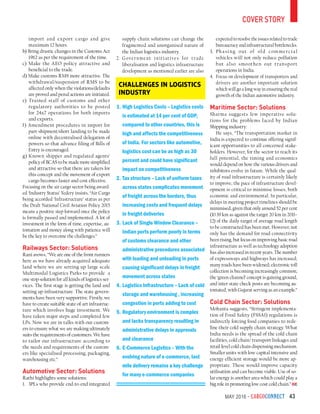
1.	High Logistics Costs – Logistics costs
is estimated at 14 per cent of GDP,
compared to other countries, this is
high and affects the competitiveness
of India. For sectors like automotive,
logistics cost can be as high as 30
percent and could have significant
impact on competitiveness
2.	Tax structure – Lack of uniform taxes
across states complicates movement
of freight across the borders, thus
increasing costs and frequent delays
in freight deliveries
3.	Lack of Single Window Clearance –
Indian ports perform poorly in terms
of customs clearance and other
administrative procedures associated
with loading and unloading in ports
causing significant delays in freight
movement across states
4.	Logistics Infrastructure – Lack of cold
storage and warehousing , increasing
congestion in ports adding to cost
5.	Regulatory environment is complex
and lacks transparency resulting in
administrative delays in approvals
and clearance
6.	E-Commerce Logistics – With the
evolving nature of e-commerce, last
mile delivery remains a key challenge
for many e-commerce companies
Challenges in Logistics
Industry
cover story

CARGO MAY-2016 Cover Story

  • 1.
    CargoConnect - May201616 cover story CargoConnect - may 201616 Roadmap for Logistics Megatrends & Opportunities
  • 2.
    May 2016 -CargoConnect 17 cover story may 2016 - CargoConnect 17 Indian Logistics Industry has witnessed an exponential growth in the last few years. If we go by the statistics, the logistics market in India is expected to be worth US$ 301.89 billion by 2020. Key initiatives like government’s ‘Make in India’ campaign, DFC, boost in e-commerce Industry, increasing number of multi-modal logistics players, development of inland waterways etc., have led to this significant growth. Ritika Arora Bhola, with the help of experts jots down key megatrends and opportunities in logistics and related sectors
  • 3.
    CargoConnect - May201618 Logistics Sector: Overview I ndian logistics industry has evolved in last two three decades from a basic transportation service with some value-added service provider to a truly com- petent partner at par with global supply chain standards. Oliver Bohm, CEO, Schenker India Pvt Ltd highlights few megatrends that have benefitted logis- tics industry as a whole. 1. Make in India - This initiative is excellent news for India. India is the country which can provide an alternative to China as a manufacturing base is India. We have abundant land, people and unutilised resources. The challenges are infrastructure and Ease of Doing Business. Fortunately the government is focused on the same and the winds of change have gradually started blowing in the right direction and all stalled infrastructure projects are being revived. The country is already witnessing a spike in investments in domestic manufacturing which will have an enormous positive impact on the logistics industry, thereby opening up endless opportunities in domestic supply chain management. 2. Dedicated Freight Corridor – Dedicated Western Freight Corridor from Mumbai to Delhi and Eastern Freight Corridor from Kolkata to Ludhiana, meeting Western Freight Corridor at Dadri, would become the backbone of India freight transportation. Apart from connecting major industrial hubs throughout India, it will make transportation more cost-effective and reduce the turnaround time for our customers. The government is trying its level best to improve railway network and increase the railway freight to reduce the burden on Indian roads which move almost 64 per cent of total freight. 3. Infrastructure Projects - The recent budget has clearly focused on large scale infrastructure development with a slew of incentives. Further improvement in infrastructure like four to six lane highways, new ports, inland waterways, Sagarmala Project etc., will reduce turnaround times and fuel consumption which would result in reducing logistics cost and bringing in efficiency. 4. IT in Logistics Sectors – Information Technology will be the deciding factor in the cutting-edge competition. Faster responses and efficient execution to the ever changing demand of customers will decide the bigger share of pie of the supply chain market in India. GST would be a game changer and industry is waiting for its implementation expecting to transform India into an uniform market. 5. Ease of Doing Business/Political environment – The Government of India has been making sincere efforts to make India business friendly. With further improvements in the Ease of Doing Business and a stable political environment; the logistics industry will certainly thrive with new initiatives. 6. Domestic and Export/Import Patterns – Improvement in the global economic scenario and continued domestic growth will be a major driver for the logistics industry in the years to come. Agreeing with Bohm, Mark Martyn–Fisher, Managing Director, UPS India, also shares his viewpoints and reiterates, “India is well-positioned to enable and capture the opportunities presented by the following trends: 1. Retail e-commerce growth: With the growing internet access and e-commerce, retailers are reaching customers across markets and geographical boundaries. While domestic e-commerce is at its growth stage, cross-border e-commerce is also gaining momentum, creating new international markets for consumers and retailers. E-commerce is not only receiving heavy investments but also driving online retailers to compete harder on prices, logistics cycles, coverage area, and developing strong domestic as well as international markets. Many online marketplaces have devised solutions to address their last mile delivery challenges. The growth of e-commerce is creating an environment where supply Implementation of Electronic Data Interchange (EDI) Introduction of Single Window System by customs Developing Indian major airports into international air cargo hubs Make in India Dedicated Freight Corridor IT in Logistics Sectors Ease of doing business Retail e-commerce growth Logistics outsourcing expected implementation of GST in the fiscal of 2017-18 Revised Land Acquisition Policy Globalisation The Automotive Mission Plan 2016-26 Entry of global players Increasing number of multi-modal logistics players Increasing importance of JIT & Lean Logistics Trends & Opportunities cover story Megatrends and Opportunities 2020
  • 4.
    While the logisticssector could be among the primary bottlenecks in driving economic growth, it will also act as a catalyst to realising India’s vision to be a manufacturing hub over the next decade. Opportunities for realising this dream will come from a more connected global marketplace and economies around the world. Mark Martyn–Fisher, Managing Director, UPS India cover story chains are adapting to new models. 2. Emerging market growth: Emerging market opportunities continue to expand. Over the next 15 years, these markets will represent nearly three quarters of global GDP growth and, thus, increasing proportion of global trade. These markets are gradually creating new hubs and trade lanes, creating substantial opportunity for international service providers. With increased focus from the global operators, many emerging markets need to focus on building stronger infrastructure and adopting business-friendly policies in order to foster further growth. 3. Logistics outsourcing: Logistics plays a major role in business strategy. Customers today want to depend on trustworthy expertise in solving complex supply chain challenges. Supply chain management is thus becoming more prevalent. The 2016 Logistics Market Research Report believes that the global outsourced logistics market was valued at over US $760 bn in 2015, R. Sai Logistics India Advantage Finished Vehicle Logistics Pan India The trucks/trailers are installed with global positioning tracking system and the location of the trucks/trailers are available on our system via the Internet. Provision for the customer to access this information can be extended. High levels of Expertise and Experience On Line Track and Trace 24x7 603, 604, Vipul Trade Center, Gurgaon-Sohna Road, Gurgaon - 122 018, Haryana, India R. Sai Logistics India Pvt. Ltd. Tel: 0124-2666080-99, Fax: 0124-2666090, Email: admin@rsailogistics.com
  • 5.
    CargoConnect - May201622 having grown by almost five per cent in 2015. The growth is primarily driven by increased economic activity and the continued trend in outsourcing logistics activities to third parties. Meanwhile Vikas Anand, Managing Director, DHL Supply Chain presents a different viewpoint. He states, “Demographic changes and urbanisation can be considered the most influential megatrend. These trends will shape countries and businesses as well as many other industries over the next few decades. The global population is expected to increase from 6.9 billion people in 2010 to 8 billion in 2025, with growth found almost exclusively in developing countries. At the same time, the population in almost all coun- tries is aging. The average age in Germany will rise from 44 in 2010 to 48 in 2025, while the median age in China will increase from 35 to 40 during the same period (UN 2010). This megatrend will lead to rising incomes in the emerging world and rising export op- portunities for life sciences manufacturers. This will be accompanied by a growing de- mand for products and services. Apart from population growth and aging, mankind will witness an unprecedented migration from rural to urban areas. By 2025, the share of people living in cit- ies, globally, is expected to increase to 58 per cent from 52 per cent in 2010 (UN 2011). This shift will have direct consequences for the supply chain industry. Cities are also the place for modern lifestyles, which are at the core of the consumerism megatrend. This underlines that economic growth in the emerging world is much faster than in industrialised countries. At the same time, we will see a changing competitive landscape with India and China trying to become more influential in global trade and politics.” Expert logistician Samik Chakraborty, Business Head East, DIESL also explains the factors which are significant to the growth of logistics Industry in India: 1. The expected implementation of GST in the fiscal of 2017-18: Due to consolidation of many direct and indirect taxes levied by state/central government, the manufacturing and trading organisations may re-look at the present structure of state based distribution model and consolidate further. This requires an alignment of logistics infrastructure and a complete revamping of distribution network for service providers. Some strategic locations may stand-out as consolidation points for storage, to support which creation of associate infrastructure would be required. 2. Revised Land Acquisition Policy: It would facilitate industrial and commercial infrastructure development programs which will act as a catalyst for supply chain realignment post GST. 3. For consumer products, the growth rate of rural markets is higher than the saturated and competitive urban areas. So, service providers are working on creating a deep delivery network and last mile capabilities to reach larger geographies. From a researcher’s viewpoint, J Sivan, Senior Consultant, Supply Chain & Logistics Transformation Practice, Frost & Sullivan briefly rounds up the key emerg- ing trends. • Globalisation – On one hand, global supply chain for many companies is becoming increasingly complex due to sourcing from different regions. On the other hand, companies increasingly focus on core competencies thus opting for logistics outsourcing. As India becomes more open to trade and investment, the need for logistics services increases proportionately, providing more opportunities for service providers. • Demography and Demand – India is expected to reap the benefits of the demographic dividend–young workforce, rapidly expanding middle income, increasing market expansion of many cover story The Government of India has been making sincere efforts to make India business friendly and with further improvements in the Ease of Doing Business and a stable political environment; the logistics industry will certainly thrive with new initiatives. Oliver Bohm, CEO, Schenker India Pvt Ltd Demographic changes and urbanisation can be considered the most influential megatrend.
  • 6.
    CargoConnect - May201624 products and services such as consumer durables, education and healthcare. Due to low penetration levels, India will remain attractive in the next ten years. • Industrialisation and Focus on Manufacturing – Make in India opens up new market opportunities for industrial expansion in both traditional and hi-tech industries. The Government reforms are targeted towards removing restrictions on business environment to improve Ease of Doing Business which will make India more attractive for international investment. • Digitalisation – Mobile and internet penetration has been grow ing exponentially in recent years, increasing digital literacy and opening up opportunities for mobile based business services such as e-commerce, education and healthcare. Traditional delivery models are being transformed to meet changing expectations of consumers. • Trade – Trade policy efforts focus on increasing exports upto $900 billion by 2020. This will have a direct impact on transportation and warehousing, as more than 80 per cent of foreign trade is done through sea trade. • Infrastructure Expansion – Infrastructure constraints are a key factor determining competitiveness. To keep up with growing demand from both industrial and consumer/ household demand; energy, construction and transportation sectors will continue to be prioritised, providing a strong base for logistics-related infrastructure development. A ir C ar go S ec tor: Key Megatrends Indian air cargo industry has grown con- siderably in the last few years. With the in- creased participation and interest of foreign freight forwarders and international airlines in India, the cargo share and movement in India hasn’t seen a downfall. K S Kunwar, Director General, Air Cargo Forum India (ACFI) jots down few mega- trends and opportunities that are certainly going to benefit the air cargo sector in the coming years: 1. The implementation of Electronic Data Interchange (EDI) supported by digital signature in the processing and documentation of EXIM trade at gateway airports by the government agencies like customs, other ancillary regulatory agencies and stakeholders of air cargo logistics trade, will assure that the required hardware shall be procured and placed in bring Ease of Doing Business with paperless transactions, processing will become faster, inconvenience due to human interference will be negligible, and transaction cost in the processing shall become reasonable. On its full implementation, the existing bottlenecks of the users shall be minimised and it will boost the growth of air cargo. 2. Introduction of Single Window System by customs for all the stakeholders including other ancillary regulatory agencies. This will provide a facility of filing EXIM documents by importers and exporters at one point online and transmission of NOC clearance by all other regulatory agencies to customs online i.e. paperless. This will infuse total paperless processing of international cargo through one access point and help in fast clearance. 3. Developing Indian major airports into international air cargo hubs: One of the key components of any successful world- class airport is that it works as a hub in-terms of better flight connectivity, fastest transit time, simplified procedures and least interference of regulatory authorities. Such ingredient could only be achieved in a cargo village which works under free zone environment where all cover story In the next few years, changes in the world of airfreight in the form of e-commerce, staff turnover, competition and belly capacity will be seen and LSPs should be prepared for these biggest disappointments because of the lack of interest that current supply chain professionals are showing for training the next generation. Bharat J Thakkar, Co-Founder & Joint Managing Director, Zeus Air Services Pvt Ltd Developing Indian major airports into international air cargo hubs.
  • 7.
    CargoConnect - May201626 the stakeholders including the regulatory and the facilitating agencies like airport operators, cargo terminal operators, airlines and freight forwarders, integrators are under one Free Zone Authority. Meanwhile, Anand Yedery, Regional Cargo Manager– South Asia, Middle East & Africa, Cathay Pacific Airways focuses on the growing e-commerce and phar- maceutical industry and says, “E-commerce and pharma are two key segments that are growing rapidly. Use of technology and automation in logistics will play a key role in changing the face of the industry in the coming years and hence will be a space to watch out for. Oil prices are expected to stay relatively low for some time, and thus boosting some increase in air freight volumes in this region. However, yields are likely to fall further.” Automotive Sector: Key Megatrends Sushil Rathi, Chief Operating Officer, Mahindra Logistics shares latest megatrends and opportunities that will benefit the Indian automotive sector in the coming years: The Automotive Mission Plan 2016-26 (AMP 2026) AMP is the collective vision of Government of India and the Indian Automotive Industry on where the vehicles, auto compo- nents, and tractor industries should reach over the next ten years in terms of size, contribution to India’s devel- opment, global footprint, technologi- cal maturity, competitiveness, and institutional capabilities. AMP 2026 also seeks to define the trajectory of evolution of the automotive ecosys- tem in India including the glide path of specific regulations and policies that govern research, design, technol- ogy, testing, manufacturing, import/ export, sale, use, repair, and recycling of automotive vehicles, components and services. With this initiative, the Indian automotive industry is expected to contribute around 13 per cent to the national GDP. ‘Make in India’ Campaign This campaign presents a great op- portunity for the Indian automotive logistics sector. There will be a signifi- cant increase in the movement of capi- tal goods, raw materials and finished goods. It will also create a demand for domestic and international transpor- tation, warehousing and distribution. Today, the transaction costs are high in India. The ‘Make in India’ cam- paign will encourage usage of technol- ogy like latest community platforms which will enable better shipment visibility and reduce inventory costs. Administrative costs will go down as the duplication of data entry will be eliminated. Technology adoption and infrastructure development expected to be brought about by the ‘Make in India’ campaign will make the Indian logistics industry globally competitive. Increased focus on making India an automotive manufacturing as well as export hub The Indian government’s focus on mak- ing India an automotive manufactur- ing as well as export hub is drawing investments and attracting the atten- tion of automakers from around the globe. Global MNCs are setting up new plants and expanding existing ones to ramp up production in anticipation of a rise in demand, both in domestic and export markets. A lot of established players have also increased their focus on the export market. Public-private investments in transport infrastructure Transport connectivity within India is still quite poor. Multiple initiatives to strengthen the same are in the process. However, there is a need for coordination between transport cor- ridors being promoted to maximise network integration and provide a major boost to economic activities. The PPPs are also expected to improve the quality of Indian automotive logis- tics operations through better speed and connectivity. Entry of global players Several global players view the Indian automotive logistics market favourably and have announced intentions to in- crease their capacity of transporting goods from/to Indian markets. Several large global logistics companies have entered India by the way of mergers cover story “We can expect a paradigm shift in the quality and scale of logistics infrastructure due to advent of e-commerce business. GST will also change the scenario in the logistics sector, creating a huge demand for Multimodal Logistics Parks and especially rail-connected Multimodal Logistics Parks. P Alli Rani, Finance Director, CONCOR
  • 8.
    CargoConnect - May201628 with or acquisitions of Indian logistics com- panies and joint venture agreements. Increasing number of multi-modal lo- gistics players The demand for multi-modal transport ser- vices by the end users is increasing, because it results in the reduction of overall transpor- tation costs and quicker movement of cargo. It also requires less documentation. Several Indian 3PLs have formed joint ventures with other global and local players so as to provide multi-modal logistics services extending to air, rail, road and water. Increasing importance of JIT & Lean Logistics Just-In-Time is the key element in lean logis- tics. It is a philosophy and a way of work- ing involving eliminating all forms of waste (where waste is defined as anything that does not add value in the production process and supply chain). JIT is aimed at reducing waste, maximising cost efficiency, and secur- ing a competitive advantage in the process. JIT typically involves small lot sizes, short set-up and changeover times, efficient and effective quality controls, and most impor- tantly, designing the whole production pro- cess to minimise backups and maximise the efficiency of human and machine labour. JIT supports lean manufacturing & logis- tics by reducing the inventory holding costs and ensuring visibility and availability of goods at the right time and place. M a r i t i m e S e c t o r : K e y Megatrends Capt. Atuldutt Sharma, Head of Operations, Sarjak Container Lines Pvt Ltd states, “The rapidly growing industrial sector, coupled with the healthy progress of the agricultural sector, has led to the rise of extensive supply chains across the country to facilitate sourcing and distribution of pro- duction. The distribution network in India comprises of multiple level of intermediaries. Organisations find it increasingly difficult to work in such an intricate market. This is en- couraging many LSPs, who are experienced in complex logistics operations, to enter and gain a strong foothold in the market. Moreover, the trend of outsourcing logistic activities to organised third-party logistics (3PLs) is finding favour among domestic companies, as it leaves them free to focus on their core competencies. Foreign companies doing business in India prefer to outsource all their major logistics requirements due to the unfamiliarity with the local policies, regulations and market. He continues, “Logistics companies are taking to expanding across geographical boundaries, a trend that is expected to gain much importance in the years to come. 3PL is anticipated to increase in future as col- laborating efficiently and strengthening al- liances are two factors which are expected to be looked up in the logistics industry. It is notable that companies with specialisations have excelled to a considerable extent in the logistics sector. However, success of these companies will be determined based on how effectively these companies make use of the opportunities available to them. Studies re- veal that logistics capability is related to a firm performance in the market, and is not affected by logistics outsourcing. “The transportation sector is evolv- ing with multimodal transportation solu- tions being set-up and the development of inter-modal transportation infrastructure facilities. Dedicated Freight Corridors by the railways and improvements in coastal shipping facilities along with the construc- tion of massive state-of-the-art logistics parks at key distribution hubs are helping cover story According to a market research data, e-commerce business is expected to grow to $220 billion by 2025 with a CAGR of 12 per cent. Based on the requirement of e-commerce business, the service providers require separate set of capabilities, which is different from conventional B2B distribution model. Samik Chakraborty, Business Head East, DIESL
  • 9.
    CargoConnect - May201630 cover story AMP is the collective vision of GOI and Indian Automotive Industry on where the vehicles, auto components, and tractor industries should reach over the next ten years in terms of size, contribution to India’s development, global footprint, technological maturity, competitiveness, and institutional structure and capabilities. Sushil Rathi, Chief Operating Officer, Mahindra Logistics to meet the specialised warehousing needs of industries. The non-major ports are driving the traffic growth, with traffic at these ports growing at a very healthy rate. This strong growth is expected to continue, with the share of the non-major ports increasing further.” Indian Railways Sector: Key Megatrends P Alli Rani, Finance Director, CONCOR affirms, “Firstly, we anticipate a paradigm shift in the quality and scale of logistics infrastructure due to the advent of e-commerce business. Secondly, GST is round the corner and is going to change the scenario in the logistics sector, creating a huge demand for multimodal logistics parks, especially rail connected multimodal parks. Thirdly, Dedicated Freight Corridors. DFC may open completed sections for rail transportation before it is ready to flag it off in its entirety. These three mega events would roll out in such a way that two definite outcomes will happen - one, the volumes for logistics would go up as never before and two, the cost for logistics would come down. It will again be driven by large scale economies. In India, logistics has been fragmented. You will have to go to different logistics players for different logistic services. That’s something which is going to be in the past now. Soon you will find a single window available for all kinds of services available under one roof like warehousing, distribution, packaging, transport services – rail, air, road etc.” Cold Chain Sector: Key Megatrends Mihir Mohanta, General Manager, Supply Chain, Mother Dairy stresses on the trends in the Indian cold chain industry and he indicates a shift from single commodity uses like potato based cold store to multi-commodity uses cold stores. He says, “The distribution of fruits and frozen products are on the rise. There is also increase of imports of fruits like apple, orange, kiwi and other temperate fruits. The number of frozen peas units has also gone up to about 60. The quantum of frozen peas processed today is about 1.2 lakh mt. Similarly the frozen sweet corn production in the Pune area has gone up to about eight units which used to be only three units ten years ago. Grapes exports from India to Europe, Middle East & Russia is on the rise.” He continues, “Another trend that is catching up is small cold stores of the size 10-50MT. These are particularly utilised for short haul distribution for largely medicines or used as ripening chamber for fruits. A pattern of 200-500MT capacity of cold chambers is increasingly in demand for better capacity utilisation and savings on power cost. These facilities would im- prove the quality of the food/drugs delivered to the consumers. This would further improve the availability to rural towns.” Current Challenges Hindering the Growth Logistics Sector Logistics industry is currently facing various major challenges like uneven taxes across the states, poor infrastructure, logistics and transportation, high cost, lack of financial support by banks, and so on. Commenting on the same, Bohm whines, “An unorganised sector and limited availability of skilled human resource make the job much tougher. Inter-state trade is a complex and critical issue, thus one has to have a registered warehouse in each and every state. This increases the cost of doing business and brings in much inefficiency. The lack of sound inland transport infrastructure – national and state highways, port infrastructure, dedicated logistics parks and world-class warehousing facilities, have been hindering the growth of
  • 10.
    CargoConnect - May201632 cover story In India, we are already very late in the introduction of Single Window system and this is the main cause of delay. Our trade partners are not ready to accept 24x7 workings of customs and regulatory authorities, as they think it will add up to their costs. K S Kunwar, Director General, Air Cargo Forum India (ACFI) the industry for a long time and need im- mediate attention. According to him, “The lack of alterna- tives for inland transportation creates a lot of pressure on state and national high- ways resulting in higher cost and transit times. The industry in India is dominated by unorganised players resulting in high barriers to enter new technologies and in- novations, potential investments and global supply chain models. These components are a prerequisite for a successful supply chain model and therefore affects operational ca- pabilities. The industry is facing shortage of skilled human resource with sound opera- tional and technical knowledge of supply chain management and practices, which in-turn make it difficult to employ the lat- est technologies to benefit the customers.” Stressing on the e-commerce market, Martyn–Fisher explains, “The e-commerce industry has disrupted the market. It has brought about its fair share of challenges into the Indian logistics industry, which re- quire immediate attention, with the critical ones being: the high cost of entry, result- ing from the soaring and differential real estate prices across country. This levitates the cost of warehousing as well, which is a critical element of the logistics industry. “With 65 per cent of freight moving on road, transportation delays which, not just impacts the transit time, but also add on the costs. Truck delays by five to seven hours at inter-state checkpoints combined with other delays due to road blocks, tolls, stoppages etc., keep the trucks from mov- ing during 60 per cent of their transit time. Curbing just these road blocks could cut freight time by 20-30 per cent and logistics cost by approximately 30-40 per cent. “These high cost and delays are also a result of high regional concentration of manufacturing and geographically diver- sified distribution activities and customer base. This variance and many other fac- tors create high degree of unpredictability and variability, which according to World Bank, further pushes the logistics cost by two to three times of the global benchmark. Adhoc taxes levied at the central and state level have contributed largely in the costs surging on the warehousing and lo- gistics. Unorganised activities in the sec- tor are growing mainly due to the taxes. A unified tax structure is one of the solution to reducing warehousing prices, logistics costs and unorganised activities in this sec- tor; exactly why Goods and Services Tax reform is critical for India” On the other hand, Anand insists that poor quality of warehousing activities, lack of trained manpower and higher dwell time are the main challenges. He continues, “The main challenge is the quality of warehous- ing, which is the most significant aspect of a distribution system, is of very low stan- dard. The overall design and smaller sizes also add up to the inventory cost. This is the reason why we are investing in large Multi-Client Site (MCS) warehouses. The other challenge is transportation. Most of the long-haul transport vehicles in India have very low carrying capacities. This is why we are investing in large capacity long- haul vehicles. On an average, the waiting time at state borders is six to seven hours and then there are waiting at toll gates as well. Compared to western countries, where cargo carriers move at an average speed of 60-70 kmph, in India they move at 30-40 kmph, which delays delivery of • Online selling of cars and two-wheel- ers – This will necessitate expertise in ecommerce logistics along with automotive logistics. • Electric/Hybrid cars – With the increasing awareness about sustain- ability, environment-friendly alterna- tives like electric / hybrid cars are gaining popularity and hence, LSPs need to gear up for handling them. • Adherence to CMVR (Central Motor Vehicles Rules) – CMVR has laid down rules related to safety and size of car carriers which will be mandatory for automobile logistics users and provid- ers to follow. Once fully implemented, these rules will require new capacity to be created which are CMVR compli- ant. In the short term, there might be a huge gap in the supply of such car- riers. Hence, OEMs and LSPs need to planjointly to address this issue and bridge the deficit. • Liberalisation of import of CBUs (Com- pletely Built Units) Trends & Opportunities in Automotive Logistics Market
  • 11.
    CargoConnect - May201634 cover story E-commerce and pharma are two key segments that are growing rapidly. Use of technology and automation in logistics will play a key role in changing the face of the industry in the coming years and hence will be a space to watch out for. Anand Yedery, Regional Cargo Manager–South Asia, Middle East & Africa, Cathay Pacific Airways cargo. All this adds up to the overall logistics cost. The recently launched e-toll collection system is one positive step towards bring- ing down average transportation time in the country.” Anand further adds on, “Moreover, there is a scarcity of quality manpower in the sec- tor. Most of the companies in India hire qual- ity manpower for manufacturing, however, when it comes to logistics and warehouse management they don’t care about quality since they consider this to be non-core to the overall production cycle. This is the rea- son why we are putting in a lot of effort on manpower training. Another challenge for the sector is application of information tech- nology (IT). In India, the use of IT for inven- tory and warehousing management is still very low and things are managed manually, which means the efficiency level remains low and a lot of time is wasted. Despite the slow progress in terms of infrastructure develop- ment, we ensure that we continue investing in setting up our facilities.” In the meantime, Chakraborty suggests solutions and says leveraging the railway net- work and creation of more freight corridors are required along with encouragement to PPP projects. He explains by citing figures, “The 65,000 km long railway network of India is one of the largest in the world, but other than bulk cargo (majorly coal), commercial usage of railway is limited. Improving the capacity of the major ports is also an area of improve- ment. India’s 7,500 kms long coastline and inland waterways are definitely areas from which the logistics industry could benefit. Waterways are the cheapest mode of trans- portation but as the minor ports are not well- equipped the 12 major ports of India stay congested handling traffic beyond the limit and face higher turnaround time of vessels. Government recently announced an invest- ment of `1 lakh crore to increase the port ca- pacity from the current 1,400 million tonnes to 3,000 million tonnes by 2025. Road trans- portation may not be the cheapest is still its most acceptable mode of transportation in India. The national highways constitute only 1.7 per cent of the Indian road network but carry 40 per cent of the national traffic. The speed of highway expansion has to be faster with simpler interstate documentation and regulations.” Gathering important facts and figures from what experts have mentioned above, Sivan underlines some of the key challenges: 1. High Logistics Costs – Logistics costs is estimated at 14 per cent of GDP, compared to other countries, this is high and affects the competitiveness of India. For sectors like automotive, logistics cost can be as high as 30 per cent and could have significant impact on competitiveness. 2. Tax Structure – Lack of uniform taxes across states complicates movement of freight across the borders, thus increasing costs and frequent delays in freight deliveries. 3. Lack of Single Window Clearance – Indian ports perform poorly in terms of customs clearance and other administrative procedures associated with loading and unloading in ports causing significant delays in freight movement across states. 4. Logistics Infrastructure – Lack of cold storage and warehousing, increasing congestion in ports adding to cost. 5. Regulatory environment is complex and lacks transparency resulting in administrative delays in approvals and clearance. 6. E-Commerce Logistics – With the evolving nature of e-commerce, last mile delivery remains a key challenge for many e-commerce companies. Air Cargo Sector Though air cargo sector is fast adopting lat- est technologies and welcoming whopping investments from Indian and foreign players, it is still struggling with few issues which need immediate government attention. Kunwar underlines: 1. Our regulations, policies and procedures Govt announced an investment of `1 lakh crore to increase the port capacity.
  • 12.
    CargoConnect - May201636 cover story Megatrends will shape countries and businesses as well as many other industries over the next few decades. The global population is expected to increase from 6.9 billion people in 2010 to 8 billion in 2025, with growth found almost exclusively in developing countries. Vikas Anand, Managing Director, DHL Supply Chain are framed with a mindset which is cumbersome, complicated and protective. 2. Government policies are outdated like Customs Act 1962 need sea changes keeping in mind the requirements of the modern world. 3. In this electronic age, EDI, e- trade and e- freight are common tools in the international trade and commerce and the world believes in paperless transactions saving lots of time. However, we still believe in hard copies in spite of our IT Act 2000. 4. Dwell Time of import and export cargo is high at Indian airports which is ranging from 4-5 days for imports and 36-48 hours for export against maximum 12 to 18 hours for both import and export cargo worldwide. 5. Main causes are free period of 72 hours given to both import and export cargo by the government, delay in clearance, late filing of papers by importers/agencies and late payment of customs duties. 6. Single Window system is yet to happen and is the main cause of delay. 7. Our trade partners are not ready to accept 24x7 workings of customs and regulatory authorities as they think it will add up to their cost. Yedery shares, “Complicated and incon- sistent regulatory processes and proce- dures, high taxes raising operating costs, sub-standard infrastructure and unavail- ability of trained resources are the basic challenges faced by the air cargo industry in India and the same have been raised on various forums.” Veteran freight forwarder, Bharat J Thakkar, Co-Founder & Joint Managing Director, Zeus Air Services Pvt Ltd, who has been significantly contributing to the air freight industry since last 43 years talks about the boost in e-commerce industry and its progress. He opines, “It is amazing the way globally retail high street shops that are closing due to e-commerce boom, for ex- ample Radio Shack in the USA, Mexx fash- ion, Target Stores in Canada, Jacob clothing closed over 200 retail outlets and will offer via e commerce only. E-commerce companies like Ali Baba invest billions in logistics; La Poste in France certifies itself as an IATA freight forwarder. This scenario is no dif- ferent in India. It is matter of time before the post offices take over, the lower part of supply chain completely and the integrators the higher part. This will cause more threat and grief to forwarders and scheduled air- lines. In the logistics chain, the new reality will be Shipper - post office or Integrators - consignee and the scheduled airlines and forwarders will lose out. “In the next few years, there will be changes in the world of airfreight in the form of e-commerce, staff turnover, competi- tion and belly capacity, this may be coming faster than shippers, forwarders, carriers and airports are prepared for the biggest disap- pointment because of their lack of interest, current supply chain professionals are show- ing for training the next generation. One of the most important innovations for which we are largely unprepared is e-commerce business, most of which is going to the inte- grators. While forwarders and airlines keep blaming each other and refuse to change, the logistics and transportation space is going to be taken over by the likes of Amazon, Google, Uber etc., as my pears warn ‘watch it is mat- ter of time.’ Those who control the last mile delivery will be the winners of the future. In some places, such as Shanghai, e-commerce facili- ties are located next to airport with a sched- uled airline in the working in tandem, others airports will follow the model soon. The effect of e-commerce will affect our operations.” Thakkar continues and stresses, “Excess capacity is another long-term problem that must be addressed. Totaling up the back- log of production of freighters, we find 230 wide-body freighters coming on stream in the next three years, using a modest market growth of less than three per cent. It looks as if there will be excess main-deck capacity in the market during 2016. Passenger growth has increased steadily since 2008, due to ris- ing travel by middle class in Asian countries, which has added to the demand for more air- crafts with belly space. It is estimated that the wide body aircraft ordered will add belly space equivalent to 450 777Fs. Over 3rd E U carriers would not have benefitted without cargo revenues. The ultimate effect of these trends appears to be the inevitable exit of all-cargo carriers. Belly capacity will determine the future.” With the evolving nature of e-commerce, lMD remains a key challenge.
  • 13.
    CargoConnect - May201638 cover story The trend of outsourcing logistics activities to 3PLs is finding favour among domestic companies, as it leaves them free to focus on their core competencies. Foreign companies doing business in India prefer to outsource all their major logistics requirements due to unfamiliarity with the local policies, regulations and market. Capt. Atuldutt Sharma, Head of Operations, Sarjak Container Lines Pvt Ltd Automotive Sector Rathi says the key challenges faced by the automotive industry are in its fragmented and unorganised nature, insufficient and inefficient transport infrastructure, trade regulations and bureaucratic policies, lack of adequate skilled manpower and training institutions, poor warehousing and storage facilities, reluctance to adopt technology, etc. Rathi states, “Factors that are affecting the truck transport in India include low capacity utilisation, poor road quality, ve- hicle overloading, high transit times, and issues like road safety and obstacles to free movement. Truck accidents and fatalities are dangerously common and frequent. Enforcement of overloading and licensing regulations are not being sufficiently done and there are no incentives for using multi- axle trucks. Fluctuating fuel prices and high toll charges increase the running costs of the trucks. Tyre maintenance is also major factor in deciding operator profit. “Over-dependence on roadways as a mode of transport is another problem faced by the Indian automotive logistics industry. Lack of suitable rail infrastructure is also driv- ing the growth of road freight. Sub-optimal rail capacity, difficulty in last-mile reach and commodity-dependent cost economics have been pushing the share of road from around 60 per cent in 2005–06 (in BTKM units) to more than 64 per cent in 2009-2010. For in- stance, when a customer outsources their transportation requirements to 3PLs like us, even if we were to look at including railways as one of the modes of travel, we would end up using road for point-to-point connectiv- ity, reducing overall cost efficiency. The first mile and last mile connectivity, and the in- frastructure available with railways inclu- sive of customised wagons etc., are the key constraint which is why we are not able to use railways effectively.” Indian Maritime Sector Talking about the Indian maritime sector, Sharma says the key challenges are lack of human resources followed by infrastructure in terms of logistics, power, and water. He reiterates, “Infrastructure is one of the biggest challenges faced by the Indian lo- gistics sector and has been a major deter- rent to its growth. Infrastructural problems like bad road conditions, poor connectivity, inadequate air and sea port capacities and lack of development of modes of transport like railways and alternates like inland water transport and domestic aviation have been constant irritants. Due to the infrastructural bottlenecks, costs per transaction in Indian logistics sector, is very high as compared to those in the developed markets. Less econo- my of scale due to high fragmentation of in- dustry, lack of skilled labor and manpower are also one of the major challenges for the lo- gistics sector. Indian subcontinent faces dif- ferent challenges vis-a-vis developed nations. In foreign countries the problem is demand; in India, demand management has been a great challenge. India still has a long way to go in terms of best practices. Maturity level of most of the companies on demand driven value network is low.” Challenges Faced by Cold Chain Sector Mohanta adds, “The distribution of cold stores in India is skewed. These are largely concentrated in UP, West Bengal and Punjab.
  • 14.
    CargoConnect - May201640 cover story Make in India opens up new market opportunities for industrial expansion in both traditional and hi-tech industries. The Government reforms are targeted towards removing restrictions on business environment to improve Ease of Doing Business which will make India more attractive for international investment. J Sivan, Senior Consultant, Supply Chain & Logistics Transformation Practice, Frost & Sullivan Around 65 per cent of India’s cold chain stor- age capacity is contributed by the states of Uttar Pradesh and West Bengal. Further, if you analyse the commodity wise storage ca- pacity, you will find that major cold storages have been set up to cater to single commodi- ties and this creates a bottleneck for other perishables. With the rising real estate price, the cost of setting up a cold storage units is also rising. In India, the agri-supply chain is poorly integrated, posing challenges at each step. There are huge gaps in the system, both in terms of capacity and integration. Critical linkages like reefer transport and on farm in- frastructure are almost non-existent.” Experts Opine: Solutions & Way Out Indian logistics industry definitely has a long way to go. Be it air cargo sector, maritime sector, railways or road, significant develop- ment has been witnessed by the industry as a whole in the last few years. Though, there’s progress happening, there are certain issues as well which hinder the growth of indus- try like inadequate infrastructure, lack of trained manpower, GST implementation, under-utilisation of resources to name a few however, experts from varied walks of life suggest some apt solutions to improve the current situation. Logistics Sector: Solutions Bohm figures out, “First, GST implemen- tation within earliest possible time frame should address the uneven tax structure challenge as it will bring the entire country under a common tax umbrella to enable the free flow of goods across India. Also, this will reduce the paperwork and waiting periods for operators, and will make India a single market which is easy to access and operate. Second, from an infrastructure standpoint, development of roads, state and national highways will increase the average speed and reduce fuel consumption, thus saving the cost of logistics. Port infrastructure should be upgraded to handle more capacity and reduce the turnaround time as per global standards. New dedicated logistics parks, SEZs and warehousing zones near the tran- sit area will significantly improve efficiency and coupled with GST implementation, will bring huge cost benefits to the logistics in- dustry and end users.” Appreciating the recent budget session, Bohm says, “The recent budget has done a remarkable job in providing a large scale boost to infrastructure projects which will certainly address the above mentioned chal- lenges and spur growth. Granting indus- try status to logistics companies will solve the problem of an unorganised sector since there will be lot more benefits in terms of FDI, more favorable policies and incentives from the governments. Skilled human re- source problems can be addressed with the industry-government collaborative efforts by introducing in-house training centers and supporting the skill development centers for logistics.” On a positive note, Martyn-Fisher says, “At a macro level, policy reforms, improved infrastructure, technological advancements with integrated and enhanced warehouse and transportation management systems for more agility and predictability are key to improve cost effectiveness and develop an efficient logistical environment. The logistics industry is in the state of positive transition with such reforms and changes already in pipeline. However, such changes are gradual and long term. Few of them are: • Internally developed integrated technologies; • Leveraging our multimodal and global network for express, air and ocean transportation options • Supporting the customers through a solution-oriented approach.” Meanwhile, Anand affirms, “It is important that private companies take the mantle to in- vest and change things to make a difference. In fact, the government has announced several measures in developing ports, roads and also in setting up a dedicated rail freight corridor. This, we believe, will strengthen the scope for logistics players to further invest in making India a strong trading hub. A little regulatory boost would go a long way in helping build world-class supply chains in India. Delays which increase cost and lead to the wastage need to be addressed even more aggressively by the industry and the regulatory authorities. Tax breaks, encouragement of FTZs, added focus on the sector to make it even more or- GST will bring the entire country under a common tax umbrella to enable the free flow of goods across India.
  • 15.
    CargoConnect - May201642 cover story Small cold stores of the size 10-50MT are new in India. These are utilised for short-haul distribution of medicines or used as ripening chamber for fruits. These facilities would improve the quality of food/drugs delivered to the consumers. This would further improve the availability to rural towns. Mihir Mohanta, General Manager, Supply Chain, Mother Dairy ganised, development of world class ports, expressways, e-tolls, single window clearance etc., are all steps in the right direction. Apart from the above, developing industry-ready tal- ent and making logistics an attractive sector for graduates should be the top agenda of every logistics player in India. Above all; a workable GST that could be implemented at the earliest would provide a solid boost to the logistics in- dustry and the economy of India.” Chak raborty a lso sug gests some imperative solutions: • More Dedicated Freight Corridors (DFCs) and coastal corridors could be created which can be supported by cargo handling capacity and operations. This can be achieved by higher level of privatisation. The road to rail balance in logistics can help the industry to optimise the cost. Presently, almost 60 per cent of the cargo is shipped through road which should ideally be evenly shared with rail in next few years. • The highway expansion plan should be consolidated and executed faster. The highways should be well connected with all the DFC’s. • Development of state highways and district roads are important for last mile deliveries. The road maintenance contracts should be made for longer stretches. Again, more private investments should be encouraged to enable this. • Backing the service providers with policies and rebates to create logistics parks with multimodal transportation facilities. Observing the same, Sivan, lists down some solutions for the logistics industry which may help to bring a change in the coming years: 1. Allocate more funds and encourage alternate funding options: Lack of funds is one of the factors affecting the transportation infrastructure development which requires huge investment to improve and modernise existing infrastructure. Public- private partnerships for logistics and infrastructure development are an important source through which the government can fast track project clearance and implementation. For this to be successful, transparent regulatory environment and easing of administrative bottlenecks are critical. 2. Reduce Administrative Burden: 24*7 availability of services and facilities including customs clearance is important for quick processing and clearance of export and import cargo. Process simplification needs to be addressed to reduce transaction costs. Greater accountability and transparency by the regulating agencies and paperless clearance process is expected to reduce the speed of customs clearance. 3. Land Transport: The government expects the freight tons per kilometre to grow 6.5 times between 2012 and 2032. To meet this target, road transport congestions and modernisation related projects should be given priority to increase efficiency, reduce cost, and upgrade tolling stations. Rail freight has been losing share in land transportation. By offering competitive freight rates and providing supportive infrastructure, share of rail in freight transportation can be increased. 4. Port Congestion: Steps need to be taken to improve dwell time, policy changes should be oriented towards making free movement of goods through any port, traffic restrictions need to be relaxed for prioritised consignments, technologies need to be upgraded and aligned with international ports. 5. Air Transport: Increase in dedicated cargo terminals in major airports, increased number of air freight stations, adoption and implementation of the IATA initiative of paperless for the air cargo supply chain etc., to reduce delays. Air cargo sector: Solutions Kunwar shares some significant solutions for the air cargo sector: a) Remove free period of 72 hours for both
  • 16.
    May 2016 -CargoConnect 43 import and export cargo and give maximum 12 hours. b) Bring drastic changes in the Customs Act 1962 as per the requirement of the time. c) Make the AEO policy attractive and beneficial to the trade. d) Make customs RMS more attractive. The withdrawal/suspension of RMS to be affected only when the violations/defaults are proved and penal actions are initiated. e) Trained staff of customs and other regulatory authorities to be posted for 24x7 operations for both imports and exports. f) Amendment procedures in import for part-shipment/short landing to be made online with decentralised delegation of powers so that advance filing of Bills of Entry is encouraged. g) Known shipper and regulated agents’ policy of BCAS to be made more simplified and attractive so that there are takers for this concept and the movement of export cargo becomes faster and cost effective. Focusing on the air cargo sector being award- ed ‘Industry Status’ Yedery insists, “Air Cargo being accorded ‘Infrastructure’ status as per the Draft National Civil Aviation Policy 2015 means a positive step forward once the policy is formally passed and implemented. A lot of investment in the form of time, expertise, au- tomation and money along with patience will be the key to overcome the challenges.” Railways Sector: Solutions Rani avows, “We are one of the front runners here as we have already acquired adequate land where we are setting up large scale Multimodal Logistics Parks to provide a one stop solution for all kinds of logistics ser- vices. The first stage is getting the land and setting up infrastructure. The state govern- ments have been very supportive. Firstly, we have to create suitable state-of-art infrastruc- ture which involves huge investment. We have taken major steps and completed few LPs. Now we are in talks with our custom- ers to ensure what we are making ultimately suits the requirements of customers. We have to tailor our infrastructure according to the needs and requirements of the custom- ers like specialised processing, packaging, warehousing etc.” Automotive Sector: Solutions Rathi highlights some solutions: 1. 3PLs who provide end-to-end integrated supply chain solutions can change the fragmented and unorganised nature of the Indian logistics industry. 2. Government initiatives for trade liberalisation and logistics infrastructure development as mentioned earlier are also expected to resolve the issues related to trade bureaucracy and infrastructural bottlenecks. 3. Phasing out of old commercial vehicles will not only reduce pollution but also smoothen out transport operations in India. 4. Focus on development of transporters and drivers are another important solution which will go a long way in ensuring the real growth of the Indian automotive industry. Maritime Sector: Solutions Sharma suggests few imperative solu- tions for the problems faced by Indian Shipping industry: He says, “The transportation market in India is expected to continue offering signif- icant opportunities to all concerned stake- holders. However, for the sector to reach its full potential, the timing and economics would depend on how the various drivers and inhibitors evolve in future. While the qual- ity of road infrastructure is certainly likely to improve, the pace of infrastructure devel- opment is critical to minimise losses, both economic and environmental. In particular, delays in meeting project timelines should be minimised, given that only around 52 per cent (10.39 km as against the target 20 km in 2011– 12) of the daily target of average road length to be constructed has been met. However, not only has the demand for road connectivity been rising, but focus on improving basic road infrastructure as well as technology adoption has also increased in recent years. The number of expressways and highways has increased; many roads have been widened; electronic toll collection is becoming increasingly common; the ‘green channel’ concept is gaining ground, and inter-state check posts are becoming au- tomated, with Gujarat serving as an example.” Cold Chain Sector: Solutions Mohanta suggests, “Stringent implementa- tion of Food Safety (FSSAI) regulations is indirectly forcing food companies to rede- fine their cold supply chain strategy. What India needs is the spread of the cold chain facilities, cold chain/ transport linkages and retail level cold chain dispensing mechanism. Smaller units with low capital intensive and energy efficient storage would be more ap- propriate. These would improve capacity utilisation and can become viable. Use of so- lar energy is another area which could play a big role in promoting low cost cold chain.” 1. High Logistics Costs – Logistics costs is estimated at 14 per cent of GDP, compared to other countries, this is high and affects the competitiveness of India. For sectors like automotive, logistics cost can be as high as 30 percent and could have significant impact on competitiveness 2. Tax structure – Lack of uniform taxes across states complicates movement of freight across the borders, thus increasing costs and frequent delays in freight deliveries 3. Lack of Single Window Clearance – Indian ports perform poorly in terms of customs clearance and other administrative procedures associated with loading and unloading in ports causing significant delays in freight movement across states 4. Logistics Infrastructure – Lack of cold storage and warehousing , increasing congestion in ports adding to cost 5. Regulatory environment is complex and lacks transparency resulting in administrative delays in approvals and clearance 6. E-Commerce Logistics – With the evolving nature of e-commerce, last mile delivery remains a key challenge for many e-commerce companies Challenges in Logistics Industry cover story