CHINA CONDITIONAL CASH TRANSFER PROGRAM
AERC/Transfer Project IE Training Workshop
June24-July 4 2019
GROUP MEMBERS
1. Uche Abamba Osakede
2. Kingstone Mujeyi
3. Happiness Saronga
4. Eric Allara Ngaba
5. Rachel Namulondo
PresentationOutline •Description of the intervention
•Hypotheses
•Research question and Indicators
•Conceptual Framework
•Identification strategy
•Estimation strategy
•Other reflections and comments
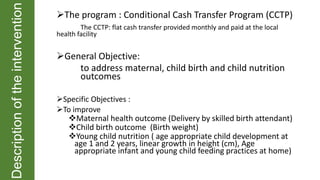
Descriptionoftheintervention The program : Conditional Cash Transfer Program (CCTP)
The CCTP: flat cash transfer provided monthly and paid at the local
health facility
General Objective:
to address maternal, child birth and child nutrition
outcomes
Specific Objectives :
To improve
Maternal health outcome (Delivery by skilled birth attendant)
Child birth outcome (Birth weight)
Young child nutrition ( age appropriate child development at
age 1 and 2 years, linear growth in height (cm), Age
appropriate infant and young child feeding practices at home)
Descriptionoftheintervention
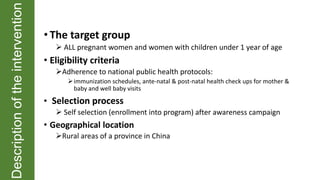
• The target group
 ALL pregnant women and women with children under 1 year of age
• Eligibility criteria
Adherence to national public health protocols:
immunization schedules, ante-natal & post-natal health check ups for mother &
baby and well baby visits
• Selection process
 Self selection (enrollment into program) after awareness campaign
• Geographical location
Rural areas of a province in China
Descriptionoftheintervention
• The start and end dates
 6 Months enrollment before introduction of the intervention
End date 36 months (3 years) after introduction of intervention
• Time limits to participation
 6 months window for enrollment in order to participate
• Time frame for the evaluation
 3 years
long enough to show an impact ? YES
Hypotheses • Statement of Hypothesis
• Intermediate to final outcome
 Intermediate Outcome hypothesis : Participation in the CCTP
increases maternal and child utilization of public health facilities
 Final Outcome hypothesis : The CCTP improves:
maternal health outcome
Child health and outcome
Young child nutrition
• The CCTP improves final outcomes through utilization of Public
Health Facilities
Researchquestions&
PrimaryIndicators
• Research questions
• What is the impact of the CCTP on
- maternal health outcome?
- Child health outcome? and
- Young child nutrition?
• Primary indicators and their units
Primary Indicator Unit
No of Delivery by skilled birth attendant Pregnant women
Birth weight Newborn children
 Gross and Fine motor skills , cognition 11 to 12 months old
Gross and Fine motor skills , cognition 22 to 24 months old
 Linear growth in height (cm) At birth, 1 and 2 years of age
 Age appropriate infant and young child
feeding practices at home (index) All children 6-24 months
Secondaryorintermediate
indicatorstomeasure Secondary Indicators
 No. of antenatal & postnatal health
checkups for mother & baby
 Immunization rates
Well baby visits
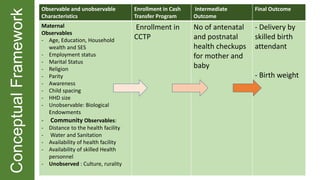
ConceptualFramework
Observable and unobservable
Characteristics
Enrollment in Cash
Transfer Program
Intermediate
Outcome
Final Outcome
Maternal
Observables
- Age, Education, Household
wealth and SES
- Employment status
- Marital Status
- Religion
- Parity
- Awareness
- Child spacing
- HHD size
- Unobservable: Biological
Endowments
- Community Observables:
- Distance to the health facility
- Water and Sanitation
- Availability of health facility
- Availability of skilled Health
personnel
- Unobserved : Culture, rurality
Enrollment in
CCTP
No of antenatal
and postnatal
health checkups
for mother and
baby
- Delivery by
skilled birth
attendant
- Birth weight
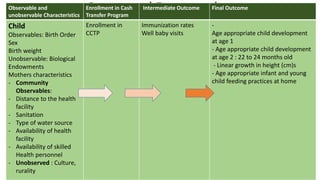
Conceptual FrameworkObservable and
unobservable Characteristics
Enrollment in Cash
Transfer Program
Intermediate Outcome Final Outcome
Child
Observables: Birth Order
Sex
Birth weight
Unobservable: Biological
Endowments
Mothers characteristics
- Community
Observables:
- Distance to the health
facility
- Sanitation
- Type of water source
- Availability of health
facility
- Availability of skilled
Health personnel
- Unobserved : Culture,
rurality
Enrollment in
CCTP
Immunization rates
Well baby visits
-
Age appropriate child development
at age 1
- Age appropriate child development
at age 2 : 22 to 24 months old
- Linear growth in height (cm)s
- Age appropriate infant and young
child feeding practices at home
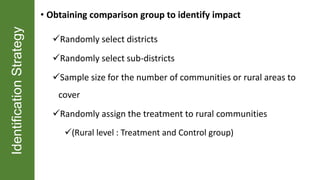
IdentificationStrategy • Obtaining comparison group to identify impact
Randomly select districts
Randomly select sub-districts
Sample size for the number of communities or rural areas to
cover
Randomly assign the treatment to rural communities
(Rural level : Treatment and Control group)
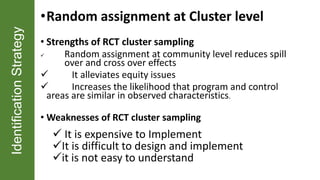
IdentificationStrategy •Random assignment at Cluster level
• Strengths of RCT cluster sampling
 Random assignment at community level reduces spill
over and cross over effects
 It alleviates equity issues
 Increases the likelihood that program and control
areas are similar in observed characteristics.
• Weaknesses of RCT cluster sampling
 It is expensive to Implement
It is difficult to design and implement
it is not easy to understand
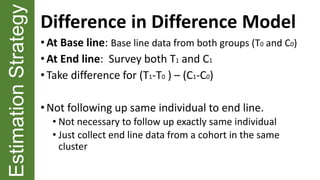
EstimationStrategy Difference in Difference Model
•At Base line: Base line data from both groups (T0 and C0)
• At End line: Survey both T1 and C1
•Take difference for (T1-T0 ) – (C1-C0)
• Not following up same individual to end line.
• Not necessary to follow up exactly same individual
• Just collect end line data from a cohort in the same
cluster
ModelSpecification Difference in Difference Model
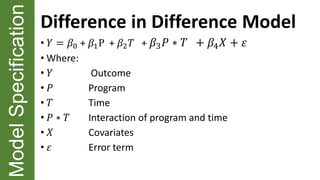
• 𝑌 = 𝛽0 + 𝛽1P + 𝛽2 𝑇 + 𝛽3 𝑃 ∗ 𝑇 + 𝛽4 𝑋 + 𝜀
• Where:
• 𝑌 Outcome
• 𝑃 Program
• 𝑇 Time
• 𝑃 ∗ 𝑇 Interaction of program and time
• 𝑋 Covariates
• 𝜀 Error term
ModelSpecification Difference in Difference Model
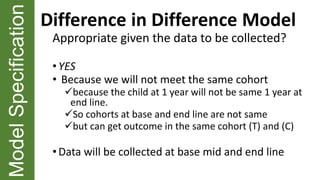
Appropriate given the data to be collected?
•YES
• Because we will not meet the same cohort
because the child at 1 year will not be same 1 year at
end line.
So cohorts at base and end line are not same
but can get outcome in the same cohort (T) and (C)
•Data will be collected at base mid and end line
ModelSpecification Difference in Difference Model
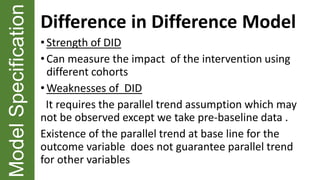
•Strength of DID
• Can measure the impact of the intervention using
different cohorts
• Weaknesses of DID
It requires the parallel trend assumption which may
not be observed except we take pre-baseline data .
Existence of the parallel trend at base line for the
outcome variable does not guarantee parallel trend
for other variables
ModelSpecification Difference in Difference Model
• Estimator: The ATT
• This is because:
• the intervention is at the village cluster level, and
• we can randomize village clusters into treatment and
control with very small chance of contamination and
cross over
Otherreflectionsor
comments
• Key strengths
•Already provided outcome measures
• Internal and external validity
•Using rural areas in similar sub district as treatment
and control enhances similarity
• External Validity : Equal representation for treatment
and control clusters from each sub district
Otherreflectionsor
comments
• Sampling issues
•Insufficient information for sample size
determination (E.g average number of clusters)
•Time frame
• End of 6 months of awareness campaign, we get base
line data and introduce the intervention
• Midline at 18 months and
• End line at 36 months
• ASANTENI SANA !!!
• GRACIAS !!!
• GRAZIE !!!
• MEDASE !!!
• MERCI BEAUCOUP !!!
• ESE !!!
• SIYABONGA !!!
• MWEBALE NYO !!!
• TINOTENDA !!!
• THANK YOU VERY MUCH !!!

Impact Evaluation Training with AERC: China Cash Transfer Programme Technical Proposal

  • 1.
    CHINA CONDITIONAL CASHTRANSFER PROGRAM AERC/Transfer Project IE Training Workshop June24-July 4 2019 GROUP MEMBERS 1. Uche Abamba Osakede 2. Kingstone Mujeyi 3. Happiness Saronga 4. Eric Allara Ngaba 5. Rachel Namulondo
  • 2.
    PresentationOutline •Description ofthe intervention •Hypotheses •Research question and Indicators •Conceptual Framework •Identification strategy •Estimation strategy •Other reflections and comments
  • 3.
    Descriptionoftheintervention The program: Conditional Cash Transfer Program (CCTP) The CCTP: flat cash transfer provided monthly and paid at the local health facility General Objective: to address maternal, child birth and child nutrition outcomes Specific Objectives : To improve Maternal health outcome (Delivery by skilled birth attendant) Child birth outcome (Birth weight) Young child nutrition ( age appropriate child development at age 1 and 2 years, linear growth in height (cm), Age appropriate infant and young child feeding practices at home)
  • 4.
    Descriptionoftheintervention • The targetgroup  ALL pregnant women and women with children under 1 year of age • Eligibility criteria Adherence to national public health protocols: immunization schedules, ante-natal & post-natal health check ups for mother & baby and well baby visits • Selection process  Self selection (enrollment into program) after awareness campaign • Geographical location Rural areas of a province in China
  • 5.
    Descriptionoftheintervention • The startand end dates  6 Months enrollment before introduction of the intervention End date 36 months (3 years) after introduction of intervention • Time limits to participation  6 months window for enrollment in order to participate • Time frame for the evaluation  3 years long enough to show an impact ? YES
  • 6.
    Hypotheses • Statementof Hypothesis • Intermediate to final outcome  Intermediate Outcome hypothesis : Participation in the CCTP increases maternal and child utilization of public health facilities  Final Outcome hypothesis : The CCTP improves: maternal health outcome Child health and outcome Young child nutrition • The CCTP improves final outcomes through utilization of Public Health Facilities
  • 7.
    Researchquestions& PrimaryIndicators • Research questions •What is the impact of the CCTP on - maternal health outcome? - Child health outcome? and - Young child nutrition? • Primary indicators and their units Primary Indicator Unit No of Delivery by skilled birth attendant Pregnant women Birth weight Newborn children  Gross and Fine motor skills , cognition 11 to 12 months old Gross and Fine motor skills , cognition 22 to 24 months old  Linear growth in height (cm) At birth, 1 and 2 years of age  Age appropriate infant and young child feeding practices at home (index) All children 6-24 months
  • 8.
    Secondaryorintermediate indicatorstomeasure Secondary Indicators No. of antenatal & postnatal health checkups for mother & baby  Immunization rates Well baby visits
  • 9.
    ConceptualFramework Observable and unobservable Characteristics Enrollmentin Cash Transfer Program Intermediate Outcome Final Outcome Maternal Observables - Age, Education, Household wealth and SES - Employment status - Marital Status - Religion - Parity - Awareness - Child spacing - HHD size - Unobservable: Biological Endowments - Community Observables: - Distance to the health facility - Water and Sanitation - Availability of health facility - Availability of skilled Health personnel - Unobserved : Culture, rurality Enrollment in CCTP No of antenatal and postnatal health checkups for mother and baby - Delivery by skilled birth attendant - Birth weight
  • 10.
    Conceptual FrameworkObservable and unobservableCharacteristics Enrollment in Cash Transfer Program Intermediate Outcome Final Outcome Child Observables: Birth Order Sex Birth weight Unobservable: Biological Endowments Mothers characteristics - Community Observables: - Distance to the health facility - Sanitation - Type of water source - Availability of health facility - Availability of skilled Health personnel - Unobserved : Culture, rurality Enrollment in CCTP Immunization rates Well baby visits - Age appropriate child development at age 1 - Age appropriate child development at age 2 : 22 to 24 months old - Linear growth in height (cm)s - Age appropriate infant and young child feeding practices at home
  • 11.
    IdentificationStrategy • Obtainingcomparison group to identify impact Randomly select districts Randomly select sub-districts Sample size for the number of communities or rural areas to cover Randomly assign the treatment to rural communities (Rural level : Treatment and Control group)
  • 12.
    IdentificationStrategy •Random assignmentat Cluster level • Strengths of RCT cluster sampling  Random assignment at community level reduces spill over and cross over effects  It alleviates equity issues  Increases the likelihood that program and control areas are similar in observed characteristics. • Weaknesses of RCT cluster sampling  It is expensive to Implement It is difficult to design and implement it is not easy to understand
  • 13.
    EstimationStrategy Difference inDifference Model •At Base line: Base line data from both groups (T0 and C0) • At End line: Survey both T1 and C1 •Take difference for (T1-T0 ) – (C1-C0) • Not following up same individual to end line. • Not necessary to follow up exactly same individual • Just collect end line data from a cohort in the same cluster
  • 14.
    ModelSpecification Difference inDifference Model • 𝑌 = 𝛽0 + 𝛽1P + 𝛽2 𝑇 + 𝛽3 𝑃 ∗ 𝑇 + 𝛽4 𝑋 + 𝜀 • Where: • 𝑌 Outcome • 𝑃 Program • 𝑇 Time • 𝑃 ∗ 𝑇 Interaction of program and time • 𝑋 Covariates • 𝜀 Error term
  • 15.
    ModelSpecification Difference inDifference Model Appropriate given the data to be collected? •YES • Because we will not meet the same cohort because the child at 1 year will not be same 1 year at end line. So cohorts at base and end line are not same but can get outcome in the same cohort (T) and (C) •Data will be collected at base mid and end line
  • 16.
    ModelSpecification Difference inDifference Model •Strength of DID • Can measure the impact of the intervention using different cohorts • Weaknesses of DID It requires the parallel trend assumption which may not be observed except we take pre-baseline data . Existence of the parallel trend at base line for the outcome variable does not guarantee parallel trend for other variables
  • 17.
    ModelSpecification Difference inDifference Model • Estimator: The ATT • This is because: • the intervention is at the village cluster level, and • we can randomize village clusters into treatment and control with very small chance of contamination and cross over
  • 18.
    Otherreflectionsor comments • Key strengths •Alreadyprovided outcome measures • Internal and external validity •Using rural areas in similar sub district as treatment and control enhances similarity • External Validity : Equal representation for treatment and control clusters from each sub district
  • 19.
    Otherreflectionsor comments • Sampling issues •Insufficientinformation for sample size determination (E.g average number of clusters) •Time frame • End of 6 months of awareness campaign, we get base line data and introduce the intervention • Midline at 18 months and • End line at 36 months
  • 20.
    • ASANTENI SANA!!! • GRACIAS !!! • GRAZIE !!! • MEDASE !!! • MERCI BEAUCOUP !!! • ESE !!! • SIYABONGA !!! • MWEBALE NYO !!! • TINOTENDA !!! • THANK YOU VERY MUCH !!!