Early Childhood Development:
From science to practice including
research
MaureenKapiyo-THRIVE ProjectCoordinatorKenya,TanzaniaandMalawi,CRS
LeslieChingang-DeputyChiefofPartyKIDSSProject,CRSCameroon
AlfonsoRosales-MaternalandChildHealthSeniorTechnicalAdvisor,WorldVisionUS
JohnHembling-SeniorTechnicalAdvisorforHealthEvaluationandResearch,CRS
JoyNoelBaumgartner-AssistantProfessor;Director,EvidenceLab,DukeUniversity
ElenaMcEwan-MaternalandChildHealthSeniorTechnicalAdvisor, CRS
1
Session Objectives
• Describe different ECD program
implementation strategies and lessons
learned in various countries
• Discuss the evaluation design issues for
ECD programs
• Demonstrate communication strategies for
engaging stakeholders on integrating ECD
programming across sectors
2
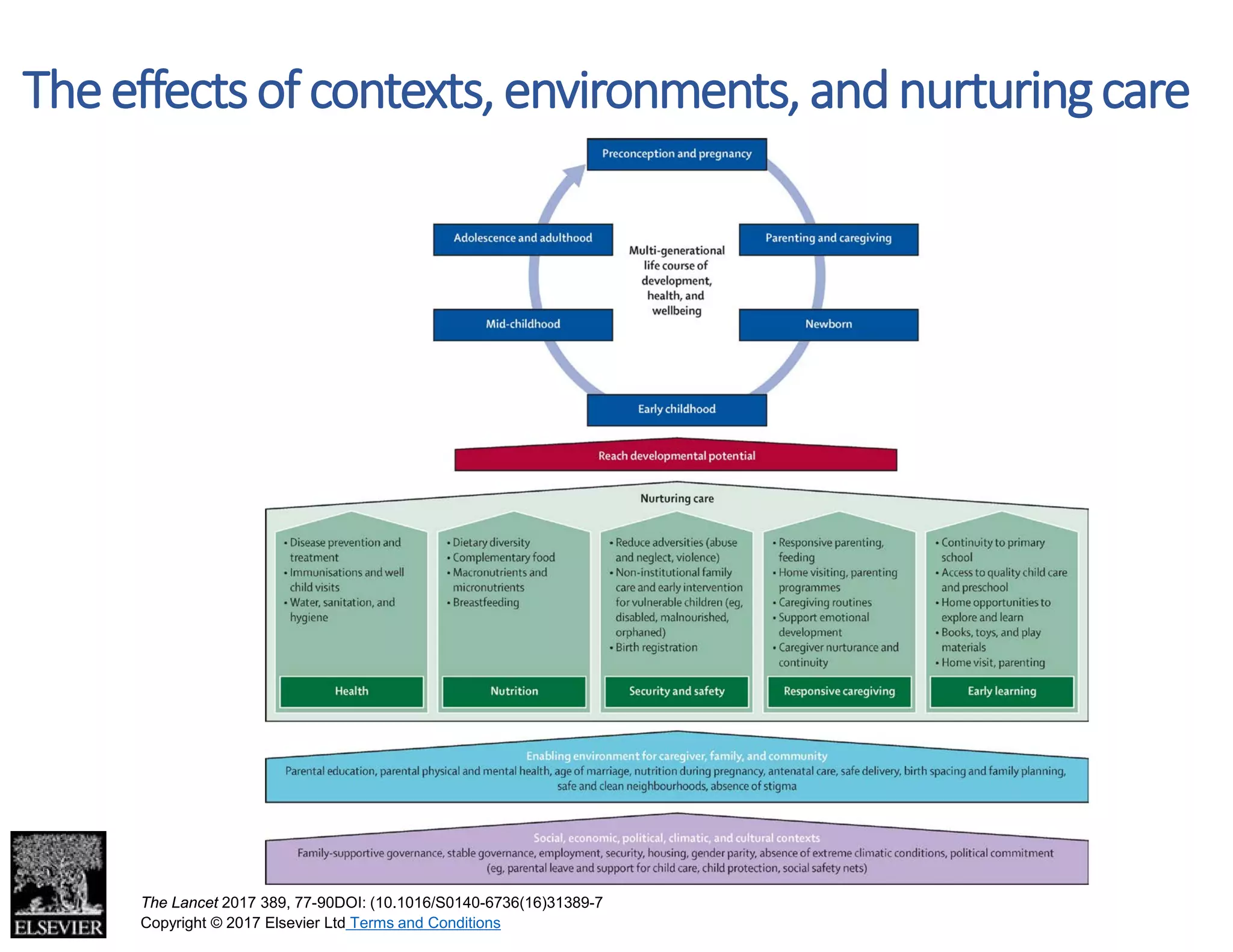
Figure 1
The Lancet 2017 389, 77-90DOI: (10.1016/S0140-6736(16)31389-7)
Copyright © 2017 Elsevier Ltd Terms and Conditions
Theeffectsof contexts,environments,andnurturingcare
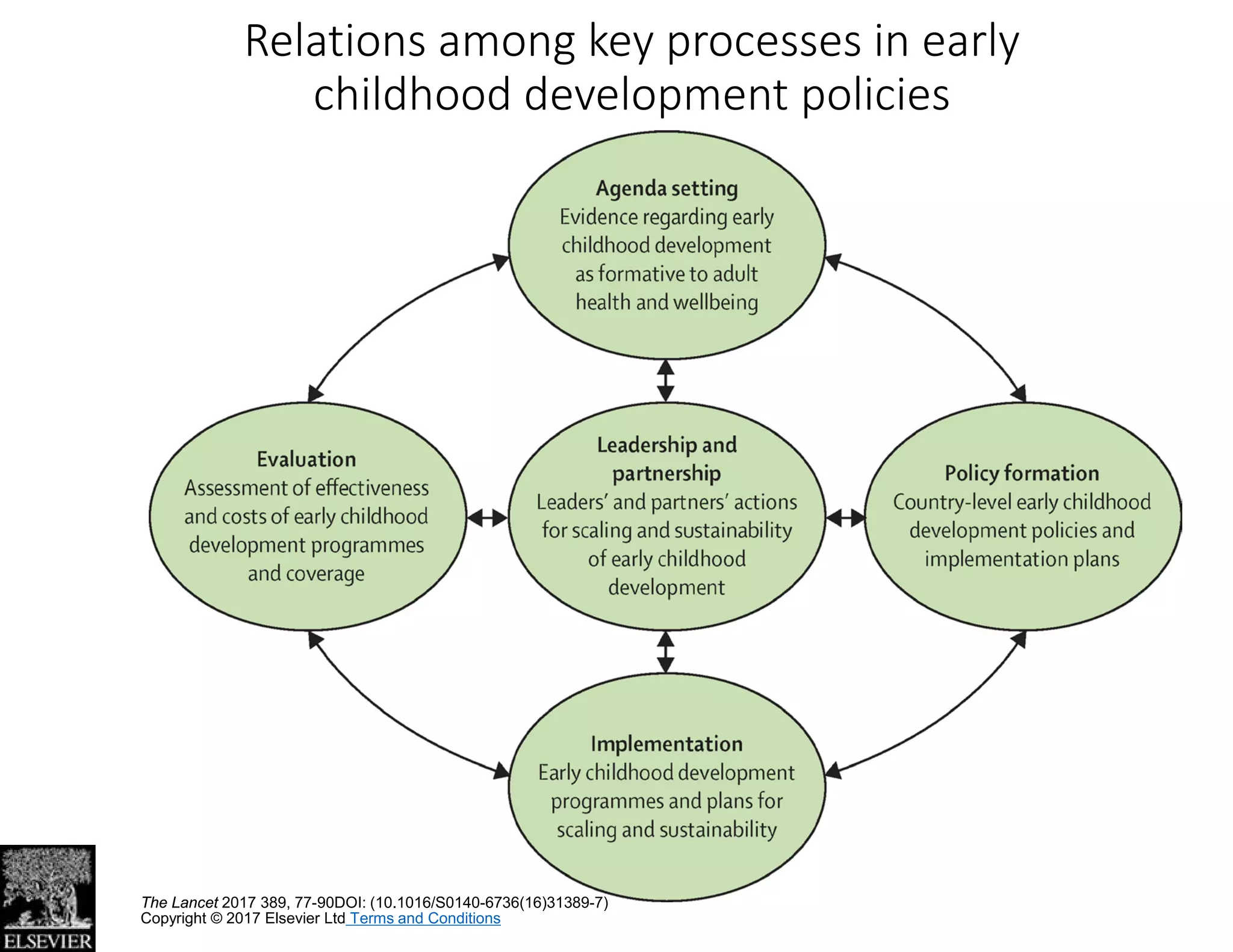
Relations among key processes in early
childhood development policies
The Lancet 2017 389, 77-90DOI: (10.1016/S0140-6736(16)31389-7)
Copyright © 2017 Elsevier Ltd Terms and Conditions
Action at global, national, and local levels
is needed to increase political commitment
to and investment in early childhood
development
The Lancet series reviewed:
– evidence linking early childhood development with
adult health and wellbeing
– evidence related to key biological and psychosocial
risks
– Summarized neuroscientific evidence on both adverse
and positive experiences affecting early brain
development
– Concluded that inequities in development begin prior
before conception, and that timely interventions
reduce inequities and increase productivity
6
7
Country programs examples
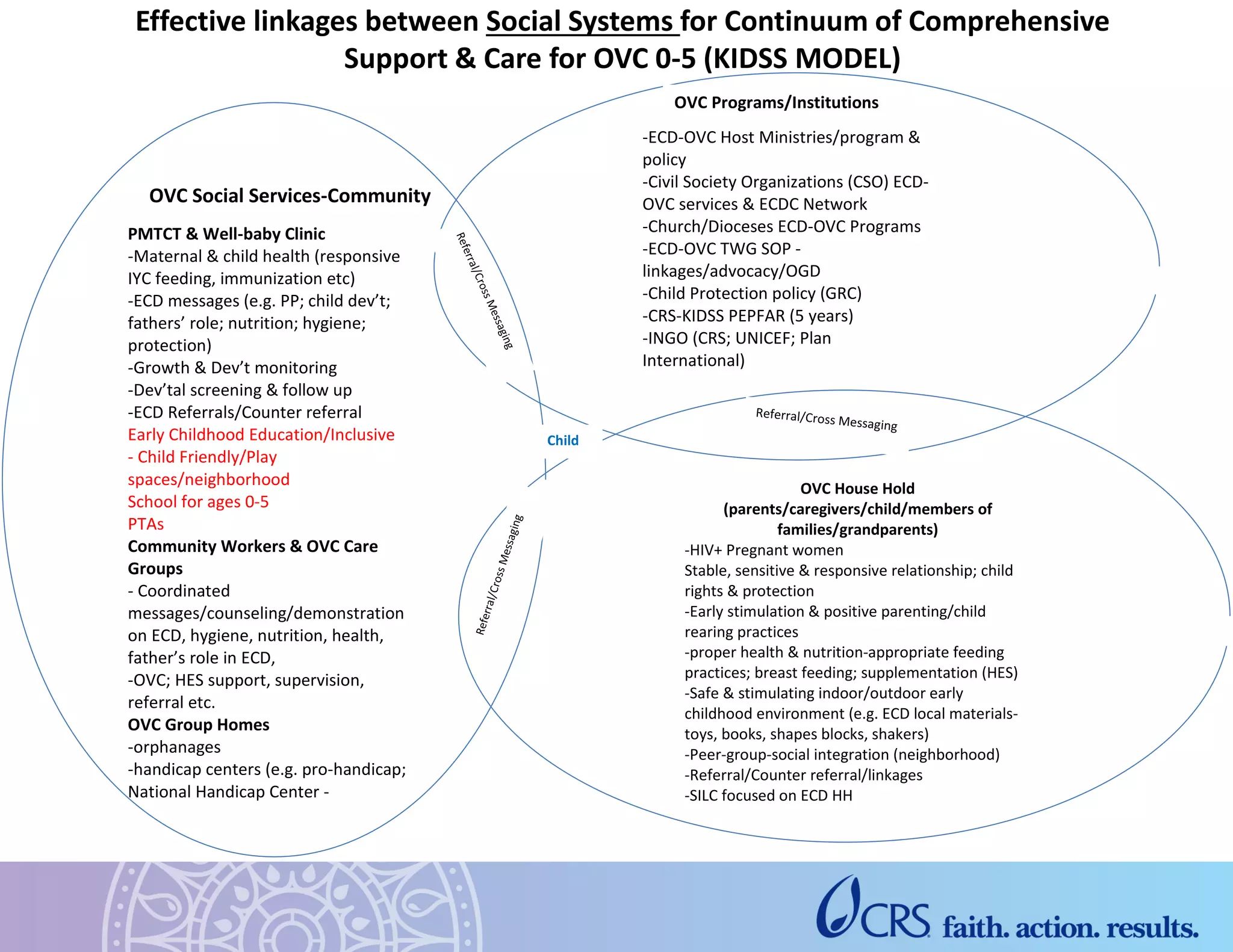
Figure 1
OVC Social Services-Community
-ECD-OVC Host Ministries/program &
policy
-Civil Society Organizations (CSO) ECD-
OVC services & ECDC Network
-Church/Dioceses ECD-OVC Programs
-ECD-OVC TWG SOP -
linkages/advocacy/OGD
-Child Protection policy (GRC)
-CRS-KIDSS PEPFAR (5 years)
-INGO (CRS; UNICEF; Plan
International)
OVC Programs/Institutions
PMTCT & Well-baby Clinic
-Maternal & child health (responsive
IYC feeding, immunization etc)
-ECD messages (e.g. PP; child dev’t;
fathers’ role; nutrition; hygiene;
protection)
-Growth & Dev’t monitoring
-Dev’tal screening & follow up
-ECD Referrals/Counter referral
Early Childhood Education/Inclusive
- Child Friendly/Play
spaces/neighborhood
School for ages 0-5
PTAs
Community Workers & OVC Care
Groups
- Coordinated
messages/counseling/demonstration
on ECD, hygiene, nutrition, health,
father’s role in ECD,
-OVC; HES support, supervision,
referral etc.
OVC Group Homes
-orphanages
-handicap centers (e.g. pro-handicap;
National Handicap Center -
OVC House Hold
(parents/caregivers/child/members of
families/grandparents)
-HIV+ Pregnant women
Stable, sensitive & responsive relationship; child
rights & protection
-Early stimulation & positive parenting/child
rearing practices
-proper health & nutrition-appropriate feeding
practices; breast feeding; supplementation (HES)
-Safe & stimulating indoor/outdoor early
childhood environment (e.g. ECD local materials-
toys, books, shapes blocks, shakers)
-Peer-group-social integration (neighborhood)
-Referral/Counter referral/linkages
-SILC focused on ECD HH
Child
Effective linkages between Social Systems for Continuum of Comprehensive
Support & Care for OVC 0-5 (KIDSS MODEL)
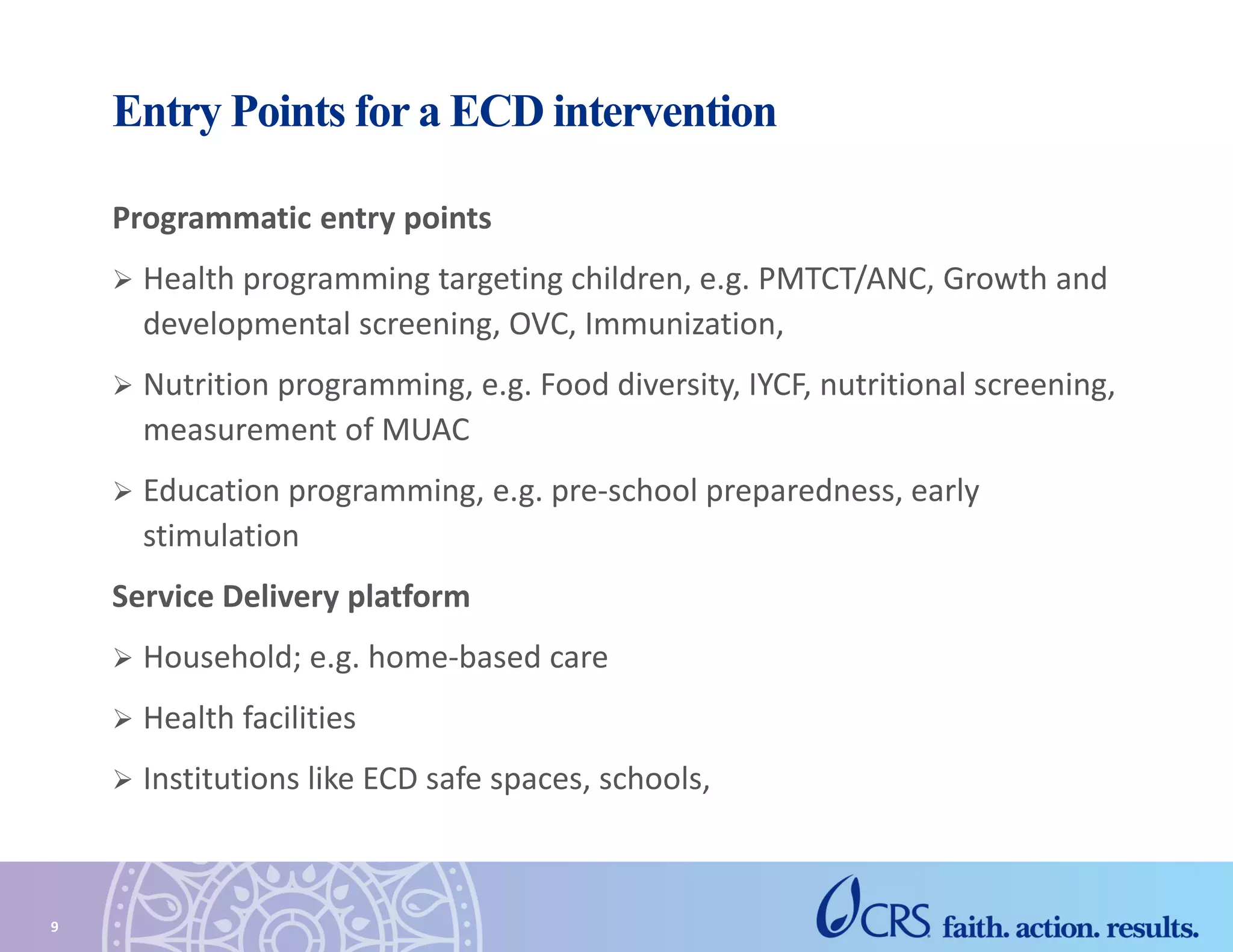
Entry Points for a ECD intervention
Programmatic entry points
 Health programming targeting children, e.g. PMTCT/ANC, Growth and
developmental screening, OVC, Immunization,
 Nutrition programming, e.g. Food diversity, IYCF, nutritional screening,
measurement of MUAC
 Education programming, e.g. pre-school preparedness, early
stimulation
Service Delivery platform
 Household; e.g. home-based care
 Health facilities
 Institutions like ECD safe spaces, schools,
9
Evidence based Strategies
Health & Nutrition
 Rapid development of the brain occurs first 2 years
 Feeding in the first 1000 days is essential for optimal growth &
Development
 Immunization EPI, combine with Vit. A
Community-based
 Home visit
10
ECD best practices in KIDSS
- An ECD baseline survey describing gaps in development and ECD health,
nutritional and educational services
- ECD framework for KIDSS (delivery platform, delivery agents, number of
messages, message materials, Dosage, Delivery strategy, Supervision and
Training/Refresher)
- Develop flipchart for home-based care to facilitate key messages, and
demonstration
- Pretest-learn-adjust-implementation-monitor/supervision
- KIDSS strengthen family wellbeing through positive parenting during
home visit (0-5years)
- Government buy-in (adopting KIDSS tool, KIDSS supporting to develop
national ECD policy.
- Families positive feedback on positive parenting and early stimulation
demonstrations.
11
Gaps in KIDSS ECD programming
- Donor restriction (is a core, near core or non-core activity?)
- Agents profile not clear, lack of trained personnel in ECD, Child
protection, nutrition, development milestone monitoring
- Non-systematic ECD referral system and formal linkages
- Nurses and doctors lack the knowledge in ECD, and not
motivated to practice new things.
- Lack of standard for budgeting.
12
Factors important for scale up of ECD program
(case KIDSS)
13
• National ECD policy document,
strategic plan or implantation plan
• Sufficient human resources
(trained agents, full time as
against volunteers.
• Integrated ECD program which
include MCH, Growth monitoring,
Breastfeeding, nutrition, WASH,
Immunization,
• Establishing play areas in health
facilities, day-care centers,
community-based safe spaces
The Lancet series reviewed:
– evidence linking early childhood development with
adult health and wellbeing
– evidence related to key biological and psychosocial
risks
– Summarized neuroscientific evidence on both adverse
and positive experiences affecting early brain
development
– Concluded that inequities in development begin prior
before conception, and that timely interventions
reduce inequities and increase productivity
14
The Lancet 2017 389, 77-90DOI: (10.1016/S0140-6736(16)31389-7)
Hypothesis tested
StuntedCognitive, language
and motor
development
Early learning
support Child feeding
practice
Population in GBG vs. control will have …
Agu!
Violating
disciplining
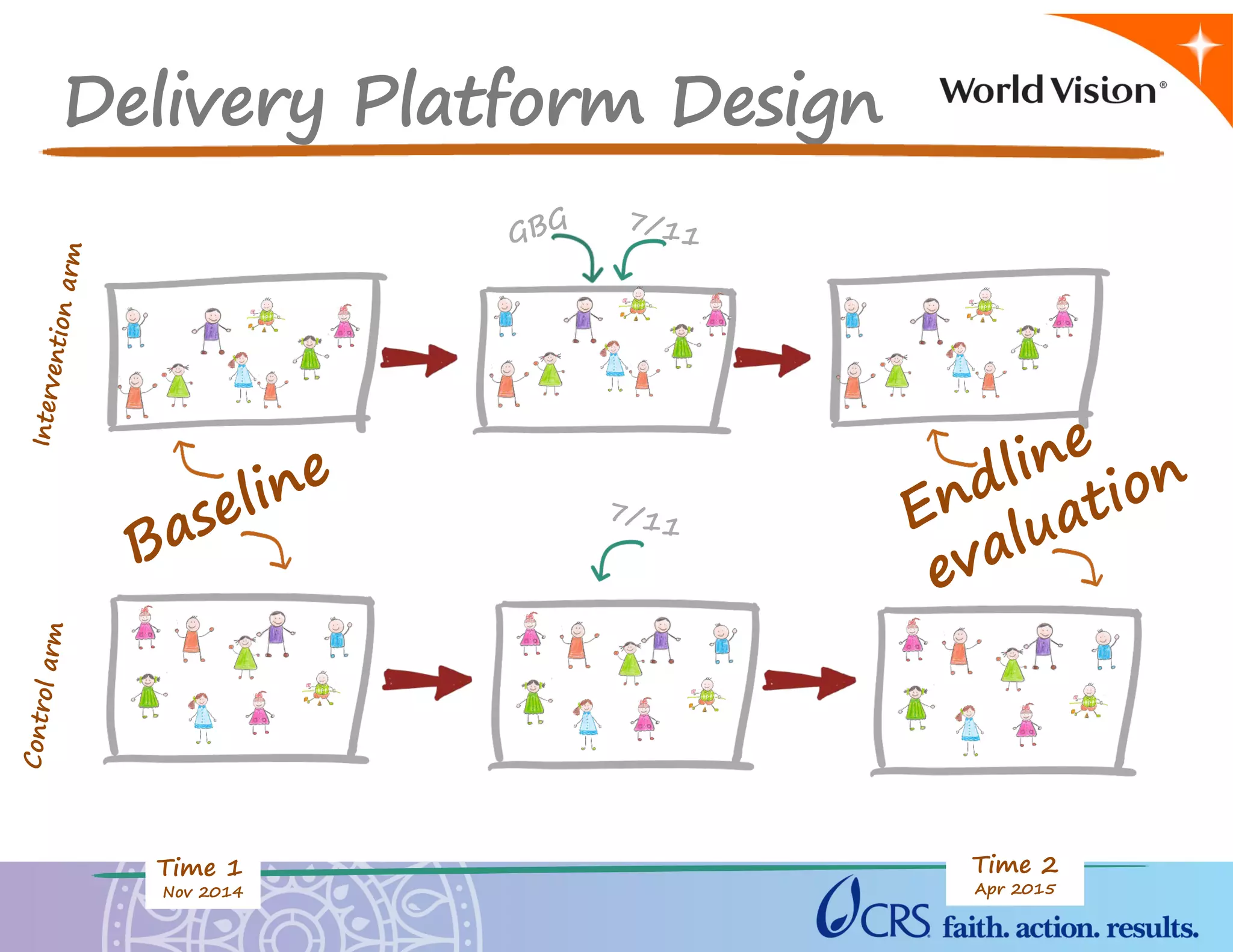
Delivery Platform Design
Time 1
Nov 2014
Time 2
Apr 2015
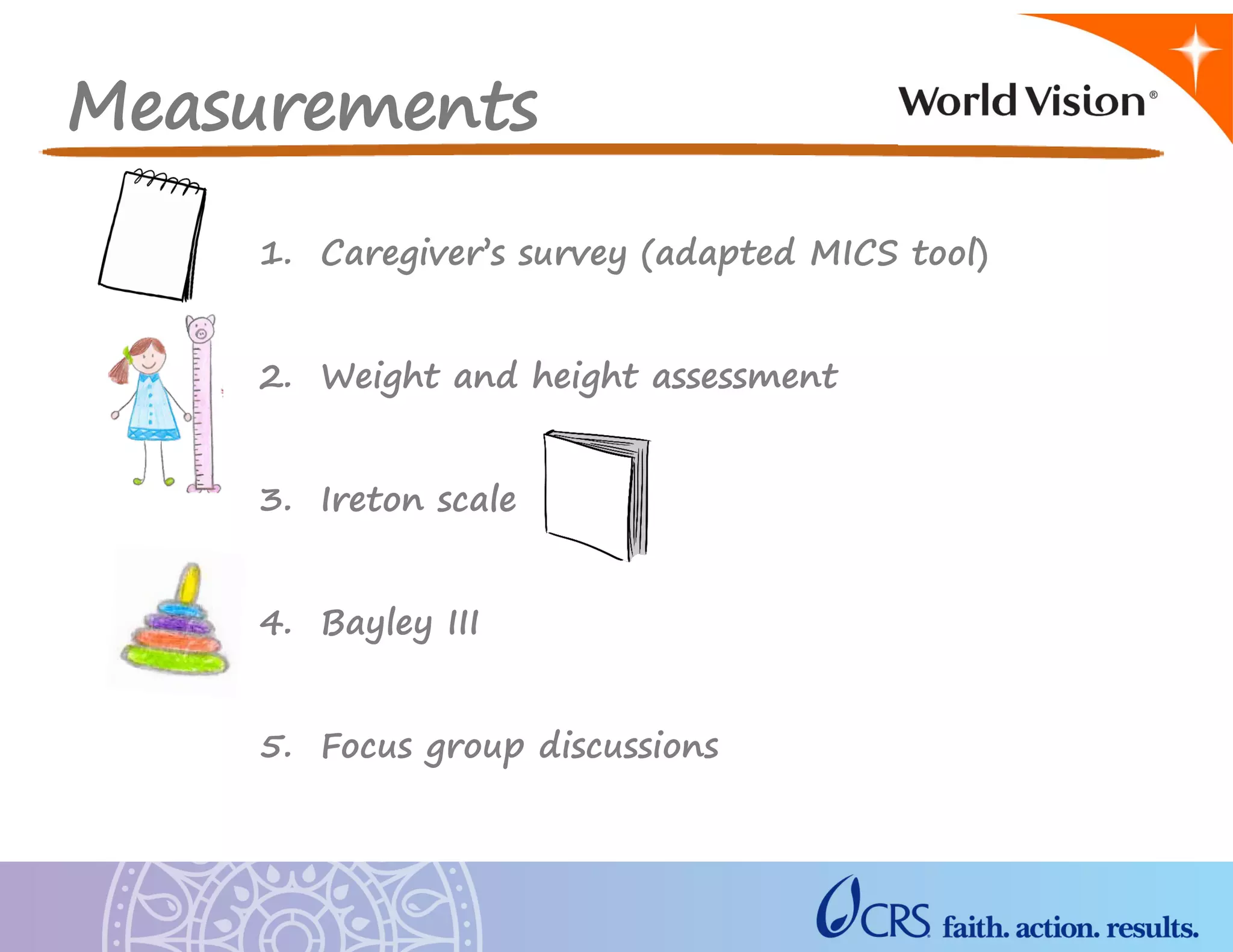
Measurements
1. Caregiver’s survey (adapted MICS tool)
2. Weight and height assessment
3. Ireton scale
4. Bayley III
5. Focus group discussions
Outcome indicators
1. % of children scoring above 85 in all 3(cognitive,
language, and motor composited sub-scales per BSID III)
2. % children stunted
1. % children whose household members in the past 3 days
were engaged at least in 4 early leaning support
activities (UNICEF MICS)
2. % of children receiving minimum diversity in last day.
3. % of parents with violating disciplining practice (MICS)
Overall effect of intervention
Stunted
Cognitive, language
and motor
development
Early learning support
Minimum diversity
Agu!
OR 1.83
P=0.025
OR 1.55
p=0.013
OR 2.22
p=0.012
OR 0.96
p=0.013
OR 1.11
P=0.501
59%
75%
83%
75%
71%
82%
87%
81%
Total score Cognitive Language Motor
Contol Intervention
% of children that achieved at least 85 scores
on BSID III
OR=1.5
p=0.175
OR=1.68c
0.151
OR 1.82
p=0.025
OR=1.36
P=0.291
% of children that achieved at least 85 in total
composite in Vardenis region only
46%
64%
84%
62%
73%
78%
94%
81%
Total scores Cognitive Language Motor
Contol Intervention
OR 3.41
p=0.003
OR 2.03
p=0.073
OR 1.68
p=0.151
OR 1.36
p=0.291
Conclusions
• GBG is effective for all who participate
• Even more effective economically
disadvantaged areas
• Longer duration studies are needed to view
the long-term effects of GBG

Early Childhood Development: Science, Practice, and Research

  • 1.
    Early Childhood Development: Fromscience to practice including research MaureenKapiyo-THRIVE ProjectCoordinatorKenya,TanzaniaandMalawi,CRS LeslieChingang-DeputyChiefofPartyKIDSSProject,CRSCameroon AlfonsoRosales-MaternalandChildHealthSeniorTechnicalAdvisor,WorldVisionUS JohnHembling-SeniorTechnicalAdvisorforHealthEvaluationandResearch,CRS JoyNoelBaumgartner-AssistantProfessor;Director,EvidenceLab,DukeUniversity ElenaMcEwan-MaternalandChildHealthSeniorTechnicalAdvisor, CRS 1
  • 2.
    Session Objectives • Describedifferent ECD program implementation strategies and lessons learned in various countries • Discuss the evaluation design issues for ECD programs • Demonstrate communication strategies for engaging stakeholders on integrating ECD programming across sectors 2
  • 3.
    Figure 1 The Lancet2017 389, 77-90DOI: (10.1016/S0140-6736(16)31389-7) Copyright © 2017 Elsevier Ltd Terms and Conditions Theeffectsof contexts,environments,andnurturingcare
  • 4.
    Relations among keyprocesses in early childhood development policies The Lancet 2017 389, 77-90DOI: (10.1016/S0140-6736(16)31389-7) Copyright © 2017 Elsevier Ltd Terms and Conditions
  • 5.
    Action at global,national, and local levels is needed to increase political commitment to and investment in early childhood development
  • 6.
    The Lancet seriesreviewed: – evidence linking early childhood development with adult health and wellbeing – evidence related to key biological and psychosocial risks – Summarized neuroscientific evidence on both adverse and positive experiences affecting early brain development – Concluded that inequities in development begin prior before conception, and that timely interventions reduce inequities and increase productivity 6
  • 7.
  • 8.
    Figure 1 OVC SocialServices-Community -ECD-OVC Host Ministries/program & policy -Civil Society Organizations (CSO) ECD- OVC services & ECDC Network -Church/Dioceses ECD-OVC Programs -ECD-OVC TWG SOP - linkages/advocacy/OGD -Child Protection policy (GRC) -CRS-KIDSS PEPFAR (5 years) -INGO (CRS; UNICEF; Plan International) OVC Programs/Institutions PMTCT & Well-baby Clinic -Maternal & child health (responsive IYC feeding, immunization etc) -ECD messages (e.g. PP; child dev’t; fathers’ role; nutrition; hygiene; protection) -Growth & Dev’t monitoring -Dev’tal screening & follow up -ECD Referrals/Counter referral Early Childhood Education/Inclusive - Child Friendly/Play spaces/neighborhood School for ages 0-5 PTAs Community Workers & OVC Care Groups - Coordinated messages/counseling/demonstration on ECD, hygiene, nutrition, health, father’s role in ECD, -OVC; HES support, supervision, referral etc. OVC Group Homes -orphanages -handicap centers (e.g. pro-handicap; National Handicap Center - OVC House Hold (parents/caregivers/child/members of families/grandparents) -HIV+ Pregnant women Stable, sensitive & responsive relationship; child rights & protection -Early stimulation & positive parenting/child rearing practices -proper health & nutrition-appropriate feeding practices; breast feeding; supplementation (HES) -Safe & stimulating indoor/outdoor early childhood environment (e.g. ECD local materials- toys, books, shapes blocks, shakers) -Peer-group-social integration (neighborhood) -Referral/Counter referral/linkages -SILC focused on ECD HH Child Effective linkages between Social Systems for Continuum of Comprehensive Support & Care for OVC 0-5 (KIDSS MODEL)
  • 9.
    Entry Points fora ECD intervention Programmatic entry points  Health programming targeting children, e.g. PMTCT/ANC, Growth and developmental screening, OVC, Immunization,  Nutrition programming, e.g. Food diversity, IYCF, nutritional screening, measurement of MUAC  Education programming, e.g. pre-school preparedness, early stimulation Service Delivery platform  Household; e.g. home-based care  Health facilities  Institutions like ECD safe spaces, schools, 9
  • 10.
    Evidence based Strategies Health& Nutrition  Rapid development of the brain occurs first 2 years  Feeding in the first 1000 days is essential for optimal growth & Development  Immunization EPI, combine with Vit. A Community-based  Home visit 10
  • 11.
    ECD best practicesin KIDSS - An ECD baseline survey describing gaps in development and ECD health, nutritional and educational services - ECD framework for KIDSS (delivery platform, delivery agents, number of messages, message materials, Dosage, Delivery strategy, Supervision and Training/Refresher) - Develop flipchart for home-based care to facilitate key messages, and demonstration - Pretest-learn-adjust-implementation-monitor/supervision - KIDSS strengthen family wellbeing through positive parenting during home visit (0-5years) - Government buy-in (adopting KIDSS tool, KIDSS supporting to develop national ECD policy. - Families positive feedback on positive parenting and early stimulation demonstrations. 11
  • 12.
    Gaps in KIDSSECD programming - Donor restriction (is a core, near core or non-core activity?) - Agents profile not clear, lack of trained personnel in ECD, Child protection, nutrition, development milestone monitoring - Non-systematic ECD referral system and formal linkages - Nurses and doctors lack the knowledge in ECD, and not motivated to practice new things. - Lack of standard for budgeting. 12
  • 13.
    Factors important forscale up of ECD program (case KIDSS) 13 • National ECD policy document, strategic plan or implantation plan • Sufficient human resources (trained agents, full time as against volunteers. • Integrated ECD program which include MCH, Growth monitoring, Breastfeeding, nutrition, WASH, Immunization, • Establishing play areas in health facilities, day-care centers, community-based safe spaces
  • 14.
    The Lancet seriesreviewed: – evidence linking early childhood development with adult health and wellbeing – evidence related to key biological and psychosocial risks – Summarized neuroscientific evidence on both adverse and positive experiences affecting early brain development – Concluded that inequities in development begin prior before conception, and that timely interventions reduce inequities and increase productivity 14 The Lancet 2017 389, 77-90DOI: (10.1016/S0140-6736(16)31389-7)
  • 15.
    Hypothesis tested StuntedCognitive, language andmotor development Early learning support Child feeding practice Population in GBG vs. control will have … Agu! Violating disciplining
  • 16.
    Delivery Platform Design Time1 Nov 2014 Time 2 Apr 2015
  • 17.
    Measurements 1. Caregiver’s survey(adapted MICS tool) 2. Weight and height assessment 3. Ireton scale 4. Bayley III 5. Focus group discussions
  • 18.
    Outcome indicators 1. %of children scoring above 85 in all 3(cognitive, language, and motor composited sub-scales per BSID III) 2. % children stunted 1. % children whose household members in the past 3 days were engaged at least in 4 early leaning support activities (UNICEF MICS) 2. % of children receiving minimum diversity in last day. 3. % of parents with violating disciplining practice (MICS)
  • 19.
    Overall effect ofintervention Stunted Cognitive, language and motor development Early learning support Minimum diversity Agu! OR 1.83 P=0.025 OR 1.55 p=0.013 OR 2.22 p=0.012 OR 0.96 p=0.013 OR 1.11 P=0.501
  • 20.
    59% 75% 83% 75% 71% 82% 87% 81% Total score CognitiveLanguage Motor Contol Intervention % of children that achieved at least 85 scores on BSID III OR=1.5 p=0.175 OR=1.68c 0.151 OR 1.82 p=0.025 OR=1.36 P=0.291
  • 21.
    % of childrenthat achieved at least 85 in total composite in Vardenis region only 46% 64% 84% 62% 73% 78% 94% 81% Total scores Cognitive Language Motor Contol Intervention OR 3.41 p=0.003 OR 2.03 p=0.073 OR 1.68 p=0.151 OR 1.36 p=0.291
  • 22.
    Conclusions • GBG iseffective for all who participate • Even more effective economically disadvantaged areas • Longer duration studies are needed to view the long-term effects of GBG