Immunotherapies currently in development for the
treatment of type 1 diabetes
Ian C Davis, Jacqueline Randell & Stephen N Davis
Expert Opinion on Investigational Drugs, 24:10, 1331-1341
Karthik Balachandran Immunotherapy in T1DM
Background
Autoantigens released from β cells prompt infiltration by
macrophages and dendritic cells
APCs present to CD4+ T cells which release cytokines
A cascade of immune attack follows which ultimately results
in type 1 DM
Immunotherapies affect steps in this process
Karthik Balachandran Immunotherapy in T1DM
Protective mechanisms
T cells have TCRs which recognize native and foreign antigens
presented by the APCs
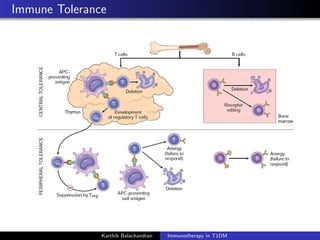
Central tolerance in the thymus ensures apoptosis of
autoreactive T cells, but some T cells escape
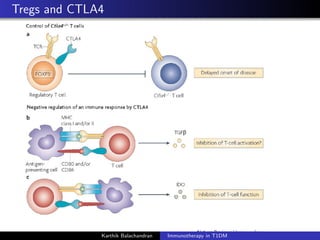
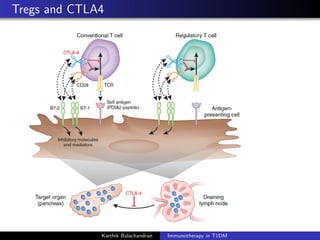
Tregs control these escaped autoreactive T cells
Peripheral tolerance or defective central deletion of
diabetogenic T cells can result in T1DM
Karthik Balachandran Immunotherapy in T1DM
Immune Tolerance
Karthik Balachandran Immunotherapy in T1DM
Tregs and CTLA4
Karthik Balachandran Immunotherapy in T1DM
Tregs and CTLA4
Karthik Balachandran Immunotherapy in T1DM
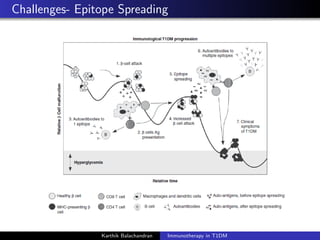
Challenges- Epitope Spreading
Karthik Balachandran Immunotherapy in T1DM
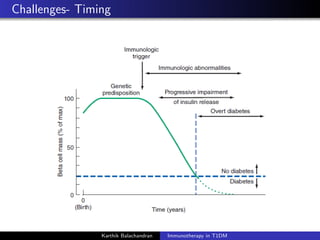
Challenges- Timing
Karthik Balachandran Immunotherapy in T1DM
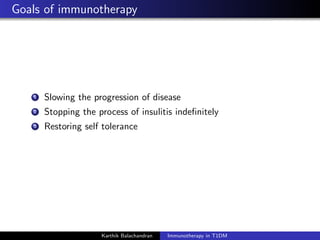
Goals of immunotherapy
1 Slowing the progression of disease
2 Stopping the process of insulitis indefinitely
3 Restoring self tolerance
Karthik Balachandran Immunotherapy in T1DM
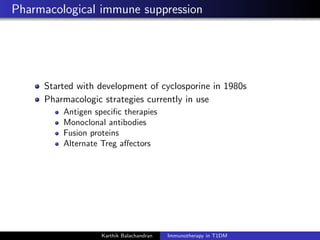
Pharmacological immune suppression
Started with development of cyclosporine in 1980s
Pharmacologic strategies currently in use
Antigen specific therapies
Monoclonal antibodies
Fusion proteins
Alternate Treg affectors
Karthik Balachandran Immunotherapy in T1DM
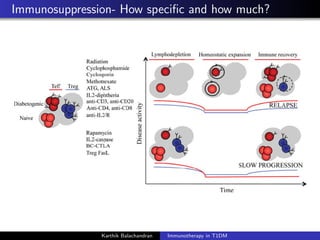
Immunosuppression- How specific and how much?
Karthik Balachandran Immunotherapy in T1DM
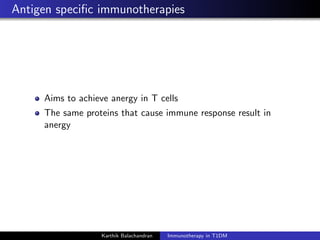
Antigen specific immunotherapies
Aims to achieve anergy in T cells
The same proteins that cause immune response result in
anergy
Karthik Balachandran Immunotherapy in T1DM
Glutamic acid decarboxylase
Triggers glutamate conversion to GABA
GAD65 vaccines potential to halt progression of diabetes
Moderate success in human trials
Phase II trial by Ludvigsson et al., 118 patients with recent
onset T1DM received two, subcutaneous injections of 20 µg
of GAD-alum treatment or placebo
NO change in C peptide at 15 months, significantly different
from placebo at 30 months
Karthik Balachandran Immunotherapy in T1DM
Glutamic acid decarboxylase
Could not be replicated in the phase III trial
No significant difference in glycated hemoglobin, daily insulin
dose or any other secondary outcomes
Karthik Balachandran Immunotherapy in T1DM
Insulin
Skyler et al - DPT1
Low dose of oral insulin to first-degree relatives of T1DM
372 patients studied, 44 in the oral insulin group and 53 in the
placebo group developed T1DM
Post-hoc subgroup analysis revealed that oral insulin delayed
diabetes onset for up to 5 years in patients with high-titer
insulin antibodies
Karthik Balachandran Immunotherapy in T1DM
Insulin
In phase I trial by Orban et al, oral insulin, despite inducing
IL-10 producing Tregs, could not prevent progression of
diabetes
Neither oral nor nasal administration of insulin had effect on
progression to type 1 diabetes
Karthik Balachandran Immunotherapy in T1DM
Heat shock protein 60
HSP 60 is expressed in β cells
Diapep277, which is a short 24 amino acid peptide that stems
from human HSP60, has been tested on both NOD mice and
humans as a potential ASI
Authors retracted the phase III trial and no further trial in
pipeline
Karthik Balachandran Immunotherapy in T1DM
CD3 and CD28-CD80/86 costimulation
Karthik Balachandran Immunotherapy in T1DM
Monoclonal antibodies - Teplizumab
Humanized, anti-CD3 monoclonal antibody
Protege and Abate trials
Protege - 513 type 1 diabetes patient, primary end point
-insulin use < 0.5u/kg/day and HbA1c < 6.5%
Four groups - 14 day high and low dose, 6 day high and low
dose
No significant difference between the groups
Karthik Balachandran Immunotherapy in T1DM
Teplizumab
AbATE study showed a significant preservation in C-peptide
for up to 2 years
Two courses of teplizumab or placebo were administered
shortly after diagnosis and again after 1 year to 52 T1DM
patients
Patients treated with teplizumab had a 75% reduced decline
in C-peptide at 2 years (-0.28 nmol/l vs control -0.46 nmol/l,
p = 0.002)
Karthik Balachandran Immunotherapy in T1DM
Otelixuzumab
anti-CD3 monoclonal antibody
In a large randomized Phase III trial Defend 1, a cumulative
3.1 mg dose of otelixizumab did not preserve C-peptide or
other markers of metabolic control in 281 recent onset
patients
Distinct risk/benefit profile for anti-CD3 therapeutics with
greater doses providing a longer slowing of the autoimmune
attack for up to 4 years but at the price of more severe side
effects
Karthik Balachandran Immunotherapy in T1DM
Rituximab
anti CD20 antibody, depletes B cells
A 1-year study of 87 patients with recent onset T1DM had
the defined primary end point of mean Cpeptide, which was
significantly better in the rituximab group vs placebo: 0.56
and 0.47 nmol/l, respectively (percentage difference 20%; p =
0.03)
At 2 years difference had vanished
Karthik Balachandran Immunotherapy in T1DM
Canakinumab (and Anakinra)
IL-1 causes β-cell dysfunction and destruction via the NFkB
and MAPK pathways
IL-1 is released locally by the β cells during hyperglycemia,
which then inhibits insulin synthesis and release and causes
apoptosis of β cells via the Fas receptor
Canakinumab is a human monoclonal anti-IL-1 antibody
Phase II trials showed neither Anakinra nor Canakinumab are
useful for halting the immune attack on β cells
Karthik Balachandran Immunotherapy in T1DM
Gevokizumab
Antibody against IL-1β
Shown in type 2 diabetes to be well tolerated and efficacious
IL-1β has role in both type 1 and type 2 diabetes
None of the antibodies have shown durable reduction in
autoimmune attack on the β cells
Karthik Balachandran Immunotherapy in T1DM
Fusion proteins
Fusion proteins are composed of an immunoglobulin Fc
domain directly linked to another protein
The fused peptide can serve as a ligand that activates when
received by a cellsurface receptor, an antigen (Ag) or as a
binding protein
Karthik Balachandran Immunotherapy in T1DM
Abatacept
Fusion protein created to curb T cells co-stimulatory signal
interceded through the CD28-CD80/86 pathway
Obstructs the early stages of T-cell activation, production and
continued existence
Phase II trial involving 103 patients
Defers immune attack for an average of 9.6 months
Well tolerated, no increased risk of EBV infection or
neutropenia
Return to inexorable decline in β cell function
Karthik Balachandran Immunotherapy in T1DM
Alefacept
Dimeric fusion protein blocking T cell costimulation
alefacept had a positive effect on preserving b-cell function,
which investigators attribute to the depletion of highly
pathogenic effecter and memory T cells (CD4+ Tcm cells
decreased by 25 – 30% and CD4+ Tem cells decreased by 40
– 60%)
Promising treatment due to its demonstrated preservation of
Treg/Teff balance
Karthik Balachandran Immunotherapy in T1DM
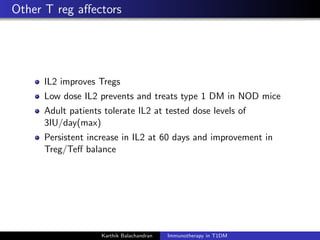
Other T reg affectors
IL2 improves Tregs
Low dose IL2 prevents and treats type 1 DM in NOD mice
Adult patients tolerate IL2 at tested dose levels of
3IU/day(max)
Persistent increase in IL2 at 60 days and improvement in
Treg/Teff balance
Karthik Balachandran Immunotherapy in T1DM
Lessons . . .
No single therapeutic gent provides a lasting halt of the
immune attack and remission of the T1DM phenotype
Responders in Abate and Protege trials
Younger (8-17 years)
HbA1c < 7.5%
Used < 0.4U/kg/d of insulin
Enrolled within 6 weeks of diagnosis of T1DM
C-peptide mean AUC > 0.2 nmol/l
Karthik Balachandran Immunotherapy in T1DM
Lessons . . .
High cumulative doses of monoclonal antibodies can have β
cell protective effects upto 4 years
Combination therapies to be evaluated, but caution to be
maintained
Combination of rapamycin(mTOR inhibitor) which decreases
Teffs and IL2 which increases Tregs resulted in transient
decline in β cell function
Ideal timing and dosing are not known
Karthik Balachandran Immunotherapy in T1DM
Conclusion
Currently immunotherapy has limited role in the management of
Type 1 Diabetes
Karthik Balachandran Immunotherapy in T1DM
Thank You
Karthik Balachandran Immunotherapy in T1DM
Table: Some
useful caption
One Two
Three 1 Four
1 The first
note...
Karthik Balachandran Immunotherapy in T1DM

Immunotherapy in type 1 Diabetes

  • 1.
    Immunotherapies currently indevelopment for the treatment of type 1 diabetes Ian C Davis, Jacqueline Randell & Stephen N Davis Expert Opinion on Investigational Drugs, 24:10, 1331-1341 Karthik Balachandran Immunotherapy in T1DM
  • 2.
    Background Autoantigens released fromβ cells prompt infiltration by macrophages and dendritic cells APCs present to CD4+ T cells which release cytokines A cascade of immune attack follows which ultimately results in type 1 DM Immunotherapies affect steps in this process Karthik Balachandran Immunotherapy in T1DM
  • 3.
    Protective mechanisms T cellshave TCRs which recognize native and foreign antigens presented by the APCs Central tolerance in the thymus ensures apoptosis of autoreactive T cells, but some T cells escape Tregs control these escaped autoreactive T cells Peripheral tolerance or defective central deletion of diabetogenic T cells can result in T1DM Karthik Balachandran Immunotherapy in T1DM
  • 4.
  • 5.
    Tregs and CTLA4 KarthikBalachandran Immunotherapy in T1DM
  • 6.
    Tregs and CTLA4 KarthikBalachandran Immunotherapy in T1DM
  • 7.
    Challenges- Epitope Spreading KarthikBalachandran Immunotherapy in T1DM
  • 8.
  • 9.
    Goals of immunotherapy 1Slowing the progression of disease 2 Stopping the process of insulitis indefinitely 3 Restoring self tolerance Karthik Balachandran Immunotherapy in T1DM
  • 10.
    Pharmacological immune suppression Startedwith development of cyclosporine in 1980s Pharmacologic strategies currently in use Antigen specific therapies Monoclonal antibodies Fusion proteins Alternate Treg affectors Karthik Balachandran Immunotherapy in T1DM
  • 11.
    Immunosuppression- How specificand how much? Karthik Balachandran Immunotherapy in T1DM
  • 12.
    Antigen specific immunotherapies Aimsto achieve anergy in T cells The same proteins that cause immune response result in anergy Karthik Balachandran Immunotherapy in T1DM
  • 13.
    Glutamic acid decarboxylase Triggersglutamate conversion to GABA GAD65 vaccines potential to halt progression of diabetes Moderate success in human trials Phase II trial by Ludvigsson et al., 118 patients with recent onset T1DM received two, subcutaneous injections of 20 µg of GAD-alum treatment or placebo NO change in C peptide at 15 months, significantly different from placebo at 30 months Karthik Balachandran Immunotherapy in T1DM
  • 14.
    Glutamic acid decarboxylase Couldnot be replicated in the phase III trial No significant difference in glycated hemoglobin, daily insulin dose or any other secondary outcomes Karthik Balachandran Immunotherapy in T1DM
  • 15.
    Insulin Skyler et al- DPT1 Low dose of oral insulin to first-degree relatives of T1DM 372 patients studied, 44 in the oral insulin group and 53 in the placebo group developed T1DM Post-hoc subgroup analysis revealed that oral insulin delayed diabetes onset for up to 5 years in patients with high-titer insulin antibodies Karthik Balachandran Immunotherapy in T1DM
  • 16.
    Insulin In phase Itrial by Orban et al, oral insulin, despite inducing IL-10 producing Tregs, could not prevent progression of diabetes Neither oral nor nasal administration of insulin had effect on progression to type 1 diabetes Karthik Balachandran Immunotherapy in T1DM
  • 17.
    Heat shock protein60 HSP 60 is expressed in β cells Diapep277, which is a short 24 amino acid peptide that stems from human HSP60, has been tested on both NOD mice and humans as a potential ASI Authors retracted the phase III trial and no further trial in pipeline Karthik Balachandran Immunotherapy in T1DM
  • 18.
    CD3 and CD28-CD80/86costimulation Karthik Balachandran Immunotherapy in T1DM
  • 19.
    Monoclonal antibodies -Teplizumab Humanized, anti-CD3 monoclonal antibody Protege and Abate trials Protege - 513 type 1 diabetes patient, primary end point -insulin use < 0.5u/kg/day and HbA1c < 6.5% Four groups - 14 day high and low dose, 6 day high and low dose No significant difference between the groups Karthik Balachandran Immunotherapy in T1DM
  • 20.
    Teplizumab AbATE study showeda significant preservation in C-peptide for up to 2 years Two courses of teplizumab or placebo were administered shortly after diagnosis and again after 1 year to 52 T1DM patients Patients treated with teplizumab had a 75% reduced decline in C-peptide at 2 years (-0.28 nmol/l vs control -0.46 nmol/l, p = 0.002) Karthik Balachandran Immunotherapy in T1DM
  • 21.
    Otelixuzumab anti-CD3 monoclonal antibody Ina large randomized Phase III trial Defend 1, a cumulative 3.1 mg dose of otelixizumab did not preserve C-peptide or other markers of metabolic control in 281 recent onset patients Distinct risk/benefit profile for anti-CD3 therapeutics with greater doses providing a longer slowing of the autoimmune attack for up to 4 years but at the price of more severe side effects Karthik Balachandran Immunotherapy in T1DM
  • 22.
    Rituximab anti CD20 antibody,depletes B cells A 1-year study of 87 patients with recent onset T1DM had the defined primary end point of mean Cpeptide, which was significantly better in the rituximab group vs placebo: 0.56 and 0.47 nmol/l, respectively (percentage difference 20%; p = 0.03) At 2 years difference had vanished Karthik Balachandran Immunotherapy in T1DM
  • 23.
    Canakinumab (and Anakinra) IL-1causes β-cell dysfunction and destruction via the NFkB and MAPK pathways IL-1 is released locally by the β cells during hyperglycemia, which then inhibits insulin synthesis and release and causes apoptosis of β cells via the Fas receptor Canakinumab is a human monoclonal anti-IL-1 antibody Phase II trials showed neither Anakinra nor Canakinumab are useful for halting the immune attack on β cells Karthik Balachandran Immunotherapy in T1DM
  • 24.
    Gevokizumab Antibody against IL-1β Shownin type 2 diabetes to be well tolerated and efficacious IL-1β has role in both type 1 and type 2 diabetes None of the antibodies have shown durable reduction in autoimmune attack on the β cells Karthik Balachandran Immunotherapy in T1DM
  • 25.
    Fusion proteins Fusion proteinsare composed of an immunoglobulin Fc domain directly linked to another protein The fused peptide can serve as a ligand that activates when received by a cellsurface receptor, an antigen (Ag) or as a binding protein Karthik Balachandran Immunotherapy in T1DM
  • 26.
    Abatacept Fusion protein createdto curb T cells co-stimulatory signal interceded through the CD28-CD80/86 pathway Obstructs the early stages of T-cell activation, production and continued existence Phase II trial involving 103 patients Defers immune attack for an average of 9.6 months Well tolerated, no increased risk of EBV infection or neutropenia Return to inexorable decline in β cell function Karthik Balachandran Immunotherapy in T1DM
  • 27.
    Alefacept Dimeric fusion proteinblocking T cell costimulation alefacept had a positive effect on preserving b-cell function, which investigators attribute to the depletion of highly pathogenic effecter and memory T cells (CD4+ Tcm cells decreased by 25 – 30% and CD4+ Tem cells decreased by 40 – 60%) Promising treatment due to its demonstrated preservation of Treg/Teff balance Karthik Balachandran Immunotherapy in T1DM
  • 28.
    Other T regaffectors IL2 improves Tregs Low dose IL2 prevents and treats type 1 DM in NOD mice Adult patients tolerate IL2 at tested dose levels of 3IU/day(max) Persistent increase in IL2 at 60 days and improvement in Treg/Teff balance Karthik Balachandran Immunotherapy in T1DM
  • 29.
    Lessons . .. No single therapeutic gent provides a lasting halt of the immune attack and remission of the T1DM phenotype Responders in Abate and Protege trials Younger (8-17 years) HbA1c < 7.5% Used < 0.4U/kg/d of insulin Enrolled within 6 weeks of diagnosis of T1DM C-peptide mean AUC > 0.2 nmol/l Karthik Balachandran Immunotherapy in T1DM
  • 30.
    Lessons . .. High cumulative doses of monoclonal antibodies can have β cell protective effects upto 4 years Combination therapies to be evaluated, but caution to be maintained Combination of rapamycin(mTOR inhibitor) which decreases Teffs and IL2 which increases Tregs resulted in transient decline in β cell function Ideal timing and dosing are not known Karthik Balachandran Immunotherapy in T1DM
  • 31.
    Conclusion Currently immunotherapy haslimited role in the management of Type 1 Diabetes Karthik Balachandran Immunotherapy in T1DM
  • 32.
    Thank You Karthik BalachandranImmunotherapy in T1DM
  • 33.
    Table: Some useful caption OneTwo Three 1 Four 1 The first note... Karthik Balachandran Immunotherapy in T1DM