Immunology-Case study
A Four Year Old Child
With Immunodeficiency
18-11-2020
Manahil khanum
contents
Patient Presentation & History
01
Diagnosis, Examinations&
Investigations
02
Discussions & Treatments
03
PART 01
Patient Presentation
& History
Patient Presentation & History
A severely undernourished 4-year-old girl is referred to the paediatric outpatient clinic for
recurrent anaemia, an erythematous rash on her face and trunk and accompanying
hepatosplenomegally.
Patient Presentation
•The child was born term, normal
vaginal delivery. Although no
complications were noted, her
Apgar scores were recorded
as 5, 6 and 8 at birth, 5 and
10 minutes respectively.
•Since birth the child was noted to have
dysmorphic features that include most
notably hypertelorism and small palpebral
fissures.
•Her mother denies any history of antenatal
alcohol use or any infections during her
pregnancy. This was the first pregnancy and
child born to both parents.
•The child was breastfed until 4
months of age; thereafter she was
put on formula feeds and started on
solid food by 9 months.
•Her developmental milestones
were delayed for both gross and
fine motor skills and verbal
development.
Past Medical history
The child had been admitted to hospital at age 2½ years for
lower respiratory tract infection (LRTI), suspected of being
TB. The child was also failing to thrive, falling below the 5th
centile for both height and weight. At this time she was
investigated for TB, Epstein- Barr Virus (EBV),
Toxoplasmosis, Rubella, Cytomegalovirus (CMV), Herpes,
Hepatitis B and HIV. She was found to be negative
for all
investigations except EBV.
Past surgical history
Nil noted.
Travel history
No Travel history Recorded
Medication
Nil known
Social history
Father is employed as a security guard and
mother is currently unemployed. They live
together in a one bedroom apartment with
electricity and running water. No pets and no
smoking in the home
Allergies
Nil Known
PART 02
Diagnosis, Examinations
& Investigations
Iffer
• HIV
• TB
• Recurrent pneumonia
• Cystic fibrosis
• Hypogammaglobulinaemia
• Agammaglobulinaemia
• Severe combined immunodeficiency (SCID)
Differential Diagnosis
Examination
Abdomen
General
Cardiovascular
.
Head and Neck
Neurological
• Weight 8.3 kg, below 5th centile
• Height 75cm, below 5th centile
• Afebrile
• Blood pressure and heart rate normal
• Moderate pallor
• Generalised lymphadenopathy with some firm axillary lymph nodes bilaterally
• No dehydration
• No jaundice
• No stigmata of HIV
• Dysmorphic features- hypertelorism and small
palpebral fissures
• Puffy eyelids
• Anterior and posterior fontanelles open
• Hair has red discolouration and straight
• Erythematous rash with mild induration noted on
parts of the face, forehead and trunk- thought to
be atypical erythema nodosum.
• Distended, with some scratch
marks noted
• Soft and non tender on
palpation
• Large hepatosplenomegaly
• Bowel sounds heard on
auscultation
•Ejection systolic murmur
but no significant cardiac lesions
• Delayed milestones with
regards to motor skills (fine and
gross) and verbal skills. Higher
function could not be assessed
because child did not
communicate adequately
• Reflexes 2/4
• Sensation intact
• Tone normal
• Strength normal
• Gait normal
Investigations
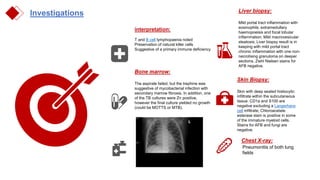
Chest X-ray:
Pneumonitis of both lung
fields
Skin Biopsy:
Skin with deep seated histiocytic
infiltrate within the subcutaneous
tissue. CD1a and S100 are
negative excluding a Langerhans
cell infiltrate; Chloroacetate
esterase stain is positive in some
of the immature myeloid cells.
Stains for AFB and fungi are
negative.
Liver biopsy:
Mild portal tract inflammation with
eosinophils, extramedullary
haemopoeisis and focal lobular
inflammation; Mild macrovesicular
steatosis; Liver biopsy result is in
keeping with mild portal tract
chronic inflammation with one non-
necrotising granuloma on deeper
sections, Ziehl Nielsen stains for
AFB negative.
Bone marrow:
The aspirate failed, but the trephine was
suggestive of mycobacterial infection with
secondary marrow fibrosis. In addition, one
of the TB cultures were Zn positive,
however the final culture yielded no growth
(could be MOTTS or MTB).
interpretation:
T and B cell lymphopaenia noted
Preservation of natural killer cells
Suggestive of a primary immune deficiency
PART 03
Discussions &
Treatments
Discussions
The resulting clinical profile is
immunodeficiency along with
autoimmunity.
This case explores the clinical
manifestation of primary
immunodeficiency, specifically
examining a type of severe
combined immunodeficiency
(SCID). SCID is a life-threatening
syndrome of recurrent infections,
diarrhoea, skin infections and
failure to thrive that results from
numerous molecular defects
leading to severe T- and B-cell
dysfunction and occasionally can
affect natural killer (NK) cells.
Without intervention, the T and B-
cell dysfunction usually results in
severe infection and death in
children by age 2 years.
Clinically, most patients present
before age 3 months with unusually
severe and frequent infections by
common or opportunistic
pathogens. This is obviously not
the situation with our patient, but we
will explore the mechanism and
pathophysiology of SCID so that a
likely scenario can be proposed
with the 4-year-old girl in our case.
It is first important to understand T
and B-cells and the way in which
they generate immunological
diversity in a normally functioning
immune system.
Treatment
Current case
The patient was transfused with packed red
cells to assist with the severe anaemia. IV
immunoglobulin prophylaxis (polygamy) was
given during admission. Empiric antibiotic
therapy was started at admission as well as
four-drug TB treatment initiated.
Bone marrow transplantation
The only cure for SCID is bone marrow
transplantation. Extreme care to match the HLA of the
donor with the host is the optimal option (usually a
living related donor), but an HLA-matched unrelated
donor and even HLA partial-mismatched related
donor transplantation can be considered with
successful outcomes. This approach is successful if
the disease is diagnosed within their first 3 months of
life and early transplantation before 3.5 months is
associated with better overall survival.
Vaccination
No live vaccines, such as the BCG
vaccine, should be administered to
patients with SCID prior to bone marrow
transplantation.
Intravenous immunoglobulin
The therapeutic function is passive immunization
to prevent infection. IVIG can be used to restore
antibody levels until the B-cell system is restored
with transplantation. However, long-term use
fails to change the terminal course of SCID.
Final Outcome
After discharge patient failed to return for follow up and no further hospital
admissions have been noted.
2020
THANK YOU!
Department of Microbiology & Molecular genetics
Khanam Durrani

Immunology case study by manahil khanam

  • 1.
    Immunology-Case study A FourYear Old Child With Immunodeficiency 18-11-2020 Manahil khanum
  • 2.
    contents Patient Presentation &History 01 Diagnosis, Examinations& Investigations 02 Discussions & Treatments 03
  • 3.
  • 4.
    Patient Presentation &History A severely undernourished 4-year-old girl is referred to the paediatric outpatient clinic for recurrent anaemia, an erythematous rash on her face and trunk and accompanying hepatosplenomegally. Patient Presentation •The child was born term, normal vaginal delivery. Although no complications were noted, her Apgar scores were recorded as 5, 6 and 8 at birth, 5 and 10 minutes respectively. •Since birth the child was noted to have dysmorphic features that include most notably hypertelorism and small palpebral fissures. •Her mother denies any history of antenatal alcohol use or any infections during her pregnancy. This was the first pregnancy and child born to both parents. •The child was breastfed until 4 months of age; thereafter she was put on formula feeds and started on solid food by 9 months. •Her developmental milestones were delayed for both gross and fine motor skills and verbal development.
  • 5.
    Past Medical history Thechild had been admitted to hospital at age 2½ years for lower respiratory tract infection (LRTI), suspected of being TB. The child was also failing to thrive, falling below the 5th centile for both height and weight. At this time she was investigated for TB, Epstein- Barr Virus (EBV), Toxoplasmosis, Rubella, Cytomegalovirus (CMV), Herpes, Hepatitis B and HIV. She was found to be negative for all investigations except EBV. Past surgical history Nil noted. Travel history No Travel history Recorded Medication Nil known Social history Father is employed as a security guard and mother is currently unemployed. They live together in a one bedroom apartment with electricity and running water. No pets and no smoking in the home Allergies Nil Known
  • 6.
  • 7.
    Iffer • HIV • TB •Recurrent pneumonia • Cystic fibrosis • Hypogammaglobulinaemia • Agammaglobulinaemia • Severe combined immunodeficiency (SCID) Differential Diagnosis
  • 8.
    Examination Abdomen General Cardiovascular . Head and Neck Neurological •Weight 8.3 kg, below 5th centile • Height 75cm, below 5th centile • Afebrile • Blood pressure and heart rate normal • Moderate pallor • Generalised lymphadenopathy with some firm axillary lymph nodes bilaterally • No dehydration • No jaundice • No stigmata of HIV • Dysmorphic features- hypertelorism and small palpebral fissures • Puffy eyelids • Anterior and posterior fontanelles open • Hair has red discolouration and straight • Erythematous rash with mild induration noted on parts of the face, forehead and trunk- thought to be atypical erythema nodosum. • Distended, with some scratch marks noted • Soft and non tender on palpation • Large hepatosplenomegaly • Bowel sounds heard on auscultation •Ejection systolic murmur but no significant cardiac lesions • Delayed milestones with regards to motor skills (fine and gross) and verbal skills. Higher function could not be assessed because child did not communicate adequately • Reflexes 2/4 • Sensation intact • Tone normal • Strength normal • Gait normal
  • 9.
    Investigations Chest X-ray: Pneumonitis ofboth lung fields Skin Biopsy: Skin with deep seated histiocytic infiltrate within the subcutaneous tissue. CD1a and S100 are negative excluding a Langerhans cell infiltrate; Chloroacetate esterase stain is positive in some of the immature myeloid cells. Stains for AFB and fungi are negative. Liver biopsy: Mild portal tract inflammation with eosinophils, extramedullary haemopoeisis and focal lobular inflammation; Mild macrovesicular steatosis; Liver biopsy result is in keeping with mild portal tract chronic inflammation with one non- necrotising granuloma on deeper sections, Ziehl Nielsen stains for AFB negative. Bone marrow: The aspirate failed, but the trephine was suggestive of mycobacterial infection with secondary marrow fibrosis. In addition, one of the TB cultures were Zn positive, however the final culture yielded no growth (could be MOTTS or MTB). interpretation: T and B cell lymphopaenia noted Preservation of natural killer cells Suggestive of a primary immune deficiency
  • 10.
  • 11.
    Discussions The resulting clinicalprofile is immunodeficiency along with autoimmunity. This case explores the clinical manifestation of primary immunodeficiency, specifically examining a type of severe combined immunodeficiency (SCID). SCID is a life-threatening syndrome of recurrent infections, diarrhoea, skin infections and failure to thrive that results from numerous molecular defects leading to severe T- and B-cell dysfunction and occasionally can affect natural killer (NK) cells. Without intervention, the T and B- cell dysfunction usually results in severe infection and death in children by age 2 years. Clinically, most patients present before age 3 months with unusually severe and frequent infections by common or opportunistic pathogens. This is obviously not the situation with our patient, but we will explore the mechanism and pathophysiology of SCID so that a likely scenario can be proposed with the 4-year-old girl in our case. It is first important to understand T and B-cells and the way in which they generate immunological diversity in a normally functioning immune system.
  • 12.
    Treatment Current case The patientwas transfused with packed red cells to assist with the severe anaemia. IV immunoglobulin prophylaxis (polygamy) was given during admission. Empiric antibiotic therapy was started at admission as well as four-drug TB treatment initiated. Bone marrow transplantation The only cure for SCID is bone marrow transplantation. Extreme care to match the HLA of the donor with the host is the optimal option (usually a living related donor), but an HLA-matched unrelated donor and even HLA partial-mismatched related donor transplantation can be considered with successful outcomes. This approach is successful if the disease is diagnosed within their first 3 months of life and early transplantation before 3.5 months is associated with better overall survival. Vaccination No live vaccines, such as the BCG vaccine, should be administered to patients with SCID prior to bone marrow transplantation. Intravenous immunoglobulin The therapeutic function is passive immunization to prevent infection. IVIG can be used to restore antibody levels until the B-cell system is restored with transplantation. However, long-term use fails to change the terminal course of SCID.
  • 13.
    Final Outcome After dischargepatient failed to return for follow up and no further hospital admissions have been noted.
  • 14.
    2020 THANK YOU! Department ofMicrobiology & Molecular genetics Khanam Durrani