Basic Concepts, History,
Principles and Significance
and Value of Forensic
Chemistry in Criminal
Investigation
At the end of the lesson, students should be able to:
 Define forensic chemistry and forensic toxicology
 Utilize the basic concepts of Chemistry in the analysis of a physical evidence.
 Appreciate the relevance and function of the Forensic Chemistry division of the
Philippine National Police in the investigation of crime in the Philippines.
 Recognize the major contributors to the development of scientific crime
laboratories Differentiate physical properties and chemical properties of a
substance.
 Apply their knowledge of scientific method as basis of identification of physical
evidence
 Determine the importance of the Class characteristics and individual
characteristics of physical evidence.
What is Forensic Chemistry?
 Forensic chemistry is defined as that branch of
chemistry that deals with the study and
application of chemical principles in the solution
of crimes and problems that arise in connection
with the administration of justice.
 Chemistry applied in the elucidation of legal
problem.
What is Forensic Toxicology?
 Forensic toxicology deals with examination of
human internal organs, food samples and water
and gastric contents for the purpose of
detecting the presence of poisonous substance,
its dosage, effects and treatment.
 Toxicology is a sub-branch of pharmacology that
studies the effects of poisons on living
organisms.
 Fibers
 Paints, explosives
 Charred debris
 Drugs
 Glass
 Soil
 Documents
 Toolmarks
 Firearms
A large number of forensic scientists are chemists.
Forensic chemists employ their knowledge of chemistry
to analyze evidence such as:
To a lesser extent, forensic chemists also use
their knowledge for toxicology, fingerprints,
footwear impression, tire impressions and hair
analyses.
Although many forensic analyses require the
expertise of a chemist, chemistry is not the only
discipline that contributes to the extremely vast
and truly interdisciplinary field of forensic science.
History of Forensic Chemistry and
Toxicology
History of Forensic Chemistry and Toxicology
 Democritus – a Greek philosopher who was
probably the first chemist to study poisons. He
communicated some of his findings with
Hippocrates (Father of Medicine)
 Poisons during the early times were used for
murder and execution
Socrates – sentenced to death by poisoning using
the deadly plant, hemlock.
History of Forensic Chemistry and Toxicology
 Arsenic – referred to as inheritance powder
in early France was a very popular poison
during the Roman times.
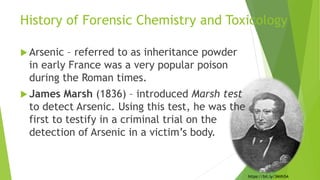
 James Marsh (1836) – introduced Marsh test
to detect Arsenic. Using this test, he was the
first to testify in a criminal trial on the
detection of Arsenic in a victim’s body.
https://bit.ly/3Milh5A
History of Forensic Chemistry and Toxicology
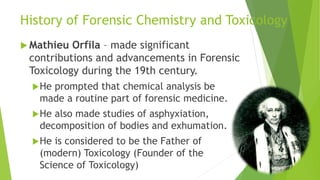
 Mathieu Orfila – made significant
contributions and advancements in Forensic
Toxicology during the 19th century.
He prompted that chemical analysis be
made a routine part of forensic medicine.
He also made studies of asphyxiation,
decomposition of bodies and exhumation.
He is considered to be the Father of
(modern) Toxicology (Founder of the
Science of Toxicology)
Development of the scientific crime
laboratory
Development of the scientific crime
laboratory in the Philippines
 In the Philippines, the first public recognition of the value
of science in the proper administration of justice was
made when the position of “Medicos Titulares” was
created in the country by virtue of the Royal Decree No.
188 of Spain dated March 31, 1876.
 For every province a Forensic physician was assigned to
perform public sanitary duties and at the same time
medico-legal aids to the administration of justice.
Development of the scientific crime
laboratory in the Philippines
 On December 15,1884, Governor General Joaquin
Javellar created a committee to study the mineral
waters of Luzon and appointed Anacleto del Rosario as
chemist.
 September 13, 1887 – the government established the
“Laboratorio Municipal de Manila” under the inspection
of “Direccion General de Administracion Civil” and the
control of “Gobierno de Provincias”
Development of the scientific crime
laboratory in the Philippines
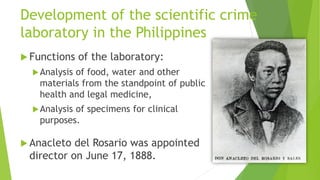
 Functions of the laboratory:
Analysis of food, water and other
materials from the standpoint of public
health and legal medicine,
Analysis of specimens for clinical
purposes.
 Anacleto del Rosario was appointed
director on June 17, 1888.
Development of the scientific crime
laboratory in the Philippines
 1889 – establishment of the 1st scientific lab in a small
building on the banks of Pasig river with Lt. R.P. Strong
of the US Army in charge
 1901 – Actual scientific work began under the initiative
of Dean C. Worcester by virtue of Act no. 156 approved
by the Civil Commission
Development of the scientific crime
laboratory in the Philippines
 July 1, 1901 – The Bureau of Government Laboratories
was created. Purpose: to perform biological and chemical
examinations and production of vaccines and sera.
 March 11, 1915 – Department of Legal Medicine was
created pursuant to the resolution of the Board of
Regents. The department took charge of the courses of
legal medicines and its branches in the College of Medicine
and Law.
Development of the scientific crime
laboratory in the Philippines
 Oct. 14, 1924 – Through Act No. 3043 by the Philippine
Legislature, the Department of Legal Medicine became a
branch of the Department of Justice and at the same time
an integral part of the University of the Philippines.
 Nov. 13, 1936 – A “Division of Investigation” (DI) under the
Department of Justice was created with the enactment of
Commonwealth Act No. 181. The DI formally organized in
1937 with 45 agents and about 100 officials and
employees. http://newsbits.mb.com.ph/2016/11/13/nbi-at-80/
Development of the scientific crime
laboratory in the Philippines
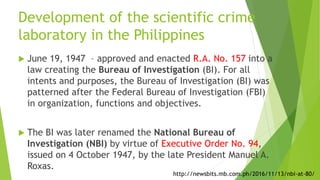
 June 19, 1947 – approved and enacted R.A. No. 157 into a
law creating the Bureau of Investigation (BI). For all
intents and purposes, the Bureau of Investigation (BI) was
patterned after the Federal Bureau of Investigation (FBI)
in organization, functions and objectives.
 The BI was later renamed the National Bureau of
Investigation (NBI) by virtue of Executive Order No. 94,
issued on 4 October 1947, by the late President Manuel A.
Roxas.
http://newsbits.mb.com.ph/2016/11/13/nbi-at-80/
From Left: President Roxas signing the Bill RA 157 creating the NBI;
and the old sweepstakes building along Taft Avenue, Manila which
housed the NBI from 1952 to 1972 http://newsbits.mb.com.ph/2016/11/13/nbi-at-80/
Development of the scientific crime
laboratory in the Philippines
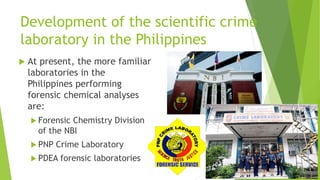
 At present, the more familiar
laboratories in the
Philippines performing
forensic chemical analyses
are:
 Forensic Chemistry Division
of the NBI
 PNP Crime Laboratory
 PDEA forensic laboratories
Forensic Chemistry and the Theory
of Forensic Analysis
Theory of Forensic Analysis
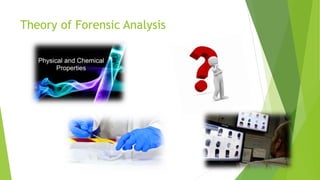
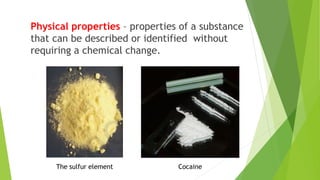
Physical properties – properties of a substance
that can be described or identified without
requiring a chemical change.
The sulfur element Cocaine
Chemical properties –
properties of a substance
that can be described
through a chemical change
only.
 Chemical change also
known as a chemical
reaction occurs when
starting substances
called reactants are
converted or transformed
into new substances
known as products.
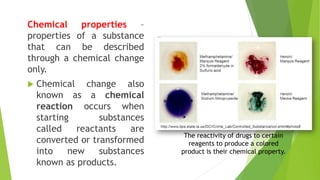
The reactivity of drugs to certain
reagents to produce a colored
product is their chemical property.
Physical and Chemical Properties
 Determine whether each of the following
statements describes a physical or chemical
property:
1. The fiber found in the crime scene is color blue
2. Black powder burns much more quickly than smokeless powder.
3. The average diameter of a red blood cell is 7.5 to 8.7 microns
4. After detonation the explosive produced a large amount of
white smoke.
5. The boiling point of the arson accelerant used is 200C
The Scientific
Method
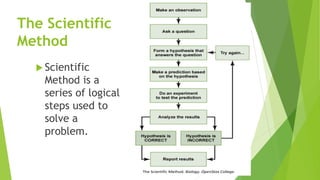
 Scientific
Method is a
series of logical
steps used to
solve a
problem.
Now once evidence (collected by a police officer or
investigator) is brought to the crime lab, the chemist
follows a specific process, based on the scientific
method, to analyze the evidence.
• Questioned samples – samples collected from the crime
scene and brought to the crime lab for analyses. The
identities and origins of these samples are unknown, hence
its namesake.
• Known samples – reference samples that may help to draw
conclusion on the questioned samples. These samples may
be collected as part of the evidence --- for example a hair
sample collected from a victim.
Forensic analyses may be performed to:
(1) identify a questioned sample or
(2) compare a questioned sample to a known sample
for the purpose of determining the source or origin
of the sample (where it came from).
The results of such comparisons can link a
questioned sample and several known samples either:
✓ to a class of samples with several possible origins
(classification) or
✓ to a single origin (individualization)
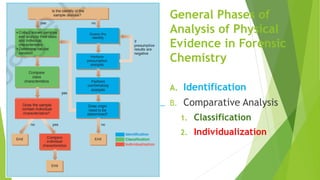
General Phases of
Analysis of Physical
Evidence in Forensic
Chemistry
A. Identification
B. Comparative Analysis
1. Classification
2. Individualization
Identification is the first task to be done when
analyzing a questioned sample in the crime
laboratory.
Following the scientific method, the chemist will
first make a hypothesis as to identify an unknown
substance.
And to validate that hypothesis, he now can
perform the 2 types of analysis to identify a
substance: presumptive then confirmatory analysis.
2 types of analysis to identify a substance
Presumptive analyses type of analyses that look at
chemical and physical properties that are not unique
enough by themselves for identification but provide
enough information to narrow the search
 Presumptive analysis may only reduce or “short-list”
the number of possibilities but does not totally
confirm the identity of the questioned sample.
 Quick and easy to perform.
 Help lead the analyses to a more expensive and
time-consuming confirmatory analyses.
Confirmatory analyses type of analyses that identify
the questioned sample absolutely.
✓ The type required by court
✓ Analyzes the unique physical and chemical
properties
✓ Makes use of a more complex instrumentation
✓ Confirmatory analysis is more expensive, more
time consuming, more laborious/ tiresome
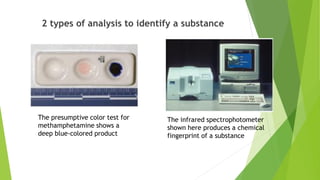
2 types of analysis to identify a substance
The presumptive color test for
methamphetamine shows a
deep blue-colored product
The infrared spectrophotometer
shown here produces a chemical
fingerprint of a substance
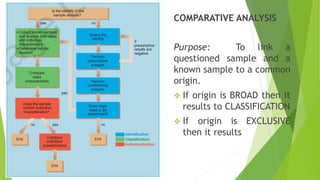
COMPARATIVE ANALYSIS
Purpose: To link a
questioned sample and a
known sample to a common
origin.
❖ If origin is BROAD then it
results to CLASSIFICATION
❖ If origin is EXCLUSIVE
then it results
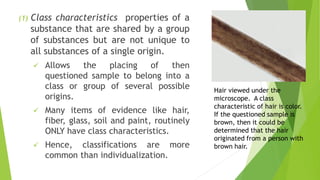
(1) Class characteristics properties of a
substance that are shared by a group
of substances but are not unique to
all substances of a single origin.
✓ Allows the placing of then
questioned sample to belong into a
class or group of several possible
origins.
✓ Many items of evidence like hair,
fiber, glass, soil and paint, routinely
ONLY have class characteristics.
✓ Hence, classifications are more
common than individualization.
Hair viewed under the
microscope. A class
characteristic of hair is color.
If the questioned sample is
brown, then it could be
determined that the hair
originated from a person with
brown hair.
2. Individual characteristics properties
of a substance that are unique and
can be used to establish origin
✓ Example: black hair sample with
intact root that can be subject to
DNA analysis. DNA would be
considered an individual
characteristics that would
exclusively link that hair sample to a
single origin (person)
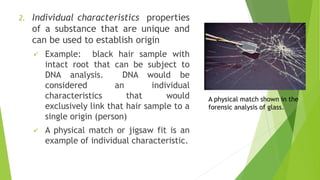
✓ A physical match or jigsaw fit is an
example of individual characteristic.
A physical match shown in the
forensic analysis of glass.
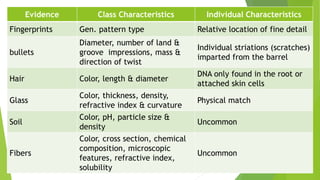
Evidence Class Characteristics Individual Characteristics
Fingerprints Gen. pattern type Relative location of fine detail
bullets
Diameter, number of land &
groove impressions, mass &
direction of twist
Individual striations (scratches)
imparted from the barrel
Hair Color, length & diameter
DNA only found in the root or
attached skin cells
Glass
Color, thickness, density,
refractive index & curvature
Physical match
Soil
Color, pH, particle size &
density
Uncommon
Fibers
Color, cross section, chemical
composition, microscopic
features, refractive index,
solubility
Uncommon
PRACTICE OF FORENSIC CHEMISTRY
STAGES IN THE PRACTICE OF FORENSIC CHEMISTRY
1. Collection or reception of the specimen to be
examined
2. Actual examination of the specimen
3. Communication of results of the examination
4. Court appearance.
STAGES IN THE PRACTICE OF FORENSIC CHEMISTRY
1. Collection or reception of the specimen to be examined
▪ The chemist should collect and/or receive the specimen
personally because questions regarding the collection,
preservation and transportation of the specimen may be
raised during the trial.
▪ The ffg. factors are considered in the collection:
▪ Sufficiency of samples
▪ Standard for comparison
▪ Maintenance of individuality
▪ Labelling and sealing
STAGES IN THE PRACTICE OF FORENSIC CHEMISTRY
1. Collection or reception of the specimen to
be examined
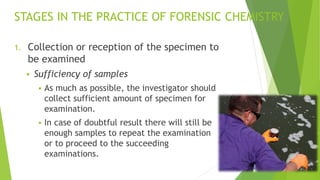
▪ Sufficiency of samples
▪ As much as possible, the investigator should
collect sufficient amount of specimen for
examination.
▪ In case of doubtful result there will still be
enough samples to repeat the examination
or to proceed to the succeeding
examinations.
STAGES IN THE PRACTICE OF FORENSIC CHEMISTRY
1. Collection or reception of the specimen to be
examined
▪ Standard for comparison
▪ When the evidence in question is located in or
added with a foreign substance, a sample of such
foreign substance must be submitted for analysis.
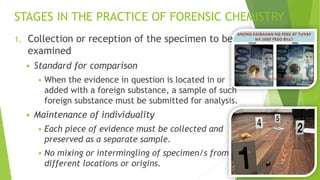
▪ Maintenance of individuality
▪ Each piece of evidence must be collected and
preserved as a separate sample.
▪ No mixing or intermingling of specimen/s from
different locations or origins.
STAGES IN THE PRACTICE OF FORENSIC CHEMISTRY
1. Collection or reception of the specimen to
be examined
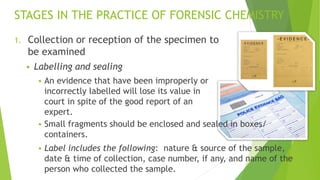
▪ Labelling and sealing
▪ An evidence that have been improperly or
incorrectly labelled will lose its value in
court in spite of the good report of an
expert.
▪ Small fragments should be enclosed and sealed in boxes/
containers.
▪ Label includes the following: nature & source of the sample,
date & time of collection, case number, if any, and name of the
person who collected the sample.
STAGES IN THE PRACTICE OF FORENSIC CHEMISTRY
2. Actual Examination of the Specimen
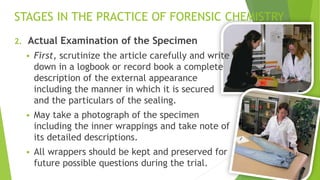
▪ First, scrutinize the article carefully and write
down in a logbook or record book a complete
description of the external appearance
including the manner in which it is secured
and the particulars of the sealing.
▪ May take a photograph of the specimen
including the inner wrappings and take note of
its detailed descriptions.
▪ All wrappers should be kept and preserved for
future possible questions during the trial.
STAGES IN THE PRACTICE OF FORENSIC CHEMISTRY
2. Actual Examination of the Specimen
▪ Second step is to measure or weigh the
object/ specimen. Again, this will be
recorded in a logbook
▪ Then the specimen shall be placed again
in a proper container or wrapper and
kept in the evidence room.
▪ Third step is the laboratory examination
which includes the physical, chemical
and confirmatory tests.
STAGES IN THE PRACTICE OF FORENSIC CHEMISTRY
3. Communication of the results of the examination
▪ Communication of the results is in the form of a written
report which must include an enumeration of facts on the
specimen with detailed description of the following:
▪ Packaging, sealing and labelling
▪ Date of receipt
▪ From whom it was received
▪ Purpose of the examination
▪ Findings and conclusion
STAGES IN THE PRACTICE OF FORENSIC CHEMISTRY
4. Court Appearance
▪ The written report of the forensic chemist
is usually supplemented by testimonial
evidence in a later date if the case is
brought to court or the fiscals’ office.
▪ The chemist should be able to refer to his/
her logbook to refresh his memory before
presenting himself in court in cases
wherein the testimonial evidence is given
in weeks, months or even years after the
examination and the written report have
been made.
SIX GOLDEN RULES IN THE
PRACTICE OF FORENSIC CHEMISTRY
SIX GOLDEN RULES IN THE PRACTICE OF
FORENSIC CHEMISTRY
1. Go slowly
• “Haste makes waste” – take all the time necessary to
make the case complete no matter how urgent it may
appear.
2. Be thorough
• Make careful and minute examination of everything. It
is better to do too much than too little.
3. Take notes
• Keep a full record of everything seen and done.
SIX GOLDEN RULES IN THE PRACTICE OF
FORENSIC CHEMISTRY
4. Consult others
• Many cases may lead the chemist into unfamiliar
data. Consult other experts in such situations.
5. Use imagination
• Being imaginative can sometimes be useful in a way
that one can create scenarios and what-ifs in his
mind. But of course, he must bear witness within
the limits of science.
SIX GOLDEN RULES IN THE PRACTICE OF
FORENSIC CHEMISTRY
6. Avoid complicated theories
• The simplest explanation is fundamentally the right
one. Interpretation of the results is often the most
difficult part of the expert’s task that is why a wide
knowledge and scientific experience are the essential
elements to obtain the right forensic examination
results.
THE FORENSIC CHEMISTRY
DIVISION OF THE
PHILIPPINE NATIONAL POLICE
An Overview
Mission, Objectives and Functions
MISSION
 To provide accurate scientific investigation services
and other technical support to PNP offices and
other investigative agencies through application of
principles of Chemistry.
OBJECTIVES
 Speedy and accurate conduct of forensic examinations
 Timely production of accurate laboratory reports of all
forensic chemistry examinations
 Provision of updated research and development to all
cases and lectures in the field; and
 Provision of expert opinion in different courts
Functions of a Forensic Chemist in the
PNP Forensic Chemistry Division
Forensic chemists employ their
knowledge of chemistry to analyze
physical evidence submitted to the crime
laboratory in order to expedite the
investigation of a crime by the
investigating party.
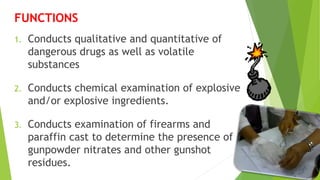
FUNCTIONS
1. Conducts qualitative and quantitative of
dangerous drugs as well as volatile
substances
2. Conducts chemical examination of explosive
and/or explosive ingredients.
3. Conducts examination of firearms and
paraffin cast to determine the presence of
gunpowder nitrates and other gunshot
residues.
4. Conducts chemical examination of clothing for
possible gunshot range
5. Conducts physical and/ or chemico-toxicological
examination of gastric contents, blood, human
internal organs, water, food sample and other
samples that contain poisons
6. Conducts examination of fake products in
comparison with standard specifications for cases of
unfair trade competition.
FUNCTIONS
7. Conducts blood alcohol determination
8. Examines urine samples and other body fluids for
the presence of abused drugs and their
metabolites
9. Conducts researches related to cases being
examined.
10. Testifies and gives expert opinion in court.
FUNCTIONS
11. Gives lectures on Forensic Chemistry and Chemical-toxicology
to various police and military training institutions, schools,
universities, and other investigating units.
12. Responds to queries of all investigating units and render
expert opinion on matters related to the application of
chemical principles for the purpose of assisting investigators
to develop investigative leads.
13. Performs all other official duties assigned by the Director, PNP
Crime Laboratory or his duly authorized representatives.
FUNCTIONS
Forensic Chemistry cases shall cover the examination of
various physical evidence containing the following:
a) Dangerous drugs and volatile substances
b) Explosives and/or explosive ingredients
c) Samples for gunpowder and gunshot residues
d) Poisons
e) Fake products
f) Drug metabolites in urine and other body fluids
g) Clandestine laboratory samples and
h) Other physical evidence that requires chemical analysis
SCOPE OF EXAMINATION OF PNP
FORENSIC CHEMISTRY DIVISION
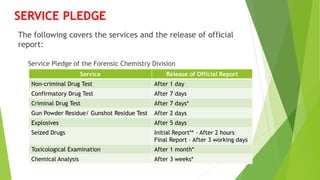
The following covers the services and the release of official
report:
SERVICE PLEDGE
Service Release of Official Report
Non-criminal Drug Test After 1 day
Confirmatory Drug Test After 7 days
Criminal Drug Test After 7 days*
Gun Powder Residue/ Gunshot Residue Test After 2 days
Explosives After 5 days
Seized Drugs Initial Report** - After 2 hours
Final Report – After 3 working days
Toxicological Examination After 1 month*
Chemical Analysis After 3 weeks*
Service Pledge of the Forensic Chemistry Division
END

Introduction to Forensic Chemistry-2.pdf

  • 1.
    Basic Concepts, History, Principlesand Significance and Value of Forensic Chemistry in Criminal Investigation
  • 2.
    At the endof the lesson, students should be able to:  Define forensic chemistry and forensic toxicology  Utilize the basic concepts of Chemistry in the analysis of a physical evidence.  Appreciate the relevance and function of the Forensic Chemistry division of the Philippine National Police in the investigation of crime in the Philippines.  Recognize the major contributors to the development of scientific crime laboratories Differentiate physical properties and chemical properties of a substance.  Apply their knowledge of scientific method as basis of identification of physical evidence  Determine the importance of the Class characteristics and individual characteristics of physical evidence.
  • 3.
    What is ForensicChemistry?  Forensic chemistry is defined as that branch of chemistry that deals with the study and application of chemical principles in the solution of crimes and problems that arise in connection with the administration of justice.  Chemistry applied in the elucidation of legal problem.
  • 4.
    What is ForensicToxicology?  Forensic toxicology deals with examination of human internal organs, food samples and water and gastric contents for the purpose of detecting the presence of poisonous substance, its dosage, effects and treatment.  Toxicology is a sub-branch of pharmacology that studies the effects of poisons on living organisms.
  • 5.
     Fibers  Paints,explosives  Charred debris  Drugs  Glass  Soil  Documents  Toolmarks  Firearms A large number of forensic scientists are chemists. Forensic chemists employ their knowledge of chemistry to analyze evidence such as:
  • 6.
    To a lesserextent, forensic chemists also use their knowledge for toxicology, fingerprints, footwear impression, tire impressions and hair analyses. Although many forensic analyses require the expertise of a chemist, chemistry is not the only discipline that contributes to the extremely vast and truly interdisciplinary field of forensic science.
  • 7.
    History of ForensicChemistry and Toxicology
  • 8.
    History of ForensicChemistry and Toxicology  Democritus – a Greek philosopher who was probably the first chemist to study poisons. He communicated some of his findings with Hippocrates (Father of Medicine)  Poisons during the early times were used for murder and execution Socrates – sentenced to death by poisoning using the deadly plant, hemlock.
  • 9.
    History of ForensicChemistry and Toxicology  Arsenic – referred to as inheritance powder in early France was a very popular poison during the Roman times.  James Marsh (1836) – introduced Marsh test to detect Arsenic. Using this test, he was the first to testify in a criminal trial on the detection of Arsenic in a victim’s body. https://bit.ly/3Milh5A
  • 10.
    History of ForensicChemistry and Toxicology  Mathieu Orfila – made significant contributions and advancements in Forensic Toxicology during the 19th century. He prompted that chemical analysis be made a routine part of forensic medicine. He also made studies of asphyxiation, decomposition of bodies and exhumation. He is considered to be the Father of (modern) Toxicology (Founder of the Science of Toxicology)
  • 11.
    Development of thescientific crime laboratory
  • 12.
    Development of thescientific crime laboratory in the Philippines  In the Philippines, the first public recognition of the value of science in the proper administration of justice was made when the position of “Medicos Titulares” was created in the country by virtue of the Royal Decree No. 188 of Spain dated March 31, 1876.  For every province a Forensic physician was assigned to perform public sanitary duties and at the same time medico-legal aids to the administration of justice.
  • 13.
    Development of thescientific crime laboratory in the Philippines  On December 15,1884, Governor General Joaquin Javellar created a committee to study the mineral waters of Luzon and appointed Anacleto del Rosario as chemist.  September 13, 1887 – the government established the “Laboratorio Municipal de Manila” under the inspection of “Direccion General de Administracion Civil” and the control of “Gobierno de Provincias”
  • 14.
    Development of thescientific crime laboratory in the Philippines  Functions of the laboratory: Analysis of food, water and other materials from the standpoint of public health and legal medicine, Analysis of specimens for clinical purposes.  Anacleto del Rosario was appointed director on June 17, 1888.
  • 15.
    Development of thescientific crime laboratory in the Philippines  1889 – establishment of the 1st scientific lab in a small building on the banks of Pasig river with Lt. R.P. Strong of the US Army in charge  1901 – Actual scientific work began under the initiative of Dean C. Worcester by virtue of Act no. 156 approved by the Civil Commission
  • 16.
    Development of thescientific crime laboratory in the Philippines  July 1, 1901 – The Bureau of Government Laboratories was created. Purpose: to perform biological and chemical examinations and production of vaccines and sera.  March 11, 1915 – Department of Legal Medicine was created pursuant to the resolution of the Board of Regents. The department took charge of the courses of legal medicines and its branches in the College of Medicine and Law.
  • 17.
    Development of thescientific crime laboratory in the Philippines  Oct. 14, 1924 – Through Act No. 3043 by the Philippine Legislature, the Department of Legal Medicine became a branch of the Department of Justice and at the same time an integral part of the University of the Philippines.  Nov. 13, 1936 – A “Division of Investigation” (DI) under the Department of Justice was created with the enactment of Commonwealth Act No. 181. The DI formally organized in 1937 with 45 agents and about 100 officials and employees. http://newsbits.mb.com.ph/2016/11/13/nbi-at-80/
  • 18.
    Development of thescientific crime laboratory in the Philippines  June 19, 1947 – approved and enacted R.A. No. 157 into a law creating the Bureau of Investigation (BI). For all intents and purposes, the Bureau of Investigation (BI) was patterned after the Federal Bureau of Investigation (FBI) in organization, functions and objectives.  The BI was later renamed the National Bureau of Investigation (NBI) by virtue of Executive Order No. 94, issued on 4 October 1947, by the late President Manuel A. Roxas. http://newsbits.mb.com.ph/2016/11/13/nbi-at-80/
  • 19.
    From Left: PresidentRoxas signing the Bill RA 157 creating the NBI; and the old sweepstakes building along Taft Avenue, Manila which housed the NBI from 1952 to 1972 http://newsbits.mb.com.ph/2016/11/13/nbi-at-80/
  • 20.
    Development of thescientific crime laboratory in the Philippines  At present, the more familiar laboratories in the Philippines performing forensic chemical analyses are:  Forensic Chemistry Division of the NBI  PNP Crime Laboratory  PDEA forensic laboratories
  • 21.
    Forensic Chemistry andthe Theory of Forensic Analysis
  • 22.
  • 23.
    Physical properties –properties of a substance that can be described or identified without requiring a chemical change. The sulfur element Cocaine
  • 24.
    Chemical properties – propertiesof a substance that can be described through a chemical change only.  Chemical change also known as a chemical reaction occurs when starting substances called reactants are converted or transformed into new substances known as products. The reactivity of drugs to certain reagents to produce a colored product is their chemical property.
  • 25.
    Physical and ChemicalProperties  Determine whether each of the following statements describes a physical or chemical property: 1. The fiber found in the crime scene is color blue 2. Black powder burns much more quickly than smokeless powder. 3. The average diameter of a red blood cell is 7.5 to 8.7 microns 4. After detonation the explosive produced a large amount of white smoke. 5. The boiling point of the arson accelerant used is 200C
  • 26.
    The Scientific Method  Scientific Methodis a series of logical steps used to solve a problem.
  • 27.
    Now once evidence(collected by a police officer or investigator) is brought to the crime lab, the chemist follows a specific process, based on the scientific method, to analyze the evidence. • Questioned samples – samples collected from the crime scene and brought to the crime lab for analyses. The identities and origins of these samples are unknown, hence its namesake. • Known samples – reference samples that may help to draw conclusion on the questioned samples. These samples may be collected as part of the evidence --- for example a hair sample collected from a victim.
  • 28.
    Forensic analyses maybe performed to: (1) identify a questioned sample or (2) compare a questioned sample to a known sample for the purpose of determining the source or origin of the sample (where it came from). The results of such comparisons can link a questioned sample and several known samples either: ✓ to a class of samples with several possible origins (classification) or ✓ to a single origin (individualization)
  • 29.
    General Phases of Analysisof Physical Evidence in Forensic Chemistry A. Identification B. Comparative Analysis 1. Classification 2. Individualization
  • 30.
    Identification is thefirst task to be done when analyzing a questioned sample in the crime laboratory. Following the scientific method, the chemist will first make a hypothesis as to identify an unknown substance. And to validate that hypothesis, he now can perform the 2 types of analysis to identify a substance: presumptive then confirmatory analysis.
  • 31.
    2 types ofanalysis to identify a substance Presumptive analyses type of analyses that look at chemical and physical properties that are not unique enough by themselves for identification but provide enough information to narrow the search  Presumptive analysis may only reduce or “short-list” the number of possibilities but does not totally confirm the identity of the questioned sample.  Quick and easy to perform.  Help lead the analyses to a more expensive and time-consuming confirmatory analyses.
  • 32.
    Confirmatory analyses typeof analyses that identify the questioned sample absolutely. ✓ The type required by court ✓ Analyzes the unique physical and chemical properties ✓ Makes use of a more complex instrumentation ✓ Confirmatory analysis is more expensive, more time consuming, more laborious/ tiresome
  • 33.
    2 types ofanalysis to identify a substance The presumptive color test for methamphetamine shows a deep blue-colored product The infrared spectrophotometer shown here produces a chemical fingerprint of a substance
  • 34.
    COMPARATIVE ANALYSIS Purpose: Tolink a questioned sample and a known sample to a common origin. ❖ If origin is BROAD then it results to CLASSIFICATION ❖ If origin is EXCLUSIVE then it results
  • 35.
    (1) Class characteristicsproperties of a substance that are shared by a group of substances but are not unique to all substances of a single origin. ✓ Allows the placing of then questioned sample to belong into a class or group of several possible origins. ✓ Many items of evidence like hair, fiber, glass, soil and paint, routinely ONLY have class characteristics. ✓ Hence, classifications are more common than individualization. Hair viewed under the microscope. A class characteristic of hair is color. If the questioned sample is brown, then it could be determined that the hair originated from a person with brown hair.
  • 36.
    2. Individual characteristicsproperties of a substance that are unique and can be used to establish origin ✓ Example: black hair sample with intact root that can be subject to DNA analysis. DNA would be considered an individual characteristics that would exclusively link that hair sample to a single origin (person) ✓ A physical match or jigsaw fit is an example of individual characteristic. A physical match shown in the forensic analysis of glass.
  • 37.
    Evidence Class CharacteristicsIndividual Characteristics Fingerprints Gen. pattern type Relative location of fine detail bullets Diameter, number of land & groove impressions, mass & direction of twist Individual striations (scratches) imparted from the barrel Hair Color, length & diameter DNA only found in the root or attached skin cells Glass Color, thickness, density, refractive index & curvature Physical match Soil Color, pH, particle size & density Uncommon Fibers Color, cross section, chemical composition, microscopic features, refractive index, solubility Uncommon
  • 38.
  • 39.
    STAGES IN THEPRACTICE OF FORENSIC CHEMISTRY 1. Collection or reception of the specimen to be examined 2. Actual examination of the specimen 3. Communication of results of the examination 4. Court appearance.
  • 40.
    STAGES IN THEPRACTICE OF FORENSIC CHEMISTRY 1. Collection or reception of the specimen to be examined ▪ The chemist should collect and/or receive the specimen personally because questions regarding the collection, preservation and transportation of the specimen may be raised during the trial. ▪ The ffg. factors are considered in the collection: ▪ Sufficiency of samples ▪ Standard for comparison ▪ Maintenance of individuality ▪ Labelling and sealing
  • 41.
    STAGES IN THEPRACTICE OF FORENSIC CHEMISTRY 1. Collection or reception of the specimen to be examined ▪ Sufficiency of samples ▪ As much as possible, the investigator should collect sufficient amount of specimen for examination. ▪ In case of doubtful result there will still be enough samples to repeat the examination or to proceed to the succeeding examinations.
  • 42.
    STAGES IN THEPRACTICE OF FORENSIC CHEMISTRY 1. Collection or reception of the specimen to be examined ▪ Standard for comparison ▪ When the evidence in question is located in or added with a foreign substance, a sample of such foreign substance must be submitted for analysis. ▪ Maintenance of individuality ▪ Each piece of evidence must be collected and preserved as a separate sample. ▪ No mixing or intermingling of specimen/s from different locations or origins.
  • 43.
    STAGES IN THEPRACTICE OF FORENSIC CHEMISTRY 1. Collection or reception of the specimen to be examined ▪ Labelling and sealing ▪ An evidence that have been improperly or incorrectly labelled will lose its value in court in spite of the good report of an expert. ▪ Small fragments should be enclosed and sealed in boxes/ containers. ▪ Label includes the following: nature & source of the sample, date & time of collection, case number, if any, and name of the person who collected the sample.
  • 44.
    STAGES IN THEPRACTICE OF FORENSIC CHEMISTRY 2. Actual Examination of the Specimen ▪ First, scrutinize the article carefully and write down in a logbook or record book a complete description of the external appearance including the manner in which it is secured and the particulars of the sealing. ▪ May take a photograph of the specimen including the inner wrappings and take note of its detailed descriptions. ▪ All wrappers should be kept and preserved for future possible questions during the trial.
  • 45.
    STAGES IN THEPRACTICE OF FORENSIC CHEMISTRY 2. Actual Examination of the Specimen ▪ Second step is to measure or weigh the object/ specimen. Again, this will be recorded in a logbook ▪ Then the specimen shall be placed again in a proper container or wrapper and kept in the evidence room. ▪ Third step is the laboratory examination which includes the physical, chemical and confirmatory tests.
  • 46.
    STAGES IN THEPRACTICE OF FORENSIC CHEMISTRY 3. Communication of the results of the examination ▪ Communication of the results is in the form of a written report which must include an enumeration of facts on the specimen with detailed description of the following: ▪ Packaging, sealing and labelling ▪ Date of receipt ▪ From whom it was received ▪ Purpose of the examination ▪ Findings and conclusion
  • 47.
    STAGES IN THEPRACTICE OF FORENSIC CHEMISTRY 4. Court Appearance ▪ The written report of the forensic chemist is usually supplemented by testimonial evidence in a later date if the case is brought to court or the fiscals’ office. ▪ The chemist should be able to refer to his/ her logbook to refresh his memory before presenting himself in court in cases wherein the testimonial evidence is given in weeks, months or even years after the examination and the written report have been made.
  • 48.
    SIX GOLDEN RULESIN THE PRACTICE OF FORENSIC CHEMISTRY
  • 49.
    SIX GOLDEN RULESIN THE PRACTICE OF FORENSIC CHEMISTRY 1. Go slowly • “Haste makes waste” – take all the time necessary to make the case complete no matter how urgent it may appear. 2. Be thorough • Make careful and minute examination of everything. It is better to do too much than too little. 3. Take notes • Keep a full record of everything seen and done.
  • 50.
    SIX GOLDEN RULESIN THE PRACTICE OF FORENSIC CHEMISTRY 4. Consult others • Many cases may lead the chemist into unfamiliar data. Consult other experts in such situations. 5. Use imagination • Being imaginative can sometimes be useful in a way that one can create scenarios and what-ifs in his mind. But of course, he must bear witness within the limits of science.
  • 51.
    SIX GOLDEN RULESIN THE PRACTICE OF FORENSIC CHEMISTRY 6. Avoid complicated theories • The simplest explanation is fundamentally the right one. Interpretation of the results is often the most difficult part of the expert’s task that is why a wide knowledge and scientific experience are the essential elements to obtain the right forensic examination results.
  • 52.
    THE FORENSIC CHEMISTRY DIVISIONOF THE PHILIPPINE NATIONAL POLICE An Overview
  • 53.
  • 54.
    MISSION  To provideaccurate scientific investigation services and other technical support to PNP offices and other investigative agencies through application of principles of Chemistry.
  • 55.
    OBJECTIVES  Speedy andaccurate conduct of forensic examinations  Timely production of accurate laboratory reports of all forensic chemistry examinations  Provision of updated research and development to all cases and lectures in the field; and  Provision of expert opinion in different courts
  • 56.
    Functions of aForensic Chemist in the PNP Forensic Chemistry Division Forensic chemists employ their knowledge of chemistry to analyze physical evidence submitted to the crime laboratory in order to expedite the investigation of a crime by the investigating party.
  • 57.
    FUNCTIONS 1. Conducts qualitativeand quantitative of dangerous drugs as well as volatile substances 2. Conducts chemical examination of explosive and/or explosive ingredients. 3. Conducts examination of firearms and paraffin cast to determine the presence of gunpowder nitrates and other gunshot residues.
  • 58.
    4. Conducts chemicalexamination of clothing for possible gunshot range 5. Conducts physical and/ or chemico-toxicological examination of gastric contents, blood, human internal organs, water, food sample and other samples that contain poisons 6. Conducts examination of fake products in comparison with standard specifications for cases of unfair trade competition. FUNCTIONS
  • 59.
    7. Conducts bloodalcohol determination 8. Examines urine samples and other body fluids for the presence of abused drugs and their metabolites 9. Conducts researches related to cases being examined. 10. Testifies and gives expert opinion in court. FUNCTIONS
  • 60.
    11. Gives lectureson Forensic Chemistry and Chemical-toxicology to various police and military training institutions, schools, universities, and other investigating units. 12. Responds to queries of all investigating units and render expert opinion on matters related to the application of chemical principles for the purpose of assisting investigators to develop investigative leads. 13. Performs all other official duties assigned by the Director, PNP Crime Laboratory or his duly authorized representatives. FUNCTIONS
  • 61.
    Forensic Chemistry casesshall cover the examination of various physical evidence containing the following: a) Dangerous drugs and volatile substances b) Explosives and/or explosive ingredients c) Samples for gunpowder and gunshot residues d) Poisons e) Fake products f) Drug metabolites in urine and other body fluids g) Clandestine laboratory samples and h) Other physical evidence that requires chemical analysis SCOPE OF EXAMINATION OF PNP FORENSIC CHEMISTRY DIVISION
  • 62.
    The following coversthe services and the release of official report: SERVICE PLEDGE Service Release of Official Report Non-criminal Drug Test After 1 day Confirmatory Drug Test After 7 days Criminal Drug Test After 7 days* Gun Powder Residue/ Gunshot Residue Test After 2 days Explosives After 5 days Seized Drugs Initial Report** - After 2 hours Final Report – After 3 working days Toxicological Examination After 1 month* Chemical Analysis After 3 weeks* Service Pledge of the Forensic Chemistry Division
  • 63.