Immunity and
Hypersensitivity
• Faculty- Dr. Shefali Goyal
(Pathology)
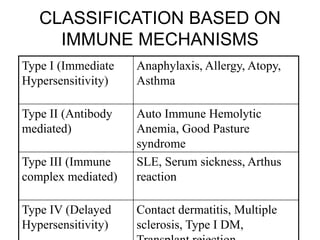
Type I (Immediate
Hypersensitivity)
Anaphylaxis, Allergy, Atopy,
Asthma
Type II (Antibody
mediated)
Auto Immune Hemolytic
Anemia, Good Pasture
syndrome
Type III (Immune
complex mediated)
SLE, Serum sickness, Arthus
reaction
Type IV (Delayed
Hypersensitivity)
Contact dermatitis, Multiple
sclerosis, Type I DM,
CLASSIFICATION BASED ON
IMMUNE MECHANISMS
MECHANISMS OF
HYPERSENSITIVITY RN:
Type I: Immediate
hypersensitivity:
• Production of IgE antibody, release of
vasoactive amines and other mediators
from mast cells; recruitment of other
inflammatory cells (late phase reaction).
• Pathologic lesions: Vascular dilatation,
edema, smooth muscle contraction, mucus
production, inflammation.
Immediate (type I) hypersensitivity:
• Rapidly developing reaction
• Occurring within minutes, a state of shock is
produced; may be fatal.
• In individuals previously sensitized.
1. Immediate response: vasodilatation,
vascular leakage, smooth muscle spasm,
glandular secretions.
2. Late phase: infiltration of tissue by
eosinophils, basophils, monocytes; tissue
destruction, mucosal epithelium damage.
Prototype disorders:
• Anaphylaxis
• Allergies (food allergy, allergic rhinitis and
conjunctivitis)
• Asthma (Bronchial)
• Atopic forms (Hay fever)
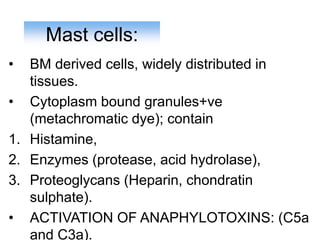
Mast cells:
• BM derived cells, widely distributed in
tissues.
• Cytoplasm bound granules+ve
(metachromatic dye); contain
1. Histamine,
2. Enzymes (protease, acid hydrolase),
3. Proteoglycans (Heparin, chondratin
sulphate).
• ACTIVATION OF ANAPHYLOTOXINS: (C5a
and C3a).
Never forget:
1. Dendritic cells—capture antigens
2. T cells differentiate to TH-2 cells
3. IL 4 activates B cells to produce Ig E
4. Ig E attracts mast cells
(Mast cells and basophils express Ig E
receptors).
5. IL 5 activates eosinophils
6. IL 13 activates epithelial cells to produce
mucous.
PRIMARY MEDIATORS OF
ALLERGY
• Histamine
• Adenosine
• Heparin
• Tryptase
• Kinins
• Complements
Primary mediators:
• Biogenic amines: Histamine: smooth muscle
contraction, increased vascular permeability.
• Enzymes: Protease (chymase, tryptase) acid
hydrolases : tissue damage.
• Proteoglycans: Heparin (anticoagulant) &
Chondratin sulphate.
SECONDARY MEDIATORS OF
ALLERGY
• Lipid mediators:: Leukotrienes- LTC4,
LTD4; Prostaglandins- PGD2
• Cytokines:: PAF, TNF, IL-1, 4, 5, 6. Eotaxin
• IL-4 is mast cell regulator; released by T
cells.
Secondary mediators:
• Arachidonic acid derivatives: Leukotriens B4,
C4, D4—bronchial smooth muscle spasm,
vasodilatation, chemotactic for neutrophils,
eosinophils.
• Prostaglandin D2: intense bronchospasm,
mucous secretion.
• PAF (Platelet Activating Factor): platelet
aggregation, bronchospasm, vasodilatation.
• Cytokines
Susceptibility: Genetically
determined
• ATOPY: predisposition to develop
immediate hypersensitivity reaction to a
variety of inhaled and ingested allergens.
• Atopic individuals have increased serum
levels of Ig E levels, and more IL 4
producing TH 2 cells.
Systemic Anaphylaxis:
• C/F: Vascular shock, wide spread edema,
difficulty in breathing, laryngeal edema,
vomiting diarrhea, even may die.
• Occur after antisera, drugs (penicillin),
hormones, enzymes.
• Previous history of allergy is important.
ANTIBODY MEDIATED
(TYPE II) HYPERSENSITIVITY:
Mechanism:
• Antibodies are directed against antigens
present on cell surface or extracellular
substances.
• Three different mechanisms:
1. Opsonization & compliment & Fc-receptor –
mediated phagocytosis.
2. Compliment and Fc receptor mediated
inflammation.
3. Antibody mediated cellular dysfunction.
Type II hypersensitivity:
• O: Autoimmune hemolytic anemia, ATP,
Transfusion rn, erythroblastosis fetalis.
• C: Vasculitis, Goodpasture syndrome, ARF,
glomerulonephritis.
• A: Myasthenia Gravis, Grave’s disease, insulin
resistant DM, Pernicious anemia, Pemphigus
vulgaris.
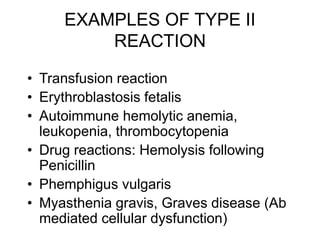
EXAMPLES OF TYPE II
REACTION
• Transfusion reaction
• Erythroblastosis fetalis
• Autoimmune hemolytic anemia,
leukopenia, thrombocytopenia
• Drug reactions: Hemolysis following
Penicillin
• Phemphigus vulgaris
• Myasthenia gravis, Graves disease (Ab
mediated cellular dysfunction)
Type III hypersensitivity:
• IMMUNE COMPLEX MEDIATED: Ag-Ab
complexes produces tissue damage mainly
by eliciting inflammation at the site of
deposition.
• Circulating immune complexes are
deposited typically in vessel wall.
• It represents normal mechanism of Ag
removal.
• Two types: Systemic/ Localized.
Immune complex mediated:
• SP-PARAS:
• S: Systemic lupus erythematosis (SLE)
• P: Polyathritis nodosa (PAN)
• P: Post-streptococcal GN
• A: Acute GN (AGN)
• R: Reactive Arthritis
• A: Arthus reaction
• S; Serum sickness
Mechanisms:
• Phase I: Immune complex
formation
• Phase II: Immune complex
deposition
• Phase III: Immune complex
mediated inflammation
Factors influencing:
• Size of immune complexes: larger complexes –
rapidly removed. So relatively harmless; smaller
–circulate longer—dangerous.
• Functional status of mononuclear phagocytic
system: intrinsic dysfunction of phagocytic
system—persistence of immune complexes in
circulation.
• Charge, affinity, structure, hemodynamic
factors…,etc.
CELL MEDIATED (type IV)
Hypersensitivity:
• Types:
1. Delayed- type hypersensitivity: CD4
+ T- cell mediated toxicity.
2. Direct T- cell mediated cytolysis:
CD 8 + T- cells.
Delayed Type Hypersensitivity:
• Classic E.g..is Tuberculosis reaction:
tuberculin injection-intracutaneous-
reddening and induration appear in 8-12
hours; reaches peak by 24 –72 hours;
thereafter gradually subsides.
• Morphology: perivascular mononuclear
cells cuffing.
DELAYED HYPERSENSITIVITY
Tuberculin reaction
• To identify susceptible persons in the
population prone for tuberculosis
• Screening procedure; not diagnostic of
disease.
• Performed in family members of patient
with open tuberculosis
• To know the family members who can get
afflicted, who are already exposed and
Immune.
TUBERCULIN TEST
• Procedure: Intracutaneous Inj. of Protein
Lipopolysaccharide (LPS) extract of
Tubercle bacillus (0.1ml)
• Mark the skin site (Volar aspect of
forearm)
• Read the result after 8 to 12 hrs
• Erythema, induration appear and peak by
24 to 72 hrs
• Response measured on size of
• Persons are categorized as Mild, Severe
and No reaction
• Persons who are immune and
sensitized show mild reaction::::
Normal.
• Persons who are not Immune, Immune
suppressed, Immune deficient show--No
response
• Persons who are Very sensitive are more
susceptible show Severe reaction.
• Conversion of Negative to Positive
Tuberculin is more significant.
• This test is not used to detect tuberculosis
• Done to see susceptible persons who are
around a case of Tuberculosis
• Persons who show No reaction and
Severe reaction----- need Anti Tb
prophylaxis
• Mild reaction persons need not be given
prophylaxis.
• Persons with No reaction: Immune
suppression to be ruled out.
• Microscopy: Perivascular (Cuffing)
accumulation of CD4+ helper T cells,
Macrophages
• Dermal edema, Fibrin deposition
• Pathogenesis of Tuberculin Reaction:
- First exposure.. The CD 4+ T cells are
formed and stay in circulation as memory T
cells
- Subsequent exposure there is response
of memory T cells to antigens
TUBERCULOSIS
TUBERCULOSIS
Infects one third of the Worlds
population
Kills about 3 million patients each year
Single most infectious cause of death on
Earth
Etiology
• Mycobacterium tuberculosis
• Mycobacterium bovis
• Mycobacterium avium
• Mycobacterium intracellulare
Mycobacteria - aerobic , non-spore bearing,
non-motile , waxy coat, AFB – positive;
Caseation
• Lysis of Macrophages
• Direct toxicity of mycobacteria to
macrophages
• Cytokines released by macrophages such
as TNF
• Inadequate blood supply
Mycobacteria cannot grow in this acidic
environment lacking oxygen & so infection
is controlled
Types
• PRIMARY
• SECONDARY
• PROGRESSIVE PULMONARY
- Cavitary Fibrocaseous Tuberculosis
- Miliary Tuberculosis
- Tuberculous Bronchopneumonia
TRANSPLANT REJECTION
• Complex phenomenon
• Both Cell and Ab mediated immune
response
• Renal, Hepatic, Cardiac, Bone marrow
• Recognition of graft as Foreign is by Direct
& Indirect pathway
• Damage is mediated by parenchymal &
endothelial cell disruption
• Cytokine, Microvascular injury, Ischemia
Transplant Rejection
• Graft rejection is an immunological
response mediated primarily by T-cells
• Major antigens involved : MHC complex
• Minor antigens: Minor H antigens
– Variable non-MHC proteins
– Presented via MHC I molecules
– Rejection is slower
MORPHOLOGY OF GRAFT
REJECTION
• Hyperacute, Acute Cellular, Acute Humoral,
Chronic
• HYPERACUTE: Preformed Anti donor Ab are
present in circulation.
• Rejection occurs within minutes (On table)
• Graft is Cyanotic, Mottled, Flaccid.
• Widespread Acute arteritis, thrombosis,
necrosis
• Can be avoided by screening Antibodies and
Cross reaction methods
Hyperacute Graft Rejection
• Donor has preexisting ABO antibodies
– Previous blood transfusions
– ABO antigens also present on leukocytes, endothelial
cells
• During surgery antibodies bind to endothelial
vessels of graft
• Immediate activation of complement, blood
clotting
• Can be prevented by cross matching donor and
recipient
• ACUTE REJECTION: Days to weeks to
months
• Both Humoral & Cellular rejection.
• Can be delayed by Immunosuppression
• Humoral rejection Vasculitis
• Cellular rejection  Edema, parenchymal
damage
• CHRONIC REJECTION: Months to
years
• There is vascular damage, loss of
parenchyma, interstitial fibrosis
• Compromised blood supply, chronic
healing, effects of immunosuppressant
on parenchyma, hyalinization, fibrosis,
atrophy
METHODS TO INCREASE GRAFT
SURVIVAL
• HLA matching of donor & recipient
• Cross matching
• Autograft, Isograft, Allograft, Xenograft
• Immunosuppression of recipient.
• Azathioprine, Corticosteroids,
Cyclosporine, Anti lymphocyte globulins
• More Immunosuppression is not
advisable
GRAFT Vs HOST DISESE
• Seen commonly in Allogenic bone marrow
transplants
• Recipient is Immunosuppressed. Donor
gives immunocompetent cells
(Transplanted)
• Donor cells recognize host tissue as
foreign and cause T cell dependant injury
(delayed hypersensitivity & CTL response)
MORPHOLOGY OF GVHD
• Acute GVHD: Days to weeks
• Epithelial necrosis in Skin, Liver, GIT
• Jaundice, Mucosal ulceration, Diarrhea,
Rash
• Chronic GVHD: Skin lesions resemble
systemic sclerosis
• Can avoid GVHD by depleting Donor T
cells, Irradiation of graft
immunity and Hypersensitivity.ppt

immunity and Hypersensitivity.ppt

  • 1.
    Immunity and Hypersensitivity • Faculty-Dr. Shefali Goyal (Pathology)
  • 2.
    Type I (Immediate Hypersensitivity) Anaphylaxis,Allergy, Atopy, Asthma Type II (Antibody mediated) Auto Immune Hemolytic Anemia, Good Pasture syndrome Type III (Immune complex mediated) SLE, Serum sickness, Arthus reaction Type IV (Delayed Hypersensitivity) Contact dermatitis, Multiple sclerosis, Type I DM, CLASSIFICATION BASED ON IMMUNE MECHANISMS
  • 3.
    MECHANISMS OF HYPERSENSITIVITY RN: TypeI: Immediate hypersensitivity: • Production of IgE antibody, release of vasoactive amines and other mediators from mast cells; recruitment of other inflammatory cells (late phase reaction). • Pathologic lesions: Vascular dilatation, edema, smooth muscle contraction, mucus production, inflammation.
  • 4.
    Immediate (type I)hypersensitivity: • Rapidly developing reaction • Occurring within minutes, a state of shock is produced; may be fatal. • In individuals previously sensitized. 1. Immediate response: vasodilatation, vascular leakage, smooth muscle spasm, glandular secretions. 2. Late phase: infiltration of tissue by eosinophils, basophils, monocytes; tissue destruction, mucosal epithelium damage.
  • 5.
    Prototype disorders: • Anaphylaxis •Allergies (food allergy, allergic rhinitis and conjunctivitis) • Asthma (Bronchial) • Atopic forms (Hay fever)
  • 6.
    Mast cells: • BMderived cells, widely distributed in tissues. • Cytoplasm bound granules+ve (metachromatic dye); contain 1. Histamine, 2. Enzymes (protease, acid hydrolase), 3. Proteoglycans (Heparin, chondratin sulphate). • ACTIVATION OF ANAPHYLOTOXINS: (C5a and C3a).
  • 8.
    Never forget: 1. Dendriticcells—capture antigens 2. T cells differentiate to TH-2 cells 3. IL 4 activates B cells to produce Ig E 4. Ig E attracts mast cells (Mast cells and basophils express Ig E receptors). 5. IL 5 activates eosinophils 6. IL 13 activates epithelial cells to produce mucous.
  • 9.
    PRIMARY MEDIATORS OF ALLERGY •Histamine • Adenosine • Heparin • Tryptase • Kinins • Complements
  • 10.
    Primary mediators: • Biogenicamines: Histamine: smooth muscle contraction, increased vascular permeability. • Enzymes: Protease (chymase, tryptase) acid hydrolases : tissue damage. • Proteoglycans: Heparin (anticoagulant) & Chondratin sulphate.
  • 11.
    SECONDARY MEDIATORS OF ALLERGY •Lipid mediators:: Leukotrienes- LTC4, LTD4; Prostaglandins- PGD2 • Cytokines:: PAF, TNF, IL-1, 4, 5, 6. Eotaxin • IL-4 is mast cell regulator; released by T cells.
  • 12.
    Secondary mediators: • Arachidonicacid derivatives: Leukotriens B4, C4, D4—bronchial smooth muscle spasm, vasodilatation, chemotactic for neutrophils, eosinophils. • Prostaglandin D2: intense bronchospasm, mucous secretion. • PAF (Platelet Activating Factor): platelet aggregation, bronchospasm, vasodilatation. • Cytokines
  • 13.
    Susceptibility: Genetically determined • ATOPY:predisposition to develop immediate hypersensitivity reaction to a variety of inhaled and ingested allergens. • Atopic individuals have increased serum levels of Ig E levels, and more IL 4 producing TH 2 cells.
  • 14.
    Systemic Anaphylaxis: • C/F:Vascular shock, wide spread edema, difficulty in breathing, laryngeal edema, vomiting diarrhea, even may die. • Occur after antisera, drugs (penicillin), hormones, enzymes. • Previous history of allergy is important.
  • 15.
    ANTIBODY MEDIATED (TYPE II)HYPERSENSITIVITY:
  • 16.
    Mechanism: • Antibodies aredirected against antigens present on cell surface or extracellular substances. • Three different mechanisms: 1. Opsonization & compliment & Fc-receptor – mediated phagocytosis. 2. Compliment and Fc receptor mediated inflammation. 3. Antibody mediated cellular dysfunction.
  • 17.
    Type II hypersensitivity: •O: Autoimmune hemolytic anemia, ATP, Transfusion rn, erythroblastosis fetalis. • C: Vasculitis, Goodpasture syndrome, ARF, glomerulonephritis. • A: Myasthenia Gravis, Grave’s disease, insulin resistant DM, Pernicious anemia, Pemphigus vulgaris.
  • 18.
    EXAMPLES OF TYPEII REACTION • Transfusion reaction • Erythroblastosis fetalis • Autoimmune hemolytic anemia, leukopenia, thrombocytopenia • Drug reactions: Hemolysis following Penicillin • Phemphigus vulgaris • Myasthenia gravis, Graves disease (Ab mediated cellular dysfunction)
  • 19.
    Type III hypersensitivity: •IMMUNE COMPLEX MEDIATED: Ag-Ab complexes produces tissue damage mainly by eliciting inflammation at the site of deposition. • Circulating immune complexes are deposited typically in vessel wall. • It represents normal mechanism of Ag removal. • Two types: Systemic/ Localized.
  • 20.
    Immune complex mediated: •SP-PARAS: • S: Systemic lupus erythematosis (SLE) • P: Polyathritis nodosa (PAN) • P: Post-streptococcal GN • A: Acute GN (AGN) • R: Reactive Arthritis • A: Arthus reaction • S; Serum sickness
  • 21.
    Mechanisms: • Phase I:Immune complex formation • Phase II: Immune complex deposition • Phase III: Immune complex mediated inflammation
  • 22.
    Factors influencing: • Sizeof immune complexes: larger complexes – rapidly removed. So relatively harmless; smaller –circulate longer—dangerous. • Functional status of mononuclear phagocytic system: intrinsic dysfunction of phagocytic system—persistence of immune complexes in circulation. • Charge, affinity, structure, hemodynamic factors…,etc.
  • 23.
    CELL MEDIATED (typeIV) Hypersensitivity: • Types: 1. Delayed- type hypersensitivity: CD4 + T- cell mediated toxicity. 2. Direct T- cell mediated cytolysis: CD 8 + T- cells.
  • 24.
    Delayed Type Hypersensitivity: •Classic E.g..is Tuberculosis reaction: tuberculin injection-intracutaneous- reddening and induration appear in 8-12 hours; reaches peak by 24 –72 hours; thereafter gradually subsides. • Morphology: perivascular mononuclear cells cuffing.
  • 25.
    DELAYED HYPERSENSITIVITY Tuberculin reaction •To identify susceptible persons in the population prone for tuberculosis • Screening procedure; not diagnostic of disease. • Performed in family members of patient with open tuberculosis • To know the family members who can get afflicted, who are already exposed and Immune.
  • 26.
    TUBERCULIN TEST • Procedure:Intracutaneous Inj. of Protein Lipopolysaccharide (LPS) extract of Tubercle bacillus (0.1ml) • Mark the skin site (Volar aspect of forearm) • Read the result after 8 to 12 hrs • Erythema, induration appear and peak by 24 to 72 hrs • Response measured on size of
  • 27.
    • Persons arecategorized as Mild, Severe and No reaction • Persons who are immune and sensitized show mild reaction:::: Normal. • Persons who are not Immune, Immune suppressed, Immune deficient show--No response • Persons who are Very sensitive are more susceptible show Severe reaction. • Conversion of Negative to Positive Tuberculin is more significant.
  • 28.
    • This testis not used to detect tuberculosis • Done to see susceptible persons who are around a case of Tuberculosis • Persons who show No reaction and Severe reaction----- need Anti Tb prophylaxis • Mild reaction persons need not be given prophylaxis. • Persons with No reaction: Immune suppression to be ruled out.
  • 29.
    • Microscopy: Perivascular(Cuffing) accumulation of CD4+ helper T cells, Macrophages • Dermal edema, Fibrin deposition • Pathogenesis of Tuberculin Reaction: - First exposure.. The CD 4+ T cells are formed and stay in circulation as memory T cells - Subsequent exposure there is response of memory T cells to antigens
  • 30.
  • 31.
    TUBERCULOSIS Infects one thirdof the Worlds population Kills about 3 million patients each year Single most infectious cause of death on Earth
  • 32.
    Etiology • Mycobacterium tuberculosis •Mycobacterium bovis • Mycobacterium avium • Mycobacterium intracellulare Mycobacteria - aerobic , non-spore bearing, non-motile , waxy coat, AFB – positive;
  • 33.
    Caseation • Lysis ofMacrophages • Direct toxicity of mycobacteria to macrophages • Cytokines released by macrophages such as TNF • Inadequate blood supply Mycobacteria cannot grow in this acidic environment lacking oxygen & so infection is controlled
  • 34.
    Types • PRIMARY • SECONDARY •PROGRESSIVE PULMONARY - Cavitary Fibrocaseous Tuberculosis - Miliary Tuberculosis - Tuberculous Bronchopneumonia
  • 35.
    TRANSPLANT REJECTION • Complexphenomenon • Both Cell and Ab mediated immune response • Renal, Hepatic, Cardiac, Bone marrow • Recognition of graft as Foreign is by Direct & Indirect pathway • Damage is mediated by parenchymal & endothelial cell disruption • Cytokine, Microvascular injury, Ischemia
  • 36.
    Transplant Rejection • Graftrejection is an immunological response mediated primarily by T-cells • Major antigens involved : MHC complex • Minor antigens: Minor H antigens – Variable non-MHC proteins – Presented via MHC I molecules – Rejection is slower
  • 37.
    MORPHOLOGY OF GRAFT REJECTION •Hyperacute, Acute Cellular, Acute Humoral, Chronic • HYPERACUTE: Preformed Anti donor Ab are present in circulation. • Rejection occurs within minutes (On table) • Graft is Cyanotic, Mottled, Flaccid. • Widespread Acute arteritis, thrombosis, necrosis • Can be avoided by screening Antibodies and Cross reaction methods
  • 38.
    Hyperacute Graft Rejection •Donor has preexisting ABO antibodies – Previous blood transfusions – ABO antigens also present on leukocytes, endothelial cells • During surgery antibodies bind to endothelial vessels of graft • Immediate activation of complement, blood clotting • Can be prevented by cross matching donor and recipient
  • 39.
    • ACUTE REJECTION:Days to weeks to months • Both Humoral & Cellular rejection. • Can be delayed by Immunosuppression • Humoral rejection Vasculitis • Cellular rejection  Edema, parenchymal damage
  • 40.
    • CHRONIC REJECTION:Months to years • There is vascular damage, loss of parenchyma, interstitial fibrosis • Compromised blood supply, chronic healing, effects of immunosuppressant on parenchyma, hyalinization, fibrosis, atrophy
  • 41.
    METHODS TO INCREASEGRAFT SURVIVAL • HLA matching of donor & recipient • Cross matching • Autograft, Isograft, Allograft, Xenograft • Immunosuppression of recipient. • Azathioprine, Corticosteroids, Cyclosporine, Anti lymphocyte globulins • More Immunosuppression is not advisable
  • 42.
    GRAFT Vs HOSTDISESE • Seen commonly in Allogenic bone marrow transplants • Recipient is Immunosuppressed. Donor gives immunocompetent cells (Transplanted) • Donor cells recognize host tissue as foreign and cause T cell dependant injury (delayed hypersensitivity & CTL response)
  • 43.
    MORPHOLOGY OF GVHD •Acute GVHD: Days to weeks • Epithelial necrosis in Skin, Liver, GIT • Jaundice, Mucosal ulceration, Diarrhea, Rash • Chronic GVHD: Skin lesions resemble systemic sclerosis • Can avoid GVHD by depleting Donor T cells, Irradiation of graft