VISA AND WORK OPTIONS :
OVERVIEW OF U.S. VISAS
AND WORK PERMITS
Nadine Yavru-Sakuk | Giannantonio & Roth, Hackensack, NJ
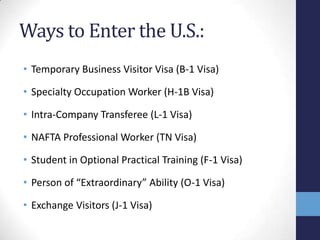
Ways to Enter the U.S.:
• Temporary Business Visitor Visa (B-1 Visa)

• Specialty Occupation Worker (H-1B Visa)
• Intra-Company Transferee (L-1 Visa)
• NAFTA Professional Worker (TN Visa)
• Student in Optional Practical Training (F-1 Visa)
• Person of “Extraordinary” Ability (O-1 Visa)
• Exchange Visitors (J-1 Visa)
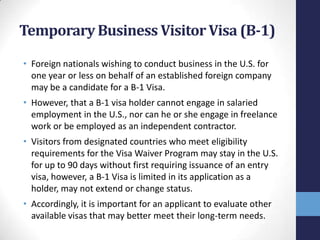
Temporary Business Visitor Visa (B-1)
• Foreign nationals wishing to conduct business in the U.S. for
one year or less on behalf of an established foreign company
may be a candidate for a B-1 Visa.
• However, that a B-1 visa holder cannot engage in salaried
employment in the U.S., nor can he or she engage in freelance
work or be employed as an independent contractor.

• Visitors from designated countries who meet eligibility
requirements for the Visa Waiver Program may stay in the U.S.
for up to 90 days without first requiring issuance of an entry
visa, however, a B-1 Visa is limited in its application as a
holder, may not extend or change status.
• Accordingly, it is important for an applicant to evaluate other
available visas that may better meet their long-term needs.
Specialty Occupation Worker (H-1B Visa)
• A U.S.-based company may apply for H-1B classification on
behalf of foreign nationals in most professional occupations
holding a Bachelor’s Degree or its equivalent.
• Under an H-1B Visa, the applicant may stay in the U.S. for a
maximum six years.
• Applicants under the H-1B may be extended for an additional
year, if a pending Labor Certification or Form I-140 is filed in a
timely manner on the worker’s behalf. (This should be done

more than a year prior to the end of the sixth year in H
status.)
Intra-Company Transferee (L-1 Visa)
• Executives and managers (L-1A) or employees with “specialized
knowledge” (L-1B) working for an overseas company or
multinational company with a U.S. affiliate may apply for L-1
nonimmigrant status.
• Under the L-1 visas, the candidate must have worked for at least one
year out of the past three years for the company overseas.

• L-1A and L-1B visa holders may stay in the U.S. for a maximum of
seven and five years, respectively.
• Managers and executives (L-1A visa holders) who have worked for at
least one year with the company overseas may be eligible for
permanent residence or “Green Card” as a “priority worker.”
• Qualifying multinational companies and organizations have the
opportunity to “pre-certify” via a “blanket” petition.
NAFTA Professional Worker (TN Visa)
• For our neighbors to the north and south, U.S. Immigration
laws allow certain Canadian and Mexican citizens whose
occupations appear in Appendix 1603.D.1 to Annex 1603 of
the North American Trade Agreement to apply for TN status.
• Under TN status, the employer must meet certain criteria to
prove that its employee’s credentials meet the required
specifications.
• A TN worker may work in the United States for a U.S.
employer for up to three years initially with the possibility of
renewal for up to three years.
• Although there is no specified limit on annual renewals, the
TN visa requires the applicant to maintain ties to his or her
home country and does not allow the applicant to reside
permanently in the United States.
Student in Optional Practical
Training (F-1 Visa)
• A foreign national pursuing a full course of study at an established college,
university, seminary, conservatory, or language-training program may qualify for
F-1 status.
• Under this visa, the consular post grants the foreign national permission to live
and study in the U.S.
• Under the F-1 visa, the educational institution admitting the foreign national into
its program provides him or her with a I-20 Form under the Student and
Exchange Visitor Information System (SEVIS).
• Students entering under an F-1 visa may not work, except under a very few
circumstances. Students entering under an F-1 visa who complete the study
requirements of their program may be eligible for a period of Optional Practical
Training (“OPT”).

• If the school’s Foreign Scholar Advisor approves OPT, the student may apply to
USCIS for work authorization for a period of up to one year, evidenced by an
Employment Authorization Document (EAD card).
Person of “Extraordinary” Ability
(O-1 Visa)
• The O-1 visa is provided to a small percentage of individuals who
demonstrate that they are at the very top of their field with
sustained national or international acclaim.
• Applicants must prove extraordinary achievement and recognition in
their field by showing, for example, receipt of a major
internationally recognized award, membership in an organization
that requires outstanding achievement, original scientific or
scholarly work of major significance in the academic field, and/or
published material by others discussing the applicant’s work.
• O-1 visa status is employer-specific and allows the foreign national
to work in the U.S. in his or her field of extraordinary ability for up to
three years, depending on the nature of the “event” or work he or
she is undertaking.
• USCIS may grant extensions one year at a time, with no specific
limit. O-1 visas are among the most difficult temporary work visas
to obtain, however allows certain O-1 visa holders the possibility of
applying for a “Green Card” under the USCIS first preference
Extraordinary Ability category.
Exchange Visitors (J-1 Visa)
• The J-1 Exchange Visitor visa allows eligible foreign nationals
to come to the United States for certain work study
opportunities approved by the U.S. Department of State.
• J-1 visa holders may receive work authorization for practical
training in business or industry for up to 18 months, however,
the practical training must be directly related to their
occupation or academic curriculum.
• There are strict requirements for certain J-1 visa holders,
including, requiring the applicant to return to their home
country for two years upon completion of their J-1 program
before they can come back to the United States or change to
another immigration status.
Disclaimer
• The information provided herein is for informational purposes
only. This information does not constitute legal advice, nor
should it take the place of independent legal counsel.
• As immigration laws are complex and ever changing, we
recommend that you consult counsel before taking action in
any particular case.

Visa and Work Options: Overview of U.S. Visas and Work Permits

  • 1.
    VISA AND WORKOPTIONS : OVERVIEW OF U.S. VISAS AND WORK PERMITS Nadine Yavru-Sakuk | Giannantonio & Roth, Hackensack, NJ
  • 2.
    Ways to Enterthe U.S.: • Temporary Business Visitor Visa (B-1 Visa) • Specialty Occupation Worker (H-1B Visa) • Intra-Company Transferee (L-1 Visa) • NAFTA Professional Worker (TN Visa) • Student in Optional Practical Training (F-1 Visa) • Person of “Extraordinary” Ability (O-1 Visa) • Exchange Visitors (J-1 Visa)
  • 3.
    Temporary Business VisitorVisa (B-1) • Foreign nationals wishing to conduct business in the U.S. for one year or less on behalf of an established foreign company may be a candidate for a B-1 Visa. • However, that a B-1 visa holder cannot engage in salaried employment in the U.S., nor can he or she engage in freelance work or be employed as an independent contractor. • Visitors from designated countries who meet eligibility requirements for the Visa Waiver Program may stay in the U.S. for up to 90 days without first requiring issuance of an entry visa, however, a B-1 Visa is limited in its application as a holder, may not extend or change status. • Accordingly, it is important for an applicant to evaluate other available visas that may better meet their long-term needs.
  • 4.
    Specialty Occupation Worker(H-1B Visa) • A U.S.-based company may apply for H-1B classification on behalf of foreign nationals in most professional occupations holding a Bachelor’s Degree or its equivalent. • Under an H-1B Visa, the applicant may stay in the U.S. for a maximum six years. • Applicants under the H-1B may be extended for an additional year, if a pending Labor Certification or Form I-140 is filed in a timely manner on the worker’s behalf. (This should be done more than a year prior to the end of the sixth year in H status.)
  • 5.
    Intra-Company Transferee (L-1Visa) • Executives and managers (L-1A) or employees with “specialized knowledge” (L-1B) working for an overseas company or multinational company with a U.S. affiliate may apply for L-1 nonimmigrant status. • Under the L-1 visas, the candidate must have worked for at least one year out of the past three years for the company overseas. • L-1A and L-1B visa holders may stay in the U.S. for a maximum of seven and five years, respectively. • Managers and executives (L-1A visa holders) who have worked for at least one year with the company overseas may be eligible for permanent residence or “Green Card” as a “priority worker.” • Qualifying multinational companies and organizations have the opportunity to “pre-certify” via a “blanket” petition.
  • 6.
    NAFTA Professional Worker(TN Visa) • For our neighbors to the north and south, U.S. Immigration laws allow certain Canadian and Mexican citizens whose occupations appear in Appendix 1603.D.1 to Annex 1603 of the North American Trade Agreement to apply for TN status. • Under TN status, the employer must meet certain criteria to prove that its employee’s credentials meet the required specifications. • A TN worker may work in the United States for a U.S. employer for up to three years initially with the possibility of renewal for up to three years. • Although there is no specified limit on annual renewals, the TN visa requires the applicant to maintain ties to his or her home country and does not allow the applicant to reside permanently in the United States.
  • 7.
    Student in OptionalPractical Training (F-1 Visa) • A foreign national pursuing a full course of study at an established college, university, seminary, conservatory, or language-training program may qualify for F-1 status. • Under this visa, the consular post grants the foreign national permission to live and study in the U.S. • Under the F-1 visa, the educational institution admitting the foreign national into its program provides him or her with a I-20 Form under the Student and Exchange Visitor Information System (SEVIS). • Students entering under an F-1 visa may not work, except under a very few circumstances. Students entering under an F-1 visa who complete the study requirements of their program may be eligible for a period of Optional Practical Training (“OPT”). • If the school’s Foreign Scholar Advisor approves OPT, the student may apply to USCIS for work authorization for a period of up to one year, evidenced by an Employment Authorization Document (EAD card).
  • 8.
    Person of “Extraordinary”Ability (O-1 Visa) • The O-1 visa is provided to a small percentage of individuals who demonstrate that they are at the very top of their field with sustained national or international acclaim. • Applicants must prove extraordinary achievement and recognition in their field by showing, for example, receipt of a major internationally recognized award, membership in an organization that requires outstanding achievement, original scientific or scholarly work of major significance in the academic field, and/or published material by others discussing the applicant’s work. • O-1 visa status is employer-specific and allows the foreign national to work in the U.S. in his or her field of extraordinary ability for up to three years, depending on the nature of the “event” or work he or she is undertaking. • USCIS may grant extensions one year at a time, with no specific limit. O-1 visas are among the most difficult temporary work visas to obtain, however allows certain O-1 visa holders the possibility of applying for a “Green Card” under the USCIS first preference Extraordinary Ability category.
  • 9.
    Exchange Visitors (J-1Visa) • The J-1 Exchange Visitor visa allows eligible foreign nationals to come to the United States for certain work study opportunities approved by the U.S. Department of State. • J-1 visa holders may receive work authorization for practical training in business or industry for up to 18 months, however, the practical training must be directly related to their occupation or academic curriculum. • There are strict requirements for certain J-1 visa holders, including, requiring the applicant to return to their home country for two years upon completion of their J-1 program before they can come back to the United States or change to another immigration status.
  • 10.
    Disclaimer • The informationprovided herein is for informational purposes only. This information does not constitute legal advice, nor should it take the place of independent legal counsel. • As immigration laws are complex and ever changing, we recommend that you consult counsel before taking action in any particular case.