International Journal of Trend in Scientific Research and Development (IJTSRD)
International Open Access Journal | www.ijtsrd.com
ISSN No: 2456 - 6470 | Volume - 2 | Issue – 6 | Sep – Oct 2018
@ IJTSRD | Available Online @ www.ijtsrd.com | Volume – 2 | Issue – 6 | Sep-Oct 2018 Page: 241
Single Image Super Resolution using Interpolation &
Discrete Wavelet Transform
Shalini Dubey1
, Prof. Pankaj Sahu2
, Prof. Surya Bazal2
1
Research Scholar, 2
Assistant Professor
Department of Electronics and Communication Engineering,
Gyan Ganga Institute of Technology and Sciences,
Jabalpur, Madhya Pradesh, India
ABSTRACT
An interpolation-based method, such as bilinear,
bicubic, or nearest neighbor interpolation, is regarded
as a simple way to increase the spatial resolution for
the LR image. It uses the interpolation kernel to
predict the missing pixel values, which fails to
approximate the underlying image structure and leads
to some blurred edges. In this work a super resolution
technique based on Sparse characteristics of wavelet
transform. Hence, we proposed a wavelet based
super-resolution technique, which will be of the
category of interpolative methods, using sparse
property of wavelets. It is based on sparse
representation property of the wavelets. Simulation
results prove that the proposed wavelet based
interpolation method outperforms all other existing
methods for single image super resolution. The
proposed method has 7.7 dB improvement in PSNR
compared with Adaptive sparse representation and
self-learning ASR-SL [1] for test image Leaves, 12.92
dB improvement for test image Mountain Lion & 7.15
dB improvement for test image Hat compared with
ASR-SL [1]. Similarly, 12% improvement in SSIM
for test image Leaves compared with [1], 29%
improvement in SSIM for test image Mountain Lion
compared with [1] & 17% improvement in SSIM for
test image Hat compared with [1].
Keyword: Super Resolution, Image Reconstruction,
Single Image Resolution Techniques, Resolution
Enhancement, Wavelet transform, Interpolation.
1. INTRODUCTION
Image super resolution is an image processing
algorithms that produce high quality, high resolution
(HR) images from a set of low quality, low resolution
(LR) images or from a single image. The SR image
reconstruction is useful in many practical cases where
multiple frames of the same scene can be obtained;
including medical imaging, satellite imaging, and
video applications [17].The basic premise for
increasing the spatial resolution in SR techniques is
the availability of multiple LR images captured from
the same scene. The set of source low resolution (LR)
images captures only a finite amount of information
from a scene; the goal of SR is to extract the
independent information from each image in that set
and combine the information into a single high
resolution (HR) image. The requirement is of SR is
that each LR image must contain some information
that is unique to that image [3]. The super resolution
method is to take more samples of the scene so as to
get some extra information which can be used, while
merging the samples to get a high resolution image.
These samples can be acquired by sub-pixel shifts, by
changing scene , by changing the amount of blur [14]
.HR means that pixel density within an image is high,
and therefore an HR image can offer more details that
are important in many applications, The major
advantage of the super resolution approach is that it
may cost less and the existing LR imaging systems
can be still utilized. Synthetic zooming of region of
interest (ROI) is another important application in
surveillance, forensic, scientific, medical, and satellite
imaging [13]. This application is most suitable for
magnifying objects in the scene such as the face of a
criminal or the license plate of a car [16].
International Journal of Trend in Scientific Research and Development (IJTSRD) ISSN: 2456-6470
@ IJTSRD | Available Online @ www.ijtsrd.com | Volume – 2 | Issue – 6 | Sep-Oct 2018 Page: 242
Figure 1: Classification of Super Resolution
Techniques
2. VARIOUS EXISTING SUPER-
RESOLUTION TECHNIQUES
2.1 SR using compressive sensing based on a
redundant dictionary
1. Y. Sun Et-al, presented a compressive sensing
based on a redundant dictionary has been successfully
applied in super resolution imaging. However, due to
the neglect of the local and nonlocal interactions of
patches of a single image, the reconstructed results are
not satisfactory in noise suppression and edge
sharpness. In this paper, we propose an improved
method by adding steering kernel regression and a
nonlocal means filter as two regularization terms and
use an efficient clustering sub-dictionary learning
scheme. We further demonstrate better results on true
images in terms of traditional image quality
assessment metrics.
2.2 SR reconstruction based on the compressive
sensing
2. Y. Sun Et-al, presented an observation for
medical imaging and astronomical, high-resolution
(HR) images are urgently desired and required. In
recent years, many researchers have proposed various
ways to achieve the goal of image super-resolution
(SR), ranging from simple linear interpolation
schemes to nonlinear complex methods. In this paper,
we deal with the SR reconstruction problem based on
the theory of compressive sensing, which uses a
redundant dictionary instead of a conventional
orthogonal basis. We further demonstrate better
results on true images in terms of peak signal-to-noise
ratio (PSNR) and root mean-square error (RMSE) and
give several important improvements, compared with
other methods.
Although wide variety of super-resolution literature is
available, it is still an open topic to investigate.
Following subsections describe some of the existing
basic image super-resolution schemes.
2.3 SR via Sparse Representation
Jianchao Yang et al. [9] considered the sparse signal
representation of an image. Based on previous
research on image statistics the image patches can be
well-represented as a sparse linear combination of
elements from an appropriately chosen over-complete
dictionary. Motivated by this, they proposed a sparse
representation for each patch of the low-resolution
input. The coefficients of this representation are used
to generate the high-resolution output. Theoretical
results from compressed sensing suggest that the
sparse representation can be correctly recovered from
the down-sampled signals under mild conditions.
Similarity of sparse representations between the
low-resolution and high-resolution image patch pair
with respect to their own dictionaries is enforced, by
jointly training two dictionaries for the low and high-
resolution image patches. So, the sparse
representation of a low-resolution image patch is
being applied with the high-resolution image patch
dictionary to generate a high-resolution image patch.
They showed the effectiveness of such a sparsity prior
for both general image super-resolution (SR) and the
special case of face hallucination. This algorithm can
handle SR with noisy inputs in a more unified
framework because the local sparse modeling is
naturally robust to noise.
2.4 Nonlinear Mapping of Coherent Features
Xiao Zeng and Hua Huang presented a regression
based method that can successfully recognize the
identity given all these difficulties. They built a radial
basis function in subspace by canonical correlation
analysis to nonlinear regression models from the
specific non frontal low resolution image to frontal
high resolution features.
2.5 Geometric Grouplets
A. Maalouf and M. C. Larabi proposed the idea of
generating a super-resolution (SR) image from a
single multi-valued low-resolution (LR) input image.
This problem approaches from the perspective of
image geometry-oriented interpolation. They
computed the group let transform to obtain geometry
of the LR image. Geometric group lets is constructed
International Journal of Trend in Scientific Research and Development (IJTSRD) ISSN: 2456-6470
@ IJTSRD | Available Online @ www.ijtsrd.com | Volume – 2 | Issue – 6 | Sep-Oct 2018 Page: 243
by orthogonal multiscale grouping with weighted
Haar lifting to points grouped by association fields.
To preserve the sharpness of edges and textures SR
image is synthesised by an adaptive directional
interpolation using the extracted geometric
information. This method showed improvements over
existing geometrically driven interpolation techniques
on a subjective scale, and in many cases with an
improvement in psycho visual color difference.
2.6 Remotely Sensed image by Hope field
Neural Network
J Tatem Andrew et al. [12] used their idea of super-
resolution for target identification in remotely sensed
images. Fuzzy classification improves the accuracy of
land cover target identification make robust and better
for spatial representation of land cover. The Hopfield
neural network converges to a minimum of an energy
function, defined as a goal and several constraints.
The energy minimum represents a best guess map of
the spatial distribution of class components in each
pixel.
They used two goal functions to make the output of a
neuron similar to that of its neighboring neurons. The
first goal function aims to increase the output of
center neuron to 1. The second goal function aims to
decrease the output of the center neuron to 0. They
showed that, by using a Hopfield neural network,
more accurate measures of land cover targets can be
obtained compared with those determined using the
proportion images alone.
2.7 Neural Network based Optimal Recovery
Theory
Yizhen Huang and YangjingLong [13] proposed a optimal recoverybased neural-network Super Resolution al
Motivated by the idea that back propagation neural
network are capable of learning complex nonlinear
function they proposed a neural network approach
that produces better results in high-frequency regions.
They integrated an optimal recovery based approach
with in a neural network framework and, if so, two
different branches of algorithms complement each
other to offer a better algorithm. Using this algorithm
in a two-pass way generates visual results that are
very similar regardless of the initial interpolation step,
and more times of iteration only waste the computing
resource but yield negligible performance gain.
2.8 Gaussian Process Regression
Wan-Chi Siu et-al, [14] addressed the problem of
producing a high-resolution image from a single low-
resolution image without any external training set.
They proposed a framework for both magnification
and deblurring using only the original low-resolution
image and its blurred version. In This method, each
pixel is predicted by its neighbors through the
Gaussian process regression.
They showed that, by using a proper covariance
function, the Gaussian process regression can perform
soft clustering of pixels based on their local
structures. This algorithm can extract adequate
information contained in a single low-resolution
image to generate a high-resolution image with sharp
edges. Compared to other edge-directed and example-
based super-resolution algorithms this algorithm is
superior in quality and performance.
2.9 Learning-based SR with a combining of
both global and local constraints
K. Guoet al. [15] proposed a statistical learning
method for SR with both global and local constraints.
More specifically, they introduced a mixture model
into maximum a posteriori (MAP) estimation, which
combines a global parametric constraint with a patch-
based local non-parametric constraint.
The global parametric constraint guarantees the super-
resolved global image to agree with the sparse
property of natural images, and the local non-
parametric constraint is used to infer the residues
between the image derived from the global constraint
and the ground truth high-resolution (HR) image.
They compared it with traditional patch-based
learning methods without the global constraint, and
showed that this method can not only preserve global
image structure, but also restore the local details more
effectively.
2.10 Interpolation based SR using Multi surface
Fitting
Fei Zhou et al. [16] proposed a interpolation-based
method of image super-resolution reconstruction.
They used the idea of multi surface fitting to take
advantage of spatial structure information. Each site
of low-resolution pixels is fitted with one surface, and
the final estimation is made by fusing the
multisampling values on these surfaces in the
maximum a posteriori fashion. Figure 2 shows the
flow chart of interpolation based SR using Multi
surface Fitting.
International Journal of Trend in Scientific Research and Development (IJTSRD) ISSN: 2456-6470
@ IJTSRD | Available Online @ www.ijtsrd.com | Volume – 2 | Issue – 6 | Sep-Oct 2018 Page: 244
Figure 2: Flow chart of Multi surface Fitting
For the final values of high intensity pixels they used
maximum a posteriori estimation on sampled surface
constructed using Taylor series. They showed that,
this method reconstructs high-resolution images that
preserve image details effectively without any
hypothesis on image prior. They extended this method
to a more general noise model.
2.11 SR Based on Interpolation of Wavelet
Domain
Gholamreza Anbarjafari and Hasan Demirel [17]
proposed a super-resolution technique based on
interpolation of the high-frequency sub band images
obtained by discrete wavelet transform (DWT) and
the input image. They used DWT to decompose an
image into different subband images. Then the high-
frequency subband images and the input low-
resolution image have been interpolated, followed by
combining all these images to generate a new super-
resolved image by using inverse DWT. Figure 3
shows the block diagram of the method proposed by
Gholamreza Anbarjafari and Hasan Demirel.
Figure 3: Block Diagram of DWT based SR
2.12 SR by Complex Wavelet Transform
Gholamreza Anbarjafari and Hasan Demirel [18]
proposed a technique to enhance to resolution of
satellite images based on interpolation of high-
frequency subband images obtained by dual-tree
complex wavelet transform (DT-CWT). This method
uses DT-CWT to decompose an input low-resolution
satellite image into different subband images and
interpolates input images followed by combining all
these images to generate high-resolution images by
using inverse DT-CWT. Figure 4 shows the diagram
of the method.
Figure 4: Block diagram of DT-CWT SR
2.13 Image Resolution Enhancement by using
Discrete and Stationary Wavelet
Decomposition
Gholamreza Anbarjafari and Hasan Demirel [19]
proposed a image resolution enhancement technique
based on interpolation of the high frequency subband
images obtained by discrete wavelet transform (DWT)
and the input image. The edges are enhanced by
introducing an intermediate stage by using stationary
wavelet transform (SWT). DWT is applied in order to
decompose an input image into different subbands.
Then the high frequency subbands as well as the input
image are interpolated. The estimated high frequency
subbands are being modified by using high frequency
subband obtained through SWT. Then all these
subbands are combined to generate a new high
resolution image by using inverse DWT (IDWT).
3. PROPOSED METHODOLOGY
An adaptive directional image interpolation is
computed by estimating sparse image mixture models
in a wavelet frame. This section describes a fast
orthogonal block matching pursuit implementation.
The detailed process of wavelet based super-
resolution is, first the sub sampled image y(n) for is
International Journal of Trend in Scientific Research and Development (IJTSRD) ISSN: 2456-6470
@ IJTSRD | Available Online @ www.ijtsrd.com | Volume – 2 | Issue – 6 | Sep-Oct 2018 Page: 245
decomposed with wavelet transform matrix 𝜓 whose
columns are the vectors of a translation invariant
wavelet frame 𝜓 𝑑,𝑚on a single scale (the finest one).
Then, it is reconstructed with a dual frame type matrix
𝜓, columns of this dual wavelet frames is𝜓 𝑑,𝑚. The
wavelet coefficients are;
𝑐(𝑑, 𝑚) = {𝑦, 𝜓 𝑑,𝑚} = 𝜓 𝑦(𝑑, 𝑚)
The wavelet transform separates a low frequency
image 𝑦𝑙projected over the low-frequency scaling
filters 𝜓𝑙(𝑑, 𝑚)& a high-frequency image 𝑦ℎprojected
over the finest scale wavelets in three directions
𝜓 𝑦(ℎ, 𝑚).
𝑦𝑙 = ∑ 𝑐(𝑙, 𝑚)
𝑚∈𝐺
𝜓𝑙,𝑚
&𝑦ℎ = ∑ 𝑐(ℎ, 𝑚)3
𝑑=1 𝜓ℎ,𝑚
The low frequency image has little aliasing & can,
thus, be precisely interpolated with a cubic spline
interpolator. Detailed process is;
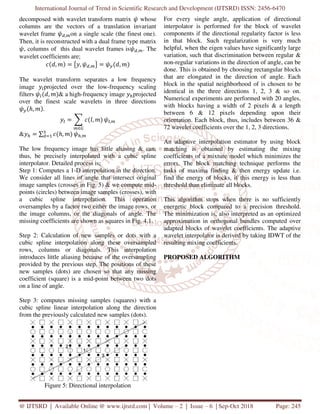
Step 1: Computes a 1-D interpolation in the direction.
We consider all lines of angle that intersect original
image samples (crosses in Fig. 5) & we compute mid-
points (circles) between image samples (crosses), with
a cubic spline interpolation. This operation
oversamples by a factor two either the image rows, or
the image columns, or the diagonals of angle. The
missing coefficients are shown as squares in Fig. 4.1.
Step 2: Calculation of new samples or dots with a
cubic spline interpolation along these oversampled
rows, columns or diagonals. This interpolation
introduces little aliasing because of the oversampling
provided by the previous step. The positions of these
new samples (dots) are chosen so that any missing
coefficient (square) is a mid-point between two dots
on a line of angle.
Step 3: computes missing samples (squares) with a
cubic spline linear interpolation along the direction
from the previously calculated new samples (dots).
Figure 5: Directional interpolation
For every single angle, application of directional
interpolator is performed for the block of wavelet
components if the directional regularity factor is less
in that block. Such regularization is very much
helpful, when the eigen values have significantly large
variation, such that discrimination between regular &
non-regular variations in the direction of angle, can be
done. This is obtained by choosing rectangular blocks
that are elongated in the direction of angle. Each
block in the spatial neighborhood of is chosen to be
identical in the three directions 1, 2, 3 & so on.
Numerical experiments are performed with 20 angles,
with blocks having a width of 2 pixels & a length
between 6 & 12 pixels depending upon their
orientation. Each block, thus, includes between 36 &
72 wavelet coefficients over the 1, 2, 3 directions.
An adaptive interpolation estimator by using block
matching is obtained by estimating the mixing
coefficients of a mixture model which minimizes the
errors. The block matching technique performs the
tasks of maxima finding & then energy update i.e.
find the energy of blocks, if this energy is less than
threshold than eliminate all blocks.
This algorithm stops when there is no sufficiently
energetic block compared to a precision threshold.
The minimization is, also interpreted as an optimized
approximation in orthogonal bundles computed over
adapted blocks of wavelet coefficients. The adaptive
wavelet interpolator is derived by taking IDWT of the
resulting mixing coefficients.
PROPOSED ALGORITHM
International Journal of Trend in Scientific Research and Development (IJTSRD) ISSN: 2456-6470
@ IJTSRD | Available Online @ www.ijtsrd.com | Volume – 2 | Issue – 6 | Sep-Oct 2018 Page: 246
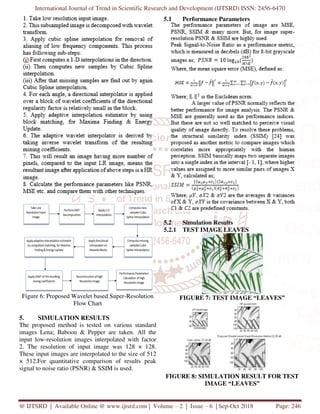
Figure 6: Proposed Wavelet based Super-Resolution
Flow Chart
5. SIMULATION RESULTS
The proposed method is tested on various standard
images Lena; Baboon & Pepper are taken. All the
input low-resolution images interpolated with factor
2. The resolution of input image was 128 × 128.
These input images are interpolated to the size of 512
× 512.For quantitative comparison of results peak
signal to noise ratio (PSNR) & SSIM is used.
5.1 Performance Parameters
5.2 Simulation Results
5.2.1 TEST IMAGE LEAVES
FIGURE 7: TEST IMAGE “LEAVES”
FIGURE 8: SIMULATION RESULT FOR TEST
IMAGE “LEAVES”
International Journal of Trend in Scientific Research and Development (IJTSRD) ISSN: 2456-6470
@ IJTSRD | Available Online @ www.ijtsrd.com | Volume – 2 | Issue – 6 | Sep-Oct 2018 Page: 247
5.2.2 TEST IMAGE HAT
FIGURE 9: TEST IMAGE “HAT”
FIGURE 10: SIMULATION RESULT FOR TEST
IMAGE “HAT”
5.2.3 TEST IMAGE MOUNTAIN LION
FIGURE 11: TEST IMAGE “MOUNTAIN LION”
FIGURE 12: SIMULATION RESULT FOR TEST
IMAGE “MOUNTAIN LION”
5.3 SIMULATION RESULT SUMMARY
Table 1 shows the simulation results for various test
images for PSNR and SSIM values.
TABLE1: SIMULATION RESULTS SUMMARY
5.4 RESULT COMPARISON
The PSNR and SSIM values with proposed algorithm
has been compared with [1]. Results shows our
method is better than all existing techniques.
TABLE 2: SIMULATION RESULT
COMPARISON WITH [1]
6. CONCLUSION
The proposed wavelet based interpolation method
outperforms all other existing methods for single
image super resolution. The proposed method has 7.7
dB improvement in PSNR compared with Adaptive
sparse representation and self-learning ASR-SL [1]
for test image Leaves, 12.92 dB improvement for test
image Mountain Lion & 7.15 dB improvement for test
image Hat compared with ASR-SL [1]. Similarly,
International Journal of Trend in Scientific Research and Development (IJTSRD) ISSN: 2456-6470
@ IJTSRD | Available Online @ www.ijtsrd.com | Volume – 2 | Issue – 6 | Sep-Oct 2018 Page: 248
12% improvement in SSIM for test image Leaves
compared with [1], 29% improvement in SSIM for
test image Mountain Lion compared with [1] & 17%
improvement in SSIM for test image Hat compared
with [1].
7. REFERENCES
1. Jianwei Zhao et-al, “Image super-resolution via
adaptive sparse representation and self-learning”,
Published in IEEE IET Computer Vision,
Volume: 12, Issue 5, 2018.
2. Wuzhen Shi et-al, “Single Image Super-
Resolution with Dilated Convolution based Multi-
Scale Information Learning Inception Module”,
IEEE International Conference on Image
Processing (ICIP), 2017.
3. Y. Sun, G. Gu, X. Sui, Y. Liu, and C. Yang,
“Compressive Super-resolution Imaging Based on
Local and Nonlocal Regularizations,” IEEE
Photonics Journal, Volume 8, No. 1, 2016.
4. Y. Sun, G. Gu, X. Sui, Y. Liu, and C. Yang,
“Single image super-resolution using compressive
sensing with a redundant dictionary,” IEEE
Photonics Journal, volume 7, No. 2, 2015.
5. Mayank Agrawal, Ratnakar Dash, “Image
Resolution Enhancement Using Lifting Wavelet
and Stationary Wavelet Transform”, IEEE
International Conference on Electronic Systems,
Signal Processing and Computing Technologies
(ICESC), 2014.
6. Mayank Agrawal, Ratnakar Dash, “Image Super-
resolution by Interpolating High Frequency Sub-
bands of Image using Surface Fitting”, IEEE
International Conference on Signal Processing and
Communication (ICSC), 2014.
7. Do Kyung Shin, Young Shik Moon, “Super-
Resolution Image Reconstruction Using Wavelet
Based Patch and Discrete Wavelet Transform”,
Journal of Signal Processing Systems, Springer,
Volume 81, Issue 1, pp 71-81, 2014.
8. V. Prasath R. Buvanesvari, N. Thilartham, K.
Nirosha, “Image Super Resolution Reconstruction
Using Wavelet Transform Method”, International
Journal of Innovative Technology and Exploring
Engineering, Volume-3, Issue-9, 2014.
9. K. Zhang, X. Gao, D. Tao, and X. Li, “Single
image super-resolution with non-local means and
steering kernel regression,” IEEE Trans. Image
Process., vol. 21, no. 11, pp. 4544–4556, Nov.
2012.
10. G. Yu, G. Sapiro, and S. Mallat, “Solving inverse
problems with piecewise linear estimators: From
Gaussian mixture models to structured sparsity,”
IEEE Trans. Image Process., vol. 21, no. 5, pp.
2481 –2499, May 2012.
11. W. Dong, L. Zhang, G. Shi, and X. Wu, “Image
deblurring and super-resolution by adaptive sparse
domain selection and adaptive regularization,”
IEEE Trans. Image Process., vol. 20, no. 7, pp.
1838–1857, Jul. 2011.
12. L. Zhang, L. Zhang, X. Mou, and D. Zhang,
“FSIM: A feature similarity index for image
quality assessment,” IEEE Trans. Image Process.,
vol. 20, no. 8, pp. 2378–2386, Aug. 2011.
13. J. Yang, J. Wright, T. S. Huang, and Y. Ma,
“Image super-resolution via sparse
representation,” IEEE Trans. Image Process., vol.
19, no. 11, pp. 2861 –2873, Nov. 2010.
14. X. Zhang, M. Burger, X. Bresson, and S. Osher,
“Bregmanized nonlocal regularization for
deconvolution and sparse reconstruction,” SIAM
J. Imag. Sci., vol. 3, no. 3, pp. 253–276, Jul. 2010.
15. H. Zhang, J. Yang, Y. Zhang, and T. S. Huang,
“Non-local kernel regression for image and video
restoration,” in Proc. Eur. Conf. Comput. Vis.,
2010, pp. 566–579.
16. J. Mairal, F. Bach, J. Ponce, G. Sapiro, and A.
Zisserman, “Non-local sparse models for image
restoration,” in Proc. IEEE Conf. Comput. Vis.
Pattern Recog., 2009, pp. 2272–2279.
17. M. Protter, M. Elad, H. Takeda, and P. Milanfar,
“Generalizing the nonlocal-means to super-
resolution reconstruction,” IEEE Trans. Image
Process., vol. 18, no. 1, pp. 36–51, Jan. 2009.
18. P. Sen and S. Darabi, “Compressive image super-
resolution,” in Proc. Conf. 43rd Asilomar Conf.
Signals, System Computer, pp. 1235–1242, 2009
19. M. Li and T. Nguyen, “Markov random field
model-based edge-directed image interpolation,”
IEEE Trans. Image Process., vol. 17, no. 7, pp.
1121 –1128, Jul. 2008.
20. R. Baraniuk, “Compressive sensing,” IEEE Signal
Process. Mag., vol. 24, no. 4, pp. 118–121, Jul.
2007.
International Journal of Trend in Scientific Research and Development (IJTSRD) ISSN: 2456-6470
@ IJTSRD | Available Online @ www.ijtsrd.com | Volume – 2 | Issue – 6 | Sep-Oct 2018 Page: 249
21. H. Takeda, S. Farsiu, and P. Milanfar, “Kernel
regression for image processing and
reconstruction,” IEEE Trans. Image Process., vol.
16, no. 2, pp. 349–366, Feb. 2007.
22. L. Zhang and X. Wu, “An edge-guided image
interpolation algorithm via directional filtering
and data fusion,” IEEE Trans. Image Process., vol.
15, no. 8, pp. 2226–2238, Aug. 2006.
23. A. Buades, B. Coll, and J. M. Morel, “A review of
image denoising algorithms, with a new one,”
Multisc. Model Simul., vol. 4, no. 2, pp. 490–530,
2005.
24. J. M. Bioucas and M. A. T. Figueiredo, “A new
TwIST: Two-step iterative shrinkage/thresholding
algorithms for image restoration,” IEEE Trans.
Image Process., vol. 16, no. 12, pp. 2992–3004,
Dec. 2007.
25. Daubechies, M. Defriese, and C. Demol, “An
iterative thresholding algorithm for linear inverse
problems with a sparsity constraint,” Commun.
Pure Appl. Math. vol. 57, no. 11, pp. 1413–1457,
Nov. 2004.
26. Z. Wang, A. C. Bovik, H. R. Sheikh, and E. P.
Simoncelli, “Image quality assessment: From
error measurement to structural similarity,” IEEE
Trans. Image Process., vol. 13, no. 4, pp. 600–
612, Apr. 2004.
27. S. C. Park, M. K. Park, and M. G. Kang, “Super-
resolution image reconstruction: A technical
overview,” IEEE Signal Process. Mag., vol. 20,
no. 3, pp. 21 –36, May 2003.
28. X. Li and M. T. Orchard, “New edge-directed
interpolation,” IEEE Trans. Image Process., vol.
10, no. 10, pp. 1521 – 1527, Oct. 2001.
29. H. Knutsson and C. F. Westin, “Normalized and
differential convolution,” in Proceeding of IEEE
Conference on Computer Visual Pattern
Recognition, pp.515–523, 1993.

Single Image Super Resolution using Interpolation and Discrete Wavelet Transform

  • 1.
    International Journal ofTrend in Scientific Research and Development (IJTSRD) International Open Access Journal | www.ijtsrd.com ISSN No: 2456 - 6470 | Volume - 2 | Issue – 6 | Sep – Oct 2018 @ IJTSRD | Available Online @ www.ijtsrd.com | Volume – 2 | Issue – 6 | Sep-Oct 2018 Page: 241 Single Image Super Resolution using Interpolation & Discrete Wavelet Transform Shalini Dubey1 , Prof. Pankaj Sahu2 , Prof. Surya Bazal2 1 Research Scholar, 2 Assistant Professor Department of Electronics and Communication Engineering, Gyan Ganga Institute of Technology and Sciences, Jabalpur, Madhya Pradesh, India ABSTRACT An interpolation-based method, such as bilinear, bicubic, or nearest neighbor interpolation, is regarded as a simple way to increase the spatial resolution for the LR image. It uses the interpolation kernel to predict the missing pixel values, which fails to approximate the underlying image structure and leads to some blurred edges. In this work a super resolution technique based on Sparse characteristics of wavelet transform. Hence, we proposed a wavelet based super-resolution technique, which will be of the category of interpolative methods, using sparse property of wavelets. It is based on sparse representation property of the wavelets. Simulation results prove that the proposed wavelet based interpolation method outperforms all other existing methods for single image super resolution. The proposed method has 7.7 dB improvement in PSNR compared with Adaptive sparse representation and self-learning ASR-SL [1] for test image Leaves, 12.92 dB improvement for test image Mountain Lion & 7.15 dB improvement for test image Hat compared with ASR-SL [1]. Similarly, 12% improvement in SSIM for test image Leaves compared with [1], 29% improvement in SSIM for test image Mountain Lion compared with [1] & 17% improvement in SSIM for test image Hat compared with [1]. Keyword: Super Resolution, Image Reconstruction, Single Image Resolution Techniques, Resolution Enhancement, Wavelet transform, Interpolation. 1. INTRODUCTION Image super resolution is an image processing algorithms that produce high quality, high resolution (HR) images from a set of low quality, low resolution (LR) images or from a single image. The SR image reconstruction is useful in many practical cases where multiple frames of the same scene can be obtained; including medical imaging, satellite imaging, and video applications [17].The basic premise for increasing the spatial resolution in SR techniques is the availability of multiple LR images captured from the same scene. The set of source low resolution (LR) images captures only a finite amount of information from a scene; the goal of SR is to extract the independent information from each image in that set and combine the information into a single high resolution (HR) image. The requirement is of SR is that each LR image must contain some information that is unique to that image [3]. The super resolution method is to take more samples of the scene so as to get some extra information which can be used, while merging the samples to get a high resolution image. These samples can be acquired by sub-pixel shifts, by changing scene , by changing the amount of blur [14] .HR means that pixel density within an image is high, and therefore an HR image can offer more details that are important in many applications, The major advantage of the super resolution approach is that it may cost less and the existing LR imaging systems can be still utilized. Synthetic zooming of region of interest (ROI) is another important application in surveillance, forensic, scientific, medical, and satellite imaging [13]. This application is most suitable for magnifying objects in the scene such as the face of a criminal or the license plate of a car [16].
  • 2.
    International Journal ofTrend in Scientific Research and Development (IJTSRD) ISSN: 2456-6470 @ IJTSRD | Available Online @ www.ijtsrd.com | Volume – 2 | Issue – 6 | Sep-Oct 2018 Page: 242 Figure 1: Classification of Super Resolution Techniques 2. VARIOUS EXISTING SUPER- RESOLUTION TECHNIQUES 2.1 SR using compressive sensing based on a redundant dictionary 1. Y. Sun Et-al, presented a compressive sensing based on a redundant dictionary has been successfully applied in super resolution imaging. However, due to the neglect of the local and nonlocal interactions of patches of a single image, the reconstructed results are not satisfactory in noise suppression and edge sharpness. In this paper, we propose an improved method by adding steering kernel regression and a nonlocal means filter as two regularization terms and use an efficient clustering sub-dictionary learning scheme. We further demonstrate better results on true images in terms of traditional image quality assessment metrics. 2.2 SR reconstruction based on the compressive sensing 2. Y. Sun Et-al, presented an observation for medical imaging and astronomical, high-resolution (HR) images are urgently desired and required. In recent years, many researchers have proposed various ways to achieve the goal of image super-resolution (SR), ranging from simple linear interpolation schemes to nonlinear complex methods. In this paper, we deal with the SR reconstruction problem based on the theory of compressive sensing, which uses a redundant dictionary instead of a conventional orthogonal basis. We further demonstrate better results on true images in terms of peak signal-to-noise ratio (PSNR) and root mean-square error (RMSE) and give several important improvements, compared with other methods. Although wide variety of super-resolution literature is available, it is still an open topic to investigate. Following subsections describe some of the existing basic image super-resolution schemes. 2.3 SR via Sparse Representation Jianchao Yang et al. [9] considered the sparse signal representation of an image. Based on previous research on image statistics the image patches can be well-represented as a sparse linear combination of elements from an appropriately chosen over-complete dictionary. Motivated by this, they proposed a sparse representation for each patch of the low-resolution input. The coefficients of this representation are used to generate the high-resolution output. Theoretical results from compressed sensing suggest that the sparse representation can be correctly recovered from the down-sampled signals under mild conditions. Similarity of sparse representations between the low-resolution and high-resolution image patch pair with respect to their own dictionaries is enforced, by jointly training two dictionaries for the low and high- resolution image patches. So, the sparse representation of a low-resolution image patch is being applied with the high-resolution image patch dictionary to generate a high-resolution image patch. They showed the effectiveness of such a sparsity prior for both general image super-resolution (SR) and the special case of face hallucination. This algorithm can handle SR with noisy inputs in a more unified framework because the local sparse modeling is naturally robust to noise. 2.4 Nonlinear Mapping of Coherent Features Xiao Zeng and Hua Huang presented a regression based method that can successfully recognize the identity given all these difficulties. They built a radial basis function in subspace by canonical correlation analysis to nonlinear regression models from the specific non frontal low resolution image to frontal high resolution features. 2.5 Geometric Grouplets A. Maalouf and M. C. Larabi proposed the idea of generating a super-resolution (SR) image from a single multi-valued low-resolution (LR) input image. This problem approaches from the perspective of image geometry-oriented interpolation. They computed the group let transform to obtain geometry of the LR image. Geometric group lets is constructed
  • 3.
    International Journal ofTrend in Scientific Research and Development (IJTSRD) ISSN: 2456-6470 @ IJTSRD | Available Online @ www.ijtsrd.com | Volume – 2 | Issue – 6 | Sep-Oct 2018 Page: 243 by orthogonal multiscale grouping with weighted Haar lifting to points grouped by association fields. To preserve the sharpness of edges and textures SR image is synthesised by an adaptive directional interpolation using the extracted geometric information. This method showed improvements over existing geometrically driven interpolation techniques on a subjective scale, and in many cases with an improvement in psycho visual color difference. 2.6 Remotely Sensed image by Hope field Neural Network J Tatem Andrew et al. [12] used their idea of super- resolution for target identification in remotely sensed images. Fuzzy classification improves the accuracy of land cover target identification make robust and better for spatial representation of land cover. The Hopfield neural network converges to a minimum of an energy function, defined as a goal and several constraints. The energy minimum represents a best guess map of the spatial distribution of class components in each pixel. They used two goal functions to make the output of a neuron similar to that of its neighboring neurons. The first goal function aims to increase the output of center neuron to 1. The second goal function aims to decrease the output of the center neuron to 0. They showed that, by using a Hopfield neural network, more accurate measures of land cover targets can be obtained compared with those determined using the proportion images alone. 2.7 Neural Network based Optimal Recovery Theory Yizhen Huang and YangjingLong [13] proposed a optimal recoverybased neural-network Super Resolution al Motivated by the idea that back propagation neural network are capable of learning complex nonlinear function they proposed a neural network approach that produces better results in high-frequency regions. They integrated an optimal recovery based approach with in a neural network framework and, if so, two different branches of algorithms complement each other to offer a better algorithm. Using this algorithm in a two-pass way generates visual results that are very similar regardless of the initial interpolation step, and more times of iteration only waste the computing resource but yield negligible performance gain. 2.8 Gaussian Process Regression Wan-Chi Siu et-al, [14] addressed the problem of producing a high-resolution image from a single low- resolution image without any external training set. They proposed a framework for both magnification and deblurring using only the original low-resolution image and its blurred version. In This method, each pixel is predicted by its neighbors through the Gaussian process regression. They showed that, by using a proper covariance function, the Gaussian process regression can perform soft clustering of pixels based on their local structures. This algorithm can extract adequate information contained in a single low-resolution image to generate a high-resolution image with sharp edges. Compared to other edge-directed and example- based super-resolution algorithms this algorithm is superior in quality and performance. 2.9 Learning-based SR with a combining of both global and local constraints K. Guoet al. [15] proposed a statistical learning method for SR with both global and local constraints. More specifically, they introduced a mixture model into maximum a posteriori (MAP) estimation, which combines a global parametric constraint with a patch- based local non-parametric constraint. The global parametric constraint guarantees the super- resolved global image to agree with the sparse property of natural images, and the local non- parametric constraint is used to infer the residues between the image derived from the global constraint and the ground truth high-resolution (HR) image. They compared it with traditional patch-based learning methods without the global constraint, and showed that this method can not only preserve global image structure, but also restore the local details more effectively. 2.10 Interpolation based SR using Multi surface Fitting Fei Zhou et al. [16] proposed a interpolation-based method of image super-resolution reconstruction. They used the idea of multi surface fitting to take advantage of spatial structure information. Each site of low-resolution pixels is fitted with one surface, and the final estimation is made by fusing the multisampling values on these surfaces in the maximum a posteriori fashion. Figure 2 shows the flow chart of interpolation based SR using Multi surface Fitting.
  • 4.
    International Journal ofTrend in Scientific Research and Development (IJTSRD) ISSN: 2456-6470 @ IJTSRD | Available Online @ www.ijtsrd.com | Volume – 2 | Issue – 6 | Sep-Oct 2018 Page: 244 Figure 2: Flow chart of Multi surface Fitting For the final values of high intensity pixels they used maximum a posteriori estimation on sampled surface constructed using Taylor series. They showed that, this method reconstructs high-resolution images that preserve image details effectively without any hypothesis on image prior. They extended this method to a more general noise model. 2.11 SR Based on Interpolation of Wavelet Domain Gholamreza Anbarjafari and Hasan Demirel [17] proposed a super-resolution technique based on interpolation of the high-frequency sub band images obtained by discrete wavelet transform (DWT) and the input image. They used DWT to decompose an image into different subband images. Then the high- frequency subband images and the input low- resolution image have been interpolated, followed by combining all these images to generate a new super- resolved image by using inverse DWT. Figure 3 shows the block diagram of the method proposed by Gholamreza Anbarjafari and Hasan Demirel. Figure 3: Block Diagram of DWT based SR 2.12 SR by Complex Wavelet Transform Gholamreza Anbarjafari and Hasan Demirel [18] proposed a technique to enhance to resolution of satellite images based on interpolation of high- frequency subband images obtained by dual-tree complex wavelet transform (DT-CWT). This method uses DT-CWT to decompose an input low-resolution satellite image into different subband images and interpolates input images followed by combining all these images to generate high-resolution images by using inverse DT-CWT. Figure 4 shows the diagram of the method. Figure 4: Block diagram of DT-CWT SR 2.13 Image Resolution Enhancement by using Discrete and Stationary Wavelet Decomposition Gholamreza Anbarjafari and Hasan Demirel [19] proposed a image resolution enhancement technique based on interpolation of the high frequency subband images obtained by discrete wavelet transform (DWT) and the input image. The edges are enhanced by introducing an intermediate stage by using stationary wavelet transform (SWT). DWT is applied in order to decompose an input image into different subbands. Then the high frequency subbands as well as the input image are interpolated. The estimated high frequency subbands are being modified by using high frequency subband obtained through SWT. Then all these subbands are combined to generate a new high resolution image by using inverse DWT (IDWT). 3. PROPOSED METHODOLOGY An adaptive directional image interpolation is computed by estimating sparse image mixture models in a wavelet frame. This section describes a fast orthogonal block matching pursuit implementation. The detailed process of wavelet based super- resolution is, first the sub sampled image y(n) for is
  • 5.
    International Journal ofTrend in Scientific Research and Development (IJTSRD) ISSN: 2456-6470 @ IJTSRD | Available Online @ www.ijtsrd.com | Volume – 2 | Issue – 6 | Sep-Oct 2018 Page: 245 decomposed with wavelet transform matrix 𝜓 whose columns are the vectors of a translation invariant wavelet frame 𝜓 𝑑,𝑚on a single scale (the finest one). Then, it is reconstructed with a dual frame type matrix 𝜓, columns of this dual wavelet frames is𝜓 𝑑,𝑚. The wavelet coefficients are; 𝑐(𝑑, 𝑚) = {𝑦, 𝜓 𝑑,𝑚} = 𝜓 𝑦(𝑑, 𝑚) The wavelet transform separates a low frequency image 𝑦𝑙projected over the low-frequency scaling filters 𝜓𝑙(𝑑, 𝑚)& a high-frequency image 𝑦ℎprojected over the finest scale wavelets in three directions 𝜓 𝑦(ℎ, 𝑚). 𝑦𝑙 = ∑ 𝑐(𝑙, 𝑚) 𝑚∈𝐺 𝜓𝑙,𝑚 &𝑦ℎ = ∑ 𝑐(ℎ, 𝑚)3 𝑑=1 𝜓ℎ,𝑚 The low frequency image has little aliasing & can, thus, be precisely interpolated with a cubic spline interpolator. Detailed process is; Step 1: Computes a 1-D interpolation in the direction. We consider all lines of angle that intersect original image samples (crosses in Fig. 5) & we compute mid- points (circles) between image samples (crosses), with a cubic spline interpolation. This operation oversamples by a factor two either the image rows, or the image columns, or the diagonals of angle. The missing coefficients are shown as squares in Fig. 4.1. Step 2: Calculation of new samples or dots with a cubic spline interpolation along these oversampled rows, columns or diagonals. This interpolation introduces little aliasing because of the oversampling provided by the previous step. The positions of these new samples (dots) are chosen so that any missing coefficient (square) is a mid-point between two dots on a line of angle. Step 3: computes missing samples (squares) with a cubic spline linear interpolation along the direction from the previously calculated new samples (dots). Figure 5: Directional interpolation For every single angle, application of directional interpolator is performed for the block of wavelet components if the directional regularity factor is less in that block. Such regularization is very much helpful, when the eigen values have significantly large variation, such that discrimination between regular & non-regular variations in the direction of angle, can be done. This is obtained by choosing rectangular blocks that are elongated in the direction of angle. Each block in the spatial neighborhood of is chosen to be identical in the three directions 1, 2, 3 & so on. Numerical experiments are performed with 20 angles, with blocks having a width of 2 pixels & a length between 6 & 12 pixels depending upon their orientation. Each block, thus, includes between 36 & 72 wavelet coefficients over the 1, 2, 3 directions. An adaptive interpolation estimator by using block matching is obtained by estimating the mixing coefficients of a mixture model which minimizes the errors. The block matching technique performs the tasks of maxima finding & then energy update i.e. find the energy of blocks, if this energy is less than threshold than eliminate all blocks. This algorithm stops when there is no sufficiently energetic block compared to a precision threshold. The minimization is, also interpreted as an optimized approximation in orthogonal bundles computed over adapted blocks of wavelet coefficients. The adaptive wavelet interpolator is derived by taking IDWT of the resulting mixing coefficients. PROPOSED ALGORITHM
  • 6.
    International Journal ofTrend in Scientific Research and Development (IJTSRD) ISSN: 2456-6470 @ IJTSRD | Available Online @ www.ijtsrd.com | Volume – 2 | Issue – 6 | Sep-Oct 2018 Page: 246 Figure 6: Proposed Wavelet based Super-Resolution Flow Chart 5. SIMULATION RESULTS The proposed method is tested on various standard images Lena; Baboon & Pepper are taken. All the input low-resolution images interpolated with factor 2. The resolution of input image was 128 × 128. These input images are interpolated to the size of 512 × 512.For quantitative comparison of results peak signal to noise ratio (PSNR) & SSIM is used. 5.1 Performance Parameters 5.2 Simulation Results 5.2.1 TEST IMAGE LEAVES FIGURE 7: TEST IMAGE “LEAVES” FIGURE 8: SIMULATION RESULT FOR TEST IMAGE “LEAVES”
  • 7.
    International Journal ofTrend in Scientific Research and Development (IJTSRD) ISSN: 2456-6470 @ IJTSRD | Available Online @ www.ijtsrd.com | Volume – 2 | Issue – 6 | Sep-Oct 2018 Page: 247 5.2.2 TEST IMAGE HAT FIGURE 9: TEST IMAGE “HAT” FIGURE 10: SIMULATION RESULT FOR TEST IMAGE “HAT” 5.2.3 TEST IMAGE MOUNTAIN LION FIGURE 11: TEST IMAGE “MOUNTAIN LION” FIGURE 12: SIMULATION RESULT FOR TEST IMAGE “MOUNTAIN LION” 5.3 SIMULATION RESULT SUMMARY Table 1 shows the simulation results for various test images for PSNR and SSIM values. TABLE1: SIMULATION RESULTS SUMMARY 5.4 RESULT COMPARISON The PSNR and SSIM values with proposed algorithm has been compared with [1]. Results shows our method is better than all existing techniques. TABLE 2: SIMULATION RESULT COMPARISON WITH [1] 6. CONCLUSION The proposed wavelet based interpolation method outperforms all other existing methods for single image super resolution. The proposed method has 7.7 dB improvement in PSNR compared with Adaptive sparse representation and self-learning ASR-SL [1] for test image Leaves, 12.92 dB improvement for test image Mountain Lion & 7.15 dB improvement for test image Hat compared with ASR-SL [1]. Similarly,
  • 8.
    International Journal ofTrend in Scientific Research and Development (IJTSRD) ISSN: 2456-6470 @ IJTSRD | Available Online @ www.ijtsrd.com | Volume – 2 | Issue – 6 | Sep-Oct 2018 Page: 248 12% improvement in SSIM for test image Leaves compared with [1], 29% improvement in SSIM for test image Mountain Lion compared with [1] & 17% improvement in SSIM for test image Hat compared with [1]. 7. REFERENCES 1. Jianwei Zhao et-al, “Image super-resolution via adaptive sparse representation and self-learning”, Published in IEEE IET Computer Vision, Volume: 12, Issue 5, 2018. 2. Wuzhen Shi et-al, “Single Image Super- Resolution with Dilated Convolution based Multi- Scale Information Learning Inception Module”, IEEE International Conference on Image Processing (ICIP), 2017. 3. Y. Sun, G. Gu, X. Sui, Y. Liu, and C. Yang, “Compressive Super-resolution Imaging Based on Local and Nonlocal Regularizations,” IEEE Photonics Journal, Volume 8, No. 1, 2016. 4. Y. Sun, G. Gu, X. Sui, Y. Liu, and C. Yang, “Single image super-resolution using compressive sensing with a redundant dictionary,” IEEE Photonics Journal, volume 7, No. 2, 2015. 5. Mayank Agrawal, Ratnakar Dash, “Image Resolution Enhancement Using Lifting Wavelet and Stationary Wavelet Transform”, IEEE International Conference on Electronic Systems, Signal Processing and Computing Technologies (ICESC), 2014. 6. Mayank Agrawal, Ratnakar Dash, “Image Super- resolution by Interpolating High Frequency Sub- bands of Image using Surface Fitting”, IEEE International Conference on Signal Processing and Communication (ICSC), 2014. 7. Do Kyung Shin, Young Shik Moon, “Super- Resolution Image Reconstruction Using Wavelet Based Patch and Discrete Wavelet Transform”, Journal of Signal Processing Systems, Springer, Volume 81, Issue 1, pp 71-81, 2014. 8. V. Prasath R. Buvanesvari, N. Thilartham, K. Nirosha, “Image Super Resolution Reconstruction Using Wavelet Transform Method”, International Journal of Innovative Technology and Exploring Engineering, Volume-3, Issue-9, 2014. 9. K. Zhang, X. Gao, D. Tao, and X. Li, “Single image super-resolution with non-local means and steering kernel regression,” IEEE Trans. Image Process., vol. 21, no. 11, pp. 4544–4556, Nov. 2012. 10. G. Yu, G. Sapiro, and S. Mallat, “Solving inverse problems with piecewise linear estimators: From Gaussian mixture models to structured sparsity,” IEEE Trans. Image Process., vol. 21, no. 5, pp. 2481 –2499, May 2012. 11. W. Dong, L. Zhang, G. Shi, and X. Wu, “Image deblurring and super-resolution by adaptive sparse domain selection and adaptive regularization,” IEEE Trans. Image Process., vol. 20, no. 7, pp. 1838–1857, Jul. 2011. 12. L. Zhang, L. Zhang, X. Mou, and D. Zhang, “FSIM: A feature similarity index for image quality assessment,” IEEE Trans. Image Process., vol. 20, no. 8, pp. 2378–2386, Aug. 2011. 13. J. Yang, J. Wright, T. S. Huang, and Y. Ma, “Image super-resolution via sparse representation,” IEEE Trans. Image Process., vol. 19, no. 11, pp. 2861 –2873, Nov. 2010. 14. X. Zhang, M. Burger, X. Bresson, and S. Osher, “Bregmanized nonlocal regularization for deconvolution and sparse reconstruction,” SIAM J. Imag. Sci., vol. 3, no. 3, pp. 253–276, Jul. 2010. 15. H. Zhang, J. Yang, Y. Zhang, and T. S. Huang, “Non-local kernel regression for image and video restoration,” in Proc. Eur. Conf. Comput. Vis., 2010, pp. 566–579. 16. J. Mairal, F. Bach, J. Ponce, G. Sapiro, and A. Zisserman, “Non-local sparse models for image restoration,” in Proc. IEEE Conf. Comput. Vis. Pattern Recog., 2009, pp. 2272–2279. 17. M. Protter, M. Elad, H. Takeda, and P. Milanfar, “Generalizing the nonlocal-means to super- resolution reconstruction,” IEEE Trans. Image Process., vol. 18, no. 1, pp. 36–51, Jan. 2009. 18. P. Sen and S. Darabi, “Compressive image super- resolution,” in Proc. Conf. 43rd Asilomar Conf. Signals, System Computer, pp. 1235–1242, 2009 19. M. Li and T. Nguyen, “Markov random field model-based edge-directed image interpolation,” IEEE Trans. Image Process., vol. 17, no. 7, pp. 1121 –1128, Jul. 2008. 20. R. Baraniuk, “Compressive sensing,” IEEE Signal Process. Mag., vol. 24, no. 4, pp. 118–121, Jul. 2007.
  • 9.
    International Journal ofTrend in Scientific Research and Development (IJTSRD) ISSN: 2456-6470 @ IJTSRD | Available Online @ www.ijtsrd.com | Volume – 2 | Issue – 6 | Sep-Oct 2018 Page: 249 21. H. Takeda, S. Farsiu, and P. Milanfar, “Kernel regression for image processing and reconstruction,” IEEE Trans. Image Process., vol. 16, no. 2, pp. 349–366, Feb. 2007. 22. L. Zhang and X. Wu, “An edge-guided image interpolation algorithm via directional filtering and data fusion,” IEEE Trans. Image Process., vol. 15, no. 8, pp. 2226–2238, Aug. 2006. 23. A. Buades, B. Coll, and J. M. Morel, “A review of image denoising algorithms, with a new one,” Multisc. Model Simul., vol. 4, no. 2, pp. 490–530, 2005. 24. J. M. Bioucas and M. A. T. Figueiredo, “A new TwIST: Two-step iterative shrinkage/thresholding algorithms for image restoration,” IEEE Trans. Image Process., vol. 16, no. 12, pp. 2992–3004, Dec. 2007. 25. Daubechies, M. Defriese, and C. Demol, “An iterative thresholding algorithm for linear inverse problems with a sparsity constraint,” Commun. Pure Appl. Math. vol. 57, no. 11, pp. 1413–1457, Nov. 2004. 26. Z. Wang, A. C. Bovik, H. R. Sheikh, and E. P. Simoncelli, “Image quality assessment: From error measurement to structural similarity,” IEEE Trans. Image Process., vol. 13, no. 4, pp. 600– 612, Apr. 2004. 27. S. C. Park, M. K. Park, and M. G. Kang, “Super- resolution image reconstruction: A technical overview,” IEEE Signal Process. Mag., vol. 20, no. 3, pp. 21 –36, May 2003. 28. X. Li and M. T. Orchard, “New edge-directed interpolation,” IEEE Trans. Image Process., vol. 10, no. 10, pp. 1521 – 1527, Oct. 2001. 29. H. Knutsson and C. F. Westin, “Normalized and differential convolution,” in Proceeding of IEEE Conference on Computer Visual Pattern Recognition, pp.515–523, 1993.