ANDROID
APPLICATION USING
IMAGE FUSION
TECHNIQUES
ACADEMIC WRITING
V S S CHAITANYA SATYANARAYANA MURTY
TYPES OF MEDICAL
IMAGING
X-rays.
CT scan (computed tomography scan)
MRI (magnetic resonance imaging)
Ultrasound.
Nuclear medicine imaging, including Positron-Emission
Tomography (PET)
IMAGE FUSION
Image fusion is the process of producing more informative
and better descriptive images based on the input ones.
Nowadays, acquiring high resolution and more informative
description of humans’ anatomies and functions becomes
possible due to the rapid advances in medical imaging
technology
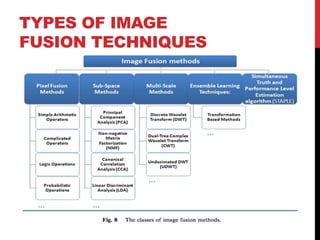
TYPES OF IMAGE
FUSION TECHNIQUES
PIXEL FUSION
METHODS
In these methods, simple pixel-by-pixel operations are used
to perform the fusion task
Although this class of fusion methods is simple, it often
faces certain limitations including contrast reduction of the
image.
SUBSPACE METHODS
A high-dimensional input image is projected onto a lower
dimensional space or subspace for Visualization ,
Generalization.
Principal component analysis (PCA), independent
component analysis (ICA), non-negative matrix factorization
(NMF), canonical correlation analysis (CCA), and linear
discriminant analysis (LDA) are examples of the well-known
subspace methods
MULTI SPACE
METHODS
Multi-scale also known as Multi-Resolution Analysis (MRA) of
images consists of a collection of techniques that transform
each input image I(k) that it can be represented in a multiscale
manner y0 ; y1 ; . . . ; yL
Discrete Wavelet Transform (DWT), dual-tree complex
wavelet transform (CWT), and undecimated DWT (UDWT)
represent examples of the methods that fall under this class
of methods
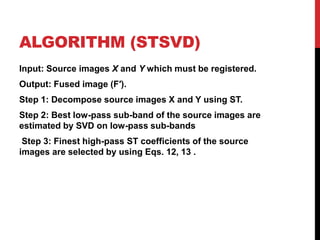
ALGORITHM (STSVD)
Input: Source images X and Y which must be registered.
Output: Fused image (F′).
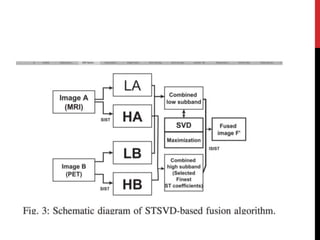
Step 1: Decompose source images X and Y using ST.
Step 2: Best low-pass sub-band of the source images are
estimated by SVD on low-pass sub-bands
Step 3: Finest high-pass ST coefficients of the source
images are selected by using Eqs. 12, 13 .
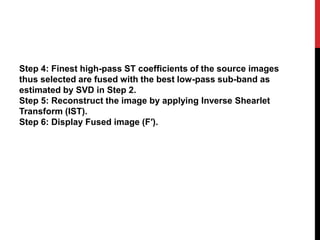
Step 4: Finest high-pass ST coefficients of the source images
thus selected are fused with the best low-pass sub-band as
estimated by SVD in Step 2.
Step 5: Reconstruct the image by applying Inverse Shearlet
Transform (IST).
Step 6: Display Fused image (F′).
SINGLE VALUE
DECOMPOSITION
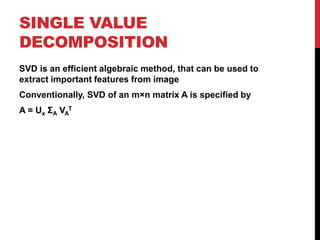
SVD is an efficient algebraic method, that can be used to
extract important features from image
Conventionally, SVD of an m×n matrix A is specified by
A = Ux ΣA VA
T
REFERENCES
http://ieeexplore.ieee.org/stamp/stamp.jsp?tp=&arnumber=70
95385
http://www.ijcsmc.com/docs/papers/November2014/V3I11201
493.pdf
https://www.sciencedirect.com/science/article/pii/S111086651
500047X

Image fusion

  • 1.
    ANDROID APPLICATION USING IMAGE FUSION TECHNIQUES ACADEMICWRITING V S S CHAITANYA SATYANARAYANA MURTY
  • 2.
    TYPES OF MEDICAL IMAGING X-rays. CTscan (computed tomography scan) MRI (magnetic resonance imaging) Ultrasound. Nuclear medicine imaging, including Positron-Emission Tomography (PET)
  • 3.
    IMAGE FUSION Image fusionis the process of producing more informative and better descriptive images based on the input ones. Nowadays, acquiring high resolution and more informative description of humans’ anatomies and functions becomes possible due to the rapid advances in medical imaging technology
  • 4.
  • 5.
    PIXEL FUSION METHODS In thesemethods, simple pixel-by-pixel operations are used to perform the fusion task Although this class of fusion methods is simple, it often faces certain limitations including contrast reduction of the image.
  • 6.
    SUBSPACE METHODS A high-dimensionalinput image is projected onto a lower dimensional space or subspace for Visualization , Generalization. Principal component analysis (PCA), independent component analysis (ICA), non-negative matrix factorization (NMF), canonical correlation analysis (CCA), and linear discriminant analysis (LDA) are examples of the well-known subspace methods
  • 7.
    MULTI SPACE METHODS Multi-scale alsoknown as Multi-Resolution Analysis (MRA) of images consists of a collection of techniques that transform each input image I(k) that it can be represented in a multiscale manner y0 ; y1 ; . . . ; yL Discrete Wavelet Transform (DWT), dual-tree complex wavelet transform (CWT), and undecimated DWT (UDWT) represent examples of the methods that fall under this class of methods
  • 8.
    ALGORITHM (STSVD) Input: Sourceimages X and Y which must be registered. Output: Fused image (F′). Step 1: Decompose source images X and Y using ST. Step 2: Best low-pass sub-band of the source images are estimated by SVD on low-pass sub-bands Step 3: Finest high-pass ST coefficients of the source images are selected by using Eqs. 12, 13 .
  • 9.
    Step 4: Finesthigh-pass ST coefficients of the source images thus selected are fused with the best low-pass sub-band as estimated by SVD in Step 2. Step 5: Reconstruct the image by applying Inverse Shearlet Transform (IST). Step 6: Display Fused image (F′).
  • 11.
    SINGLE VALUE DECOMPOSITION SVD isan efficient algebraic method, that can be used to extract important features from image Conventionally, SVD of an m×n matrix A is specified by A = Ux ΣA VA T
  • 12.