
Improving Organizational Efficiency through
Information & Communication Technology
Elizabeth Lyons
UC San Diego
IBLI/ADRAS Policy Workshop
June 9, 2015
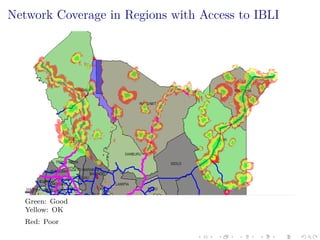
Network Coverage in Regions with Access to IBLI
Green: Good
Yellow: OK
Red: Poor
Improving Organizational Efficiency through Information & Communication Technology
ICT in Northern Kenya
Cell Phone Use Among IBLI Clients, Partners
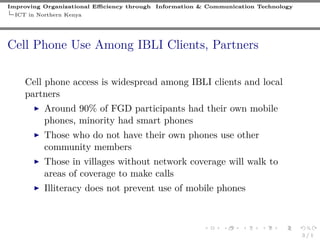
Cell phone access is widespread among IBLI clients and local
partners
Around 90% of FGD participants had their own mobile
phones, minority had smart phones
Those who do not have their own phones use other
community members
Those in villages without network coverage will walk to
areas of coverage to make calls
Illiteracy does not prevent use of mobile phones
3 / 1
Improving Organizational Efficiency through Information & Communication Technology
ICT in Northern Kenya
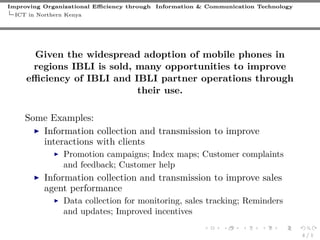
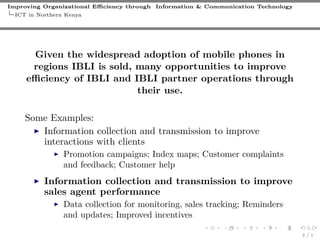
Given the widespread adoption of mobile phones in
regions IBLI is sold, many opportunities to improve
efficiency of IBLI and IBLI partner operations through
their use.
Some Examples:
Information collection and transmission to improve
interactions with clients
Promotion campaigns; Index maps; Customer complaints
and feedback; Customer help
Information collection and transmission to improve sales
agent performance
Data collection for monitoring, sales tracking; Reminders
and updates; Improved incentives
4 / 1
Improving Organizational Efficiency through Information & Communication Technology
ICT in Northern Kenya
Given the widespread adoption of mobile phones in
regions IBLI is sold, many opportunities to improve
efficiency of IBLI and IBLI partner operations through
their use.
Some Examples:
Information collection and transmission to improve
interactions with clients
Promotion campaigns; Index maps; Customer complaints
and feedback; Customer help
Information collection and transmission to improve
sales agent performance
Data collection for monitoring, sales tracking; Reminders
and updates; Improved incentives
4 / 1
Improving Organizational Efficiency through Information & Communication Technology
Sales Agent Model Background
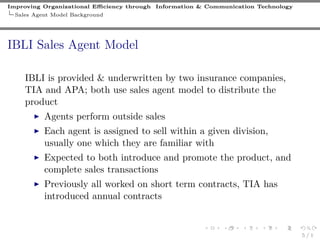
IBLI Sales Agent Model
IBLI is provided & underwritten by two insurance companies,
TIA and APA; both use sales agent model to distribute the
product
Agents perform outside sales
Each agent is assigned to sell within a given division,
usually one which they are familiar with
Expected to both introduce and promote the product, and
complete sales transactions
Previously all worked on short term contracts, TIA has
introduced annual contracts
5 / 1
Improving Organizational Efficiency through Information & Communication Technology
Sales Agent Model Background
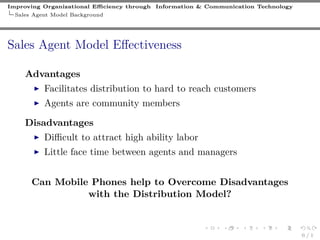
Sales Agent Model Effectiveness
Advantages
Facilitates distribution to hard to reach customers
Agents are community members
Disadvantages
Difficult to attract high ability labor
Little face time between agents and managers
Can Mobile Phones help to Overcome Disadvantages
with the Distribution Model?
6 / 1
Improving Organizational Efficiency through Information & Communication Technology
Mobile Phones and the Sales Agent Model
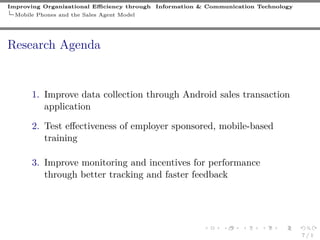
Research Agenda
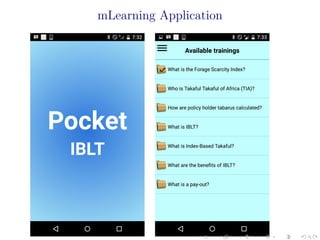
1. Improve data collection through Android sales transaction
application
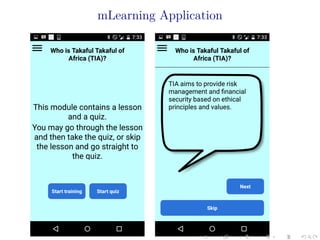
2. Test effectiveness of employer sponsored, mobile-based
training
3. Improve monitoring and incentives for performance
through better tracking and faster feedback
7 / 1
Improving Organizational Efficiency through Information & Communication Technology
Mobile Phones and the Sales Agent Model
Research Agenda
1. Improve data collection through Android sales
transaction application
2. Test effectiveness of employer sponsored,
mobile-based training
3. Improve monitoring and incentives for performance
through better tracking and faster feedback
7 / 1
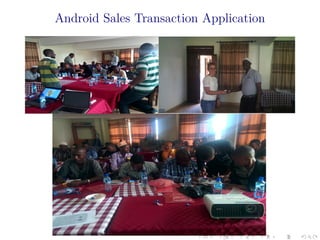
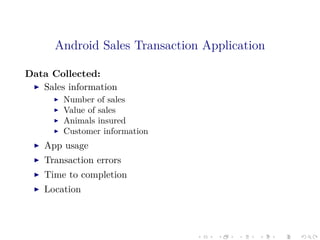
Android Sales Transaction Application
Data Collected:
Sales information
Number of sales
Value of sales
Animals insured
Customer information
App usage
Transaction errors
Time to completion
Location
The Impact of Mobile Training on Sales Agent
Performance
Due to cost and infrastructural constraints, face-to-face
agent training is short and intensive
Many agents do not have a complete understanding of IBLI
or of the sales process at the conclusion of the training
period
Mobile phones offer a means for continuing training even
after agents return to their sales divisions
Can employer sponsored mobile-based learning improve
sales, firm revenue, and customer satisfaction?
mLearning Application
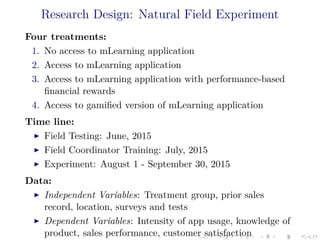
Research Design: Natural Field Experiment
Four treatments:
1. No access to mLearning application
2. Access to mLearning application
3. Access to mLearning application with performance-based
financial rewards
4. Access to gamified version of mLearning application
Time line:
Field Testing: June, 2015
Field Coordinator Training: July, 2015
Experiment: August 1 - September 30, 2015
Data:
Independent Variables: Treatment group, prior sales
record, location, surveys and tests
Dependent Variables: Intensity of app usage, knowledge of
product, sales performance, customer satisfaction
Looking Ahead
How can we best harness ICT to achieve low-cost
solutions to high-cost challenges in pastoralist
communities?
Lessons from these studies with further research may be
applicable to broader audiences, for instance:
Improving information transfer among pastoralists
Improving distribution of consumer goods and services to
rural regions
Improving provision of aid and public goods to
under-served populations
Thank you!

Improving organizational efficiency through information and communication technology

  • 1.
    Improving Organizational Efficiencythrough Information & Communication Technology Elizabeth Lyons UC San Diego IBLI/ADRAS Policy Workshop June 9, 2015
  • 2.
    Network Coverage inRegions with Access to IBLI Green: Good Yellow: OK Red: Poor
  • 3.
    Improving Organizational Efficiencythrough Information & Communication Technology ICT in Northern Kenya Cell Phone Use Among IBLI Clients, Partners Cell phone access is widespread among IBLI clients and local partners Around 90% of FGD participants had their own mobile phones, minority had smart phones Those who do not have their own phones use other community members Those in villages without network coverage will walk to areas of coverage to make calls Illiteracy does not prevent use of mobile phones 3 / 1
  • 4.
    Improving Organizational Efficiencythrough Information & Communication Technology ICT in Northern Kenya Given the widespread adoption of mobile phones in regions IBLI is sold, many opportunities to improve efficiency of IBLI and IBLI partner operations through their use. Some Examples: Information collection and transmission to improve interactions with clients Promotion campaigns; Index maps; Customer complaints and feedback; Customer help Information collection and transmission to improve sales agent performance Data collection for monitoring, sales tracking; Reminders and updates; Improved incentives 4 / 1
  • 5.
    Improving Organizational Efficiencythrough Information & Communication Technology ICT in Northern Kenya Given the widespread adoption of mobile phones in regions IBLI is sold, many opportunities to improve efficiency of IBLI and IBLI partner operations through their use. Some Examples: Information collection and transmission to improve interactions with clients Promotion campaigns; Index maps; Customer complaints and feedback; Customer help Information collection and transmission to improve sales agent performance Data collection for monitoring, sales tracking; Reminders and updates; Improved incentives 4 / 1
  • 6.
    Improving Organizational Efficiencythrough Information & Communication Technology Sales Agent Model Background IBLI Sales Agent Model IBLI is provided & underwritten by two insurance companies, TIA and APA; both use sales agent model to distribute the product Agents perform outside sales Each agent is assigned to sell within a given division, usually one which they are familiar with Expected to both introduce and promote the product, and complete sales transactions Previously all worked on short term contracts, TIA has introduced annual contracts 5 / 1
  • 7.
    Improving Organizational Efficiencythrough Information & Communication Technology Sales Agent Model Background Sales Agent Model Effectiveness Advantages Facilitates distribution to hard to reach customers Agents are community members Disadvantages Difficult to attract high ability labor Little face time between agents and managers Can Mobile Phones help to Overcome Disadvantages with the Distribution Model? 6 / 1
  • 8.
    Improving Organizational Efficiencythrough Information & Communication Technology Mobile Phones and the Sales Agent Model Research Agenda 1. Improve data collection through Android sales transaction application 2. Test effectiveness of employer sponsored, mobile-based training 3. Improve monitoring and incentives for performance through better tracking and faster feedback 7 / 1
  • 9.
    Improving Organizational Efficiencythrough Information & Communication Technology Mobile Phones and the Sales Agent Model Research Agenda 1. Improve data collection through Android sales transaction application 2. Test effectiveness of employer sponsored, mobile-based training 3. Improve monitoring and incentives for performance through better tracking and faster feedback 7 / 1
  • 10.
  • 11.
    Android Sales TransactionApplication Data Collected: Sales information Number of sales Value of sales Animals insured Customer information App usage Transaction errors Time to completion Location
  • 12.
    The Impact ofMobile Training on Sales Agent Performance Due to cost and infrastructural constraints, face-to-face agent training is short and intensive Many agents do not have a complete understanding of IBLI or of the sales process at the conclusion of the training period Mobile phones offer a means for continuing training even after agents return to their sales divisions Can employer sponsored mobile-based learning improve sales, firm revenue, and customer satisfaction?
  • 13.
  • 14.
  • 15.
    Research Design: NaturalField Experiment Four treatments: 1. No access to mLearning application 2. Access to mLearning application 3. Access to mLearning application with performance-based financial rewards 4. Access to gamified version of mLearning application Time line: Field Testing: June, 2015 Field Coordinator Training: July, 2015 Experiment: August 1 - September 30, 2015 Data: Independent Variables: Treatment group, prior sales record, location, surveys and tests Dependent Variables: Intensity of app usage, knowledge of product, sales performance, customer satisfaction
  • 16.
    Looking Ahead How canwe best harness ICT to achieve low-cost solutions to high-cost challenges in pastoralist communities? Lessons from these studies with further research may be applicable to broader audiences, for instance: Improving information transfer among pastoralists Improving distribution of consumer goods and services to rural regions Improving provision of aid and public goods to under-served populations
  • 17.