The Wonder from Sweden:
Is IKEA’s success
sustainable?
Alyssa Joi D. Alamar
BA 190 - Strategic Management
University of the Philippines
Prof. Mita Angela M. Dimalanta
About IKEA
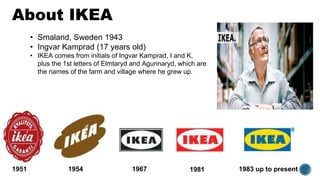
• Smaland, Sweden 1943
• Ingvar Kamprad (17 years old)
• IKEA comes from initials of Ingvar Kamprad, I and K,
plus the 1st letters of Elmtaryd and Agunnaryd, which are
the names of the farm and village where he grew up.
1951 1954 1967 1981 1983 up to present
BUSINESS
IDEA
“to offer a wide
range of well-
designed, functional
home furnishing
products at prices so
low that as many
people as possible
will be able to afford
them”
The IKEA Concept:
The IKEA Product Range
Where the IKEA Concept comes
to life
You do your part.
We do our part.
Together we
save money.
Challenges faced by IKEA
External Internal
IKEA’s decision to shift from an international
strategy toward a global standardization
strategy
Discretion with regards to strategic
decisions lies on one person
Transition to new management
The company is privately held
Keeping costs low
- Standardized products
- Issue on wood
- Finding suppliers
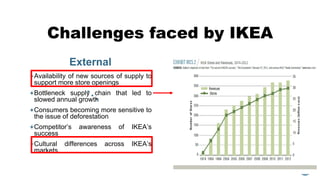
Availability of new sources of supply to
support more store openings
Bottleneck supply chain that led to
slowed annual growth
Consumers becoming more sensitive to
the issue of deforestation
Competitor’s awareness of IKEA’s
success
Cultural differences across IKEA’s
markets
Walmart entered a period of difficulties after Sam
Walton stepped down. Do you anticipate IKEA having
the same leadership challenge? Why or why not?
Did it surprise you to learn that both a developed
country (US) and also emerging economies (i.e.,
China and Russia) are the fastest growing
international markets for IKEA? Does this fact pose
any challenges in the way IKEA ought to compete
across the globe?
What can IKEA do to continue to drive growth
globally, especially given its strategic intent to
double annual store openings?
• E-commerce
• IKEA Café and Restaurants
• IKEA Click and Collect Stores worldwide
• Expanding the product line (high end product line, crockery products, interior
designing)
• Continuous product development
o Adapt country-based designs
o Collaborate with local artists
o Product customization by customers
Assume you are hired to consult IKEA on corporate social
responsibility. Which areas would you recommend the
company be most sensitive to, and how should these be
addressed to?
1. Environment
2. Workers
3. Suppliers
IKEA Group at a glance FY2015
 TOTAL SALES FY15 €31.9 BILLION
Total sales translated into Euro increased by 11.2% compared
with FY14, to €31.9 billion.
FY05: 14.9, FY14: 28.7, FY15: 31.9
Billions of Euros
 1.9 BILLION VISITS TO IKEA.COM
IKEA.com had almost 1.9 billion visits during FY15, up 21%
from FY14.
 9,500 PRODUCTS
The IKEA range consists of approximately 9,500 products.
Every year we renew our range, launching about 2,500 new
products. We have 15 in-house designers and approximately
200 external designers via contracts.
 IKEA GROUP HAS OPERATIONS IN 43 COUNTRIES
As of 31 August 2015, we had a total of 328 stores in 28
countries; 27 Trading Service Offices in 23 countries; 33
Distribution Centres and 15 Customer Distribution Centres in
17 countries; 43 IKEA Industry production units in 11 countries.
In total, we have 978 suppliers, including external suppliers.
 771 MILLION STORE VISITS
In FY15, IKEA Group store visits increased 7.7% over
FY14.
 978 SUPPLIERS
In FY15, the IKEA Group had 978 home furnishing
suppliers in 50 countries.
 155,000 CO-WORKERS
Europe: 107,400, Americas: 20,000, Asia & Australia:
15,200, Russia: 12,400
 213 MILLION CATALOGUES
213 million catalogues printed in 32 languages.
 328 IKEA GROUP STORES
In FY15, the IKEA Group opened 13 new stores in 9
countries. As of August 31, 2015, the IKEA Group had
328 stores in 28 countries.
FY05: 196, FY14: 315, FY15: 328
Number of IKEA Group stores
 IKEA FOOD €1.6 BILLION YEARLY TURNOVER
IKEA Food is comprised of the IKEA Restaurant, IKEA
Bistro, IKEA Swedish Food Market and the IKEA co-
worker restaurant.
References:
IKEA (2016). The Ikea Concept. Retrieved from Ikea:http://www.ikea.com/ms/en_
US/this-is-ikea/the-ikea-concept/index.html
IKEA (2016). Democratic Design. Retrieved from Ikea:http://www.ikea.com/ms/en_US/
this-is-ikea/democratic-design/index.html
IKEA (2016). People & Planet. Retrieved from Ikea:http://www.ikea.com/ms/en_US/this-
is-ikea/people-and-planet/index.html
IKEA (2016). Key Figures. Retrieved from Ikea: http://www.ikea.com/gb/en/this-is-
ikea/about-the-ikea-group/key-figures/
Rothaermel, F. (2015). Strategic Management. New York: McGraw-Hill Education.

Ikea Strategies

  • 1.
    The Wonder fromSweden: Is IKEA’s success sustainable? Alyssa Joi D. Alamar BA 190 - Strategic Management University of the Philippines Prof. Mita Angela M. Dimalanta
  • 2.
    About IKEA • Smaland,Sweden 1943 • Ingvar Kamprad (17 years old) • IKEA comes from initials of Ingvar Kamprad, I and K, plus the 1st letters of Elmtaryd and Agunnaryd, which are the names of the farm and village where he grew up. 1951 1954 1967 1981 1983 up to present
  • 3.
    BUSINESS IDEA “to offer awide range of well- designed, functional home furnishing products at prices so low that as many people as possible will be able to afford them”
  • 4.
    The IKEA Concept: TheIKEA Product Range
  • 5.
    Where the IKEAConcept comes to life You do your part. We do our part. Together we save money.
  • 6.
    Challenges faced byIKEA External Internal IKEA’s decision to shift from an international strategy toward a global standardization strategy Discretion with regards to strategic decisions lies on one person Transition to new management The company is privately held Keeping costs low - Standardized products - Issue on wood - Finding suppliers Availability of new sources of supply to support more store openings Bottleneck supply chain that led to slowed annual growth Consumers becoming more sensitive to the issue of deforestation Competitor’s awareness of IKEA’s success Cultural differences across IKEA’s markets
  • 7.
    Walmart entered aperiod of difficulties after Sam Walton stepped down. Do you anticipate IKEA having the same leadership challenge? Why or why not? Did it surprise you to learn that both a developed country (US) and also emerging economies (i.e., China and Russia) are the fastest growing international markets for IKEA? Does this fact pose any challenges in the way IKEA ought to compete across the globe?
  • 8.
    What can IKEAdo to continue to drive growth globally, especially given its strategic intent to double annual store openings? • E-commerce • IKEA Café and Restaurants • IKEA Click and Collect Stores worldwide • Expanding the product line (high end product line, crockery products, interior designing) • Continuous product development o Adapt country-based designs o Collaborate with local artists o Product customization by customers
  • 9.
    Assume you arehired to consult IKEA on corporate social responsibility. Which areas would you recommend the company be most sensitive to, and how should these be addressed to? 1. Environment 2. Workers 3. Suppliers
  • 10.
    IKEA Group ata glance FY2015  TOTAL SALES FY15 €31.9 BILLION Total sales translated into Euro increased by 11.2% compared with FY14, to €31.9 billion. FY05: 14.9, FY14: 28.7, FY15: 31.9 Billions of Euros  1.9 BILLION VISITS TO IKEA.COM IKEA.com had almost 1.9 billion visits during FY15, up 21% from FY14.  9,500 PRODUCTS The IKEA range consists of approximately 9,500 products. Every year we renew our range, launching about 2,500 new products. We have 15 in-house designers and approximately 200 external designers via contracts.  IKEA GROUP HAS OPERATIONS IN 43 COUNTRIES As of 31 August 2015, we had a total of 328 stores in 28 countries; 27 Trading Service Offices in 23 countries; 33 Distribution Centres and 15 Customer Distribution Centres in 17 countries; 43 IKEA Industry production units in 11 countries. In total, we have 978 suppliers, including external suppliers.  771 MILLION STORE VISITS In FY15, IKEA Group store visits increased 7.7% over FY14.  978 SUPPLIERS In FY15, the IKEA Group had 978 home furnishing suppliers in 50 countries.  155,000 CO-WORKERS Europe: 107,400, Americas: 20,000, Asia & Australia: 15,200, Russia: 12,400  213 MILLION CATALOGUES 213 million catalogues printed in 32 languages.  328 IKEA GROUP STORES In FY15, the IKEA Group opened 13 new stores in 9 countries. As of August 31, 2015, the IKEA Group had 328 stores in 28 countries. FY05: 196, FY14: 315, FY15: 328 Number of IKEA Group stores  IKEA FOOD €1.6 BILLION YEARLY TURNOVER IKEA Food is comprised of the IKEA Restaurant, IKEA Bistro, IKEA Swedish Food Market and the IKEA co- worker restaurant.
  • 11.
    References: IKEA (2016). TheIkea Concept. Retrieved from Ikea:http://www.ikea.com/ms/en_ US/this-is-ikea/the-ikea-concept/index.html IKEA (2016). Democratic Design. Retrieved from Ikea:http://www.ikea.com/ms/en_US/ this-is-ikea/democratic-design/index.html IKEA (2016). People & Planet. Retrieved from Ikea:http://www.ikea.com/ms/en_US/this- is-ikea/people-and-planet/index.html IKEA (2016). Key Figures. Retrieved from Ikea: http://www.ikea.com/gb/en/this-is- ikea/about-the-ikea-group/key-figures/ Rothaermel, F. (2015). Strategic Management. New York: McGraw-Hill Education.

Editor's Notes

  • #3 The IKEA Concept began when Ingvar Kamprad, an entrepreneur from the Småland province in southern Sweden, had an innovative idea. In Småland, the soil is thin and poor, and the people have a reputation for working hard, living frugally and making the most of limited resources. So when Ingvar started his furniture business in the late 1940s, he applied the lessons he learned in Småland to the home furnishings market. Ingvar’s innovative idea was to offer well-functioning home furnishing products of good design at prices much lower than competitors by using simple cost-cutting solutions that did not affect the quality of the products. Ingvar used every opportunity to reduce costs, and he scraped and saved in every way possible - except on ideas and quality. This is how the IKEA Concept began. The company is known for its modern architectural designs for various types of appliances and furniture, and its interior design work is often associated with an eco-friendly simplicity.[10] In addition, the firm is known for its attention to cost control, operational details, and continuous product development, corporate attributes that allowed IKEA to lower its prices by an average of two to three percent over the decade to 2010 during a period of global expansion The IKEA logo has changed little throughout the years. The design of the 1967 logo remains a consistent symbol of the IKEA business. The blue and yellow logo was first used in 1977 and since 1983 focus has been on this version of the IKEA logo. Today, it is one of the world’s strongest brands.
  • #4 Rather than selling expensive home furnishings that only a few can buy, the IKEA Concept makes it possible to serve the many by providing low-priced products that contribute to helping more people live a better life at home.
  • #11 the leading home furnishings brand in the world with more than 330 stores in 40 countries and close to 154,000 co-workers (as of January 2014)