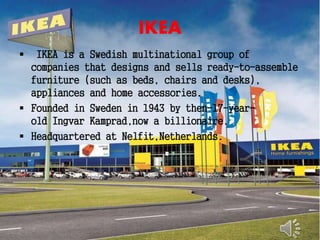
IKEA
 IKEA is a Swedish multinational group of
companies that designs and sells ready-to-assemble
furniture (such as beds, chairs and desks),
appliances and home accessories.
 Founded in Sweden in 1943 by then-17-year-
old Ingvar Kamprad,now a billionaire.
 Headquartered at Nelfit,Netherlands.
Company’s Vision
• “To create a better everyday life
for the many people”
• People have very thin wallets. We
should take care of them.
Unique Value Proposition
• Leading-edge design and functional
home furnishings at extremely low
prices.
What Influences Consumer
Behavior???
CULTURAL FACTORS
SOCIAL FACTORS
PERSONAL FACTORS
REFERENCE GROUPS
FAMILY
ROLES,STATUS
AGE PERSONALITY
What IKEA did very well
• Identified its consumer market
which consists of college
students and families with
children.
Simple Efficient Designs
• Introduced simple and efficient
designs for consumers which can be
easily assembled.
Initiatives
• Introduced IKEA family card scheme
for working families.
• Ikea in-store restaurants gives
relatively inexpensive food.
Product Design
• Designed product according to
regional and cultural tastes.
Showrooms
• Showrooms size as well as design vary
according to region.
Efficiency
• IKEA runs its business more
efficiently and passes the cost
savings to its customers.
Cost Saving Measures
• The company employs a large number of
cost saving strategies such as
Buying in bulk
Use of solar panels
Stores located at a good distance
from city centers thereby reducing
land costs.
• DO IT YOURSELF
• Consumers themselves do the
shopping, shipping and assembly.
• This strategy makes storage and
transportation easier and
cheaper for the store.
Pros of IKEA’s strategy
• Using common names for its products
such as Hektor, Billy makes the
people remember its product easily.
• Do it yourself concept has proved to
save costs for both IKEA and the
consumer itself.
• Quirky marketing fun campaigns like
“Ambassador of Kul”and ads helped
to create a good brand image.
Cons of IKEA’s strategy
• People are lazy. They do not want to do
assembling and shipping themselves.
• Stores are located at a far location.
• Since so many products are displayed
in the store the consumer might get
confused and end up going to a
different store.
IKEA as of today
• As of December 2016, IKEA owns and
operates 392 stores in 48 countries.
• Total Revenue:29.93 billion euros.
• Total type of products sold:12000
• No. of employees:1,83,000
• Introduction to IKEA and its history.
• The company’s vision.
• What Ikea did very well.
• Pros of IKEA’s strategy.
• Cons of IKEA’s strategy.
• IKEA as of today.
Disclaimer
• Created by Vishal Gupta, IIT-BHU during a
marketing internship by Prof. Sameer Mathur,
IIM LUCKNOW.

IKEA- A CASE STUDY

  • 2.
    IKEA  IKEA isa Swedish multinational group of companies that designs and sells ready-to-assemble furniture (such as beds, chairs and desks), appliances and home accessories.  Founded in Sweden in 1943 by then-17-year- old Ingvar Kamprad,now a billionaire.  Headquartered at Nelfit,Netherlands.
  • 3.
    Company’s Vision • “Tocreate a better everyday life for the many people” • People have very thin wallets. We should take care of them.
  • 4.
    Unique Value Proposition •Leading-edge design and functional home furnishings at extremely low prices.
  • 5.
    What Influences Consumer Behavior??? CULTURALFACTORS SOCIAL FACTORS PERSONAL FACTORS REFERENCE GROUPS FAMILY ROLES,STATUS AGE PERSONALITY
  • 6.
    What IKEA didvery well • Identified its consumer market which consists of college students and families with children.
  • 7.
    Simple Efficient Designs •Introduced simple and efficient designs for consumers which can be easily assembled.
  • 8.
    Initiatives • Introduced IKEAfamily card scheme for working families. • Ikea in-store restaurants gives relatively inexpensive food.
  • 9.
    Product Design • Designedproduct according to regional and cultural tastes.
  • 10.
    Showrooms • Showrooms sizeas well as design vary according to region.
  • 11.
    Efficiency • IKEA runsits business more efficiently and passes the cost savings to its customers.
  • 12.
    Cost Saving Measures •The company employs a large number of cost saving strategies such as Buying in bulk Use of solar panels Stores located at a good distance from city centers thereby reducing land costs.
  • 13.
    • DO ITYOURSELF • Consumers themselves do the shopping, shipping and assembly. • This strategy makes storage and transportation easier and cheaper for the store.
  • 14.
    Pros of IKEA’sstrategy • Using common names for its products such as Hektor, Billy makes the people remember its product easily.
  • 15.
    • Do ityourself concept has proved to save costs for both IKEA and the consumer itself.
  • 16.
    • Quirky marketingfun campaigns like “Ambassador of Kul”and ads helped to create a good brand image.
  • 17.
    Cons of IKEA’sstrategy • People are lazy. They do not want to do assembling and shipping themselves. • Stores are located at a far location.
  • 18.
    • Since somany products are displayed in the store the consumer might get confused and end up going to a different store.
  • 19.
    IKEA as oftoday • As of December 2016, IKEA owns and operates 392 stores in 48 countries. • Total Revenue:29.93 billion euros. • Total type of products sold:12000 • No. of employees:1,83,000
  • 20.
    • Introduction toIKEA and its history. • The company’s vision. • What Ikea did very well. • Pros of IKEA’s strategy. • Cons of IKEA’s strategy. • IKEA as of today.
  • 21.
    Disclaimer • Created byVishal Gupta, IIT-BHU during a marketing internship by Prof. Sameer Mathur, IIM LUCKNOW.