Edward  Na  
Jun  hee Kim
Erdem  Tokmakoglu
Contents
I. Company  Origins
II. IKEA  Strategy  – Early  Stages
III. IKEA  Strategy  – Up  to  Recent  Stages
IV.New  Directions  and  Future
Ingvar  Kamprad,  Management  Philosophy  and  PracticesIngvar  Kamprad,  Management  Philosophy  and  Practices
I ngvar
K amprad
E lmtaryd
A gunnyard
IKEA Timeline
1943 IKEA  founded  by  Ingvar  Kamprad
1947 Furnitures  introduced  into  IKEAs  product  range
1953 First  showroom  introduced  in  Älmhult  
1955 Begin  to  design  their  own  furniture
1963    First  international  expansion  in  Oslo  (Norway)
1965 Flat  packages  and  Knock-­down  kits  introduced
1974   opened  warehouses  in  Munich  (Germany)  and  Zurich  (Switzerland)
1976 First  expansion  outside  Europe,  Vancouver  (Canada)
1986 Anders  Moberg  appointed    2° CEO
1997 Launch  of  website  www.IKEA.com
2013 IKEA  Group  exceeds  100,000  co-­workers  operating  
in  44  countries.  
Income Statement (12’)
Facts & Figures
Ingvar  Kampard,  Management  Philosophy  and  Practices
‘ To create a better everyday life for the majority of the people ’‘ To create a better everyday life for the majority of the people ’
Ingvar  Kamprad
“Only while sleeping one makes no mistakes”
Testament of a furniture dealer
1. Product range, profile, quality
– our identity
2. IKEA spirit. A strong and Living
Reality
3. Profit gives us resources
4. To Reach Good Results with Small
Means
5. Simplicity is a Virtue
6. The Different Way
7. Concentration of Energy
– Important to our Success
8. To Assume Responsibility
– A privilege
9. Most Things Still Remain to be
done. A Glorious Future
Ödmjukhet
IKEA strategy – Early Stages
Cost-­ consciousness
Product  range
-­ finding  low  priced  materials
-­ matching  products  to  capabilities
-­ developing  long-­term  relationships  with  suppliers
Excessive  differentiation  and  wheel  reinventions  
-­>  unnecessary  expenses
Greater  coordination  &  standardization  began  to  
arise
-­>  ex  )  studios  :  standardized  in-­store  display  
areas
IKEA strategy – Early Stages
Ingvar  Kampard,  Management  Philosophy  and  Practices
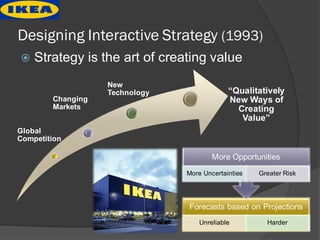
Designing Interactive Strategy (1993)
ž Strategy  is  the  art  of  creating  value
Global  
Competition
Changing  
Markets
New  
Technology “Qualitatively  
New  Ways  of  
Creating  
Value”
Forecasts  based  on  Projections  
Unreliable Harder
More  Opportunities
More  Uncertainties Greater  Risk
Successful companies
ž Not  just  add  value,  but  reinvent  it
ž The  focus  of  strategic  analysis  is  not  the  
company  or  even  the  industry  but  the  
value-­creating  system  itself
ž Create  an  ever-­improving  fit  between  
competencies  and  customers
ž Strategy  as  systematic  social  innovation;;  
the  continuous  design  and  redesign  of  
complex  business  systems
IKEA: The Wealth of Realizing New Ideas
ž IKEA’s  transformation  from  a  small  
Swedish  mail-­order  furniture  
operation  into  the  world’s  largest  
retailer  of  home  furnishings
Simple
Global  
Sourcing
Customer  
self-­service
The IKEA Effect: When Labor Leads to
Love(2011)
ž Labor  is  not  just  a  meaningful  
experience  – it’s  also  a  marketable  one.
ž E.g.)  Instant  cake  mixes
ž Labor  enhances  affection  for  its  results
ž When  people  construct  products  
themselves,  they  come  to  overvalue  
their  (often  poorly  made)  creations.  
ž Origami,  they  valued  them  as  highly  as  
origami  made  by  experts
The limits of IKEA Effect
Ø Only  when  the  labor  is  fruitful:  
when  participants  failed  to  complete  an  
effortful  task,  the  IKEA  effect  dissipated
Ø Difficult  enough  to  lead  to  higher  valuation  
but  not  so  difficult  that  customers  can’t  
complete  them
The Experimental Roots of
Revolutionary Vision (2006)
ž A  Process  of  
deliberate  
formulation?
ž A  General  Vision
ž Both  proactively  
developed  a  viable  
course  of  action  
and  reactively  
adapted  to  the  
circumstances
How  did  IKEA’s  
revolutionary  
strategy  come  
about?
Global  
product  
sourcing
Customer  
self-­
service
Plenty  of  
Amenities
Unusual  
shopping  
experience
Well-­
designed  
furniture
Logical Incrementalism
ž Actual  strategic  management  practices  
have  little  resemblance  to  the  rational  and  
analytic  approach  to  strategic  planning
ž In  the  real  world,  the  processes  are  often  
fragmented,  evolutionary  and  largely  
intuitive
ž A  general  sense  of  direction  is  necessary  to  
guide  the  organization  and  its  employees
How IKEA’s Strategy Was Created
ž Continuation  of  adaptation  and  improvement
rather  than  deliberate  strategy
ž E.g.)  Global  Sourcing  of  products  (50%  lower)
IKEA’s  strategy  consisted  of  selling  
furniture  at  much  lower  prices
the  Swedish  retail  cartel  warned  
local  manufacturers
Looking  for  suppliers  outside  
Sweden  to  overcome  a  boycott
New Horizons
NewHorizons
Accelerated Expension
AcceleratedExpension
Concerns
ž A-­class  sites
ž Less  efficiency  and  less  willing  employees
ž Risky  investments  as  4-­6  stores  every  year
ž Increasing  median  age  and  income  level
ž Standardization  failures
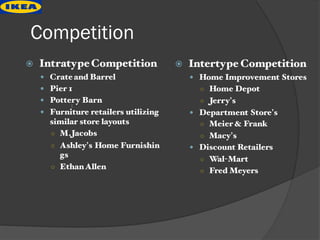
Competition
ž IntratypeCompetition
— Crate and Barrel
— Pier 1
— Pottery Barn
— Furniture retailers utilizing
similar store layouts
○ M.Jacobs
○ Ashley’s Home Furnishin
gs
○ EthanAllen
ž Intertype Competition
— Home Improvement Stores
○ Home Depot
○ Jerry’s
— Department Store’s
○ Meier & Frank
○ Macy’s
— Discount Retailers
○ Wal-Mart
○ Fred Meyers
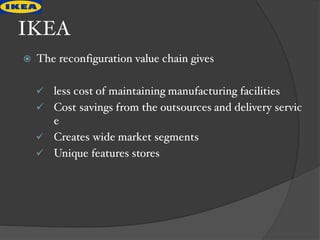
IKEA
ž The reconfiguration value chain gives
ü less cost of maintaining manufacturing facilities
ü Cost savings from the outsources and delivery servic
e
ü Creates wide market segments
ü Unique features stores
IKEA
ž Cost Leadership & Product Differentiation
— Ware-house sales so no delivery prices
— self-service
— flat-pack boxes
— Unified Modern Design
— Low price materials as pinewood
— Matching products to capabilities
— Monopoly created by economies of scale
— Tax
Discussion Questions
ž For  the  future,  as  IKEA  expands  further  i
nto  new  markets,  will  it  be  more  benefici
al  for  the  brand  to  stick  to  consistent  str
ategy  or  to  adopt  more  to  local  market?
ž Would  it  make  sense  to  extend  the  bran
d  towards  a  more  upscale  product  line?
0-­25 47%
25-­35 32
35-­45 14
45+ 7
Design 14%
Price 44%
Quality 3%
Large  assortment 16%
Catalog 11%
Recommendations 1%
Guarantees 0
Others 11%

Ikea

  • 1.
    Edward  Na   Jun hee Kim Erdem  Tokmakoglu
  • 2.
    Contents I. Company  Origins II.IKEA  Strategy  – Early  Stages III. IKEA  Strategy  – Up  to  Recent  Stages IV.New  Directions  and  Future
  • 3.
    Ingvar  Kamprad,  Management Philosophy  and  PracticesIngvar  Kamprad,  Management  Philosophy  and  Practices
  • 4.
    I ngvar K amprad Elmtaryd A gunnyard
  • 5.
    IKEA Timeline 1943 IKEA founded  by  Ingvar  Kamprad 1947 Furnitures  introduced  into  IKEAs  product  range 1953 First  showroom  introduced  in  Älmhult   1955 Begin  to  design  their  own  furniture 1963    First  international  expansion  in  Oslo  (Norway) 1965 Flat  packages  and  Knock-­down  kits  introduced 1974   opened  warehouses  in  Munich  (Germany)  and  Zurich  (Switzerland) 1976 First  expansion  outside  Europe,  Vancouver  (Canada) 1986 Anders  Moberg  appointed    2° CEO 1997 Launch  of  website  www.IKEA.com 2013 IKEA  Group  exceeds  100,000  co-­workers  operating   in  44  countries.  
  • 6.
  • 7.
  • 8.
    Ingvar  Kampard,  Management Philosophy  and  Practices ‘ To create a better everyday life for the majority of the people ’‘ To create a better everyday life for the majority of the people ’
  • 9.
    Ingvar  Kamprad “Only whilesleeping one makes no mistakes”
  • 10.
    Testament of afurniture dealer 1. Product range, profile, quality – our identity 2. IKEA spirit. A strong and Living Reality 3. Profit gives us resources 4. To Reach Good Results with Small Means 5. Simplicity is a Virtue 6. The Different Way 7. Concentration of Energy – Important to our Success 8. To Assume Responsibility – A privilege 9. Most Things Still Remain to be done. A Glorious Future
  • 11.
  • 12.
    IKEA strategy –Early Stages Cost-­ consciousness Product  range -­ finding  low  priced  materials -­ matching  products  to  capabilities -­ developing  long-­term  relationships  with  suppliers
  • 13.
    Excessive  differentiation  and wheel  reinventions   -­>  unnecessary  expenses Greater  coordination  &  standardization  began  to   arise -­>  ex  )  studios  :  standardized  in-­store  display   areas IKEA strategy – Early Stages
  • 14.
    Ingvar  Kampard,  Management Philosophy  and  Practices
  • 15.
    Designing Interactive Strategy(1993) ž Strategy  is  the  art  of  creating  value Global   Competition Changing   Markets New   Technology “Qualitatively   New  Ways  of   Creating   Value” Forecasts  based  on  Projections   Unreliable Harder More  Opportunities More  Uncertainties Greater  Risk
  • 16.
    Successful companies ž Not just  add  value,  but  reinvent  it ž The  focus  of  strategic  analysis  is  not  the   company  or  even  the  industry  but  the   value-­creating  system  itself ž Create  an  ever-­improving  fit  between   competencies  and  customers ž Strategy  as  systematic  social  innovation;;   the  continuous  design  and  redesign  of   complex  business  systems
  • 17.
    IKEA: The Wealthof Realizing New Ideas ž IKEA’s  transformation  from  a  small   Swedish  mail-­order  furniture   operation  into  the  world’s  largest   retailer  of  home  furnishings Simple Global   Sourcing Customer   self-­service
  • 19.
    The IKEA Effect:When Labor Leads to Love(2011) ž Labor  is  not  just  a  meaningful   experience  – it’s  also  a  marketable  one. ž E.g.)  Instant  cake  mixes ž Labor  enhances  affection  for  its  results ž When  people  construct  products   themselves,  they  come  to  overvalue   their  (often  poorly  made)  creations.   ž Origami,  they  valued  them  as  highly  as   origami  made  by  experts
  • 20.
    The limits ofIKEA Effect Ø Only  when  the  labor  is  fruitful:   when  participants  failed  to  complete  an   effortful  task,  the  IKEA  effect  dissipated Ø Difficult  enough  to  lead  to  higher  valuation   but  not  so  difficult  that  customers  can’t   complete  them
  • 21.
    The Experimental Rootsof Revolutionary Vision (2006) ž A  Process  of   deliberate   formulation? ž A  General  Vision ž Both  proactively   developed  a  viable   course  of  action   and  reactively   adapted  to  the   circumstances How  did  IKEA’s   revolutionary   strategy  come   about? Global   product   sourcing Customer   self-­ service Plenty  of   Amenities Unusual   shopping   experience Well-­ designed   furniture
  • 22.
    Logical Incrementalism ž Actual strategic  management  practices   have  little  resemblance  to  the  rational  and   analytic  approach  to  strategic  planning ž In  the  real  world,  the  processes  are  often   fragmented,  evolutionary  and  largely   intuitive ž A  general  sense  of  direction  is  necessary  to   guide  the  organization  and  its  employees
  • 23.
    How IKEA’s StrategyWas Created ž Continuation  of  adaptation  and  improvement rather  than  deliberate  strategy ž E.g.)  Global  Sourcing  of  products  (50%  lower) IKEA’s  strategy  consisted  of  selling   furniture  at  much  lower  prices the  Swedish  retail  cartel  warned   local  manufacturers Looking  for  suppliers  outside   Sweden  to  overcome  a  boycott
  • 25.
  • 26.
  • 28.
    Concerns ž A-­class  sites žLess  efficiency  and  less  willing  employees ž Risky  investments  as  4-­6  stores  every  year ž Increasing  median  age  and  income  level ž Standardization  failures
  • 29.
    Competition ž IntratypeCompetition — Crateand Barrel — Pier 1 — Pottery Barn — Furniture retailers utilizing similar store layouts ○ M.Jacobs ○ Ashley’s Home Furnishin gs ○ EthanAllen ž Intertype Competition — Home Improvement Stores ○ Home Depot ○ Jerry’s — Department Store’s ○ Meier & Frank ○ Macy’s — Discount Retailers ○ Wal-Mart ○ Fred Meyers
  • 30.
    IKEA ž The reconfigurationvalue chain gives ü less cost of maintaining manufacturing facilities ü Cost savings from the outsources and delivery servic e ü Creates wide market segments ü Unique features stores
  • 31.
    IKEA ž Cost Leadership& Product Differentiation — Ware-house sales so no delivery prices — self-service — flat-pack boxes — Unified Modern Design — Low price materials as pinewood — Matching products to capabilities — Monopoly created by economies of scale — Tax
  • 33.
    Discussion Questions ž For the  future,  as  IKEA  expands  further  i nto  new  markets,  will  it  be  more  benefici al  for  the  brand  to  stick  to  consistent  str ategy  or  to  adopt  more  to  local  market? ž Would  it  make  sense  to  extend  the  bran d  towards  a  more  upscale  product  line? 0-­25 47% 25-­35 32 35-­45 14 45+ 7 Design 14% Price 44% Quality 3% Large  assortment 16% Catalog 11% Recommendations 1% Guarantees 0 Others 11%