International Journal of Scientific Research and Engineering Development-– Volume2 Issue 2, Mar –Apr 2019
Available at www.ijsred.com
ISSN : 2581-7175 ©IJSRED: All Rights are Reserved Page 491
MULTI-KEYWORD SEARCH FOR MULTIPLE DATA
OWNERS USING ID-BASED ENCRYPTION TECHNIQUE
*Arumugam. P, **Pavithra. M, ***Shyamala. S, ****Ezhilarasan. M
*(Information Technology, Pondicherry Engineering College, Pondicherry)
** (Information Technology, Pondicherry Engineering College, Pondicherry)
*** (Information Technology, Pondicherry Engineering College, Pondicherry)
****(Professor,Information Technology, Pondicherry Engineering College, Pondicherry)
----------------------------------------************************----------------------------------
Abstract:
Cloud computing is a standout amongst the most famous innovation among the new rising advancements
in the field of web and PCs. With the expanding appropriation of cloud computing, a developing number
of clients re-appropriate their documents to the cloud. To protect the security, the datasets are normally
scrambled before redistributing. In any case, the regular routine with regards to encryption makes the
powerful use of the information troublesome. For instance, it is hard to look through the given watchwords
in scrambled records. Customary symmetric encryption strategy won't fit into the security bend where
there is an increase in the number of information proprietors and clients, even the information proprietors
can't have their very own documents. Consequently, ID-based Encryption procedure has been proposed for
productive recovery of information from the cloud.
Keywords —MRSE, IBE, PKG, PKI
----------------------------------------************************----------------------------------
I. INTRODUCTION
Cloud computing is a computing paradigm, where
an extensive pool of frameworks are associated in
private or open systems, to give powerfully
versatile foundation to application, information, and
record stockpiling. With the appearance of this
innovation, the expense of calculation, application
facilitating, content stockpiling and conveyance are
decreased altogether. Cloud computing is a viable
way to deal with experience direct money-saving
advantages and it can possibly change a server farm
from a capital-serious set up to a variable
evaluated condition. Cloud registering depends on
an essential vital of 'reusability' of IT industries.
The distinction that cloud computing brings
contrasted with conventional ideas of "lattice
figuring", "disseminated registering", "utility
processing", or "autonomic processing" is to widen
skylines crosswise over authoritative limits. Cloud
computing incorporates a gathering of PCs that are
mutually used to give distinctive calculations and
errands. Cloud computing is a standout amongst the
most imperative IT standards over the most recent
couple of years. One of the key advantages that are
offered from this IT innovation for the
organizations is decreased time and expenses
available. Cloud computing is giving organizations
and associations to utilize shared capacity and
registering assets. It is superior to create and work
with the claim foundation. Cloud computing
additionally gives associations and organizations to
have an adaptable, secure, and financially savvy IT
RESEARCH ARTICLE OPEN ACCESS
International Journal of Scientific Research and Engineering Development-– Volume2 Issue 2, Mar –Apr 2019
Available at www.ijsred.com
ISSN : 2581-7175 ©IJSRED: All Rights are Reserved Page 492
foundation. There are diverse sorts and models in
cloud computing with respect to the distinctive gave
administrations. Along these lines, cloud computing
includes open cloud, private cloud, half and half
cloud, and network cloud. Administration
conveyance models, then again, could be arranged
as SaaS (Software as an administration), PaaS
(Platform as a Service), and IaaS (Infrastructure as
a Service).
The existing encryption techniques makes retrieval
of documents difficult as data users need to manage
multiple keys for different data owners. Data users
need to generate multiple trapdoors for data
owner’s data even for the same query condition. In
the paper, ID-based encryption has been proposed
which results in efficient data retrieval from cloud
without the need to manage multiple encryption
keys by the data users for the same data.
II. LITERATURE SURVEY
Encryption plays a major role in retrieval of data
from cloud securely. The two major types of
encryption are symmetric and asymmetric
encryption.
Symmetric Encryption [1] is the simplest kind of
encryption that involves only one secret key to
cipher and decipher information. It utilizes a secret
key that can either be a number, a word or a string
of random letters. It is combined with the plain text
of a message to change the content in a particular
way. The sender and the recipient should know the
secret key that is used to encrypt and decrypt all the
messages. DES, Triple-DES, Blowfish, RC5 and
Advanced Encryption Standard are examples of
symmetric encryption. The main limitation of the
symmetric key encryption is that all parties
involved have to exchange the key used to encrypt
the data before they can decrypt it.
Asymmetric encryption is also known as public key
cryptography, which is a relatively new method,
compared to symmetric encryption. It uses two keys
to encrypt a plain text. A public key is made
available to anyone who wants to send a message.
The second private key is kept secret so that sender
can only know. A message that is encrypted with
the public key can only be decrypted using a private
key, while also, a message encrypted using a
private key can be decrypted using a public key.
Security of the public key is not required because it
is publicly available and can be passed over the
internet.Diffie Hellman key exchange algorithm,
RSA (Rivest–Shamir–Adleman), ID-Based
Encryption, Elliptic Curve Cryptography (ECC),
Digital Signature Algorithm (DSA), Attribute based
encryption(ABE) are some examples of asymmetric
encryption. Asymmetric key has a far better
efficiency in ensuring the security of data
transmitted during communication.
Cong Wang [2] proposed search which solves
processing overhead, data and keyword privacy,
minimum communication and computation aerial.
The information proprietor constructs file alongside
the keyword frequency based relevance scores for
documents. The user request to Cloud Server using
the private key. The Cloud Server searches the
index with scores and sends encrypted file based on
the ranked sequence. It does not perform multiple
keyword searches. Minimal overhead in index
building.
Jiadi [3] proposed search using two round
searchable encryption (TRSE). In the first round,
users present multiple keyword ‘REQ’ ‘W’ as the
encrypted query for accomplishing data, keyword
privacy and create trapdoor (REQ, PK) as Tw and
send to Cloud Server. Then Cloud Server figure out
the score from the encrypted index for files and
returns the encrypted score result vector to the user.
In the second round, user decodes N with the secret
key and calculates the file ranking and then request
files with Top k scores. The ranking of record is
done on the client side and scoring is done on the
server side. The contraction and confining are
utilized to decrease cipher text size, still the key
International Journal of Scientific Research and Engineering Development-– Volume2 Issue 2, Mar –Apr 2019
Available at www.ijsred.com
ISSN : 2581-7175 ©IJSRED: All Rights are Reserved Page 493
size is too large. The communication aerial will be
very high if the encrypted trapdoor's size is too
large. It does not make an effective searchable
index update.
Ning [4] designed search for known cipher text
model and background model over encrypted data
providing low computation and communication
overhead. The coordinate matching is chosen for
multi-keyword search. They used inner product
similarity to quantitatively evaluate similarity for
ranking files. The limitation is that MRSE have
small standard deviation σ which weakens keyword
privacy.
Qin Liu [5] proposed search that provides keyword
privacy, data privacy and semantic secure by public
key encryption. Cloud Server is involved in partial
decipherment by reducing the communication and
computational aerial in the decryption process for
end users. The user submits the keyword trapdoor
encrypted by the user’s private key to Cloud Server
securely and retrieve the encrypted documents. The
communication and computational expense for
encryption and decoding are more.
A secure tree-based search scheme [6] over the
encrypted cloud storage, which supports multi
keyword ranked search along with dynamic
operation on document collection available at
server has also been designed. The vector space
model and term frequency (TF) × inverse document
frequency (IDF) model are combined and used in
the construction of index and generation of query to
provide multi keyword ranked search output.. The
Searchable Symmetric Encryption has been applied
to encrypt the index and query vectors, and till then
ensure accurate relevance score calculation between
encrypted index and query vectors.
Wenhai Sun [7] proposed Attribute-based Keyword
search that facilitates conjunctive keyword search,
keyword semantic security and Trapdoor
unlinkability. The owners makes an index with all
keywords and access list with policy attributes
which specifies the user’s list authorized for
searching. Now owners encrypt the document,
index with access list utilizing ciphertext policy
attribute-based encryption technique. To have user
membership management, they used proxy re-
encryption and lazy re-encryption techniques to
share the workload to Cloud Server. The user
requests the Tw to Cloud Server using its private
key. Now Cloud Server recovers Tw and searches
the encrypted indexes and returns documents only if
the user’s attributes in Tw satisfies access policies
in indexes which makes coarse-grained dataset
search authorization. Trapdoor generation will need
additional time with the increased number of
attributes.
In the paper, the proposed technique Identity Based
Encryption has characterized and solved the
problem of multi- keyword search over encrypted
cloud data without the need of acquisition of
multiple encryption keys by the data users with less
retrieval time compared with existing searchable
symmetric encryption technique.
III. PROPOSED SYSTEM
3.1 Problem Definition
The retrieval of documents owned by multiple data
owners becomes difficult for data users because of
different encryption keys used by data owners
causing the delay in retrieval time. With the help of
the ID-based encryption technique, this issue can be
eliminated.
3.2 System Model
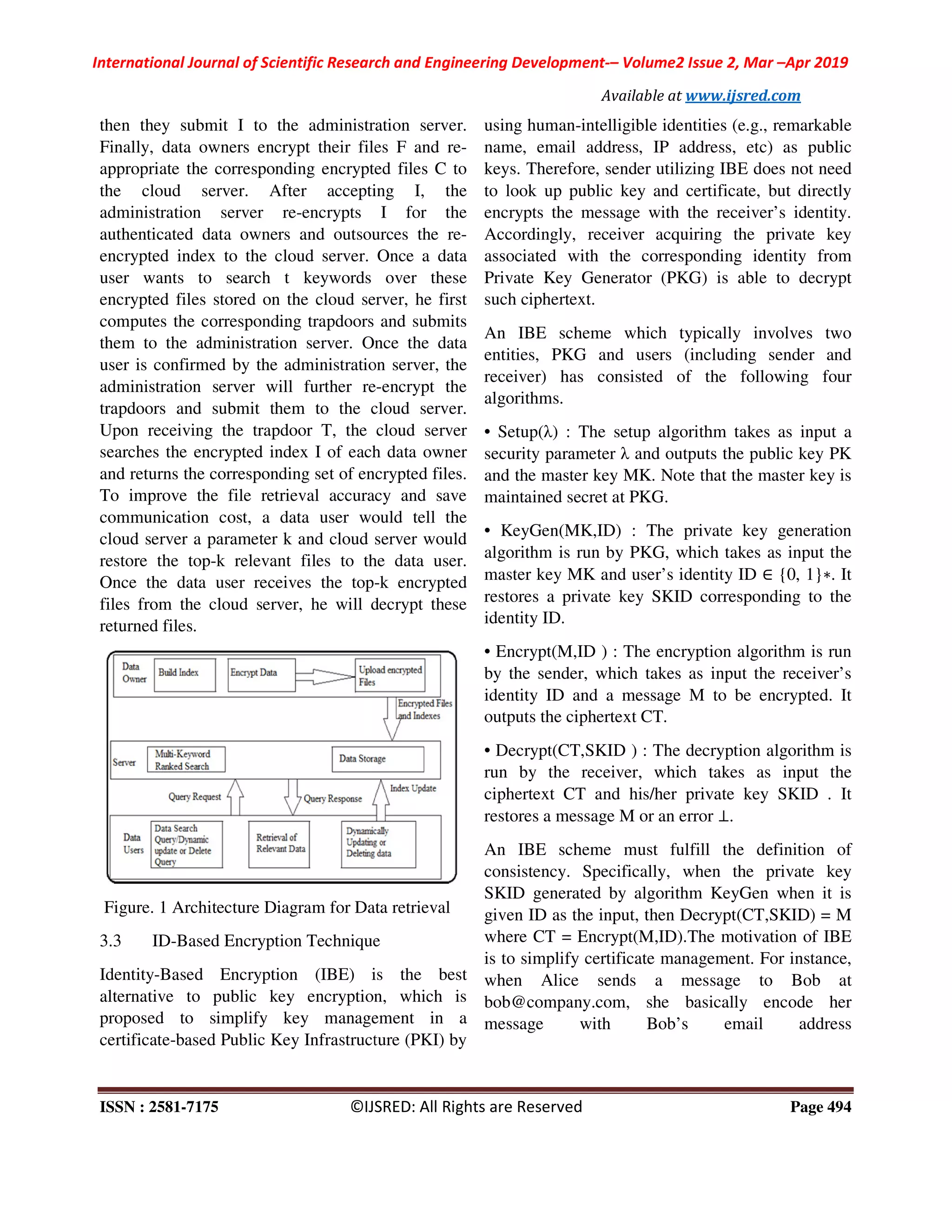
In our multi-owner and multi-user cloud computing
model, four entities are involved, as illustrated in
Fig.1, they are data owners, the cloud server,
administration server, and data users. Data owners
have a collection of files F. To enable efficient
search operations on these files which will be
encoded, data owners first build a secure searchable
index I on the keyword set W extracted from F,
International Journal of Scientific Research and Engineering Development
ISSN : 2581-7175 ©IJSRED: All Rights are Reserved
then they submit I to the administration server.
Finally, data owners encrypt their files F and re
appropriate the corresponding encrypted files C to
the cloud server. After accepting I, the
administration server re-encrypts
authenticated data owners and outsources the re
encrypted index to the cloud server. Once a data
user wants to search t keywords over these
encrypted files stored on the cloud server, he first
computes the corresponding trapdoors and submits
them to the administration server. Once the data
user is confirmed by the administration server, the
administration server will further re
trapdoors and submit them to the cloud server.
Upon receiving the trapdoor T, the cloud server
searches the encrypted index I of each data owner
and returns the corresponding set of encrypted files.
To improve the file retrieval accuracy and save
communication cost, a data user would tell the
cloud server a parameter k and cloud server would
restore the top-k relevant files to the data user.
Once the data user receives the top-
files from the cloud server, he will decrypt these
returned files.
Figure. 1 Architecture Diagram for Data retrieval
3.3 ID-Based Encryption Technique
Identity-Based Encryption (IBE) is the best
alternative to public key encryption, which is
proposed to simplify key management in a
certificate-based Public Key Infrastructure (PKI) by
International Journal of Scientific Research and Engineering Development-– Volume2 Issue 2, Mar
Available at www.ijsred.com
©IJSRED: All Rights are Reserved
then they submit I to the administration server.
Finally, data owners encrypt their files F and re-
appropriate the corresponding encrypted files C to
the cloud server. After accepting I, the
encrypts I for the
authenticated data owners and outsources the re-
encrypted index to the cloud server. Once a data
user wants to search t keywords over these
encrypted files stored on the cloud server, he first
computes the corresponding trapdoors and submits
to the administration server. Once the data
user is confirmed by the administration server, the
administration server will further re-encrypt the
trapdoors and submit them to the cloud server.
Upon receiving the trapdoor T, the cloud server
ncrypted index I of each data owner
and returns the corresponding set of encrypted files.
To improve the file retrieval accuracy and save
communication cost, a data user would tell the
cloud server a parameter k and cloud server would
evant files to the data user.
-k encrypted
files from the cloud server, he will decrypt these
Figure. 1 Architecture Diagram for Data retrieval
Based Encryption Technique
Based Encryption (IBE) is the best
alternative to public key encryption, which is
proposed to simplify key management in a
based Public Key Infrastructure (PKI) by
using human-intelligible identities (e.g., remarkable
name, email address, IP address, etc) as public
keys. Therefore, sender utilizing IBE does not need
to look up public key and certificate, but directly
encrypts the message with the receiver’s identity.
Accordingly, receiver acquiring the private key
associated with the corresponding identity from
Private Key Generator (PKG) is able to decrypt
such ciphertext.
An IBE scheme which typically involves two
entities, PKG and users (including sender and
receiver) has consisted of the following four
algorithms.
• Setup(λ) : The setup algorithm takes as input a
security parameter λ and outputs the public key PK
and the master key MK. Note that the master key is
maintained secret at PKG.
• KeyGen(MK,ID) : The private key generation
algorithm is run by PKG, which takes as input the
master key MK and user’s identity ID
restores a private key SKID corresponding to the
identity ID.
• Encrypt(M,ID ) : The encryption algorithm is run
by the sender, which takes as input the receiver’s
identity ID and a message M to be encrypted. It
outputs the ciphertext CT.
• Decrypt(CT,SKID ) : The decryption algorithm is
run by the receiver, which takes as in
ciphertext CT and his/her private key SKID . It
restores a message M or an error
An IBE scheme must fulfill the definition of
consistency. Specifically, when the private key
SKID generated by algorithm KeyGen when it is
given ID as the input, then Decrypt(CT,SKID) = M
where CT = Encrypt(M,ID).The motivation of IBE
is to simplify certificate management. For instance,
when Alice sends a message to Bob at
bob@company.com, she basically encode her
message with Bob’s email address
Issue 2, Mar –Apr 2019
www.ijsred.com
Page 494
intelligible identities (e.g., remarkable
ss, IP address, etc) as public
keys. Therefore, sender utilizing IBE does not need
to look up public key and certificate, but directly
encrypts the message with the receiver’s identity.
Accordingly, receiver acquiring the private key
rresponding identity from
Private Key Generator (PKG) is able to decrypt
An IBE scheme which typically involves two
entities, PKG and users (including sender and
receiver) has consisted of the following four
etup algorithm takes as input a
and outputs the public key PK
and the master key MK. Note that the master key is
• KeyGen(MK,ID) : The private key generation
algorithm is run by PKG, which takes as input the
master key MK and user’s identity ID ∈ {0, 1}∗. It
restores a private key SKID corresponding to the
M,ID ) : The encryption algorithm is run
by the sender, which takes as input the receiver’s
identity ID and a message M to be encrypted. It
• Decrypt(CT,SKID ) : The decryption algorithm is
run by the receiver, which takes as input the
ciphertext CT and his/her private key SKID . It
restores a message M or an error ⊥.
An IBE scheme must fulfill the definition of
consistency. Specifically, when the private key
SKID generated by algorithm KeyGen when it is
hen Decrypt(CT,SKID) = M
where CT = Encrypt(M,ID).The motivation of IBE
is to simplify certificate management. For instance,
when Alice sends a message to Bob at
bob@company.com, she basically encode her
message with Bob’s email address
International Journal of Scientific Research and Engineering Development
ISSN : 2581-7175 ©IJSRED: All Rights are Reserved
“bob@company.com”, yet does not need to acquire
Bob’s public key certificate. At this point, when
Bob receives the encrypted email he confirms
himself at PKG to obtain his private key, and read
his email with such a private key.
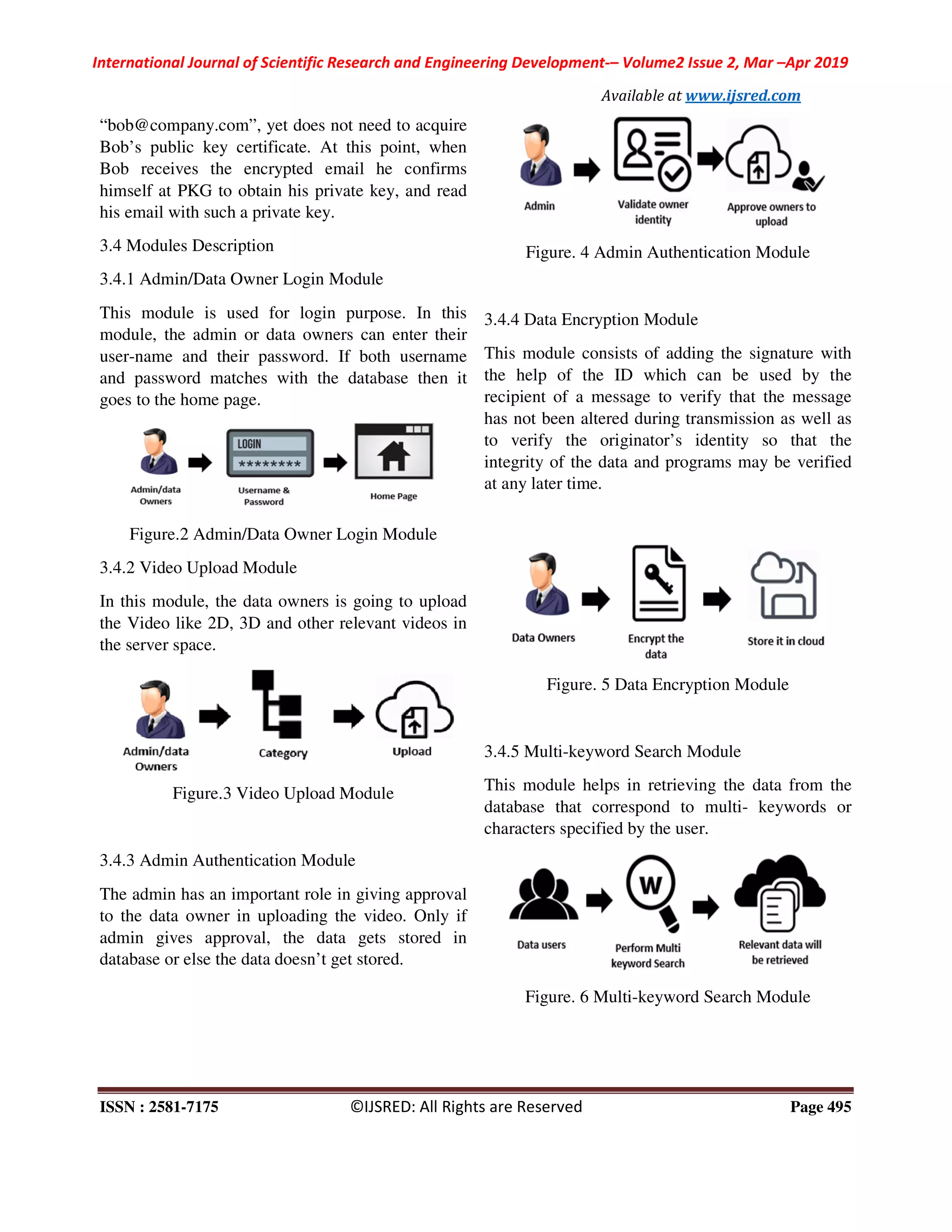
3.4 Modules Description
3.4.1 Admin/Data Owner Login Module
This module is used for login purpose. In this
module, the admin or data owners can enter their
user-name and their password. If both username
and password matches with the database then it
goes to the home page.
Figure.2 Admin/Data Owner Login Module
3.4.2 Video Upload Module
In this module, the data owners is going to upload
the Video like 2D, 3D and other relevant videos in
the server space.
Figure.3 Video Upload Module
3.4.3 Admin Authentication Module
The admin has an important role in giving approval
to the data owner in uploading the video. Only if
admin gives approval, the data gets stored in
database or else the data doesn’t get stored.
International Journal of Scientific Research and Engineering Development-– Volume2 Issue 2, Mar
Available at www.ijsred.com
©IJSRED: All Rights are Reserved
yet does not need to acquire
Bob’s public key certificate. At this point, when
Bob receives the encrypted email he confirms
himself at PKG to obtain his private key, and read
Login Module
This module is used for login purpose. In this
module, the admin or data owners can enter their
name and their password. If both username
and password matches with the database then it
ogin Module
In this module, the data owners is going to upload
the Video like 2D, 3D and other relevant videos in
Figure.3 Video Upload Module
le in giving approval
to the data owner in uploading the video. Only if
admin gives approval, the data gets stored in
database or else the data doesn’t get stored.
Figure. 4 Admin Authentication Module
3.4.4 Data Encryption Module
This module consists of adding the signature with
the help of the ID which can be used by the
recipient of a message to verify that the message
has not been altered during transmission as well as
to verify the originator’s identity so that the
integrity of the data and programs
at any later time.
Figure. 5 Data Encryption Module
3.4.5 Multi-keyword Search Module
This module helps in retrieving the data from the
database that correspond to multi
characters specified by the user.
Figure. 6 Multi-keyword Search Module
Issue 2, Mar –Apr 2019
www.ijsred.com
Page 495
Figure. 4 Admin Authentication Module
f adding the signature with
the help of the ID which can be used by the
recipient of a message to verify that the message
has not been altered during transmission as well as
to verify the originator’s identity so that the
integrity of the data and programs may be verified
Figure. 5 Data Encryption Module
keyword Search Module
This module helps in retrieving the data from the
database that correspond to multi- keywords or
keyword Search Module
International Journal of Scientific Research and Engineering Development-– Volume2 Issue 2, Mar –Apr 2019
Available at www.ijsred.com
ISSN : 2581-7175 ©IJSRED: All Rights are Reserved Page 496
3.4.6 .Data Request Module
The Data User needs to request for the complete
data with user identity (uid) key. The Data Owner
will verify the uid Key and approve the data to be
accessed with the data owner. Once the data owner
gave access, the data will be visible to the user
requested.
Fig.7. Data Request Module
3.5 Complexity involved in the proposal
The complexity involved in the proposal is to
reduce the acquisition of multiple keys by the data
users which helps in reducing the computational
time for searching the files using ID-Based
Encryption technique.
IV. RESULT ANALYSIS
The implementation has been done by using PHP
language with SQL database as backend in
Windows 10 environment. The response time of
video retrieval based on the designation of data
users using Identity Based Encryption has been
compared with existing Searchable Symmetric
encryption.
Fig 8. Response Time Graph for Data retrieval
V. CONCLUSION
In our proposed work, the problem of multi-
keyword search for multiple data owners and
multiple data users in the cloud computing
environment has been analysed. Different from
prior works, the proposed scheme enable
authenticated data users to achieve secure,
convenient, and efficient searches over multiple
data owner’s data. To efficiently authenticate data
users and detect attackers who steal the secret key
and perform illegal searches, we use ID-based
Encryption, a public key cryptography algorithm.
To empower the cloud server to perform secure
search among multiple owner’s data encrypted with
different secret keys along with fast retrieval time,
the ID-based Encryption plays a key role by
limiting the use of more number of private keys for
the data users in accessing the data with the help of
Private Key Generator and reduces retrieval time of
data.
REFERENCES
[1] S.Chandra , S. Paira , SkSafikulAlam ,” A comparative survey of
Symmetric and Asymmetric Key Cryptography”, International
Conference on Electronics, Communication and Computational
Engineering, Pg no 83-93, 16 April 2015.
[2] Cong Wang et al., “Enabling Secure and Efficient Ranked Keyword
Search over Outsourced Cloud Data”, IEEE Transactions on parallel
and distributed systems, Vol. 23, no. 8, August 2012.
[3] Jiadi Yu, Peng Lu, Yanmin Zhu, GuangtaoXue, IEEE Computer
Society, and MingluLi, “Toward Secure Multi-keyword Top k
Retrieval over Encrypted Cloud Data”, IEEE Journal of Theoretical
International Journal of Scientific Research and Engineering Development-– Volume2 Issue 2, Mar –Apr 2019
Available at www.ijsred.com
ISSN : 2581-7175 ©IJSRED: All Rights are Reserved Page 497
and Applied Information Technology , Vol. 66 No.1, 10th August
2014.
[4] Ning Cao et al., “Privacy-Preserving Multi Keyword Ranked Search
over Encrypted Cloud Data”, IEEE Transactions on parallel and
distributed systems, vol. 25, no. 1, Jan 2014.
[5] Qin Liuy, GuojunWangyz, and JieWuz, “Secure and privacy
preserving keyword searching for cloud storage services”, ELSEVIER
Journal of Network and computer Applications, March 2011.
[6] TianyuePeng ,Yaping Lin ,XinYao, Wei Zhang, “An Efficient Ranked
Multi-Keyword Search for Multiple Data Owners OverEncrypted
Cloud Data”, IEEE-Translations and content mining, Volume 6, Pg no.
21924- 21932, May 9, 2018.
[7] Wenhai Sun et al., “Privacy-Preserving Multi keyword Text Search in
the Cloud Supporting Similarity-based Ranking”, the 8th ACM
Symposium on Information, Computer and Communications Security,
Hangzhou, China, May 2013.
[8] Zhihua Xia, “A Secure and Dynamic Multi-keyword Ranked Search
Scheme over Encrypted Cloud Data”, IEEE Transactions on Parallel
and Distributed Systems, Vol. Pg No: 99 Year 2015.

IJSRED-V2I2P55

  • 1.
    International Journal ofScientific Research and Engineering Development-– Volume2 Issue 2, Mar –Apr 2019 Available at www.ijsred.com ISSN : 2581-7175 ©IJSRED: All Rights are Reserved Page 491 MULTI-KEYWORD SEARCH FOR MULTIPLE DATA OWNERS USING ID-BASED ENCRYPTION TECHNIQUE *Arumugam. P, **Pavithra. M, ***Shyamala. S, ****Ezhilarasan. M *(Information Technology, Pondicherry Engineering College, Pondicherry) ** (Information Technology, Pondicherry Engineering College, Pondicherry) *** (Information Technology, Pondicherry Engineering College, Pondicherry) ****(Professor,Information Technology, Pondicherry Engineering College, Pondicherry) ----------------------------------------************************---------------------------------- Abstract: Cloud computing is a standout amongst the most famous innovation among the new rising advancements in the field of web and PCs. With the expanding appropriation of cloud computing, a developing number of clients re-appropriate their documents to the cloud. To protect the security, the datasets are normally scrambled before redistributing. In any case, the regular routine with regards to encryption makes the powerful use of the information troublesome. For instance, it is hard to look through the given watchwords in scrambled records. Customary symmetric encryption strategy won't fit into the security bend where there is an increase in the number of information proprietors and clients, even the information proprietors can't have their very own documents. Consequently, ID-based Encryption procedure has been proposed for productive recovery of information from the cloud. Keywords —MRSE, IBE, PKG, PKI ----------------------------------------************************---------------------------------- I. INTRODUCTION Cloud computing is a computing paradigm, where an extensive pool of frameworks are associated in private or open systems, to give powerfully versatile foundation to application, information, and record stockpiling. With the appearance of this innovation, the expense of calculation, application facilitating, content stockpiling and conveyance are decreased altogether. Cloud computing is a viable way to deal with experience direct money-saving advantages and it can possibly change a server farm from a capital-serious set up to a variable evaluated condition. Cloud registering depends on an essential vital of 'reusability' of IT industries. The distinction that cloud computing brings contrasted with conventional ideas of "lattice figuring", "disseminated registering", "utility processing", or "autonomic processing" is to widen skylines crosswise over authoritative limits. Cloud computing incorporates a gathering of PCs that are mutually used to give distinctive calculations and errands. Cloud computing is a standout amongst the most imperative IT standards over the most recent couple of years. One of the key advantages that are offered from this IT innovation for the organizations is decreased time and expenses available. Cloud computing is giving organizations and associations to utilize shared capacity and registering assets. It is superior to create and work with the claim foundation. Cloud computing additionally gives associations and organizations to have an adaptable, secure, and financially savvy IT RESEARCH ARTICLE OPEN ACCESS
  • 2.
    International Journal ofScientific Research and Engineering Development-– Volume2 Issue 2, Mar –Apr 2019 Available at www.ijsred.com ISSN : 2581-7175 ©IJSRED: All Rights are Reserved Page 492 foundation. There are diverse sorts and models in cloud computing with respect to the distinctive gave administrations. Along these lines, cloud computing includes open cloud, private cloud, half and half cloud, and network cloud. Administration conveyance models, then again, could be arranged as SaaS (Software as an administration), PaaS (Platform as a Service), and IaaS (Infrastructure as a Service). The existing encryption techniques makes retrieval of documents difficult as data users need to manage multiple keys for different data owners. Data users need to generate multiple trapdoors for data owner’s data even for the same query condition. In the paper, ID-based encryption has been proposed which results in efficient data retrieval from cloud without the need to manage multiple encryption keys by the data users for the same data. II. LITERATURE SURVEY Encryption plays a major role in retrieval of data from cloud securely. The two major types of encryption are symmetric and asymmetric encryption. Symmetric Encryption [1] is the simplest kind of encryption that involves only one secret key to cipher and decipher information. It utilizes a secret key that can either be a number, a word or a string of random letters. It is combined with the plain text of a message to change the content in a particular way. The sender and the recipient should know the secret key that is used to encrypt and decrypt all the messages. DES, Triple-DES, Blowfish, RC5 and Advanced Encryption Standard are examples of symmetric encryption. The main limitation of the symmetric key encryption is that all parties involved have to exchange the key used to encrypt the data before they can decrypt it. Asymmetric encryption is also known as public key cryptography, which is a relatively new method, compared to symmetric encryption. It uses two keys to encrypt a plain text. A public key is made available to anyone who wants to send a message. The second private key is kept secret so that sender can only know. A message that is encrypted with the public key can only be decrypted using a private key, while also, a message encrypted using a private key can be decrypted using a public key. Security of the public key is not required because it is publicly available and can be passed over the internet.Diffie Hellman key exchange algorithm, RSA (Rivest–Shamir–Adleman), ID-Based Encryption, Elliptic Curve Cryptography (ECC), Digital Signature Algorithm (DSA), Attribute based encryption(ABE) are some examples of asymmetric encryption. Asymmetric key has a far better efficiency in ensuring the security of data transmitted during communication. Cong Wang [2] proposed search which solves processing overhead, data and keyword privacy, minimum communication and computation aerial. The information proprietor constructs file alongside the keyword frequency based relevance scores for documents. The user request to Cloud Server using the private key. The Cloud Server searches the index with scores and sends encrypted file based on the ranked sequence. It does not perform multiple keyword searches. Minimal overhead in index building. Jiadi [3] proposed search using two round searchable encryption (TRSE). In the first round, users present multiple keyword ‘REQ’ ‘W’ as the encrypted query for accomplishing data, keyword privacy and create trapdoor (REQ, PK) as Tw and send to Cloud Server. Then Cloud Server figure out the score from the encrypted index for files and returns the encrypted score result vector to the user. In the second round, user decodes N with the secret key and calculates the file ranking and then request files with Top k scores. The ranking of record is done on the client side and scoring is done on the server side. The contraction and confining are utilized to decrease cipher text size, still the key
  • 3.
    International Journal ofScientific Research and Engineering Development-– Volume2 Issue 2, Mar –Apr 2019 Available at www.ijsred.com ISSN : 2581-7175 ©IJSRED: All Rights are Reserved Page 493 size is too large. The communication aerial will be very high if the encrypted trapdoor's size is too large. It does not make an effective searchable index update. Ning [4] designed search for known cipher text model and background model over encrypted data providing low computation and communication overhead. The coordinate matching is chosen for multi-keyword search. They used inner product similarity to quantitatively evaluate similarity for ranking files. The limitation is that MRSE have small standard deviation σ which weakens keyword privacy. Qin Liu [5] proposed search that provides keyword privacy, data privacy and semantic secure by public key encryption. Cloud Server is involved in partial decipherment by reducing the communication and computational aerial in the decryption process for end users. The user submits the keyword trapdoor encrypted by the user’s private key to Cloud Server securely and retrieve the encrypted documents. The communication and computational expense for encryption and decoding are more. A secure tree-based search scheme [6] over the encrypted cloud storage, which supports multi keyword ranked search along with dynamic operation on document collection available at server has also been designed. The vector space model and term frequency (TF) × inverse document frequency (IDF) model are combined and used in the construction of index and generation of query to provide multi keyword ranked search output.. The Searchable Symmetric Encryption has been applied to encrypt the index and query vectors, and till then ensure accurate relevance score calculation between encrypted index and query vectors. Wenhai Sun [7] proposed Attribute-based Keyword search that facilitates conjunctive keyword search, keyword semantic security and Trapdoor unlinkability. The owners makes an index with all keywords and access list with policy attributes which specifies the user’s list authorized for searching. Now owners encrypt the document, index with access list utilizing ciphertext policy attribute-based encryption technique. To have user membership management, they used proxy re- encryption and lazy re-encryption techniques to share the workload to Cloud Server. The user requests the Tw to Cloud Server using its private key. Now Cloud Server recovers Tw and searches the encrypted indexes and returns documents only if the user’s attributes in Tw satisfies access policies in indexes which makes coarse-grained dataset search authorization. Trapdoor generation will need additional time with the increased number of attributes. In the paper, the proposed technique Identity Based Encryption has characterized and solved the problem of multi- keyword search over encrypted cloud data without the need of acquisition of multiple encryption keys by the data users with less retrieval time compared with existing searchable symmetric encryption technique. III. PROPOSED SYSTEM 3.1 Problem Definition The retrieval of documents owned by multiple data owners becomes difficult for data users because of different encryption keys used by data owners causing the delay in retrieval time. With the help of the ID-based encryption technique, this issue can be eliminated. 3.2 System Model In our multi-owner and multi-user cloud computing model, four entities are involved, as illustrated in Fig.1, they are data owners, the cloud server, administration server, and data users. Data owners have a collection of files F. To enable efficient search operations on these files which will be encoded, data owners first build a secure searchable index I on the keyword set W extracted from F,
  • 4.
    International Journal ofScientific Research and Engineering Development ISSN : 2581-7175 ©IJSRED: All Rights are Reserved then they submit I to the administration server. Finally, data owners encrypt their files F and re appropriate the corresponding encrypted files C to the cloud server. After accepting I, the administration server re-encrypts authenticated data owners and outsources the re encrypted index to the cloud server. Once a data user wants to search t keywords over these encrypted files stored on the cloud server, he first computes the corresponding trapdoors and submits them to the administration server. Once the data user is confirmed by the administration server, the administration server will further re trapdoors and submit them to the cloud server. Upon receiving the trapdoor T, the cloud server searches the encrypted index I of each data owner and returns the corresponding set of encrypted files. To improve the file retrieval accuracy and save communication cost, a data user would tell the cloud server a parameter k and cloud server would restore the top-k relevant files to the data user. Once the data user receives the top- files from the cloud server, he will decrypt these returned files. Figure. 1 Architecture Diagram for Data retrieval 3.3 ID-Based Encryption Technique Identity-Based Encryption (IBE) is the best alternative to public key encryption, which is proposed to simplify key management in a certificate-based Public Key Infrastructure (PKI) by International Journal of Scientific Research and Engineering Development-– Volume2 Issue 2, Mar Available at www.ijsred.com ©IJSRED: All Rights are Reserved then they submit I to the administration server. Finally, data owners encrypt their files F and re- appropriate the corresponding encrypted files C to the cloud server. After accepting I, the encrypts I for the authenticated data owners and outsources the re- encrypted index to the cloud server. Once a data user wants to search t keywords over these encrypted files stored on the cloud server, he first computes the corresponding trapdoors and submits to the administration server. Once the data user is confirmed by the administration server, the administration server will further re-encrypt the trapdoors and submit them to the cloud server. Upon receiving the trapdoor T, the cloud server ncrypted index I of each data owner and returns the corresponding set of encrypted files. To improve the file retrieval accuracy and save communication cost, a data user would tell the cloud server a parameter k and cloud server would evant files to the data user. -k encrypted files from the cloud server, he will decrypt these Figure. 1 Architecture Diagram for Data retrieval Based Encryption Technique Based Encryption (IBE) is the best alternative to public key encryption, which is proposed to simplify key management in a based Public Key Infrastructure (PKI) by using human-intelligible identities (e.g., remarkable name, email address, IP address, etc) as public keys. Therefore, sender utilizing IBE does not need to look up public key and certificate, but directly encrypts the message with the receiver’s identity. Accordingly, receiver acquiring the private key associated with the corresponding identity from Private Key Generator (PKG) is able to decrypt such ciphertext. An IBE scheme which typically involves two entities, PKG and users (including sender and receiver) has consisted of the following four algorithms. • Setup(λ) : The setup algorithm takes as input a security parameter λ and outputs the public key PK and the master key MK. Note that the master key is maintained secret at PKG. • KeyGen(MK,ID) : The private key generation algorithm is run by PKG, which takes as input the master key MK and user’s identity ID restores a private key SKID corresponding to the identity ID. • Encrypt(M,ID ) : The encryption algorithm is run by the sender, which takes as input the receiver’s identity ID and a message M to be encrypted. It outputs the ciphertext CT. • Decrypt(CT,SKID ) : The decryption algorithm is run by the receiver, which takes as in ciphertext CT and his/her private key SKID . It restores a message M or an error An IBE scheme must fulfill the definition of consistency. Specifically, when the private key SKID generated by algorithm KeyGen when it is given ID as the input, then Decrypt(CT,SKID) = M where CT = Encrypt(M,ID).The motivation of IBE is to simplify certificate management. For instance, when Alice sends a message to Bob at bob@company.com, she basically encode her message with Bob’s email address Issue 2, Mar –Apr 2019 www.ijsred.com Page 494 intelligible identities (e.g., remarkable ss, IP address, etc) as public keys. Therefore, sender utilizing IBE does not need to look up public key and certificate, but directly encrypts the message with the receiver’s identity. Accordingly, receiver acquiring the private key rresponding identity from Private Key Generator (PKG) is able to decrypt An IBE scheme which typically involves two entities, PKG and users (including sender and receiver) has consisted of the following four etup algorithm takes as input a and outputs the public key PK and the master key MK. Note that the master key is • KeyGen(MK,ID) : The private key generation algorithm is run by PKG, which takes as input the master key MK and user’s identity ID ∈ {0, 1}∗. It restores a private key SKID corresponding to the M,ID ) : The encryption algorithm is run by the sender, which takes as input the receiver’s identity ID and a message M to be encrypted. It • Decrypt(CT,SKID ) : The decryption algorithm is run by the receiver, which takes as input the ciphertext CT and his/her private key SKID . It restores a message M or an error ⊥. An IBE scheme must fulfill the definition of consistency. Specifically, when the private key SKID generated by algorithm KeyGen when it is hen Decrypt(CT,SKID) = M where CT = Encrypt(M,ID).The motivation of IBE is to simplify certificate management. For instance, when Alice sends a message to Bob at bob@company.com, she basically encode her message with Bob’s email address
  • 5.
    International Journal ofScientific Research and Engineering Development ISSN : 2581-7175 ©IJSRED: All Rights are Reserved “bob@company.com”, yet does not need to acquire Bob’s public key certificate. At this point, when Bob receives the encrypted email he confirms himself at PKG to obtain his private key, and read his email with such a private key. 3.4 Modules Description 3.4.1 Admin/Data Owner Login Module This module is used for login purpose. In this module, the admin or data owners can enter their user-name and their password. If both username and password matches with the database then it goes to the home page. Figure.2 Admin/Data Owner Login Module 3.4.2 Video Upload Module In this module, the data owners is going to upload the Video like 2D, 3D and other relevant videos in the server space. Figure.3 Video Upload Module 3.4.3 Admin Authentication Module The admin has an important role in giving approval to the data owner in uploading the video. Only if admin gives approval, the data gets stored in database or else the data doesn’t get stored. International Journal of Scientific Research and Engineering Development-– Volume2 Issue 2, Mar Available at www.ijsred.com ©IJSRED: All Rights are Reserved yet does not need to acquire Bob’s public key certificate. At this point, when Bob receives the encrypted email he confirms himself at PKG to obtain his private key, and read Login Module This module is used for login purpose. In this module, the admin or data owners can enter their name and their password. If both username and password matches with the database then it ogin Module In this module, the data owners is going to upload the Video like 2D, 3D and other relevant videos in Figure.3 Video Upload Module le in giving approval to the data owner in uploading the video. Only if admin gives approval, the data gets stored in database or else the data doesn’t get stored. Figure. 4 Admin Authentication Module 3.4.4 Data Encryption Module This module consists of adding the signature with the help of the ID which can be used by the recipient of a message to verify that the message has not been altered during transmission as well as to verify the originator’s identity so that the integrity of the data and programs at any later time. Figure. 5 Data Encryption Module 3.4.5 Multi-keyword Search Module This module helps in retrieving the data from the database that correspond to multi characters specified by the user. Figure. 6 Multi-keyword Search Module Issue 2, Mar –Apr 2019 www.ijsred.com Page 495 Figure. 4 Admin Authentication Module f adding the signature with the help of the ID which can be used by the recipient of a message to verify that the message has not been altered during transmission as well as to verify the originator’s identity so that the integrity of the data and programs may be verified Figure. 5 Data Encryption Module keyword Search Module This module helps in retrieving the data from the database that correspond to multi- keywords or keyword Search Module
  • 6.
    International Journal ofScientific Research and Engineering Development-– Volume2 Issue 2, Mar –Apr 2019 Available at www.ijsred.com ISSN : 2581-7175 ©IJSRED: All Rights are Reserved Page 496 3.4.6 .Data Request Module The Data User needs to request for the complete data with user identity (uid) key. The Data Owner will verify the uid Key and approve the data to be accessed with the data owner. Once the data owner gave access, the data will be visible to the user requested. Fig.7. Data Request Module 3.5 Complexity involved in the proposal The complexity involved in the proposal is to reduce the acquisition of multiple keys by the data users which helps in reducing the computational time for searching the files using ID-Based Encryption technique. IV. RESULT ANALYSIS The implementation has been done by using PHP language with SQL database as backend in Windows 10 environment. The response time of video retrieval based on the designation of data users using Identity Based Encryption has been compared with existing Searchable Symmetric encryption. Fig 8. Response Time Graph for Data retrieval V. CONCLUSION In our proposed work, the problem of multi- keyword search for multiple data owners and multiple data users in the cloud computing environment has been analysed. Different from prior works, the proposed scheme enable authenticated data users to achieve secure, convenient, and efficient searches over multiple data owner’s data. To efficiently authenticate data users and detect attackers who steal the secret key and perform illegal searches, we use ID-based Encryption, a public key cryptography algorithm. To empower the cloud server to perform secure search among multiple owner’s data encrypted with different secret keys along with fast retrieval time, the ID-based Encryption plays a key role by limiting the use of more number of private keys for the data users in accessing the data with the help of Private Key Generator and reduces retrieval time of data. REFERENCES [1] S.Chandra , S. Paira , SkSafikulAlam ,” A comparative survey of Symmetric and Asymmetric Key Cryptography”, International Conference on Electronics, Communication and Computational Engineering, Pg no 83-93, 16 April 2015. [2] Cong Wang et al., “Enabling Secure and Efficient Ranked Keyword Search over Outsourced Cloud Data”, IEEE Transactions on parallel and distributed systems, Vol. 23, no. 8, August 2012. [3] Jiadi Yu, Peng Lu, Yanmin Zhu, GuangtaoXue, IEEE Computer Society, and MingluLi, “Toward Secure Multi-keyword Top k Retrieval over Encrypted Cloud Data”, IEEE Journal of Theoretical
  • 7.
    International Journal ofScientific Research and Engineering Development-– Volume2 Issue 2, Mar –Apr 2019 Available at www.ijsred.com ISSN : 2581-7175 ©IJSRED: All Rights are Reserved Page 497 and Applied Information Technology , Vol. 66 No.1, 10th August 2014. [4] Ning Cao et al., “Privacy-Preserving Multi Keyword Ranked Search over Encrypted Cloud Data”, IEEE Transactions on parallel and distributed systems, vol. 25, no. 1, Jan 2014. [5] Qin Liuy, GuojunWangyz, and JieWuz, “Secure and privacy preserving keyword searching for cloud storage services”, ELSEVIER Journal of Network and computer Applications, March 2011. [6] TianyuePeng ,Yaping Lin ,XinYao, Wei Zhang, “An Efficient Ranked Multi-Keyword Search for Multiple Data Owners OverEncrypted Cloud Data”, IEEE-Translations and content mining, Volume 6, Pg no. 21924- 21932, May 9, 2018. [7] Wenhai Sun et al., “Privacy-Preserving Multi keyword Text Search in the Cloud Supporting Similarity-based Ranking”, the 8th ACM Symposium on Information, Computer and Communications Security, Hangzhou, China, May 2013. [8] Zhihua Xia, “A Secure and Dynamic Multi-keyword Ranked Search Scheme over Encrypted Cloud Data”, IEEE Transactions on Parallel and Distributed Systems, Vol. Pg No: 99 Year 2015.