Kasula Rama Gopi et.al. Int. Journal of Engineering Research and Applications www.ijera.com
ISSN: 2248-9622, Vol. 6, Issue 3, (Part - 4) March 2016, pp.54-57
www.ijera.com 54|P a g e
Secure Syntactic key Ranked Search over Encrypted Cloud in
Data
Kasula Rama Gopi 1
Vemula Rajiv Jetson 2
B. Satyanarayana Reddy3
Dr. B.
Tarakeswara Rao 4
1
PG Student,Dept of CSE,Kallam Haranadhareddy Inst of Technology,NH-5 Guntur(dt),A.P.
2
Assoc.Professor, Dept of CSE,Kallam Haranadhareddy Inst of Technology,NH-5 Guntur(dt),A.P
3
Assoc.Professor,HOD, Dept of CSE,Kallam Haranadhareddy Inst of Technology,NH-5 Guntur(dt),A.P
4
Professor, Dept of CSE,Kallam Haranadhareddy Inst of Technology,NH-5 Guntur(dt),A.P
ABSTRACT
In Today‟s world cloud computing is one of the most effective data storage centre. The data owners usually
want to share or outsource their data. They find cloud is the alternative storage data centre to outsource their
data from local sites to cloud server. Outsourcing data will have great flexibility and economically effective.
Usually outsourcing data is sensitive data. So we need to provide some security to that data.
As data is sensitive we use access control mechanisms to stop accessing unauthorized users in clouds. The data
must be encrypted before it is going to outsource. Which obsoletes traditional data utilization based on plaintext
keyword search Thus, enabling an encrypted cloud data search service is of paramount importance. Cloud
usually maintains multiple users and also stores huge amount of data in it. In the proposed system we use a
multiple search keyword for searching most relevant data stored in clouds. In early system, the scheme is
entirely focused on single key search or a Boolean keyword search.
In implementing system we overcome the all the problems in the existing system like single key search
technique, unauthorized users access on data stored in clouds. We used Access Control method to to avoid
unauthorized access from data stored in clouds. For multi keyword search we proposed “coordinate matching”
that is “ as many matches as possible” for the given query.
Key Words: Cloud Computing, Privacy preserving, Keyword Search, Searchable encryption, Access Control.
I. INTRODUCTION
In clouds, Access control is the one of the
most important concept which gains more attention
from user of the clouds. This is why because of
only the authorized individuals can access valid
services. Usually a bulk or huge amount of data or
information stores in clouds. All most all the data
stored in the clouds is sensitive data only. As it is
sensitive data, we need to provide valid access to
access the information stored in the clouds. Mostly
the information stored in clouds is totally related to
the health domain that can be a important
documents or the personal information in the social
networking. So in this paper we mainly
concentrated on Access control and Privacy
Preserving.. Access controls are of 3 types. User
Based Access Control, Role Based Access Control
and Attribute based Access control.
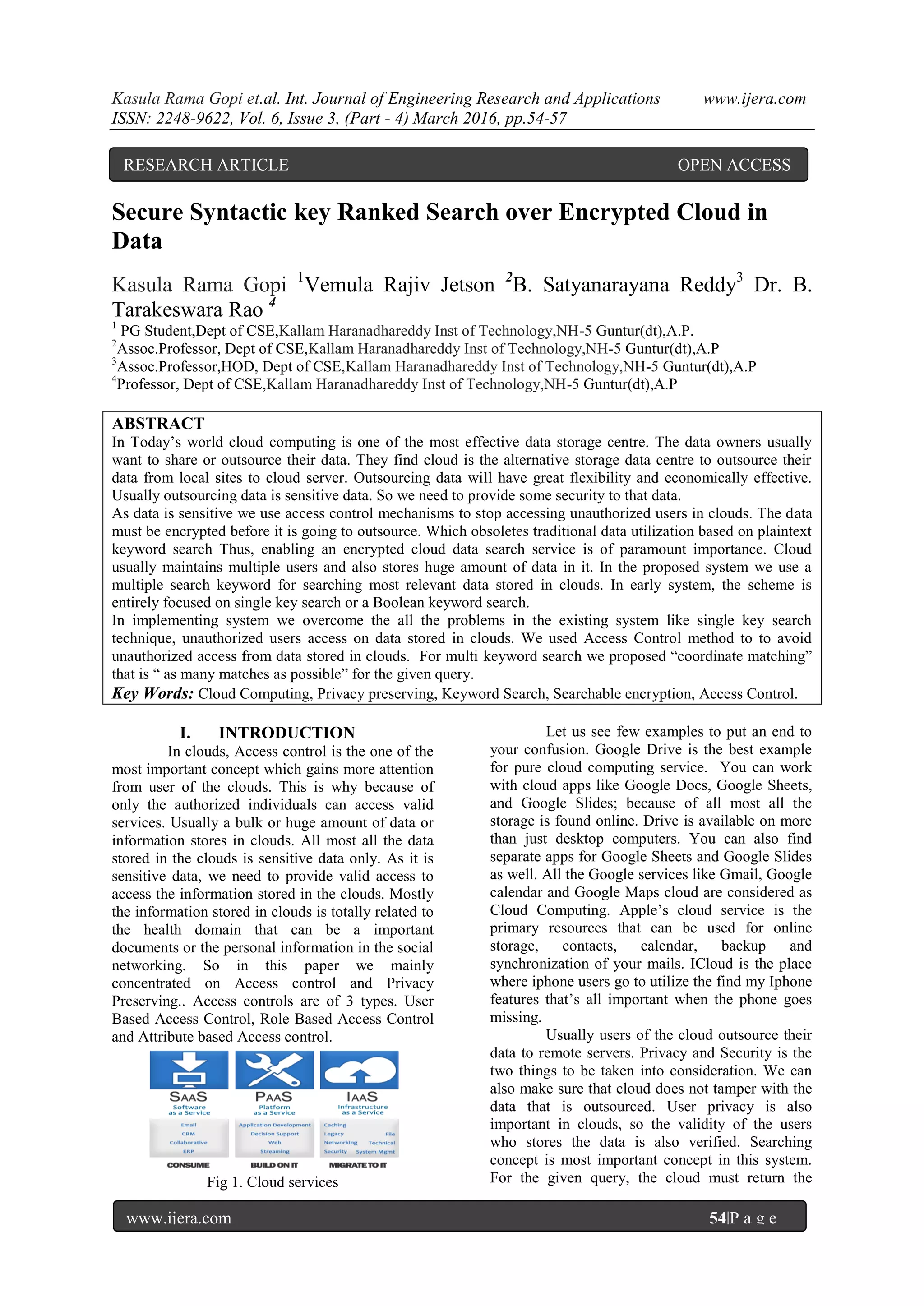
Fig 1. Cloud services
Let us see few examples to put an end to
your confusion. Google Drive is the best example
for pure cloud computing service. You can work
with cloud apps like Google Docs, Google Sheets,
and Google Slides; because of all most all the
storage is found online. Drive is available on more
than just desktop computers. You can also find
separate apps for Google Sheets and Google Slides
as well. All the Google services like Gmail, Google
calendar and Google Maps cloud are considered as
Cloud Computing. Apple‟s cloud service is the
primary resources that can be used for online
storage, contacts, calendar, backup and
synchronization of your mails. ICloud is the place
where iphone users go to utilize the find my Iphone
features that‟s all important when the phone goes
missing.
Usually users of the cloud outsource their
data to remote servers. Privacy and Security is the
two things to be taken into consideration. We can
also make sure that cloud does not tamper with the
data that is outsourced. User privacy is also
important in clouds, so the validity of the users
who stores the data is also verified. Searching
concept is most important concept in this system.
For the given query, the cloud must return the
RESEARCH ARTICLE OPEN ACCESS
Kasula Rama Gopi et.al. Int. Journal of Engineering Research and Applications www.ijera.com
ISSN: 2248-9622, Vol. 6, Issue 3, (Part - 4) March 2016, pp.54-57
www.ijera.com 55|P a g e
matched records. The correct matched records are
returned by the clouds. “Coordinate matching” to
capture the relevance of files to the query. They use
“inner product similarity” to measure the score of
each file. This solution supports exact multi-
keyword ranked search. It is practical, and the
search is flexible. Sun et al., proposed a MDB-tree
based scheme which supports ranked multi-
keyword search. This scheme is very efficient, but
the higher efficiency will lead to lower precision of
the search results in this scheme.
Existing System
Most of the data is outsourcing to remote
servers. Maintaining all these in clouds is crucial
issue. If larger the number of cloud users and
documents search results and inefficient with
existing system.. So search with multi keyword is
very crucial in-addition to retrieve ranked data. In
the existing it mainly focused on single key or
Boolean key searches only, so it does not
differentiate the search results. To improve the
accuracy of the search results and also to extend
user searching experience ranking system with
multiple keyword search is necessary.
Disadvantages of Existing System:
 Single Keyword search Without Ranking
 Boolean Keyword search Without Ranking.
 Single Keyword search with Ranking.
Proposed System
In implemented system, we overcome all
the problems identified in the existing system, i.e.,
single keyword is replaced multiple keywords,
Provides privacy and security to the data stores in
clouds, generates ranking results. We can find
various algorithms for multi-keyword search.
Among these semantic we choose an efficient
principle of “coordinate matching”. Specifically,
we use „inner product similarity”, that is the
number of query keywords appearing in a
document, to quantitatively evaluate such a
similarity measure of that document to the search
query. During the index construction, each
document is associated with a binary vector as a
sub index where each bit represents whether
corresponding keyword is contained in the
documents.
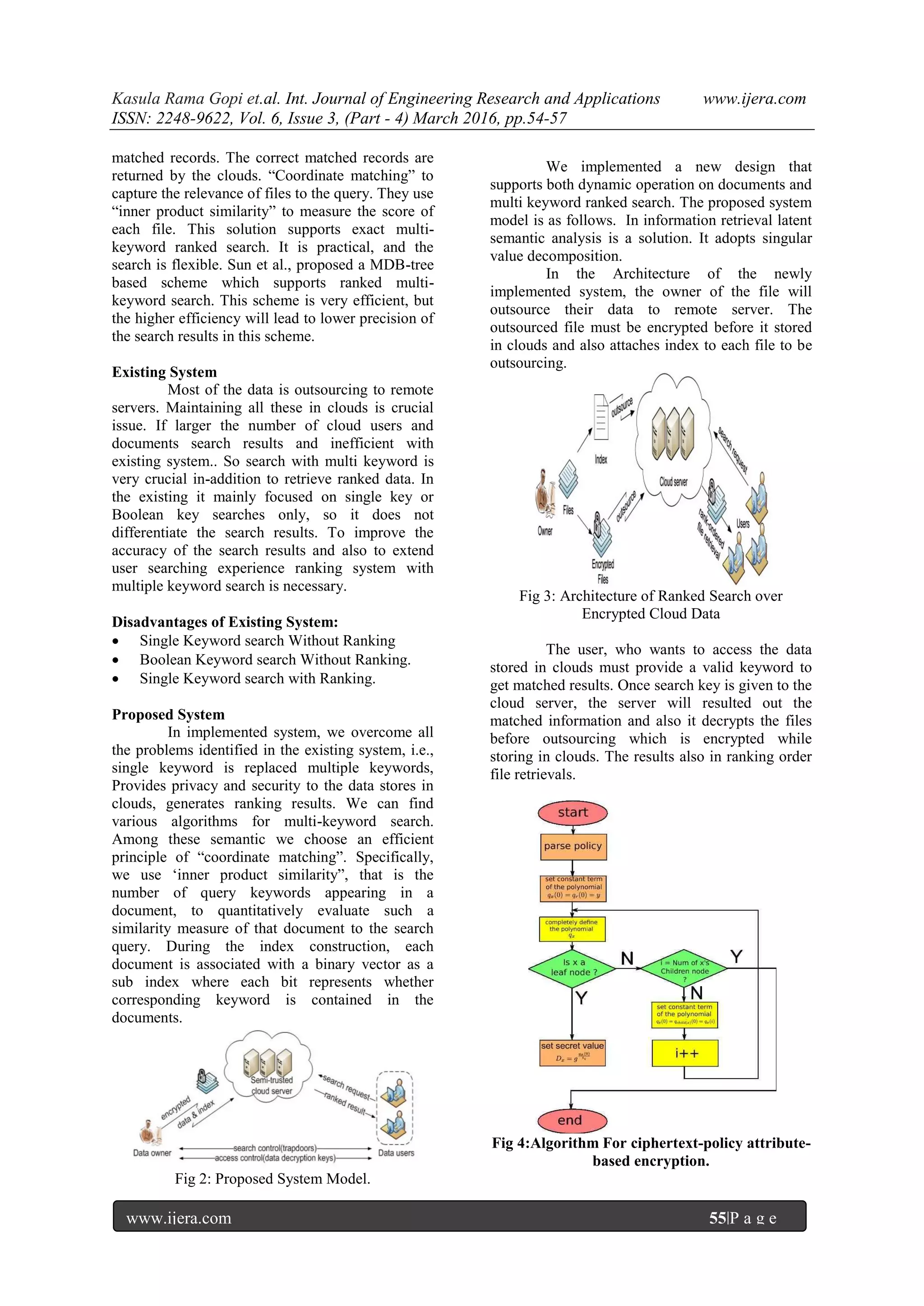
Fig 2: Proposed System Model.
We implemented a new design that
supports both dynamic operation on documents and
multi keyword ranked search. The proposed system
model is as follows. In information retrieval latent
semantic analysis is a solution. It adopts singular
value decomposition.
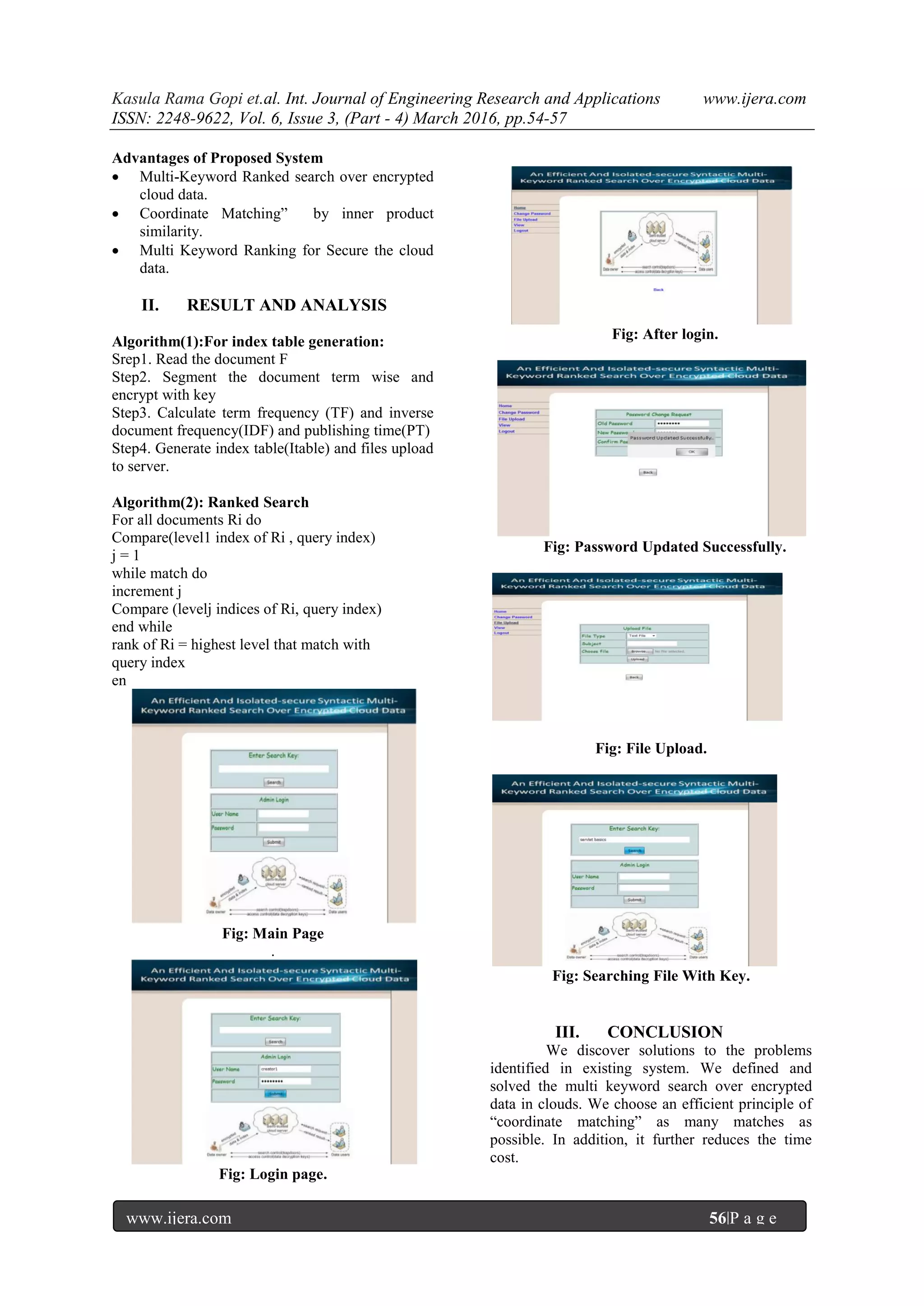
In the Architecture of the newly
implemented system, the owner of the file will
outsource their data to remote server. The
outsourced file must be encrypted before it stored
in clouds and also attaches index to each file to be
outsourcing.
Fig 3: Architecture of Ranked Search over
Encrypted Cloud Data
The user, who wants to access the data
stored in clouds must provide a valid keyword to
get matched results. Once search key is given to the
cloud server, the server will resulted out the
matched information and also it decrypts the files
before outsourcing which is encrypted while
storing in clouds. The results also in ranking order
file retrievals.
Fig 4:Algorithm For ciphertext-policy attribute-
based encryption.
Kasula Rama Gopi et.al. Int. Journal of Engineering Research and Applications www.ijera.com
ISSN: 2248-9622, Vol. 6, Issue 3, (Part - 4) March 2016, pp.54-57
www.ijera.com 56|P a g e
Advantages of Proposed System
 Multi-Keyword Ranked search over encrypted
cloud data.
 Coordinate Matching” by inner product
similarity.
 Multi Keyword Ranking for Secure the cloud
data.
II. RESULT AND ANALYSIS
Algorithm(1):For index table generation:
Srep1. Read the document F
Step2. Segment the document term wise and
encrypt with key
Step3. Calculate term frequency (TF) and inverse
document frequency(IDF) and publishing time(PT)
Step4. Generate index table(Itable) and files upload
to server.
Algorithm(2): Ranked Search
For all documents Ri do
Compare(level1 index of Ri , query index)
j = 1
while match do
increment j
Compare (levelj indices of Ri, query index)
end while
rank of Ri = highest level that match with
query index
en
Fig: Main Page
.
Fig: Login page.
Fig: After login.
Fig: Password Updated Successfully.
Fig: File Upload.
Fig: Searching File With Key.
III. CONCLUSION
We discover solutions to the problems
identified in existing system. We defined and
solved the multi keyword search over encrypted
data in clouds. We choose an efficient principle of
“coordinate matching” as many matches as
possible. In addition, it further reduces the time
cost.
Kasula Rama Gopi et.al. Int. Journal of Engineering Research and Applications www.ijera.com
ISSN: 2248-9622, Vol. 6, Issue 3, (Part - 4) March 2016, pp.54-57
www.ijera.com 57|P a g e
FUTURE SCOPE
Following the current research, we
propose several possible directions for future work
on ranked keyword search over encrypted data. The
most promising one is the support for multiple
keywords. In this case, for the security requirement
of searchable encryption, constructions for
conjunctive keyword search in the existing
literature might be good candidates for our
proposed ranked search. However, as the IDF
factor now has to be included for score calculation,
new approaches still need to be designed to
completely preserve the order when summing up
scores for all the provided keywords. Another
interesting direction is to integrate advanced crypto
techniques, such as attribute-based encryption to
enable finegrained access control in our multi-user
settings.
ACKNOWLEDGEMENT
Mr.Kasula Rama Gopi would like to thank
Sri. Vemula Rajiv Jetson, Assoc.Professor and B.
Satyanarayana Reddy Assoc. Professor, HOD,
Dept of CSE, who had been guiding throughout the
project and supporting me. Also in giving technical
ideas about the paper and motivating me to
complete the work efficiently and successfully.
REFERENCES
[1] K. Ren C. Wang, Q. Wang et al.,
“Security challenges for the public
clouds” IEEE Internet computing, vol.16,
no.1, pp.69-73, 2012
[2] S. Kamara and K. Lauter, “Cryptographic
cloud storage” in financial cryptography
and Data Security, Springer, 2010,
pp.136-149
[3] D. Boneh, “ Public key encryption with
keyword search”, Advances in ryptology-
Encryption 2004, Springer,(2004).
[4] R. Curtmola, “ Searchable symmetric
encryption: improved definitions and
efficient constructions”, Proceedings of
the 13the ACM conference on Computer
and Communications security, ACM,
(2006).
[5] C. wang, “Secure ranked keyword search
over encrypted cloud data”, Distributed
Computing Systems and Privacy”, 2000.
S&P 2000, Proceedings 2000 IEEE
Symposium, IEEE, (2000).
[6] D. S. Song, D. Wagner, and A. Perrig, “
Practical Techniques for searches on
encrypted data” in security and privacy,
2000, S&P 2000, Proceedings, 2000 IEEE
Symposium on IEEE, 2000, pp 44-55.
[7] E.J. Goh et al., “ Secure indexes.” IACR
Cryptology ePrint Archive, vol.2003,
p.216, 2003.
[8] Y. C. Chang and M. Mitzenmacher, “
Privacy Preserving keyword searches on
remote encrypted data” in Proceedings of
the third international conference on
Applied Cryptography and Newtork
Security. Springer-Verlag, 2005, pp.442-
455.
[9] J.Li, Q. Wang, C.Wang, N. Cao, K. Ren
and W. Lou, “Fuzzy keyword search over
encrypted data in cloud computing” in
INFOCOM, 2000 Proceedings IEEE,
IEEE 2010, pp.1-5
[10] I. H. Witten, A. Moffat, and T. C. Bell,
“Managing gigabytes: Compressing and
indexing documents and images”, Morgan
Kaufmann Publishing, Sam Francisco,
May 1999.
[11] M Abdalla, M. Bellare, D. Catalano, E.
Kiltz, T. Kohno, T. Lange, J. Malone-Lee,
G. Neven, P. Pailer, and H. Shi, “
Searchable encryption revisited:
Consistency properties, relation to
anonymous ibe, and extensions” J.
Cryptol., vol. 21, no. 3, pp.350-391, 2008
[12] L. Ballard, S. Kamara and F. Monrose,
“Achieving efficient conjunctive keyword
searches over encrypted data” in Proc.of
ICICS, 2005.
[13] R. Brinkman, “ Searching in encrypted
data” in University of Twente, PhD thesis,
2007.
[14] J. Katz, A. Sahai, and B/ Waters
“Predicate encryption supporting
disjunctions, polynomial equations, and
inner products” in Proc.of EUROCRYPT,
2008.

Secure Syntactic key Ranked Search over Encrypted Cloud in Data

  • 1.
    Kasula Rama Gopiet.al. Int. Journal of Engineering Research and Applications www.ijera.com ISSN: 2248-9622, Vol. 6, Issue 3, (Part - 4) March 2016, pp.54-57 www.ijera.com 54|P a g e Secure Syntactic key Ranked Search over Encrypted Cloud in Data Kasula Rama Gopi 1 Vemula Rajiv Jetson 2 B. Satyanarayana Reddy3 Dr. B. Tarakeswara Rao 4 1 PG Student,Dept of CSE,Kallam Haranadhareddy Inst of Technology,NH-5 Guntur(dt),A.P. 2 Assoc.Professor, Dept of CSE,Kallam Haranadhareddy Inst of Technology,NH-5 Guntur(dt),A.P 3 Assoc.Professor,HOD, Dept of CSE,Kallam Haranadhareddy Inst of Technology,NH-5 Guntur(dt),A.P 4 Professor, Dept of CSE,Kallam Haranadhareddy Inst of Technology,NH-5 Guntur(dt),A.P ABSTRACT In Today‟s world cloud computing is one of the most effective data storage centre. The data owners usually want to share or outsource their data. They find cloud is the alternative storage data centre to outsource their data from local sites to cloud server. Outsourcing data will have great flexibility and economically effective. Usually outsourcing data is sensitive data. So we need to provide some security to that data. As data is sensitive we use access control mechanisms to stop accessing unauthorized users in clouds. The data must be encrypted before it is going to outsource. Which obsoletes traditional data utilization based on plaintext keyword search Thus, enabling an encrypted cloud data search service is of paramount importance. Cloud usually maintains multiple users and also stores huge amount of data in it. In the proposed system we use a multiple search keyword for searching most relevant data stored in clouds. In early system, the scheme is entirely focused on single key search or a Boolean keyword search. In implementing system we overcome the all the problems in the existing system like single key search technique, unauthorized users access on data stored in clouds. We used Access Control method to to avoid unauthorized access from data stored in clouds. For multi keyword search we proposed “coordinate matching” that is “ as many matches as possible” for the given query. Key Words: Cloud Computing, Privacy preserving, Keyword Search, Searchable encryption, Access Control. I. INTRODUCTION In clouds, Access control is the one of the most important concept which gains more attention from user of the clouds. This is why because of only the authorized individuals can access valid services. Usually a bulk or huge amount of data or information stores in clouds. All most all the data stored in the clouds is sensitive data only. As it is sensitive data, we need to provide valid access to access the information stored in the clouds. Mostly the information stored in clouds is totally related to the health domain that can be a important documents or the personal information in the social networking. So in this paper we mainly concentrated on Access control and Privacy Preserving.. Access controls are of 3 types. User Based Access Control, Role Based Access Control and Attribute based Access control. Fig 1. Cloud services Let us see few examples to put an end to your confusion. Google Drive is the best example for pure cloud computing service. You can work with cloud apps like Google Docs, Google Sheets, and Google Slides; because of all most all the storage is found online. Drive is available on more than just desktop computers. You can also find separate apps for Google Sheets and Google Slides as well. All the Google services like Gmail, Google calendar and Google Maps cloud are considered as Cloud Computing. Apple‟s cloud service is the primary resources that can be used for online storage, contacts, calendar, backup and synchronization of your mails. ICloud is the place where iphone users go to utilize the find my Iphone features that‟s all important when the phone goes missing. Usually users of the cloud outsource their data to remote servers. Privacy and Security is the two things to be taken into consideration. We can also make sure that cloud does not tamper with the data that is outsourced. User privacy is also important in clouds, so the validity of the users who stores the data is also verified. Searching concept is most important concept in this system. For the given query, the cloud must return the RESEARCH ARTICLE OPEN ACCESS
  • 2.
    Kasula Rama Gopiet.al. Int. Journal of Engineering Research and Applications www.ijera.com ISSN: 2248-9622, Vol. 6, Issue 3, (Part - 4) March 2016, pp.54-57 www.ijera.com 55|P a g e matched records. The correct matched records are returned by the clouds. “Coordinate matching” to capture the relevance of files to the query. They use “inner product similarity” to measure the score of each file. This solution supports exact multi- keyword ranked search. It is practical, and the search is flexible. Sun et al., proposed a MDB-tree based scheme which supports ranked multi- keyword search. This scheme is very efficient, but the higher efficiency will lead to lower precision of the search results in this scheme. Existing System Most of the data is outsourcing to remote servers. Maintaining all these in clouds is crucial issue. If larger the number of cloud users and documents search results and inefficient with existing system.. So search with multi keyword is very crucial in-addition to retrieve ranked data. In the existing it mainly focused on single key or Boolean key searches only, so it does not differentiate the search results. To improve the accuracy of the search results and also to extend user searching experience ranking system with multiple keyword search is necessary. Disadvantages of Existing System:  Single Keyword search Without Ranking  Boolean Keyword search Without Ranking.  Single Keyword search with Ranking. Proposed System In implemented system, we overcome all the problems identified in the existing system, i.e., single keyword is replaced multiple keywords, Provides privacy and security to the data stores in clouds, generates ranking results. We can find various algorithms for multi-keyword search. Among these semantic we choose an efficient principle of “coordinate matching”. Specifically, we use „inner product similarity”, that is the number of query keywords appearing in a document, to quantitatively evaluate such a similarity measure of that document to the search query. During the index construction, each document is associated with a binary vector as a sub index where each bit represents whether corresponding keyword is contained in the documents. Fig 2: Proposed System Model. We implemented a new design that supports both dynamic operation on documents and multi keyword ranked search. The proposed system model is as follows. In information retrieval latent semantic analysis is a solution. It adopts singular value decomposition. In the Architecture of the newly implemented system, the owner of the file will outsource their data to remote server. The outsourced file must be encrypted before it stored in clouds and also attaches index to each file to be outsourcing. Fig 3: Architecture of Ranked Search over Encrypted Cloud Data The user, who wants to access the data stored in clouds must provide a valid keyword to get matched results. Once search key is given to the cloud server, the server will resulted out the matched information and also it decrypts the files before outsourcing which is encrypted while storing in clouds. The results also in ranking order file retrievals. Fig 4:Algorithm For ciphertext-policy attribute- based encryption.
  • 3.
    Kasula Rama Gopiet.al. Int. Journal of Engineering Research and Applications www.ijera.com ISSN: 2248-9622, Vol. 6, Issue 3, (Part - 4) March 2016, pp.54-57 www.ijera.com 56|P a g e Advantages of Proposed System  Multi-Keyword Ranked search over encrypted cloud data.  Coordinate Matching” by inner product similarity.  Multi Keyword Ranking for Secure the cloud data. II. RESULT AND ANALYSIS Algorithm(1):For index table generation: Srep1. Read the document F Step2. Segment the document term wise and encrypt with key Step3. Calculate term frequency (TF) and inverse document frequency(IDF) and publishing time(PT) Step4. Generate index table(Itable) and files upload to server. Algorithm(2): Ranked Search For all documents Ri do Compare(level1 index of Ri , query index) j = 1 while match do increment j Compare (levelj indices of Ri, query index) end while rank of Ri = highest level that match with query index en Fig: Main Page . Fig: Login page. Fig: After login. Fig: Password Updated Successfully. Fig: File Upload. Fig: Searching File With Key. III. CONCLUSION We discover solutions to the problems identified in existing system. We defined and solved the multi keyword search over encrypted data in clouds. We choose an efficient principle of “coordinate matching” as many matches as possible. In addition, it further reduces the time cost.
  • 4.
    Kasula Rama Gopiet.al. Int. Journal of Engineering Research and Applications www.ijera.com ISSN: 2248-9622, Vol. 6, Issue 3, (Part - 4) March 2016, pp.54-57 www.ijera.com 57|P a g e FUTURE SCOPE Following the current research, we propose several possible directions for future work on ranked keyword search over encrypted data. The most promising one is the support for multiple keywords. In this case, for the security requirement of searchable encryption, constructions for conjunctive keyword search in the existing literature might be good candidates for our proposed ranked search. However, as the IDF factor now has to be included for score calculation, new approaches still need to be designed to completely preserve the order when summing up scores for all the provided keywords. Another interesting direction is to integrate advanced crypto techniques, such as attribute-based encryption to enable finegrained access control in our multi-user settings. ACKNOWLEDGEMENT Mr.Kasula Rama Gopi would like to thank Sri. Vemula Rajiv Jetson, Assoc.Professor and B. Satyanarayana Reddy Assoc. Professor, HOD, Dept of CSE, who had been guiding throughout the project and supporting me. Also in giving technical ideas about the paper and motivating me to complete the work efficiently and successfully. REFERENCES [1] K. Ren C. Wang, Q. Wang et al., “Security challenges for the public clouds” IEEE Internet computing, vol.16, no.1, pp.69-73, 2012 [2] S. Kamara and K. Lauter, “Cryptographic cloud storage” in financial cryptography and Data Security, Springer, 2010, pp.136-149 [3] D. Boneh, “ Public key encryption with keyword search”, Advances in ryptology- Encryption 2004, Springer,(2004). [4] R. Curtmola, “ Searchable symmetric encryption: improved definitions and efficient constructions”, Proceedings of the 13the ACM conference on Computer and Communications security, ACM, (2006). [5] C. wang, “Secure ranked keyword search over encrypted cloud data”, Distributed Computing Systems and Privacy”, 2000. S&P 2000, Proceedings 2000 IEEE Symposium, IEEE, (2000). [6] D. S. Song, D. Wagner, and A. Perrig, “ Practical Techniques for searches on encrypted data” in security and privacy, 2000, S&P 2000, Proceedings, 2000 IEEE Symposium on IEEE, 2000, pp 44-55. [7] E.J. Goh et al., “ Secure indexes.” IACR Cryptology ePrint Archive, vol.2003, p.216, 2003. [8] Y. C. Chang and M. Mitzenmacher, “ Privacy Preserving keyword searches on remote encrypted data” in Proceedings of the third international conference on Applied Cryptography and Newtork Security. Springer-Verlag, 2005, pp.442- 455. [9] J.Li, Q. Wang, C.Wang, N. Cao, K. Ren and W. Lou, “Fuzzy keyword search over encrypted data in cloud computing” in INFOCOM, 2000 Proceedings IEEE, IEEE 2010, pp.1-5 [10] I. H. Witten, A. Moffat, and T. C. Bell, “Managing gigabytes: Compressing and indexing documents and images”, Morgan Kaufmann Publishing, Sam Francisco, May 1999. [11] M Abdalla, M. Bellare, D. Catalano, E. Kiltz, T. Kohno, T. Lange, J. Malone-Lee, G. Neven, P. Pailer, and H. Shi, “ Searchable encryption revisited: Consistency properties, relation to anonymous ibe, and extensions” J. Cryptol., vol. 21, no. 3, pp.350-391, 2008 [12] L. Ballard, S. Kamara and F. Monrose, “Achieving efficient conjunctive keyword searches over encrypted data” in Proc.of ICICS, 2005. [13] R. Brinkman, “ Searching in encrypted data” in University of Twente, PhD thesis, 2007. [14] J. Katz, A. Sahai, and B/ Waters “Predicate encryption supporting disjunctions, polynomial equations, and inner products” in Proc.of EUROCRYPT, 2008.