AMAE Int. J. on Production and Industrial Engineering, Vol. 02, No. 01, April 2012


                 Thermoelastic Damping of Vibrations in a
                 Transversely Isotropic Hollow Cylinder
                                                   H Singh1 and J N Sharma2
                        1
                        Department of Mathematics, Lyallpur Khalsa College, Jalandhar(PB)- 144001 India
                 2
                     Department of Mathematics, National Institute of Technology, Hamirpur(HP)- 177005 India
                                                Email: harjitlkc@rediffmail.com
                                                    Email: jns@nitham.ac.in

Abstract-The purpose of the paper is to analyze the damping of         are not affected by thermal field. By using the method of
three-dimensional free vibrations in a transversely isotropic,         separation of variables the model of instant vibration problem
thermoelastic hollow cylinder, which is initially undeformed           is reduced to four second order coupled ordinary differential
and kept at uniform temperature. The surfaces of the cylinder          equations in radial coordinates. One of the standard
are subjected to stress free and thermally insulated boundary
                                                                       techniques to solve ordinary differential equations with
conditions. The displacement potential functions have been
introduced for decoupling the purely shear and longitudinal            variable coefficients is the Frobenius method available in
motions in the equations of motion and heat equation. The              literature, see Tomentschger [12]. The secular equation which
purely transverse wave gets decoupled from rest of the motion          governs the three dimensional vibration of hollow cylinder
and is not affected by thermal field. By using the method of           has been derived by using Matrix Frobenius method. The
separation of variables, the system of governing partial               numerical solution of secular equation has been carried out
differential equations is reduced to four second order coupled         by MATLAB programming to compute lowest frequency and
ordinary differential equation in radial coordinate. The matrix        thermoelastic damping factor which have been presented
Frobenius method of extended power series is employed to
obtain the solution of coupled ordinary differential equations         graphically with respect to the parameter t L for first two
along the radial coordinate. In order to illustrate the analytic
results, the numerical solution of various relations and               modes of vibrations n  1,2  .
equations are carried out to compute lowest frequency and
thermoelastic damping factor with M ATLAB software                                  II. FORMULATION OF PROBLEM
programming for zinc material. The computer simulated
results have been presented graphically.                                  We consider a homogeneous transversely isotropic,
                                                                       thermal conducting elastic hollow cylinder of length L and
Key words: Damping; Frobenius method; Cylinder
                                                                       radius R at uniform temperature T0 in the undisturbed state
                            I. INTRODUCTION                            initially. The basic governing equation of motion and heat
    The vibrations in thermoelastic materials have many                conduction for three-dimensional linear coupled
applications in various fields of science and technology,              homogeneous and transversely isotropic thermoelastic
namely aerospace, atomic physics, thermal power plants,                cylinder in cylindrical co-ordinates r ,  , z  system, in the
chemical pipes, pressure vessels, offshore, submarine                  absence of body force and heat source, are given by
structure, civil engineering structure etc. The hollow cylinders
are frequently used as structural components and their
vibrations are obviously important for practical design. The
investigations of wave propagation in different cylinderical
structures have been carried out by many researchers [1-6].
Ponnusamy [7] studied wave propagation in a generalized
thermoelastic solid cylinder of arbitrary cross section. Suhubi
and Erbey [8] investigated longitudinal wave propagation in
thermoelastic cylinder. Sharma [9] investigated the vibrations
in a thermoelastic cylindrical panel with voids.
    The theory of elastic vibrations and waves well
established; see Graff [10] and Love [11].The objective of the         where
present paper is to study the three dimensional vibration
analysis of simply supported, homogeneous transversely
isotropic, hollow cylinder of length ‘L’ and radius ‘R’. Three
displacement potential functions are employed for solving
the equation of motion and heat equation. The purely
transverse wavesget decoupled from the rest of motion and

© 2012 AMAE                                                        1
DOI: 01.IJPIE.02.01.43
AMAE Int. J. on Production and Industrial Engineering, Vol. 02, No. 01, April 2012


                                                                   On using solutions (8) in equations (5) and (6), we get


                                                                   Here we have used the following non-dimensional quantities


Here u  u r , u , u z  is the displacement vector;

T ( r ,  , z , t ) is the temperature change;   c11 , c12 , c13
and c 44 are elastic constants;  1 ,  3 and  1 ,  3 are
the coefficients of linear thermal expansion and thermal
conductivities along and perpendicular to the axis of symmetry
respectively;  and Ce are the mass density and specific

heat at constant strain respectively, eij the strain tensor ;

 ij the stress tensor. The comma notation is used for spatial-
derivatives and superimposed dot denotes time derivatives.
                                                                   where
We introduce potential functions      , G , W as used by
Sharma [5]
                                                                   Here    v2 is the velocity of purely elastic wave in hollow
Using equation (4) in equation (1) we find that G , W , , T       cylinder and  * is the characteristic frequency. The equation
                                                                   (9.1) represents purely transverse wave, which is not affected
satisfies the equations:
                                                                   by the temperature change. The equation (9.1) is a Bessel’s
                                                                   equation and its possible solutions are


                                                                   where k1 2   k12 . Here E 7 and
                                                                                                           
                                                                                                          E 7 are two arbitrary
                                                                   constants, and J n and Yn are Bessel functions for first and

                                                                   second kind and I n and K n are modified Bessel functions
where
                                                                   for the first and second kind respectively. Generally k12  0
                                                                   , so we go on with our derivation by taking the form of 
  We consider the free vibrations of a right circular hollow
cylinder subject to traction free and thermally insulated or       for k12  0 , the derivation for k12  0 is obviously similar.
                                                                                                                                .
isothermal boundary conditions on the surface r  R which          Therefore the solution valid in case of hollow cylinder is
is simply supported on the edges z  0 and z  L .                 taken here as
Therefore, we assume solution for three
displacementfunctions and temperature change as
© 2012 AMAE                                        2
DOI: 01.IJPIE.02.01.43
AMAE Int. J. on Production and Industrial Engineering, Vol. 02, No. 01, April 2012


               III. METHOD OF FROBENIUS                                 where
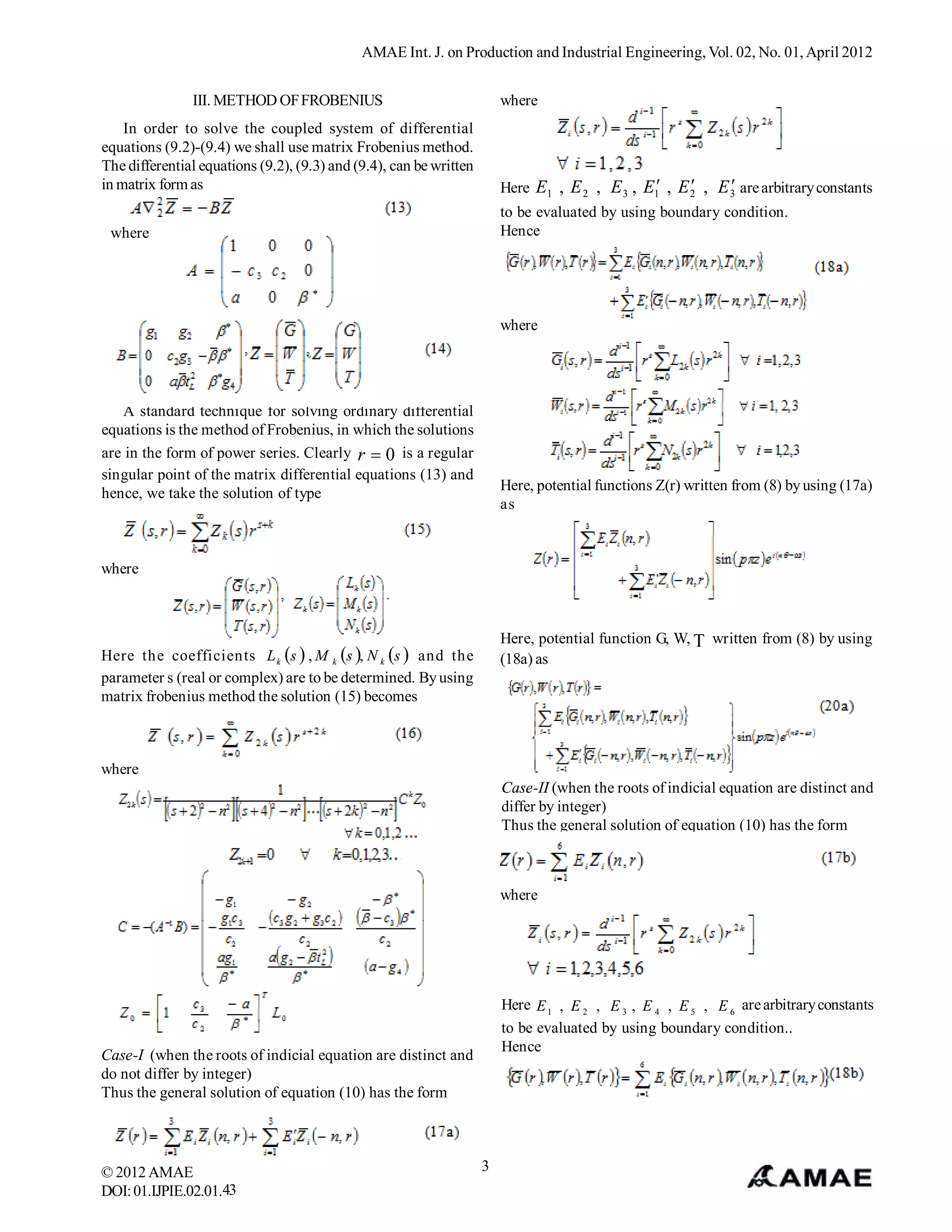
    In order to solve the coupled system of differential
equations (9.2)-(9.4) we shall use matrix Frobenius method.
The differential equations (9.2), (9.3) and (9.4), can be written
in matrix form as                                                                                        
                                                                        Here E1 , E 2 , E 3 , E1 , E 2 , E 3 are arbitrary constants
                                                                        to be evaluated by using boundary condition.
 where                                                                  Hence


                                                                        where


   A standard technique for solving ordinary differential
equations is the method of Frobenius, in which the solutions
are in the form of power series. Clearly r  0 is a regular
singular point of the matrix differential equations (13) and
hence, we take the solution of type                                     Here, potential functions Z(r) written from (8) by using (17a)
                                                                        as


where


                                                                        Here, potential function G, W,  written from (8) by using
Here the coefficients L k s  , M k s , N k s  and the             (18a) as
parameter s (real or complex) are to be determined. By using
matrix frobenius method the solution (15) becomes


where
                                                                        Case-II (when the roots of indicial equation are distinct and
                                                                        differ by integer)
                                                                        Thus the general solution of equation (10) has the form


                                                                        where


                                                                        Here E 1 , E 2 , E 3 , E 4 , E 5 , E 6 are arbitrary constants
                                                                        to be evaluated by using boundary condition..
                                                                        Hence
Case-I (when the roots of indicial equation are distinct and
do not differ by integer)
Thus the general solution of equation (10) has the form


© 2012 AMAE                                                         3
DOI: 01.IJPIE.02.01.43
AMAE Int. J. on Production and Industrial Engineering, Vol. 02, No. 01, April 2012


 where


                                                                      where

Here, potential functions Z(r) written from (8) by using              prime has been suppressed for convenience.
(17b) as                                                              Case: I-Using the equation (18a) in (24), we obtain the
                                                                      temperature gradient and stresses as

Here, potential function G, W,  written from (8) by using
(31b) as


              IV. BOUNDARY CONDITIONS
    We consider the free vibration of hollow–cylinder which
is subjected to two types of boundary condition at lower and
upper surface r  R 1 , R 2 
(A) MECHANICAL CONDITION
The surface are assumed to be traction free, so that

                                                                      where
(B)THERMAL CONDITION
The surface are assumed to be thermally insulated which
leads to

                V. FREQUENCY EQUATION
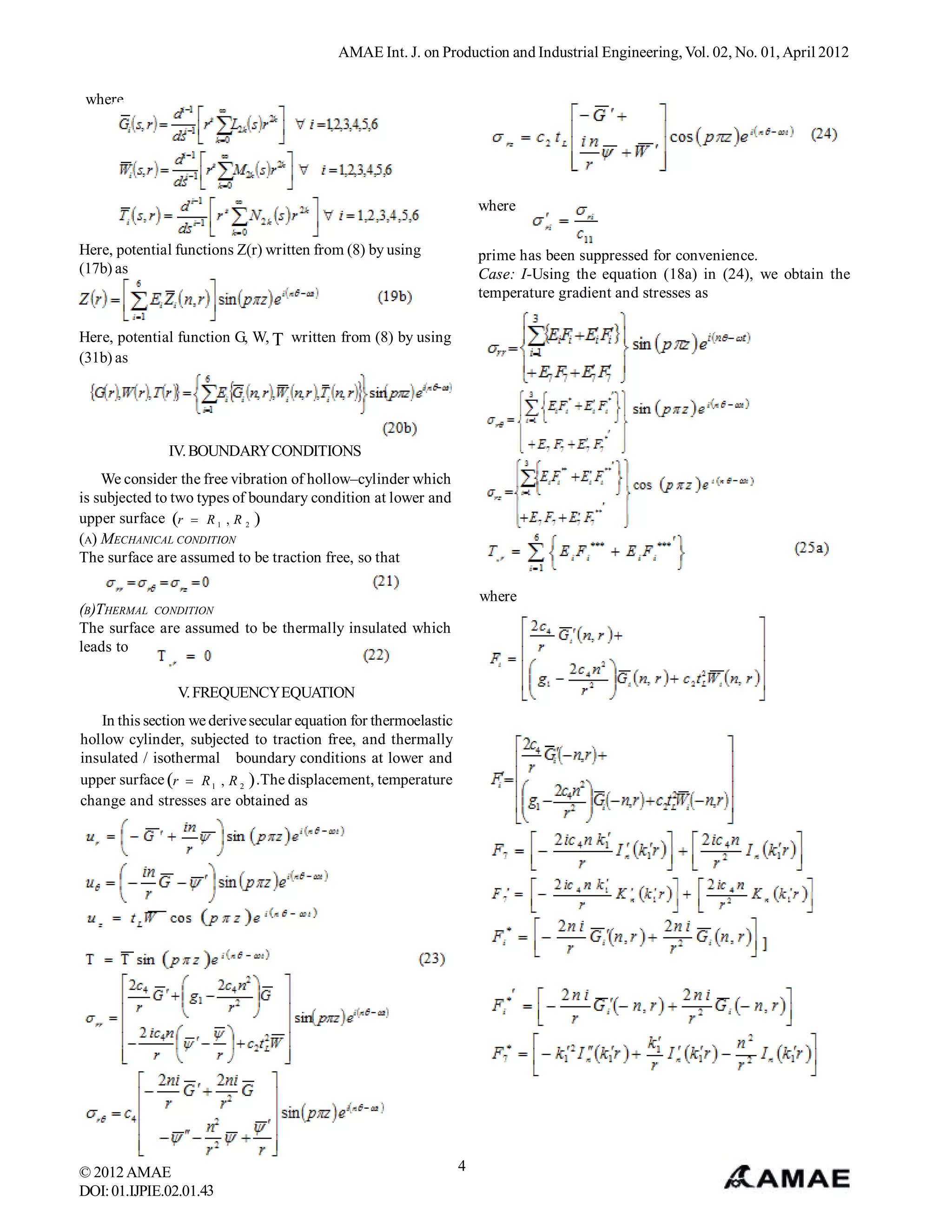
   In this section we derive secular equation for thermoelastic
hollow cylinder, subjected to traction free, and thermally
insulated / isothermal boundary conditions at lower and
upper surface r  R 1 , R 2  .The displacement, temperature
change and stresses are obtained as


© 2012 AMAE                                                       4
DOI: 01.IJPIE.02.01.43
AMAE Int. J. on Production and Industrial Engineering, Vol. 02, No. 01, April 2012


   Using the boundary conditions (21)-(22) and (25a), we
get systems of eight simultaneously equations in
                                           
 E 1 , E 1 , E 2 , E 2 , E 3 , E 3 , E 7 , E 7 , which will have non-
trivial solution if the determinant of their co efficient
vanishes. This requirement of non trivial solution leads to
secular equation for hollow cylinder. The secular equation
are obtained as
                                                                                    
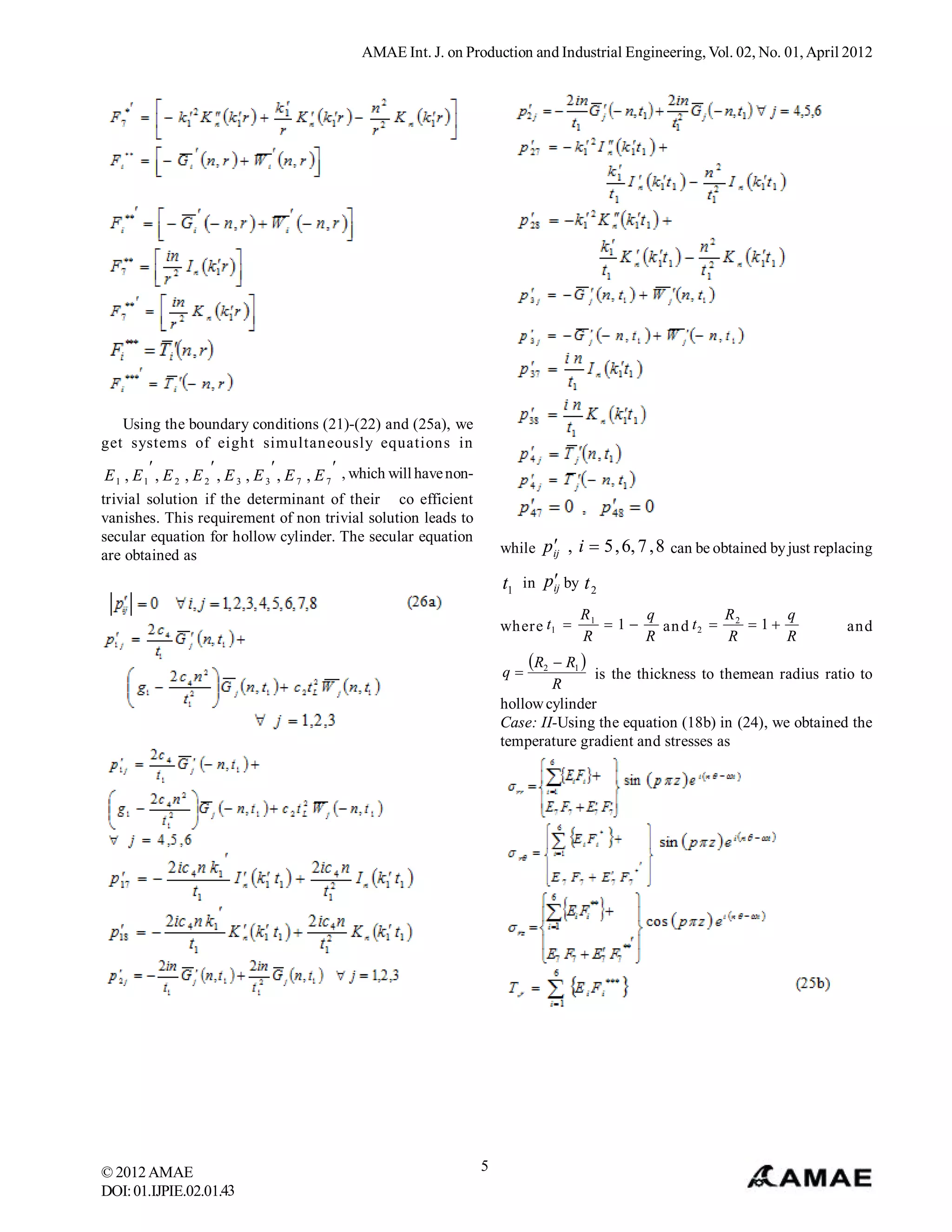
                                                                            while p ij , i  5 , 6, 7 , 8 can be obtained by just replacing

                                                                            t1 in p by t 2
                                                                                   ij

                                                                                          R1     q           R        q
                                                                            where t1        1   an d t 2  2  1                  and
                                                                                          R      R            R       R

                                                                            q
                                                                                 R2  R1 
                                                                                           is the thickness to themean radius ratio to
                                                                                    R
                                                                            hollow cylinder
                                                                            Case: II-Using the equation (18b) in (24), we obtained the
                                                                            temperature gradient and stresses as


© 2012 AMAE                                                             5
DOI: 01.IJPIE.02.01.43
AMAE Int. J. on Production and Industrial Engineering, Vol. 02, No. 01, April 2012


where


                                                                            while p ij , i  5 , 6, 7 , 8 can be obtained by just

                                                                                                                                   R1     q
                                                                            r e p l a c i n g t1 i n p ij b y t 2 w h e r e t1       1
                                                                                                                                   R      R
                                                                                     R2          q            R 2  R 1 
                                                                            and t 2       1      and q                 is the thickness
                                                                                      R          R                 R
                                                                            to the mean radius ratio to hollow cylinder

                                                                                  VI. NUMERICAL RESULTS AND DISCUSSION
                                                                                In order to illustrate and verify results obtained in previous
                                                                            sections, we present some numerical simulation results. For
                                                                            the purpose of numerical computation, we have considered
                                                                            zinc-crystal like material whose physical data is given below
                                                                            (Dhaliwal and Singh [14]).


   Using the boundary conditions (21)-(22) and (25b), we
get systems of eight simultaneously equations in
                                             
 E 1 , E 2 , E 3 , E 4 , E 5 , E 6 , E 7 , E 7 , which will have non-
trivial solution if the determinant of their             Co efficient
vanishes. This requirement of non trivial solution leads to
                                                                                Due to presence of dissipation term in heat conduction
secular equation for hollow cylinder. The secular equation
                                                                            equation, the frequency equation in general complex
are obtained as
                                                                            transcendental equation provides us complex value of
                                                                            frequency (  ). For fixed value of n and k, the lowest
                                                                            frequency   and dissipation factor (D) are defined as


                                                                            where                  and
                                                                            The thermoelastic damping factor is given by


                                                                            The numerical computation has been carried out for
                                                                            n  0 , k  0 with the help of MATLAB files .The secular
                                                                            equation (26) has been expressed in the form of   g  
                                                                            and the fixed point iteration numerical technique as outlined
                                                                            in Sharma [15] is used to find approximate solution of

© 2012 AMAE                                                             6
DOI: 01.IJPIE.02.01.43
AMAE Int. J. on Production and Industrial Engineering, Vol. 02, No. 01, April 2012


  g   near to the initial guess of the root with tolerance                  trends of variations of thermoelastic damping factor for each
                                                                                 considered mode of vibrations are almost steady and uniform
( 10 5 ). We computed lowest frequency and thermoelastic                        for of thickness to mean radius ratio of the hollow cylinder. It
damping factor of first two modes of vibrations n  1 , 2                      is also revealed that the variations of thermoelastic damping
                                                                                 factor for each mode of vibrations is dispersive in the range
for different value of parameter axial wave number t L of the                    and remains close to each other for in case. Moreover, there
cylinder. The variations of computer simulated lowest                            exists atleast one value of parameterforeach at which the
frequency and thermoelastic damping factor are with                              magnitude of thermoelastic damping factor is same for each
parameter t L in respect to first two modes of vibration in                      considered mode of vibrations.
figures 1 to 2.Fig. 1 represents the variations of lowest                                                  CONCLUSIONS
frequency of first two modes of vibrations, versus axial wave
number for different values of thickness to mean radius ratio                        The modified Bessel functions and Matrix Frobenius
of the simply supported hollow cylinder of zinc-crystal like                     method have been successfully used to study the vibrations
material, respectively. It is observed that the lowest frequency                 of a homogeneous, transversely isotropic hollow cylinder
increases monotonically with axial wave number in both first                     based on three-dimensional thermoelasticity after decoupling
and second modes of vibrations though its magnitude has                          the equations of motion and heat conduction with the use of
been noticed to be larger in second mode of vibrations as                        potential functions. The decoupled purely transverse mode
compared to that of first mode of vibrations. It is also noticed                 is found to be independent of rest of the motion and
that the magnitude of lowest frequency for each modes of                         temperature change. The various thermal and mechanical
vibrationsincreases monotonically with increasing value of                       parameters have significant effects on the natural frequency,
q.                                                                               thermoelastic damping factor of the hollow cylinder. The
                                                                                 thermoelastic damping factor increases monotonically with
                                                                                 axial wave number but decreases with thickness to mean
                                                                                 radius ratio of the hollow cylinder.

                                                                                                            REFERENCES
                                                                                 [1] K. P. Soldatos, V.P. Hadhgeorgian, “Three dimensional solution
                                                                                 of the free vibration problem of homogeneous isotropic cylindrical
                                                                                 shells and panels” J. Sound Vib..” vol. 195, pp-369-384, 1990.
                                                                                 [2] A.W. Leissa, I.Y. So, “Free vibrations of thick hollow circular
     Fig 1. Lowest frequency         of first and second modes                cylinders from three dimensional analysis,” ASME J. Vib. Acous.,
                                                                                 vol. 119, pp. 46-51, 1997.
    n    1 , 2  versus parameter t L  for different values of               [3] I. J. Mirsky, “Wave propagation in transversely isotropic circular
                    thickness to mean radius ratio.                              cylinder,” J. Acous. Soc. Am.,” vol. 37, pp. 1016-1026, 1965.
                                                                                 [4] P.A. Martin, J.R. Berger, “Waves in wood: free vibrations of
                                                                                 wooden pole,” J. Mech. Phys. solids, vol. 49, pp. 1155-1178, 2001.
                                                                                 [5 ] J.N. Sharma, “Three-dimensional vibration analysis of a
                                                                                 homogeneous transversely isotropic cylindrical panel,” J. Acous,
                                                                                 Soc, Am., vol. 110, pp. 254-259, 2001.
                                                                                 [6 ] J.N. Sharma , P.K. Sharma, “Free vibration ana lysis of
                                                                                 homogeneous transversely isotropic thermoelastic cylindrically panel,”
                                                                                 J. Therm. stress., vol. 25, pp. 169-182, 2002.
                                                                                 [7] P. Ponnusamy, “Wave propagation in a generalized thermoelastic
                                                                                 solid cylinder of arbitrary cross-section,” Inter. J. Solids Struct, vol.
                                                                                 44, pp. 5336-5348, 2007.
                                                                                 [8 ] E.S. Su hubi, E.S. Erba y, “Longitudina l wave propa gationed
 Fig 2. Thermoelastic damping factor Q       1
                                                      of first and second       thermoelastic cylinder,” Journal of Therm. stresses, vol. 9, pp, 279-
                                                                                 295 ,198 6.
 modes   n    1 , 2  versus parameter t L  for different values of
                                                                                 [9] P.K.Sharma, D.Kaur, J.N.Sharma, “Three-dimensional vibration
                    thickness to mean radius ratio.                              analysis of thermoelastic cylindrically panel with voids,” Inter. J.
                                                                                 Solids Struct., vol. 45, pp.5049-5048, 2008.
    From fig. 2 it is observed that the thermoelastic damping                    [10] K. F. Graff, Wave motion in elastic solids, Dover Publications,
factor of each mode of vibrationsincreases monotonically                         Inc., New York , 2008.
with increasing value of axial wave number for different values                  [11] A. E. H. Love, A Treatise on Mathematical theory of Elasticity,
                                                                                 Cambridge: Cambridge University press, 1927.
of thickness to mean radius ratio of the hollow cylinder. The


© 2012 AMAE                                                                  7
DOI: 01.IJPIE.02.01.43

Thermoelastic Damping of Vibrations in a Transversely Isotropic Hollow Cylinder

  • 1.
    AMAE Int. J.on Production and Industrial Engineering, Vol. 02, No. 01, April 2012 Thermoelastic Damping of Vibrations in a Transversely Isotropic Hollow Cylinder H Singh1 and J N Sharma2 1 Department of Mathematics, Lyallpur Khalsa College, Jalandhar(PB)- 144001 India 2 Department of Mathematics, National Institute of Technology, Hamirpur(HP)- 177005 India Email: harjitlkc@rediffmail.com Email: jns@nitham.ac.in Abstract-The purpose of the paper is to analyze the damping of are not affected by thermal field. By using the method of three-dimensional free vibrations in a transversely isotropic, separation of variables the model of instant vibration problem thermoelastic hollow cylinder, which is initially undeformed is reduced to four second order coupled ordinary differential and kept at uniform temperature. The surfaces of the cylinder equations in radial coordinates. One of the standard are subjected to stress free and thermally insulated boundary techniques to solve ordinary differential equations with conditions. The displacement potential functions have been introduced for decoupling the purely shear and longitudinal variable coefficients is the Frobenius method available in motions in the equations of motion and heat equation. The literature, see Tomentschger [12]. The secular equation which purely transverse wave gets decoupled from rest of the motion governs the three dimensional vibration of hollow cylinder and is not affected by thermal field. By using the method of has been derived by using Matrix Frobenius method. The separation of variables, the system of governing partial numerical solution of secular equation has been carried out differential equations is reduced to four second order coupled by MATLAB programming to compute lowest frequency and ordinary differential equation in radial coordinate. The matrix thermoelastic damping factor which have been presented Frobenius method of extended power series is employed to obtain the solution of coupled ordinary differential equations graphically with respect to the parameter t L for first two along the radial coordinate. In order to illustrate the analytic results, the numerical solution of various relations and modes of vibrations n  1,2  . equations are carried out to compute lowest frequency and thermoelastic damping factor with M ATLAB software II. FORMULATION OF PROBLEM programming for zinc material. The computer simulated results have been presented graphically. We consider a homogeneous transversely isotropic, thermal conducting elastic hollow cylinder of length L and Key words: Damping; Frobenius method; Cylinder radius R at uniform temperature T0 in the undisturbed state I. INTRODUCTION initially. The basic governing equation of motion and heat The vibrations in thermoelastic materials have many conduction for three-dimensional linear coupled applications in various fields of science and technology, homogeneous and transversely isotropic thermoelastic namely aerospace, atomic physics, thermal power plants, cylinder in cylindrical co-ordinates r ,  , z  system, in the chemical pipes, pressure vessels, offshore, submarine absence of body force and heat source, are given by structure, civil engineering structure etc. The hollow cylinders are frequently used as structural components and their vibrations are obviously important for practical design. The investigations of wave propagation in different cylinderical structures have been carried out by many researchers [1-6]. Ponnusamy [7] studied wave propagation in a generalized thermoelastic solid cylinder of arbitrary cross section. Suhubi and Erbey [8] investigated longitudinal wave propagation in thermoelastic cylinder. Sharma [9] investigated the vibrations in a thermoelastic cylindrical panel with voids. The theory of elastic vibrations and waves well established; see Graff [10] and Love [11].The objective of the where present paper is to study the three dimensional vibration analysis of simply supported, homogeneous transversely isotropic, hollow cylinder of length ‘L’ and radius ‘R’. Three displacement potential functions are employed for solving the equation of motion and heat equation. The purely transverse wavesget decoupled from the rest of motion and © 2012 AMAE 1 DOI: 01.IJPIE.02.01.43
  • 2.
    AMAE Int. J.on Production and Industrial Engineering, Vol. 02, No. 01, April 2012 On using solutions (8) in equations (5) and (6), we get Here we have used the following non-dimensional quantities Here u  u r , u , u z  is the displacement vector; T ( r ,  , z , t ) is the temperature change; c11 , c12 , c13 and c 44 are elastic constants;  1 ,  3 and  1 ,  3 are the coefficients of linear thermal expansion and thermal conductivities along and perpendicular to the axis of symmetry respectively;  and Ce are the mass density and specific heat at constant strain respectively, eij the strain tensor ;  ij the stress tensor. The comma notation is used for spatial- derivatives and superimposed dot denotes time derivatives. where We introduce potential functions  , G , W as used by Sharma [5] Here v2 is the velocity of purely elastic wave in hollow Using equation (4) in equation (1) we find that G , W , , T cylinder and  * is the characteristic frequency. The equation (9.1) represents purely transverse wave, which is not affected satisfies the equations: by the temperature change. The equation (9.1) is a Bessel’s equation and its possible solutions are where k1 2   k12 . Here E 7 and   E 7 are two arbitrary constants, and J n and Yn are Bessel functions for first and second kind and I n and K n are modified Bessel functions where for the first and second kind respectively. Generally k12  0 , so we go on with our derivation by taking the form of  We consider the free vibrations of a right circular hollow cylinder subject to traction free and thermally insulated or for k12  0 , the derivation for k12  0 is obviously similar. . isothermal boundary conditions on the surface r  R which Therefore the solution valid in case of hollow cylinder is is simply supported on the edges z  0 and z  L . taken here as Therefore, we assume solution for three displacementfunctions and temperature change as © 2012 AMAE 2 DOI: 01.IJPIE.02.01.43
  • 3.
    AMAE Int. J.on Production and Industrial Engineering, Vol. 02, No. 01, April 2012 III. METHOD OF FROBENIUS where In order to solve the coupled system of differential equations (9.2)-(9.4) we shall use matrix Frobenius method. The differential equations (9.2), (9.3) and (9.4), can be written in matrix form as    Here E1 , E 2 , E 3 , E1 , E 2 , E 3 are arbitrary constants to be evaluated by using boundary condition. where Hence where A standard technique for solving ordinary differential equations is the method of Frobenius, in which the solutions are in the form of power series. Clearly r  0 is a regular singular point of the matrix differential equations (13) and hence, we take the solution of type Here, potential functions Z(r) written from (8) by using (17a) as where Here, potential function G, W,  written from (8) by using Here the coefficients L k s  , M k s , N k s  and the (18a) as parameter s (real or complex) are to be determined. By using matrix frobenius method the solution (15) becomes where Case-II (when the roots of indicial equation are distinct and differ by integer) Thus the general solution of equation (10) has the form where Here E 1 , E 2 , E 3 , E 4 , E 5 , E 6 are arbitrary constants to be evaluated by using boundary condition.. Hence Case-I (when the roots of indicial equation are distinct and do not differ by integer) Thus the general solution of equation (10) has the form © 2012 AMAE 3 DOI: 01.IJPIE.02.01.43
  • 4.
    AMAE Int. J.on Production and Industrial Engineering, Vol. 02, No. 01, April 2012 where where Here, potential functions Z(r) written from (8) by using prime has been suppressed for convenience. (17b) as Case: I-Using the equation (18a) in (24), we obtain the temperature gradient and stresses as Here, potential function G, W,  written from (8) by using (31b) as IV. BOUNDARY CONDITIONS We consider the free vibration of hollow–cylinder which is subjected to two types of boundary condition at lower and upper surface r  R 1 , R 2  (A) MECHANICAL CONDITION The surface are assumed to be traction free, so that where (B)THERMAL CONDITION The surface are assumed to be thermally insulated which leads to V. FREQUENCY EQUATION In this section we derive secular equation for thermoelastic hollow cylinder, subjected to traction free, and thermally insulated / isothermal boundary conditions at lower and upper surface r  R 1 , R 2  .The displacement, temperature change and stresses are obtained as © 2012 AMAE 4 DOI: 01.IJPIE.02.01.43
  • 5.
    AMAE Int. J.on Production and Industrial Engineering, Vol. 02, No. 01, April 2012 Using the boundary conditions (21)-(22) and (25a), we get systems of eight simultaneously equations in     E 1 , E 1 , E 2 , E 2 , E 3 , E 3 , E 7 , E 7 , which will have non- trivial solution if the determinant of their co efficient vanishes. This requirement of non trivial solution leads to secular equation for hollow cylinder. The secular equation are obtained as  while p ij , i  5 , 6, 7 , 8 can be obtained by just replacing t1 in p by t 2 ij R1 q R q where t1  1 an d t 2  2  1  and R R R R q R2  R1  is the thickness to themean radius ratio to R hollow cylinder Case: II-Using the equation (18b) in (24), we obtained the temperature gradient and stresses as © 2012 AMAE 5 DOI: 01.IJPIE.02.01.43
  • 6.
    AMAE Int. J.on Production and Industrial Engineering, Vol. 02, No. 01, April 2012 where while p ij , i  5 , 6, 7 , 8 can be obtained by just R1 q r e p l a c i n g t1 i n p ij b y t 2 w h e r e t1  1 R R R2 q R 2  R 1  and t 2   1 and q  is the thickness R R R to the mean radius ratio to hollow cylinder VI. NUMERICAL RESULTS AND DISCUSSION In order to illustrate and verify results obtained in previous sections, we present some numerical simulation results. For the purpose of numerical computation, we have considered zinc-crystal like material whose physical data is given below (Dhaliwal and Singh [14]). Using the boundary conditions (21)-(22) and (25b), we get systems of eight simultaneously equations in  E 1 , E 2 , E 3 , E 4 , E 5 , E 6 , E 7 , E 7 , which will have non- trivial solution if the determinant of their Co efficient vanishes. This requirement of non trivial solution leads to Due to presence of dissipation term in heat conduction secular equation for hollow cylinder. The secular equation equation, the frequency equation in general complex are obtained as transcendental equation provides us complex value of frequency (  ). For fixed value of n and k, the lowest frequency   and dissipation factor (D) are defined as where and The thermoelastic damping factor is given by The numerical computation has been carried out for n  0 , k  0 with the help of MATLAB files .The secular equation (26) has been expressed in the form of   g   and the fixed point iteration numerical technique as outlined in Sharma [15] is used to find approximate solution of © 2012 AMAE 6 DOI: 01.IJPIE.02.01.43
  • 7.
    AMAE Int. J.on Production and Industrial Engineering, Vol. 02, No. 01, April 2012   g   near to the initial guess of the root with tolerance trends of variations of thermoelastic damping factor for each considered mode of vibrations are almost steady and uniform ( 10 5 ). We computed lowest frequency and thermoelastic for of thickness to mean radius ratio of the hollow cylinder. It damping factor of first two modes of vibrations n  1 , 2  is also revealed that the variations of thermoelastic damping factor for each mode of vibrations is dispersive in the range for different value of parameter axial wave number t L of the and remains close to each other for in case. Moreover, there cylinder. The variations of computer simulated lowest exists atleast one value of parameterforeach at which the frequency and thermoelastic damping factor are with magnitude of thermoelastic damping factor is same for each parameter t L in respect to first two modes of vibration in considered mode of vibrations. figures 1 to 2.Fig. 1 represents the variations of lowest CONCLUSIONS frequency of first two modes of vibrations, versus axial wave number for different values of thickness to mean radius ratio The modified Bessel functions and Matrix Frobenius of the simply supported hollow cylinder of zinc-crystal like method have been successfully used to study the vibrations material, respectively. It is observed that the lowest frequency of a homogeneous, transversely isotropic hollow cylinder increases monotonically with axial wave number in both first based on three-dimensional thermoelasticity after decoupling and second modes of vibrations though its magnitude has the equations of motion and heat conduction with the use of been noticed to be larger in second mode of vibrations as potential functions. The decoupled purely transverse mode compared to that of first mode of vibrations. It is also noticed is found to be independent of rest of the motion and that the magnitude of lowest frequency for each modes of temperature change. The various thermal and mechanical vibrationsincreases monotonically with increasing value of parameters have significant effects on the natural frequency, q. thermoelastic damping factor of the hollow cylinder. The thermoelastic damping factor increases monotonically with axial wave number but decreases with thickness to mean radius ratio of the hollow cylinder. REFERENCES [1] K. P. Soldatos, V.P. Hadhgeorgian, “Three dimensional solution of the free vibration problem of homogeneous isotropic cylindrical shells and panels” J. Sound Vib..” vol. 195, pp-369-384, 1990. [2] A.W. Leissa, I.Y. So, “Free vibrations of thick hollow circular Fig 1. Lowest frequency   of first and second modes cylinders from three dimensional analysis,” ASME J. Vib. Acous., vol. 119, pp. 46-51, 1997. n  1 , 2  versus parameter t L  for different values of [3] I. J. Mirsky, “Wave propagation in transversely isotropic circular thickness to mean radius ratio. cylinder,” J. Acous. Soc. Am.,” vol. 37, pp. 1016-1026, 1965. [4] P.A. Martin, J.R. Berger, “Waves in wood: free vibrations of wooden pole,” J. Mech. Phys. solids, vol. 49, pp. 1155-1178, 2001. [5 ] J.N. Sharma, “Three-dimensional vibration analysis of a homogeneous transversely isotropic cylindrical panel,” J. Acous, Soc, Am., vol. 110, pp. 254-259, 2001. [6 ] J.N. Sharma , P.K. Sharma, “Free vibration ana lysis of homogeneous transversely isotropic thermoelastic cylindrically panel,” J. Therm. stress., vol. 25, pp. 169-182, 2002. [7] P. Ponnusamy, “Wave propagation in a generalized thermoelastic solid cylinder of arbitrary cross-section,” Inter. J. Solids Struct, vol. 44, pp. 5336-5348, 2007. [8 ] E.S. Su hubi, E.S. Erba y, “Longitudina l wave propa gationed Fig 2. Thermoelastic damping factor Q  1  of first and second thermoelastic cylinder,” Journal of Therm. stresses, vol. 9, pp, 279- 295 ,198 6. modes n  1 , 2  versus parameter t L  for different values of [9] P.K.Sharma, D.Kaur, J.N.Sharma, “Three-dimensional vibration thickness to mean radius ratio. analysis of thermoelastic cylindrically panel with voids,” Inter. J. Solids Struct., vol. 45, pp.5049-5048, 2008. From fig. 2 it is observed that the thermoelastic damping [10] K. F. Graff, Wave motion in elastic solids, Dover Publications, factor of each mode of vibrationsincreases monotonically Inc., New York , 2008. with increasing value of axial wave number for different values [11] A. E. H. Love, A Treatise on Mathematical theory of Elasticity, Cambridge: Cambridge University press, 1927. of thickness to mean radius ratio of the hollow cylinder. The © 2012 AMAE 7 DOI: 01.IJPIE.02.01.43