IOSR Journal Of Pharmacy
(e)-ISSN: 2250-3013, (p)-ISSN: 2319-4219
www.iosrphr.org Volume 5, Issue 3 (March 2015), PP. 26-30
26
The Gastroprotective Effect of Coenzyme Q10 in Indomethacin-
Induced Gastropathy: Role of MMP-9
Basmah A Hayder , Samir Y.N. Matloub
1,2
Dept of Pharmacology, College of Pharmacy/ University of Baghdad, Iraq
ABSTRACT
Background : Coenzyme Q10 (CoQ10) is a vitamin-like substance with potent antioxidant activity. MMP-9 is
one of the major proteins in the family of matrix metalloproteinases involved in extracellular matrix (ECM)
remodeling . MMP-9 is modulated by oxidative stress and its activity was found to increase considerably in
indomethacin-induced ulcers .
Objective:To investigate whether CoQ10 gastroprotection against indomethacin induced gastric mucosal
injury also involves modulation of MMP-9 activity.
Materials and methods: The study was conducted on adult male albino rats, previously submitted to starvation
for 24 hrs. The animals were divided into four groups of six animals. The first group served as a control
received the vehicle, the second group received indomethacin orally of 60 mg/kg. The third group was
pretreated orally 1hr prior to indomethacin with Co- Q10 (400 mg/kg) .To study the possible role of nitric
oxide (NO) in the gastroprotective effects of CoQ10 intraperitoneal L-NAME (20mg/kg ) was given prior to Co-
Q10 administration and this served as the fourth group. The rats were sacrificed after 4hours following
indomethacin administration and their stomachs were isolated and submitted to the macroscopical assessment
and for biological estimation of gastric PGE2, MMP-9 and MPO activities
Results:Indomethacin in a dose of 60mg/kg given orally produced gastric mucosal injury in 100% of the
animals with a mean GDS of 32.44±1.9 mm , this injury was also, associated with a significant decrease
(p<0.01) in PGE2 levels and a significant (p<0.01) increase in MMP-9 and MPO activities. Co-Q10
pretreatment produced a significant reduction (p<0.01) in gastric damage score, a significant (p<0.01)
increase in PGE2 levels and a significant decrease (p<0.01) in MMP-9 and MPO activities. L-NAME
administration significantly attenuated the gastroprotective effect of CoQ10.
Conclusions :This study demonstrates that regulation of MMP-9 activity is one of the cytoprotective
mechanisms of CoQ10 against indomethacin induced gastropathy .Other mechanisms included replenishment of
PG and NO content and reduction of oxidative stress.
Key words: CoQ10 , MMP-9 , NSAID, Gastropathy.
I. INTRODUCTION:
Gastric mucosal injury caused by non-steroidal anti-inflammatory drugs (NSAIDs) remains a
significant clinical problem( Becker, et al., 2004). The gastric ulcerognic action of NSAIDs is attributed mainly
to their ability to inhibit gastric prostaglandins (PGs) and nitric oxide (NO) production(Van and Botting, 1998)
,( Martín, et al., 2001).There is also evidence that modultion of matrix metalloproteinase (MMPs) (Singh, et al.,
2011) and formation of reactive oxygen species (ROS) resulting from neutrophil adherence to vascular
endothelium also play important role in the pathogenic mechanisms of NSAIDs( Calatayud, et al., 2001),( Pan,
et al.,2005).Matrix metalloproteinases (MMPs),are a class of zinc-dependent endopeptidases that degrade matrix
macromolecules and numerous other components such as growth factors, proteinases, and plasma proteins(
Egeblad and Werb, 2002 ),( Nelson and Melendez., 2004). .MMPs are best known for their action on
extracellular matrix (ECM) remodeling, wound healing and angiogenesis. MMPs are synthesized and secreted
by gastric epithelial cells, macrophages, and neutrophils and have been implicated in the pathogenesis of
gastric ulcers (Swarnakar , et al., 2005),( McCawley and Matrisian, 2001). MMP-9 (gelatinase B) one of the
major proteins in this family is modulated by oxidative stress and its activity was found to increase significantly
in indomethacin-induced ulcers (Yu, et al., 2008).
The Gastroprotective Effect Of
27
Coenzyme Q10 (CoQ10) an endogenously synthesized provitamin that serves as a lipid-soluble
electron carrier in the mitochondrial electron transport is known for its potent antioxidant activity. Its reduced
form, ubiquinol is a potent free radical scavenger due to its electron donating properties.Q10 has demonstrated
gastroprotective actions against NSAID induced gastropathy(El-Abhar, 2010). In this study the role of MMP-9
in addition to the other potential gastroprotective mechanisms of Q10 including its effect on PGE2, NO and
oxidative stress(MPO activity) are investigated.
II. MATERIALS AND METHODS
The experimental protocol was approved by the Ethical and Scientific Committee of the department of
Pharmacology/College of Medicine/Baghdad University. The study was conducted on 24 adult male albino-
Wister rats weighing (200-250 g) .Rats were starved for at least 24 hours before indomethacin administration.
During starvation , rats were kept in cages provided with a wide wire –mesh floor to avoid coprophagy but
allowed free access to tap water . On the day of the experiment, water was held two hours before the procedure.
Indomethacin 60 mg/kg was used for the induction of gastric damage. Indomethacin and CoQ10 were
dissolved in a vehicle of 0.9% NaCl containing tween 80. L-NAME a non selective NO inhibitor was
dissolved in phosphate buffer saline (PH 7.2) at a concentration of 32.5 mg/ml for intraperitoneal (I.P)
administration according to the method of Griffith and Kilbourn (1996). All drugs were freshly prepared
immediately before use. The animals were divided into four groups the first group served as a control received
the vehicle , the second group received indomethacin orally of 60mg/kg .The third group was pretreated orally
one hour prior indomethacin with CoQ10 400mg/kg. In order to study the role of NO in the protective effect of
CoQ10, intraperitoneal L-NAME 20mg/kg was administered 30 minutes before CoQ10and served as the fourth
group . At the end of each experiment (4 hours following indomethacin administration ) the rats were sacrificed
after being anesthetized by diethyl ether and the abdominal wall was opened longitudinally and the stomach
was isolated and rapidly opened along the greater curvature and rinsed gently with normal saline then pinned
on to wax platform. The length of hemorrhagic and ulcerative lesions were measured with a digital caliper and
the stomach was then quickly divided into two parts and each part was kept in suitable and special buffer and
stored at -20 C for biological assays.
ASSESSMENT OF GASTRIC MUCOSAL DAMAGE: Gastric damage score (GDS) was calculated by
the summation of the length of all hemorrhagic and linear erosions according to Santucci , et al., (1998).
BIOLOGICAL ASSAYS: Gastric mucosal samples were collected each in phosphate buffer saline PBS at
(PH =7.4)and stored in freeze until evaluation of biological parameters.
A)PROSTAGLANDIN E2 ASSAY: 100mg of stomach tissue was rinsed with phosphate buffer saline PBS
at (PH =7.4), then homogenized in 1 mL of 1X PBS using tissue homogenizer and stored overnight at -20° C.
After two freeze-thaw cycles were performed to break the cell membranes, the homogenates were centrifuged
for 5 minutes at 5000 x g, 2 - 8°C. The concentration of PGE2 in the supernatant was determined by enzyme
linked immunosorbent system (ELISA) Operation was performed according to the instructions of the PGE2 rat
ELISA kit .
B)MATRIX METALLOPROTEINASE MMP-9 ASSAY: 100mg of stomach tissue was rinsed with
phosphate buffer saline PBS at (PH =7.4), then homogenized in 1 mL of 1X PBS using tissue homogenizer and
stored overnight at -20° C. After two freeze-thaw cycles were performed to break the cell membranes, the
homogenates were centrifuged for 5 minutes at 5000 x g, 2 - 8°C. The concentration of MMP-9 in the
supernatant was determined by enzyme linked immunosorbent system (ELISA).Operation was performed
according to the instructions of the rat MMP9 ELISA kit.
C) MPO ACTIVITY ASSAY : (100 mg) of gastric tissues were homogenized in 2 ml of ( 50 mmol/L)
phosphate buffer saline at (pH 6.0) containing 0.5%hexadecyl trimethyl ammonium bromide (HTAB). Each
sample was homogenized on ice bath for 2 min using a polytron homogenizer and then centrifuged at 2000 x g
for 5 min at 4°C. MPO activity of supernatant was determined by adding 0.1 ml of the supernatant to 2.9 ml
of 50 mm phosphate buffer containing 0.167 mg/ml O-dianisidine HCL and 50 µl of 1% H2O2,the change in
absorbance at 460 nm over 3 min was measured spectrophotometrically . The correlation between the number
of neutrophils and units of MPO was determined using a reported technique Bradley, et al (1982). One unit of
MPO activity is defined as that converting 1 µmol of hydrogen peroxide to water in 1 min at 22°C.
The Gastroprotective Effect Of
28
III. STATISTICAL ANALYSIS
Statistical analysis and graphics were performed using SPSS version 21computer software (Statistical
Package for Social Science).All data were expressed as mean ± standard error of mean(SEM).One-way analysis
of variance,(ANOVA-test) was used for comparison between several experimental groups. The level of
statistical significance was set as p <0.01.
IV. RESULTS
Indomethacin treated group: Intragastric instillation of 60 mg/kg indomethacin on empty stomach,
caused extensive multiple hemorrhagic lesions, affecting mostly the glandular portion of the stomach in all
animals (100% induction)which was observed 4 hours after indomethacin administration . CoQ10 pretreatment
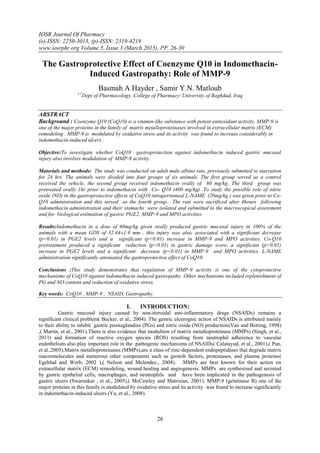
caused significant reduction (p<0.01) in the GDS by 90.9% mean (2.9±0.35mm) compared to (32.44±1.9 mm)
in the indomethacin alone treated group as shown in figure (1). L-NAME pretreatment significantly reduced
(p<0.01) the gastroprotective effect of CoQ10, GDS (9.2±0.8mm) compared to (2.9±0.35mm) in the Co-Q10
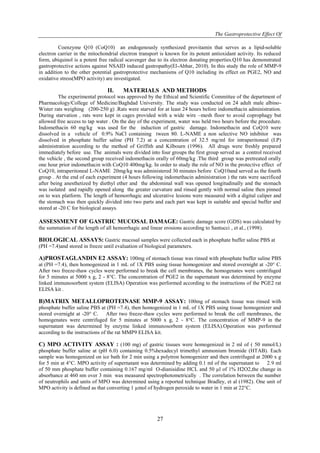
alone treated group as depicted in the same figure . CoQ10 caused a significant increase in the gastric PGE2
levels (p<0.01) mean (4.09±0.3 pg/g) compared to (1.88±0.14 pg/g) in the indomethacin treated group as shown
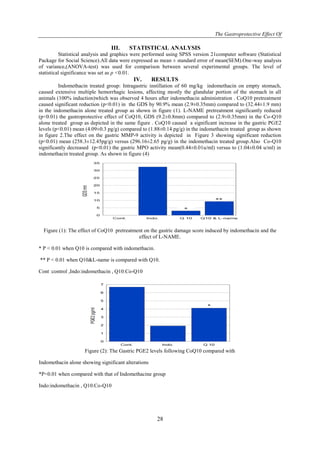
in figure 2.The effect on the gastric MMP-9 activity is depicted in Figure 3 showing significant reduction
(p<0.01) mean (258.3±12.45pg/g) versus (296.16±2.65 pg/g) in the indomethacin treated group.Also Co-Q10
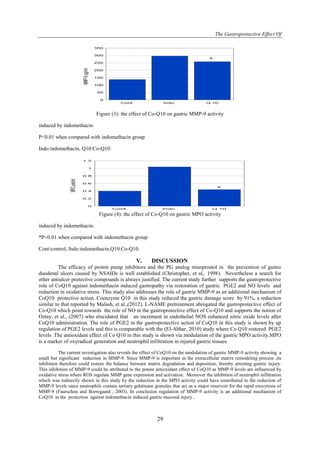
significantly decreased (p<0.01) the gastric MPO activity mean(0.44±0.01u/ml) versus to (1.04±0.04 u/ml) in
indomethacin treated group. As shown in figure (4)
Figure (1): The effect of CoQ10 pretreatment on the gastric damage score induced by indomethacin and the
effect of L-NAME.
* P < 0.01 when Q10 is compared with indomethacin.
** P < 0.01 when Q10&L-name is compared with Q10.
Cont :control ,Indo:indomethacin , Q10:Co-Q10
Figure (2): The Gastric PGE2 levels following CoQ10 compared with
Indomethacin alone showing significant alterations
P<0.01 when compared with that of Indomethacine group*
Indo:indomethacin , Q10:Co-Q10
The Gastroprotective Effect Of
29
Figure (3): the effect of Co-Q10 on gastric MMP-9 activity
induced by indomethacin.
P<0.01 when compared with indomethacin group
Indo:indomethacin, Q10:Co-Q10.
Figure (4): the effect of Co-Q10 on gastric MPO activity
induced by indomethacin.
*P<0.01 when compared with indomethacin group
Cont:control, Indo:indomethacin,Q10:Co-Q10.
V. DISCUSSION
The efficacy of proton pump inhibitors and the PG analog misoprostol in the prevention of gastro
duodenal ulcers caused by NSAIDs is well established (Christopher, et al,. 1998). Nevertheless a search for
other antiulcer protective compounds is always justified. The current study further supports the gastroprotective
role of CoQ10 against indomethacin induced gastropathy via restoration of gastric PGE2 and NO levels and
reduction in oxidative stress. This study also addresses the role of gastric MMP-9 as an additional mechanism of
CoQ10 protective action. Coenzyme Q10 in this study reduced the gastric damage score by 91%, a reduction
similar to that reported by Malash, et al.,(2012). L-NAME pretreatment abrogated the gastroprotective effect of
Co-Q10 which point towards the role of NO in the gastroprotective effect of Co-Q10 and supports the notion of
Oztay, et al., (2007) who elucidated that an increment in endothelial NOS enhanced nitric oxide levels after
CoQ10 administration. The role of PGE2 in the gastroprotective action of CoQ10 in this study is shown by up
regulation of PGE2 levels and this is comparable with the (El-Abhar, 2010) study where Co Q10 restored PGE2
levels .The antioxidant effect of Co Q10 in this study is shown via modulation of the gastric MPO activity.MPO
is a marker of oxyradical generation and neutrophil infiltration in injured gastric tissues.
The current investigation also reveals the effect of CoQ10 on the modulation of gastric MMP-9 activity showing a
small but significant reduction in MMP-9. Since MMP-9 is important in the extracellular matrix remodeling process ,its
inhibition therefore could restore the balance between matrix degradation and deposition, thereby arresting gastric injury.
This inhibition of MMP-9 could be attributed to the potent antioxidant effect of CoQ10 as MMP-9 levels are influenced by
oxidative stress where ROS regulate MMP gene expression and activation. Moreover the inhibition of neutrophil infiltration
which was indirectly shown in this study by the reduction in the MPO activity could have contributed to the reduction of
MMP-9 levels since neutrophils contain tertiary gelatinase granules that act as a major reservoir for the rapid exocytosis of
MMP-9 (Faurschou and Borregaard , 2003). In conclusion regulation of MMP-9 activity is an additional mechanism of
CoQ10 in the protection against indomethacin induced gastric mucosal injury .
The Gastroprotective Effect Of
30
REFERENCES
[1]. Becker J, Domschke W ,Pohle T.(2004).Current approaches to prevent NSAID-induced gastropathy – COX selectivity and beyond.Br
J ClinPharmacol; 58(6): 587–600.
[2]. Bradley P.P, Christensen R.D and Rothstein G( 1982).Cellular and extracellular myeloperoxidase in pyogenic inflammation, Blood
60;618-622.
[3]. Calatayud S, Barrachina D, Esplugues JV.(2001).Nitric oxide: relation to integrity, injury, and healing of the gastric mucosa.Microsc
Res Tech. 53(5):325-35.
[4]. Christopher J. Hawkey, D.M., Jeffrey A. Karrasch, M.B., B.S., Leszek Szczepañski, Ph.D., Donald G et al ,.(1998). Omeprazole
Compared with Misoprostol for Ulcers Associated with Nonsteroidal Antiinflammatory Drugs. N Engl J Med 338:727-734.
[5]. Egeblad M, Werb Z.New functions for the matrix metalloproteinases in cancer progression. Nat Rev Cancer. 2002;2:161–174.
[6]. El-Abhar HS.(2010). Coenzyme Q10: a novel gastroprotective effect via modulation of vascular permeability, prostaglandin E₂, nitric
oxide and redox status in indomethacin-induced gastric ulcer model. Eur J Pharmacol. 15;649(1-3):314-9.
[7]. Faurschou M, Borregaard N (2003) Neutrophil granules and secretory vesicles in inflammation. Microbes Infect 5: 1317–1327
[8]. Griffith O.W and Kilbourn, R.G.(1996). Nitric oxide synthase inhibitors , amino acid . method.J. enzymol.268, 375-392.
[9]. Malash, A. M., Abdallah D. M., Agha A. M., and Kenawy S. A., (2012). Gastroprotective Efficacy of Coenzyme Q10 in
Indomethacin-Induced Gastropathy: Other Potential Mechanisms J.Ulcers, Article ID 957898.
[10]. Martín MJ1, Jiménez MD, Motilva V.(2001)New Issues about Nitric Oxide and its Effects on the Gastrointestinal
Tract.CurrPharm.7(10):881-908.
[11]. McCawley LJ, Matrisian LM. Matrix metalloproteinases: they're not just for matrix anymore! CurrOpin Cell Biol. 2001;13:534–540.
[12]. Nelson KK, Melendez JA. Mitochondrial redox control of matrix metalloproteinases.FreeRadicBiol Med. 2004;37:768–784.
[13]. Oztay F, Ergin B, Ustunova S, Balci H, Kapucu A, Caner M, Demirci C. (2007). “Effects of coenzyme Q10 on the heart
ultrastructure and nitric oxide synthase during hyperthyroidism,” The Chinese Journal of Physiology, 50; 5; 217–224.
[14]. Pan LR, Tang Q, Fu Q, Hu BR, Xiang JZ, Qian JQ.(2005).Roles of nitric oxide in protective effect of berberine in ethanol-induced
gastric ulcer mice.ActaPharmacol Sin. 26(11):1334-8.
[15]. Santucci L, Fiorucci S, Giansanti M, Brunori P M, Di Matteo F M, Morelli A. (1994). Pentoxifylline prevents indomethacin induced
acute gastric mucosal damage in rats: role of tumor necrosis factor-alpha. Gut 35: 909.
[16]. Singh Laishram, Mishra Amartya, SahaDebjit, SwarnakarSnehasikta.(2011). Doxycycline blocks gastric ulcer by regulating matrix
metalloproteinase-2 activity and oxidative stress World J Gastroenterol.17(28): 3310–3321.
[17]. Swarnakar S, Ganguly K, Kundu P, Banerjee A, Maity P, Sharma AV. Curcumin regulates expression and activity of matrix
metalloproteinases 9 and 2 during prevention and healing of indomethacin-induced gastric ulcer. J Biol Chem. 2005;280:9409–9415.
[18]. Vane JR, Botting RM. (1998). Mechanism of action of anti-inflammatory drugs. International Journal Tissue React.20; 3-15.
[19]. Yu F, Kamada H, Niizuma K, Endo H, Chan PH.Induction of MMP-9 Expression and Endothelial Injury by Oxidative Stress after
Spinal Cord Injury.J Neurotrauma. 2008 Mar;25(3):184-95.

E0532026030

  • 1.
    IOSR Journal OfPharmacy (e)-ISSN: 2250-3013, (p)-ISSN: 2319-4219 www.iosrphr.org Volume 5, Issue 3 (March 2015), PP. 26-30 26 The Gastroprotective Effect of Coenzyme Q10 in Indomethacin- Induced Gastropathy: Role of MMP-9 Basmah A Hayder , Samir Y.N. Matloub 1,2 Dept of Pharmacology, College of Pharmacy/ University of Baghdad, Iraq ABSTRACT Background : Coenzyme Q10 (CoQ10) is a vitamin-like substance with potent antioxidant activity. MMP-9 is one of the major proteins in the family of matrix metalloproteinases involved in extracellular matrix (ECM) remodeling . MMP-9 is modulated by oxidative stress and its activity was found to increase considerably in indomethacin-induced ulcers . Objective:To investigate whether CoQ10 gastroprotection against indomethacin induced gastric mucosal injury also involves modulation of MMP-9 activity. Materials and methods: The study was conducted on adult male albino rats, previously submitted to starvation for 24 hrs. The animals were divided into four groups of six animals. The first group served as a control received the vehicle, the second group received indomethacin orally of 60 mg/kg. The third group was pretreated orally 1hr prior to indomethacin with Co- Q10 (400 mg/kg) .To study the possible role of nitric oxide (NO) in the gastroprotective effects of CoQ10 intraperitoneal L-NAME (20mg/kg ) was given prior to Co- Q10 administration and this served as the fourth group. The rats were sacrificed after 4hours following indomethacin administration and their stomachs were isolated and submitted to the macroscopical assessment and for biological estimation of gastric PGE2, MMP-9 and MPO activities Results:Indomethacin in a dose of 60mg/kg given orally produced gastric mucosal injury in 100% of the animals with a mean GDS of 32.44±1.9 mm , this injury was also, associated with a significant decrease (p<0.01) in PGE2 levels and a significant (p<0.01) increase in MMP-9 and MPO activities. Co-Q10 pretreatment produced a significant reduction (p<0.01) in gastric damage score, a significant (p<0.01) increase in PGE2 levels and a significant decrease (p<0.01) in MMP-9 and MPO activities. L-NAME administration significantly attenuated the gastroprotective effect of CoQ10. Conclusions :This study demonstrates that regulation of MMP-9 activity is one of the cytoprotective mechanisms of CoQ10 against indomethacin induced gastropathy .Other mechanisms included replenishment of PG and NO content and reduction of oxidative stress. Key words: CoQ10 , MMP-9 , NSAID, Gastropathy. I. INTRODUCTION: Gastric mucosal injury caused by non-steroidal anti-inflammatory drugs (NSAIDs) remains a significant clinical problem( Becker, et al., 2004). The gastric ulcerognic action of NSAIDs is attributed mainly to their ability to inhibit gastric prostaglandins (PGs) and nitric oxide (NO) production(Van and Botting, 1998) ,( Martín, et al., 2001).There is also evidence that modultion of matrix metalloproteinase (MMPs) (Singh, et al., 2011) and formation of reactive oxygen species (ROS) resulting from neutrophil adherence to vascular endothelium also play important role in the pathogenic mechanisms of NSAIDs( Calatayud, et al., 2001),( Pan, et al.,2005).Matrix metalloproteinases (MMPs),are a class of zinc-dependent endopeptidases that degrade matrix macromolecules and numerous other components such as growth factors, proteinases, and plasma proteins( Egeblad and Werb, 2002 ),( Nelson and Melendez., 2004). .MMPs are best known for their action on extracellular matrix (ECM) remodeling, wound healing and angiogenesis. MMPs are synthesized and secreted by gastric epithelial cells, macrophages, and neutrophils and have been implicated in the pathogenesis of gastric ulcers (Swarnakar , et al., 2005),( McCawley and Matrisian, 2001). MMP-9 (gelatinase B) one of the major proteins in this family is modulated by oxidative stress and its activity was found to increase significantly in indomethacin-induced ulcers (Yu, et al., 2008).
  • 2.
    The Gastroprotective EffectOf 27 Coenzyme Q10 (CoQ10) an endogenously synthesized provitamin that serves as a lipid-soluble electron carrier in the mitochondrial electron transport is known for its potent antioxidant activity. Its reduced form, ubiquinol is a potent free radical scavenger due to its electron donating properties.Q10 has demonstrated gastroprotective actions against NSAID induced gastropathy(El-Abhar, 2010). In this study the role of MMP-9 in addition to the other potential gastroprotective mechanisms of Q10 including its effect on PGE2, NO and oxidative stress(MPO activity) are investigated. II. MATERIALS AND METHODS The experimental protocol was approved by the Ethical and Scientific Committee of the department of Pharmacology/College of Medicine/Baghdad University. The study was conducted on 24 adult male albino- Wister rats weighing (200-250 g) .Rats were starved for at least 24 hours before indomethacin administration. During starvation , rats were kept in cages provided with a wide wire –mesh floor to avoid coprophagy but allowed free access to tap water . On the day of the experiment, water was held two hours before the procedure. Indomethacin 60 mg/kg was used for the induction of gastric damage. Indomethacin and CoQ10 were dissolved in a vehicle of 0.9% NaCl containing tween 80. L-NAME a non selective NO inhibitor was dissolved in phosphate buffer saline (PH 7.2) at a concentration of 32.5 mg/ml for intraperitoneal (I.P) administration according to the method of Griffith and Kilbourn (1996). All drugs were freshly prepared immediately before use. The animals were divided into four groups the first group served as a control received the vehicle , the second group received indomethacin orally of 60mg/kg .The third group was pretreated orally one hour prior indomethacin with CoQ10 400mg/kg. In order to study the role of NO in the protective effect of CoQ10, intraperitoneal L-NAME 20mg/kg was administered 30 minutes before CoQ10and served as the fourth group . At the end of each experiment (4 hours following indomethacin administration ) the rats were sacrificed after being anesthetized by diethyl ether and the abdominal wall was opened longitudinally and the stomach was isolated and rapidly opened along the greater curvature and rinsed gently with normal saline then pinned on to wax platform. The length of hemorrhagic and ulcerative lesions were measured with a digital caliper and the stomach was then quickly divided into two parts and each part was kept in suitable and special buffer and stored at -20 C for biological assays. ASSESSMENT OF GASTRIC MUCOSAL DAMAGE: Gastric damage score (GDS) was calculated by the summation of the length of all hemorrhagic and linear erosions according to Santucci , et al., (1998). BIOLOGICAL ASSAYS: Gastric mucosal samples were collected each in phosphate buffer saline PBS at (PH =7.4)and stored in freeze until evaluation of biological parameters. A)PROSTAGLANDIN E2 ASSAY: 100mg of stomach tissue was rinsed with phosphate buffer saline PBS at (PH =7.4), then homogenized in 1 mL of 1X PBS using tissue homogenizer and stored overnight at -20° C. After two freeze-thaw cycles were performed to break the cell membranes, the homogenates were centrifuged for 5 minutes at 5000 x g, 2 - 8°C. The concentration of PGE2 in the supernatant was determined by enzyme linked immunosorbent system (ELISA) Operation was performed according to the instructions of the PGE2 rat ELISA kit . B)MATRIX METALLOPROTEINASE MMP-9 ASSAY: 100mg of stomach tissue was rinsed with phosphate buffer saline PBS at (PH =7.4), then homogenized in 1 mL of 1X PBS using tissue homogenizer and stored overnight at -20° C. After two freeze-thaw cycles were performed to break the cell membranes, the homogenates were centrifuged for 5 minutes at 5000 x g, 2 - 8°C. The concentration of MMP-9 in the supernatant was determined by enzyme linked immunosorbent system (ELISA).Operation was performed according to the instructions of the rat MMP9 ELISA kit. C) MPO ACTIVITY ASSAY : (100 mg) of gastric tissues were homogenized in 2 ml of ( 50 mmol/L) phosphate buffer saline at (pH 6.0) containing 0.5%hexadecyl trimethyl ammonium bromide (HTAB). Each sample was homogenized on ice bath for 2 min using a polytron homogenizer and then centrifuged at 2000 x g for 5 min at 4°C. MPO activity of supernatant was determined by adding 0.1 ml of the supernatant to 2.9 ml of 50 mm phosphate buffer containing 0.167 mg/ml O-dianisidine HCL and 50 µl of 1% H2O2,the change in absorbance at 460 nm over 3 min was measured spectrophotometrically . The correlation between the number of neutrophils and units of MPO was determined using a reported technique Bradley, et al (1982). One unit of MPO activity is defined as that converting 1 µmol of hydrogen peroxide to water in 1 min at 22°C.
  • 3.
    The Gastroprotective EffectOf 28 III. STATISTICAL ANALYSIS Statistical analysis and graphics were performed using SPSS version 21computer software (Statistical Package for Social Science).All data were expressed as mean ± standard error of mean(SEM).One-way analysis of variance,(ANOVA-test) was used for comparison between several experimental groups. The level of statistical significance was set as p <0.01. IV. RESULTS Indomethacin treated group: Intragastric instillation of 60 mg/kg indomethacin on empty stomach, caused extensive multiple hemorrhagic lesions, affecting mostly the glandular portion of the stomach in all animals (100% induction)which was observed 4 hours after indomethacin administration . CoQ10 pretreatment caused significant reduction (p<0.01) in the GDS by 90.9% mean (2.9±0.35mm) compared to (32.44±1.9 mm) in the indomethacin alone treated group as shown in figure (1). L-NAME pretreatment significantly reduced (p<0.01) the gastroprotective effect of CoQ10, GDS (9.2±0.8mm) compared to (2.9±0.35mm) in the Co-Q10 alone treated group as depicted in the same figure . CoQ10 caused a significant increase in the gastric PGE2 levels (p<0.01) mean (4.09±0.3 pg/g) compared to (1.88±0.14 pg/g) in the indomethacin treated group as shown in figure 2.The effect on the gastric MMP-9 activity is depicted in Figure 3 showing significant reduction (p<0.01) mean (258.3±12.45pg/g) versus (296.16±2.65 pg/g) in the indomethacin treated group.Also Co-Q10 significantly decreased (p<0.01) the gastric MPO activity mean(0.44±0.01u/ml) versus to (1.04±0.04 u/ml) in indomethacin treated group. As shown in figure (4) Figure (1): The effect of CoQ10 pretreatment on the gastric damage score induced by indomethacin and the effect of L-NAME. * P < 0.01 when Q10 is compared with indomethacin. ** P < 0.01 when Q10&L-name is compared with Q10. Cont :control ,Indo:indomethacin , Q10:Co-Q10 Figure (2): The Gastric PGE2 levels following CoQ10 compared with Indomethacin alone showing significant alterations P<0.01 when compared with that of Indomethacine group* Indo:indomethacin , Q10:Co-Q10
  • 4.
    The Gastroprotective EffectOf 29 Figure (3): the effect of Co-Q10 on gastric MMP-9 activity induced by indomethacin. P<0.01 when compared with indomethacin group Indo:indomethacin, Q10:Co-Q10. Figure (4): the effect of Co-Q10 on gastric MPO activity induced by indomethacin. *P<0.01 when compared with indomethacin group Cont:control, Indo:indomethacin,Q10:Co-Q10. V. DISCUSSION The efficacy of proton pump inhibitors and the PG analog misoprostol in the prevention of gastro duodenal ulcers caused by NSAIDs is well established (Christopher, et al,. 1998). Nevertheless a search for other antiulcer protective compounds is always justified. The current study further supports the gastroprotective role of CoQ10 against indomethacin induced gastropathy via restoration of gastric PGE2 and NO levels and reduction in oxidative stress. This study also addresses the role of gastric MMP-9 as an additional mechanism of CoQ10 protective action. Coenzyme Q10 in this study reduced the gastric damage score by 91%, a reduction similar to that reported by Malash, et al.,(2012). L-NAME pretreatment abrogated the gastroprotective effect of Co-Q10 which point towards the role of NO in the gastroprotective effect of Co-Q10 and supports the notion of Oztay, et al., (2007) who elucidated that an increment in endothelial NOS enhanced nitric oxide levels after CoQ10 administration. The role of PGE2 in the gastroprotective action of CoQ10 in this study is shown by up regulation of PGE2 levels and this is comparable with the (El-Abhar, 2010) study where Co Q10 restored PGE2 levels .The antioxidant effect of Co Q10 in this study is shown via modulation of the gastric MPO activity.MPO is a marker of oxyradical generation and neutrophil infiltration in injured gastric tissues. The current investigation also reveals the effect of CoQ10 on the modulation of gastric MMP-9 activity showing a small but significant reduction in MMP-9. Since MMP-9 is important in the extracellular matrix remodeling process ,its inhibition therefore could restore the balance between matrix degradation and deposition, thereby arresting gastric injury. This inhibition of MMP-9 could be attributed to the potent antioxidant effect of CoQ10 as MMP-9 levels are influenced by oxidative stress where ROS regulate MMP gene expression and activation. Moreover the inhibition of neutrophil infiltration which was indirectly shown in this study by the reduction in the MPO activity could have contributed to the reduction of MMP-9 levels since neutrophils contain tertiary gelatinase granules that act as a major reservoir for the rapid exocytosis of MMP-9 (Faurschou and Borregaard , 2003). In conclusion regulation of MMP-9 activity is an additional mechanism of CoQ10 in the protection against indomethacin induced gastric mucosal injury .
  • 5.
    The Gastroprotective EffectOf 30 REFERENCES [1]. Becker J, Domschke W ,Pohle T.(2004).Current approaches to prevent NSAID-induced gastropathy – COX selectivity and beyond.Br J ClinPharmacol; 58(6): 587–600. [2]. Bradley P.P, Christensen R.D and Rothstein G( 1982).Cellular and extracellular myeloperoxidase in pyogenic inflammation, Blood 60;618-622. [3]. Calatayud S, Barrachina D, Esplugues JV.(2001).Nitric oxide: relation to integrity, injury, and healing of the gastric mucosa.Microsc Res Tech. 53(5):325-35. [4]. Christopher J. Hawkey, D.M., Jeffrey A. Karrasch, M.B., B.S., Leszek Szczepañski, Ph.D., Donald G et al ,.(1998). Omeprazole Compared with Misoprostol for Ulcers Associated with Nonsteroidal Antiinflammatory Drugs. N Engl J Med 338:727-734. [5]. Egeblad M, Werb Z.New functions for the matrix metalloproteinases in cancer progression. Nat Rev Cancer. 2002;2:161–174. [6]. El-Abhar HS.(2010). Coenzyme Q10: a novel gastroprotective effect via modulation of vascular permeability, prostaglandin E₂, nitric oxide and redox status in indomethacin-induced gastric ulcer model. Eur J Pharmacol. 15;649(1-3):314-9. [7]. Faurschou M, Borregaard N (2003) Neutrophil granules and secretory vesicles in inflammation. Microbes Infect 5: 1317–1327 [8]. Griffith O.W and Kilbourn, R.G.(1996). Nitric oxide synthase inhibitors , amino acid . method.J. enzymol.268, 375-392. [9]. Malash, A. M., Abdallah D. M., Agha A. M., and Kenawy S. A., (2012). Gastroprotective Efficacy of Coenzyme Q10 in Indomethacin-Induced Gastropathy: Other Potential Mechanisms J.Ulcers, Article ID 957898. [10]. Martín MJ1, Jiménez MD, Motilva V.(2001)New Issues about Nitric Oxide and its Effects on the Gastrointestinal Tract.CurrPharm.7(10):881-908. [11]. McCawley LJ, Matrisian LM. Matrix metalloproteinases: they're not just for matrix anymore! CurrOpin Cell Biol. 2001;13:534–540. [12]. Nelson KK, Melendez JA. Mitochondrial redox control of matrix metalloproteinases.FreeRadicBiol Med. 2004;37:768–784. [13]. Oztay F, Ergin B, Ustunova S, Balci H, Kapucu A, Caner M, Demirci C. (2007). “Effects of coenzyme Q10 on the heart ultrastructure and nitric oxide synthase during hyperthyroidism,” The Chinese Journal of Physiology, 50; 5; 217–224. [14]. Pan LR, Tang Q, Fu Q, Hu BR, Xiang JZ, Qian JQ.(2005).Roles of nitric oxide in protective effect of berberine in ethanol-induced gastric ulcer mice.ActaPharmacol Sin. 26(11):1334-8. [15]. Santucci L, Fiorucci S, Giansanti M, Brunori P M, Di Matteo F M, Morelli A. (1994). Pentoxifylline prevents indomethacin induced acute gastric mucosal damage in rats: role of tumor necrosis factor-alpha. Gut 35: 909. [16]. Singh Laishram, Mishra Amartya, SahaDebjit, SwarnakarSnehasikta.(2011). Doxycycline blocks gastric ulcer by regulating matrix metalloproteinase-2 activity and oxidative stress World J Gastroenterol.17(28): 3310–3321. [17]. Swarnakar S, Ganguly K, Kundu P, Banerjee A, Maity P, Sharma AV. Curcumin regulates expression and activity of matrix metalloproteinases 9 and 2 during prevention and healing of indomethacin-induced gastric ulcer. J Biol Chem. 2005;280:9409–9415. [18]. Vane JR, Botting RM. (1998). Mechanism of action of anti-inflammatory drugs. International Journal Tissue React.20; 3-15. [19]. Yu F, Kamada H, Niizuma K, Endo H, Chan PH.Induction of MMP-9 Expression and Endothelial Injury by Oxidative Stress after Spinal Cord Injury.J Neurotrauma. 2008 Mar;25(3):184-95.