

IoT vs IIoT
segmentation and
trends
MAKSYM ROMANOV
IIOT vs IOT –
10
Differences
that matter
IIOT
•Securit
y •Interop
erability
•Scalabi
lity
•Precisi
on and
Accurac
y
•Progra
mmabili
ty
•Low
latency
•Reliabil
ity
•Resilie
nce
•Autom
ation
•Service
•ability
Security for IIOT is more critical
• Robustness
• Process safety
Higher cost of
failure
• IT security
policy and
technologies
• Hazards
environments
Higher
requirements
from
environment
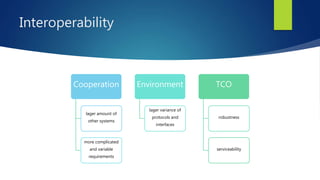
Interoperability
Cooperation
lager amount of
other systems
more complicated
and variable
requirements
Environment
lager variance of
protocols and
interfaces
TCO
robustness
serviceability
Scalability
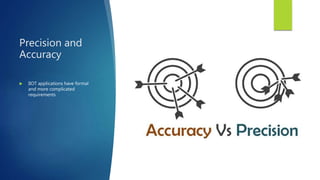
Precision and
Accuracy
 IIOT applications have formal
and more complicated
requirements
Programmability
 Agility is typical requirement for
production process
 Customization is the driver to
raise sales
Low latency
 In a high speed continuous production system
with sensors monitoring every aspect of the
operation, every second matters. Anomalies must
be detected, and corrective actions applied in near
real time. Any delay in detection, assessment,
decision-making, and execution would be costly, in
terms of worker safety, product quality, costs and
lost revenues. Industrial IoT solutions must
similarly be built to support the low latency
requirements of some industrial applications.
Reliability
 Industrial systems operate in long time scales before replacement – twenty
to thirty years is not uncommon. They operate in harsh environments,
sometimes subject to extreme heat, cold, high vibration, pressure, and dust
conditions. They may operate in remote locations, far away from
headquarters.
 Industrial IoT solutions may be subject to the same conditions and
requirements. They must be hardened to support high availability,
withstand high duty cycles, and operate reliably and within tolerance, day
in, day out for years and years, with shutdowns only for maintenance.
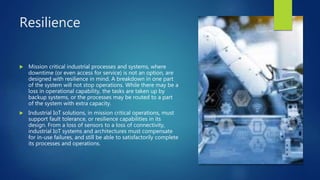
Resilience
 Mission critical industrial processes and systems, where
downtime (or even access for service) is not an option, are
designed with resilience in mind. A breakdown in one part
of the system will not stop operations. While there may be a
loss in operational capability, the tasks are taken up by
backup systems, or the processes may be routed to a part
of the system with extra capacity.
 Industrial IoT solutions, in mission critical operations, must
support fault tolerance, or resilience capabilities in its
design. From a loss of sensors to a loss of connectivity,
industrial IoT systems and architectures must compensate
for in-use failures, and still be able to satisfactorily complete
its processes and operations.
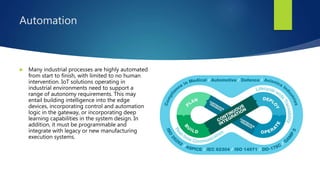
Automation
 Many industrial processes are highly automated
from start to finish, with limited to no human
intervention. IoT solutions operating in
industrial environments need to support a
range of autonomy requirements. This may
entail building intelligence into the edge
devices, incorporating control and automation
logic in the gateway, or incorporating deep
learning capabilities in the system design. In
addition, it must be programmable and
integrate with legacy or new manufacturing
execution systems.
Serviceability
 Industrial systems must operate reliably and
predictably in harsh conditions for years and years.
Supporting this level of performance requires regular
maintenance from in-house and field service
technicians. IoT solutions operating in industrial
environments must be serviceable in order to sustain
the levels of performance required. From swapping
out sensors, updating firmware, to configuring
gateways and servers, the ability to maintain
industrial IoT solutions over its entire lifecycle is an
essential requirement.
Key
takeaways
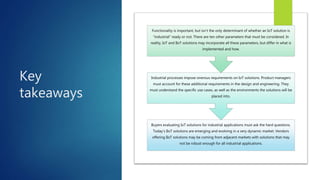
Buyers evaluating IoT solutions for industrial applications must ask the hard questions.
Today’s IIoT solutions are emerging and evolving in a very dynamic market. Vendors
offering IIoT solutions may be coming from adjacent markets with solutions that may
not be robust enough for all industrial applications.
Industrial processes impose onerous requirements on IoT solutions. Product managers
must account for these additional requirements in the design and engineering. They
must understand the specific use cases, as well as the environments the solutions will be
placed into.
Functionality is important, but isn’t the only determinant of whether an IoT solution is
“industrial” ready or not. There are ten other parameters that must be considered. In
reality, IoT and IIoT solutions may incorporate all these parameters, but differ in what is
implemented and how.