IGNOU Sample Synopsis File for MPCE016 Research Project Dissertation GW1
2.
Contents
Title ...............................................................................................................................................................3
Background ofstudy .....................................................................................................................................3
Review of literature ......................................................................................................................................4
Objectives .....................................................................................................................................................9
Methodology.................................................................................................................................................9
References ....................................................................................................................................................9
3.
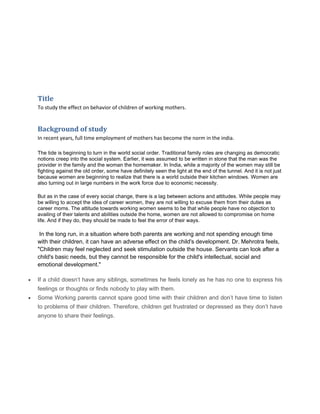
Title
To study theeffect on behavior of children of working mothers.
Background of study
In recent years, full time employment of mothers has become the norm in the india.
The tide is beginning to turn in the world social order. Traditional family roles are changing as democratic
notions creep into the social system. Earlier, it was assumed to be written in stone that the man was the
provider in the family and the woman the homemaker. In India, while a majority of the women may still be
fighting against the old order, some have definitely seen the light at the end of the tunnel. And it is not just
because women are beginning to realize that there is a world outside their kitchen windows. Women are
also turning out in large numbers in the work force due to economic necessity.
But as in the case of every social change, there is a lag between actions and attitudes. While people may
be willing to accept the idea of career women, they are not willing to excuse them from their duties as
career moms. The attitude towards working women seems to be that while people have no objection to
availing of their talents and abilities outside the home, women are not allowed to compromise on home
life. And if they do, they should be made to feel the error of their ways.
In the long run, in a situation where both parents are working and not spending enough time
with their children, it can have an adverse effect on the child's development. Dr. Mehrotra feels,
"Children may feel neglected and seek stimulation outside the house. Servants can look after a
child's basic needs, but they cannot be responsible for the child's intellectual, social and
emotional development."
• If a child doesn’t have any siblings, sometimes he feels lonely as he has no one to express his
feelings or thoughts or finds nobody to play with them.
• Some Working parents cannot spare good time with their children and don’t have time to listen
to problems of their children. Therefore, children get frustrated or depressed as they don’t have
anyone to share their feelings.
4.
Review of literature
In1991, the National Institute of Child Health and Development
initiated a comprehensive longitudinal study in ten centers across
the United States to address questions about the relationships
between maternal employment, child-care experiences and various
outcomes in children. The leaders of this study were among the
most respected researchers in the field of developmental
psychology, making the conclusions of this research particularly
worthy of attention. In a recent review of their findings, they drew
the following conclusions:[2]
In terms of the behavioral adjustment of children of middle class or
upper middle class mothers who worked when they were infants:
• Full-time maternal employment begun before the child was
three months old was associated with significantly more
behavior problems reported by caregivers at age 4½ years and
by teachers at first grade;
• Children whose mothers worked part-time before their child
was one year old had fewer disruptive behavioral problems
than the children of mothers who worked full-time before their
child’s first birthday. This increased risk for behavioral
difficulties was apparent at age three, and during first grade;
5.
• The pathwaythrough which those protective effects of part-
time work operated was through increases in the quality of the
home environment and in the mother’s sensitivity.
With regard to cognitive difference in the middle and upper middle
class sample, the study found that:
• Children of mothers who worked full-time in the first year of
that child’s life received modestly lower child cognitive scores
relative to children of mothers who do not work on all eight
cognitive outcomes examined. Associations at 4½ years and
first grade were roughly similar in size to those at age three;
• Mothers who worked full-time were more likely to have
symptoms of depression;
• Lower cognitive scores were not found in children of mothers
who worked part-time during the first year of their child’s life.
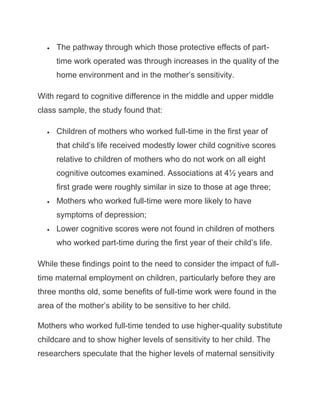
While these findings point to the need to consider the impact of full-
time maternal employment on children, particularly before they are
three months old, some benefits of full-time work were found in the
area of the mother’s ability to be sensitive to her child.
Mothers who worked full-time tended to use higher-quality substitute
childcare and to show higher levels of sensitivity to her child. The
researchers speculate that the higher levels of maternal sensitivity
6.
seen in employedmothers might have stemmed from their having
greater financial security.
A recent meta-analysis of 69 research studies spanning five
decades,[3] evaluating the impact of maternal employment, came to
similar conclusions as those summarized above. Early maternal
employment was found to be associated with beneficial child
outcomes when families were at risk because of either financial
challenges or as the result of being single-parent families. In those
families, children of working mothers showed higher levels of
achievement and lower levels of internalizing behaviors such as
anxiety and depression.
These benefits are generally explained by a compensatory
hypothesis that views work in those families as providing added
financial security, lower levels of family stress and enhanced
learning opportunities for children who would otherwise be home
with a parent who is dealing with the ongoing stress of poverty and
child-rearing challenges with little external support.
Employment was associated with negative child outcomes,
however, when children were from intact, middle class families that
were not at risk financially. In those families, early full-time
employment (relative to mothers who were not working outside the
home) was associated with later risk for child behavioral difficulties.
7.
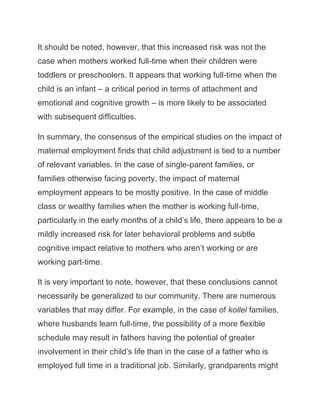
It should benoted, however, that this increased risk was not the
case when mothers worked full-time when their children were
toddlers or preschoolers. It appears that working full-time when the
child is an infant – a critical period in terms of attachment and
emotional and cognitive growth – is more likely to be associated
with subsequent difficulties.
In summary, the consensus of the empirical studies on the impact of
maternal employment finds that child adjustment is tied to a number
of relevant variables. In the case of single-parent families, or
families otherwise facing poverty, the impact of maternal
employment appears to be mostly positive. In the case of middle
class or wealthy families when the mother is working full-time,
particularly in the early months of a child’s life, there appears to be a
mildly increased risk for later behavioral problems and subtle
cognitive impact relative to mothers who aren’t working or are
working part-time.
It is very important to note, however, that these conclusions cannot
necessarily be generalized to our community. There are numerous
variables that may differ. For example, in the case of kollel families,
where husbands learn full-time, the possibility of a more flexible
schedule may result in fathers having the potential of greater
involvement in their child’s life than in the case of a father who is
employed full time in a traditional job. Similarly, grandparents might
8.
be more activelyinvolved in caring for their grandchildren – a factor
that is generally associated with improved childcare and improved
outcomes.[4]
Awareness About Full-Time Versus Part-Time
Although based on relatively small levels of statistical significance,
the findings of a number of well-executed studies suggest that when
parents have a choice early in their child’s life (particularly during
the first three months), they should consider working part-time.
During that critical period, when there is an option, the father should
make an effort to be present in as active a parenting role as
possible. Similarly, if at all feasible, grandparents should be more
actively recruited to take care of their grandchildren when they are
infants and both parents are working full-time. This has an added
benefit since research has found that actively-involved grandparents
serve a crucial role as a protective buffer against the potential
harmful influences of parental stress.[5]
It is important to note that the potential dangers of full-time versus
part-time work are only found in middle and upper middle class
families. This recommendation is therefore most relevant for the
segment of our community that falls in that category.
9.
Objectives
To study theeffect on social interaction of children of working mothers.
To study the the development of challenging behavior in children of working mothers.
To study the effect on child behavior in school of working mothers.
Methodology
The project will be a cross sectional study including sample of working as well as non working mothers.
The data will be collected in forms of interviews of Mother on their quality time spend with the child
and questionnaires to assess any development of challenging behavior in the child shown by tantrums
etc. questionnaire will also be filled to note the behavior of child in school and a child self report
inventory.
References
The Impact of Working Mothers on Child Development | Everyday Jewish Living | OU Life.
Retrieved from http://www.ou.org/life/parenting/impact-working-mothers-child-
development-empirical-research-david-pelcovitz/ (Accessed on )
[1] Brooks-Gunn, J. Han, W., Waldfogel, J. (2010), First-year maternal employment and child
development in the first 7 years: VIII. Discussion and Conclusions. Monographs of the Society for
Research in Child Development, Vol. 75(2), pp. 96-113.
[2] Brooks-Gunn, J. Han, W., Waldfogel, J. (2010), First-year maternal employment and child
development in the first 7 years: Monographs of the Society for Research in Child Development, Vol
75(2)
[3] Lucas-Thompson, R., Goldberg, W., Prause, J., (2010)Maternal work early in the lives of children and
its distal associations with achievement and behavior problems: A meta-analysis. Psychological Bulletin,
136(6)915-942.
[4] The NICHD Early Childcare Research Network (2005) Childcare and child development: Results from
the NICHD study of early childcare and youth development.; New York, NY, Guilford Press
10.
[5] Lussier, G.(2002) Support Across Two Generations Children’s Closeness to Grandparents Following
Parental Divorce and Remarriage. Journal of Family Psychology, 16:363-376
[6] Bugental, D. B., Lyon, J. E., Krantz, J. and Cortez, V., & Krantz, J. (1997). Who’s the boss? Accessibility
of dominance ideation among individuals with low perceptions of interpersonal power. Journal of
Personality and Social Psychology, 72, 1297-1309.
[7] Cahn, J. (2011). Adolescent children of newly-Orthodox Jewish parents: Family functioning,
parenting, and community integration as correlates of adjustment. (Unpublished doctoral dissertation).
Yeshiva University Azrieli Graduate School of Jewish Education and Administration, New York.


![Review of literature
In 1991, the National Institute of Child Health and Development
initiated a comprehensive longitudinal study in ten centers across
the United States to address questions about the relationships
between maternal employment, child-care experiences and various
outcomes in children. The leaders of this study were among the
most respected researchers in the field of developmental
psychology, making the conclusions of this research particularly
worthy of attention. In a recent review of their findings, they drew
the following conclusions:[2]
In terms of the behavioral adjustment of children of middle class or
upper middle class mothers who worked when they were infants:
• Full-time maternal employment begun before the child was
three months old was associated with significantly more
behavior problems reported by caregivers at age 4½ years and
by teachers at first grade;
• Children whose mothers worked part-time before their child
was one year old had fewer disruptive behavioral problems
than the children of mothers who worked full-time before their
child’s first birthday. This increased risk for behavioral
difficulties was apparent at age three, and during first grade;](https://image.slidesharecdn.com/mpce016dissertationsynopsisgw1r-250213184924-6de7c251/85/IGNOU-Sample-Synopsis-File-for-MPCE016-Research-Project-Dissertation-GW1-4-320.jpg)
![seen in employed mothers might have stemmed from their having
greater financial security.
A recent meta-analysis of 69 research studies spanning five
decades,[3] evaluating the impact of maternal employment, came to
similar conclusions as those summarized above. Early maternal
employment was found to be associated with beneficial child
outcomes when families were at risk because of either financial
challenges or as the result of being single-parent families. In those
families, children of working mothers showed higher levels of
achievement and lower levels of internalizing behaviors such as
anxiety and depression.
These benefits are generally explained by a compensatory
hypothesis that views work in those families as providing added
financial security, lower levels of family stress and enhanced
learning opportunities for children who would otherwise be home
with a parent who is dealing with the ongoing stress of poverty and
child-rearing challenges with little external support.
Employment was associated with negative child outcomes,
however, when children were from intact, middle class families that
were not at risk financially. In those families, early full-time
employment (relative to mothers who were not working outside the
home) was associated with later risk for child behavioral difficulties.](https://image.slidesharecdn.com/mpce016dissertationsynopsisgw1r-250213184924-6de7c251/85/IGNOU-Sample-Synopsis-File-for-MPCE016-Research-Project-Dissertation-GW1-6-320.jpg)
![be more actively involved in caring for their grandchildren – a factor
that is generally associated with improved childcare and improved
outcomes.[4]
Awareness About Full-Time Versus Part-Time
Although based on relatively small levels of statistical significance,
the findings of a number of well-executed studies suggest that when
parents have a choice early in their child’s life (particularly during
the first three months), they should consider working part-time.
During that critical period, when there is an option, the father should
make an effort to be present in as active a parenting role as
possible. Similarly, if at all feasible, grandparents should be more
actively recruited to take care of their grandchildren when they are
infants and both parents are working full-time. This has an added
benefit since research has found that actively-involved grandparents
serve a crucial role as a protective buffer against the potential
harmful influences of parental stress.[5]
It is important to note that the potential dangers of full-time versus
part-time work are only found in middle and upper middle class
families. This recommendation is therefore most relevant for the
segment of our community that falls in that category.](https://image.slidesharecdn.com/mpce016dissertationsynopsisgw1r-250213184924-6de7c251/85/IGNOU-Sample-Synopsis-File-for-MPCE016-Research-Project-Dissertation-GW1-8-320.jpg)
![Objectives
To study the effect on social interaction of children of working mothers.
To study the the development of challenging behavior in children of working mothers.
To study the effect on child behavior in school of working mothers.
Methodology
The project will be a cross sectional study including sample of working as well as non working mothers.
The data will be collected in forms of interviews of Mother on their quality time spend with the child
and questionnaires to assess any development of challenging behavior in the child shown by tantrums
etc. questionnaire will also be filled to note the behavior of child in school and a child self report
inventory.
References
The Impact of Working Mothers on Child Development | Everyday Jewish Living | OU Life.
Retrieved from http://www.ou.org/life/parenting/impact-working-mothers-child-
development-empirical-research-david-pelcovitz/ (Accessed on )
[1] Brooks-Gunn, J. Han, W., Waldfogel, J. (2010), First-year maternal employment and child
development in the first 7 years: VIII. Discussion and Conclusions. Monographs of the Society for
Research in Child Development, Vol. 75(2), pp. 96-113.
[2] Brooks-Gunn, J. Han, W., Waldfogel, J. (2010), First-year maternal employment and child
development in the first 7 years: Monographs of the Society for Research in Child Development, Vol
75(2)
[3] Lucas-Thompson, R., Goldberg, W., Prause, J., (2010)Maternal work early in the lives of children and
its distal associations with achievement and behavior problems: A meta-analysis. Psychological Bulletin,
136(6)915-942.
[4] The NICHD Early Childcare Research Network (2005) Childcare and child development: Results from
the NICHD study of early childcare and youth development.; New York, NY, Guilford Press](https://image.slidesharecdn.com/mpce016dissertationsynopsisgw1r-250213184924-6de7c251/85/IGNOU-Sample-Synopsis-File-for-MPCE016-Research-Project-Dissertation-GW1-9-320.jpg)
![[5] Lussier, G. (2002) Support Across Two Generations Children’s Closeness to Grandparents Following
Parental Divorce and Remarriage. Journal of Family Psychology, 16:363-376
[6] Bugental, D. B., Lyon, J. E., Krantz, J. and Cortez, V., & Krantz, J. (1997). Who’s the boss? Accessibility
of dominance ideation among individuals with low perceptions of interpersonal power. Journal of
Personality and Social Psychology, 72, 1297-1309.
[7] Cahn, J. (2011). Adolescent children of newly-Orthodox Jewish parents: Family functioning,
parenting, and community integration as correlates of adjustment. (Unpublished doctoral dissertation).
Yeshiva University Azrieli Graduate School of Jewish Education and Administration, New York.](https://image.slidesharecdn.com/mpce016dissertationsynopsisgw1r-250213184924-6de7c251/85/IGNOU-Sample-Synopsis-File-for-MPCE016-Research-Project-Dissertation-GW1-10-320.jpg)


