IGNOU Sample Synopsis File for MPCE016 Research Project Dissertation GW3
2.
2 | Pa g e
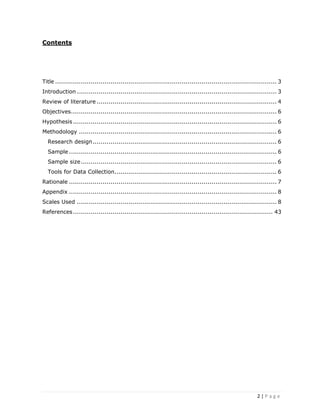
Contents
Title ................................................................................................................ 3
Introduction ..................................................................................................... 3
Review of literature ........................................................................................... 4
Objectives........................................................................................................ 6
Hypothesis....................................................................................................... 6
Methodology .................................................................................................... 6
Research design............................................................................................. 6
Sample ......................................................................................................... 6
Sample size................................................................................................... 6
Tools for Data Collection.................................................................................. 6
Rationale ......................................................................................................... 7
Appendix ......................................................................................................... 8
Scales Used ..................................................................................................... 8
References..................................................................................................... 43
3.
3 | Pa g e
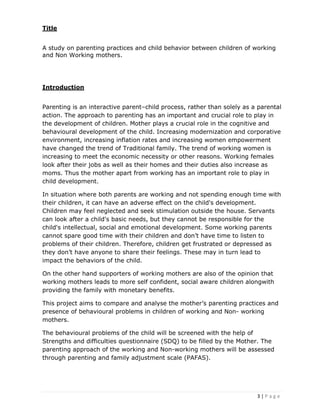
Title
A study on parenting practices and child behavior between children of working
and Non Working mothers.
Introduction
Parenting is an interactive parent–child process, rather than solely as a parental
action. The approach to parenting has an important and crucial role to play in
the development of children. Mother plays a crucial role in the cognitive and
behavioural development of the child. Increasing modernization and corporative
environment, increasing inflation rates and increasing women empowerment
have changed the trend of Traditional family. The trend of working women is
increasing to meet the economic necessity or other reasons. Working females
look after their jobs as well as their homes and their duties also increase as
moms. Thus the mother apart from working has an important role to play in
child development.
In situation where both parents are working and not spending enough time with
their children, it can have an adverse effect on the child's development.
Children may feel neglected and seek stimulation outside the house. Servants
can look after a child's basic needs, but they cannot be responsible for the
child's intellectual, social and emotional development. Some working parents
cannot spare good time with their children and don’t have time to listen to
problems of their children. Therefore, children get frustrated or depressed as
they don’t have anyone to share their feelings. These may in turn lead to
impact the behaviors of the child.
On the other hand supporters of working mothers are also of the opinion that
working mothers leads to more self confident, social aware children alongwith
providing the family with monetary benefits.
This project aims to compare and analyse the mother’s parenting practices and
presence of behavioural problems in children of working and Non- working
mothers.
The behavioural problems of the child will be screened with the help of
Strengths and difficulties questionnaire (SDQ) to be filled by the Mother. The
parenting approach of the working and Non-working mothers will be assessed
through parenting and family adjustment scale (PAFAS).
4.
4 | Pa g e
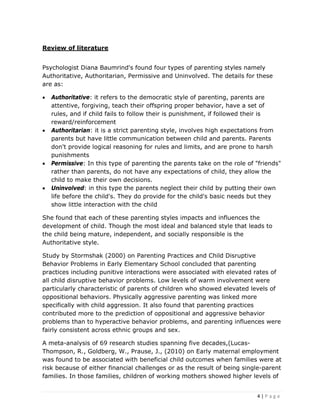
Review of literature
Psychologist Diana Baumrind's found four types of parenting styles namely
Authoritative, Authoritarian, Permissive and Uninvolved. The details for these
are as:
• Authoritative: it refers to the democratic style of parenting, parents are
attentive, forgiving, teach their offspring proper behavior, have a set of
rules, and if child fails to follow their is punishment, if followed their is
reward/reinforcement
• Authoritarian: it is a strict parenting style, involves high expectations from
parents but have little communication between child and parents. Parents
don't provide logical reasoning for rules and limits, and are prone to harsh
punishments
• Permissive: In this type of parenting the parents take on the role of "friends"
rather than parents, do not have any expectations of child, they allow the
child to make their own decisions.
• Uninvolved: in this type the parents neglect their child by putting their own
life before the child's. They do provide for the child's basic needs but they
show little interaction with the child
She found that each of these parenting styles impacts and influences the
development of child. Though the most ideal and balanced style that leads to
the child being mature, independent, and socially responsible is the
Authoritative style.
Study by Stormshak (2000) on Parenting Practices and Child Disruptive
Behavior Problems in Early Elementary School concluded that parenting
practices including punitive interactions were associated with elevated rates of
all child disruptive behavior problems. Low levels of warm involvement were
particularly characteristic of parents of children who showed elevated levels of
oppositional behaviors. Physically aggressive parenting was linked more
specifically with child aggression. It also found that parenting practices
contributed more to the prediction of oppositional and aggressive behavior
problems than to hyperactive behavior problems, and parenting influences were
fairly consistent across ethnic groups and sex.
A meta-analysis of 69 research studies spanning five decades,(Lucas-
Thompson, R., Goldberg, W., Prause, J., (2010) on Early maternal employment
was found to be associated with beneficial child outcomes when families were at
risk because of either financial challenges or as the result of being single-parent
families. In those families, children of working mothers showed higher levels of
5.
5 | Pa g e
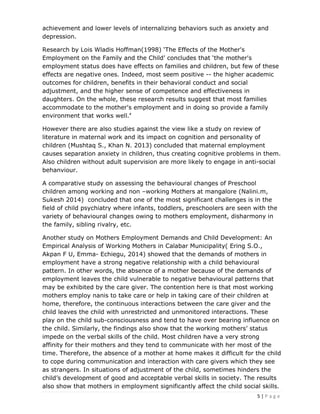
achievement and lower levels of internalizing behaviors such as anxiety and
depression.
Research by Lois Wladis Hoffman(1998) ‘The Effects of the Mother's
Employment on the Family and the Child’ concludes that ‘the mother's
employment status does have effects on families and children, but few of these
effects are negative ones. Indeed, most seem positive -- the higher academic
outcomes for children, benefits in their behavioral conduct and social
adjustment, and the higher sense of competence and effectiveness in
daughters. On the whole, these research results suggest that most families
accommodate to the mother's employment and in doing so provide a family
environment that works well.’
However there are also studies against the view like a study on review of
literature in maternal work and its impact on cognition and personality of
children (Mushtaq S., Khan N. 2013) concluded that maternal employment
causes separation anxiety in children, thus creating cognitive problems in them.
Also children without adult supervision are more likely to engage in anti-social
behanviour.
A comparative study on assessing the behavioural changes of Preschool
children among working and non –working Mothers at mangalore (Nalini.m,
Sukesh 2014) concluded that one of the most significant challenges is in the
field of child psychiatry where infants, toddlers, preschoolers are seen with the
variety of behavioural changes owing to mothers employment, disharmony in
the family, sibling rivalry, etc.
Another study on Mothers Employment Demands and Child Development: An
Empirical Analysis of Working Mothers in Calabar Municipality( Ering S.O.,
Akpan F U, Emma- Echiegu, 2014) showed that the demands of mothers in
employment have a strong negative relationship with a child behavioural
pattern. In other words, the absence of a mother because of the demands of
employment leaves the child vulnerable to negative behavioural patterns that
may be exhibited by the care giver. The contention here is that most working
mothers employ nanis to take care or help in taking care of their children at
home, therefore, the continuous interactions between the care giver and the
child leaves the child with unrestricted and unmonitored interactions. These
play on the child sub-consciousness and tend to have over bearing influence on
the child. Similarly, the findings also show that the working mothers’ status
impede on the verbal skills of the child. Most children have a very strong
affinity for their mothers and they tend to communicate with her most of the
time. Therefore, the absence of a mother at home makes it difficult for the child
to cope during communication and interaction with care givers which they see
as strangers. In situations of adjustment of the child, sometimes hinders the
child’s development of good and acceptable verbal skills in society. The results
also show that mothers in employment significantly affect the child social skills.
6.
6 | Pa g e
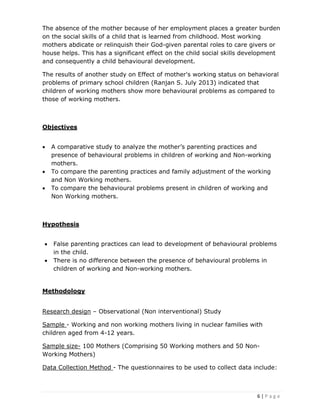
The absence of the mother because of her employment places a greater burden
on the social skills of a child that is learned from childhood. Most working
mothers abdicate or relinquish their God-given parental roles to care givers or
house helps. This has a significant effect on the child social skills development
and consequently a child behavioural development.
The results of another study on Effect of mother's working status on behavioral
problems of primary school children (Ranjan S. July 2013) indicated that
children of working mothers show more behavioural problems as compared to
those of working mothers.
Objectives
• A comparative study to analyze the mother’s parenting practices and
presence of behavioural problems in children of working and Non-working
mothers.
• To compare the parenting practices and family adjustment of the working
and Non Working mothers.
• To compare the behavioural problems present in children of working and
Non Working mothers.
Hypothesis
• False parenting practices can lead to development of behavioural problems
in the child.
• There is no difference between the presence of behavioural problems in
children of working and Non-working mothers.
Methodology
Research design – Observational (Non interventional) Study
Sample - Working and non working mothers living in nuclear families with
children aged from 4-12 years.
Sample size- 100 Mothers (Comprising 50 Working mothers and 50 Non-
Working Mothers)
Data Collection Method - The questionnaires to be used to collect data include:
7.
7 | Pa g e
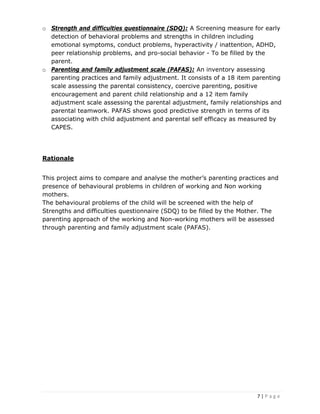
o Strength and difficulties questionnaire (SDQ): A Screening measure for early
detection of behavioral problems and strengths in children including
emotional symptoms, conduct problems, hyperactivity / inattention, ADHD,
peer relationship problems, and pro-social behavior - To be filled by the
parent.
o Parenting and family adjustment scale (PAFAS): An inventory assessing
parenting practices and family adjustment. It consists of a 18 item parenting
scale assessing the parental consistency, coercive parenting, positive
encouragement and parent child relationship and a 12 item family
adjustment scale assessing the parental adjustment, family relationships and
parental teamwork. PAFAS shows good predictive strength in terms of its
associating with child adjustment and parental self efficacy as measured by
CAPES.
Rationale
This project aims to compare and analyse the mother’s parenting practices and
presence of behavioural problems in children of working and Non working
mothers.
The behavioural problems of the child will be screened with the help of
Strengths and difficulties questionnaire (SDQ) to be filled by the Mother. The
parenting approach of the working and Non-working mothers will be assessed
through parenting and family adjustment scale (PAFAS).
9 | Pa g e
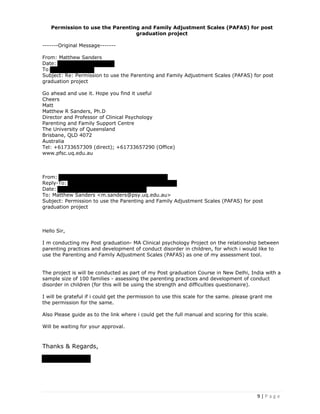
Permission to use the Parenting and Family Adjustment Scales (PAFAS) for post
graduation project
-------Original Message-------
From: Matthew Sanders
Date:
To:
Subject: Re: Permission to use the Parenting and Family Adjustment Scales (PAFAS) for post
graduation project
Go ahead and use it. Hope you find it useful
Cheers
Matt
Matthew R Sanders, Ph.D
Director and Professor of Clinical Psychology
Parenting and Family Support Centre
The University of Queensland
Brisbane, QLD 4072
Australia
Tel: +61733657309 (direct); +61733657290 (Office)
www.pfsc.uq.edu.au
From:
Reply-To:
Date:
To: Matthew Sanders <m.sanders@psy.uq.edu.au>
Subject: Permission to use the Parenting and Family Adjustment Scales (PAFAS) for post
graduation project
Hello Sir,
I m conducting my Post graduation- MA Clinical psychology Project on the relationship between
parenting practices and development of conduct disorder in children, for which i would like to
use the Parenting and Family Adjustment Scales (PAFAS) as one of my assessment tool.
The project is will be conducted as part of my Post graduation Course in New Delhi, India with a
sample size of 100 families - assessing the parenting practices and development of conduct
disorder in children (for this will be using the strength and difficulties questionaire).
I will be grateful if i could get the permission to use this scale for the same. please grant me
the permission for the same.
Also Please guide as to the link where i could get the full manual and scoring for this scale.
Will be waiting for your approval.
Thanks & Regards,
10.
32 | Pa g e
: Permission to use the Strengths and Difficulties Questionnaires
-------Original Message-------
From: Youthinmind
Date:
To:
Subject: Re: Permission to use the Strengths and Difficulties Questionnaires
Dear
You are welcome to download paper copies from our website.
You don't need our special permission to do so. You are only not allowed to create or to distribute
electronic versions for any purpose.
Best wishes
Helena Hamilton
YIM
On Fri, wrote:
Hello,
Had come to know about the Strengths and Difficulties Questionnaires, and wish to use it for my
MA Clinical psychology Course project titled " To Study the Effects on Behaviour in children of
Working mother".
I will be grateful if to get the permission to use it for the same.
Best Regards,
11.
43 | Pa g e
References
1. Almani A.S., Abro A., Mugheri R.A., 2012, Study of the Effects of Working Mothers on the Development of
Children in Pakistan, International Journal of Humanities and Social Science, Vol. 2 No. 11
2. ALSPAC(2003), WORKING MUMS: The Impact On Children’s Early Development
3. Brooks-Gunn, J. Han, W., Waldfogel, J. (2010), First-year maternal employment and child development in the
first 7 years: VIII. Discussion and Conclusions. Monographs of the Society for Research in Child Development,
Vol. 75(2), pp. 96-113.
4. Brooks-Gunn, J. Han, W., Waldfogel, J. (2010), First-year maternal employment and child development in the
first 7 years: Monographs of the Society for Research in Child Development, Vol 75(2)
5. The Impact of Working Mothers on Child Development | Everyday Jewish Living | OU Life. Retrieved from
http://www.ou.org/life/parenting/impact-working-mothers-child-development-empirical-research-david-
pelcovitz/ (
6. Akpan F U , Emma- Echiegu, Ering S.O., 2014, Mothers Employment Demands and Child Development: An
Empirical Analysis of Working Mothers in Calabar Municipality, American International Journal of Contemporary
Research Vol. 4, No. 4; {ONLINE:
http://www.aijcrnet.com/journals/Vol 4 No 4 April 2014/24.pdf]
7. Coste B., The Four Basic Parenting Styles Taken a Step Further: - Reviewing Diana Baumrind's Model with the
Tool of High Awareness, Positive-Parenting-Ally.com, accessed http://www.positive-parenting-ally.com/four-
basic-parenting-styles.html
8. Stormshak E. A. et al (2000, Parenting Practices and Child Disruptive Behavior Problems in Early Elementary
School, Pubmed, Journal of Clinical Child Psychology, Volume 29, Issue 1, 2000, pages 17-29, Accessed Online
at http://www.tandfonline.com/doi/abs/10.1207/S15374424jccp2901 3
9. Emerita, Hoffman, L. W.(1998), The Effects of the Mother's Employment on the Family and the Child, retrieved
from http://parenthood.library.wisc.edu/Hoffman/Hoffman.html
10. Lucas-Thompson, R., Goldberg, W., Prause, J., (2010)Maternal work early in the lives of children and its distal
associations with achievement and behavior problems: A meta-analysis. Psychological Bulletin, 136(6)915-
942.
11. Mushtaq S., Khan N. 2013, Maternal Work and its Impact on Cognition and Personality of Children - A Review
of Literature, Institute of Home Science, University of Kashmir, India, Published in ASJ International Journal of
Advances in Scientific Research and Reviews (IJASRR), Vol. 1(1) 28 June, 2013, Pp. 01-06,
www.academiascholarlyjournals.org/ijasrr/index.htm
12. Nalini.M, Sukesh (May 2014), A comparative study on assess the behavioural changes of preschool children
among working and non –working mothers at mangalore, Journal of International Academic Research for
Multidisciplinary, Impact Factor 1.393, ISSN: 2320-5083, Volume 2, Issue 4, May 2014 [Accessed Online
http://www.jiarm.com/MAY2014/paper13922.pdf]
13. PHYS.ORG, Children of working mothers less healthy: study (2009, October 8) retrieved
from http://phys.org/news174200436.htm
14. Ranjan S. (July 2013) Effect of mother's working status on behavioral problems of primary school children,
Shaikshik Parisamvad (An International Journal of Education), SPIJE , ISSN 2231 – 2323 (Print), 2231 – 2404
(Online), Vol.3, No.2, July 2013, pp 36 - 41.[Accessed Online
http://www.spijebhu.in/SPIJEJuly13%2036-41.pdf]
15. Santrock & Warshak, 1979, Child Adjustment Scale, School of Education, University of California, Accessed
online :
http://www.education.uci.edu/childcare/pdf/afterschool/CHILD%20ADJUSTMENT%20SCALE%20documentatio
n.pdf ,
http://www.education.uci.edu/childcare/pdf/questionnaire interview/Child%20Adjustment%20Scale.pdf
16. Youthinmind. SDQ - Information for researchers and professionals about the Strengths & Difficulties
Questionnaires. Retrieved from http://www.sdqinfo.com



![43 | P a g e
References
1. Almani A.S., Abro A., Mugheri R.A., 2012, Study of the Effects of Working Mothers on the Development of
Children in Pakistan, International Journal of Humanities and Social Science, Vol. 2 No. 11
2. ALSPAC(2003), WORKING MUMS: The Impact On Children’s Early Development
3. Brooks-Gunn, J. Han, W., Waldfogel, J. (2010), First-year maternal employment and child development in the
first 7 years: VIII. Discussion and Conclusions. Monographs of the Society for Research in Child Development,
Vol. 75(2), pp. 96-113.
4. Brooks-Gunn, J. Han, W., Waldfogel, J. (2010), First-year maternal employment and child development in the
first 7 years: Monographs of the Society for Research in Child Development, Vol 75(2)
5. The Impact of Working Mothers on Child Development | Everyday Jewish Living | OU Life. Retrieved from
http://www.ou.org/life/parenting/impact-working-mothers-child-development-empirical-research-david-
pelcovitz/ (
6. Akpan F U , Emma- Echiegu, Ering S.O., 2014, Mothers Employment Demands and Child Development: An
Empirical Analysis of Working Mothers in Calabar Municipality, American International Journal of Contemporary
Research Vol. 4, No. 4; {ONLINE:
http://www.aijcrnet.com/journals/Vol 4 No 4 April 2014/24.pdf]
7. Coste B., The Four Basic Parenting Styles Taken a Step Further: - Reviewing Diana Baumrind's Model with the
Tool of High Awareness, Positive-Parenting-Ally.com, accessed http://www.positive-parenting-ally.com/four-
basic-parenting-styles.html
8. Stormshak E. A. et al (2000, Parenting Practices and Child Disruptive Behavior Problems in Early Elementary
School, Pubmed, Journal of Clinical Child Psychology, Volume 29, Issue 1, 2000, pages 17-29, Accessed Online
at http://www.tandfonline.com/doi/abs/10.1207/S15374424jccp2901 3
9. Emerita, Hoffman, L. W.(1998), The Effects of the Mother's Employment on the Family and the Child, retrieved
from http://parenthood.library.wisc.edu/Hoffman/Hoffman.html
10. Lucas-Thompson, R., Goldberg, W., Prause, J., (2010)Maternal work early in the lives of children and its distal
associations with achievement and behavior problems: A meta-analysis. Psychological Bulletin, 136(6)915-
942.
11. Mushtaq S., Khan N. 2013, Maternal Work and its Impact on Cognition and Personality of Children - A Review
of Literature, Institute of Home Science, University of Kashmir, India, Published in ASJ International Journal of
Advances in Scientific Research and Reviews (IJASRR), Vol. 1(1) 28 June, 2013, Pp. 01-06,
www.academiascholarlyjournals.org/ijasrr/index.htm
12. Nalini.M, Sukesh (May 2014), A comparative study on assess the behavioural changes of preschool children
among working and non –working mothers at mangalore, Journal of International Academic Research for
Multidisciplinary, Impact Factor 1.393, ISSN: 2320-5083, Volume 2, Issue 4, May 2014 [Accessed Online
http://www.jiarm.com/MAY2014/paper13922.pdf]
13. PHYS.ORG, Children of working mothers less healthy: study (2009, October 8) retrieved
from http://phys.org/news174200436.htm
14. Ranjan S. (July 2013) Effect of mother's working status on behavioral problems of primary school children,
Shaikshik Parisamvad (An International Journal of Education), SPIJE , ISSN 2231 – 2323 (Print), 2231 – 2404
(Online), Vol.3, No.2, July 2013, pp 36 - 41.[Accessed Online
http://www.spijebhu.in/SPIJEJuly13%2036-41.pdf]
15. Santrock & Warshak, 1979, Child Adjustment Scale, School of Education, University of California, Accessed
online :
http://www.education.uci.edu/childcare/pdf/afterschool/CHILD%20ADJUSTMENT%20SCALE%20documentatio
n.pdf ,
http://www.education.uci.edu/childcare/pdf/questionnaire interview/Child%20Adjustment%20Scale.pdf
16. Youthinmind. SDQ - Information for researchers and professionals about the Strengths & Difficulties
Questionnaires. Retrieved from http://www.sdqinfo.com](https://image.slidesharecdn.com/mpce016dissertationsynopsisgw3r-250213184925-f5ba3993/85/IGNOU-Sample-Synopsis-File-for-MPCE016-Research-Project-Dissertation-GW3-11-320.jpg)


