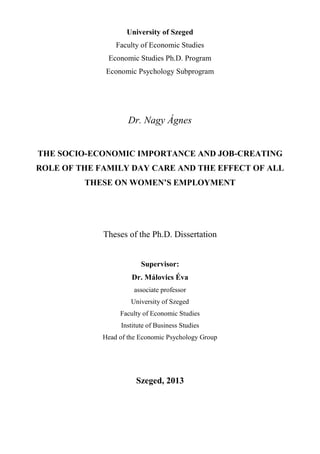
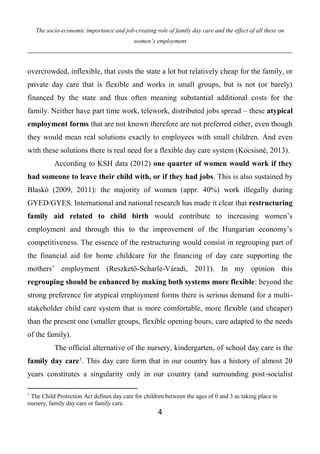
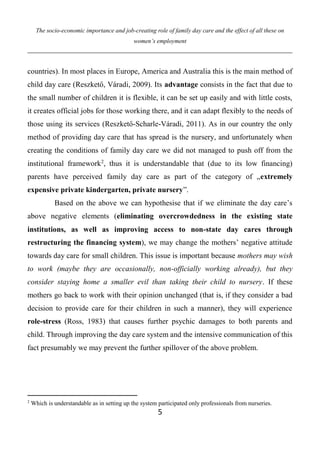
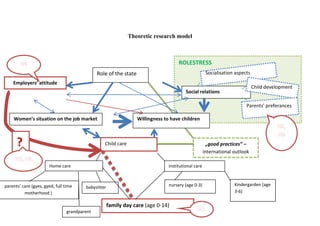
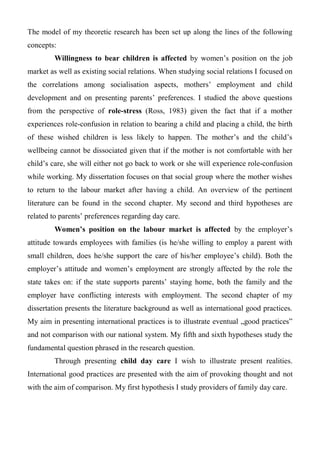
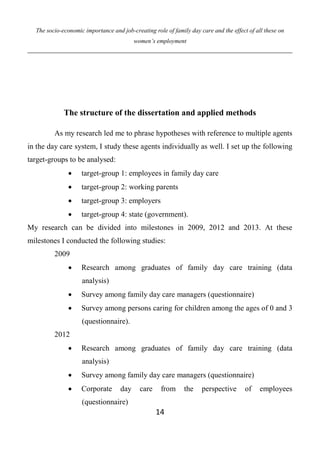
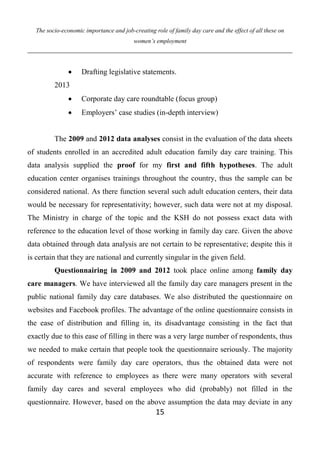
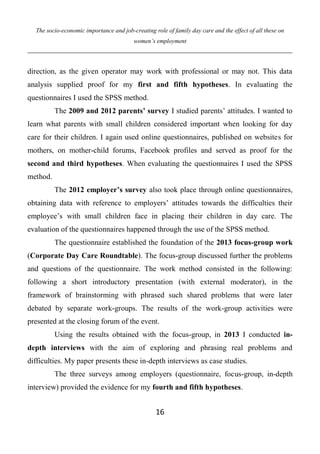
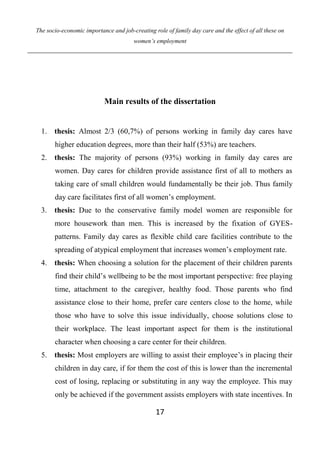
This document outlines a dissertation on the socio-economic importance of family day care and its impact on women's employment in Hungary. The dissertation aims to examine how improving access to affordable, flexible day care options could change mothers' negative attitudes towards early child care and increase women's participation in the workforce. The theoretical model discusses factors influencing women's employment decisions, including social norms, employer attitudes, state policies, and availability of child care arrangements like family day care centers. The dissertation will analyze literature on socialization, child development, and parental preferences to understand perceptions of early child care and explore how restructuring state aid could better support working mothers in Hungary.


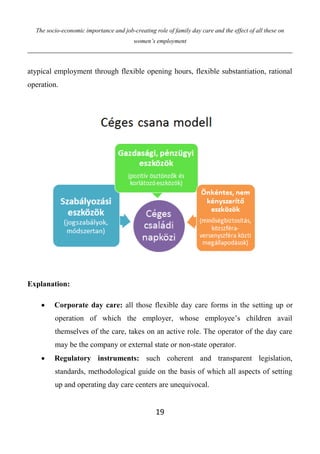
![The socio-economic importance and job-creating role of family day care and the effect of all these on
women’s employment
21
Bibliography
Blaskó Zs. (2009).: Does early maternal employment affect non-cognitive
children outcomes? - A literature review, Budapest Working Papers On The
Labour Market, BWP – 2008/5, Institute of Economics, Hungarian Academy
of Sciences, Department of Human Resources, Corvinus University of
Budapest
Blaskó Zs. (2008): Az anya korai munkavállalásának hatásai a gyermek
pszichés fejlődésére. Szakirodalmi áttekintés [The effect of the mother’s
early employment on the child’s psychic development. Bibliographic
overview.], in: Demográfia 2008, Vol. 51. No. 2-3, 259-281
Blaskó Zs. (2011): „Hároméves kor alatt mindenképpen megsínyli?”
Interjús kutatás kisgyermekes anyák körében. [„Under the age of three he/she
will suffer anyway.” Interview research among mothers with small children.]
In: Nagy I. – Pongrácz T. (eds.): Szerepváltozások [Roleshifts], TÁRKI,
Budapest, 2011, p. 156-170.
Cseres-Gergely Zs. (2008): Foglalkoztatottság Magyarországon: a
GYES/GYED és a nyugdíjrendszer hatása, Termelékenység és gazdasági
növekedés, munkaerőpiaci kihívások [Employment in Hungary: the effects of
GYES/GYED and of the pension system. Productivity and economic
development, challenges of the labour market.] MNB-PM Conference.](https://image.slidesharecdn.com/1fd0d1c4-05fb-4d22-8089-12f1fe2116a0-150415050225-conversion-gate01/85/theses-21-320.jpg)
![The socio-economic importance and job-creating role of family day care and the effect of all these on
women’s employment
22
Kocsisné P.H. (szerk) (2013): Nők a nemzetgazdaságban. Látható és
láthatatlan munka. [Women in the national economy. Visible and invisible
labour.] ERGO, Budapest
Központi Statisztikai Hivatal (KSH) [Central Statistical Office.] (2012):
Kisgyermekek napközbeni ellátása [Small children’s day care.], Budapest
NGM (2012): Új baby boom. A középosztály gyermekvállalási forradalma
[New Baby Boom. The middle class’s revolution in childbearing.],
Nemzetgazdasági Minisztérium [Ministry of National Economy], Családbarát
Magyarországért Munkacsoport [Workgroup for a Family Friendly
Hungary.]
Pongrácz T. (2011): A családi értékek és a demográfiai magatartás
változásai [Changes in family values and demographic behavior.] -
Népességtudományi Kutatóintézet [Population Science Research Institute],
Budapest
Reszkető P. – Scharle Á. – Váradi B. (2011): A kisgyermekek napközbeni
ellátásának bővítése: célok, eszköztár és várható társadalmi hatások
[Inlarging day care: aims, instruments and expected social effects.] , In: Nagy
I. – Pongrácz T. (eds.): Szerepváltozások [Roleshifts.], 2011, TÁRKI,
Budapest, p. 171-191.
Reszkető P., Váradi B. (2009): A regionális operatív programok keretében
kiírásra került szociális alapszolgáltatások és gyermekjóléti alapellátások
infrastrukturális fejlesztését, bölcsődék önálló fejlesztését, valamint az
akadálymenesítést érintő pályázatok előrehaladásának összegzése [Summary
of the progression of project with reference to infrastructural developments
of fundamental social and child welbeing services, to the individual](https://image.slidesharecdn.com/1fd0d1c4-05fb-4d22-8089-12f1fe2116a0-150415050225-conversion-gate01/85/theses-22-320.jpg)
![The socio-economic importance and job-creating role of family day care and the effect of all these on
women’s employment
23
development of nurseries and to obstracle clearing issued under the regional
operational programs.], Budapest Intézet [Budapest Institute], Budapest,
2009
Ross, C. E., Mirowsky, J, Huber.J. (1983): "Dividing work, sharing work,
and in-between: Marriage patterns and depression." American Sociological
Review 48: 809-823.
Szalai, P. (2012): Segítsük elő a nők foglalkoztatásának bővülését! [Let’s
facilitate the increase of women’s employment.] NGM, Budapest](https://image.slidesharecdn.com/1fd0d1c4-05fb-4d22-8089-12f1fe2116a0-150415050225-conversion-gate01/85/theses-23-320.jpg)
![The socio-economic importance and job-creating role of family day care and the effect of all these on
women’s employment
24
Publications serving as the foundation of the dissertation
Accepted for publication:
Nagy Á.: A női foglalkoztatás hatása a demográfiára [The effect of women’s
employment on demography.], Munkaügyi Szemle, Budapest (2014)
Published:
Nagy Á. (2013): Az anyai munkavállalás és a gyermekfejlődés összefüggései
[Correlations of the mother’s employment and child development.], Kapocs
Folyóirat [Link Journal], Nemzeti Család-és Szociálpolitikai Intézet
[National Family- and Social Policy Institute], Budapest
Publications, books:
Nagy Á. (szerk) (2011): Professzionális kisgyermekellátás a gyakorlatban -
Szakmai kézikönyv. [Professional child day care in practice –
Professional Guide.] Csodacsalád Egyesület, Budapest, ISBN: 978-963-08-
0395-3
Nagy Á. (szerk) (2010): Kézikönyv családi napközi működtetőknek.
[Handbook for family day care operators.] Csodacsalád Egyesület, Budapest,
ISBN: 978-963-06-8684-6
Conference presentations, posters:
Nagy Á. (2013): Az anyai munkavállalás és a gyermekfejlődés összefüggései
[Correlations of the mother’s employment and child development.], Magyar
Gyermekorvosok Társasága Országos Naggyűlés [National Summit of the
Association of Hungarian Pediatricians.], Debrecen (poster)](https://image.slidesharecdn.com/1fd0d1c4-05fb-4d22-8089-12f1fe2116a0-150415050225-conversion-gate01/85/theses-24-320.jpg)
![The socio-economic importance and job-creating role of family day care and the effect of all these on
women’s employment
25
Nagy Á. (2012): Óvónő vagy vállalkozó? Családi napközis kutatások
bemutatása, Gazdasági és üzleti döntések, s azok pszichológiai háttere,
Economic and business decisions and psychological mechanisms in their
background, Közgazdaságtani Doktori Iskola Gazdaságpszichológia Kutató
Műhelyének kutatói fóruma [Researchers’ Forum of the Economic Studies
Ph.D. Program, Research Workshop of Economic Psychology], SZTE,
Szeged,
Nagy Á. (2012): Quo vadis, Family Day Care? Crossroads of economics and
psychology, SZTE
Nagy, Á. (2012): Mi a családi napközi hálózat? [What is the family day care
network?] NCSSZI Csana Módszertani Munkacsoport Konferencia [Family
Day Care Methodological Workgroup Conference], Székesfehérvár
Nagy, Á. (2012): Találós kérdés: mitől fognak gyermeket vállalni a fiatalok?
Megvalósul az "új baby-boom"? [Conandrum: what makes young people
decide to have a child? Will the „new baby boom” take place?] I. Házasság
Világnapja Konferencia [I. World Marriage Day Conference], Nyíregyháza
Nagy, Á. (2011): A családi napközi direkt és indirekt munkahelyteremtő
szerepe [The family day care’s role in creating direct and indirect jobs.],
Gazdaságpszichológia Konferencia [Economic Psychology Conference],
Szeged
Nagy, Á. (2011): Családi napközi mint alternatív gyermekellátó egység
[Family Day Care as Alternative Child Care Unit.] , NCA Conference,
Nyíregyháza
Nagy Á. (2011): Gyermeke van? Köszönjük, majd értesítjük… [You have a
child? ... Thank you, we’ll be in contact...] 12. Gazdaságpszichológia](https://image.slidesharecdn.com/1fd0d1c4-05fb-4d22-8089-12f1fe2116a0-150415050225-conversion-gate01/85/theses-25-320.jpg)
![The socio-economic importance and job-creating role of family day care and the effect of all these on
women’s employment
26
Kutatói Fórum [12th Economic Psychology Research Forum], Szeged
SZTE
Nagy Á. (2010): Női munkavállalás a szerepfeszültség tükrében [Women’s
employment through the perspective of rolestress.], 11.
Gazdaságpszichológia Kutatói Fórum [11th Economic Psychology
Research Forum], Szeged SZTE
Nagy Á. (2010): Vannak jó vállalkozók és rossz vállalkozók? Mitől
működőképes a családi napközi mint vállalkozás? [Are there good and bad
enterpreneurs? What makes the family day care as enterprise functional?]
10. Gazdaságpszichológia Kutatói Fórum [10th Economic Psychology
Research Forum], Szeged SZTE
Nagy Á. (2010): Egy csodálatos lehetőség – a családi napközi bemutatása [A
wonderful opportunity – presentation of the family day care.], „A munka
világa konferencia nap” [Labour Day Conference] – Sapientia Szerzetesi
Hittudományi Főiskola, Budapest
Nagy Á. (2010): Családi napközikkel az egyszülős családokért [With Family
Day Cares for the One-Parent Families.], Csongrád Megyei
Esélyegyenlőségi Iroda [Csongrád County Equality Office], Szeged
Nagy Á. (2010): Érvek és tények a családi napközikről a számok és a
kutatások tükrében [Arguments and Facts about Family Day Care in the
Mirror of Numbers and Research.], Háló a Családi Napközikért Egyesület
Konferencia [Network for Family Day Cares Association Conference],
Budapest](https://image.slidesharecdn.com/1fd0d1c4-05fb-4d22-8089-12f1fe2116a0-150415050225-conversion-gate01/85/theses-26-320.jpg)
![The socio-economic importance and job-creating role of family day care and the effect of all these on
women’s employment
27
Nagy Á. (2010): Mi is az a családi napközi? A védőnő szerepe a napközbeni
alapellátásban [What is family day care? The role of the health visitor in
basic day care.] , ÁNTSZ OTH, Budapest
Nagy Á. (2010): Mi is az a családi étkeztetés? A védőnő szerepe a
napközbeni alapellátásban [What is family day care? The role of the health
visitor in basic day care.], Magyar Védőnők Egyesülete – XX. Pest megyei
védőnői nap [Association of Hungarian Health Visitors – XX. Pest county
health visitor day], Dunakeszi](https://image.slidesharecdn.com/1fd0d1c4-05fb-4d22-8089-12f1fe2116a0-150415050225-conversion-gate01/85/theses-27-320.jpg)


![Group presentation child care[1].pptx 2 (1)](https://cdn.slidesharecdn.com/ss_thumbnails/grouppresentationchildcare1-pptx21-130314140726-phpapp02-thumbnail.jpg?width=640&height=640&fit=bounds)
![Group presentation child care[1].pptx 2 (1).pptx 104first semester](https://cdn.slidesharecdn.com/ss_thumbnails/grouppresentationchildcare1-pptx21-pptx-104firstsemester-130412224827-phpapp02-thumbnail.jpg?width=640&height=640&fit=bounds)