Auditing Practice and
Secretarial Practice
Aspects to be covered in Audit
• An examination of the system of accounting and internal control
• Reviewing the system and procedures to find out whether they are
adequate and comprehensive
• Checking of the arithmetical accuracy of the books of account
• Verification of the authenticity and validity of transactions
• Ascertaining that a proper distinction has been made between items
of capital and of revenue nature
• Comparison of the balance sheet and profit and loss account or other
statements with the underlying record
Aspects to be covered in Audit (Contd..)
• Verification of the title , existence and value of the assets
• Verification of the liabilities stated in the balance sheet
• Checking the results shown by profit and loss
• Confirming that the statutory requirements have been complied with
• Reporting whether statement of the account examined do reveal a
true and fair state of affairs and of the profit and loss of the
organisation.
Types of Audit
• Audit required under law
• Voluntary audits
Advantages of Audit of financial statements
• It safeguards the financial interest of persons who are not associated
with the management of the entity
• It acts as a moral check on the employees
• Helpful in setting liability for taxes, negotiating loans etc.
• Useful for settling trade disputes and claims in respect of damage
• Helps in detection of wastages and losses due to absence of internal
checks
• Ascertains whether necessary books of accounts and allied records
have been properly kept
Advantages of Audit of financial statements
(Contd..)
• Audit reviews the existence and operations of various controls in the
organisations and reports weaknesses, adequacies etc.
• Settlement of accounts at the time of admission or death of partner
• Government may require audits and certified financial statements for
providing assistances or issuing licence for a particular trade.
Inherent limitations of Audit
• The nature of financial reporting: preparation of financial statements
involve judgement by management in applying the requirements of
the entity’s applicable financial reporting framework.
• The nature of Audit procedures: there are practical and legal
limitations on the auditor’s ability to obtain audit evidence. For
example: not providing complete information, sophisticatedly
concealing frauds. Also, audit is not an official investigation.
• Timeliness of financial reporting and the balance between benefit
and cost:
Relationship of auditing with other disciplines
• Auditing and accounting
• Auditing and law
• Auditing and economics
• Auditing and behavioral science
• Auditing and statistics & mathematics
• Auditing and data processing
• Auditing and financial management
Standard Setting Process
• International Federation of Accountants (IFAC) was set up to bring
harmony in the profession of accounting on international scale.
• IFAC board has established International Auditing and Assurance
Standards Board (IAASB) to develop high quality auditing standards.
• ICAI in India has set up AASB to develop Engagement and Quality
control standards in India
• SAs (Standards of Auditing) apply in the audit of historical financial
information
Standard Setting Process (contd..)
• Some examples of Standards on Auditing are:
• SA 200 overall objective of auditor and conduct of an audit in
accordance with standards on auditing
• SA 230 Audit documentation
• SA 500 Audit evidence etc.
Principles of Audit
• Integrity
• Independence
• Skills and competence
• Planning
• Confidentiality
Principles of Audit
• Audit Evidence
• Internal Control System
• Working paper
• Audit report
• Work done by others
Qualities of a good auditor
1. Integrity
2. Independence
3. Objectivity
4. Logical abilities
5. Awareness of acts
6. Communication abilities
7. Tactfulness
8. Technical confidence
9. Confidentiality
Elements of a System of Quality Control
• Leadership responsibilities for quality within the firm
• Ethical requirements
• Independence of Auditors
• Threats to independence (self interest threats, self review threats, advocacy threats,
familiarity threats, intimidation threats)
• Safeguards to independence
• Professional skepticism (questioning mind)
• Acceptance and continuance of client relationships and specific
engagements
• Human resources
• Engagement performance
• Monitoring
Preconditions for an Audit
• SA 210 “Agreeing the Terms of Audit Engagements”
• Use by management of an acceptable framework in the preparation
of financial statements
• Agreement of management to the premise on which an audit is
conducted
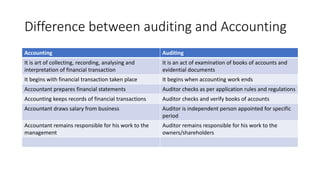
Difference between auditing and Accounting
Accounting Auditing
It is art of collecting, recording, analysing and
interpretation of financial transaction
It is an act of examination of books of accounts and
evidential documents
It begins with financial transaction taken place It begins when accounting work ends
Accountant prepares financial statements Auditor checks as per application rules and regulations
Accounting keeps records of financial transactions Auditor checks and verify books of accounts
Accountant draws salary from business Auditor is independent person appointed for specific
period
Accountant remains responsible for his work to the
management
Auditor remains responsible for his work to the
owners/shareholders
THANK YOU

APSP Class 2.pptx

  • 1.
  • 2.
    Aspects to becovered in Audit • An examination of the system of accounting and internal control • Reviewing the system and procedures to find out whether they are adequate and comprehensive • Checking of the arithmetical accuracy of the books of account • Verification of the authenticity and validity of transactions • Ascertaining that a proper distinction has been made between items of capital and of revenue nature • Comparison of the balance sheet and profit and loss account or other statements with the underlying record
  • 3.
    Aspects to becovered in Audit (Contd..) • Verification of the title , existence and value of the assets • Verification of the liabilities stated in the balance sheet • Checking the results shown by profit and loss • Confirming that the statutory requirements have been complied with • Reporting whether statement of the account examined do reveal a true and fair state of affairs and of the profit and loss of the organisation.
  • 4.
    Types of Audit •Audit required under law • Voluntary audits
  • 5.
    Advantages of Auditof financial statements • It safeguards the financial interest of persons who are not associated with the management of the entity • It acts as a moral check on the employees • Helpful in setting liability for taxes, negotiating loans etc. • Useful for settling trade disputes and claims in respect of damage • Helps in detection of wastages and losses due to absence of internal checks • Ascertains whether necessary books of accounts and allied records have been properly kept
  • 6.
    Advantages of Auditof financial statements (Contd..) • Audit reviews the existence and operations of various controls in the organisations and reports weaknesses, adequacies etc. • Settlement of accounts at the time of admission or death of partner • Government may require audits and certified financial statements for providing assistances or issuing licence for a particular trade.
  • 7.
    Inherent limitations ofAudit • The nature of financial reporting: preparation of financial statements involve judgement by management in applying the requirements of the entity’s applicable financial reporting framework. • The nature of Audit procedures: there are practical and legal limitations on the auditor’s ability to obtain audit evidence. For example: not providing complete information, sophisticatedly concealing frauds. Also, audit is not an official investigation. • Timeliness of financial reporting and the balance between benefit and cost:
  • 8.
    Relationship of auditingwith other disciplines • Auditing and accounting • Auditing and law • Auditing and economics • Auditing and behavioral science • Auditing and statistics & mathematics • Auditing and data processing • Auditing and financial management
  • 9.
    Standard Setting Process •International Federation of Accountants (IFAC) was set up to bring harmony in the profession of accounting on international scale. • IFAC board has established International Auditing and Assurance Standards Board (IAASB) to develop high quality auditing standards. • ICAI in India has set up AASB to develop Engagement and Quality control standards in India • SAs (Standards of Auditing) apply in the audit of historical financial information
  • 10.
    Standard Setting Process(contd..) • Some examples of Standards on Auditing are: • SA 200 overall objective of auditor and conduct of an audit in accordance with standards on auditing • SA 230 Audit documentation • SA 500 Audit evidence etc.
  • 11.
    Principles of Audit •Integrity • Independence • Skills and competence • Planning • Confidentiality
  • 12.
    Principles of Audit •Audit Evidence • Internal Control System • Working paper • Audit report • Work done by others
  • 13.
    Qualities of agood auditor 1. Integrity 2. Independence 3. Objectivity 4. Logical abilities 5. Awareness of acts 6. Communication abilities 7. Tactfulness 8. Technical confidence 9. Confidentiality
  • 14.
    Elements of aSystem of Quality Control • Leadership responsibilities for quality within the firm • Ethical requirements • Independence of Auditors • Threats to independence (self interest threats, self review threats, advocacy threats, familiarity threats, intimidation threats) • Safeguards to independence • Professional skepticism (questioning mind) • Acceptance and continuance of client relationships and specific engagements • Human resources • Engagement performance • Monitoring
  • 15.
    Preconditions for anAudit • SA 210 “Agreeing the Terms of Audit Engagements” • Use by management of an acceptable framework in the preparation of financial statements • Agreement of management to the premise on which an audit is conducted
  • 16.
    Difference between auditingand Accounting Accounting Auditing It is art of collecting, recording, analysing and interpretation of financial transaction It is an act of examination of books of accounts and evidential documents It begins with financial transaction taken place It begins when accounting work ends Accountant prepares financial statements Auditor checks as per application rules and regulations Accounting keeps records of financial transactions Auditor checks and verify books of accounts Accountant draws salary from business Auditor is independent person appointed for specific period Accountant remains responsible for his work to the management Auditor remains responsible for his work to the owners/shareholders
  • 17.