Protons, Neutrons and Electrons
1- State the relative charges and approximate relative masses of protons, neutrons and electrons
If you tried to cut anything , what do you think the smallest part that you will get if you just keep cutting.
The Atom. The name comes from (a – tom_ meaning can not be divided.
All of the substances around us or even us goes back to the same building units, (The atoms).
Please meet your first atom
Chemists usually draw atoms as circles and write its name inside or a symbol abbreviating its name
Let’s concentrate now on the atoms and their structure.
Atoms are very very tiny, they cannot be seen by the naked eye.
A lot of theories were done about the structure of the atom and how the particles inside it are arranged until we reached to the well-known struc
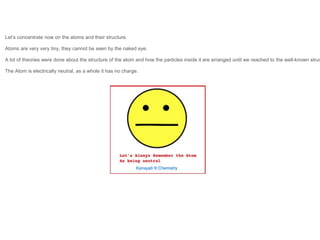
The Atom is electrically neutral, as a whole it has no charge.
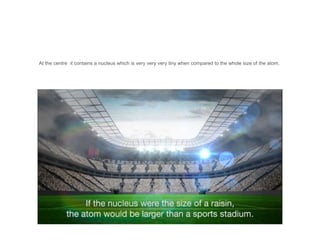
At the centre it contains a nucleus which is very very very tiny when compared to the whole size of the atom.
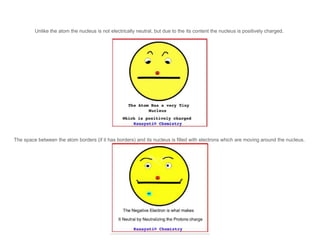
Unlike the atom the nucleus is not electrically neutral, but due to the its content the nucleus is positively charged.
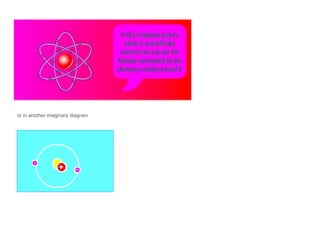
The space between the atom borders (if it has borders) and its nucleus is filled with electrons which are moving around the nucleus.
f we go to check the nucleus and its content and why it is positively charged we will find it contains two types of particles
which we can call Subatomic particles
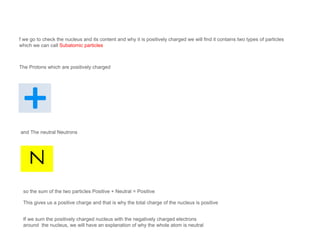
The Protons which are positively charged
and The neutral Neutrons
so the sum of the two particles Positive + Neutral = Positive
This gives us a positive charge and that is why the total charge of the nucleus is positive
If we sum the positively charged nucleus with the negatively charged electrons
around the nucleus, we will have an explanation of why the whole atom is neutral
or in another imaginary diagram
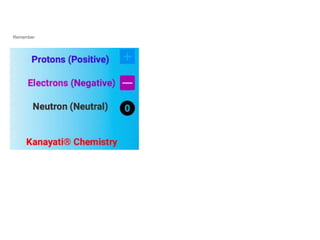
Remember

IGCSE 0620 Lesson 1 Slide 1

  • 1.
    Protons, Neutrons andElectrons 1- State the relative charges and approximate relative masses of protons, neutrons and electrons If you tried to cut anything , what do you think the smallest part that you will get if you just keep cutting. The Atom. The name comes from (a – tom_ meaning can not be divided. All of the substances around us or even us goes back to the same building units, (The atoms). Please meet your first atom Chemists usually draw atoms as circles and write its name inside or a symbol abbreviating its name
  • 2.
    Let’s concentrate nowon the atoms and their structure. Atoms are very very tiny, they cannot be seen by the naked eye. A lot of theories were done about the structure of the atom and how the particles inside it are arranged until we reached to the well-known struc The Atom is electrically neutral, as a whole it has no charge.
  • 3.
    At the centreit contains a nucleus which is very very very tiny when compared to the whole size of the atom.
  • 4.
    Unlike the atomthe nucleus is not electrically neutral, but due to the its content the nucleus is positively charged. The space between the atom borders (if it has borders) and its nucleus is filled with electrons which are moving around the nucleus.
  • 5.
    f we goto check the nucleus and its content and why it is positively charged we will find it contains two types of particles which we can call Subatomic particles The Protons which are positively charged and The neutral Neutrons so the sum of the two particles Positive + Neutral = Positive This gives us a positive charge and that is why the total charge of the nucleus is positive If we sum the positively charged nucleus with the negatively charged electrons around the nucleus, we will have an explanation of why the whole atom is neutral
  • 6.
    or in anotherimaginary diagram
  • 7.