Presented by;
Arya.
S3 MBA
GIMS,Kadakkal
Foreign Exchange…
Foreign exchange is the art and science of international
monetary exchange. The term foreign exchange
implies two things;
Foreign currency
Exchange rate.
Foreign exchange is the international market for the free
trade of currencies. Traders place orders to buy one
currency with another currency.
FORIGN EXCHANGE MARKET.
It is the market in which national currencies are traded
for one another. The major participants in this market
are commercial banks, Forex banks, and authorized
dealers and the monetary authorities.
Foreign currencies are bought and sold in the foreign
exchange market. The structure and functioning of the
forex market should be understood properly so that can
trade in this market efficiently. Both spot transactions
and forward transactions are executed.
FORIGN EXCHANGE RISK…
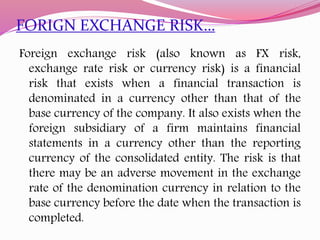
Foreign exchange risk (also known as FX risk,
exchange rate risk or currency risk) is a financial
risk that exists when a financial transaction is
denominated in a currency other than that of the
base currency of the company. It also exists when the
foreign subsidiary of a firm maintains financial
statements in a currency other than the reporting
currency of the consolidated entity. The risk is that
there may be an adverse movement in the exchange
rate of the denomination currency in relation to the
base currency before the date when the transaction is
completed.
Exchange risk simply means that the rate at which a
currency is exchanged for another currency may be
uncertain and volatile and the amount that an
exporter receives in domestic currency or an importer
has to pay in terms of domestic currency will be
unpredictable and uncertain.
If funds are transmitted from one country to another , the
amounts to be sent or to be received will not be certain ,
if exchange rates are not fixed. But in the present global
economy , free market forces operate to determine the
exchange rates depending upon the supply and demand
for the currency. This will lead to fluctuating rates ,
which may result in profits or losses to the holders of
foreign currency.
Foreign Exchange Exposure
The impact of a particular risk factor on the operational
variables of a firm varies from one factor to another. The
extent of variability or sensitivity of the operational
variables to change in a risk factor is referred to as
EXPOSURE.
Foreign exchange exposure is the risk associated with
activities that involve a global firm in currencies other
than its home currency.
It is the risk that a foreign currency may move in a
direction which is financially detrimental to the global
firm.
Foreign Exchange Exposure & Risk..
More and more business firms are now facing foreign
exchange exposure and risk.
The vulnerability of the firm’s assets, liabilities and cash
flows to changes in exchange rates of foreign
currencies is known as foreign exchange exposure.
The variability likely to be caused in the domestic
currency values of assets, liabilities and cash flows of
firms due to the changes in exchange rates f foreign
currencies is known as foreign exchange risk.
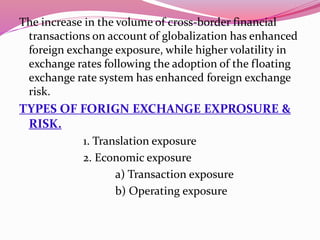
The increase in the volume of cross-border financial
transactions on account of globalization has enhanced
foreign exchange exposure, while higher volatility in
exchange rates following the adoption of the floating
exchange rate system has enhanced foreign exchange
risk.
TYPES OF FORIGN EXCHANGE EXPROSURE &
RISK.
1. Translation exposure
2. Economic exposure
a) Transaction exposure
b) Operating exposure
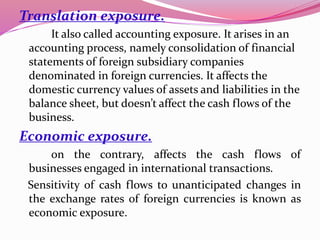
Translation exposure.
It also called accounting exposure. It arises in an
accounting process, namely consolidation of financial
statements of foreign subsidiary companies
denominated in foreign currencies. It affects the
domestic currency values of assets and liabilities in the
balance sheet, but doesn’t affect the cash flows of the
business.
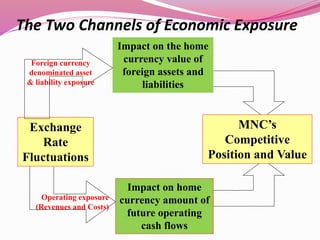
Economic exposure.
on the contrary, affects the cash flows of
businesses engaged in international transactions.
Sensitivity of cash flows to unanticipated changes in
the exchange rates of foreign currencies is known as
economic exposure.
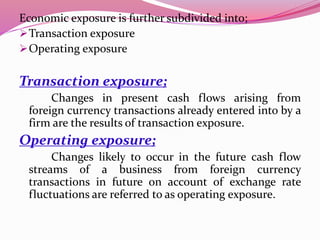
Economic exposure is further subdivided into;
Transaction exposure
Operating exposure
Transaction exposure;
Changes in present cash flows arising from
foreign currency transactions already entered into by a
firm are the results of transaction exposure.
Operating exposure;
Changes likely to occur in the future cash flow
streams of a business from foreign currency
transactions in future on account of exchange rate
fluctuations are referred to as operating exposure.
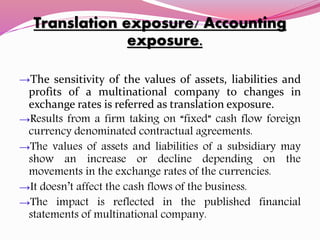
Translation exposure/ Accounting
exposure.
→The sensitivity of the values of assets, liabilities and
profits of a multinational company to changes in
exchange rates is referred as translation exposure.
→Results from a firm taking on “fixed” cash flow foreign
currency denominated contractual agreements.
→The values of assets and liabilities of a subsidiary may
show an increase or decline depending on the
movements in the exchange rates of the currencies.
→It doesn’t affect the cash flows of the business.
→The impact is reflected in the published financial
statements of multinational company.
Examples of translation exposure:
 An Account Receivable denominate in a foreign
currency.
 A maturing financial asset (e.g., a bond)
denominated in a foreign currency.
 An Account Payable denominate in a foreign
currency.
 A maturing financial liability (e.g., a loan)
denominated in a foreign currency.
Economic exposure.
→Results from the “physical” entry (and on-going
presence) of a global firm into a foreign market.
→This is a long term foreign exchange exposure resulting
from a previous FDI location decision.
→These are really “future” transaction exposures which are
unknown today.
Operating exposure.
→The variability in the future operating revenue, cost
and profit of firms on account of unexpected exchange
rate fluctuations in future is termed as operating
exposure.
→It has longer time horizon.
→It refers to the impact of exchange rate fluctuations on
future cash flows.
→It is the sensitivity of future operating profits to
unanticipated changes in the exchange rate.
Transaction exposure.
→The variability in domestic currency values of cash
flows arising from cross-border transactions already
entered into by firms or individuals is termed as
transaction exposure.
→It is other ways referred to as contractual exposure, as
the foreign currency values of cash flows are fixed
contractually.
→It arises in transactions of cross-border borrowing and
lending. Domestic borrower borrows funds in foreign
currency from a lender in a foreign country.
Operating exposure
(Revenues and Costs)
The Two Channels of Economic Exposure
MNC’s
Competitive
Position and Value
Impact on the home
currency value of
foreign assets and
liabilities
Impact on home
currency amount of
future operating
cash flows
Exchange
Rate
Fluctuations
Foreign currency
denominated asset
& liability exposure
Ifm ...arya

Ifm ...arya

  • 1.
  • 3.
    Foreign Exchange… Foreign exchangeis the art and science of international monetary exchange. The term foreign exchange implies two things; Foreign currency Exchange rate. Foreign exchange is the international market for the free trade of currencies. Traders place orders to buy one currency with another currency.
  • 4.
    FORIGN EXCHANGE MARKET. Itis the market in which national currencies are traded for one another. The major participants in this market are commercial banks, Forex banks, and authorized dealers and the monetary authorities. Foreign currencies are bought and sold in the foreign exchange market. The structure and functioning of the forex market should be understood properly so that can trade in this market efficiently. Both spot transactions and forward transactions are executed.
  • 6.
    FORIGN EXCHANGE RISK… Foreignexchange risk (also known as FX risk, exchange rate risk or currency risk) is a financial risk that exists when a financial transaction is denominated in a currency other than that of the base currency of the company. It also exists when the foreign subsidiary of a firm maintains financial statements in a currency other than the reporting currency of the consolidated entity. The risk is that there may be an adverse movement in the exchange rate of the denomination currency in relation to the base currency before the date when the transaction is completed.
  • 7.
    Exchange risk simplymeans that the rate at which a currency is exchanged for another currency may be uncertain and volatile and the amount that an exporter receives in domestic currency or an importer has to pay in terms of domestic currency will be unpredictable and uncertain. If funds are transmitted from one country to another , the amounts to be sent or to be received will not be certain , if exchange rates are not fixed. But in the present global economy , free market forces operate to determine the exchange rates depending upon the supply and demand for the currency. This will lead to fluctuating rates , which may result in profits or losses to the holders of foreign currency.
  • 9.
    Foreign Exchange Exposure Theimpact of a particular risk factor on the operational variables of a firm varies from one factor to another. The extent of variability or sensitivity of the operational variables to change in a risk factor is referred to as EXPOSURE. Foreign exchange exposure is the risk associated with activities that involve a global firm in currencies other than its home currency. It is the risk that a foreign currency may move in a direction which is financially detrimental to the global firm.
  • 10.
    Foreign Exchange Exposure& Risk.. More and more business firms are now facing foreign exchange exposure and risk. The vulnerability of the firm’s assets, liabilities and cash flows to changes in exchange rates of foreign currencies is known as foreign exchange exposure. The variability likely to be caused in the domestic currency values of assets, liabilities and cash flows of firms due to the changes in exchange rates f foreign currencies is known as foreign exchange risk.
  • 11.
    The increase inthe volume of cross-border financial transactions on account of globalization has enhanced foreign exchange exposure, while higher volatility in exchange rates following the adoption of the floating exchange rate system has enhanced foreign exchange risk. TYPES OF FORIGN EXCHANGE EXPROSURE & RISK. 1. Translation exposure 2. Economic exposure a) Transaction exposure b) Operating exposure
  • 12.
    Translation exposure. It alsocalled accounting exposure. It arises in an accounting process, namely consolidation of financial statements of foreign subsidiary companies denominated in foreign currencies. It affects the domestic currency values of assets and liabilities in the balance sheet, but doesn’t affect the cash flows of the business. Economic exposure. on the contrary, affects the cash flows of businesses engaged in international transactions. Sensitivity of cash flows to unanticipated changes in the exchange rates of foreign currencies is known as economic exposure.
  • 13.
    Economic exposure isfurther subdivided into; Transaction exposure Operating exposure Transaction exposure; Changes in present cash flows arising from foreign currency transactions already entered into by a firm are the results of transaction exposure. Operating exposure; Changes likely to occur in the future cash flow streams of a business from foreign currency transactions in future on account of exchange rate fluctuations are referred to as operating exposure.
  • 14.
    Translation exposure/ Accounting exposure. →Thesensitivity of the values of assets, liabilities and profits of a multinational company to changes in exchange rates is referred as translation exposure. →Results from a firm taking on “fixed” cash flow foreign currency denominated contractual agreements. →The values of assets and liabilities of a subsidiary may show an increase or decline depending on the movements in the exchange rates of the currencies. →It doesn’t affect the cash flows of the business. →The impact is reflected in the published financial statements of multinational company.
  • 15.
    Examples of translationexposure:  An Account Receivable denominate in a foreign currency.  A maturing financial asset (e.g., a bond) denominated in a foreign currency.  An Account Payable denominate in a foreign currency.  A maturing financial liability (e.g., a loan) denominated in a foreign currency.
  • 16.
    Economic exposure. →Results fromthe “physical” entry (and on-going presence) of a global firm into a foreign market. →This is a long term foreign exchange exposure resulting from a previous FDI location decision. →These are really “future” transaction exposures which are unknown today.
  • 17.
    Operating exposure. →The variabilityin the future operating revenue, cost and profit of firms on account of unexpected exchange rate fluctuations in future is termed as operating exposure. →It has longer time horizon. →It refers to the impact of exchange rate fluctuations on future cash flows. →It is the sensitivity of future operating profits to unanticipated changes in the exchange rate.
  • 18.
    Transaction exposure. →The variabilityin domestic currency values of cash flows arising from cross-border transactions already entered into by firms or individuals is termed as transaction exposure. →It is other ways referred to as contractual exposure, as the foreign currency values of cash flows are fixed contractually. →It arises in transactions of cross-border borrowing and lending. Domestic borrower borrows funds in foreign currency from a lender in a foreign country.
  • 19.
    Operating exposure (Revenues andCosts) The Two Channels of Economic Exposure MNC’s Competitive Position and Value Impact on the home currency value of foreign assets and liabilities Impact on home currency amount of future operating cash flows Exchange Rate Fluctuations Foreign currency denominated asset & liability exposure