
Chapter -1
Various Risks in Banking
Structure of the chapter -
Understanding the risks in banking
sector.

Understanding risks in international
banking.

Components of risks and meanings
thereof.
What is risk in banking ?
Risk is exposure to uncertainty

There are two aspects of risks viz.
uncertainty and exposure to that
uncertainty

Risk in banking may lead to losses in
transactions, loss of customer
confidence etc.
Business risk -
Business Risk are those risks that are
considered inherent in the activities
undertaken by a bank irrespective of
whether the controls are in place.

These can be, broadly further
classified into different categories
like, Capital risk, Market risk,
Liquidity risk etc.
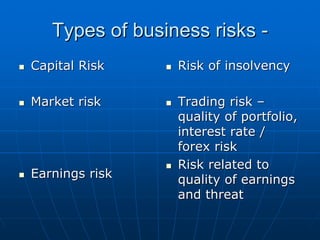
Types of business risks -
Capital Risk     Risk of insolvency

Market risk      Trading risk –
                 quality of portfolio,
                 interest rate /
                 forex risk
                 Risk related to
Earnings risk    quality of earnings
                 and threat
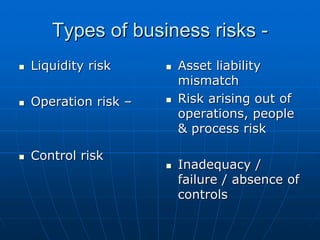
Types of business risks -
Liquidity risk     Asset liability
                   mismatch
Operation risk –   Risk arising out of
                   operations, people
                   & process risk

Control risk
                   Inadequacy /
                   failure / absence of
                   controls
Risk in international banking -
Risks in international banking are
unexpected loss from operations that
can result from international banking
transactions turn adverse due to
foreign currency exposures.

It can be foreign exchange risk,
country risk, legal risk etc.
Foreign exchange risk -
Foreign exchange risk means a risk arising
from a foreign currency exposure. E.g.
losses due to adverse exchange rate
movements during a period in which it has
open position in spot or forward.

Exchange risks, related to currency
exposure are commonly connected to
transaction and translation exposures.
Transaction exposure -
The risk that the base currency value
of a foreign currency denominated
transaction will vary with the change
in exchange rates during the life of
the transaction.

This arises when business has
foreign currency denominated
receipts or payments.
Translation Exposure -
It may also be called as accounting
exposure.

It arises when there is need to
translate foreign currency assets and
liabilities in to the home currency for
the purpose of finalizing the
accounts.
Economic Exposure -

It is a change in future earning
power and cash flow as a result of
adjustment of the currencies.

It represents a change in competitive
position.
Exchange risk in open & mismatch
           positions -
Banks dealing in the foreign exchange market, in
the course of their dealing with exporters,
importers and others, buy and sell currencies and
build up open positions in various currencies in
which these transactions are denominated, an
open position arises when a bank buys or sells
currency outright and does not square it up by
undertaking an offsetting opposite transaction.

When the assets exceeds the liabilities a long or
overbought position is created in that currency
and when the liabilities exceed the assets, a short
or oversold position is created in that currency.
Gap risks -
Gap risks arising out of open gaps be
contained within manageable limits
by fixing suitable gaps.
Usually two types of gaps limits are
fixed – individual gap limit (IGL) and
aggregate gap limit (AGL)
IGL defines net overbought or
oversold position for a particular
month, while AGL is aggregate of IGL
Value at risk (VaR)
VaR is the popular risk measurement
concept for forex risk.

It is defined as the estimate of potential
loss in a position or asset, portfolio of
assets over a given holding period at a
given level of certainty.

VaR is based on statistical concepts like
standard deviation, normal distribution,
mean etc.
Credit risk -
Credit Risk is the failure on the part of borrower
while performing an obligation. It means non-
payment of debt in timely manner.

If parties of different countries transact with each
other credit risk is high.

To avoid this risk Proper selection of borrowers,
adoption of sound credit granting policies, using
effective loan review mechanism process for
controlling risks, fixing inter-bank and country
exposure limits etc. is being done
Country Risk -
If one party deals in foreign currency with
bank situated outside its country then it
involves country risk. Change in the
government or the policies of the
government are factors responsible for
making the contract invalid.

By fixing the country risk limits, such risk
can be minimised.
Operational Risk -
Loss due to lack of internal control,
breakdown in information
processing, settlement or legal
compliance systems are factors
responsible for operational risks.

Thus failure in operation controls
which results in financial loss is the
main factor in operational risk.
Legal Risk -

Due to legal enforceability of
contracts such risks arise.

To avoid such legal risks and get
protected from it will be better to
make internationally accepted Master
Agreements.
Summary -
Risk is exposure to uncertainty

Business Risk are those risks that are
considered inherent in the activities
undertaken by a bank irrespective of
whether the controls are in place.

Foreign exchange risk means a risk arising
from a foreign currency exposure. E.g.
losses due to adverse exchange rate
movements during a period in which it has
open position in spot or forward.
Summary -
The transaction risk is that arising
due to variations in exchange rates
during the life of the transaction.
Translation risk is conversion risk on
balance sheet date.
Credit risk is failure of borrower to
pay the money.
County risk is country specific.
“Like” us on Facebook: 
   p //                 /
http://www.facebook.com/welearnindia 

“Follow” us on Twitter:
http://twitter.com/WeLearnIndia
http://twitter com/WeLearnIndia

Watch informative videos on Youtube: 
http://www.youtube.com/WelingkarDLP

Foreign Exchange Management

  • 1.
  • 2.
    Structure of thechapter - Understanding the risks in banking sector. Understanding risks in international banking. Components of risks and meanings thereof.
  • 3.
    What is riskin banking ? Risk is exposure to uncertainty There are two aspects of risks viz. uncertainty and exposure to that uncertainty Risk in banking may lead to losses in transactions, loss of customer confidence etc.
  • 4.
    Business risk - BusinessRisk are those risks that are considered inherent in the activities undertaken by a bank irrespective of whether the controls are in place. These can be, broadly further classified into different categories like, Capital risk, Market risk, Liquidity risk etc.
  • 5.
    Types of businessrisks - Capital Risk Risk of insolvency Market risk Trading risk – quality of portfolio, interest rate / forex risk Risk related to Earnings risk quality of earnings and threat
  • 6.
    Types of businessrisks - Liquidity risk Asset liability mismatch Operation risk – Risk arising out of operations, people & process risk Control risk Inadequacy / failure / absence of controls
  • 7.
    Risk in internationalbanking - Risks in international banking are unexpected loss from operations that can result from international banking transactions turn adverse due to foreign currency exposures. It can be foreign exchange risk, country risk, legal risk etc.
  • 8.
    Foreign exchange risk- Foreign exchange risk means a risk arising from a foreign currency exposure. E.g. losses due to adverse exchange rate movements during a period in which it has open position in spot or forward. Exchange risks, related to currency exposure are commonly connected to transaction and translation exposures.
  • 9.
    Transaction exposure - Therisk that the base currency value of a foreign currency denominated transaction will vary with the change in exchange rates during the life of the transaction. This arises when business has foreign currency denominated receipts or payments.
  • 10.
    Translation Exposure - Itmay also be called as accounting exposure. It arises when there is need to translate foreign currency assets and liabilities in to the home currency for the purpose of finalizing the accounts.
  • 11.
    Economic Exposure - Itis a change in future earning power and cash flow as a result of adjustment of the currencies. It represents a change in competitive position.
  • 12.
    Exchange risk inopen & mismatch positions - Banks dealing in the foreign exchange market, in the course of their dealing with exporters, importers and others, buy and sell currencies and build up open positions in various currencies in which these transactions are denominated, an open position arises when a bank buys or sells currency outright and does not square it up by undertaking an offsetting opposite transaction. When the assets exceeds the liabilities a long or overbought position is created in that currency and when the liabilities exceed the assets, a short or oversold position is created in that currency.
  • 13.
    Gap risks - Gaprisks arising out of open gaps be contained within manageable limits by fixing suitable gaps. Usually two types of gaps limits are fixed – individual gap limit (IGL) and aggregate gap limit (AGL) IGL defines net overbought or oversold position for a particular month, while AGL is aggregate of IGL
  • 14.
    Value at risk(VaR) VaR is the popular risk measurement concept for forex risk. It is defined as the estimate of potential loss in a position or asset, portfolio of assets over a given holding period at a given level of certainty. VaR is based on statistical concepts like standard deviation, normal distribution, mean etc.
  • 15.
    Credit risk - CreditRisk is the failure on the part of borrower while performing an obligation. It means non- payment of debt in timely manner. If parties of different countries transact with each other credit risk is high. To avoid this risk Proper selection of borrowers, adoption of sound credit granting policies, using effective loan review mechanism process for controlling risks, fixing inter-bank and country exposure limits etc. is being done
  • 16.
    Country Risk - Ifone party deals in foreign currency with bank situated outside its country then it involves country risk. Change in the government or the policies of the government are factors responsible for making the contract invalid. By fixing the country risk limits, such risk can be minimised.
  • 17.
    Operational Risk - Lossdue to lack of internal control, breakdown in information processing, settlement or legal compliance systems are factors responsible for operational risks. Thus failure in operation controls which results in financial loss is the main factor in operational risk.
  • 18.
    Legal Risk - Dueto legal enforceability of contracts such risks arise. To avoid such legal risks and get protected from it will be better to make internationally accepted Master Agreements.
  • 19.
    Summary - Risk isexposure to uncertainty Business Risk are those risks that are considered inherent in the activities undertaken by a bank irrespective of whether the controls are in place. Foreign exchange risk means a risk arising from a foreign currency exposure. E.g. losses due to adverse exchange rate movements during a period in which it has open position in spot or forward.
  • 20.
    Summary - The transactionrisk is that arising due to variations in exchange rates during the life of the transaction. Translation risk is conversion risk on balance sheet date. Credit risk is failure of borrower to pay the money. County risk is country specific.
  • 21.
    “Like” us on Facebook:  p // / http://www.facebook.com/welearnindia  “Follow” us on Twitter: http://twitter.com/WeLearnIndia http://twitter com/WeLearnIndia Watch informative videos on Youtube:  http://www.youtube.com/WelingkarDLP