Indian Partnership Act,1932 
Aji R Lal 
Chindu Raj 
Rahul R G 
Indian Partnership Act,1932
PARTNERSHIP 
Meaning & Definition 
Definition 
According to The Indian 
PartnershipAct 1932 
“Partnership 
is the relation between 
two or more persons who 
have agreed to share the 
profits of a business 
carried on by all of them 
or any of them acting for 
all”. 
Meaning 
Simply speaking, a 
1 2 
partnership is an 
association of persons who 
conduct some business 
activity and agree to share 
profits earned out of it.
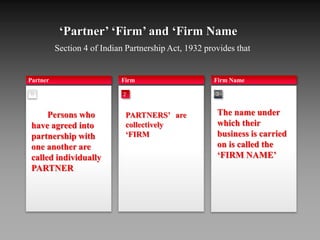
‘Partner’ ‘Firm’ and ‘Firm Name 
Section 4 of Indian Partnership Act, 1932 provides that 
Firm 
PARTNERS’ are 
collectively 
‘FIRM 
Partner 
1 
Firm Name 
The name under 
which their 
business is carried 
on is called the 
‘FIRM NAME’ 
Persons who 
have agreed into 
partnership with 
one another are 
called individually 
PARTNER 
2 3
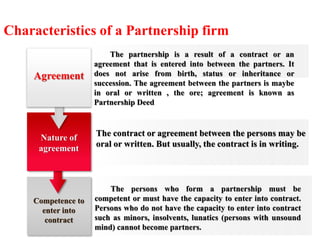
Characteristics of a Partnership firm 
The partnership is a result of a contract or an 
agreement that is entered into between the partners. It 
does not arise from birth, status or inheritance or 
succession. The agreement between the partners is maybe 
in oral or written , the ore; agreement is known as 
Partnership Deed 
The contract or agreement between the persons may be 
oral or written. But usually, the contract is in writing. 
The persons who form a partnership must be 
competent or must have the capacity to enter into contract. 
Persons who do not have the capacity to enter into contract 
such as minors, insolvents, lunatics (persons with unsound 
mind) cannot become partners. 
Agreement 
Nature of 
agreement 
Competence to 
enter into 
contract
Characteristics of a Partnership firm 
To form a partnership at least two persons are required. The 
maximum number of partners is limited to 20, in case of general 
type of business and 10, in case of banking business. 
The agreement between partners must be to carry on some 
business which includes all lawful trade, occupation or 
profession. Hence, the presence of a business is a must and it 
does not cover any club or charitable association 
The agreement between the partners must be for making 
profits and sharing the profits among themselves. 
The partners share the profits in the agreed proportions. 
Number of 
partners 
Presence of 
business 
Sharing of 
profits
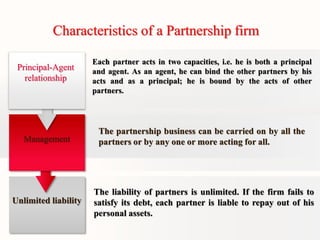
Characteristics of a Partnership firm 
Each partner acts in two capacities, i.e. he is both a principal 
and agent. As an agent, he can bind the other partners by his 
acts and as a principal; he is bound by the acts of other 
partners. 
The partnership business can be carried on by all the 
partners or by any one or more acting for all. 
The liability of partners is unlimited. If the firm fails to 
satisfy its debt, each partner is liable to repay out of his 
personal assets. 
Principal-Agent 
relationship 
Management 
Unlimited liability
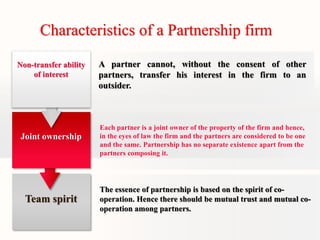
Characteristics of a Partnership firm 
A partner cannot, without the consent of other 
partners, transfer his interest in the firm to an 
outsider. 
Each partner is a joint owner of the property of the firm and hence, 
in the eyes of law the firm and the partners are considered to be one 
and the same. Partnership has no separate existence apart from the 
partners composing it. 
The essence of partnership is based on the spirit of co-operation. 
Hence there should be mutual trust and mutual co-operation 
among partners. 
Non-transfer ability 
of interest 
Joint ownership 
Team spirit
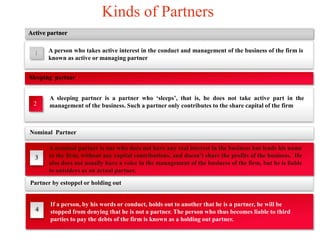
Kinds of Partners 
Active partner 
A person who takes active interest in the conduct and management of the business of the firm is 
known as active or managing partner 
Sleeping partner 
Nominal Partner 
3 
A nominal partner is one who does not have any real interest in the business but lends his name 
to the firm, without any capital contributions, and doesn’t share the profits of the business. He 
also does not usually have a voice in the management of the business of the firm, but he is liable 
to outsiders as an actual partner. 
1 
A sleeping partner is a partner who ‘sleeps’, that is, he does not take active part in the 
management of the business. Such a partner only contributes to the share capital of the firm 
2 
Partner by estoppel or holding out 
4 
If a person, by his words or conduct, holds out to another that he is a partner, he will be 
stopped from denying that he is not a partner. The person who thus becomes liable to third 
parties to pay the debts of the firm is known as a holding out partner.
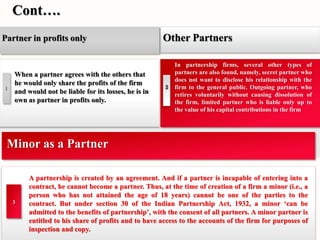
Cont…. 
Other Partners 
2 
In partnership firms, several other types of 
partners are also found, namely, secret partner who 
does not want to disclose his relationship with the 
firm to the general public. Outgoing partner, who 
retires voluntarily without causing dissolution of 
the firm, limited partner who is liable only up to 
the value of his capital contributions in the firm 
Partner in profits only 
When a partner agrees with the others that 
he would only share the profits of the firm 
and would not be liable for its losses, he is in 
own as partner in profits only. 
1 
Minor as a Partner 
A partnership is created by an agreement. And if a partner is incapable of entering into a 
contract, he cannot become a partner. Thus, at the time of creation of a firm a minor (i.e., a 
person who has not attained the age of 18 years) cannot be one of the parties to the 
contract. But under section 30 of the Indian Partnership Act, 1932, a minor ‘can be 
admitted to the benefits of partnership’, with the consent of all partners. A minor partner is 
entitled to his share of profits and to have access to the accounts of the firm for purposes of 
inspection and copy. 
3
Kinds of Partnership
Partnership at Will 
[Sec.7 read with Sec.43)] 
When there is no provision in partnership agreement (known as 
partnership Deed, if in writing) for: 
– The duration of their partnership, or 
– The determination of their partnership, 
then the partnership is called ‘Partnership at Will’. 
Special feature of ‘Partnership at will’ is that such partnership may be 
dissolved by any partner by giving a notice in writing to all other 
partners of his intention to dissolve the partnership. 
The partnership will be dissolved from that date which is mentioned in 
the notice as the date of dissolution and if no date is mentioned then 
from the date of communication of notice.
Particular Partnership 
[sec. 8] 
When a partnership is formed for a 
• Specific venture or undertaking, or 
• Particular period (fixed term) 
then such partnership is called a ‘particular partnership’. 
Such partnership comes to an end on the completion of the venture or 
the expiry of time period. 
If such partnership is continued after the expiry of term or completion 
of venture, it is deemed to be a partnership at will. 
A particular partnership may be dissolved before the expiry of the term 
or completion of the venture only by the mutual consent of all the 
partners.
Partnership deed 
A partnership is formed by an agreement. This agreement 
may be in writing or oral. though the law does not expressly 
require that the partnership agreement should be in writing, it 
is desirable to have it in writing in order to avoid any dispute 
with regard to the terms of the partnership. The document 
which contains the term of a partnership as agreed among the 
partners is called “Partnership deed”. 
The Partnership Deed is to be duly stamped as per the 
Indian Stamp Act, and duly signed by all the partners.
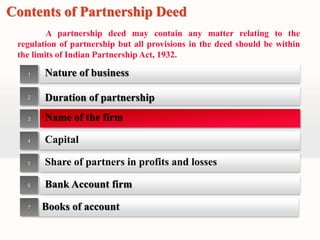
Contents of Partnership Deed 
A partnership deed may contain any matter relating to the 
regulation of partnership but all provisions in the deed should be within 
the limits of Indian Partnership Act, 1932. 
Nature of business 
Duration of partnership 
Name of the firm 
Capital 
Share of partners in profits and losses 
Bank Account firm 
Books of account 
1 
2 
3 
4 
5 
6 
7
1 
2 
3 
4 
5 
6 
7 
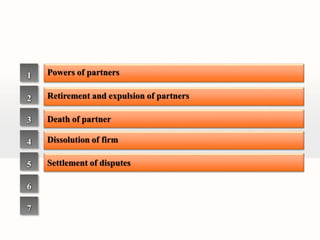
Powers of partners 
Retirement and expulsion of partners 
Death of partner 
Dissolution of firm 
Settlement of disputes
Registration of 
Partnership
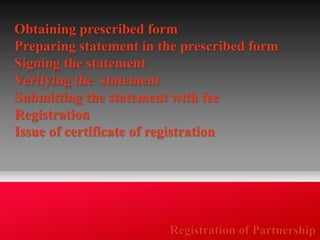
Obtaining prescribed form 
Preparing statement in the prescribed form 
Signing the statement 
Verifying the statement 
Submitting the statement with fee 
Registration 
Issue of certificate of registration 
Registration of Partnership
Right And Liabilities of Partners Subject 
to Contract 
(Between the Partners)
Rights….. 
Right to take part in business 
Right to be consulted 
Right to access to books 
Right to share the profits 
Right in emergency 
Right as an agent of the firm 
Right to prevent admission of a new partner 
1 
2 
3 
4 
5 
6 
7 
8 
Right not to be expelled
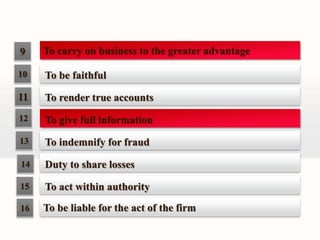
To be faithful 
To render true accounts 
To give full information 
To indemnify for fraud 
Duty to share losses 
To act within authority 
To be liable for the act of the firm 
9 
10 
11 
12 
13 
14 
16 
To carry on business to the greater advantage 
15
Liabilities….. 
1. Partners are bound to carry on the business of the firm: 
a. To greatest common advantage, 
b. Be just and faithful to each other, 
c. To render true accounts and full information of all 
things affecting the firm to any partner, his heir or legal 
representative. 
2. If he derives any profits for himself from any transaction 
of the firm, or from the use of the property or business 
connection of the firm or the firm-name, he shall account 
for that profit and pay it to the firm;
Cont… 
3. If he carries on any business of the same nature as and 
competing with that of the firm, he shall account for and 
pay to the firm all profits made by him in that business. 
4. Indemnify the firm for any loss caused to it by his willful 
neglect in the conduct of the business of the firm. 
5. Even upon dissolution of a firm, the partners continue to 
be liable as such to third parties for any act done by any 
of them which would have been an act of the firm, if done 
before the dissolution, until public notice is given of the 
dissolution
Cont… 
6. In unlimited partnership, every partner is liable, jointly 
with all the other partners and also severally, for all acts of 
the firm done while he is a partner. You can be held 
personally responsible for another partner’s negligence or 
carelessness. This means that if your partnership firm is 
insufficient to meet its financial obligations, you may have 
to use your personal assets to pay off debtors, even though 
you personally may not be at fault.
DISSOLUTION OF A FIRM
Dissolution of Partnership 
and Dissolution of Firm
Cont… 
The dissolution of partnership between all the 
partners of a firm is called the dissolution of the 
firm. [section 39]. Thus, if some partner is 
changed/added/ goes out, the ‘relation’ between them 
changes and hence ‘partnership’ is dissolved, but the 
‘firm’ continues. However, complete breakage 
between relations of all partners is termed as 
‘dissolution of firm’. After such dissolution, the firm 
no more exists.
Cont… 
Thus, ‘Dissolution of partnership’ is 
different from ‘dissolution of firm’. 
‘Dissolution of partnership’ is only 
reconstruction of firm, while ‘dissolution of 
firm’ means the firm no more exists after 
dissolution.
Cont… 
Dissolution of a Firm - A partnership firm is an ‘organization’ 
and like every ‘organ’ it has to either grow or perish. Thus, 
dissolution of a firm is inevitable part in the life of partnership firm 
some time or the other.
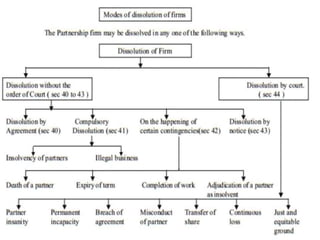
Mode of Dissolution of Firm
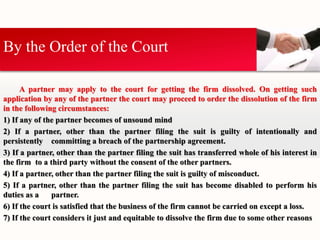
By the Order of the Court 
A partner may apply to the court for getting the firm dissolved. On getting such 
application by any of the partner the court may proceed to order the dissolution of the firm 
in the following circumstances: 
1) If any of the partner becomes of unsound mind 
2) If a partner, other than the partner filing the suit is guilty of intentionally and 
persistently committing a breach of the partnership agreement. 
3) If a partner, other than the partner filing the suit has transferred whole of his interest in 
the firm to a third party without the consent of the other partners. 
4) If a partner, other than the partner filing the suit is guilty of misconduct. 
5) If a partner, other than the partner filing the suit has become disabled to perform his 
duties as a partner. 
6) If the court is satisfied that the business of the firm cannot be carried on except a loss. 
7) If the court considers it just and equitable to dissolve the firm due to some other reasons
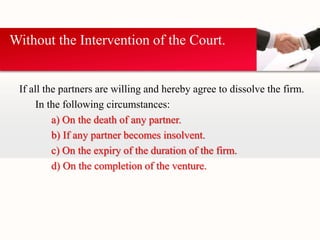
Without the Intervention of the Court. 
If all the partners are willing and hereby agree to dissolve the firm. 
In the following circumstances: 
a) On the death of any partner. 
b) If any partner becomes insolvent. 
c) On the expiry of the duration of the firm. 
d) On the completion of the venture.
Partnership act 1932

Partnership act 1932

  • 1.
    Indian Partnership Act,1932 Aji R Lal Chindu Raj Rahul R G Indian Partnership Act,1932
  • 2.
    PARTNERSHIP Meaning &Definition Definition According to The Indian PartnershipAct 1932 “Partnership is the relation between two or more persons who have agreed to share the profits of a business carried on by all of them or any of them acting for all”. Meaning Simply speaking, a 1 2 partnership is an association of persons who conduct some business activity and agree to share profits earned out of it.
  • 3.
    ‘Partner’ ‘Firm’ and‘Firm Name Section 4 of Indian Partnership Act, 1932 provides that Firm PARTNERS’ are collectively ‘FIRM Partner 1 Firm Name The name under which their business is carried on is called the ‘FIRM NAME’ Persons who have agreed into partnership with one another are called individually PARTNER 2 3
  • 4.
    Characteristics of aPartnership firm The partnership is a result of a contract or an agreement that is entered into between the partners. It does not arise from birth, status or inheritance or succession. The agreement between the partners is maybe in oral or written , the ore; agreement is known as Partnership Deed The contract or agreement between the persons may be oral or written. But usually, the contract is in writing. The persons who form a partnership must be competent or must have the capacity to enter into contract. Persons who do not have the capacity to enter into contract such as minors, insolvents, lunatics (persons with unsound mind) cannot become partners. Agreement Nature of agreement Competence to enter into contract
  • 5.
    Characteristics of aPartnership firm To form a partnership at least two persons are required. The maximum number of partners is limited to 20, in case of general type of business and 10, in case of banking business. The agreement between partners must be to carry on some business which includes all lawful trade, occupation or profession. Hence, the presence of a business is a must and it does not cover any club or charitable association The agreement between the partners must be for making profits and sharing the profits among themselves. The partners share the profits in the agreed proportions. Number of partners Presence of business Sharing of profits
  • 6.
    Characteristics of aPartnership firm Each partner acts in two capacities, i.e. he is both a principal and agent. As an agent, he can bind the other partners by his acts and as a principal; he is bound by the acts of other partners. The partnership business can be carried on by all the partners or by any one or more acting for all. The liability of partners is unlimited. If the firm fails to satisfy its debt, each partner is liable to repay out of his personal assets. Principal-Agent relationship Management Unlimited liability
  • 7.
    Characteristics of aPartnership firm A partner cannot, without the consent of other partners, transfer his interest in the firm to an outsider. Each partner is a joint owner of the property of the firm and hence, in the eyes of law the firm and the partners are considered to be one and the same. Partnership has no separate existence apart from the partners composing it. The essence of partnership is based on the spirit of co-operation. Hence there should be mutual trust and mutual co-operation among partners. Non-transfer ability of interest Joint ownership Team spirit
  • 8.
    Kinds of Partners Active partner A person who takes active interest in the conduct and management of the business of the firm is known as active or managing partner Sleeping partner Nominal Partner 3 A nominal partner is one who does not have any real interest in the business but lends his name to the firm, without any capital contributions, and doesn’t share the profits of the business. He also does not usually have a voice in the management of the business of the firm, but he is liable to outsiders as an actual partner. 1 A sleeping partner is a partner who ‘sleeps’, that is, he does not take active part in the management of the business. Such a partner only contributes to the share capital of the firm 2 Partner by estoppel or holding out 4 If a person, by his words or conduct, holds out to another that he is a partner, he will be stopped from denying that he is not a partner. The person who thus becomes liable to third parties to pay the debts of the firm is known as a holding out partner.
  • 9.
    Cont…. Other Partners 2 In partnership firms, several other types of partners are also found, namely, secret partner who does not want to disclose his relationship with the firm to the general public. Outgoing partner, who retires voluntarily without causing dissolution of the firm, limited partner who is liable only up to the value of his capital contributions in the firm Partner in profits only When a partner agrees with the others that he would only share the profits of the firm and would not be liable for its losses, he is in own as partner in profits only. 1 Minor as a Partner A partnership is created by an agreement. And if a partner is incapable of entering into a contract, he cannot become a partner. Thus, at the time of creation of a firm a minor (i.e., a person who has not attained the age of 18 years) cannot be one of the parties to the contract. But under section 30 of the Indian Partnership Act, 1932, a minor ‘can be admitted to the benefits of partnership’, with the consent of all partners. A minor partner is entitled to his share of profits and to have access to the accounts of the firm for purposes of inspection and copy. 3
  • 10.
  • 11.
    Partnership at Will [Sec.7 read with Sec.43)] When there is no provision in partnership agreement (known as partnership Deed, if in writing) for: – The duration of their partnership, or – The determination of their partnership, then the partnership is called ‘Partnership at Will’. Special feature of ‘Partnership at will’ is that such partnership may be dissolved by any partner by giving a notice in writing to all other partners of his intention to dissolve the partnership. The partnership will be dissolved from that date which is mentioned in the notice as the date of dissolution and if no date is mentioned then from the date of communication of notice.
  • 12.
    Particular Partnership [sec.8] When a partnership is formed for a • Specific venture or undertaking, or • Particular period (fixed term) then such partnership is called a ‘particular partnership’. Such partnership comes to an end on the completion of the venture or the expiry of time period. If such partnership is continued after the expiry of term or completion of venture, it is deemed to be a partnership at will. A particular partnership may be dissolved before the expiry of the term or completion of the venture only by the mutual consent of all the partners.
  • 13.
    Partnership deed Apartnership is formed by an agreement. This agreement may be in writing or oral. though the law does not expressly require that the partnership agreement should be in writing, it is desirable to have it in writing in order to avoid any dispute with regard to the terms of the partnership. The document which contains the term of a partnership as agreed among the partners is called “Partnership deed”. The Partnership Deed is to be duly stamped as per the Indian Stamp Act, and duly signed by all the partners.
  • 14.
    Contents of PartnershipDeed A partnership deed may contain any matter relating to the regulation of partnership but all provisions in the deed should be within the limits of Indian Partnership Act, 1932. Nature of business Duration of partnership Name of the firm Capital Share of partners in profits and losses Bank Account firm Books of account 1 2 3 4 5 6 7
  • 15.
    1 2 3 4 5 6 7 Powers of partners Retirement and expulsion of partners Death of partner Dissolution of firm Settlement of disputes
  • 16.
  • 17.
    Obtaining prescribed form Preparing statement in the prescribed form Signing the statement Verifying the statement Submitting the statement with fee Registration Issue of certificate of registration Registration of Partnership
  • 18.
    Right And Liabilitiesof Partners Subject to Contract (Between the Partners)
  • 19.
    Rights….. Right totake part in business Right to be consulted Right to access to books Right to share the profits Right in emergency Right as an agent of the firm Right to prevent admission of a new partner 1 2 3 4 5 6 7 8 Right not to be expelled
  • 20.
    To be faithful To render true accounts To give full information To indemnify for fraud Duty to share losses To act within authority To be liable for the act of the firm 9 10 11 12 13 14 16 To carry on business to the greater advantage 15
  • 21.
    Liabilities….. 1. Partnersare bound to carry on the business of the firm: a. To greatest common advantage, b. Be just and faithful to each other, c. To render true accounts and full information of all things affecting the firm to any partner, his heir or legal representative. 2. If he derives any profits for himself from any transaction of the firm, or from the use of the property or business connection of the firm or the firm-name, he shall account for that profit and pay it to the firm;
  • 22.
    Cont… 3. Ifhe carries on any business of the same nature as and competing with that of the firm, he shall account for and pay to the firm all profits made by him in that business. 4. Indemnify the firm for any loss caused to it by his willful neglect in the conduct of the business of the firm. 5. Even upon dissolution of a firm, the partners continue to be liable as such to third parties for any act done by any of them which would have been an act of the firm, if done before the dissolution, until public notice is given of the dissolution
  • 23.
    Cont… 6. Inunlimited partnership, every partner is liable, jointly with all the other partners and also severally, for all acts of the firm done while he is a partner. You can be held personally responsible for another partner’s negligence or carelessness. This means that if your partnership firm is insufficient to meet its financial obligations, you may have to use your personal assets to pay off debtors, even though you personally may not be at fault.
  • 24.
  • 25.
    Dissolution of Partnership and Dissolution of Firm
  • 26.
    Cont… The dissolutionof partnership between all the partners of a firm is called the dissolution of the firm. [section 39]. Thus, if some partner is changed/added/ goes out, the ‘relation’ between them changes and hence ‘partnership’ is dissolved, but the ‘firm’ continues. However, complete breakage between relations of all partners is termed as ‘dissolution of firm’. After such dissolution, the firm no more exists.
  • 27.
    Cont… Thus, ‘Dissolutionof partnership’ is different from ‘dissolution of firm’. ‘Dissolution of partnership’ is only reconstruction of firm, while ‘dissolution of firm’ means the firm no more exists after dissolution.
  • 28.
    Cont… Dissolution ofa Firm - A partnership firm is an ‘organization’ and like every ‘organ’ it has to either grow or perish. Thus, dissolution of a firm is inevitable part in the life of partnership firm some time or the other.
  • 29.
  • 31.
    By the Orderof the Court A partner may apply to the court for getting the firm dissolved. On getting such application by any of the partner the court may proceed to order the dissolution of the firm in the following circumstances: 1) If any of the partner becomes of unsound mind 2) If a partner, other than the partner filing the suit is guilty of intentionally and persistently committing a breach of the partnership agreement. 3) If a partner, other than the partner filing the suit has transferred whole of his interest in the firm to a third party without the consent of the other partners. 4) If a partner, other than the partner filing the suit is guilty of misconduct. 5) If a partner, other than the partner filing the suit has become disabled to perform his duties as a partner. 6) If the court is satisfied that the business of the firm cannot be carried on except a loss. 7) If the court considers it just and equitable to dissolve the firm due to some other reasons
  • 32.
    Without the Interventionof the Court. If all the partners are willing and hereby agree to dissolve the firm. In the following circumstances: a) On the death of any partner. b) If any partner becomes insolvent. c) On the expiry of the duration of the firm. d) On the completion of the venture.