








Introducing the New
IESVE Passivent Tool
11th
September, 2024
www.iesve.com
— Welcome and Introduction
— Introduction and Overview of Passivent
— Introducing the New IESVE Passivent Tool
— Q&A / Discussion with all presenters
Today’s Agenda
www.iesve.com
Your Speakers
John Service, IES
Huw Poppy, Passivent
Niall Gibson, IES
www.iesve.com
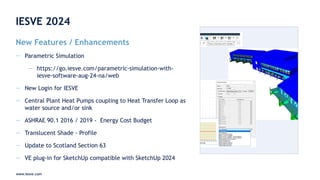
IESVE 2024
New Features / Enhancements
— Parametric Simulation
— https://go.iesve.com/parametric-simulation-with-
iesve-software-aug-24-na/web
— New Login for IESVE
— Central Plant Heat Pumps coupling to Heat Transfer Loop as
water source and/or sink
— ASHRAE 90.1 2016 / 2019 - Energy Cost Budget
— Translucent Shade - Profile
— Update to Scotland Section 63
— VE plug-in for SketchUp compatible with SketchUp 2024
www.iesve.com
Introduction and overview of Passivent
Huw Poppy
Business Operations Manager &
Secretary of the CIBSE Natural Ventilation Group
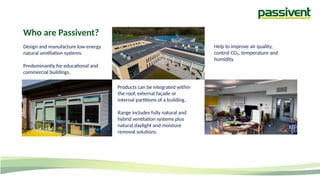
Who are Passivent?
Design and manufacture low energy
natural ventilation systems.
Predominantly for educational and
commercial buildings.
Products can be integrated within
the roof, external façade or
internal partitions of a building.
Range includes fully natural and
hybrid ventilation systems plus
natural daylight and moisture
removal solutions.
Help to improve air quality,
control CO₂, temperature and
humidity.
Group structure
Passivent is a division of Building Product Design Ltd, a
wholly owned subsidiary of Wienerberger after its
acquisition by them in 2019.
As a group, Building Product Design is widely
experienced in ventilation solutions, condensation
control and energy efficiency.
Passivent was a pioneer of natural ventilation and is a
leading UK company with over 40 years experience in
this field.
Building Product Design Group
Passivent
Design and manufacture low energy natural ventilation systems.
Kingfisher Louvres
Architectural aluminium louvre systems for ventilation, screening,
weather protection, acoustic attenuation and solar shading.
Glidevale Protect
Airtightness and construction membranes, roofing underlays and
roofing accessories.
Richmond Germany
Own branded roofing and construction membranes in mainland
Europe.
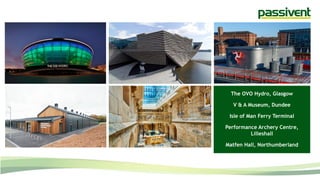
The OVO Hydro, Glasgow
V & A Museum, Dundee
Isle of Man Ferry Terminal
Performance Archery Centre,
Lilleshall
Matfen Hall, Northumberland
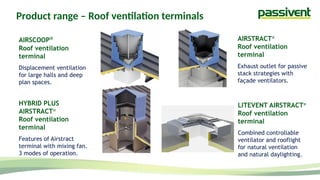
Product range – Roof ventilation terminals
AIRSCOOP®
Roof ventilation
terminal
Displacement ventilation
for large halls and deep
plan spaces.
HYBRID PLUS
AIRSTRACT®
Roof ventilation
terminal
Features of Airstract
terminal with mixing fan.
3 modes of operation.
AIRSTRACT®
Roof ventilation
terminal
Exhaust outlet for passive
stack strategies with
façade ventilators.
LITEVENT AIRSTRACT®
Roof ventilation
terminal
Combined controllable
ventilator and rooflight
for natural ventilation
and natural daylighting.
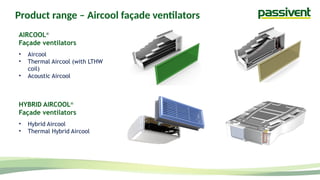
Product range – Aircool façade ventilators
AIRCOOL®
Façade ventilators
• Aircool
• Thermal Aircool (with LTHW
coil)
• Acoustic Aircool
HYBRID AIRCOOL®
Façade ventilators
• Hybrid Aircool
• Thermal Hybrid Aircool
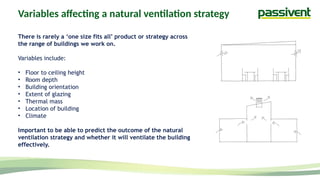
Variables affecting a natural ventilation strategy
There is rarely a ‘one size fits all’ product or strategy across
the range of buildings we work on.
Variables include:
• Floor to ceiling height
• Room depth
• Building orientation
• Extent of glazing
• Thermal mass
• Location of building
• Climate
Important to be able to predict the outcome of the natural
ventilation strategy and whether it will ventilate the building
effectively.
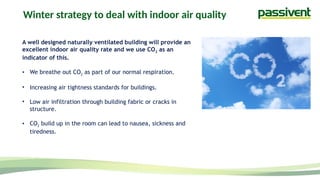
A well designed naturally ventilated building will provide an
excellent indoor air quality rate and we use CO2 as an
indicator of this.
• We breathe out CO2 as part of our normal respiration.
• Increasing air tightness standards for buildings.
• Low air infiltration through building fabric or cracks in
structure.
• CO2 build up in the room can lead to nausea, sickness and
tiredness.
Winter strategy to deal with indoor air quality
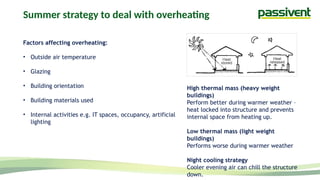
Summer strategy to deal with overheating
Factors affecting overheating:
• Outside air temperature
• Glazing
• Building orientation
• Building materials used
• Internal activities e.g. IT spaces, occupancy, artificial
lighting
High thermal mass (heavy weight
buildings)
Perform better during warmer weather –
heat locked into structure and prevents
internal space from heating up.
Low thermal mass (light weight
buildings)
Performs worse during warmer weather
Night cooling strategy
Cooler evening air can chill the structure
down.
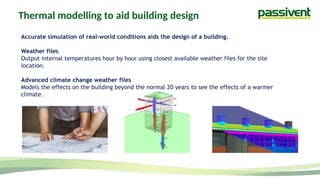
Thermal modelling to aid building design
Accurate simulation of real-world conditions aids the design of a building.
Weather files
Output internal temperatures hour by hour using closest available weather files for the site
location.
Advanced climate change weather files
Models the effects on the building beyond the normal 20 years to see the effects of a warmer
climate.
Why is it so important to get the design right?
Duty of care to size natural ventilation openings correctly.
Compliance with regulations e.g. Building Bulletin 101
(BB101) - mandatory for all school buildings
• Prescribes maximum allowable internal temperatures & CO₂
levels
• No cold draughts, particularly on a cold winter’s day.
IES is invaluable with tightening regulations and contractor
liabilities.
• Free running or low energy natural ventilation systems will
help achieve more net zero carbon buildings.
Passivent / IES partnership
• Provides reassurance to building designers that outcomes
can be accurately predicted.
Image courtesy of TG
Escapes
Thank you for
your time
Follow Passivent on Linkedin
for up-to-date news.
www.passivent.com
www.iesve.com
— Design Standards including:
— Department for Education (DfE)
— Building Bulletin 101 (BB101)
— CIBSE TM52
— Introducing the Passivent Navigator in IESVE
— Live Demo: example school sports hall project
— BB101 results outputs from IESVE
What We Will Cover
www.iesve.com
Design Standards
www.iesve.com
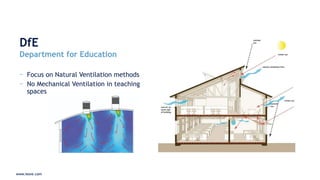
− Focus on Natural Ventilation methods
− No Mechanical Ventilation in teaching
spaces
DfE
Department for Education
www.iesve.com
www.iesve.com
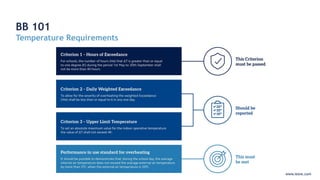
BB 101
Temperature Requirements
www.iesve.com
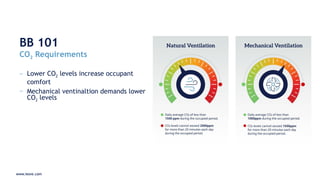
− Lower CO2 levels increase occupant
comfort
− Mechanical ventinaltion demands lower
CO2 levels
BB 101
CO2 Requirements
www.iesve.com
www.iesve.com
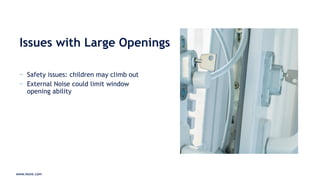
− Safety issues: children may climb out
− External Noise could limit window
opening ability
Issues with Large Openings
www.iesve.com
www.iesve.com
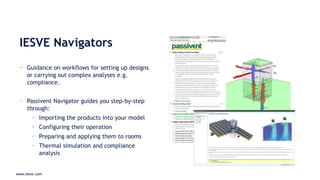
− Guidance on workflows for setting up designs
or carrying out complex analyses e.g.
compliance.
− Passivent Navigator guides you step-by-step
through:
− Importing the products into your model
− Configuring their operation
− Preparing and applying them to rooms
− Thermal simulation and compliance
analysis
IESVE Navigators
www.iesve.com
www.iesve.com
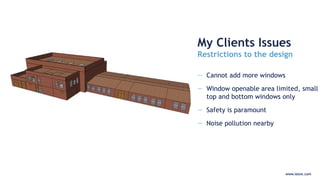
— Cannot add more windows
— Window openable area limited, small
top and bottom windows only
— Safety is paramount
— Noise pollution nearby
My Clients Issues
Restrictions to the design
www.iesve.com
www.iesve.com
— Look at baseline model and its BB101 results
— Move into our Navigator and add Passivent Airscoop®
Roof
Ventilation Terminals to the Sports Hall
— Return to our results and view the impact on the model
School Sports Hall Case Study
Live Demo
Thank you
Any Questions?

Introducing the New IESVE Passivent Tool

  • 1.
    Introducing the New IESVEPassivent Tool 11th September, 2024
  • 2.
    www.iesve.com — Welcome andIntroduction — Introduction and Overview of Passivent — Introducing the New IESVE Passivent Tool — Q&A / Discussion with all presenters Today’s Agenda
  • 3.
    www.iesve.com Your Speakers John Service,IES Huw Poppy, Passivent Niall Gibson, IES
  • 4.
    www.iesve.com IESVE 2024 New Features/ Enhancements — Parametric Simulation — https://go.iesve.com/parametric-simulation-with- iesve-software-aug-24-na/web — New Login for IESVE — Central Plant Heat Pumps coupling to Heat Transfer Loop as water source and/or sink — ASHRAE 90.1 2016 / 2019 - Energy Cost Budget — Translucent Shade - Profile — Update to Scotland Section 63 — VE plug-in for SketchUp compatible with SketchUp 2024 www.iesve.com
  • 5.
    Introduction and overviewof Passivent Huw Poppy Business Operations Manager & Secretary of the CIBSE Natural Ventilation Group
  • 6.
    Who are Passivent? Designand manufacture low energy natural ventilation systems. Predominantly for educational and commercial buildings. Products can be integrated within the roof, external façade or internal partitions of a building. Range includes fully natural and hybrid ventilation systems plus natural daylight and moisture removal solutions. Help to improve air quality, control CO₂, temperature and humidity.
  • 7.
    Group structure Passivent isa division of Building Product Design Ltd, a wholly owned subsidiary of Wienerberger after its acquisition by them in 2019. As a group, Building Product Design is widely experienced in ventilation solutions, condensation control and energy efficiency. Passivent was a pioneer of natural ventilation and is a leading UK company with over 40 years experience in this field.
  • 8.
    Building Product DesignGroup Passivent Design and manufacture low energy natural ventilation systems. Kingfisher Louvres Architectural aluminium louvre systems for ventilation, screening, weather protection, acoustic attenuation and solar shading. Glidevale Protect Airtightness and construction membranes, roofing underlays and roofing accessories. Richmond Germany Own branded roofing and construction membranes in mainland Europe.
  • 9.
    The OVO Hydro,Glasgow V & A Museum, Dundee Isle of Man Ferry Terminal Performance Archery Centre, Lilleshall Matfen Hall, Northumberland
  • 10.
    Product range –Roof ventilation terminals AIRSCOOP® Roof ventilation terminal Displacement ventilation for large halls and deep plan spaces. HYBRID PLUS AIRSTRACT® Roof ventilation terminal Features of Airstract terminal with mixing fan. 3 modes of operation. AIRSTRACT® Roof ventilation terminal Exhaust outlet for passive stack strategies with façade ventilators. LITEVENT AIRSTRACT® Roof ventilation terminal Combined controllable ventilator and rooflight for natural ventilation and natural daylighting.
  • 11.
    Product range –Aircool façade ventilators AIRCOOL® Façade ventilators • Aircool • Thermal Aircool (with LTHW coil) • Acoustic Aircool HYBRID AIRCOOL® Façade ventilators • Hybrid Aircool • Thermal Hybrid Aircool
  • 13.
    Variables affecting anatural ventilation strategy There is rarely a ‘one size fits all’ product or strategy across the range of buildings we work on. Variables include: • Floor to ceiling height • Room depth • Building orientation • Extent of glazing • Thermal mass • Location of building • Climate Important to be able to predict the outcome of the natural ventilation strategy and whether it will ventilate the building effectively.
  • 14.
    A well designednaturally ventilated building will provide an excellent indoor air quality rate and we use CO2 as an indicator of this. • We breathe out CO2 as part of our normal respiration. • Increasing air tightness standards for buildings. • Low air infiltration through building fabric or cracks in structure. • CO2 build up in the room can lead to nausea, sickness and tiredness. Winter strategy to deal with indoor air quality
  • 15.
    Summer strategy todeal with overheating Factors affecting overheating: • Outside air temperature • Glazing • Building orientation • Building materials used • Internal activities e.g. IT spaces, occupancy, artificial lighting High thermal mass (heavy weight buildings) Perform better during warmer weather – heat locked into structure and prevents internal space from heating up. Low thermal mass (light weight buildings) Performs worse during warmer weather Night cooling strategy Cooler evening air can chill the structure down.
  • 16.
    Thermal modelling toaid building design Accurate simulation of real-world conditions aids the design of a building. Weather files Output internal temperatures hour by hour using closest available weather files for the site location. Advanced climate change weather files Models the effects on the building beyond the normal 20 years to see the effects of a warmer climate.
  • 17.
    Why is itso important to get the design right? Duty of care to size natural ventilation openings correctly. Compliance with regulations e.g. Building Bulletin 101 (BB101) - mandatory for all school buildings • Prescribes maximum allowable internal temperatures & CO₂ levels • No cold draughts, particularly on a cold winter’s day. IES is invaluable with tightening regulations and contractor liabilities. • Free running or low energy natural ventilation systems will help achieve more net zero carbon buildings. Passivent / IES partnership • Provides reassurance to building designers that outcomes can be accurately predicted.
  • 18.
    Image courtesy ofTG Escapes Thank you for your time Follow Passivent on Linkedin for up-to-date news. www.passivent.com
  • 19.
    www.iesve.com — Design Standardsincluding: — Department for Education (DfE) — Building Bulletin 101 (BB101) — CIBSE TM52 — Introducing the Passivent Navigator in IESVE — Live Demo: example school sports hall project — BB101 results outputs from IESVE What We Will Cover
  • 20.
  • 21.
    www.iesve.com − Focus onNatural Ventilation methods − No Mechanical Ventilation in teaching spaces DfE Department for Education www.iesve.com
  • 22.
  • 23.
    www.iesve.com − Lower CO2levels increase occupant comfort − Mechanical ventinaltion demands lower CO2 levels BB 101 CO2 Requirements www.iesve.com
  • 24.
    www.iesve.com − Safety issues:children may climb out − External Noise could limit window opening ability Issues with Large Openings www.iesve.com
  • 25.
    www.iesve.com − Guidance onworkflows for setting up designs or carrying out complex analyses e.g. compliance. − Passivent Navigator guides you step-by-step through: − Importing the products into your model − Configuring their operation − Preparing and applying them to rooms − Thermal simulation and compliance analysis IESVE Navigators www.iesve.com
  • 26.
    www.iesve.com — Cannot addmore windows — Window openable area limited, small top and bottom windows only — Safety is paramount — Noise pollution nearby My Clients Issues Restrictions to the design www.iesve.com
  • 27.
    www.iesve.com — Look atbaseline model and its BB101 results — Move into our Navigator and add Passivent Airscoop® Roof Ventilation Terminals to the Sports Hall — Return to our results and view the impact on the model School Sports Hall Case Study Live Demo
  • 28.

Editor's Notes

  • #22 Overheating Guidance for Schools Sets out criteria to follow Takes guidance from CIBSE TM52