Part of the BRE Trust
BREEAM
Constructing Excellence Sustainability Theme Group
4th October 2016
Chris Broadbent,
Director, BREEAM Infrastructure
Managing Director, CEEQUAL Ltd
Customer
service
Robust flexible
governance &
certification
Online delivery,
BIM ready,
integrated 3rd party
tools & data
exploitation
Sharing of
performance data
with investment
market organisations
International real
estate clients who
‘choose and want’
BREEAM
The most authoritative,
comprehensive & widely
used building environmental
assessment and certification
system globally!
BREEAM Vision 2018
1
1
A Global Standard Locally Adapted
+ Our National Scheme Operators
Used in 77 countries, 550,000 certificated buildings, over 2.2m registered
Site
selection
Design and
planning
Construction &
post-
construction
Occupation End of life
Region scale
City scale
Neighbourhood
scale
Building scale
Non Domestic
Infrastructure
Communities
Domestic
Refurbishment
Domestic
In-Use
Non Domestic
Refurbishment
Communities
Across Scale & Life-Cycle
Existing
The Principles
BREEAM Aims & Objectives
BREEAM family of schemes aim to:
– Ensure best environmental practice
– Consider a broad range of environmental concerns
– Balanced to ensure quality, safe & healthy environment
– Set standards surpassing those required by regulation
– Challenge the market to provide innovative solutions
– Provide a credible environmental label
– Stimulate demand for sustainability in the built environment
1
Key benefits of BREEAM
Third party validation of sustainable credentials
– Evaluate, improve and demonstrate
sustainability throughout the project’s design
and construction
– Drives sustainable performance of an asset
– Creates value and helps manage risk and
reduce obsolescence
– An inspirational standard that encourages
improvement
– Based on documented science based
research, evidence & market best practice
– Balanced across a range of sustainability
issues
– Robust certification & independence
– Benchmarking against other international
projects through consistency of approach
– Encourages innovation
Environmental Standards
Numberofbuildings
Regulatoryminimum
Minimal Aspirational
Pass
Good
VeryGood
Excellent
Outstanding
Drivers
Building Regulations
– Towards zero carbon from 2019 for all buildings
UN framework Convention on Climate Change & Kyoto Protocol
– Legally binding commitments for the reduction of greenhouse gases
EU Renewable Energy Directive 15
– 15% of energy consumption should be from renewable sources by 2020
Climate Change Act 2008
– places a legal obligation on Government to reduce carbon dioxide
emissions by at least 80% by 2050 and 26% by 2020, against a 1990
baseline, with the trajectory defined by a system of five-year carbon
budgets.
Planning system
– National ambitions will be tested through the planning system, both at
regional and local level.
Construction industry impacts and market drivers
• Large impacts from construction
– Construction and demolition waste
alone represents 32% of total UK
waste (DEFRA)
– Infrastructure accounts for 53% of
the UK’s carbon footprint (HM Treasury)
– Water on construction sites could be
saved by 15-50% on most projects
(WRAP)
• Construction 2025 targets (HM Treasury, July
2013)
• Increased focus on carbon (Infrastructure
Carbon Review 2013)
• Green Construction Board:
• ‘Fundamental Truths’ case studies
Meeting challenges in a changing world
• Reduced whole life cost
• Reduced resource use
• Improved health and safety
• Improved project certainty
• Adaptation to climate
• Resilient and durable assets
• Best practice delivery and world class projects
Top image: IMG_9094 by Ingy The Wingy on Flickr | CC BY-ND 2.0
Bottom image: Mini Stack Interchange of Interstate 10, Loop 202, and State Route 51 (1) by Alan Stark on Flickr | CC BY-SA 2.0
Assessments
Communities Scheme
• A standard to improve the design of large-scale developments;
• An holistic assessment of environmental, social and economic
sustainability;
• A framework for collaborating on key master planning issues;
Image: White Architects and PEAB
Complementary to building assessments
Images: Kanozi Arkitekter
Integrated with the masterplanning process
Step 1
The
Principle
Step 2
The
Layout
Step 3
The
Details
Images: Farrells
© 2014 BRE
Home Quality Mark (HQM)
8000 Homes Registered…
Running Costs
Health and Wellbeing
Environmental Footprint
Visit www.homequalitymark.com
Energy
Health and
wellbeing
Materials
Management
Pollution
Land use
and Ecology
Transport
Waste
Water
15%
15%
13.5%
12%
10%
10%
9%
8.5%
7%
BREEAM UK NC 2014 - Sections and weightings
Improveyour
business
Verification
Initial
assessment
Inception
Target setting
Action plan
Review
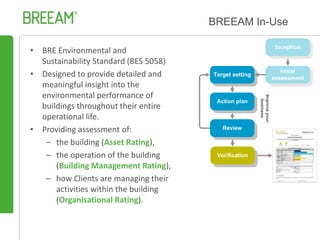
BREEAM In-Use
• BRE Environmental and
Sustainability Standard (BES 5058)
• Designed to provide detailed and
meaningful insight into the
environmental performance of
buildings throughout their entire
operational life.
• Providing assessment of:
– the building (Asset Rating),
– the operation of the building
(Building Management Rating),
– how Clients are managing their
activities within the building
(Organisational Rating).
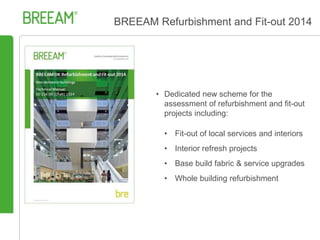
BREEAM Refurbishment and Fit-out 2014
• Dedicated new scheme for the
assessment of refurbishment and fit-out
projects including:
• Fit-out of local services and interiors
• Interior refresh projects
• Base build fabric & service upgrades
• Whole building refurbishment
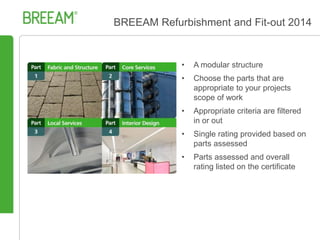
BREEAM Refurbishment and Fit-out 2014
• A modular structure
• Choose the parts that are
appropriate to your projects
scope of work
• Appropriate criteria are filtered
in or out
• Single rating provided based on
parts assessed
• Parts assessed and overall
rating listed on the certificate
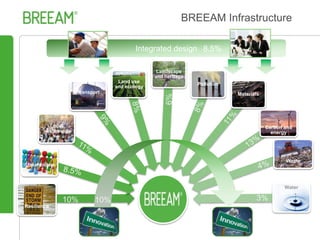
BREEAM New Construction
for infrastructure buildings
Resilience
Stakeholders
Local
wellbeing
Transport
Land use
and ecology
Landscape
and heritage
Pollution
Materials
Carbon and
energy
Waste
Water
Integrated design
10%
6%
3%10%
8.5%
BREEAM Infrastructure
BREEAM and CEEQUAL infrastructure
– Recently extended BREEAM to include infrastructure
– This is being piloted with several projects including HS2
and Thames Tideway
– BRE acquired CEEQUAL in 2015
– CEEQUAL was established in 2004 and is well known as
a environmental awards scheme for civil engineering
project teams
– There is strong industry preference for one rather than
two schemes; BRE is therefore:
– continuing to operate CEEQUAL as business as usual
– continuing to pilot the BREEAM infrastructure
methodology
– bringing the two together so in two years time it will be
the next version of both (becoming the intended
CEEQUAL v6)
– Supporting all CEEQUAL projects to completion
© CEEQUAL Ltd 2015
Wide coverage
Sustainability assessment, rating and awards
for civil engineering and infrastructure
Established Flexible but rigorous
Significant influencer & change agent tool
Delivers better projects and cost savings
Open process
Better performanceWorthwhileness
Major on-going development
Benefits
Growing evidence of sustainability benefits
Investment costs not as
high as perceived
2013 Construction 2025 (HM Government)
2013 Infrastructure Carbon Review (HM Treasury)
2013 World Green Building Council (WorldGBC)
report
2012 BSRIA Report: The Value of BREEAM report
2012 RICS report :Supply, Demand and the Value
of Green
2012 Town & Country Planning Association’s
publication ‘Good Practice Guide –
Sustainable Design & Construction
Potentially significant life
cycle cost savings
Increased value,
suggested higher staff
productivity levels
Decreasing costs
Improvement targets
Reduced costs
Green buildings pay
– There is increased investor demand
for high quality properties with low
risk
– Certified buildings are more highly
valued and safer long-term
investments
Better with
Better value for buildings
Benefits news from the real estate market
opps
costs
-
43%
energy
costs
-15%
reputation
+18%
rents
+24.9
%
sales
+30
%
value
+38
%
$ $$
Part of the BRE Trust
Thank you
Contact details
www.breeam.com www.ceequal.com
breeam@bre.co.uk enquiries@ceequal.com
+44 (0)333 321 8811 +44 (0)333 014 7880
BRE, Garston, Watford, WD25 9XX, UK
Chris Broadbent
Managing Director, CEEQUAL; BRE Group Director - Infrastructure
Chris.Broadbent@bre.co.uk
Chris.Broadbent@ceequal.com
+44 (0)1923 664958

Delivering Sustainability Digitally - BREEAM & Data

  • 1.
    Part of theBRE Trust BREEAM Constructing Excellence Sustainability Theme Group 4th October 2016 Chris Broadbent, Director, BREEAM Infrastructure Managing Director, CEEQUAL Ltd
  • 2.
    Customer service Robust flexible governance & certification Onlinedelivery, BIM ready, integrated 3rd party tools & data exploitation Sharing of performance data with investment market organisations International real estate clients who ‘choose and want’ BREEAM The most authoritative, comprehensive & widely used building environmental assessment and certification system globally! BREEAM Vision 2018 1 1
  • 3.
    A Global StandardLocally Adapted + Our National Scheme Operators Used in 77 countries, 550,000 certificated buildings, over 2.2m registered
  • 4.
    Site selection Design and planning Construction & post- construction OccupationEnd of life Region scale City scale Neighbourhood scale Building scale Non Domestic Infrastructure Communities Domestic Refurbishment Domestic In-Use Non Domestic Refurbishment Communities Across Scale & Life-Cycle Existing
  • 5.
  • 6.
    BREEAM Aims &Objectives BREEAM family of schemes aim to: – Ensure best environmental practice – Consider a broad range of environmental concerns – Balanced to ensure quality, safe & healthy environment – Set standards surpassing those required by regulation – Challenge the market to provide innovative solutions – Provide a credible environmental label – Stimulate demand for sustainability in the built environment 1
  • 7.
    Key benefits ofBREEAM Third party validation of sustainable credentials – Evaluate, improve and demonstrate sustainability throughout the project’s design and construction – Drives sustainable performance of an asset – Creates value and helps manage risk and reduce obsolescence – An inspirational standard that encourages improvement – Based on documented science based research, evidence & market best practice – Balanced across a range of sustainability issues – Robust certification & independence – Benchmarking against other international projects through consistency of approach – Encourages innovation
  • 8.
  • 9.
    Drivers Building Regulations – Towardszero carbon from 2019 for all buildings UN framework Convention on Climate Change & Kyoto Protocol – Legally binding commitments for the reduction of greenhouse gases EU Renewable Energy Directive 15 – 15% of energy consumption should be from renewable sources by 2020 Climate Change Act 2008 – places a legal obligation on Government to reduce carbon dioxide emissions by at least 80% by 2050 and 26% by 2020, against a 1990 baseline, with the trajectory defined by a system of five-year carbon budgets. Planning system – National ambitions will be tested through the planning system, both at regional and local level.
  • 10.
    Construction industry impactsand market drivers • Large impacts from construction – Construction and demolition waste alone represents 32% of total UK waste (DEFRA) – Infrastructure accounts for 53% of the UK’s carbon footprint (HM Treasury) – Water on construction sites could be saved by 15-50% on most projects (WRAP) • Construction 2025 targets (HM Treasury, July 2013) • Increased focus on carbon (Infrastructure Carbon Review 2013) • Green Construction Board: • ‘Fundamental Truths’ case studies
  • 11.
    Meeting challenges ina changing world • Reduced whole life cost • Reduced resource use • Improved health and safety • Improved project certainty • Adaptation to climate • Resilient and durable assets • Best practice delivery and world class projects Top image: IMG_9094 by Ingy The Wingy on Flickr | CC BY-ND 2.0 Bottom image: Mini Stack Interchange of Interstate 10, Loop 202, and State Route 51 (1) by Alan Stark on Flickr | CC BY-SA 2.0
  • 12.
  • 13.
    Communities Scheme • Astandard to improve the design of large-scale developments; • An holistic assessment of environmental, social and economic sustainability; • A framework for collaborating on key master planning issues; Image: White Architects and PEAB
  • 14.
    Complementary to buildingassessments Images: Kanozi Arkitekter
  • 15.
    Integrated with themasterplanning process Step 1 The Principle Step 2 The Layout Step 3 The Details Images: Farrells
  • 16.
    © 2014 BRE HomeQuality Mark (HQM) 8000 Homes Registered… Running Costs Health and Wellbeing Environmental Footprint Visit www.homequalitymark.com
  • 17.
    Energy Health and wellbeing Materials Management Pollution Land use andEcology Transport Waste Water 15% 15% 13.5% 12% 10% 10% 9% 8.5% 7% BREEAM UK NC 2014 - Sections and weightings
  • 18.
    Improveyour business Verification Initial assessment Inception Target setting Action plan Review BREEAMIn-Use • BRE Environmental and Sustainability Standard (BES 5058) • Designed to provide detailed and meaningful insight into the environmental performance of buildings throughout their entire operational life. • Providing assessment of: – the building (Asset Rating), – the operation of the building (Building Management Rating), – how Clients are managing their activities within the building (Organisational Rating).
  • 19.
    BREEAM Refurbishment andFit-out 2014 • Dedicated new scheme for the assessment of refurbishment and fit-out projects including: • Fit-out of local services and interiors • Interior refresh projects • Base build fabric & service upgrades • Whole building refurbishment
  • 20.
    BREEAM Refurbishment andFit-out 2014 • A modular structure • Choose the parts that are appropriate to your projects scope of work • Appropriate criteria are filtered in or out • Single rating provided based on parts assessed • Parts assessed and overall rating listed on the certificate
  • 21.
    BREEAM New Construction forinfrastructure buildings
  • 22.
    Resilience Stakeholders Local wellbeing Transport Land use and ecology Landscape andheritage Pollution Materials Carbon and energy Waste Water Integrated design 10% 6% 3%10% 8.5% BREEAM Infrastructure
  • 23.
    BREEAM and CEEQUALinfrastructure – Recently extended BREEAM to include infrastructure – This is being piloted with several projects including HS2 and Thames Tideway – BRE acquired CEEQUAL in 2015 – CEEQUAL was established in 2004 and is well known as a environmental awards scheme for civil engineering project teams – There is strong industry preference for one rather than two schemes; BRE is therefore: – continuing to operate CEEQUAL as business as usual – continuing to pilot the BREEAM infrastructure methodology – bringing the two together so in two years time it will be the next version of both (becoming the intended CEEQUAL v6) – Supporting all CEEQUAL projects to completion
  • 24.
    © CEEQUAL Ltd2015 Wide coverage Sustainability assessment, rating and awards for civil engineering and infrastructure Established Flexible but rigorous Significant influencer & change agent tool Delivers better projects and cost savings Open process Better performanceWorthwhileness Major on-going development
  • 25.
  • 26.
    Growing evidence ofsustainability benefits Investment costs not as high as perceived 2013 Construction 2025 (HM Government) 2013 Infrastructure Carbon Review (HM Treasury) 2013 World Green Building Council (WorldGBC) report 2012 BSRIA Report: The Value of BREEAM report 2012 RICS report :Supply, Demand and the Value of Green 2012 Town & Country Planning Association’s publication ‘Good Practice Guide – Sustainable Design & Construction Potentially significant life cycle cost savings Increased value, suggested higher staff productivity levels Decreasing costs Improvement targets Reduced costs
  • 27.
    Green buildings pay –There is increased investor demand for high quality properties with low risk – Certified buildings are more highly valued and safer long-term investments
  • 28.
    Better with Better valuefor buildings Benefits news from the real estate market opps costs - 43% energy costs -15% reputation +18% rents +24.9 % sales +30 % value +38 % $ $$
  • 29.
    Part of theBRE Trust Thank you
  • 30.
    Contact details www.breeam.com www.ceequal.com breeam@bre.co.ukenquiries@ceequal.com +44 (0)333 321 8811 +44 (0)333 014 7880 BRE, Garston, Watford, WD25 9XX, UK Chris Broadbent Managing Director, CEEQUAL; BRE Group Director - Infrastructure Chris.Broadbent@bre.co.uk Chris.Broadbent@ceequal.com +44 (0)1923 664958