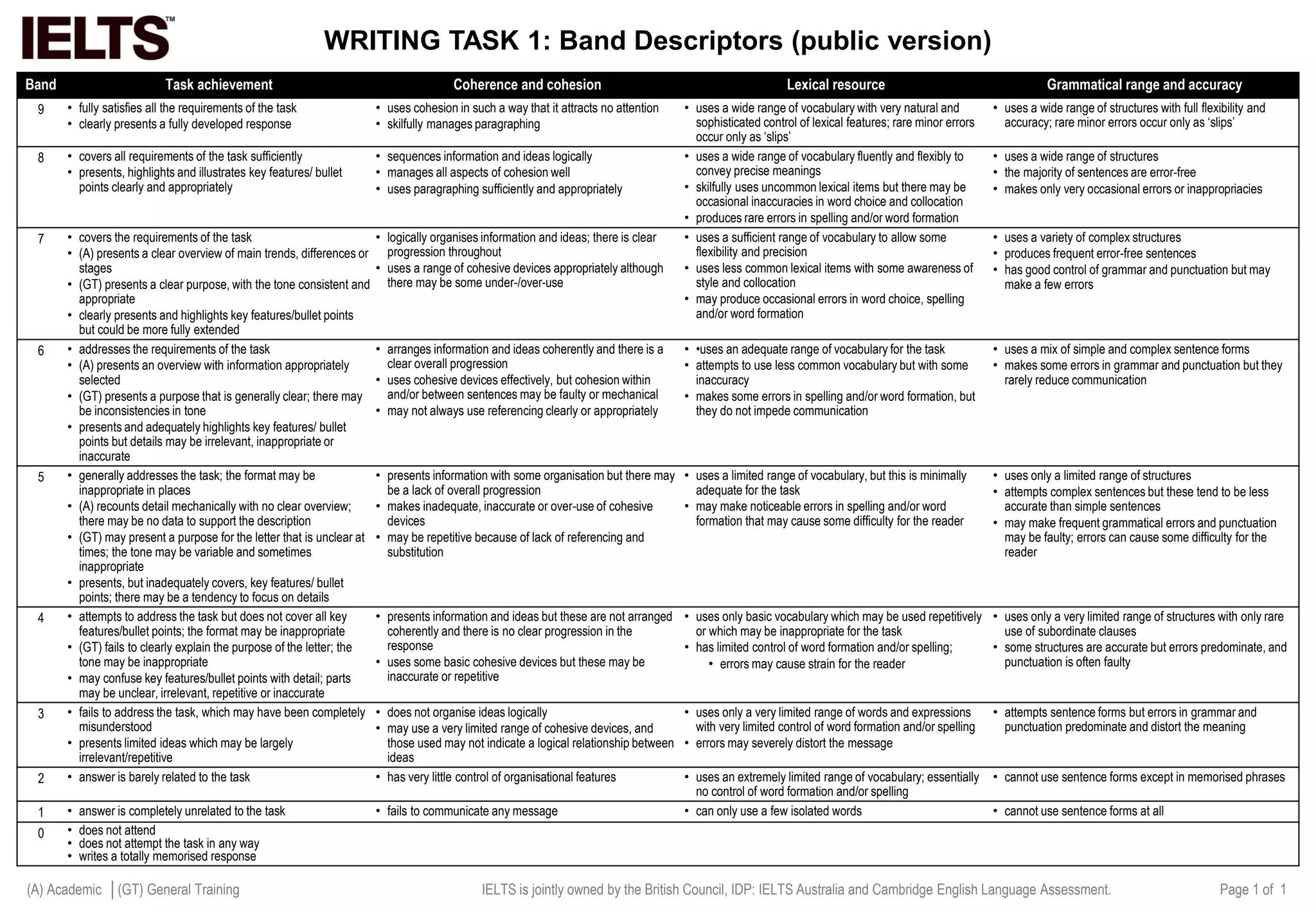
WRITING TASK 1: Band Descriptors (public version)
Band Task achievement Coherence and cohesion Lexical resource Grammatical range and accuracy
9 • fully satisfies all the requirements of the task
• clearly presents a fully developed response
• uses cohesion in such a way that it attracts no attention
• skilfully manages paragraphing
• uses a wide range of vocabulary with very natural and
sophisticated control of lexical features; rare minor errors
occur only as ‘slips’
• uses a wide range of structures with full flexibility and
accuracy; rare minor errors occur only as ‘slips’
8 • covers all requirements of the task sufficiently
• presents, highlights and illustrates key features/ bullet
points clearly and appropriately
• sequences information and ideas logically
• manages all aspects of cohesion well
• uses paragraphing sufficiently and appropriately
• uses a wide range of vocabulary fluently and flexibly to
convey precise meanings
• skilfully uses uncommon lexical items but there may be
occasional inaccuracies in word choice and collocation
• produces rare errors in spelling and/or word formation
• uses a wide range of structures
• the majority of sentences are error-free
• makes only very occasional errors or inappropriacies
7 • covers the requirements of the task
• (A) presents a clear overview of main trends, differences or
stages
• (GT) presents a clear purpose, with the tone consistent and
appropriate
• clearly presents and highlights key features/bullet points
but could be more fully extended
• logically organises information and ideas; there is clear
progression throughout
• uses a range of cohesive devices appropriately although
there may be some under-/over-use
• uses a sufficient range of vocabulary to allow some
flexibility and precision
• uses less common lexical items with some awareness of
style and collocation
• may produce occasional errors in word choice, spelling
and/or word formation
• uses a variety of complex structures
• produces frequent error-free sentences
• has good control of grammar and punctuation but may
make a few errors
6 • addresses the requirements of the task
• (A) presents an overview with information appropriately
selected
• (GT) presents a purpose that is generally clear; there may
be inconsistencies in tone
• presents and adequately highlights key features/ bullet
points but details may be irrelevant, inappropriate or
inaccurate
• arranges information and ideas coherently and there is a
clear overall progression
• uses cohesive devices effectively, but cohesion within
and/or between sentences may be faulty or mechanical
• may not always use referencing clearly or appropriately
• •uses an adequate range of vocabulary for the task
• attempts to use less common vocabulary but with some
inaccuracy
• makes some errors in spelling and/or word formation, but
they do not impede communication
• uses a mix of simple and complex sentence forms
• makes some errors in grammar and punctuation but they
rarely reduce communication
5 • generally addresses the task; the format may be
inappropriate in places
• (A) recounts detail mechanically with no clear overview;
there may be no data to support the description
• (GT) may present a purpose for the letter that is unclear at
times; the tone may be variable and sometimes
inappropriate
• presents, but inadequately covers, key features/ bullet
points; there may be a tendency to focus on details
• presents information with some organisation but there may
be a lack of overall progression
• makes inadequate, inaccurate or over-use of cohesive
devices
• may be repetitive because of lack of referencing and
substitution
• uses a limited range of vocabulary, but this is minimally
adequate for the task
• may make noticeable errors in spelling and/or word
formation that may cause some difficulty for the reader
• uses only a limited range of structures
• attempts complex sentences but these tend to be less
accurate than simple sentences
• may make frequent grammatical errors and punctuation
may be faulty; errors can cause some difficulty for the
reader
4 • attempts to address the task but does not cover all key
features/bullet points; the format may be inappropriate
• (GT) fails to clearly explain the purpose of the letter; the
tone may be inappropriate
• may confuse key features/bullet points with detail; parts
may be unclear, irrelevant, repetitive or inaccurate
• presents information and ideas but these are not arranged
coherently and there is no clear progression in the
response
• uses some basic cohesive devices but these may be
inaccurate or repetitive
• uses only basic vocabulary which may be used repetitively
or which may be inappropriate for the task
• has limited control of word formation and/or spelling;
• errors may cause strain for the reader
• uses only a very limited range of structures with only rare
use of subordinate clauses
• some structures are accurate but errors predominate, and
punctuation is often faulty
3 • fails to address the task, which may have been completely
misunderstood
• presents limited ideas which may be largely
irrelevant/repetitive
• does not organise ideas logically
• may use a very limited range of cohesive devices, and
those used may not indicate a logical relationship between
ideas
• uses only a very limited range of words and expressions
with very limited control of word formation and/or spelling
• errors may severely distort the message
• attempts sentence forms but errors in grammar and
punctuation predominate and distort the meaning
2 • answer is barely related to the task • has very little control of organisational features • uses an extremely limited range of vocabulary; essentially
no control of word formation and/or spelling
• cannot use sentence forms except in memorised phrases
1 • answer is completely unrelated to the task • fails to communicate any message • can only use a few isolated words • cannot use sentence forms at all
0 • does not attend
• does not attempt the task in any way
• writes a totally memorised response
IELTS is jointly owned by the British Council, IDP: IELTS Australia and Cambridge English Language Assessment.
(A) Academic │(GT) General Training Page 1 of 1

IELTS Writing band-descriptors-task-1

  • 1.
    WRITING TASK 1:Band Descriptors (public version) Band Task achievement Coherence and cohesion Lexical resource Grammatical range and accuracy 9 • fully satisfies all the requirements of the task • clearly presents a fully developed response • uses cohesion in such a way that it attracts no attention • skilfully manages paragraphing • uses a wide range of vocabulary with very natural and sophisticated control of lexical features; rare minor errors occur only as ‘slips’ • uses a wide range of structures with full flexibility and accuracy; rare minor errors occur only as ‘slips’ 8 • covers all requirements of the task sufficiently • presents, highlights and illustrates key features/ bullet points clearly and appropriately • sequences information and ideas logically • manages all aspects of cohesion well • uses paragraphing sufficiently and appropriately • uses a wide range of vocabulary fluently and flexibly to convey precise meanings • skilfully uses uncommon lexical items but there may be occasional inaccuracies in word choice and collocation • produces rare errors in spelling and/or word formation • uses a wide range of structures • the majority of sentences are error-free • makes only very occasional errors or inappropriacies 7 • covers the requirements of the task • (A) presents a clear overview of main trends, differences or stages • (GT) presents a clear purpose, with the tone consistent and appropriate • clearly presents and highlights key features/bullet points but could be more fully extended • logically organises information and ideas; there is clear progression throughout • uses a range of cohesive devices appropriately although there may be some under-/over-use • uses a sufficient range of vocabulary to allow some flexibility and precision • uses less common lexical items with some awareness of style and collocation • may produce occasional errors in word choice, spelling and/or word formation • uses a variety of complex structures • produces frequent error-free sentences • has good control of grammar and punctuation but may make a few errors 6 • addresses the requirements of the task • (A) presents an overview with information appropriately selected • (GT) presents a purpose that is generally clear; there may be inconsistencies in tone • presents and adequately highlights key features/ bullet points but details may be irrelevant, inappropriate or inaccurate • arranges information and ideas coherently and there is a clear overall progression • uses cohesive devices effectively, but cohesion within and/or between sentences may be faulty or mechanical • may not always use referencing clearly or appropriately • •uses an adequate range of vocabulary for the task • attempts to use less common vocabulary but with some inaccuracy • makes some errors in spelling and/or word formation, but they do not impede communication • uses a mix of simple and complex sentence forms • makes some errors in grammar and punctuation but they rarely reduce communication 5 • generally addresses the task; the format may be inappropriate in places • (A) recounts detail mechanically with no clear overview; there may be no data to support the description • (GT) may present a purpose for the letter that is unclear at times; the tone may be variable and sometimes inappropriate • presents, but inadequately covers, key features/ bullet points; there may be a tendency to focus on details • presents information with some organisation but there may be a lack of overall progression • makes inadequate, inaccurate or over-use of cohesive devices • may be repetitive because of lack of referencing and substitution • uses a limited range of vocabulary, but this is minimally adequate for the task • may make noticeable errors in spelling and/or word formation that may cause some difficulty for the reader • uses only a limited range of structures • attempts complex sentences but these tend to be less accurate than simple sentences • may make frequent grammatical errors and punctuation may be faulty; errors can cause some difficulty for the reader 4 • attempts to address the task but does not cover all key features/bullet points; the format may be inappropriate • (GT) fails to clearly explain the purpose of the letter; the tone may be inappropriate • may confuse key features/bullet points with detail; parts may be unclear, irrelevant, repetitive or inaccurate • presents information and ideas but these are not arranged coherently and there is no clear progression in the response • uses some basic cohesive devices but these may be inaccurate or repetitive • uses only basic vocabulary which may be used repetitively or which may be inappropriate for the task • has limited control of word formation and/or spelling; • errors may cause strain for the reader • uses only a very limited range of structures with only rare use of subordinate clauses • some structures are accurate but errors predominate, and punctuation is often faulty 3 • fails to address the task, which may have been completely misunderstood • presents limited ideas which may be largely irrelevant/repetitive • does not organise ideas logically • may use a very limited range of cohesive devices, and those used may not indicate a logical relationship between ideas • uses only a very limited range of words and expressions with very limited control of word formation and/or spelling • errors may severely distort the message • attempts sentence forms but errors in grammar and punctuation predominate and distort the meaning 2 • answer is barely related to the task • has very little control of organisational features • uses an extremely limited range of vocabulary; essentially no control of word formation and/or spelling • cannot use sentence forms except in memorised phrases 1 • answer is completely unrelated to the task • fails to communicate any message • can only use a few isolated words • cannot use sentence forms at all 0 • does not attend • does not attempt the task in any way • writes a totally memorised response IELTS is jointly owned by the British Council, IDP: IELTS Australia and Cambridge English Language Assessment. (A) Academic │(GT) General Training Page 1 of 1